
Biography
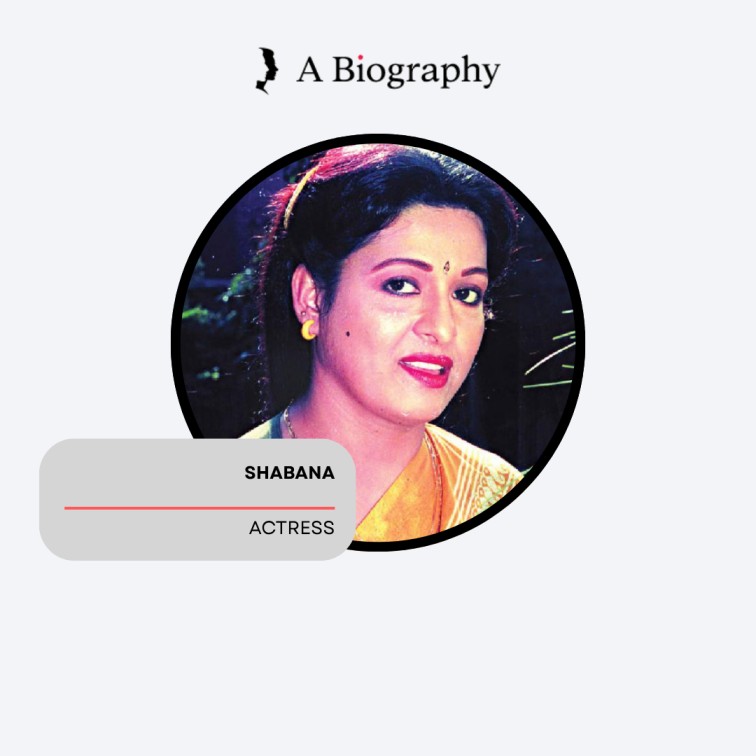
A Biography of Shabana

Introduction
Who was the most popular and influential actress of Bangladeshi cinema in the 80s and 90s? Only one answer: Shabana. Afroza Sultana Ratna — known to the world as Shabana — is a legend. Each of her films was a new chapter of success. Regardless of her co-star, a Shabana film was destined to triumph. She formed an unforgettable on-screen pair with Alamgir, acting together in over 130 films. Yet she also created cinematic magic with Rajjak, Bulbul Ahmed, Farooque, Jashim, Sohel Rana, Uzzal, Jafar Iqbal, Elias Kanchan, and Humayun Faridi.
Shabana began as a child artist in 1962 with Notun Sur. In 1967, director Ehtesham cast her opposite Pakistan’s superstar Nadeem in the Urdu film Chokori. It was a commercial hit, and Shabana became a regular leading lady. She acted in nearly 300 films in Urdu, Bengali, and Hindi. She married government official Wahid Sadik in 1973 and, with his support, founded her own production house, SS Productions. She produced and starred in Matir Ghar (1979), followed by Pita-Mata-Sontan, Sneho, and Ghore Ghore Juddho.
In the late 1990s, she suddenly announced her retirement from acting. In 2000, she moved permanently to the United States with her family. Though she no longer graces the screen, she remains honoured, her performances cherished. This epic of 28 chapters unfolds the complete tapestry of Shabana’s life.
At a Glance : Life of Shabana
| Information | Details | Special Notes |
| Full Name | Afroza Sultana Ratna (Stage name: Shabana) | Also spelled Afroza Sultana Ratna |
| Profession | Actress, Producer | Known as “Queen of Dhallywood” & the “Shabana-Alamgir pair” |
| Birth | 15 June 1952 (some sources 1953), Dabua village, Raozan, Chittagong | Father: Fayez Chowdhury (typist), Mother: Fazilatunnesa (homemaker) |
| Education | Studied up to class four; dropped out at age 9 | Had little interest in formal schooling |
| Nationality | Bangladeshi (permanent resident of the USA) | Living in New Jersey since 2000 |
| First Film | Notun Sur (1962) as a child artist | Name was ‘Ratna’ |
| Debut as Heroine | Chokori (1967) – Urdu, opposite Nadeem | Named ‘Shabana’ by director Ehtesham |
| Last Film | Ghore Ghore Juddho (1997) | Marked the end of her acting career |
| Career Span | 1962–1997 (approx. 35 years) | As heroine: 1967–1997 (30 years) |
| Total Films | 299 (Bengali, Urdu, one Hindi) | Numbers vary slightly across sources |
| Shabana-Alamgir Pair | Over 130 films | The most successful on-screen couple in Bangladesh cinema history |
| Highest Honour | 10 National Film Awards (9 for acting, 1 as producer) | A record in Bangladesh |
| Award-Winning Films | Jononi (1977), Shokhi Tumi Kar (1980), Dui Poyshar Alta (1982), Najma (1983), Bhat De (1984), Akangkha (1987), Ranga Bhabhi (1989), Moroner Pore (1990), Ochena (1991), and Matir Ghar (as producer) | |
| Lifetime Achievement | 2017, awarded by the Government of Bangladesh | National Film Award for Lifetime Achievement |
| First Production | Matir Ghar (1979) | Under SS Productions; she also acted in it |
| Husband | Wahid Sadik (government official) | Married in 1973 |
| Children | Two daughters (Sumi Iqbal, Urmi Sadik) and one son (Nahin Sadik) | Sumi: MBA, CPA; Urmi: PhD from Harvard; Nahin: works at Bloomberg |
| Current Residence | New Jersey, USA | Seldom visits Bangladesh regularly |
| Personality | Exceptionally humble, gentle, and simple | Known among peers as a ‘good human being’ |
| Legacy | 10 National Awards, nearly 300 films, the ‘Shabana-Alamgir pair’, production of Matir Ghar | Still hailed as the ‘Queen of Dhallywood’ |
Early Life
On 15 June 1952, in the village of Dabua, Raozan, Chittagong, then East Pakistan, Afroza Sultana Ratna was born. Her father, Fayez Chowdhury, was a typist — a hardworking, low-income earner. Her mother, Fazilatunnesa, was a homemaker. Their financial situation was fragile. Ratna grew up amidst scarcity.
Her childhood was spent in the village — simple surroundings, green fields, hilly landscapes. She loved the hills and rivers of Chittagong. But poverty meant formal education was brief. Shabana never enjoyed school; she preferred watching movies. Visiting Chittagong’s cinema halls, she would watch heroines and dream of becoming one herself.
Her father moved to Dhaka’s Gendaria area. Ratna was still young. Her uncle (maternal) — director Ehtesham — was already a notable filmmaker of Urdu and Bengali cinema. Through him, Ratna’s entry into films began. He gave her a small role as a child artist in Notun Sur. She was just nine. That experience kindled a fire within her. Despite poverty and little schooling, she dreamed of being a star, loved by millions. And from that tin-shed home in Gendaria, she set out on her magnificent journey.
Education
Shabana’s formal education ended after the fourth grade. She found school monotonous. Instead, she dreamed of the bustle of cinema halls, the music, the camera lights. Her father could not force her. “When I sat down to study, my mind wouldn’t stay — I wanted to watch a movie instead,” she once confessed.
Yet despite her lack of schooling, her acting talent was innate. She was fluent in expressing emotion and language. Directors’ instructions were easily absorbed. She was self-taught, an artist who learned from life and observation. Her lack of education never diminished her; she won millions of hearts through her keen understanding of human nature.
In later years, she admitted, “I regret not studying more — perhaps I could have done even better.” Still, she takes pride that her children are highly educated.
Film Journey
Uncle Ehtesham was her gateway to cinema. He directed Chokori, Daag, Anari. Shabana would visit his sets as a child, mesmerised by the camera lights and makeup magic. She learned the nuances of acting from him.
In 1967, Ehtesham was casting for the Urdu film Chokori opposite Pakistani superstar Nadeem. He chose ‘Ratna’ as the heroine. But he felt the name ‘Ratna’ would not captivate audiences. He renamed her ‘Shabana’ – a Persian name meaning ‘moonlight’ or ‘one who spreads light at night’. Chokori was a commercial success in both Lahore and Dhaka. Critics wrote, “There is a unique magic in Shabana’s eyes.” Her stardom had begun. Even after success in Urdu cinema, Shabana never forgot her roots. She turned increasingly towards Bengali films, the language of the common people of East Pakistan (later Bangladesh).
Stepping into Bengali Cinema
Despite success in Urdu, Shabana realised that Bengali audiences preferred films in their own language. Her first Bengali film was Obujh Mon (1971), opposite the legendary Rajjak. Shooting was interrupted by the Liberation War in 1971. The film was completed and released in 1972. It was a resounding success. Audiences embraced Shabana wholeheartedly.
She then acted in Modhu Milon, Ora 11 Jon, Chutir Ghonta, Matir Ghar, Sotto-Mittha, Shami Keno Ashami, and Chashir Meye. Her special skill was her eyes — the way she could cry with heartbreaking naturalness. By 1975, she had become Bangladesh’s top heroine. In Chashir Meye, she first worked with Alamgir, a pair that would become the most successful in Dhallywood history.
Dhallywood’s Most Successful On-Screen Couple
In 1975, Chashir Meye introduced Shabana and Alamgir. Audiences adored them. They went on to act together in Joy Porajoy (1976), Monihar, Rongin Rupban, Banduk, Bhai Bondhu, Noyonmoni, Boro Bou, Sohagi, Agomon, Amar Desh Amar Manush — over 130 films in total. A record.
Their chemistry was extraordinary. Audiences believed their on-screen love, conflict, and reconciliation. Song sequences like “Ore Grihobashi,” “Ei Pakhi Urale Re,” “Ami Rastar Kinare Phul Pelam Na,” “Ekdin Shopon Diye Ghor Bandhibo” are still etched in memory. Shabana’s eyes and Alamgir’s expressions created an intoxicating magic. Even today, their pair is considered unmatched in Dhallywood’s history.
SS Productions and the Success
Shabana was not just an actress but a successful producer. After marrying Wahid Sadik in 1973, they founded ‘SS Productions’. Their first production was Matir Ghar (1979) — a different kind of story, starring Shabana as ‘Amina’ and Rajjak. The film was a critical and commercial success, winning the National Film Award for Best Film. Shabana received the National Award as a producer.
She also produced Pita-Mata-Sontan, Sneho, Ghore Ghore Juddho, Jibon-Moron. She consistently focused on quality stories with social messages. Through her production house, she gave opportunities to young directors like Kazi Hayat and Kalam Kibria. Shabana proved that actresses could also succeed behind the camera.
First National Award (1977)
In 1977, Jononi was released, directed by Sirajul Islam. Shabana played ‘Ayesha’, a mother who sacrifices everything for her children. The film was shot mostly in villages; she used almost no makeup, letting her natural beauty and raw emotion shine. A scene where she cries like a madwoman after losing her child is still unforgettable. She won her first National Film Award for Best Supporting Actress. “It was a very difficult role,” she said, “but I drew from memories of my own mother.”
Second National Award (1980)
In 1980, Kazi Zahir’s Shokhi Tumi Kar — a romantic drama — earned Shabana her first Best Actress National Award. She played a young woman in love but unable to be with her beloved. The film showcased her versatility — dancing, singing, and crying with equal grace. “This award reflects my audience’s love,” she said.
Three National Awards in Three Consecutive Years (1982-1984)
· 1982 – Dui Poyshar Alta: Shabana played a poor woman who cannot afford even two paisa worth of vermilion. She won her third National Award (Best Actress).
· 1983 – Najma: A story of an abused woman’s rehabilitation. Shabana won her fourth National Award.
· 1984 – Bhat De: She played a starving fisherwoman’s daughter. For realism, she lost nearly a kilogram. The scene where she cries asking for rice tore hearts. Fifth National Award.
Three years, three awards. Some jokingly called her a ‘prize machine’. But she knew it was the fruit of relentless hard work.
The Award Streak Continues
1987 – Akangkha: A revenge drama. Shabana played a tortured girl who finally stands up for justice. Sixth National Award (Best Actress).
1989 – Ranga Bhabhi: A supporting role where she played an elderly woman. Seventh National Award.
She never held press conferences after winning. Silently, she kept working. Her humility was admired by all.
Last of the Record-breaking Wins
1990 – Moroner Pore: A tragedy exploring the impact of the heroine’s death. Eighth National Award.
1991 – Ochena: Ninth National Award (Best Actress).
Combined with her Producer’s Award for Matir Ghar, Shabana became the recipient of 10 National Film Awards — the highest ever by any Bangladeshi actress.
International Film Festivals and Recognition
Shabana represented Bangladesh at the Moscow International Film Festival, the Romania Film Festival, and the Cannes Film Festival. A Russian critic wrote, “Shabana’s eyes speak the soul of Bengal.” In 2019, the Kolkata International Film Festival gave her a special honour. She also acted in a Turkish-Pakistani co-production Halchal and the Hindi film Shatru opposite Rajesh Khanna. These international accolades made her a source of national pride.
Acting in Urdu, Nepali, and Turkish Productions
She worked confidently in Urdu films like Andhi, Meherban, Daag, Paal, Chand Aur. Without formal language training, she mastered on-set adaptation. Of her experience in Nepal, she said, “The language was difficult, but emotions don’t recognise barriers.”
Personal Life
Shabana married Wahid Sadik, a government officer, in 1973. His elder brother, A. H. K. Sadik, was a former Education Minister, but Shabana stayed away from politics. Wahid became her partner in SS Productions.
Their children:
· Sumi Iqbal: MBA, CPA, now a homemaker.
· Urmi Sadik: PhD from Harvard University.
· Nahin Sadik: Master’s from Rutgers, works at Bloomberg.
Shabana glows with pride: “I grew up poor. I wanted my children to be highly educated. I succeeded.”
Bidding Farewell to Acting, Devoting to Family
In 1997, her last film Ghore Ghore Juddho was released. She unexpectedly announced retirement: “Now I will care for my family, give time to my children. Goodbye to acting.” In 2000, she moved to New Jersey, USA. She wanted to see her children grow up and be by their side. Even in America, she remains connected to the Bangladeshi community. Though she is a housewife in New Jersey, she is still ‘Bengal’s Queen’.
Lifetime Achievement Award (2017)
In July 2017, the Government of Bangladesh honoured her with the National Film Award for Lifetime Achievement. At the Bangabandhu International Conference Centre, with the Information Minister and Prime Minister Sheikh Hasina present, Shabana broke down in tears: “I am who I am because of my audience. I am forever indebted.” The entire film fraternity gave her a standing ovation.
Earlier she had received numerous other awards: Bachsas, Nritya Niketan, Art Forum, Science Club, Kamrul Hasan Award, Nritya Shova, Kathak Academy, National Youth Organisation, and Producers’ Association.
The Shabana-Alamgir Pair and Nostalgia
On social media, clips from Chashir Meye, Shokhi Tumi Kar, Monihar are shared daily. Their songs have millions of YouTube views. Even today, their chemistry attracts new generations. Alamgir once said in an interview, “If I could get a co-artist like Shabana again, I’m certain the film would be a hit.”
Relationships with Fellow Artists
Director Abdullah Al Mamun said, “Shabana apu would come to set and treat everyone with affection. She never got angry with anyone.” Actor Uzzal: “Despite being such a big star, she speaks with everyone smiling. She is without ego.” Sohel Rana: “I never saw Shabana act arrogantly. She is a gentle lady.”
When she learned a former struggling artist was ill and in financial trouble, she quietly sent money. She answered fan letters personally. She would greet fans on their birthdays. These small acts made her beloved beyond the screen.
Unknown Facts
· She initially disliked the name ‘Shabana’ but grew to love it.
· At the premiere of Chokori in Lahore, fans showered her with flowers alongside Nadeem.
· She loves Turkish baklava.
· Once, she was late to a wedding ceremony because of traffic and apologised so sweetly that the story went viral.
· She never took extra time on set; even when unwell, she finished shooting to avoid losses.
Beyond Cinema
In New Jersey, she participates in Bengali community events. She donated to relief funds during COVID-19. She once modelled for Lux soap. After a television interview, a young woman was inspired to study medicine — a story that spread widely. She attended Mujibnagar government events, helping spread the spirit of Bangladesh’s Liberation War.
The Shabana-Rajjak Pair
Although not as frequent as with Alamgir, Shabana and Rajjak worked together in Obujh Mon, Matir Ghar, and Ranga Bhabhi. Rajjak once said, “Shabana is a thoroughly professional actress. Working with her was stress-free.”
Timeline of Major Events in Shabana’s Life
· 15 June 1952/53 – Born in Dabua village, Raozan, Chittagong.
· 1962 – Child artist debut in Notun Sur.
· 1967 – Heroine debut in Chokori, named ‘Shabana’.
· 1971 – First Bengali film Obujh Mon.
· 1973 – Marries Wahid Sadik.
· 1975 – First film with Alamgir: Chashir Meye.
· 1977 – First National Award for Jononi.
· 1979 – Produces Matir Ghar; wins National Award as producer.
· 1980 – Second National Award (Shokhi Tumi Kar).
· 1982 – Third National Award (Dui Poyshar Alta).
· 1983 – Fourth National Award (Najma).
· 1984 – Fifth National Award (Bhat De).
· 1986 – Acts in Turkish-Pakistani Halchal.
· 1987 – Sixth National Award (Akangkha).
· 1989 – Seventh National Award (Ranga Bhabhi).
· 1990 – Eighth National Award (Moroner Pore).
· 1991 – Ninth National Award for acting (Ochena).
· 1997 – Last film Ghore Ghore Juddho; retires.
· 2000 – Moves permanently to New Jersey, USA.
· 2017 – Receives Lifetime Achievement Award at National Film Awards.
· 2026 – Lives in New Jersey with family.
Shabana to the Current Generation
Young people may not have seen all her films, but they know her name from their parents. YouTube searches for ‘Shabana’ yield thousands of videos. She is the icon of the ‘golden age’ of Bangladeshi cinema. Researchers write theses on her work. In 2020, a student at Jagannath University used her as a case study on women’s representation in cinema. Even today, the Ministry of Culture invites her to programmes; in 2025, she joined a women’s empowerment event virtually.
The Rhythm Breaks
Why doesn’t she act again? Her clear answer: “My time is over. The new generation should be given a chance. Besides, I am older now, my health isn’t what it once was. I dislike seeing senior artists given disrespectful roles. Staying away is better.”
Opinions and Reminiscences
Journalist and film analyst Motin Rahman wrote, “Shabana is the symbol of an era. Her eyes touched the heart of emotion. She was the most successful brand in visual media.”
Shabana herself says, “I am very fortunate. There was a time when our films were celebrated across countries. Now things have changed, cinema halls are closing. Still, I am grateful to those who remember me.”
Bengal’s Eternal Queen
From a typist’s daughter ‘Ratna’ in a remote Chittagong village to the National Film Awards stage, from international film festivals to a quiet home in New Jersey — Shabana’s journey proves that hard work and talent command universal respect.
Ten National Awards. Nearly 300 films. The legendary Shabana-Alamgir pair. The production of Matir Ghar. She is Dhallywood’s queen, the pride of Bengali cinema.
She is no longer on screen, but she lives in the hearts of millions. Audiences will never forget ‘Shabana-Alamgir’. They will never forget Amina of Matir Ghar. They will never forget the starving girl of Bhat De.
Shabana, now a New Jersey housewife, remains ‘Bengal’s Queen’ to her fans. She once wished to make a film called Fire Dekha (Looking Back). It never happened. Yet she is content. Because no one can take away her golden past.
“When ‘Ratna’, the typist’s daughter from Gendaria, stepped into the industry as ‘Shabana’, perhaps no one imagined she would reign for three decades, win one National Award after another, and earn the title Queen of Dhallywood. Shabana stands today as living proof that the value of relentless hard work and talent is universally recognised. She is a living legend, a part of Bengal’s cinematic glory, someone to hold our heads high for.”

