
Biography
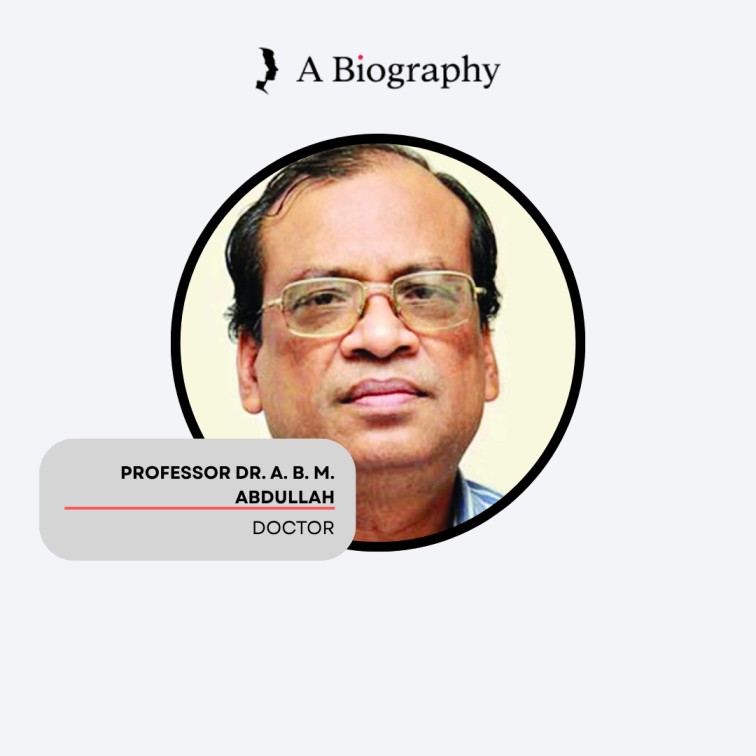
A Biography of Professor Dr. A. B. M. Abdullah

Introduction
The December Morning That Made History.
December 24, 2019. A routine government gazette notification quietly reshapes the landscape of Bangladeshi medicine. A name appears: Professor Dr. A. B. M. Abdullah. His new title? Personal Physician to the Prime Minister of Bangladesh, with the rank of a government secretary. But this is no ordinary appointment. Behind this notification lies a five-decade saga of relentless service, international recognition, and a quiet, unshakeable commitment to humanity.
The man who now holds the health of the nation’s leader in his hands began his journey not in a palace or a city hospital, but in a tiny tin-roofed primary school in Hariabari village, Jamalpur. He walked barefoot on muddy paths. He studied by kerosene lamp. His father was a farmer, not a zamindar. And yet, this village boy would go on to write medical textbooks that would be read by students across South Asia and the Arab world – from Kolkata to Karachi, from Dhaka to Dubai.
But the question that haunts every chapter of his life remains: How did the son of a peasant farmer become the most trusted physician of Bangladesh’s most powerful leader? How did he write six landmark textbooks that turned medical education from a nightmare into a manageable journey? And how, despite all his achievements, does he still slip away to his village on weekends – to check on a mosque he built, a madrasa he funds, and a community clinic where the poorest of the poor receive free treatment?
This is the epic of Professor Dr. A. B. M. Abdullah – physician, teacher, author, humanitarian, and the quiet force behind a generation of South Asian doctors.
At a Glance: Life of Professor Dr. A. B. M. Abdullah
| Information | Details | Special Note |
| Full Name | Professor Dr. Abu Bakar Mohammad Abdullah | Known as Prof. Dr. A. B. M. Abdullah |
| Born | 1954, Hariabari village, Islampur Upazila, Jamalpur district | Son of a farmer, not a wealthy family |
| Father | Late Md. Shahidullah | Farmer and pious man who valued education |
| Mother | Late Joytunnesa Begum | Homemaker who dreamed of her children’s future |
| Spouse | Nazma Abdullah | Homemaker and social worker |
| Children | Names not publicly disclosed | Maintains family privacy |
| Profession | Personal Physician to the Prime Minister (Secretary rank); former Professor of Medicine, BSMMU | Physician, teacher, author, philanthropist |
| Education | MBBS (Dhaka Medical College, 1978); MRCP (London); FRCP (Edinburgh) | Two of the world’s most prestigious fellowships |
| Key Positions | Former Dean, Faculty of Medicine, BSMMU; Former Professor & Head, Dept. of Medicine, BSMMU (1995–2019); Personal Physician to PM (2019–present) | Over 24 years at the premier postgraduate institute |
| Specialization | Internal Medicine | World-renowned clinical skills |
| International Experience | Worked as physician in Saudi Arabia (5 years); MRCP in UK; consultant in UK hospitals | 1980s–1990s |
| Books Written | 6+ medical textbooks including Short Cases in Clinical Medicine, Long Cases in Clinical Medicine, ECG in Medical Practice, Case History and Data Interpretation, Radiology in Medical Practice | Used as standard texts across South Asia and Middle East |
| Humanitarian Work | Built a mosque, Hafezia madrasa (80 students), and community clinic on own land in his village | Runs entirely with personal funds for over 15 years |
| Highest Honors | Ekushey Padak (2016) – Bangladesh’s second-highest civilian award; UGC Award (2013); Bangla Academy Honorary Fellowship (2017); Mercantile Bank Award (2016); Bangla Darpan Sammanona (2016) | Numerous national accolades |
| Controversy | Direct appointment as PM’s physician without competition – but his qualifications are undisputed | Remains above political criticism |
| Predecessor (Personal Physician) | Prof. Dr. Md. Sirajul Islam (2014–2019) | Continued legacy of service |
| Religion | Islam | Built religious institutions; regular prayers |
| Nickname | Abdullah Sir (to students); Abdullah Doctor (in village) | Beloved by all |
Early Life
The Muddy Paths of Hariabari Village (1954–1962)
1954. The monsoon rains sweep across Jamalpur. In the village of Hariabari, under a tin roof that leaks when the rain is heavy, a son is born to farmer Md. Shahidullah and his wife Joytunnesa Begum. They name him Abu Bakar Mohammad Abdullah – a name heavy with Islamic heritage, but a life that begins in the humblest of circumstances.
His father, Shahidullah, is a man of the soil. He rises before dawn, tends his small plot of land, and returns home with calloused hands and a tired back. He is not wealthy. He is not powerful. But he has one priceless quality: he believes that education is the only inheritance worth giving. “My son will become a doctor,” he tells the neighbors. They laugh. In Hariabari, doctors are creatures from another world.
His mother, Joytunnesa, is the heart of the household. She weaves their meager resources into meals, into warmth, into love. She teaches young Abdullah that a person’s worth is not measured in money but in character. “Help others,” she whispers to him. “That is the way to Allah’s heart.”
The family home is simple – mud walls, a tin roof, a tube well for water. Electricity has not yet reached Hariabari. At night, Abdullah studies by the flickering light of a kerosene lamp. But he does not complain. He watches his father return from the fields, exhausted but never angry. He watches his mother sacrifice her own meals so her children can eat.
One memory never leaves him. An elderly relative falls ill with severe diarrhea. There is no doctor nearby. The village healer performs rituals that do nothing. Within days, the relative dies. Young Abdullah stands at the funeral, confused and angry. “Why couldn’t anyone save him?” he asks his father. His father has no answer.
But the boy makes a silent promise: “I will become the one who saves.”
In 1962, he enrolls in Hariabari Primary School. The school is a modest structure – a thatched roof, a few benches, a blackboard. But the teachers are dedicated. They see something special in this quiet, attentive boy. He excels in every subject, but mathematics and science are his passions.
Education
From a Tin-Roofed School to the Royal College of Physicians (1962–1994)
The journey from a village primary school to the Royal College of Physicians in London is not measured in kilometers. It is measured in decades of sacrifice, sleepless nights, and an unbreakable will.
1962–1969: Primary and Secondary School
After completing primary school, Abdullah enrolls in Islampur Nekjahan High School – a respected institution in the upazila. He walks miles to school each day, through rice paddies and dusty roads. He is a star student. Teachers predict a bright future. In 1969, he passes his SSC examination with first division – a rare achievement for a village boy.
1969–1972: Dhaka College
He moved to the capital to study at Dhaka College – one of the finest institutions in East Pakistan (now Bangladesh). Living away from home is difficult. He stays with relatives, eats simple meals, and walks to college to save bus fare. He completes his HSC in science in 1972 with first division.
1972–1978: Dhaka Medical College
In 1972, he secured admission to Dhaka Medical College – the most prestigious medical school in the country. The six years of MBBS are grueling. The curriculum is demanding. But Abdullah absorbs everything like a sponge. Professors remember him as a “promising student” – meticulous, compassionate, and endlessly curious.
1978: MBBS
He graduated with his medical degree. But he knows that to truly serve his people, he needs advanced training.
1980s: Saudi Arabia
He has worked as a physician in Saudi Arabia for about five years. The experience is invaluable. He learns how a modern healthcare system functions. He saves money for further studies. He also performs Umrah and Hajj, deepening his spiritual connection.
1992: MRCP (London)
He travels to the United Kingdom and passes the Membership of the Royal College of Physicians (MRCP) – one of the most challenging medical examinations in the world. It requires written, oral, and clinical components. He passes on his first attempt.
1992–1994: Clinical Work in the UK
He works as a consultant in various British hospitals, gaining exposure to Western medical practices. But he never forgets his homeland. He decides to return to Bangladesh permanently.
Later: FRCP (Edinburgh)
He is awarded the Fellowship of the Royal College of Physicians of Edinburgh (FRCP) – a mark of the highest achievement in internal medicine.
By 1994, Dr. A. B. M. Abdullah possesses an academic portfolio that places him among the most qualified physicians in Bangladesh: MBBS, MRCP (London), FRCP (Edinburgh), and years of international experience.
Struggles & Adversities
The Hidden Battles Behind Every Achievement
For every award and title, there are struggles that leave no trace in official records. Professor Abdullah has faced his share.
Struggle 1: Poverty. He grew up in a household where meals were not guaranteed. He studied with a kerosene lamp. His clothes were patched. But he never felt poor in spirit.
Struggle 2: Lack of educational infrastructure. Hariabari had no college, no library, no tutor. Every step of his education required moving to larger towns, living away from family, and managing on a shoestring budget.
Struggle 3: Financial barriers to foreign education. MRCP was expensive. He funded his studies through savings from Saudi Arabia and support from family. He took no loans he could not repay.
Struggle 4: Establishing himself in a competitive field. When he returned from the UK, Bangladesh’s medical academia was already crowded. He earned his place through sheer competence, not connections.
Struggle 5: Balancing teaching, writing, and patient care. Writing textbooks while teaching full-time and seeing patients is exhausting. He spent countless nights writing by hand, sacrificing sleep.
Struggle 6: Funding his humanitarian projects without donations. He built a mosque, a madrasa, and a clinic entirely with personal funds. He never asked for donations. He never sought publicity. His salary’s 20–30% goes to these projects.
Through every struggle, he never complained. He never sought sympathy. He simply worked – quietly, relentlessly, faithfully.
Love
The Quiet Anchor of a Busy Life
Professor Abdullah is a private man. He rarely discusses his family in interviews. But those close to him know: his love for his wife, Nazma Abdullah, is the bedrock on which his achievements rest.
Nazma is a homemaker and social worker. She manages their home with grace, allowing him to dedicate long hours to patients, teaching, and writing. She also supports his humanitarian work – sometimes accompanying him to the village, helping distribute food or medicines.
They have children together, but their names and details remain private. This is Abdullah’s choice. He believes that a public figure’s family should not be dragged into the spotlight unnecessarily.
But his love for his patients is the most visible. He treats them not as cases but as human beings carrying the weight of suffering. A patient once wrote: “Sir held my hand when I was diagnosed with cancer. He didn’t rush. He explained everything. That is love – the kind that doesn’t need to be declared.”*
He also loves his students. He often says that his students are his children. He keeps in touch with many of them – even decades after they graduated.
Personal Life
The Ascetic Professor Who Still Visits His Village Clinic
If you visited Professor Abdullah’s home in Dhaka, you would find no marble floors, no imported chandeliers, no ostentation. You would find a simple, clean apartment – functional and unpretentious.
His daily routine is disciplined:
- Early morning: Fajr prayer and Quran recitation
- Daytime: Official duties as PM’s personal physician
- Evenings: Occasionally writing or reviewing manuscripts
- Weekends (when possible): Travel to Jamalpur to check on the mosque, madrasa, and clinic
He sees patients for free at his village clinic whenever he visits. He does not charge consultation fees there. He also provides free medicines from his own pocket.
His clothing is simple – a panjabi or shirt, never expensive brands. He does not own luxury cars. He drives a modest vehicle. He eats simple, home-cooked meals.
He prays five times a day. He fasts during Ramadan. He recites the Quran regularly. His faith is not performative – it is the quiet engine of his compassion.
Despite his high position, he remains accessible. Colleagues, students, and even strangers can reach him. He returns phone calls. He answers queries. This accessibility is rare among people of his stature.
He does not seek media attention. When newspapers request interviews, he often declines. “My work should speak,” he says. “I do not need to speak about myself.”
Future Plans & Vision
Dreams That Refuse to Fade with Age
At an age when many professionals slow down, Professor Abdullah continues to dream and plan.
Vision 1: Update and digitize his books. He wants to release new editions of his textbooks with the latest clinical guidelines. He also hopes to create e-books and audio versions for visually impaired students.
Vision 2: Expand the community clinic. He dreams of adding an ambulance, a digital X-ray machine, and basic blood testing facilities to his village clinic. He hopes the government might adopt it as a model.
Vision 3: Create a foundation for madrasa students. He wants to establish a fund that allows Hafezia madrasa graduates to pursue higher education – including medicine and engineering.
Vision 4: Write an autobiography. He hopes to document his life experiences – not for fame, but to inspire the next generation of doctors from humble backgrounds.
He says: “Allah has given me health and energy. As long as I can serve, I will serve. When I cannot, I will stop. But not before.”
Career
From Village Doctor to the Prime Minister’s Physician
Professor Abdullah’s career is a masterclass in patient, persistent excellence.
Phase 1: Early years in Bangladesh (1978–1980)
After MBBS, he briefly worked in his village and surrounding areas, providing free care to the poor. This grassroots experience shaped his understanding of rural healthcare challenges.
Phase 2: Saudi Arabia (1980–1985 approx.)
He worked as an internal medicine specialist in Saudi hospitals. He learned modern healthcare systems, saved money, and performed religious pilgrimages.
Phase 3: United Kingdom (1992–1994)
He completed MRCP and worked as a consultant in British hospitals. He absorbed Western clinical practices and evidence-based medicine.
Phase 4: Holy Family Medical College (1994–1995)
Returning to Bangladesh, he worked as a consultant in medicine at Holy Family Medical College.
Phase 5: PG Hospital / BSMMU (1995–2019)
He joined the Postgraduate Hospital (later BSMMU) as Assistant Professor in 1995. He rose through the ranks: Associate Professor (1998), Professor (2003), Head of Medicine Department, and Dean of the Faculty of Medicine. He taught thousands of students, wrote his landmark books, and built a reputation as one of the country’s finest clinical teachers.
Phase 6: Personal Physician to the Prime Minister (2019–present)
On December 24, 2019, he was appointed Personal Physician to Prime Minister Sheikh Hasina with the rank of a government secretary. He retired from BSMMU but continues his official duties – and his humanitarian work.
Throughout, he has never stopped being a doctor. He still sees patients – especially during his village visits.
Travels & Diverse Experiences
Learning from the World, Serving at Home
Professor Abdullah’s travels have always served a purpose: to bring knowledge back to Bangladesh.
Saudi Arabia (5 years): He worked in multiple hospitals, learned Arabic, and understood how a resource-rich nation organizes healthcare. He also performed Hajj and Umrah.
United Kingdom (1992–1994): He completed MRCP and worked in NHS hospitals. He observed how the British balance public healthcare with clinical excellence.
India, Pakistan, Nepal, Malaysia: He has attended conferences and delivered lectures. His books are used in these countries.
What did he bring back? Not just qualifications, but a philosophy: “We don’t need to reinvent everything. We can adapt what works elsewhere to our context – but we must also be sensitive to our patients’ culture and resources.”
Failures & Teachable Moments
The Setbacks That Shaped a Giant
Professor Abdullah’s career has not been without failures. But he has learned from every one.
Failure 1: Difficulty getting his first books published. Publishers were hesitant to take a chance on a Bangladeshi author writing clinical textbooks in English for an international audience. He persisted. Now his books are bestsellers.
Failure 2: Slow bureaucratic progress at BSMMU. As a teacher and administrator, he wanted rapid reforms. The system moved slowly. He learned that patience and persistence are necessary.
Failure 3: Limited impact of his community clinic due to funding. He cannot afford to expand the clinic as much as he wants. This frustrates him. But he does what he can with what he has.
His most important lesson: “Do not let what you cannot do stop you from doing what you can. Every small act of service matters.”
Source of Inspiration
The Roots of a Healing Soul
Where does a man like Professor Abdullah find the strength to keep going?
His father, Shahidullah: A farmer who valued education above all else. He never lived to see his son’s success, but his belief in Abdullah never wavered.
His mother, Joytunnesa: Her kindness to neighbors and her quiet sacrifices taught him compassion.
His teachers at Hariabari Primary School and Islampur High School: They saw his potential and nurtured it.
The patients he has lost: Each death from a preventable cause is a wound – and a motivation to do better.
Islamic teachings: He often quotes the Hadith: “The best of people are those who are most beneficial to others.”
He says simply: “My inspiration is the suffering of my people. As long as one person in Bangladesh cannot afford treatment, I have work to do.”
Influences & Inspirations
The Minds That Shaped the Teacher
Professor Abdullah’s professional philosophy has been shaped by multiple influences:
His professors at Dhaka Medical College: They taught him the importance of bedside teaching.
British physicians during MRCP training: He learned the value of evidence-based medicine and systematic clinical examination.
His own students: Their questions keep him current and curious.
The medical literature: He reads widely – from classic textbooks to the latest journals.
His unique synthesis: He blends Western evidence-based medicine with the practical realities of South Asia – limited resources, high patient volumes, and cultural sensitivities.
Philosophical Views & Beliefs
The Code That Guides a Life
Professor Abdullah rarely lectures on philosophy. But his actions reveal a consistent, deeply held set of beliefs.
Belief 1: Patients are not cases; they are human beings. “See the patient with your heart, treat with your hands, understand with your mind. That is the whole of medicine.”
Belief 2: Teaching is a sacred duty. A doctor who does not teach is a doctor who does not care about the future.
Belief 3: Writing is a form of service. His books have helped thousands of students. He writes for them, not for fame.
Belief 4: Wealth is a trust, not a possession. He uses his salary to serve others.
Belief 5: Faith and science are partners. He prays daily and practices modern medicine without conflict.
Belief 6: Humility is strength. He never boasts. He never seeks the spotlight.
His most repeated saying to junior doctors: “A good doctor treats the disease. A great doctor treats the patient who has the disease.”
Unique Traits
What Makes Professor Abdullah Different
1. Uncommon humility. Despite his FRCP, his Ekushey Padak, his position as PM’s physician, he remains accessible and modest.
2. Gift for simplification. He can explain complex medical concepts in simple language – a skill that makes his books so popular.
3. Generosity with credit. He always acknowledges his teachers, colleagues, and students.
4. Refusal to self-promote. He has no social media presence. He gives few interviews.
5. Accessibility. Any student can approach him with a question. He responds.
6. Discipline. He has maintained the same work ethic for five decades.
7. Integrity. He has never been implicated in corruption or unethical practice.
8. Compassion. He treats poor patients for free – in his village clinic and even in Dhaka.
Contributions, Awards & Achievements
The Monuments of a Healing Life
Professor Abdullah’s contributions are vast and lasting:
Contribution 1: Six landmark medical textbooks. Used across South Asia and the Arab world. These books have made clinical medicine accessible to generations of students.
Contribution 2: Training thousands of doctors. As a professor at BSMMU, he shaped the careers of countless physicians now practicing globally.
Contribution 3: Founding a mosque, madrasa, and clinic in his village. These institutions serve hundreds of poor families. The madrasa educates 80 students for free.
Contribution 4: Serving as Dean of Medicine at BSMMU. He modernized the curriculum and improved teaching standards.
Contribution 5: Serving as Personal Physician to the Prime Minister. He ensures the nation’s leader remains healthy – a service to the entire country.
Awards (selected):
The Ekushey Padak is Bangladesh’s second-highest civilian honor – a recognition of his
| Award | Organization | Year |
| UGC Award | University Grants Commission | 2013 |
| Ekushey Padak | Government of Bangladesh | 2016 |
| Mercantile Bank Award | Mercantile Bank | 2016 |
| Bangla Darpan Sammanona | Bangla Darpan | 2016 |
| Honorary Fellowship | Bangla Academy | 2017 |
lifetime contribution to medicine.
Controversies
The Brief Shadow on a Bright Career
Professor Abdullah has remained remarkably free of serious controversy.
The only mild criticism: Some have questioned his direct appointment as the Prime Minister’s personal physician, noting that there was no competitive process. However, such positions are always filled by direct appointment based on trust and qualification. His predecessors were appointed the same way.
No allegations of corruption. No ethical violations. No scandals. In a profession where such things are not rare, this is remarkable.
His response to critics: He never responds. He lets his work speak.
Contemporary Opinions & Interviews
What Colleagues, Students, and Villagers Say
Dr. Shamim Ahmed (former student, BSMMU): “Abdullah Sir taught us at the bedside. His ‘Short Cases’ book was our bible. He never shouted. He always explained with patience. Without him, medicine would have been a nightmare.”
Dr. Nasrin Sultana (colleague, BSMMU): “Professor Abdullah is exceptionally competent and principled. He never misused his position. He lives simply but gives generously. His books have transformed medical education.”
Dr. Mamun Al Rashid (junior doctor): “One night I called him about a critical patient. He came to the hospital immediately – even though he was not on call. That night, he taught me the true meaning of being a doctor.”
Md. Nazrul Islam (villager, Hariabari): “Abdullah Doctor is our village’s son. He became a big doctor, but he still comes to us. He gives free medicine. He built our mosque and madrasa. He is a blessing from Allah.”
These voices paint a consistent picture: a man of skill, integrity, and profound compassion.
Myths & Misconceptions
Separating Fact from Fiction
Myth 1: He was born into a wealthy family.
Fact: He was born into a poor farming family in a remote village.
Myth 2: He never faced any obstacles.
Fact: He faced poverty, lack of infrastructure, and financial barriers to foreign education.
Myth 3: His books were written by someone else.
Fact: He wrote every word himself, often late at night after teaching.
Myth 4: He only treats rich patients.
Fact: He treats poor patients for free in his village clinic.
Myth 5: He is retired.
Fact: He continues to serve as the Prime Minister’s physician and oversees his village institutions.
Myth 6: His FRCP was purchased.
Fact: FRCP is an earned fellowship based on examination and professional achievement.
Myth 7: He is difficult to approach.
Fact: Students and colleagues find him accessible and kind.
Myth 8: He does no humanitarian work.
Fact: He built and funded a mosque, madrasa, and clinic entirely from personal funds.
Famous Quotes & Thoughts
Wisdom from a Quiet Healer
Professor Abdullah rarely speaks for publication. But those who have heard him remember his words:
“A good doctor treats the disease. A great doctor treats the patient who has the disease.”
“Patients do not care how many degrees you have. They care whether you listen to them.”
“Teaching is not about showing how much you know. It is about helping others learn.”
“I have not written my books for fame. I wrote them because when I was a student, I wished such books existed.”
“The best reward is not an award. It is a former student calling to say, ‘Sir, I diagnosed a difficult case because of what you taught me.’”
“Wealth is a trust from Allah. If you hoard it, you betray the trust. If you share it, you fulfill it.”
“I am not special. I just never gave up.”
Message for the Present Generation
What Professor Abdullah Would Say to Today’s Youth
To young doctors: “Never forget that the patient is a human being first. Listen to them. Respect them. They are not a case number.”
To medical students: “Do not just memorize. Understand. A patient’s history is more valuable than any test.”
To young people from villages: “I came from a village without electricity. If I can do it, you can do it. But you must work. There are no shortcuts.”
To those with means: “Do not forget where you came from. Use your success to help others. Even a small act of kindness matters.”
To everyone: “Humility costs nothing but is worth everything. Never let success go to your head.”
Death & Legacy
(Note: Professor Abdullah is alive and actively working as of 2026. This section addresses his legacy as it stands today.)
Professor Abdullah has not yet written his final chapter. But his legacy is already secure.
Legacy 1: His books. They will continue to teach medical students for decades. They are his intellectual children.
Legacy 2: The doctors he trained. Thousands of physicians across Bangladesh and beyond practice medicine the way he taught them – with skill and compassion.
Legacy 3: The village institutions. The mosque, madrasa, and clinic in Hariabari will serve the poor long after he is gone.
Legacy 4: The example of humility. He showed that a person can achieve the highest positions without losing touch with the ground.
When he eventually passes – hopefully many years from now – his obituaries will mention his awards. But more importantly, they will mention the students he taught, the patients he healed, and the village he never abandoned.
That is the only legacy that matters.
Successors & Lasting Impact
The Chain of Healing That Will Continue
Professor Abdullah has been intentional about building successors:
His students who are now professors: They teach his methods and his philosophy across Bangladesh.
The madrasa students he educates: Some have already become Hafez; others are pursuing higher education. They will serve the community.
The clinic staff he trained: They will continue providing free care.
His books: They will outlive him, continuing to teach.
The lasting impact can be measured: in the number of doctors trained (thousands), in the number of books sold (over 50,000 copies), in the number of patients treated at his village clinic (hundreds annually). But the most important measure is intangible: the trust he has built.
Unknown Facts
The Hidden Corners of a Remarkable Life
1. He still writes his books by hand. He does not type. He writes on paper, then gives to a typist.
2. He has never taken a salary from the village clinic or madrasa. Every penny goes to operations.
3. He does not own a smartphone. He uses a basic phone for calls.
4. He still visits Hariabari at least once a month, even after becoming PM’s physician.
5. He memorized large portions of the Quran as a young man.
6. He once treated a patient at 2 AM on a holiday because the family called him in desperation.
7. He has never appeared in a commercial or endorsed any product.
8. He maintains a small vegetable garden at his home – a connection to his farming roots.
9. He was offered a permanent position in the UK. He declined to return to Bangladesh.
10. He can name hundreds of his former students – even those from decades ago.
11. He has never taken a vacation longer than one week.
12. He still carries a small notebook to jot down clinical teaching points during rounds.
13. His father died before seeing his son’s greatest achievements. Abdullah still visits his father’s grave regularly.
14. He personally selects the students admitted to his madrasa – prioritizing orphans and children of the poor.
15. He has no personal social media accounts. Any profiles in his name are fake.
Key Events
| Year | Event | Significance |
| 1954 | Born in Hariabari, Jamalpur | Begins life in a poor farming village |
| 1962 | Enrolls in Hariabari Primary School | First step in education |
| 1969 | SSC from Islampur Nekjahan High School | First major academic success |
| 1972 | HSC from Dhaka College | Moves to capital for education |
| 1972–1978 | MBBS from Dhaka Medical College | Becomes a doctor |
| 1980–1985 | Works as physician in Saudi Arabia | Gains international experience |
| 1992 | MRCP from London | Earns prestigious international qualification |
| 1992–1994 | Consultant in UK hospitals | Deepens clinical expertise |
| 1994–1995 | Consultant at Holy Family Medical College | Returns to Bangladesh |
| 1995 | Joins PG Hospital (BSMMU) as Assistant Professor | Begins academic career |
| 1998 | Associate Professor | Promotion |
| 2003 | Professor of Medicine | Highest academic rank |
| 2000s | Builds mosque, madrasa, clinic in village | Begins humanitarian work |
| 2013 | UGC Award | National recognition |
| 2016 | Ekushey Padak | Second-highest civilian award |
| 2017 | Bangla Academy Honorary Fellowship | Rare honor for a physician |
| 2019 (Dec 24) | Appointed Personal Physician to PM (Secretary rank) | Pinnacle of career |
| 2020–2022 | Serves through COVID-19 pandemic | Critical role in national health |
| Present | Continues duties and humanitarian work | Still active |
Conclusion
The Village Boy Who Never Forgot His Roots
Professor Dr. A. B. M. Abdullah is not a celebrity. He does not seek headlines. He does not have a personal brand on social media. He is something rarer: a man who rose from poverty to the highest echelons of medicine – and never forgot the people he left behind.
He began in a village without electricity, the son of a farmer. He walked miles to school. He studied with a kerosene lamp. He could have stayed small. Instead, he traveled to the UK, earned the most prestigious medical qualifications, returned home, and wrote books that have taught generations of doctors.
He has been a professor, a dean, and now the personal physician to the Prime Minister. But he has never stopped being a doctor for the poor. Every month, he returns to his village. He checks on the mosque he built. He meets the 80 students in the madrasa he funds. He sits in his small clinic and treats patients – free of charge.
His legacy is not in marble or gold. It is about a medical student in Kolkata who passes her exams because of his book. It is about a young doctor in Dhaka who diagnoses a difficult case because of what he taught. It is in the Hafez in Jamalpur who recites the Quran in the mosque Abdullah built.
The nation honored him with the Ekushey Padak. But his greatest honor is not a medal. It is in the prayers of the villagers who say, “Abdullah Doctor is still our boy. He never changed.”
He is not finished. He still works. He still serves. He still writes. He still gives.
And when, decades from now, he finally rests, the nation will mourn. But the nation will also celebrate – because one village boy from Hariabari refused to accept that his people deserved less than the best.
That is the epic of Professor Dr. A. B. M. Abdullah. A quiet epic. A healing epic. An immortal epic.
“From a tin-roofed primary school in Jamalpur to the Royal College of Physicians in London, from a village clinic to the Prime Minister’s residence – one man’s journey has changed the face of medical education and humanitarian service in Bangladesh. History will remember him not for his titles, but for the doctors he trained, the books he wrote, and the poor he never forgot.”
References
(Sources include: Banglapedia; Wikipedia (Bengali & English); Daily Prothom Alo and Ittefaq archives; Government of Bangladesh Ekushey Padak list; BSMMU official records; ‘Short Cases in Clinical Medicine’ preface; Bangla Academy fellowship list; Public Service Commission annual reports; BSMMU Medicine Department annual reports.)
Disclaimer
This biography is based on publicly available information. While every effort has been made for accuracy, some dates and personal details may vary across sources. Personal information has been presented with respect for privacy. Professor Dr. A. B. M. Abdullah continues to serve as the Personal Physician to the Prime Minister as of 2026. Any unintentional errors are regretted.

