
Biography
A Biography of Dinesh Chandra Sen

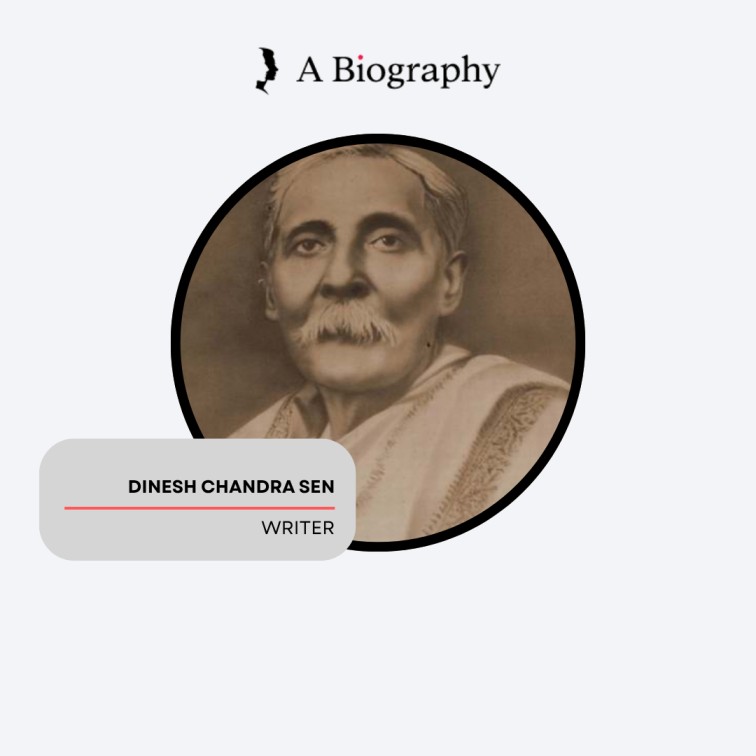
Introduction
20 November 1939. Rupeshwar Bhavan, Behala, Kolkata. An elderly man lay on his bed. He was 73 years old, his body weakened by long-standing kidney complications and age-related ailments. The stain of writing ink was still fresh on his fingers. On the table beside him lay the last few pages of the unfinished manuscript of ‘Brihat Bangla’ (Greater Bengal). Moments earlier, he had whispered, “Please, do not let my collections be lost.” Then, closing his eyes, he fell silent forever. Dinesh Chandra Sen, respectfully known as ‘Acharya’, had bid farewell. He took with him the invaluable treasures of Bengal’s folk ballads, but left behind ‘Maimansingha Gitika’, ‘Purba Banga Gitika’, ‘Bangla Bhasha O Sahitya’, ‘Brihat Bangla’, and countless other books, along with a vast collection of rare manuscripts and papers.
As news spread, the campus of the University of Calcutta was stunned with grief. Professors and students of the Bengali department broke down in tears. This revered scholar, whose contribution to Bengali literature was unparalleled, who had been praised by Rabindranath Tagore and Haraprasad Shastri, was bid farewell by many eminent figures. A wreath was placed on behalf of the Maharaja of Tripura. Lord Ronaldshay, then Governor and Secretary of State for India, expressed his condolences through a letter. This report chronicles the complete story of that great scholar – from his childhood in the zamindar household of Suapur village, Manikganj, to his education at Jagannath College and Dhaka College, from teaching in schools to becoming a university professor and Ramtanu Lahiri Fellow, traveling on foot from village to village collecting folklore, remaining steadfast in the face of controversy, and finally, his death while researching in Kolkata – the story of an extraordinary scholarly life.
At a Glance — Life of Acharya Dinesh Chandra Sen
| Information | Details | Thriller Note |
| Full Name | Dinesh Chandra Sen | The surname ‘Sen’ indicates a Bengali Kayastha, but he was above all distinctions |
| Nickname | Acharya Dinesh Chandra Sen | Received the title ‘Acharya’ for his scholarship and knowledge of the scriptures |
| Birth | 3 November 1866, Bagjuri village, Manikganj (then Dhaka district, British India) | A Bengali scholar born in the mid-heart of British rule |
| Death | 20 November 1939, Rupeshwar Bhavan, Behala, Kolkata (age 73) | Breathed his last due to kidney disease and old age |
| Father’s Name | Ishwar Chandra Sen | A lawyer at the Manikganj court; died when Dinesh was a child |
| Mother’s Name | Rupalata Devi | Passed away when Dinesh was only 15 |
| Ancestral Village | Suapur, Dhamrai, Manikganj, Dhaka | Suapur village in Dhamrai Upazila, Manikganj district, now in Bangladesh |
| Marital Status | Married; wife’s name Manikya Bala Devi | Daughter Shishirkumari Devi and son Smriti Sen notable among children |
| Education | Entrance from Jagannath College (1882), FA from Dhaka College (1885), BA Honours in English Literature privately (1889) | Passed Entrance at only 16; tireless worker |
| Profession | Teacher (Habiganj, Comilla); Headmaster (Victoria School, Comilla); Reader (Bengali Dept., Calcutta University 1909-1913); Ramtanu Lahiri Research Fellow (from 1913); Department Head (1920-1932) | Nearly four decades of teaching and research |
| Highest Honours | D.Lit (Calcutta University, 1921), Jagattarini Gold Medal (1931), Rai Bahadur (1921), titles ‘Kabi Shekhar’ and ‘Prāchyatattva-bhūshaṇa’ | Numerous honours for his contribution to Bengali folklore |
| Notable Books | ‘Bangla Bhasha O Sahitya’ (1896), ‘Brihat Bangla’, ‘Bangla Sahityer Itihas’ (5 vols, 1926-1935), ‘Maimansingha Gitika’ (1923), ‘Purba Banga Gitika’ (1926/1932), ‘Folk Literature of Bengal’ (1920) | Established the foundation of Bengali folklore |
| Legacy | Dr. Dinesh Chandra Sen Research Centre (University of Dhaka), Acharya Dinesh Chandra Sen Research Society (Kolkata) | Research institutes in his name in both Bengals |
Hidden in every gap of the table are the dedication and selfless labour of a scholar revered by an era. Especially the ‘Death’ column – at 73, a chapter of quiet scholarship came to an end.
Early Life (1866-1880)
On 3 November 1866 (some sources mention 1867, but most researchers accept 1866), Dinesh Chandra Sen was born in Bagjuri village, Manikganj, then under Dhaka district of British India. His ancestral home was in Suapur village, Dhamrai Upazila, in the same district. The region was then prosperous – surrounded by rivers and canals, with thriving agriculture and trade. Bagjuri village was situated amidst beautiful nature – rice fields and jute fields all around, and forests in the distance. The pristine natural environment of his childhood deeply influenced his later literary sensibility. His father, Ishwar Chandra Sen, was a lawyer at the Manikganj court. He was not only a legal practitioner but also a scholar of Sanskrit, Persian, and Bengali. He was a respected figure in local society. His mother, Rupalata Devi, was a homemaker and a poet by nature. She would often tell her children Bengali rhymes and stories from the Panchatantra. Dinesh Chandra was the second son of his parents. The family had zamindari in the Dhamrai region, though it was not very large. By family lineage, they were Kayasthas with a passion for Sanskrit learning.
As a child, Dinesh Chandra began his primary education in the village pathshala. There he learned the Bengali alphabet, Sanskrit words, and arithmetic. He then enrolled in a local English school. From childhood, he was highly intelligent. At the age of seven, he composed a hymn to the goddess Saraswati – the first indication of his poetic talent. From that time, he was attracted to manuscripts and folk tales. He would listen to elderly village women reciting ‘Chandrabati’s Ramayana’ and ‘Manasa’s Vasan’, or sit in the Jari song gatherings listening to the tales of ‘Kamala’ and ‘Kanka o Leela’. These childhood memories guided his path to folklore throughout his life.
But fortune was not kind. At just eight years old, his father, Ishwar Chandra Sen, passed away. The family fell into financial distress. Some portions of their zamindari were lost. And only seven years later, at fifteen, his mother, Rupalata Devi, also died. This loss turned Dinesh Chandra into a rock of resilience. He became orphaned. His only source of support was his elder brother, a reform-minded man who did business and bore the expenses of Dinesh’s education. The trauma of childhood and the experience of poverty made him empathetic towards people. He realised that the true source of literature lies in the joys and sorrows of ordinary people. Because of his own experiences of deprivation and hardship, he valued the stories of rural women and working people. This life-philosophy drove him to collect folklore. In a reminiscence, he once said, “As a child, I used to hear rhymes and stories from my grandmother. My grandmother would sing Hindustani Shyama, and I grew up listening to her. Those threads are woven into my very soul.”
After finishing his studies at the school in Manikganj, he moved to Dhaka. He enrolled at Jagannath College in Dhaka (now Jagannath University). At that time, opportunities for higher education in Dhaka were limited, yet he continued his studies diligently. He acquired proficiency in Sanskrit and Persian and also read Western literature deeply. Professor Krishna Chandra Dutta of Jagannath College particularly encouraged him. Krishna Chandra Dutta was a renowned scholar of Sanskrit and Bengali literature. Coming into contact with him, the seeds of literary research were planted in Dinesh Chandra Sen’s mind.
Education (1882-1889)
In 1882, Dinesh Chandra Sen passed the Entrance examination from Jagannath College, Dhaka. The standard of education in Dhaka city at that time was not very high, yet he passed in the first division. His passing was widely discussed in the Manikganj region. While studying at Jagannath College, he came under the influence of Professor Krishna Chandra Dutta, a renowned scholar. Krishna Chandra Dutta kindled his interest in Bengali and Sanskrit and handed him some collections of rare manuscripts. Subsequently, he enrolled at Dhaka College. In 1885, he passed the FA (First Arts) examination. But during this time, he was plunged into an ocean of grief. In 1881, his mother passed away. He became like a weary traveller. He had no family; there was no one he could call his own. The burden of poverty was also growing heavy. He then decided to take a job, but within him was a burning desire to complete his higher education. He decided to study for his BA privately. He would work and study in his spare time. During this period, he gained a reputation as a brilliant student, but due to poverty, he could not attend regular classes. In 1889, he earned his BA degree with honours in English literature from the University of Calcutta. He had a fondness for English literature, but his insight into Bengali and Sanskrit was extraordinary. He sought knowledge deeply and realised that even after receiving Western education, one should not forget one’s roots. After finishing his studies, he came into contact with Western literature and the writings of scholars like Sir William Jones, Max Müller, and Edward Arnold. But instead of becoming attracted to the West, he became more devoted to his mother tongue. The work of Sir George Abraham Grierson particularly showed him the way. Grierson had collected folk songs from Burdwan and Bihar in works like ‘Bihar Peasant Life’ and ‘Medley of Bihari Folk Songs’. Dinesh Chandra Sen thought that he too must collect the folklore of Bengal. From this desire began the main work of his long life.
Beginning of Professional Career (1887-1893)
In 1887, he took his first job as a teacher at Habiganj Government High School in Sylhet. The salary was very meagre (about 30 taka per month), but he enjoyed teaching his students. During this time, he became interested in collecting local folk tales and manuscripts. While travelling through the villages around Habiganj, he heard hints of ballads like ‘Malua’, ‘Mahuya’, and ‘Dasyu Kenaram’. These stirred his curiosity. He bought a notebook and wrote down everything he heard. These were the first steps of his collection. During this time, he was mesmerised to hear a part of the ‘Mahuya’ ballad from a young girl singer named Indubala Devi, who later sang many more songs for Dinesh Chandra. He travelled to remote villages in Habiganj, collecting Jari songs, Sari songs, Bhatiali, Murshidi, and manuscripts. This experience made him realise that the folk literature of East Bengal is filled with countless invaluable gems. He would mix with local teachers and share his experiences. He also came to understand that rural women might be illiterate, but their poetic talent was extraordinary. They composed songs and stories orally, which remained neglected in a male-dominated society.
In 1889, he was appointed Headmaster of Shambhunath Institution in Comilla. Just a year and a half later, in 1890, he joined as Headmaster of Victoria Government High School in Comilla. The Comilla region then had a rich repository of Bengali folk culture. On holidays, he would cycle or walk to remote villages to listen to ballads and jatras. This experience laid the foundation for his future massive work. He was not alone; he would take his students and colleagues as travel companions. His companions would help him by bicycle or boat. It was in Comilla that he found a talented person like Chandrakumar De. During this time, he began work on ‘Bangla Bhasha O Sahitya’, which would bring him to the attention of the scholars of Calcutta University. While in Comilla, he also collected folk tales from the local Buddhist and Hindu communities. He observed that irrespective of religion and caste, the common people of Bengal were bound by a common cultural bond. He spent nearly two decades in Comilla, and during this time he came into contact with many skilled folk artists.
Bangla Bhasha O Sahitya (1896)
In 1896, his first major work ‘Bangla Bhasha O Sahitya’ (Bengali Language and Literature) was published. Dinesh Chandra Sen was then 30 years old. At a very young age, he composed this scholarly book. The book can be divided into three parts: the first part on the origin and evolution of the Bengali language, the second on the history of literature, and the third on criticism and evaluation. In his linguistic analysis, he presented the forms of Sanskr and Magadhi Prakrit. He claimed that the Bengali language did not derive directly from Sanskrit, but rather evolved through the stream of Prakrit and Apabhramsha. He identified the Charyapada as the earliest specimen of the Bengali language. Here he also shed light on literature: analysing the Charyapada, Vaishnava Padavali, Shakta Pad, Mangalkavya, and the contributions of modern poets and writers. At the time of publication, the Maharaja of Tripura, Birchandra Manikya, provided financial assistance. He remembered this generosity with gratitude. Through this book, Dinesh Chandra Sen sought to prove that the Bengali language and literature are equal to any modern language in the world. The English version of the book, ‘History of the Bengali Language and Literature’, was published in 1911. The journal of the Royal Asiatic Society of London published a long review praising the book. European scholars like Senati, Rich Davis, Burnett, Baron, and Berg wrote letters of praise. This marked the beginning of Dinesh Chandra Sen’s international fame. The influence of this book was so profound that Sir Ashutosh Mukherjee, the then Vice-Chancellor of the University of Calcutta, personally congratulated Dinesh Chandra Sen.
The Help of Kaliprasanna Singha (1909-1913)
The publication of ‘Bangla Bhasha O Sahitya’ spread Dinesh Chandra Sen’s reputation. The then educationist and social worker Kaliprasanna Singha (not the famous author of ‘Hutom Pyachar Naksha’ – this Kaliprasanna Singha was an agricultural and educational reformer, a leader of the agricultural and business community) was impressed by his work. He invited Dinesh Chandra Sen to Kolkata and helped him secure a position in the Bengali department of the University of Calcutta. In 1909, he joined the newly established Department of Bengali Language and Literature at the University of Calcutta as a ‘Reader’. This was the turning point in his life. He now had full opportunity for administrative responsibilities and research. He quickly planned his research. While a ‘Reader’, he created a syllabus for collecting folk ballads ‘on the model of Grierson’. He was given financial and logistical support by the university. During this time, he created a synthesis between teaching and research. His students respected him, because he did not just teach from textbooks but taught through real-life examples and field trips. He was also respected by his university colleagues. It is worth noting that he became an active member of the ‘Bangiya Sahitya Parishad’ and drew research inspiration from there as well.
In 1913, he was appointed ‘Ramtanu Lahiri Research Fellow’. The financial benefits and independence of this fellowship allowed him to travel throughout Bengal to collect folklore. He formally began collecting folk songs, vows, and manuscripts with full vigour. He first chose the Mymensingh and Sylhet regions, because his prior experience told him that folk ballads were still alive there. From this fellowship began his timeless achievements, the ‘Maimansingha Gitika’ and ‘Purba Banga Gitika’. He visited thousands of villages, traversed difficult paths by boat and horseback. He would go to each village and seek out singers, jatra troupes, and manuscript collectors. His success was the result of this hard work. The Ramtanu Lahiri Fellowship was for five years, renewable. He consistently renewed it by demonstrating productive work.
Chandrakumar De (1916-1925)
While Dinesh Chandra Sen was collecting folk ballads in Mymensingh, he read an article titled ‘Mahila Kabi Chandrabati’ by a young teacher and researcher named Chandrakumar De (published in a literary magazine from Comilla). He was overwhelmed. He presumed that if this Chandrakumar De could be engaged, great success would follow. He asked Chandrakumar De to join in collecting folklore. Chandrakumar De was a resident of the Nandail region of Mymensingh district. He was hesitant at first but later agreed. From 1916 onwards, Chandrakumar De tirelessly travelled through Mymensingh, Netrokona, Sylhet, and Kishoreganj, collecting songs and manuscripts. Sometimes alone, sometimes with the help of villagers, he would record the songs. The ballads he collected – ‘Mahuya’, ‘Malua’, ‘Chandrabati’, ‘Kanka o Leela’, ‘Dasyu Kenaram’, ‘Kamala’, ‘Rupbati’, ‘Dewana Madina’ – were published under Dinesh Chandra Sen’s editorship. The ‘Mahuya’ ballad, in particular, became an immortal treasure of the Bengali soul. Later, in comparative discussions with Western literature, these ballads found a place.
Dinesh Chandra Sen gave credit to Chandrakumar De, but Chandrakumar De did not seek any recognition. Sen himself wrote about the humble and self-sacrificing attitude of Chandrakumar De. This collaboration is unparalleled in the history of Bengali literature. Chandrakumar De later conducted important research on ‘Banglar Lokasahitya’, but he did not gain the popularity of Dinesh Chandra Sen. The manuscripts of the ballads collected by Chandrakumar De are now preserved in the library of the University of Calcutta. Dinesh Chandra Sen also arranged a job for Chandrakumar De in an institution, so that he could pursue research without worry. This generosity demonstrates the depth of their relationship.
Maimansingha Gitika (1923)
In 1923, ‘Maimansingha Gitika’ (or ‘Maimansingha Gitika’ collection) was published. It was also known in English as ‘Eastern Bengal Ballads’. In this book, Dinesh Chandra Sen compiled and edited 13 ballads. The first edition contained the original songs (in Bengali script) and an English translation. The foreword to the book was written by the then Governor of Bengal, Lord Ronaldshay. He praised it highly, saying, “This is an extraordinary document of the literary talent of the lower classes of Bengal.” Lord Ronaldshay was one of the most cultured governors of the British Raj in India. This praise brought unprecedented popularity to the book. Rabindranath Tagore, though initially unable to write a foreword, was enchanted after reading ‘Mahuya’. He wrote a letter congratulating Dinesh Chandra Sen: “When such great poetic works can emanate from the mouths of the neglected masses, then all theories of literature await being compiled.” Haraprasad Shastri said with joy, “This is a unique discovery of our literary heritage.” The English translation of the book created a considerable stir in Europe and America. The sister of French Nobel laureate writer Romain Rolland (Madame Rolland) herself translated some of the ballads into French. This spread Dinesh Chandra Sen’s international fame. After the book’s publication, Dinesh Chandra Sen received over five hundred letters mixing praise and criticism. He patiently replied to them. The popularity of the ‘Mahuya’ ballad increased so much that several plays and films were made based on it. The heroine Mahuya became known in every Bengali home.
Purba Banga Gitika (1926 and 1932)
After the success of ‘Maimansingha Gitika’, Dinesh Chandra Sen published his second collection, ‘Purba Banga Gitika’. The first volume was published in 1926, the second in 1932. It contained over 25 ballads, such as ‘Bhelua Sundari’ (a folk tale from Chittagong), ‘Moishal Bandhu’ (a ballad from Sylhet), ‘Ayana Bibi’ (from Mymensingh), ‘Dewan Isa Khan’, ‘Firoz Khan Dewan’, ‘Shyamray’, ‘Shiladevi’, ‘Andha Bandhu’, ‘Bandular Baramasi’, ‘Ratan Thakur’, and others. Here too, he presented the original ballad with an English translation. The language and metre of the Purba Banga Gitika were composed in the regional variations of East Bengal, which holds immense historical and cultural significance. Chandrakumar De played a leading role in this work as well. However, in the second volume, Dinesh Chandra Sen himself brought many new songs, especially from the Sylhet and Chittagong regions. He travelled to the hilly areas of Sylhet and collected the song ‘Moishal Bandhu’ from the mouths of local Pathans. These books changed the perspective of critics. The educated society of Bengal first accepted that uneducated peasants and boatmen have poetry equal to nectar in their mouths. Dinesh Chandra Sen’s collection undoubtedly elevated the position of Bengali literature in world literature. Lord Ronaldshay wrote in the foreword, “These poems are comparable to the Iliad and the Odyssey.” The method he followed in editing this book – including the original songs alongside English translations, necessary notes, and introductions – became an ideal for subsequent folklorists. He tried to preserve the spelling and pronunciation of the collected ballads, although it created controversy.
Folk Literature of Bengal (1920)
The 1920 book ‘Folk Literature of Bengal’, published in English, established Bengali folk literature on the international stage. In this book, he analysed the various genres of Bengali folklore – vrata kathas (vows), rhymes, riddles, proverbs, jatra, and manuscript plays. He showed that each strand of folk literature is a true mirror of Bengali social life. He made a scientific classification of vrata kathas, which became a guide for subsequent researchers. This book created a considerable stir among Western folklorists. Scholars like Bernard, Martin, and Gordon praised it through letters. Dinesh Chandra Sen proved that Bengali folk literature is not mere imitation, but distinct and rich. It was for the scholarship of this book that the University of Calcutta awarded him a D.Lit degree. In this book, he collected specimens of vrata kathas spanning a thousand years, among which ‘Gazir Gaan’, ‘Manasar Vasan’, ‘Sasthir Brata’, ‘Jiban Brata’, and ‘Bater Brata’ are particularly notable. The book is also preserved in the library of the British Museum. He arranged the vrata kathas based on festivals, ceremonies, and contexts, which is highly valuable to ethnologists.
Bangla Sahityer Itihas (1926-1935)
Dinesh Chandra Sen composed another monumental work – ‘Bangla Sahityer Itihas’ (History of Bengali Literature) in 5 volumes (1926-1935). It is a comprehensive document of the history of Bengali literature. The first volume covers the Charyapada and the ancient era, the second covers Mangalkavya and translation literature, the third covers Vaishnava Padavali and Shakta Pad, the fourth covers the beginning of modern literature and the end of the medieval age, and the fifth covers the poets and novelists of the 19th and 20th centuries. This book became a Bible for subsequent researchers in a sense. It is still read, and although some research has advanced, it remains essential for its wealth of information. While writing, he not only gave an account of written literature but also highlighted the importance of folk literature in separate chapters. It took him nearly a decade to complete the series. He himself noted that he had reviewed nearly ten thousand manuscripts and papers for this work. To collect manuscripts, he approached private collectors and personally bought many manuscripts. ‘Bangla Sahityer Itihas’ was included in the curriculum of the University of Calcutta, and many students used it for exams. No previous English or Bengali book was so detailed and rich.
Brihat Bangla
‘Brihat Bangla’ (Greater Bengal) is another extraordinary creation of his. It integrated the social, political, and cultural picture of Bengal from ancient times up to the Battle of Plassey into a single framework. Dinesh Chandra Sen was not limited to literary history; he extensively discussed Bengali public life, economy, religion, architecture, customs, agriculture, commerce, vows, and festivals. He beautifully described ancient Bengal’s maritime trade, Buddhist monasteries, and the background of the fall of the Sena dynasty. This book is called a milestone in the study of Bengali history. The book was completed shortly before his death. In writing ‘Brihat Bangla’, he used many manuscripts and ancient documents. It became popular for his scholarship and lucid prose style. His ‘Brihat Bangla’ is still a basic text read by history students. A special feature of the book is that, alongside history, he included descriptions of daily life – such as ancient Bengali cuisine, clothing, ornaments, and sports. These sections are very attractive to readers. He sought to prove that the history of Bengal is not merely one of wars and dynasties, but the history of its people.
Other Notable Books and Editorial Works
Dinesh Chandra Sen wrote and edited many other books. In ‘Ramayanik Katha’, he analysed the influence of the Ramayana on Bengali literature and various regional versions of the Ramayana, such as Krittivasi Ramayana and Chandrabati’s Ramayana. ‘Behula’ is a play based on the folk tale of the Manasamangal. ‘Jaravarat’, ‘Kasthadhwaja’, ‘Dharadrona’ are plays that reinterpret the stories of King Dhritarashtra and the Pandavas. In ‘Vaishnava Sahitya Parichay’, he edited and analysed manuscripts of Vaishnava Padavali. He edited ‘Chaitanya Charitamrita’ with the original commentary. He published a five-volume series titled ‘Prachin Puthi Sangraha’, containing the recovery and annotation of rare manuscripts. These were a unique repository of Bengali manuscript literature. He also published a simple Bengali translation of the ‘Srimad Bhagavad Gita’, which made the Gita accessible to ordinary people. The prefaces and introductions of his editions bear the mark of his scholarship. He translated parts of the ‘Brahmavaivarta Purana’. Through these translations, he demonstrated the richness of Bengali translation literature. Alongside collecting folklore, he was also skilled in Bengali translation of Sanskrit texts, a sign of his rare talent.
Appreciations and Correspondence from Rabindranath and Haraprasad Shastri
Rabindranath Tagore deeply valued Dinesh Chandra Sen’s work. After the publication of ‘Maimansingha Gitika’ in 1923, Tagore wrote in a letter, “This ballad will give new life to Bengal. An extraordinary achievement.” Later, in his essay ‘Sahityer Pathe’ (On the Path of Literature), Tagore gave high praise to folk ballads. He further said that the beauty of these ballads is equal to any epic. Although Tagore did not write the foreword to the ballads, he was attracted to Dinesh Chandra Sen’s work and wrote him several letters. These letters are collected in the anthology of Tagore’s letters. Haraprasad Shastri (renowned manuscript researcher and Sanskrit scholar) said with joy, “He has recovered a treasure that was on the verge of being lost forever.” Shastri wanted to bestow the title ‘Grimm of Bengal’ upon Dinesh Chandra Sen. This praise inspired Dinesh Chandra Sen. He would send his subsequent collections to Tagore as gifts. Tagore became even more interested in jatra and folk culture. What greater honour could there be than praise from two legends! After Dinesh Chandra Sen’s death, Rabindranath wrote a letter eulogising him, saying, “Bengali folk literature will remember his name forever.”
Rai Bahadur and Doctorate Titles (1921)
In 1921, the British government awarded him the title ‘Rai Bahadur’. This was one of the most prestigious honours in British India, usually given for social service and administrative contributions. Dinesh Chandra Sen received this honour for his contributions to literature. The same year, the University of Calcutta awarded him a Doctor of Literature (D.Lit) degree. While presenting the title, Vice-Chancellor Hirenndranath Ghosh praised him, saying, “You are a foremost architect of the history and literature of Bengal.” At the ceremony for the D.Lit degree, the assembled scholars gave him a standing ovation. The following year, in 1922, when the Prince of Wales visited India, Dinesh Chandra Sen was specially honoured, and he was also awarded a doctorate on that occasion (it is said a second time or a special certificate). He received the Jagattarini Gold Medal from the university in 1931. That medal is the highest honour in Bengali literature. Upon receiving the award, he said, “I am merely repaying some of the debt to the villagers. Their intellect is the source of this honour.” He did not use the money or prize of this honour for himself but donated it to Jagattarini College and other educational institutions.
Titles ‘Kabi Shekhar’ and ‘Prāchyatattva-bhūshaṇa’
The scholars of Nabadwip awarded Dinesh Chandra Sen the title ‘Kabi Shekhar’. Nabadwip was a centre of Sanskrit learning. Impressed by Sen’s knowledge of Sanskrit, interpretation of poetry, and command over Bengali literature, they bestowed this title. Additionally, the Bharat Dharma Mahamandal (Indian Religious Council) awarded him the title ‘Prāchyatattva-bhūshaṇa’ (Ornament of Eastern Studies). This title was given for his outstanding contributions to the study of Bengali folklore and archaeology. He accepted these titles with humility. But later, he never used them before his name; rather, he would tell his students, “I am just a researcher; titles are secondary to me.” The scholars of Nabadwip wrote him a certificate of praise in Sanskrit, which is still preserved in the archives of the University of Calcutta. The Asiatic Society also awarded him honorary membership. These titles maintained his prestige in contemporary society and established the legitimacy of his work.
Head of the Bengali Department at Calcutta University and Teaching (1920-1932)
In 1920, the University of Calcutta granted departmental status to the Bengali Language and Literature department, and Dinesh Chandra Sen was appointed its head. He created the curriculum and research framework for the department. Under his guidance, countless researchers earned MA and PhD degrees (numbering over fifty). He was a very strict yet affectionate teacher. He would not sit still in the classroom; he would ask his students, “Have you gone to the villages to collect folk songs?” If anyone answered ‘no’, he would take them on field trips to teach them hands-on. Among his notable students were Jasimuddin (the rural poet), Binay Bhattacharya, Basanta Kumar Chattopadhyay, Sudhir Chakraborty, and others. Many who later became professors at Jadavpur University and Calcutta University were Sen’s students. The rural poet Jasimuddin assisted him in collecting the ‘Purba Banga Gitika’. Jasimuddin admitted, “I learned reverence for folk culture from Acharya.” He did not easily use a microphone for his students; rather, he would communicate with a glance. Dinesh Chandra Sen’s lectures were lucid and attractive. He would recite Sanskrit and Bengali verses from memory. To be present in his class, preparation was mandatory. This strictness instilled discipline and a sense of scholarship in his students. He was also active in the administrative work of the university and edited the ‘Journal of the Department of Letters’ of the University of Calcutta, where he gave young researchers the opportunity to publish.
Membership in the Royal Asiatic Society
Upon reading the English version of his ‘Bangla Bhasha O Sahitya’, European scholars such as Senati, Rich Davis, Burnett, Baron, and Berg wrote letters praising Dinesh Chandra Sen. He was awarded full membership by the Royal Asiatic Society of London. The sister of French Nobel laureate writer Romain Rolland (Madame Rolland) translated several of the folk ballads into French. Rolland himself highly praised Sen. In a research paper of the French Academy, Romain Rolland gave Dinesh Chandra Sen the title ‘Grimm of Bengal’ (after the German brothers who collected folk tales). The Max Müller Trust in Germany compared his work to that of the Grimms. In the 1920s, Sen was invited to give lectures at Cambridge and Oxford in London, but due to illness and personal reasons, he could not go. Nevertheless, his work enhanced Bengal’s reputation in the West. While these international connections gave him pride, he never became arrogant.
Controversy (from the 1960s to Present)
Long after Dinesh Chandra Sen’s death, a controversy arose. Scholar Sukumar Sen (the renowned Bengali linguist) claimed that the language of the ‘Maimansingha Gitika’ and ‘Purba Banga Gitika’ was interpolated and impure. He argued that Chandrakumar De might have altered the collected manuscripts, and Dinesh Chandra Sen approved the changes in his editing. This, he claimed, resulted in the original language being extremely modernised. In the wake of this allegation, in the 1960s, the Czechoslovak scholar Dusan Zbavitel conducted extensive fieldwork in the Mymensingh and Netrokona regions. There, he heard parts of the ‘Mahuya’, ‘Malua’, and ‘Chandrabati’ songs from elderly villagers. He concluded that the ballads are original and authentic. However, he admitted that there are differences between the written manuscripts (which were written down in the late 19th century) and the language prevalent in the villagers’ mouths. But the core story and sentiment remain intact. Zbavitel’s research ruled in favour of Dinesh Chandra Sen. Nevertheless, some still believe that Dinesh Chandra Sen and Chandrakumar De ‘created’ the folk literature rather than merely collecting it. But most scholars reject this allegation. Contemporary research has shown that eight out of ten elderly people in rural Bengal still know the story of ‘Mahuya’. This evidence supports its authenticity. This controversy actually points to the importance of Dinesh Chandra Sen’s work, because without his collection, there would be no subject for this debate. It is proof of his rare achievement.
Personal Life
Dinesh Chandra Sen was a man of pure character. He married Manikya Bala Devi. It is known that his family life was solitary and simple. His daughter was Shishirkumari Devi, his son Smriti Sen. Smriti Sen later became a professor at the University of Calcutta and preserved the legacy of his father’s manuscripts and collections. Dinesh Chandra Sen was very frugal, wearing a white dhoti and panjabi. He was a family man, but it is known that he abstained from non-vegetarian food. Until the end of his teaching and research career, he worked tirelessly. He loved listening to music, especially Jari and Bhawaiya. In the evenings, he would sit at home and sing songs of nature. His simple lifestyle inspired his students. He did not buy even cheap things cheaply; he saved every taka to buy books. His personal library contained about ten thousand books. He never owned a private car; he always travelled by tram or on foot. This lifestyle made him distinct among scholars of the subcontinent.
Final Life and Death (1936-1939)
After retiring in 1932, Dinesh Chandra Sen moved to Rupeshwar Bhavan in Behala, Kolkata. There, he classified his collected manuscripts and worked on projects like ‘Brihat Bangla’. After 1936, his kidneys began to fail. He refused treatment, saying, “Let me finish Brihat Bangla.” He knew his death was near, so he worked day and night. Finally, on 20 November 1939, he breathed his last. Numerous scholars and students attended his funeral. His last rites were performed according to his wishes. He was cremated at the crematorium in Behala. The then Chief Minister of West Bengal, the Education Minister, and literary figures expressed their condolences. The University of Calcutta and the Kolkata Municipal Corporation adopted resolutions of mourning. The final chapter of ‘Brihat Bangla’ remained unfinished. Later, his son Smriti Sen completed it. His last wish was, “May my collections not go to undeserving hands.” He expressed this wish publicly. Shortly before his death, he made a will, instructing that his manuscripts and papers be preserved at the University of Calcutta and the University of Dhaka.
Legacy
Many years after his death, the ‘Dr. Dinesh Chandra Sen Research Centre’ was established at the University of Dhaka. It is dedicated to research on folklore and Bengali literature. The centre regularly holds international seminars and publication activities. The ‘Acharya Dinesh Chandra Sen Research Society’ was established in Kolkata, which regularly conducts research and publishes books on Bengali folk culture. Both institutions have long carried the ideals of Dinesh Chandra Sen. A road and a public library in Manikganj are named after him. The West Bengal government organises various events every year on 3 November (his birth anniversary). He is still remembered across the borders of Bangladesh and India. In 2016, the Manikganj district introduced the ‘Acharya Dinesh Chandra Sen Memorial Medal’. This honour is awarded for research on folk culture. It keeps his legacy memorable.
Preservation Challenges and Digitalisation
Most of the manuscripts and papers collected by Dinesh Chandra Sen are preserved in the History of Literature Library of the University of Calcutta and the archives of the Bengali department. Some are in the Dr. Dinesh Chandra Sen Research Centre at the University of Dhaka. Unfortunately, over time, many manuscripts have become extremely fragile, damaged by bookworms. However, researchers are trying to preserve them through digital archives. The Society in Kolkata has republished several manuscripts under the ‘Prachin Puthi Uddhar Project’ (Ancient Manuscript Recovery Project). Bangla Academy and UNESCO have jointly carried out some digitalisation. Nevertheless, proper maintenance of the manuscripts is not yet complete. Currently, about three and a half thousand manuscripts in the archives of the University of Calcutta have been converted to digital format. This work was completed in 2022 and made available on the university’s website. Researchers can now read them from afar.
Timeless Relevance
Even in the 21st century, Dinesh Chandra Sen’s works remain essential for research on Bengali literature. His methods of collecting and editing authentic folklore serve as a guide for students. His genuine love for the language and culture of rural Bengal is instructive in today’s mechanical world. Researchers benefit from reading his ‘Bangla Sahityer Itihas’ and ‘Brihat Bangla’. European and Asian researchers are still conducting doctoral research on him. Recently, a research project at Heidelberg University in Germany has conducted a linguistic analysis of his ‘Maimansingha Gitika’. A researcher at the University of Rome in Italy is using Dinesh Chandra Sen’s information on ‘Bengali Vrata Kathas’. This proves that his work is timeless. In an age of globalisation where cultural exchange and appreciation are increasing, the relevance of Dinesh Chandra Sen’s work has only grown. The ballads he collected are now spreading through digital media, allowing ordinary people to easily hear the songs.
The Title ‘Acharya’, the Triumph of Regional Culture
Why did Dinesh Chandra Sen receive the title ‘Acharya’? ‘Acharya’ means teacher or master of knowledge. He received this title from the love of his students and the recognition of the scholars of Nabadwip. He never used the word ‘Acharya’ with authority; rather, everyone was comfortable calling him ‘Dinesh Babu’. When he went to Kolkata, he would ride trams, never using a luxury car. He would buy books for poor students with his own money. One of his curious habits was that he would walk at a fixed time every day, because he believed that walking reduces mental stress and creates clarity of thought. He also enjoyed Western music, particularly Beethoven’s symphonies. This international taste gave him a multi-dimensional personality. He never saw a conflict between East and West; rather, he wished for a synthesis of the two.
Timeline
- 1866 – 3 November: Born in Bagjuri village, Manikganj.
- 1874 – Father Ishwar Chandra Sen passes away.
- 1881 – Mother Rupalata Devi passes away.
- 1882 – Passes Entrance from Jagannath College (first division).
- 1885 – Passes FA from Dhaka College.
- 1887 – Begins teaching at Habiganj Government School; starts collecting folk tales.
- 1889 – Passes BA with Honours in English Literature; appointed Headmaster of Shambhunath Institution, Comilla.
- 1890 – Appointed Headmaster of Victoria Government High School, Comilla (until 1909).
- 1896 – ‘Bangla Bhasha O Sahitya’ published (with financial help from the Maharaja of Tripura).
- 1909 – Joins as Reader at the University of Calcutta; begins work in the Bengali department.
- 1911 – ‘History of the Bengali Language and Literature’ published in English; international recognition.
- 1913 – Appointed Ramtanu Lahiri Research Fellow; begins full-time folk ballad collection.
- 1916-1925 – Extensive collection in the Mymensingh and Sylhet regions with the collaboration of Chandrakumar De.
- 1920 – ‘Folk Literature of Bengal’ published; appointed Head of the Bengali Department; title ‘Kabi Shekhar’.
- 1921 – Title ‘Rai Bahadur’; University of Calcutta awards D.Lit.
- 1922 – Received honorary doctorate from the hands of the Prince of Wales.
- 1923 – ‘Maimansingha Gitika’ (Eastern Bengal Ballads) published. Praise from Rabindranath.
- 1926 – First volume of ‘Purba Banga Gitika’ published; first volume of ‘Bangla Sahityer Itihas’ published.
- 1931 – Receives Jagattarini Gold Medal.
- 1932 – Retires as Head of the Bengali Department and from teaching; second volume of ‘Purba Banga Gitika’ published.
- 1935 – Completes fifth volume of ‘Bangla Sahityer Itihas’, reaching the peak of scholarship.
- 1936-1939 – Works on ‘Brihat Bangla’ and other projects; physical decline.
- 1939 – 20 November: Dies in Behala, Kolkata (age 73).
Epilogue
Acharya Dinesh Chandra Sen was a marvel of Bengali literature; by recovering the invaluable treasure of folklore, he showed the world what great creators the ordinary people of rural Bengal are. It is because of his scholarship and dedication that we can read the tragic story of ‘Mahuya’ today, listen to Chandrabati’s Ramayana, and be amazed by the imagination of the ballads of East Bengal. He was an institution from head to toe; the research centres he established are still producing new researchers. Not only literature, but researchers in sociology, anthropology, and history also rely on his work. His works are included in the curricula of almost all university Bengali departments in West Bengal and Bangladesh.
From his life, we learn: the practice of culture is not a luxury, but a matter of dedication. Knowledge cannot be confined to imposed boundaries; it must be spread from mouth to mouth. He proved that the educated society should cherish the culture of the marginalised and unknown. Therefore, today, long after his death, when we sit in the research centre of Dhaka University and read the ‘Gitika’, or attend seminars at the Acharya Dinesh Chandra Sen Research Society in Kolkata, we confess in one voice – we are eternally indebted to him. Not only his contemporaries but every researcher of subsequent generations acknowledges his debt. Acharya Dinesh Chandra Sen is immortal, ever memorable. He once said, “Without folk literature, Bengali literature is half.” Through his work, that half of Bengali literature has been made whole.
The thriller does not end. The manuscripts collected by Dinesh Chandra Sen still amaze scholars today. The songs of ‘Mahuya’ or ‘Chandrabati’ are still hummed on the shores of some char in Sylhet. The voices of countless unknown folk poets, whose names are not in history, became immortal through the hands of Dinesh Chandra Sen. From that sense of responsibility, the future generation will continue the practice of folklore. Acharya Dinesh Chandra Sen is immortal.

