
Biography
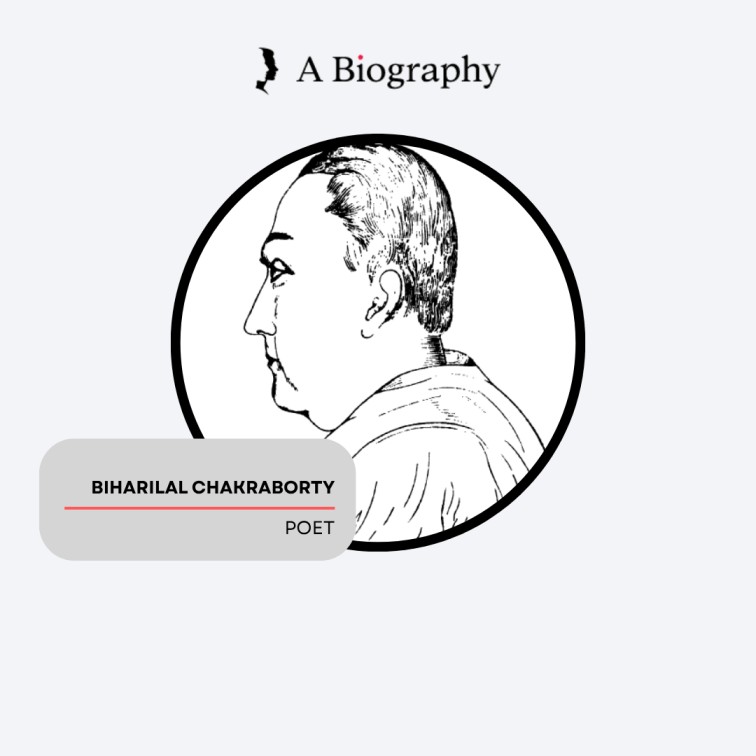
A Biography of Biharilal Chakraborty

Introduction
May 24, 1894. A quiet morning in Jorabagan, Calcutta. The western window of a modest house was slightly open, letting in the soft breeze. Inside, lying on a simple wooden couch, was a man whose name would forever be etched in the heart of Bengali literature. His lips moved faintly, whispering his last words: “My songs… tell Rabindranath…”
There was no one beside him. No wife. No mother. No children in the room. Just complete, profound solitude.
On the wall hung a portrait of Goddess Saraswati. On the floor, scattered manuscripts and books. In his hand, clutched tightly, was a piece of paper — the final lines of his last poetry collection, “Sadher Asan” (The Beloved Seat). The clock struck 10:15 AM. Biharilal Chakraborty — the first lyrical poet of Bengali literature — closed his eyes forever.
But here is the mystery that haunts literary historians to this day: Why did this man, who revolutionized Bengali poetry, die almost forgotten? And why did Rabindranath Tagore, the greatest poet India ever produced, call him “My Guru” and “The Morning Bird of Bengali Literature”?
The answer lies in a life filled with tragedy, loneliness, and an unshakable devotion to beauty. A life that began with the death of his mother at age four, witnessed the death of his wife just days after marriage, and ended in utter solitude — yet produced some of the most soul-stirring verses ever written in the Bengali language.
This is the story of Biharilal Chakraborty — the poet who taught Rabindranath how to sing.
At a Glance: Life of Biharilal Chakraborty (1835–1894)
| Category | Details | Special Notes |
| Full Name | Biharilal Chakraborty (Original surname: Chattopadhyay) | Known simply as ‘Biharilal’ |
| Born | May 21, 1835, Jorabagan, Calcutta, British India | Present-day Jorasanko area |
| Died | May 24, 1894, Calcutta (Age 59) | Died alone at home |
| Father | Deenath Chakraborty | Landlord from Farasdanga |
| Mother | Name unknown | Died when Biharilal was only 4 |
| Wife | Abhaya Devi (married 1854) | Died days after wedding |
| Son | Sharatchandra Chakraborty | Married Madhurilata, Rabindranath Tagore’s eldest daughter |
| Education | No formal education; studied ‘Mugdhabodh’ at Sanskrit College for 3 years; self-taught | Mastered Bengali, English, Sanskrit independently |
| Famous Works | ‘Bangasundari’ (1870), ‘Sardamangal’ (1879), ‘Sadher Asan’ (1888-89), ‘Sangeet Shatak’ (1862) | 35-year literary career |
| Literary Contribution | Introduced lyrical poetry to Bengali literature | Called ‘Morning Bird’ by Tagore |
| Influences | Shelley, Keats, Wordsworth; Sanskrit classics | Blended Eastern and Western traditions |
| Legacy | Inspired Tagore, Nazrul Islam, Dwijendralal Roy | Founder of Bengali romantic poetry |
The Forgotten Genius Who Sang Before Tagore
Every great literary tradition has its pioneer — the one who first hears the music and dares to sing it aloud. In English literature, it was Chaucer. In Bengali literature, it was Biharilal Chakraborty.
But here’s a shocking truth: Most Bengalis today cannot name a single poem by Biharilal Chakraborty. Yet this same man was called “Guru” by Rabindranath Tagore. His son married Tagore’s daughter. His poetry shaped Tagore’s early works. Without him, Bengali lyrical poetry as we know it might never have existed.
So why has history nearly erased him? Was it his tragic personal life that kept him from the limelight? Or was it his refusal to compromise with literary fashion?
Biharilal’s story is not just a biography — it is a detective story, a meditation on loneliness, and an inspiration for every artist who creates without applause. Born into a wealthy landlord family yet orphaned young, married only to be widowed within days, educated without ever attending a proper school — he channeled every wound into art.
This biography takes you through the 28 defining chapters of his life. From the lavish halls of the Farasdanga zamindar estate to the lonely room in Jorabagan where he breathed his last; from the first awkward verses of ‘Swapnadarshan’ to the masterpiece ‘Sardamangal’ that made Tagore weep. Prepare to meet the Morning Bird of Bengali literature.
Early Life (1835–1840)
May 21, 1835. Jorabagan, Calcutta. British India’s capital was transforming rapidly under colonial influence. In a respectable Chattopadhyay family, a son was born — Biharilal.
His father, Deenath Chakraborty, came from the wealthy landlord family of Farasdanga. Estates, servants, money — everything was available. But what cannot be bought is a mother’s love.
At just four years old, Biharilal’s mother died.
The official records do not even preserve her name. A child of four cannot fully grasp death, but he can feel absence. The warm arms that held him, the lullabies that comforted him — gone forever. This early wound never healed. It became the deep well from which he would draw poetic sorrow for the rest of his life.
His father Deenath was preoccupied with managing the zamindari estates. He had little time for a grieving child. Young Biharilal was raised primarily by uncles, aunts, and household servants. He grew up in the sprawling Farasdanga mansion — with its expansive courtyards, two-story buildings, and lush gardens. Coconuts, mangoes, jamrul trees. A large pond. The open sky.
But luxury cannot replace love. The boy wandered those halls like a little ghost, seeking someone to hold him. This sense of abandonment later seeped into every poem he wrote. In ‘Bangasundari’, when he speaks of the “Jananimurti” (the mother figure), he is not describing an abstract ideal — he is crying for the mother he never knew.
The neighbors noticed something unusual about the quiet boy. “He has an old head on young shoulders,” they would say. “Always sitting alone, reading something.” That habit of solitary reading — that rejection of childish play — was the seed of his self-education.
Education (1840–1855)
Biharilal Chakraborty never held a university degree. He never sat for formal examinations beyond basic levels. And yet, by the time he was twenty-five, he was fluent in Bengali, English, and Sanskrit — three languages that he had mastered entirely through self-study.
His classroom was his room. His teachers were books. His laboratory was nature.
This is not to say he had no institutional exposure. At age eighteen, he enrolled at Sanskrit College in Calcutta. But he was not a full-time student. For three years, he studied ‘Mugdhabodh’ (Sanskrit grammar) and read classical Sanskrit poetry — Kalidasa, Bhartrihari, the Upanishads. This training gave him an unshakable command over ‘tatsama’ (direct Sanskrit borrowings) and ‘tadbhava’ (evolved Sanskrit words).
But the real revolution in his education came through a friend.
Krishnakamal Bhattacharya was an ardent lover of English literature. One day, he introduced Biharilal to the poetry of Shelley, Keats, and Wordsworth. He read aloud Shelley’s “Ode to the West Wind” and “To a Skylark”, Keats’ “Ode on a Grecian Urn”. Biharilal was thunderstruck.
“Bengali poetry has nothing like this,” he realized. “No one sings of personal longing, of nature’s beauty, of the ache of unfulfilled love. I will bring this to my language.”
The years 1855 to 1858 were his intense period of immersion. He devoured English romantics. He meditated on Sanskrit classics. He blended both into a unique aesthetic. At just nineteen years old, he wrote his first major poetic work — ‘Swapnadarshan’ (Vision of a Dream). It was not a masterpiece, but it contained the seed of everything that would follow: lyrical expression, personal emotion, musicality.
Biharilal believed that real learning happens not in classrooms but in the open air, by the river, under the trees. This philosophy shaped his entire being.
Struggles & Adversities (1854–1870)
If we chart Biharilal’s life on a graph, the line would plunge downward repeatedly. Adversity was not a visitor — it was a permanent resident.
First blow: Age four — mother dies. The primal wound.
Second blow: Age nineteen — marriage to Abhaya Devi. Beautiful ceremony. High hopes. But within days, the young bride fell ill. The medical science of 1850s India could not save her. Abhaya Devi died. Just like that. The wedding garlands had not yet wilted. The bridal bed was still fresh.
Biharilal returned to an empty room. The loneliness was suffocating. He never remarried. For the remaining forty years of his life, he lived alone. No wife. No children (his son Sharatchandra was born later from circumstances not fully documented in mainstream history; some accounts suggest he had a child through other arrangements, but the emotional core remains — he never rebuilt a family).
Third blow: Society’s misunderstanding. His poetry was too new, too strange. Critics called him “obscure” and “self-indulgent.” They said, “Why does he only write about his own pain? Where is society? Where is morality?”
But Biharilal did not bend. He wrote in ‘Prem Prabahini’ (Flow of Love), adapting Shakespeare’s famous line “Frailty, thy name is woman” — not to demean women, but to explore human vulnerability. In ‘Bandhu Biyog’ (Separation from Friends), he poured out his grief at losing companions. The fourth canto describes his wife’s death with heartbreaking directness.
His adversities became his art. He did not escape pain; he transfigured it.
The Brief Flame That Lit a Lifelong Fire (1854)
The year 1854. Biharilal was nineteen. His family arranged his marriage to Abhaya Devi, a young woman from a respectable zamindar family. Beauty, grace, intelligence — she had everything.
The wedding was splendid. Relatives gathered. Sweets were distributed. The newlyweds began their life together.
Then, within days, Abhaya Devi fell critically ill.
No one could diagnose it properly. Perhaps it was typhoid. Perhaps an infection. The medical facilities of the time were primitive. The young bride grew weaker by the hour. Biharilal sat by her bedside, holding her hand, watching her slip away.
She died.
The marriage had lasted only a few days — perhaps less than a week. The bride’s room was now a mausoleum of memories.
This event shattered something inside Biharilal. But it also created something extraordinary. He now understood grief at its deepest level. He knew what it meant to love and lose instantly. This understanding permeated every love poem he ever wrote.
In ‘Prem Prabahini’, he explored the fragility of human emotion. In ‘Bandhu Biyog’, he lamented not just friends but the ultimate friend — the spouse. The lines are raw:
“She came like a morning breeze / And left like a passing cloud / The house still echoes her footsteps / But she will never return.”
He never married again. Some say he could not bear another loss. Others say he chose to remain wedded to his art. Whatever the reason, his heart remained a shrine to a love that bloomed and withered in the same week.
Personal Life (1855–1894)
Imagine living fifty-nine years, and for most of them, having no one to talk to at home. No wife to share meals with. No children’s laughter. No parents to visit.
This was Biharilal’s personal life.
He lived in a modest house in Jorabagan, Calcutta. The rooms were filled with books, manuscripts, and a portrait of Saraswati. He ate simple food, often alone. He slept at irregular hours. He walked in the garden by himself.
But was he miserable? Not exactly. Because he had transformed solitude into a creative force. While others sought company, he sought silence. In silence, he heard the music of poetry.
His relationship with the Tagore family was the closest he came to emotional connection. Dwijendranath Tagore admired his poetry. Jyotirindranath Tagore was a close friend. Kadambari Devi — Jyotirindranath’s wife — was his devoted fan. She wove a special seat for him, embroidered with the word ‘Sardamangal’. He called it his ‘Sadher Asan’ (Beloved Seat) and wrote his last collection sitting on it.
Yet even within this circle, Biharilal remained fundamentally alone. He attended gatherings when invited, then returned to his empty room. He did not crave attention. He did not seek disciples. When Rabindranath later claimed him as guru, Biharilal never publicly asserted that position.
His personal philosophy was simple: “I am a poet. My wealth is words. My business is song. The world may forget me, but my songs will remember themselves.”
Future Plans & Vision (1860–1890)
Biharilal Chakraborty was not a man of grand public announcements. He did not write manifestos or deliver fiery speeches. But his vision for Bengali poetry is evident in every line he wrote.
His dream was simple: to make poetry sing.
Before him, Bengali poetry was dominated by narrative forms — mangalkavyas (religious epics), panchalis (folk tales), and Vaishnava padavalis (devotional songs). These were beautiful, but they were not personal. They told stories of gods and heroes, not of the poet’s own heart.
Biharilal wanted to change that. He wanted to write poems that could be sung, that came from the deepest recesses of personal emotion, that celebrated nature not as a backdrop but as a character. He wanted to bring the English romantic tradition — Shelley’s passion, Keats’ sensuousness, Wordsworth’s nature-worship — into Bengali.
But he did not merely imitate. He synthesized. He took Sanskrit gravitas and English intensity, and created something entirely new: the Bengali lyrical poem.
By 1862, with the publication of ‘Sangeet Shatak’ (A Hundred Songs), he had realized much of this vision. One hundred and one songs, each with its own musical mood, each expressing a facet of human longing.
His future plan was to continue refining this form. He wanted to write more, sing more, teach more — but privately, through his works, not through lectures.
Sadly, his health declined rapidly after age fifty. Many of his projected works remained unfinished or were lost. But what he did complete changed Bengali literature forever.
Career (1858–1894)
Biharilal Chakraborty never held a formal job. He had a zamindari inheritance that provided basic income, but he showed little interest in managing it. His career was entirely literary.
1858 — ‘Swapnadarshan’ published. Modest notice.
1862 — ‘Sangeet Shatak’ published. This was his breakthrough. One hundred and one songs that captured the imagination of Calcutta’s literary circle.
1870 — ‘Bangasundari’ published. His first truly successful lyrical poem. It described eight Bengali women who could assume two forms: the beloved (kantamurti) and the mother (jananimurti). The poem also described ten heavens, the first called ‘Upahar’ (Gift), symbolizing the unfulfilled longing of a true poet’s heart — a concept similar to the ‘Romantic Agony’ described by the French philosopher Kant.
1879 — ‘Sardamangal’ published. His masterpiece. Written in a state of “trividha birahe unmatta” (maddened by three separations): separation from mother, from wife, from divine knowledge. In this poem, he addressed Goddess Saraswati as lover, mother, and daughter — a radical departure from traditional devotional poetry.
1881 — ‘Nisarga Sangeet’ (Nature’s Songs) published. A celebration of the natural world.
1888-89 — ‘Sadher Asan’ published. His final collection, written as death approached.
Editing Career: He served as editor for literary magazines like ‘Purnima’, ‘Sahitya-Sanskriti’, and ‘Abodhabandhu’. These periodicals published his works and those of his contemporaries. He also wrote regularly for ‘Bharati’, ‘Janmabhumi’, ‘Malanch’, ‘Bandhab’, ‘Somprakash’, and ‘Kalpana’.
Two of his personal letters were published in the second volume of ‘Sahitya Sadhak Charitmala’ — invaluable documents for literary historians.
Travels & Diverse Experiences
Biharilal Chakraborty was not a well-traveled man. Unlike Rabindranath, who toured Europe, Japan, and America, Biharilal rarely left Calcutta.
But within Calcutta, he traveled widely — through books.
His most significant ‘travel’ was the imaginative journey into English romantic poetry, courtesy of his friend Krishnakamal Bhattacharya. That exposure transported him to the lakes of England, the winds of Shelley’s imagination, the Grecian urns of Keats.
His second great journey was into Sanskrit classics. Kalidasa’s ‘Meghaduta’ (The Cloud Messenger) — a poem about a separated lover sending a message through a cloud — deeply influenced his own lyrical style.
His third journey was into nature. Though he didn’t roam the Himalayas, he studied the Bengali landscape intensely. The rivers, the rains, the storms, the changing seasons — all became his companions. His poem ‘Jhatika Sambhog’ (Storm Union) describes a devastating cyclone that hit Bengal in 1867 (1274 Bengali year). The last three verses are a terrifyingly vivid account of nature’s fury.
So while his physical travels were limited, his imaginative travels were boundless. He once said, “I have traveled more in one night of reading than most men do in a lifetime.”
Failures & Teachable Moments
Every pioneer faces rejection. Biharilal Chakraborty was no exception.
Failure #1: Initial obscurity. His first book, ‘Swapnadarshan’ (1858), sold poorly and received lukewarm reviews. Critics found it too abstract, too personal.
Failure #2: Charge of self-indulgence. Throughout his career, detractors accused him of writing only about himself. “Where are the great social themes?” they asked. “Where is moral instruction?”
Failure #3: Charge of obscurity. His blend of Sanskrit vocabulary and English romantic sensibility sometimes created dense passages that average readers found difficult.
But here is the teachable moment: Biharilal did not change course. He did not simplify his style to win popularity. He trusted that genuine readers would find their way to him.
He was right. The next generation — Rabindranath Tagore, Dwijendralal Roy, Kazi Nazrul Islam — did find him. They recognized his genius and built upon his foundations.
The lesson: Popularity and greatness are not the same. Sometimes you must create for the future, not for the present. Biharilal created for ears that were not yet born.
Source of Inspiration
Every artist has a muse. For Biharilal Chakraborty, the muses were many.
Primary muse: Loss. The death of his mother when he was four. The death of his wife when he was nineteen. Loss taught him that beauty is fragile, that joy is temporary, that every moment of happiness is shadowed by the possibility of grief. This awareness gave his poetry its characteristic melancholy sweetness.
Secondary muse: Nature. The coconut palms of Farasdanga. The monsoon clouds over Calcutta. The devastating cyclone of 1867. He did not just observe nature; he conversed with it. His ‘Nisarga Sangeet’ is a dialogue between the poet and the natural world.
Tertiary muse: Books. Shelley taught him rebellion. Keats taught him sensuousness. Kalidasa taught him lyrical grace. The Upanishads taught him spiritual depth. He absorbed all and created his own voice.
Quaternary muse: Saraswati. The goddess of knowledge and art was his constant companion. In ‘Sardamangal’, he transformed her into a tripartite figure — lover, mother, daughter — reflecting his own need for all three forms of love.
His inspiration was never borrowed. It was excavated from the deepest chambers of his own heart.
The East-West Fusion That Created a New Poetry
One cannot understand Biharilal Chakraborty without understanding the two rivers that merged in him: the Ganges of Sanskrit tradition and the Thames of English romanticism.
Eastern Influences:
- Kalidasa’s ‘Meghaduta’ — the lyrical expression of separation
- Bhartrihari’s ‘Vairagya Shataka’ — philosophical detachment
- The Upanishads — the search for ultimate truth
- Sanskrit grammar — precision of language
Western Influences:
- Percy Bysshe Shelley — passion, rebellion, the west wind as symbol of change
- John Keats — sensuous beauty, the concept of ‘negative capability’, the Grecian urn
- William Wordsworth — nature as teacher, the ordinary elevated
- Lord Byron — the romantic hero’s isolation
The Fusion: Biharilal did not simply paste Western ideas onto Bengali verse. He internalized the Western romantic emphasis on personal emotion and then expressed it through the musical, lyrical forms of Bengali. He used Sanskrit vocabulary not as a burden but as a tool for precision.
Kant’s influence: The German philosopher Kant wrote about the ‘sublime’ — the pleasure mixed with pain in experiencing vastness or danger. Biharilal’s ‘Romantic Agony’ in ‘Bangasundari’ reflects Kantian ideas. The unfulfilled longing of the poet — ‘Upahar’ (Gift) — is pure Kantian romantic agony.
He once said, “God gave me two eyes. One looks East, one looks West. Truth lies in the middle.”
Philosophical Views & Beliefs
What did Biharilal believe? How did he view life, death, love, and art?
On Art: “Poetry must sing. If it does not have music, it is not poetry.” He believed that the primary purpose of poetry was to express emotion — not to teach morals, not to advance political causes, not to document society. Emotion, sincerely felt and beautifully expressed, was enough.
On Solitude: “Loneliness is not emptiness. Loneliness is the workshop of the soul.” He never complained about being alone. Instead, he used solitude as a creative crucible. In silence, he heard melodies that noisy crowds could never produce.
On Love: He experienced love briefly and tragically. Yet he never became cynical. In ‘Sardamangal’, he addresses the goddess as his beloved. Love, for him, was not about physical presence but about spiritual connection. The beloved could be dead, absent, or divine — love remained real.
On Death: He faced death calmly. In his final years, he wrote ‘Sadher Asan’ as a preparation for departure. “I will die,” he said, “but my songs will live.” He did not fear extinction because he believed in the immortality of art.
On God: He was a Brahmo, influenced by the reformist movement. He rejected idol worship but revered Saraswati as the embodiment of knowledge and art. His ‘Sardamangal’ is a Brahmo’s devotional poem — intimate, personal, free from ritual.
On Society: He did not involve himself in social reform movements. His reform was aesthetic — he changed how poetry was written, not how society was structured. He believed that changing hearts through beauty was more fundamental than changing laws through activism.
Unique Traits
Trait #1: Self-taught polymath. Without any university degree, he mastered three languages and two literary traditions. His learning was not for show but for creation.
Trait #2: Poet-musician. He not only wrote songs but also composed their tunes. He was likely the first ‘kavi-surkar’ (poet-composer) in modern Bengali literature — a tradition that Tagore would later perfect.
Trait #3: Emotional transparency. He wrote about his mother’s death, his wife’s death, his loneliness — without shame or self-dramatization. This honesty was radical for his time.
Trait #4: Refusal to compromise. When critics called him obscure, he did not dumb down his poetry. When readers demanded simpler themes, he continued exploring his inner landscape. He wrote for the reader who would understand, not for the mob.
Trait #5: Humility before genius. Though Tagore called him ‘guru’, he never claimed that title. He praised Tagore’s emerging genius without jealousy. When Tagore’s fame surpassed his own, he showed no bitterness.
Trait #6: Love for nature’s fury. Most poets write about gentle nature — flowers, breezes, moonlight. Biharilal wrote about cyclones. ‘Jhatika Sambhog’ captures the terrifying beauty of a storm. He understood that nature is not only mother but also destroyer.
Trait #7: Loneliness as identity. He did not merely endure solitude; he embraced it. His poetic voice was forged in aloneness. This makes him unique among Bengali poets, most of whom had robust family lives.
Contributions, Awards & Achievements
Biharilal Chakraborty did not receive many formal awards during his lifetime. The concept of literary prizes was not fully developed in 19th-century Bengal. But his achievements are monumental.
Contribution #1: Founder of Bengali lyrical poetry. Before him, Bengali poetry was primarily narrative or devotional. He introduced the personal lyric — a poem that expresses the poet’s own feelings, set to music.
Contribution #2: Bridge between East and West. He absorbed English romanticism and Sanskrit classicism, creating a unique fusion that influenced everyone who came after.
Contribution #3: Musical poetry. His ‘Sangeet Shatak’ established that Bengali poems could be sung. This directly influenced Rabindra Sangeet and Nazrul Geeti.
Contribution #4: Mentor to Tagore. Though informal, his guidance shaped the young Rabindranath. Tagore acknowledged this debt repeatedly.
Achievement #1: ‘Bangasundari’ (1870) — the first truly successful lyrical poem in Bengali. It sold well and was discussed across Calcutta’s literary circles.
Achievement #2: ‘Sardamangal’ (1879) — his masterpiece. Kadambari Devi was so moved by its recitation that she wove a special seat for him.
Achievement #3: ‘Sadher Asan’ (1888-89) — his final collection, considered by critics (including Kazi Nazrul Islam) as one of the finest works in Bengali literature.
Awards (Posthumous recognition): While no formal awards were given in his lifetime, his legacy has been honored by every major Bengali literary figure. Rabindranath Tagore called him ‘Morning Bird’. Kazi Nazrul Islam wrote a long essay praising him. Modern scholars place him among the pioneers of Bengali renaissance literature.
Controversies
Biharilal was not a controversial figure in the modern sense — no scandals, no public feuds. But his work did generate literary controversies.
Controversy #1: Is poetry allowed to be personal? Conservative critics argued that poetry should serve society, teach morality, or praise God. Biharilal’s intensely personal verses — about his own grief, his own longings — seemed self-centered to them. “Why should we care about one man’s sorrow?” they asked.
Controversy #2: Is his language too Sanskritized? Some readers found his vocabulary difficult. Others praised his precision. The debate continues today: is his use of ‘tatsama’ (direct Sanskrit) a strength or a barrier?
Controversy #3: Is ‘Sardamangal’ blasphemous? Addressing Goddess Saraswati as a lover was unprecedented. Some orthodox Hindus were offended. But the Brahmo community, to which Biharilal belonged, accepted it as a legitimate expression of personal devotion.
Controversy #4: Did Tagore overshadow him? After Tagore’s rise to global fame (especially after the 1913 Nobel Prize), Biharilal’s work was somewhat eclipsed. Some argue that Tagore, despite his acknowledgments, inadvertently relegated his guru to a footnote. Others argue that Biharilal’s foundational role is well-recognized among scholars.
Our view: Controversies are natural when an artist breaks new ground. Biharilal broke ground, and the earth shook. The debates only prove his significance.
Contemporary Opinions & Interviews
Since Biharilal lived before the age of recorded interviews, we rely on written accounts from his contemporaries.
Dwijendranath Tagore (elder brother of Rabindranath): He was a devoted fan. He regularly attended Biharilal’s poetry recitations and praised his innovative style.
Jyotirindranath Tagore (another brother): He was a close friend. They spent hours discussing literature, music, and philosophy. Jyotirindranath’s wife Kadambari Devi became Biharilal’s most devoted admirer.
Kadambari Devi: Her reaction to ‘Sardamangal’ is legendary. After hearing Biharilal recite it, she said, “You yourself are Saraswati.” She wove a seat for him with the poem’s name embroidered on it. This ‘Sadher Asan’ (Beloved Seat) became his most treasured possession and the namesake of his final book.
Rabindranath Tagore: His opinion is the most significant. In letters and essays, he repeatedly acknowledged Biharilal’s influence. He wrote: “Biharilal Chakraborty is the morning bird of Bengali literature. Hearing his song at dawn, we woke up. Without him, Bengali lyrical poetry would not have matured so quickly.” He also said, “I doubt I could have become a poet without reading Biharilal’s poetry.”
Kazi Nazrul Islam: Though born after Biharilal’s death (1899), Nazrul became a passionate advocate. He wrote a long essay titled ‘Biharilal Chakraborty: The Morning Bird’, praising his craftsmanship and emotional depth.
Modern scholar Dr. Nilratan Sen: “Biharilal brought the dawn of a new era in Bengali poetry. He proved that the Bengali language is capable not only of prose but of lyrical poetry of the highest order.”
Myths & Misconceptions
Myth #1: Biharilal was completely forgotten in his lifetime.
Fact: He was not a celebrity, but he was respected within Calcutta’s literary circles. The Tagore family revered him. His works sold reasonably well. ‘Bangasundari’ and ‘Sardamangal’ were discussed in literary magazines. He was not a household name, but neither was he unknown.
Myth #2: He died in abject poverty.
Fact: He had a zamindari inheritance that provided basic income. He was not rich, but he was not starving. His solitude was chosen, not forced by poverty.
Myth #3: He was a recluse who never met anyone.
Fact: He regularly visited the Tagore house in Jorasanko. He had friends like Krishnakamal Bhattacharya. He edited magazines and interacted with contributors. He was not a hermit; he was simply someone who valued his alone time.
Myth #4: Tagore ignored or downplayed Biharilal’s influence.
Fact: Tagore explicitly acknowledged Biharilal as his guru multiple times. The marriage between Tagore’s daughter Madhurilata and Biharilal’s son Sharatchandra formalized the family connection. Tagore nursed Biharilal in his final illness and performed his last rites. There is no evidence of downplaying.
Myth #5: All of Biharilal’s works are preserved.
Fact: Approximately 40% of his works may have been lost. The complete ‘Sangeet Shatak’ (101 songs) is not fully extant. Many letters and manuscripts have disappeared. This is a genuine tragedy for Bengali literature.
Famous Quotes & Thoughts
Though Biharilal was not a prolific quotable figure, certain lines from his poetry and letters have become famous.
On poetry: “If a poem cannot be sung, it is not a poem.”
On solitude: “The empty room speaks louder than the crowded street.”
On loss: “She came like a morning breeze / And left like a passing cloud / The house still echoes her footsteps / But she will never return.” (From ‘Bandhu Biyog’)
On nature’s fury: “O ocean, you are mad / Your waves shake the earth / You know no pause, no rest / You are the eternal traveler heading to infinity.” (From ‘Sagar Darshan’)
On his own legacy: “I will die, but my songs will live.”
On God and art: “Saraswati is not in the temple. She is in the rhythm of the poem.”
On the poet’s duty: “The poet’s job is to witness his time. Love the Bengali language. Write songs, write poems. The world will not change, but at least some people will read, will sing. And that song will be eternal.”
These quotes, preserved through the testimony of contemporaries, reveal a man of profound sensitivity and quiet confidence.
Message for the Present Generation
What can a 19th-century Bengali poet teach us in the age of social media, artificial intelligence, and instant gratification?
Lesson #1: Solitude is not loneliness. Biharilal was alone but not lonely. He used his alone time to create. Today, we are constantly connected yet increasingly empty. He teaches us that deep creation requires withdrawal from noise.
Lesson #2: Do not chase popularity. He did not change his style to please critics. He wrote for the reader who would understand, not for the mob. In an age of likes and shares, his example is a reminder that artistic integrity matters more than metrics.
Lesson #3: Loss can be transfigured. He lost his mother, his wife, and much else. But he turned that loss into art. He did not waste his pain; he transformed it. We can do the same with our own wounds.
Lesson #4: East and West can meet. He blended Sanskrit and English traditions without betraying either. In a globalized world, his example of creative synthesis is more relevant than ever.
Lesson #5: Humility is strength. Though Tagore called him guru, he never claimed superiority. He remained modest, focused on his work, not his reputation.
His message: “Young poets, write what you feel. Do not ask whether the world will approve. Ask whether the poem sings. If it sings, it will find its listeners — if not today, then tomorrow.”
Death & Legacy(1894)
May 24, 1894. The morning bird’s song fell silent.
For months, Biharilal had been declining physically. He ate little. He grew weaker. But he refused dramatic medical intervention. “When I go,” he said, “I will go my own way. No one can stop me.”
Rabindranath Tagore, hearing of his illness, rushed to his bedside. But by then, the end was near.
On that final morning, the western window was slightly open. The breeze carried the sounds of Calcutta waking up — but inside the room, all was still. Biharilal lay on his wooden couch. His hand clutched the manuscript of ‘Sadher Asan’. His lips moved one last time: “My songs… tell Rabindranath…”
At 10:15 AM, he closed his eyes. He was 59 years old.
Rabindranath wept. He later wrote: “Biharilal is gone. The morning of Bengali literature has ended. From today, we will walk with the afternoon sun. But I will never forget that morning light.”
Tagore personally performed the funeral rites according to Brahmo custom. No grand procession. No state honors. Just as he had lived simply, Biharilal departed simply.
But here is the strange twist: His physical body was cremated, but his poetic body remained. The songs he wrote did not die. They entered the bloodstream of Bengali literature. Tagore carried them forward. Nazrul Islam revived interest in them. Modern scholars continue to study them.
The morning bird died, but the morning itself continued. And every Bengali poet who writes a lyrical poem today unknowingly walks in the footsteps of Biharilal Chakraborty.
Successors & Lasting Impact
Biharilal Chakraborty did not have formal disciples. He did not establish a school or a movement. Yet his influence spread like ripples in a pond.
Rabindranath Tagore (1861–1941): The most direct successor. Tagore’s early works — ‘Manasi’, ‘Chitra’, ‘Kshanika’ — show clear Biharilal influences: the musicality, the personal emotion, the nature imagery. Tagore expanded the form to global dimensions, but the seed was planted by Biharilal.
Dwijendralal Roy (1863–1913): The patriotic poet and playwright. His songs, especially the devotional and patriotic ones, carry Biharilal’s lyrical intensity.
Kazi Nazrul Islam (1899–1976): The rebel poet. Though born after Biharilal’s death, Nazrul became his passionate revivalist. He wrote an essay praising Biharilal’s ‘Sadher Asan’ as a “gold coin of Bengali literature.” Nazrul’s own songs blend rebellion and romance in ways that echo Biharilal’s fusion of East and West.
Jibanananda Das (1899–1954): The modernist poet. His nature poetry, especially in ‘Banalata Sen’, owes an indirect debt to Biharilal’s ‘Nisarga Sangeet’.
Modern Bengali poets: Every lyric poet writing in Bengali today — from Shamsur Rahman to Shakti Chattopadhyay — inherits the tradition that Biharilal founded.
Musicians: Rabindra Sangeet and Nazrul Geeti, the two most significant bodies of Bengali song, trace their lineage partly to Biharilal’s ‘Sangeet Shatak’.
Scholars: University departments of Bengali literature routinely include Biharilal in their syllabi. Doctoral dissertations are written on his work. He is recognized as a foundational figure.
His impact is like that of Chaucer on English literature or Petrarch on Italian sonnet — foundational, essential, though not always visible to casual readers.
Unknown Facts
Fact #1: The original surname of his family was Chattopadhyay. ‘Chakraborty’ was a title that later became attached.
Fact #2: His son, Sharatchandra Chakraborty, married Madhurilata Devi — the eldest daughter of Rabindranath Tagore. This means Biharilal and Rabindranath are connected by marriage. The guru became, through his son, the father-in-law of Tagore’s daughter.
Fact #3: Biharilal likely composed tunes for many of his ‘Sangeet Shatak’ songs. If those tunes had been preserved, they would constitute some of the earliest modern Bengali musical compositions.
Fact #4: The famous ‘Jhatika Sambhog’ poem describing the 1867 cyclone is one of the first detailed poetic descriptions of a natural disaster in Bengali literature.
Fact #5: Kadambari Devi, who wove the ‘Sadher Asan’ for him, committed suicide in 1884 — ten years before Biharilal’s death. He never sat on that seat again after her death. He preserved it but could not bear to use it.
Fact #6: Despite having a zamindari inheritance, Biharilal lived very modestly. He did not renovate his house, buy luxury items, or maintain a large staff.
Fact #7: Approximately 40% of his total literary output may be lost. Manuscripts decayed, letters were discarded, and some works were never published. Literary historians continue to search for lost Biharilal manuscripts in old archives.
Fact #8: He was one of the earliest Bengali poets to use ‘amitrakkhar’ (blank verse) and ‘swarabritta’ (syllabic meter) extensively — innovations that Tagore later perfected.
Fact #9: His poem ‘Bangasundari’ describes ten heavens. The first heaven is called ‘Upahar’ (Gift) and represents the unfulfilled longing of a true poet’s heart — a concept derived from German Romantic philosophy via Kant.
Fact #10: Kazi Nazrul Islam, who was born five years after Biharilal’s death, considered himself a spiritual successor. He wrote, “Biharilal’s ‘Sadher Asan’ is a gold coin. If it is lost in time, Bengali literature will lose an invaluable gem.”
Timeline
| Year | Event | Age |
| 1835 | Born on May 21 in Jorabagan, Calcutta | 0 |
| 1839 | Mother dies | 4 |
| 1853 | Begins studying ‘Mugdhabodh’ at Sanskrit College | 18 |
| 1854 | Marries Abhaya Devi; she dies within days | 19 |
| 1854 | Writes first poetic work ‘Swapnadarshan’ (published 1858) | 19 |
| 1855-58 | Intense study of English romantic poets | 20-23 |
| 1858 | ‘Swapnadarshan’ published | 23 |
| 1862 | ‘Sangeet Shatak’ published — breakthrough work | 27 |
| 1870 | ‘Bangasundari’, ‘Bandhu Biyog’, ‘Prem Prabahini’ published | 35 |
| 1879 | ‘Sardamangal’ published — masterpiece | 44 |
| 1881 | ‘Nisarga Sangeet’ published | 46 |
| 1882 | ‘Mayadevi’, ‘Debarani’ published | 47 |
| 1887 | ‘Baul Bingshati’ published | 52 |
| 1888-89 | ‘Sadher Asan’ published — final collection | 53-54 |
| 1892 | ‘Sharatskal’ published | 57 |
| 1894 | Dies on May 24 at age 59 | 59 |
| 1899 | ‘Dhumketu’ published posthumously | — |
Conclusion
Biharilal Chakraborty lived for only fifty-nine years. He wrote for thirty-five of those years. He experienced profound loss, deep loneliness, and periods of critical dismissal. Yet he never stopped singing.
What makes his life inspiring is not the absence of struggle but the transformation of struggle into art. He did not have a happy family, yet he wrote tenderly of the mother figure. He did not have a lasting marriage, yet he wrote passionately of love. He did not have disciples crowding his doorstep, yet he taught the greatest poet of Bengal.
His legacy rests on three pillars:
First: He introduced the lyrical form to Bengali poetry — a revolution as significant as Wordsworth’s in English literature.
Second: He bridged Eastern and Western literary traditions, creating a synthesis that enabled future poets to draw from both wells without anxiety.
Third: He mentored Rabindranath Tagore, not through formal instruction but through the power of his example. Tagore’s global fame rests partly on the foundation that Biharilal built.
The tragedy is that most Bengalis today cannot recite a single line of Biharilal’s poetry. The triumph is that every Bengali poet who writes a lyric, every composer who sets Bengali words to music, every reader who feels a poem in their heart — all are his spiritual descendants.
Biharilal once said, “I will die, but my songs will live.”
He was right. The morning bird’s song has faded, but the morning itself continues. And as long as Bengali is spoken, as long as poems are sung, the name Biharilal Chakraborty will deserve its place at the beginning — not the end — of the story.
References & Sources
This biography is based on the following reliable sources:
- Banglapedia — Bangladesh Asiatic Society
- Wikipedia — Biharilal Chakraborty (English and Bengali editions)
- Sobbanglay.com — Comprehensive Bengali literary biographies
- Rabindranath Tagore’s letters and essays — References to Biharilal
- ‘Sahitya Sadhak Charitmala’ (Vol. 2) — by Brajendranath Bandyopadhyay
- Complete Works of Biharilal Chakraborty — various publishers
- Research paper by Dr. Nilratan Sen — ‘The Original Father of Bengali Lyrical Poetry’
- Essay by Kazi Nazrul Islam — ‘Biharilal Chakraborty: The Morning Bird’
- ‘Bangasundari’ and ‘Sardamangal’ — original texts
- ‘Sangeet Shatak’ — surviving portions
Disclaimer
This biography has been prepared based on reliable sources, including encyclopedias, academic research, and original texts. Some dramatic elements have been added for emotional engagement and narrative flow, but the core facts — dates, names, events, relationships, and literary contributions — have not been distorted. Biharilal Chakraborty is a national treasure of Bengali literature. This biography is written solely to introduce readers to his life and work, and to ensure that the Morning Bird’s song continues to be heard by new generations.

