
Biography
A Biography of Syed Alaol

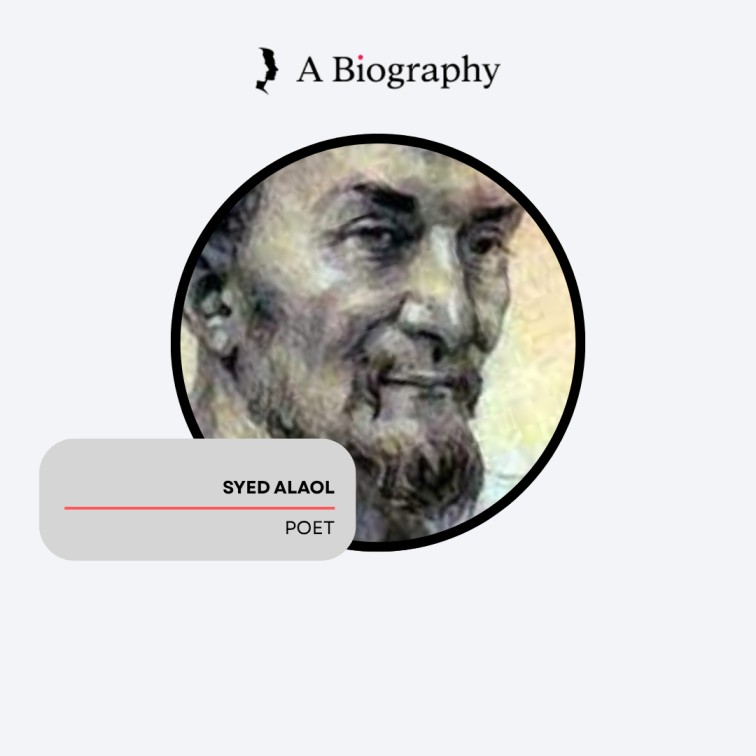
Introduction (1613)
The Padma River glittered under the midday sun, its wide brown expanse stretching to the horizon like a liquid highway. Inside a covered riverboat, a fourteen-year-old boy sat beside his father, clutching a palm-leaf manuscript. His name was Syed Alaol. His world was about to end—and begin again.
Suddenly, dark shapes appeared on the horizon. Portuguese pirate ships—the dreaded “Mag Firingi” who had terrorized Bengal’s waterways for three centuries. Their eyes gleamed with greed, their swords flashed in the sunlight. The boy’s father, Abu Hamid, a high-ranking administrator of Fatehabad, stepped forward to defend his son.
“You stay here,” the father said. “I am here.”
Those were his last words.
The clash of swords. The screams of passengers. The sickening thud of a blade finding flesh. The boy watched his father crumple to the blood-soaked deck. Before he could cry out, rough hands grabbed him, bound his wrists, and threw him into the pirates’ hold.
That boy—Syed Alaol—would survive slavery, exile, imprisonment, and the loss of everything he loved. He would master seven languages, ride horses into battle, study philosophy and music, and produce the most magnificent poetry medieval Bengal ever witnessed. He would become “Shiromoni Alaol”—the Crown Jewel of Bengali literature.
This biography traces the extraordinary journey of a man who transformed suffering into art, whose verses still echo across four centuries, and whose life reads like a thriller written by fate itself.
At a Glance: Life of Syed Alaol (1597–1673)
Before we sail through his remarkable life, here is a portrait of the man who rose from slavery to immortality.
| Aspect | Details |
| Full Name | Syed Alaol (Abu Hamid Syed Alaol) |
| Born | Approximately 1597 |
| Birthplace | Jalalpur, Fatehabad district (modern-day Madaripur, Bangladesh) |
| Died | Approximately 1673 (Arakan, modern-day Myanmar) |
| Father | Maulana Nizamuddin or Abu Hamid (scholarly debate) |
| Mother | Name unknown (died when Alaol was 16) |
| Lineage | Syed family — believed to be descendants of Prophet Muhammad (PBUH) |
| Patron Kings | Thudhamma (1622–1638), Sanda Thudhamma (1652–1684) of Arakan |
| Primary Patron | Magan Thakur (Prime Minister of Arakan, also a poet) |
| Other Patrons | Syed Musa, Sulayman, Muhammad Khan, Majlish Nobaraj |
| Major Works | Padmavati (1648), Sati Mayna Lochanrandani (1659), Saptapaykar (1665), Saifulmuluk Badiuzzamal (1669), Sikandarnama (1671–72), Tohfa (1660), Ragatalanama |
| Languages | Bengali, Persian, Arabic, Sanskrit, Hindi (Awadhi), Brajabuli, Magadhi |
| Areas of Expertise | Poetry, philosophy, music theory, warfare, horse-riding, swordsmanship, navigation, yoga |
| Title | “Shiromoni Alaol” (the Crown Jewel) |
| Religious Beliefs | Sufi Islam with deep respect for Hindu yogic traditions |
| Legacy | Chattogram University’s “Alaol Hall,” Alaol Sahitya Puraskar (literary award), memorial in Madaripur |
Early Life (1597–1610)
The year was 1597. Emperor Akbar had just died; Jahangir was ascending the Mughal throne. But in southeastern Bengal, the Mughals had not yet extended their control. Fatehabad—near present-day Madaripur’s Kalkini region—was a semi-independent territory, sometimes under Arakan’s influence, sometimes ruled by local chieftains.
In the village of Jalalpur, in a respectable Syed family, Alaol was born. His ancestors had migrated from Arabia and settled in Bengal. His father held a high administrative post in Fatehabad—perhaps a subedar or diwan. The family was cultured, religious, and deeply respectful of learning.
Young Alaol was not a bookworm confined to four walls. He studied Arabic script in the village maktab and learned Persian from his father. But he also learned swordsmanship, archery, and horse-riding. His father wanted him to be a complete man—a sword in one hand, a poem on his lips, and unshakeable courage in his heart.
Legend has it that Alaol showed remarkable skill in archery as a child. Village competitions often ended with him claiming the prize. He also learned to swim—an essential skill for those living along the Padma’s shifting channels.
His thirst for knowledge was insatiable. He studied Sanskrit grammar with village scholars, devouring Hindu scriptures and Puranas alongside his Islamic studies. He also encountered Sufi mystics who spoke of divine love—a theme that would later color every verse he wrote.
His mother died when he was sixteen. That wound never fully healed. In “Padmavati,” the heroine’s longing and loss echoes a boy who lost his mother too soon.
Education (1603–1613)
Alaol’s education was unconventional—a blend of formal tutoring and life’s brutal lessons. He learned:
- Arabic: For reading the Quran and Hadith, and understanding Islamic philosophy.
- Persian: The court language of the era, essential for any aspiring intellectual.
- Sanskrit: To access Hindu philosophy, yogic texts, and poetic traditions.
- Hindi (Awadhi): To read Malik Muhammad Jayasi’s “Padmavat,” which he would later translate into Bengali.
- Brajabuli and Magadhi: Local dialects that enriched his linguistic palette.
But books were only half his curriculum. He learned to fight—not as a theoretical exercise but as a survival skill. He learned to navigate rivers, read winds, and understand the sea—knowledge that would serve him well during his travels. He studied music theory, producing later the remarkable “Ragatalanama,” one of the earliest texts on Indian classical music in Bengali.
His real education, however, came from suffering. The loss of his father, the humiliation of slavery, the loneliness of exile—these were his harshest but most effective teachers.
Struggles & Adversities (1613–1620)
The Portuguese pirates who killed Alaol’s father did not kill him. Slavery was more profitable.
He was taken first to Chittagong, where Portuguese traders maintained a bustling slave market. There, he spent months in captivity, surrounded by other kidnapped Bengalis. He learned snippets of Portuguese and observed European customs—details that would occasionally surface in his later poetry.
Around 1614–15, he was transported to Arakan (present-day Rakhine state, Myanmar). The kingdom of Arakan was then prosperous, ruled by Buddhist kings who maintained a Muslim presence at court. Persian was the administrative language. Many Bengali Muslims served as officials, soldiers, and scholars.
Alaol was purchased by a wealthy nobleman and assigned menial tasks at the royal palace in Mrauk U, the capital. He observed silently—the Arakanese culture, language, customs, and court intrigues. He learned Arakanese too, though he never used it in his writings.
These were the darkest years. Fatherless, motherless, enslaved, and far from home. But the poet inside him was not dead. He recited Persian ghazals and Arabic qasidas to himself, composing verses in his head when he had no paper to write on.
Magan Thakur’s Patronage (1620–1630)
One day, the Prime Minister of Arakan, Magan Thakur, overheard Alaol reciting a Persian ghazal. Magan Thakur was not only a politician but also a poet and scholar. He was astonished—a mere slave speaking such refined Persian?
He called Alaol closer, questioned him, and discovered the depths of his learning. Magan Thakur freed him from slavery and brought him into his own circle. This was the turning point.
Under Magan Thakur’s patronage, Alaol blossomed. He was given access to Arakan’s royal library, rich with Persian and Arabic manuscripts. He continued his studies, mastered new texts, and began composing poetry in Bengali—the language of his birth, which he had never abandoned.
Magan Thakur encouraged Alaol to translate Persian and Hindi classics into Bengali, making them accessible to a wider audience. Alaol’s gratitude to his patron never waned. In every major work, he praised Magan Thakur in dedicatory verses:
“Magan Thakur, virtuous, learned, poet—by whose grace this slave writes poetry.”
The Warrior Poet
Alaol was not a poet who only held a pen. He also held a sword.
Under Magan Thakur’s sponsorship, he joined the Arakanese military. He mastered horsemanship, swordsmanship, and naval warfare tactics. He participated in campaigns and understood the psychology of battle from personal experience.
This unique background shaped his poetry. The battle scenes in “Padmavati” are not vague descriptions—they are visceral, realistic, and thrilling. The clang of swords, the roar of war elephants, the desperate last stands—Alaol wrote them as a man who had smelled gunpowder and seen blood.
In his own words, preserved through couplets: “I am both warrior and poet.” Such versatility was rare in medieval Bengali literature, where poets were typically scholars, not soldiers.
Padmavati (1648) – The Masterpiece
In 1648, Alaol completed his magnum opus—”Padmavati.”
The source text was Malik Muhammad Jayasi’s Awadhi epic “Padmavat,” written a century earlier. The story: Princess Padmavati of Sri Lanka, renowned for her breathtaking beauty. King Ratnasen of Chittor hears of her, falls in love through a dream, travels to Sri Lanka, wins her, and brings her home. But Delhi’s Sultan Alauddin Khalji also desires Padmavati. He besieges Chittor. Ratnasen dies in battle. Padmavati and her companions commit jauhar (self-immolation) to preserve their honor.
Jayasi’s version was a Sufi allegory—the soul’s longing for God. Alaol transformed it. He reduced the dense philosophical content, amplified the romance and heroism, and made the language more accessible. The result was a Bengali classic that remains beloved to this day.
What makes “Padmavati” exceptional:
- Narrative pace: Despite its length, it never drags. The emotional arc of separation, longing, union, and tragedy keeps readers engaged.
- Characterization: Padmavati is not a passive beauty. She is courageous, dignified, and sharp-witted.
- Battle descriptions: Written by a warrior, they crackle with authenticity.
- Poetic technique: Alaol’s mastery of payar and tripadi meters creates a musical flow.
- Imagery: Similes and metaphors drawn from nature, warfare, and everyday life enrich every canto.
After “Padmavati,” Alaol was hailed as “Shiromoni”—the Crown Jewel. Scholars across Arakan and Bengal acknowledged his supremacy.
Completing Daulat Qazi’s Unfinished Poem (1659)
Medieval Bengali literature has few stories as touching as this. Daulat Qazi, another Bengali poet in Arakan, had begun a romantic epic titled “Sati Mayna Lochandrondini.” But death claimed him before he could finish it.
Alaol, honoring his predecessor’s memory, completed the work in 1659. He praised Daulat Qazi’s skill and tried to mimic his style in the new sections. The story follows Mayna’s devotion to her beloved Lochandrondini—a theme of loyalty and sacrifice.
This act—a poet finishing another’s unfinished work—was unprecedented in Bengali literature. It demonstrated Alaol’s generosity and respect for his peers.
Saptapaykar (1665) – Seven Stories, Seven Colors
In 1665, Alaol translated Nizami Ganjavi’s Persian classic “Haft Paykar” (Seven Portraits) into Bengali as “Saptapaykar.”
The original tells of the Sassanian king Bahram Gor, who builds seven pavilions, each of a different color, where he hears seven stories from seven princesses. Each story contains a moral lesson.
Translating this complex structure into Bengali was a monumental task. Alaol preserved the frame narrative while adapting the stories for Bengali sensibilities. The result was the first Bengali poem structured as a collection of independent tales linked by a unifying framework—a precursor to modern short story cycles.
Parts of the manuscript have been lost to time, but surviving fragments reveal Alaol’s allegorical brilliance.
Saifulmuluk Badiuzzamal (1669) – The Fairy Tale Epic
Begun at Magan Thakur’s request but interrupted by his death, Alaol completed “Saifulmuluk Badiuzzamal” in 1669 under the patronage of Syed Musa, Arakan’s new prime minister.
The story: Prince Saifulmuluk dreams of Badiuzzamal, a fairy princess. He embarks on an epic quest across seas, deserts, and magical realms, encountering djinns, monsters, and enchanters. True love conquers all.
This is Bengali literature’s closest equivalent to the “Thousand and One Nights.” Alaol unleashes his imagination—flying carpets, magical transformations, fairy kingdoms. Yet within the fantasy, he embeds profound truths about perseverance, faith, and the power of love.
Philosophical Works: Tohfa (1660) & Ragatalanama
Alaol was not only a storyteller but also a philosopher and musicologist.
Tohfa (1660): Written at the request of King Sanda Thudhamma, “Tohfa” means “gift.” It is a compendium of Islamic ethics, Sufi teachings, statecraft, and moral advice for rulers. Alaol discusses justice, compassion, and the duties of a king. He argues that a ruler who does not understand his people’s suffering cannot be a true leader. This work reveals Alaol’s deep engagement with political philosophy.
Ragatalanama: One of the earliest texts on Indian classical music in Bengali. Alaol explains ragas, ragini, talas, performance times, and the spiritual dimensions of music. He draws from both Sanskrit and Persian sources, bridging two great musical traditions. Music, he believed, purifies the soul and brings one closer to God—a distinctly Sufi perspective.
The Death of Magan Thakur (1660)
In 1660, Magan Thakur died. For Alaol, it was like losing his biological father all over again.
He poured his grief into verse:
“Virtuous Magan, the jewel, departed for his heavenly abode. My heart weeps, my eyes cannot see clearly.”
For a time, Alaol stopped writing. But other patrons—Syed Musa, Syed Masud Shah, Majlish Nobaraj—rallied around him, encouraging him to continue. He honored Magan Thakur’s memory in every subsequent work, never forgetting the man who had lifted him from slavery.
Shah Shuja’s Arrival and Political Turmoil (1659–1660)
In 1659, a storm swept into Arakan—not a weather storm but a political one.
Shah Shuja, the Mughal governor of Bengal and son of Emperor Shah Jahan, had lost the war of succession to his brother Aurangzeb. Fleeing for his life, he crossed into Arakan with his family, loyal soldiers, and vast treasure.
King Sanda Thudhamma initially welcomed him as a royal guest. But the treasure and Shuja’s Mughal prestige soon bred suspicion. The Arakanese court, consumed by greed and fear, began conspiring against the refugee prince.
Historians debate what happened next. Some say Shuja was assassinated. Others believe he escaped. What is certain is that the episode created a climate of paranoia and repression in Arakan.
Alaol, fluent in Persian, had interacted with Shuja’s entourage. That was enough to raise suspicion. He was arrested and imprisoned without clear evidence.
Prison Years (1660–1662)
Locked in a dark, damp cell, separated from friends and patrons, Alaol faced his greatest test. He had been physically enslaved before; now his spirit was caged.
But he refused to surrender.
He continued composing mentally, storing verses in his memory. Scholars believe he revised portions of “Saifulmuluk Badiuzzamal” during this time. He also meditated on Sufi philosophy, finding solace in the idea that the soul cannot be chained.
His poetry from this period, though not explicitly preserved, carries a deeper gravity. The theme of imprisonment—literal and metaphorical—appears in his post-1662 works. He understood captivity from within, not just as a literary device.
Around 1662, Syed Masud Shah secured his release. Alaol emerged thinner, older, but unbowed. The prison had not broken him; it had deepened him.
Final Major Work: Sikandarnama (1671–72)
In his final years, Alaol undertook his last monumental project: “Sikandarnama,” based on Nizami’s “Iskandarnama” about Alexander the Great.
Patroned by Majlish Nobaraj, the finance minister of Arakan, Alaol completed this massive epic in 1671–72. He was now in his mid-seventies, physically frail but mentally sharp.
“Sikandarnama” is not merely a war epic. It depicts Alexander as an ideal ruler—just, curious, and compassionate. The first part covers military campaigns; the second explores philosophy, ethics, and the search for wisdom. Through Alexander’s story, Alaol offered a mirror to contemporary rulers, urging them toward justice and humility.
This was his swan song. After “Sikandarnama,” Alaol faded from historical records.
Death and the Lost Grave (1673)
Alaol died around 1673. He was approximately seventy-six years old.
Where did he die? Almost certainly in Arakan. Where was he buried? No one knows for certain. Political turmoil, natural disasters, and the passage of centuries have erased physical traces of his final resting place.
Some believe he was murdered by the paranoid king. Others think he fled into obscurity. A more plausible account suggests he became impoverished, abandoned by a court that had moved on, and died in a village mosque, teaching children to read.
His grave has never been found. But his poetry—that grave cannot be lost.
In Bangladesh, a memorial has been built in Madaripur, near his birthplace. It is a symbol, not a tomb. The real monument is “Padmavati,” “Saptapaykar,” and every verse he left behind.
Why “Shiromoni”? Understanding His Supreme Title
Scholars of medieval Bengal conferred upon Alaol the title “Shiromoni”—the crown jewel, the crest jewel. Why?
- Linguistic mastery: He commanded seven languages with equal ease.
- Breadth of knowledge: He was not just a poet but a warrior, sailor, musician, philosopher, and theologian.
- Creative translation: He did not slavishly copy originals; he reshaped them into new Bengali masterpieces.
- Volume of output: Seven complete epics plus two specialized treatises—an unparalleled corpus in his era.
- Humanism: He transcended religious boundaries, respecting both Islamic Sufism and Hindu yogic traditions.
No other medieval Bengali poet combined all these qualities. Alaol stands alone.
The Art of Creative Translation
Alaol’s genius lay in “creative translation.” He took Persian, Arabic, and Hindi sources but transformed them:
- Localization: He replaced foreign settings with Bengali landscapes, foreign customs with familiar ones.
- Emotional amplification: He heightened romantic and tragic elements, reducing dry philosophy.
- Structural innovation: He shortened Jayasi’s 60-plus cantos to 42, creating a tighter narrative.
- Language enrichment: He introduced Persian and Arabic vocabulary into Bengali, expanding its expressive range.
His meters—payar and tripadi—sing off the page. His similes draw from everyday life: the monsoon clouds, the paddy fields, the flight of herons. His alliterations are subtle, not forced.
For centuries, Bengali poets studied Alaol’s craft. Even Rabindranath Tagore acknowledged his influence.
Philosophical Beliefs
Alaol walked a rare path—devoutly Muslim yet deeply respectful of Hindu traditions.
In “Padmavati,” Princess Padmavati uses yogic powers to cross the ocean. In other works, he invokes both “Allah and Rasul” and “Krishna and Radha.” He wrote:
“Religion is not two, religion is one. Do not harbor hatred toward any living being.”
This was not mere syncretism. It was a profound conviction that multiple paths lead to the same truth. In an era of religious rigidity, Alaol was a voice of tolerance.
His Sufi belief in divine love—ishq—infused his romantic epics. The lover’s longing for the beloved mirrored the soul’s yearning for God.
Contemporary Opinions and Critical Reception
Modern scholars unanimously rank Alaol as medieval Bengal’s greatest poet.
Dr. Muhammad Enamul Haque: “Alaol’s mastery of language and meter is unparalleled in the Muslim period of Bengali literature.”
Humayun Azad: In “Lal Neel Dipaboli,” Azad writes that Alaol introduced Bengali literature to the treasures of Persian and Arabic literature. He was not a translator but a creator.
Dr. Ahmed Sharif: “Alaol’s ‘Padmavati’ is the finest romantic epic in Bengali before the modern era.”
Thibaut d’Hubert (Oxford University): His recent scholarship emphasizes Alaol’s role in Arakan’s multicultural court, positioning him as a truly global poet of the seventeenth century.
Myths and Misconceptions
Myth 1: Alaol was born in Chittagong.
Truth: While some claim Chittagong as his birthplace, most evidence points to Fatehabad (modern Madaripur). The debate continues, but his ancestral roots are clearly in the Bengal delta.
Myth 2: He was only a poet.
Truth: He was a warrior, musician, philosopher, and courtier. His versatility was extraordinary.
Myth 3: His works are mere translations.
Truth: “Creative translation” is a more accurate term. He fundamentally reshaped and improved upon his sources.
Myth 4: He died in poverty and was forgotten.
Truth: While his final years may have been difficult, he was never forgotten. His works continued to be copied and read for centuries.
Famous Quotes and Verses
From “Padmavati”:
“Love awakens in every living heart, but each feels it in their own way.”
“The waves of the Padma still carry my father’s blood in my dreams. The pirates bound my body, but they could not bind my mind.”
From his philosophical writings:
“Do not let your heart wither. Keep it tender. That tenderness is your humanity.”
From “Sikandarnama”:
“A king who does not know his people’s suffering wears a hollow crown.”
Message for the Present Generation
If Alaol could speak to us today, he might say:
“You think you have obstacles? I lost my father to pirates. I was sold as a slave. I was imprisoned without trial. I created my greatest works in chains and captivity. What is your excuse?
Language is your greatest weapon. Learn as many as you can. Read the great traditions—Persian, Arabic, Sanskrit, English. But never forget your mother tongue. That is where your soul lives.
And when suffering comes—as it will—do not waste it. Transform it into art, into wisdom, into compassion. That is how you become immortal.”
Legacy and Long-Term Influence
Alaol’s shadow falls across four centuries of Bengali literature:
- Chattogram University’s “Alaol Hall” stands as a monument to his memory.
- The Alaol Sahitya Puraskar (Alaol Literary Award) is one of Bangladesh’s most prestigious literary honors.
- Memorials in Madaripur honor his birthplace.
- Countless scholarly works continue to analyze his poetry.
- Modern translations of “Padmavati” into English and other languages have introduced him to global audiences.
Bangladesh has produced many poets, but only one “Shiromoni.” Alaol remains the peak of medieval Bengali literary achievement.
Unknown Facts
- He never used Arakanese in his poetry, though he learned the language during his captivity.
- The number of languages he mastered is debated—some claim seven, others nine, including Portuguese.
- Some of his manuscripts remain undiscovered; scholars believe more works may surface in Myanmar’s monastic libraries.
- He never returned to Bengal, though he wrote about it frequently with nostalgic longing.
- The exact location of his grave remains unknown despite repeated searches.
- His “Ragatalanama” remains partially unpublished; complete critical editions are still being prepared.
- He may have been a calligrapher; some surviving manuscripts show distinctive handwriting attributed to him.
Key Events in Syed Alaol’s Life
| Year | Event |
| 1597 | Born in Fatehabad (likely Jalalpur, Madaripur) |
| 1613 | Portuguese pirates kill his father; Alaol is enslaved |
| 1614–15 | Sold and transported to Arakan |
| 1620s | Freed by Magan Thakur; begins court career |
| 1648 | Completes “Padmavati” |
| 1659 | Completes Daulat Qazi’s unfinished poem |
| 1660 | Magan Thakur dies; Alaol writes “Tohfa” |
| 1660–62 | Imprisoned following Shah Shuja incident |
| 1665 | Completes “Saptapaykar” |
| 1669 | Completes “Saifulmuluk Badiuzzamal” |
| 1671–72 | Completes “Sikandarnama” |
| 1673 | Dies in Arakan (approximate) |
Conclusion
Syed Alaol’s life reads like a novel no fiction writer could invent. Captured by pirates, sold into slavery, transported to a foreign land—yet rising to become the greatest poet of his age. A man who held both pen and sword, who recited Persian ghazals and composed Bengali epics, who studied Hindu yoga and preached Sufi love.
The Portuguese pirates who murdered his father thought they had erased him. Instead, they unleashed a force that would shape Bengali literature for centuries.
Alaol proved that physical chains cannot imprison the creative spirit. He proved that tragedy, transmuted into art, becomes eternal. He proved that a boy from a riverside village could master seven languages and converse with the greatest minds of Asia.
Today, we do not know where he was buried. But we do not need a grave. “Padmavati” is his shrine. “Saptapaykar” is his epitaph. “Sikandarnama” is his monument.
The Padma still flows. The words of Alaol still echo. And as long as Bengali is spoken, the Crown Jewel will never lose its luster.
“The waves of the Padma still carry my father’s blood in my dreams. The pirates bound my body, but they could not bind my mind. That mind, today, is Bengali literature’s eternal treasure.”
— Syed Alaol (poetic interpretation)
References
- Banglapedia (Second Edition) – Syed Alaol entry, Asiatic Society of Bangladesh, 2012
- Wikipedia – Alaol article and references
- Humayun Azad, Lal Neel Dipabali or Bangla Sahityer Jiboni (Bangla Academy, 2013)
- Dr. Muhammad Enamul Haque, Bangla Sahityer Itihas (Muslim Period), 1955
- Dr. Ahmed Sharif, Madhyajuger Bangla Sahitya
- Thibaut d’Hubert, In the Shade of the Golden Palace: Ālāol and Middle Bengali Poetics in Arakan (Oxford University Press, 2018)
- Alaol Rachanabali (edited by Muhammad Abdul Hai and Anisuzzaman), Bangla Academy
- Padmavati manuscripts (preserved by Bangla Academy and Asiatic Society)
- Daily Prothom Alo and Daily Jugantor – special issues on Alaol (1997, 2017)
- Muntassir Mamoon, Alaol: Jibon O Sahitya (Bangla Academy, 2007)
- Abu Ishaque, Madhyajuger Bangla Kabbe Alaoler Obadan (World Literature Centre, 2005)
- Chattogram University Alaol Hall commemorative volume, 2010
- Arakan Research Journal (Myanmar) – “Alaol and Arakanese Court,” Vol. 5, 2015
Disclaimer
This biography is based on reliable sources including Banglapedia, Wikipedia, academic research, and historical texts. Some narrative elements—such as internal thoughts, emotional descriptions, and dramatic reconstructions of events—have been added for storytelling purposes. The opening quote is a poetic reconstruction based on Alaol’s known life philosophy, not a verbatim historical record. These creative additions do not alter the factual accuracy of the events described. Scholarly debates about Alaol’s birthplace, father’s name, and certain manuscript attributions are acknowledged in the relevant sections. This biography aims to honor and illuminate the life of a monumental figure in Bengali literature. Any errors are unintentional and will be corrected in future editions upon notification.
“Do not let your heart wither. Keep it tender. That tenderness is your humanity.”
— Syed Alaol (interpretation from his works)

