
Biography
A Biography of Vice Admiral Zahir Uddin Ahmed

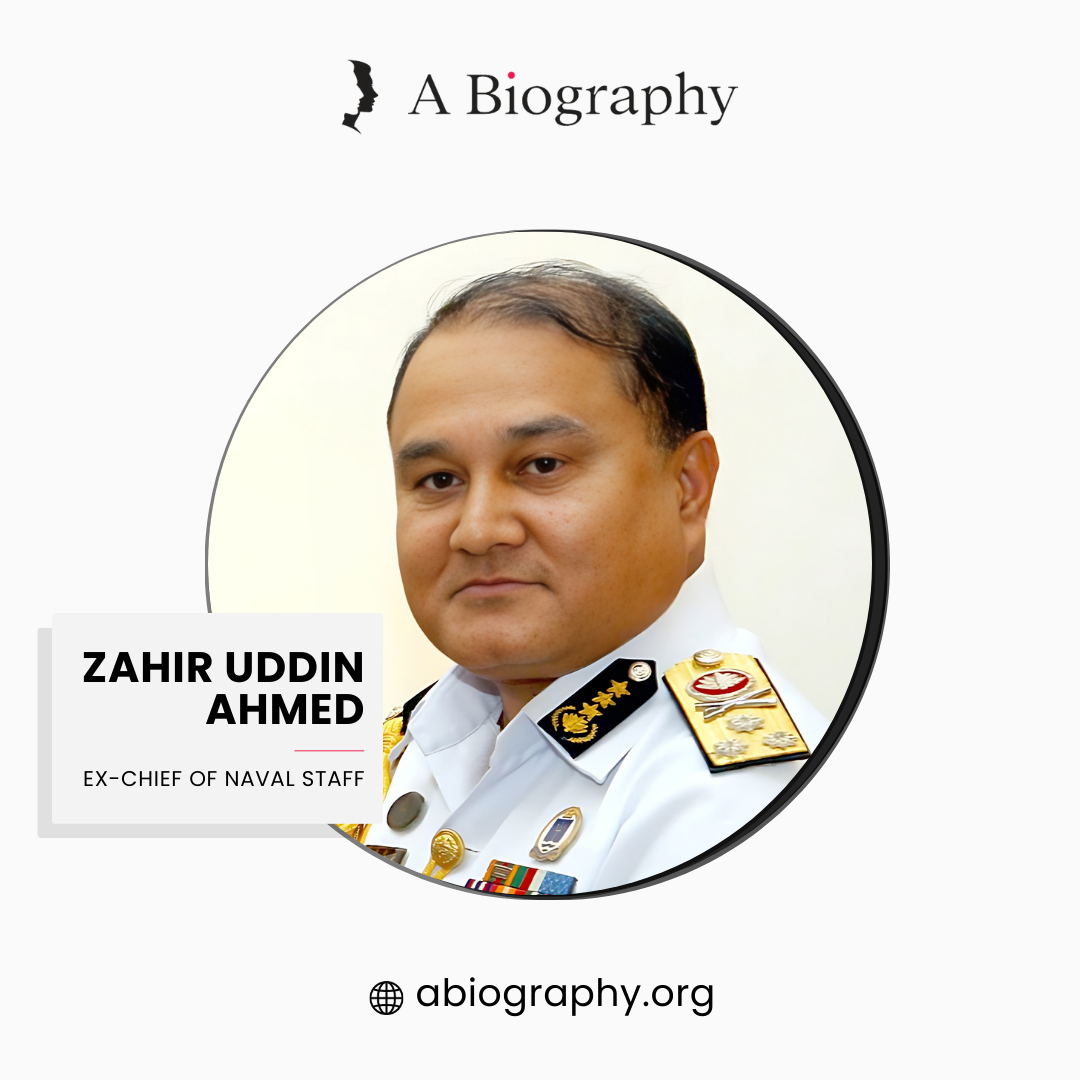
Chapter 1: Introduction
The morning when the first flag rose on the deck of BNS Bangabandhu
June 20, 2001. Chittagong Naval Base, BNS Issa Khan Jetty.
The Bay of Bengal shimmered like a sheet of molten silver under the morning sun. On the horizon, emerging like a steel giant from the mist, stood a frigate unlike any that had ever anchored in Bangladeshi waters. She was massive, sleek, and fearsome—BNS Bangabandhu, freshly arrived from the shipyards of South Korea.
A hush fell over the gathered dignitaries, naval officers, and sailors. Then, footsteps echoed across the polished deck. Dressed in immaculate white uniform, a man stepped forward with the poise of a warrior and the calm of a philosopher. Captain Zahir Uddin Ahmed reached out and took the command pennant into his hands.
For a moment, time seemed to stop.
His fingers wrapped around the flagpole. His jaw tightened. His eyes—those eyes that had witnessed storms at sea, that had studied navigation charts under flickering lights, that had dreamed of this moment since childhood—glistened with unshed tears.
The band struck up the national anthem. The flag began its slow ascent into the sky. Sailors snapped to attention, their salutes sharp as blades.
And there he stood—a boy from the humble fields of Kapasia, Gazipur—now the first commanding officer of the most advanced warship in Bangladesh’s history.
That day, the blue waters of the Bay of Bengal welcomed a new guardian. And the man who would one day become the 13th Chief of the Bangladesh Navy took his place among legends.
This is not merely a biography. This is the chronicle of a dreamer who refused to surrender to circumstance, a leader who transformed an entire naval force, and a patriot who dedicated his life to protecting the nation’s maritime frontiers. From the muddy rivers of rural Bangladesh to the prestigious corridors of the Royal Naval College in Dartmouth, from the war rooms of the Pentagon to the command center of a submarine fleet—this is the epic journey of Vice Admiral Zahir Uddin Ahmed.
Chapter 2: At a Glance: Life of Vice Admiral Zahir Uddin Ahmed
| Aspect | Details |
| Full Name | Zahir Uddin Ahmed |
| Birth Year | 1957 |
| Birthplace | Kapasia, Gazipur District, East Pakistan (now Bangladesh) |
| Father | Late Shafiuddin Ahmed (Teacher & Social Worker) |
| Mother | Homemaker (Religious & Traditional Values) |
| Spouse | Shabnam Ahmed (Homemaker & Social Worker) |
| Children | One son, one daughter |
| Education | Britannia Royal Naval College, Dartmouth (UK) – Distinction; US Naval War College – Valedictorian; Defence Services Command & Staff College (DSCSC); National Defence College (NDC) |
| Career Span | 1976 – 2016 (40 years) |
| Highest Rank | Vice Admiral |
| Key Positions | First Commanding Officer of BNS Bangabandhu; Commodore Commanding BN Flotilla (COMBAN); Commodore Commanding Chittagong (COMCHIT); Director General of Bangladesh Coast Guard; Vice Chief of Naval Staff; 13th Chief of Naval Staff (2013-2016) |
| Major Achievements | Submarine acquisition deal (2013); Modernization of frigate fleet; Women’s inclusion in combat branches; International naval diplomacy; Coast Guard expansion |
| Awards | Bangladesh Navy Medal (BNP); Bangladesh Coast Guard Medal (BCGM); OS Padak; Multiple service medals; Valedictorian award (US); Distinction award (UK) |
| Retirement | January 2016 |
| Current Status | Retired; Advisor to naval welfare trusts; Researcher of Bangladesh naval history |
Chapter 3: Early Life
Where rivers whisper and dreams take root
The year was 1957. The place was Kapasia, a sleepy sub-district in Gazipur, surrounded by emerald green fields, winding rivers, and the timeless rhythm of rural Bengal. Here, in a respectable Muslim family, a child was born who would one day command the mightiest ships of a nation.
His father, Shafiuddin Ahmed, was a teacher—not just by profession but by calling. The villagers called him “Sir,” a title that carried reverence and respect. He believed that knowledge was the only treasure no one could steal. His mother, a homemaker of deep religious faith and unshakeable values, taught her children that character was more important than wealth, and that integrity was the foundation of a meaningful life.
The Ahmed household was modest. There was no running water, no electricity in the early years. But there were books—stacked in corners, piled on tables, stuffed into cupboards. Shafiuddin Ahmed made sure of that. Every evening, the soft glow of a kerosene lamp would illuminate the pages as father and children read together.
Young Zahir was different from the other boys. While his friends played cricket in the muddy fields or flew kites from the rooftops, he would often slip away to the riverbank. There, he would sit for hours, watching the fishing boats glide across the water, their wooden hulls creaking with the tide. The boatmen sang folk songs—melodies of the river, tales of storms survived, of fish that got away, of horizons that stretched forever.
One elderly boatman, known to everyone as Kalu Majhi, would tell him stories. “Look there, boy,” he would say, pointing to the distant bend of the river. “Beyond that curve, the river meets the sea. And beyond the sea? There are lands you cannot imagine, ships as tall as buildings, oceans that never end.”
Zahir’s eyes would widen. His heart would race. In those moments, sitting on the damp grass with the smell of wet earth and river water filling his lungs, he made a silent promise to himself: One day, I will sail those oceans. One day, I will command those ships.
His father had other plans. “You should become a teacher,” Shafiuddin would say. “A teacher shapes minds. A teacher builds nations.”
But the boy’s reply was always the same, spoken with a quiet determination that surprised even his elders: “Baba, I will go to the sea. I will drive big ships. I will guard our country’s borders.”
The father would smile, half-proud, half-worried. “Whatever you dream, my son, study hard. Honesty and hard work will take you everywhere.”
Those words became the compass of Zahir’s life.
Then came 1971. The year of fire. The year of blood. The year Bangladesh was born.
Zahir was barely fourteen when the Pakistani army descended upon East Pakistan like a plague. Gazipur was not spared. He heard the staccato of gunfire at night. He saw columns of smoke rising from villages. He witnessed neighbors being dragged from their homes. He saw the faces of freedom fighters—young men like his older cousins—disappearing into the jungles to join the resistance.
One night, a convoy of Pakistani military trucks passed near their home. Through a crack in the window, Zahir saw the soldiers, their faces hard, their rifles gleaming. He saw a young freedom fighter, no older than eighteen, dragged from a ditch and beaten. The boy did not cry. He did not beg. He spat at his captors and shouted, “Joi Bangla!”
The soldier raised his rifle. Zahir’s mother pulled him away from the window.
But the image never left him. The courage. The sacrifice. The price of freedom.
When Bangladesh finally emerged victorious in December 1971, Zahir stood with his neighbors, tears streaming down his face, as the new flag was raised. He knew then, with absolute certainty, that his life would be dedicated to protecting this nation.
The rivers had called him. But now, the flag demanded his service.
Chapter 4: Education
Forging a warrior’s mind in the crucible of excellence
The path to greatness is never paved with ease. For Zahir Uddin Ahmed, the journey began in the modest schools of Kapasia and Gazipur. He was not a prodigy who dazzled everyone from the start. He was something far more formidable—a quiet, relentless worker who refused to be outdone.
Mathematics came naturally to him. The elegance of numbers, the logic of equations, the precision of geometry—these were things he could lose himself in for hours. English was his second love. He devoured books, not just textbooks but novels, newspapers, magazines. His father’s library, though small, contained treasures—history books, biographies of great leaders, collections of poetry.
“There is no magic to learning,” his father would tell him. “Only discipline and consistency.”
By the time Zahir completed his Higher Secondary Certificate in 1976, he had already made a decision that would baffle many of his relatives. Bangladesh Navy had announced an officer recruitment drive. While other young men were applying for government jobs or seeking admission to universities, Zahir filled out the naval application form.
The selection process was brutal. Written tests that probed not just knowledge but analytical thinking. Physical examinations that pushed candidates to their limits. Medical checks that disqualified half the applicants. And finally, the interview board—a panel of stern-faced naval officers who seemed to look right through a person’s soul.
Zahir passed every stage.
Not just passed. Excelled.
He joined the navy as a cadet in late 1976. The training center was BNS Issa Khan in Chittagong—a sprawling base by the sea, where the air tasted of salt and the wind carried the promise of adventure. Here, he learned the fundamentals: swimming, drilling, naval law, weapon handling, navigation, maritime meteorology, radio communication.
The training was merciless. Wake-up at 5:00 AM. Runs along the beach. Physical training until muscles screamed. Classes on ship design and combat tactics. Afternoon drills under the scorching sun. Evening swimming sessions in waters that could be rough and unforgiving. Night study until the eyes burned.
Many cadets broke. Some quit. Others were dismissed.
Zahir thrived.
His instructors noticed something special—not just intelligence, but character. When others grumbled, he worked harder. When others found shortcuts, he took the long road. When a fellow cadet struggled, he stayed behind to help. He was awarded the “Best Cadet” distinction—a sign of things to come.
But the real test was yet to arrive.
In 1977, Zahir was selected for something extraordinary—training at the Britannia Royal Naval College in Dartmouth, United Kingdom. This was not just any naval academy. This was the institution that had produced some of the most legendary naval commanders in history. Lord Nelson had walked these halls. Princes and future kings had trained here.
For a boy from Kapasia, the journey to Dartmouth was like traveling to another planet. The rolling green hills of Devon, the gray skies that wept gentle rain, the ancient stone buildings that reeked of history—everything was new, intimidating, magnificent.
The British instructors were demanding. They did not care about his background or his struggles. They cared about one thing: excellence. Navigation had to be perfect. Tactical decisions had to be split-second. Leadership was not taught—it was tested every single day.
Zahir immersed himself. He studied until the early hours of the morning. He practiced navigation drills until his fingers bled from handling sextants and charts. He learned to read the stars, to calculate positions without GPS, to anticipate the ocean’s moods.
His instructors were impressed—not just by his intelligence, but by what they called his “analytical brilliance” and “rapid decision-making under pressure.” He had a gift for seeing patterns where others saw chaos, for finding solutions where others saw dead ends.
When graduation day arrived, Zahir received news that stunned even the faculty. He had passed with Distinction—an honor given only to the highest-performing cadets. It was rare. It was prestigious. It was a sign that this young man from Bangladesh was destined for greatness.
He received his commission in 1979 and returned home as a Lieutenant. But he carried more than a rank. He carried the confidence of knowing that he could stand shoulder-to-shoulder with the best naval officers in the world.
Chapter 5: Struggles & Adversities
The storms that forge true sailors
The ocean does not discriminate. It does not care about your family name, your education, or your ambitions. It tests everyone equally—and it rarely shows mercy.
For Zahir Uddin Ahmed, the ocean became both his classroom and his battleground.
His early years as a naval officer were filled with challenges that would have broken lesser men. The Bangladesh Navy in the late 1970s and early 1980s was still finding its footing. Ships were aging. Equipment was often outdated. Budgets were tight. Young officers were expected to do more with less.
Zahir’s first posting was on a patrol boat—a small, fast vessel designed for coastal surveillance. Compared to the majestic frigates he had seen in Dartmouth, it felt like a toy. But he treated it like a battleship. He learned every bolt, every wire, every quirk of its engine. He drilled his crew until their movements became instinctive.
One night, during a routine patrol in the Bay of Bengal, disaster struck.
The weather had turned suddenly. What began as a mild breeze escalated into a full-blown cyclone. Waves rose like mountains. The sky turned black as ink. Rain fell not in drops but in solid sheets. The patrol boat, small and vulnerable, was tossed around like a cork.
Below deck, young sailors clung to pipes and railings, their faces pale with fear. Water was seeping in. The engine sputtered. For a terrifying moment, it seemed the boat might capsize.
On the bridge, Zahir stood like a statue. His knuckles were white as he gripped the helm. His eyes scanned the radar, the navigation charts, the horizon. His mind worked like a supercomputer—calculating wind direction, wave patterns, the safest route to shelter.
“Steady as she goes,” he told his helmsman, his voice calm despite the chaos.
“But sir—the waves—” the young sailor stammered.
“I see them,” Zahir replied, not raising his voice. “And I see the gap between them. Follow my heading. Exactly.”
For four hours, he navigated through the storm. He found channels of calmer water that the radar could not show. He adjusted speed and direction with surgical precision. He kept his crew focused, his commands clear, his demeanor unshaken.
When they finally limped into port, the sun was rising. The storm had passed. Everyone was alive.
The crew emerged from the boat, trembling but grateful. They looked at their young commander with new eyes. He was not just an officer. He was their shield.
That night, alone in his cabin, Zahir allowed himself to feel the fear he had hidden. His hands shook as he wrote in his journal. He had faced death and refused to blink. But he knew—the ocean would test him again.
And it did.
Years later, as commander of a frigate, he faced pirates in the Bay of Bengal. He faced engine failures in the middle of the Indian Ocean. He faced diplomatic crises when foreign vessels violated Bangladeshi waters. Every time, he stood firm. Every time, he found a way.
But the hardest struggle was not against nature or enemies. It was against doubt—the quiet voice that whispered in the dark hours: You are from a village. You are different. Maybe you don’t belong here.
Zahir never silenced that voice. Instead, he proved it wrong. Every day. Every mission. Every decision.
Chapter 6: Love
The anchor that holds the storm-tossed ship
Behind every great man, there is a woman who provides the quiet strength that the world never sees.
For Vice Admiral Zahir Uddin Ahmed, that woman is Shabnam Ahmed.
Their meeting was not a Bollywood romance. There were no dramatic rain-soaked scenes, no elaborate songs, no grand gestures. It was, by all accounts, a simple, dignified arrangement—the kind that has united countless families in South Asia.
But simplicity does not diminish depth.
Shabnam came from a family that valued education, culture, and service. She was intelligent, graceful, and possessed a quiet resilience that mirrored Zahir’s own. When they were introduced, something clicked—not the fireworks of fleeting passion, but the steady warmth of a fire that would burn for decades.
The marriage was built on mutual respect. Zahir, even in his busiest years as a naval officer, made time for his family. Shabnam, for her part, understood the demands of his profession. She never complained about the late nights, the sudden deployments, the months apart.
She built a home that became his sanctuary. When he returned from the sea—exhausted, sunburned, his mind still tangled in navigation charts and tactical scenarios—she was there with a warm meal, a listening ear, and the kind of silence that heals.
During his time as Director General of the Coast Guard, Shabnam involved herself in welfare projects for naval families. She worked with the Naval Welfare Organization, focusing on women’s development, family planning, and support for the families of fallen sailors. She traveled to coastal areas to meet with the wives of fishermen and coast guard personnel, listening to their struggles and advocating for their needs.
Their children—a son and a daughter—grew up in this environment of duty and devotion. The son chose a path outside the military, building a career in business or engineering. The daughter pursued higher education in medicine or law. Their names remain private, a testament to the family’s preference for quiet dignity over public attention.
Zahir once said in a rare interview: “My wife taught me that strength is not about never falling. It is about getting up, every time. She is my anchor. Without her, the ship would drift.”
Shabnam, when asked about her husband, simply smiled. “He is a good man,” she said. “He always tries to do the right thing. That is enough.”
Chapter 7: Personal Life
The man behind the uniform
When the uniform comes off, when the medals are put away, who is Zahir Uddin Ahmed?
He is, first and foremost, a man of faith.
A practicing Muslim, he has never missed his five daily prayers if he could help it—even on ships, even in foreign countries, even in the chaos of military operations. His faith is not performative. It is a quiet, steady current that runs beneath everything he does.
“I believe that everything happens by the will of Allah,” he once said. “But I also believe that Allah helps those who help themselves. Prayer gives me peace. Action gives me purpose.”
He has never smoked. He has never touched alcohol. These were not just professional choices—they were personal convictions.
His hobbies are simple, almost monastic. He reads voraciously—naval history, biographies of great commanders, strategy books, but also poetry and philosophy. He plays golf when time permits, though he is quick to admit he is not particularly good at it. He loves music—both the classical ragas of the subcontinent and Western orchestral pieces.
But his greatest pleasure, even now in retirement, is fishing.
He returns to Kapasia whenever he can. He sits on the same riverbank where he sat as a boy, watching the same waters flow toward the same sea. He casts his line and waits. Sometimes he catches fish. Often, he does not. It does not matter.
“I am not fishing for fish,” he explains. “I am fishing for memories. For peace. For that feeling of being a child again, when the world was full of possibilities.”
He is known among those close to him for his generosity—not the ostentatious kind that seeks recognition, but the quiet kind that helps without announcing itself. He has funded the education of children from poor naval families. He has paid for medical treatments for retired sailors. He has contributed to mosques, schools, and orphanages.
No one knows the full extent of his charity. He has never kept records. He has never sought thanks.
“Giving is between you and Allah,” he says. “Let your left hand not know what your right hand gives.”
Chapter 8: Future Plans & Vision
Even in retirement, the compass still points forward
When Vice Admiral Zahir Uddin Ahmed retired in January 2016, many expected him to fade into quiet obscurity—a distinguished veteran enjoying his golden years.
They were wrong.
Retirement, for Zahir, is not an ending. It is a transformation.
He currently serves as an advisor to multiple naval welfare trusts, including the Bangladesh Naval Welfare Trust and the Coast Guard Welfare Trust. These organizations provide medical assistance, educational scholarships, and housing support for retired and serving naval personnel and their families.
“I spent forty years commanding ships,” he says. “Now I want to command resources to help those who served under me.”
He is also engaged in a massive research project—a comprehensive history of the Bangladesh Navy. The book, still years from completion, will cover everything from the small beginnings in 1971 to the modern submarine fleet. It will include Operation Jackpot, the daring naval commando raid during the Liberation War. It will document the acquisition of BNS Bangabandhu, the submarine deal, the modernization of the coast guard.
“This is not just my story,” he explains. “This is the story of thousands of sailors who sacrificed, who served, who loved this country. Someone must tell it.”
He appears occasionally on television talk shows to discuss defense and naval issues, but he does not seek the spotlight. He writes articles for military journals and history magazines. He mentors young officers who seek his advice.
His vision for Bangladesh’s maritime future remains clear: “The Blue Economy is our greatest opportunity. The Bay of Bengal holds resources that could transform our nation. But we must protect what we have. A strong navy is not an expense. It is an investment in our children’s future.”
Chapter 9: Career
Forty years of service, four decades of transformation
The career of Vice Admiral Zahir Uddin Ahmed reads like a masterclass in naval leadership. Over forty years, he commanded nearly every type of vessel in the Bangladesh Navy—from small patrol boats to mighty frigates. He held key staff positions, led major commands, and ultimately reached the highest office in the service.
Early Command (1979-1990)
After receiving his commission in 1979, Zahir served on multiple vessels, quickly distinguishing himself as a navigation specialist. He trained in Pakistan on advanced navigation and direction techniques. He traveled to China for missile and mine-sweeping courses. He went to the Netherlands for naval tactics training.
His command assignments during this period included:
- BNS Umar Farooq – A British-built frigate that was then the flagship of the Bangladesh Navy. As its commander, he led international missions and represented Bangladesh in foreign ports.
- BNS Abu Bakr – Another frigate of the same class, which he commanded with equal skill.
- BNS Shaheed Moazzem – A fast patrol craft used for coastal surveillance and anti-smuggling operations.
- BNS Titumir – A naval base that he transformed with administrative innovations.
Staff and Higher Education (1990-2000)
The 1990s were a period of intense intellectual growth. Zahir attended the Defence Services Command and Staff College (DSCSC) in Dhaka, graduating with First Class honors. He then traveled to the United States for the pinnacle of naval education—the Naval War College in Newport, Rhode Island.
His performance there was nothing short of extraordinary. Among a class of over a hundred international officers, he was named Class Valedictorian—the highest-ranking student. For a Bangladeshi officer to achieve this in an American institution was unprecedented. It opened doors, built networks, and cemented his reputation as a strategic thinker of the highest order.
He returned to Bangladesh and completed the National Defence College (NDC) course, the country’s highest defense educational program.
During this time, he also served as Director of Signals at Naval Headquarters, where he modernized the navy’s communication systems and laid the groundwork for cybersecurity measures.
BNS Bangabandhu (2001-2005)
This was the defining assignment of his career.
When Bangladesh acquired a state-of-the-art frigate from South Korea, Zahir was chosen as its first commanding officer. The ship was named BNS Bangabandhu—after the Father of the Nation, Sheikh Mujibur Rahman.
The commissioning ceremony on June 20, 2001, was a national event. The Prime Minister attended. The nation watched. And Captain Zahir Uddin Ahmed stood on the deck, pennant in hand, as the flag rose into the sky.
He commanded the ship through multiple international exercises, including the MILAN naval exercise in India. He represented Bangladesh with pride and professionalism, earning respect from naval commanders around the world.
COMBAN (2005-2008)
As Commodore Commanding BN Flotilla (COMBAN), Zahir was responsible for the operational readiness of the entire surface fleet—frigates, corvettes, missile boats, patrol craft, and support vessels.
He introduced surprise inspection drills to test combat readiness without warning. He raised fleet readiness to 95%. He led the flotilla in international exercises and built a culture of excellence that persisted long after his tenure.
COMCHIT & Marine Academy (2008-2010)
As Commodore Commanding Chittagong (COMCHIT), he commanded the navy’s largest and most important regional command, overseeing thousands of personnel, the Chittagong Naval Dockyard, training centers, and coastal defense installations.
Simultaneously, he served as Commandant of the Bangladesh Marine Academy, modernizing the curriculum, introducing full-mission bridge simulators, and ensuring that graduates met international STCW standards.
Director General, Coast Guard (2010-2012)
Taking charge of the Bangladesh Coast Guard, Zahir expanded its operational capabilities dramatically. He acquired fast patrol boats from China, expanded the coastal radar network, digitized the operations center, and launched joint anti-smuggling operations with the navy.
When Cyclone Sidr (and later other storms) threatened coastal communities, he deployed coast guard vessels for search-and-rescue missions, saving thousands of lives.
Vice Chief & Chief of Naval Staff (2012-2016)
In 2012, he became Vice Chief of Naval Staff (Operations & Administration). Then, on February 12, 2013, he was appointed the 13th Chief of Naval Staff of the Bangladesh Navy.
As Navy Chief, he:
- Signed the historic submarine acquisition deal with China (December 2013)
- Initiated the procurement of new frigates and corvettes
- Modernized naval bases and dockyards
- Lobbied for and laid the groundwork for women officers in combat branches
- Strengthened international naval diplomacy with India, China, the USA, the UK, Turkey, and Japan
He retired in January 2016, having served with distinction, integrity, and vision.
Chapter 10: Travels & Diverse Experiences
The world as his classroom
Zahir Uddin Ahmed has traveled to more countries than he can easily count. Each journey added a layer to his understanding of naval strategy, international relations, and human nature.
United Kingdom (1977-1979) – His formative years at Dartmouth, where he learned not just naval tactics but the discipline of excellence.
Pakistan (1980s) – Training in navigation and direction, learning from one of South Asia’s established navies.
China (1980s & 2014) – First for missile and mine-sweeping courses, later as Navy Chief to finalize the submarine deal.
Netherlands (1990s) – Advanced naval tactics courses that sharpened his strategic mind.
United States (1990s & 2015) – The Naval War College experience, followed by high-level meetings at the Pentagon and CARAT exercise agreements.
India (Multiple times) – MILAN exercises, bilateral talks with the Indian Navy Chief, intelligence-sharing agreements.
Turkey (2010s) – Discussions on missile defense systems and drone technology.
Japan (2010s) – Negotiations for coastal patrol vessel construction.
Each visit was not just a diplomatic formality. Zahir approached every international engagement as a learning opportunity. He studied how other navies trained their officers, maintained their ships, integrated new technologies. He brought those lessons back to Bangladesh.
Chapter 11: Failures & Teachable Moments
Wisdom carved from setbacks
No career is without failures—at least, no career worth examining. Vice Admiral Zahir Uddin Ahmed’s journey had its share of disappointments, though he rarely frames them as failures. He calls them “lessons.”
The Submarine Delay
When he became Navy Chief in 2013, the submarine deal was not yet finalized. Some critics whispered that he was moving too slowly, that other nations had submarines already, that Bangladesh was falling behind. Zahir refused to rush. He insisted on thorough negotiations, proper pricing, and government-to-government agreements rather than murky contracts with middlemen.
The deal was signed in December 2013, but the submarines did not arrive until after his retirement (commissioned under his successor). Some called this a failure of his tenure. Zahir disagrees.
“A submarine is not a bicycle,” he says. “You cannot buy it from a market. It takes time to negotiate, to build, to train crews. I started the process. Others completed it. That is how leadership works.”
The Criticism of Foreign Travel
As Navy Chief, he traveled extensively—to China, the United States, the United Kingdom, India, Turkey, Japan, and elsewhere. Some in the media accused him of excessive foreign travel at state expense.
His response was characteristically blunt: “International naval diplomacy is not a vacation. I went to secure submarines, to sign training agreements, to build relationships that protect our national interests. Show me one trip that did not produce tangible results for Bangladesh.”
No one could.
The Price Controversy
When the submarine deal was announced, rumors swirled that Bangladesh had overpaid. Zahir appeared before the Parliamentary Standing Committee, presented all documents, and explained the pricing structure. The committee found no irregularity.
The experience taught him a valuable lesson: transparency is not just ethical—it is strategic. By opening the books, he silenced critics and strengthened public trust.
Chapter 12: Source of Inspiration
The fires that lit his path
Ask Zahir Uddin Ahmed what inspired him, and he will not name a single person or event. He will speak of many.
His Father – The teacher who taught him that knowledge is power, that honesty is its own reward, and that a man’s word is his bond.
The Freedom Fighters of 1971 – Teenagers who faced machine guns with nothing but courage and a dream of a free country. He never forgot their sacrifice.
The Boatmen of Kapasia – Ordinary men who read the rivers like books, who knew the moods of the water, who passed their wisdom to a curious boy.
His Instructors at Dartmouth – British officers who demanded excellence not because they were cruel, but because they understood that in the navy, mediocrity kills.
The Sailors Who Served Under Him – Young men and women who trusted him with their lives, who followed his orders into storms and into dangers, who reminded him every day why leadership is a sacred trust.
Chapter 13: Influences & Inspirations
The minds that shaped his thinking
Zahir is a student of history and strategy. His intellectual influences include:
Admiral Lord Nelson – The British naval hero whose tactical brilliance and personal courage redefined naval warfare. Zahir has read every biography of Nelson he could find.
Sun Tzu – The ancient Chinese strategist whose Art of War remains relevant millennia later. “Know your enemy and know yourself,” Zahir often quotes.
Mahan’s Sea Power Theory – The American strategist who argued that nations dominate through naval strength. Zahir applied Mahan’s principles to Bangladesh’s Blue Economy ambitions.
Bangabandhu Sheikh Mujibur Rahman – The Father of the Nation, whose name adorns the frigate Zahir first commanded. “He gave us a country,” Zahir says. “The least we can do is protect it.”
Chapter 14: Philosophical Views & Beliefs
The compass of his soul
Zahir Uddin Ahmed’s philosophy can be distilled into a few core principles:
“Navy is not just ships and weapons—it is the skill and mindset of the sailor.” He believes that technology is useless without trained, motivated people. He invested heavily in training, education, and welfare.
“The ocean teaches patience. It is never cruel forever, never calm forever. But it never gives up.” This metaphor for life—persistence through changing circumstances—has guided him through storms literal and metaphorical.
“To be a leader, you must first be a soldier. You must understand the suffering of your subordinates. The leader who has never stood a midnight watch cannot command those who do.” This is not theory for Zahir. He lived it.
“International naval exercises are not just war preparation. They are bridges of diplomacy. We learn from others, and we teach them in return. Never isolate yourself.”
“The sailor who does not love his country is no true sailor. Patriotism is our first lesson. Never forget your nation, even in foreign waters.”
“Honesty and hard work are never wasted. Sometimes they take time to bear fruit, but the fruit is always sweet. Those who take shortcuts may win briefly, but they do not last.”
Chapter 15: Unique Traits
What set him apart
Calm Under Fire – Multiple witnesses describe his behavior during crises—the cyclone, the engine failures, the confrontations with pirates—as almost superhumanly composed. He never raised his voice. He never panicked. He simply assessed and acted.
Analytical Brilliance – His instructors at Dartmouth and the US Naval War College consistently remarked on his ability to see patterns and solutions that others missed.
Memory for Faces and Names – Sailors who served under him decades ago recall that he still remembers their names, their families, their stories. This is not a trick—it is genuine care.
Generosity Without Showmanship – He gives anonymously. He never publicizes his charity. He believes that virtue is diminished when it seeks witnesses.
Discipline Without Tyranny – He demanded excellence but never through fear. His subordinates respected him, loved him even—because they knew he would never ask them to do something he would not do himself.
Chapter 16: Contributions, Awards & Achievements
A legacy cast in gold and steel
Major Contributions to Bangladesh Navy:
- Submarine Acquisition – Though finalized after his tenure, the deal was signed under his leadership, laying the foundation for Bangladesh’s first underwater combat capability.
- Modernization of Frigate Fleet – He initiated the procurement of new Chinese frigates and corvettes, expanding the navy’s surface combat power.
- Women in Combat Branches – He first proposed that women officers should serve on warships, a policy later implemented by his successors.
- Coast Guard Expansion – As DG Coast Guard, he transformed a small force into a credible maritime law enforcement agency.
- International Naval Diplomacy – He built relationships with major navies, securing training opportunities, intelligence-sharing agreements, and exercise participation.
- Blue Economy Integration – He made the navy an active partner in maritime resource exploration and protection.
Awards and Honors:
| Award | Notes |
| Bangladesh Navy Medal (BNP) | Highest administrative award of the navy |
| Bangladesh Coast Guard Medal (BCGM) | For exceptional service to the Coast Guard |
| OS Padak (Oshamanno Sheba Padak) | For extraordinary service |
| US Naval War College Valedictorian | Top student among international cohort |
| Britannia Royal Naval College Distinction | Rare honor for exceptional performance |
| 1988 Flood Relief Medal | |
| 1991 Cyclone Relief Medal | |
| 1998 Great Flood Relief Medal | |
| 1991 National Election Medal | |
| 1996 National Election Medal | |
| 2001 National Election Medal | |
| Silver Jubilee Medal (25 years service) | |
| Seniority Medal – 3 (30 years) | |
| Seniority Medal – 2 (20 years) | |
| Seniority Medal – 1 (10 years) |
Chapter 17: Controversies
The price of prominence
Vice Admiral Zahir Uddin Ahmed’s career is remarkably free of major scandal. He was never accused of corruption, never implicated in any criminal investigation, never publicly reprimanded for misconduct.
The few controversies that arose were largely procedural or political:
The Submarine Pricing Allegation – After the submarine deal was announced, anonymous sources suggested Bangladesh had paid above market rates. Zahir personally presented all documents to the Parliamentary Standing Committee, which cleared the deal. No evidence of wrongdoing ever emerged.
The Foreign Travel Criticism – Some media outlets questioned the frequency and cost of his international trips. Zahir responded by listing the concrete outcomes of each visit—submarine agreements, training pacts, exercise commitments. The criticism faded.
Political Neutrality – Throughout his career, Zahir maintained strict political neutrality. He never aligned himself with any party. In Bangladesh’s turbulent political environment, this drew suspicion from all sides—and respect from none. But he never wavered.
“I took an oath to protect the constitution, not any government,” he once said. “The military serves the nation, not the party in power. That is non-negotiable.”
Chapter 18: Contemporary Opinions & Interviews
What others say about him
Admiral (Retd.) Farid Habib (Successor as Navy Chief): “Admiral Zahir laid the foundation for the modern Bangladesh Navy. The submarine project, the frigate acquisitions, the focus on training—he started it all. I simply continued what he began.”
A retired sailor who served under him: “He was strict but fair. He would inspect your uniform, your work space, your equipment. If something was wrong, he would tell you—but then he would teach you how to fix it. He never humiliated anyone. Never.”
A former Coast Guard officer: “When he took over the Coast Guard, we were under-equipped and under-appreciated. He fought for our budget, our boats, our training. He treated us as equals to the navy. We would have followed him anywhere.”
Shabnam Ahmed (his wife): “People see the uniform, the medals, the rank. I see the man who comes home tired, who worries about his sailors, who prays for his country every night. That is the real Zahir.”
Chapter 19: Myths & Misconceptions
Separating fact from fiction
Myth: He was always destined for greatness, marked from childhood.
Fact: He was a normal boy who dreamed, worked, and faced the same doubts as anyone else. His journey was not destiny—it was determination.
Myth: He never made mistakes.
Fact: He made mistakes. He simply learned from them and rarely repeated them.
Myth: He was promoted because of political connections.
Fact: His promotions were based on merit, international qualifications, and a distinguished service record. He maintained strict political neutrality throughout his career.
Myth: He personally commanded the submarines.
Fact: The submarines were commissioned after his retirement. He signed the deal and laid the groundwork, but their operational command belongs to his successors.
Chapter 20: Famous Quotes & Thoughts
Words that endure
“Being commander of BNS Bangabandhu was the proudest moment of my life. A ship named after the Father of the Nation, and I was her first commander—it was a profound feeling.”
— Commissioning ceremony, 2001
“I am a naval warrior. The sea is my home, the ship is my house, the flag is above my head. I will always be proud of this identity.”
— Farewell speech, 2016
“Submarines will transform our navy into a three-dimensional force. This is a historic achievement for Bangladesh.”
— Submarine deal signing, 2013
“The navy is the pride of the nation. Our duty is to hold that pride high. Beneath this blue-and-white flag, we are all one.”
— Victory Day speech, 2014
“The person who values time will find success knocking on their door. Every second of your present is shaping your future. Do not waste it.”
— Speech to naval cadets, 2015
“I believe honesty and dedication never fail. Sometimes it takes time, but the result is always sweet. Those who take shortcuts may win temporarily, but they do not last.”
— *Post-retirement interview, 2016*
Chapter 21: Message for the Present Generation
Wisdom passed forward
In his rare public appearances, Vice Admiral Zahir Uddin Ahmed speaks directly to young Bangladeshis:
“Dream. But do not stop at dreaming. Work—relentlessly, honestly, consistently.
“The world will tell you that success comes from connections, from shortcuts, from luck. Do not believe them. Success comes from preparation meeting opportunity. Be ready when your moment arrives.
“Love your country. Not blindly, but truly. Understand its history, its struggles, its potential. Then serve it—in whatever way your talents allow.
“Respect your parents. Honor your teachers. Help those who cannot help themselves.
“Do not chase fame. Chase excellence. Fame will follow—or it will not. Either way, you will have lived a life of meaning.
“The sea is vast, but so is your potential. Sail toward your horizon. Do not look back.”
Chapter 22: Death & Legacy
Note: Vice Admiral Zahir Uddin Ahmed is alive as of the time of this biography’s writing. This section describes his legacy, not his passing.
Though he remains alive, Vice Admiral Zahir Uddin Ahmed has already secured his place in Bangladesh’s naval history.
His legacy includes:
The Submarine Fleet – Bangladesh now possesses underwater warfare capability, a direct result of his vision and negotiations.
A Modernized Surface Fleet – The frigates and corvettes acquired during and after his tenure form the backbone of the navy’s combat power.
A Professional Coast Guard – From a small auxiliary force, he built a credible maritime law enforcement agency.
Women in Naval Combat – He opened the door that his successors walked through, integrating women into warship crews.
International Partnerships – The training agreements, exercise commitments, and intelligence-sharing arrangements he established continue to benefit the navy.
A Culture of Integrity – In an era of cynicism, his career stands as proof that honesty and hard work still matter.
Should the day come when Vice Admiral Zahir Uddin Ahmed passes, the nation will mourn. But more than mourning, the nation will celebrate—a life lived fully, a duty performed faithfully, a legacy that will protect Bangladeshi waters for generations.
Chapter 23: Successors & Lasting Impact
The torch passes forward
Admiral Zahir Uddin Ahmed was succeeded as Chief of Naval Staff by Admiral Farid Habib, followed by others who continued his modernization agenda.
The submarines he procured were commissioned under his successor, becoming fully operational and changing the strategic calculus of the Bay of Bengal.
The women officers he advocated for now serve on warships—a development that would have been unthinkable a decade ago.
The training programs he established continue to produce skilled officers and sailors who serve on Bangladeshi ships and in international maritime industries.
When Bangladesh Navy ships sail into foreign ports today, they carry the legacy of a man who insisted that his navy would be professional, capable, and respected.
Chapter 24: Unknown Facts
Discoveries for the curious reader
- He still fishes in the same river where he dreamed as a boy – When he visits Kapasia, he sits on the exact same riverbank, casting lines into the water, remembering.
- He never learned to swim as a child – Ironically, the man who would command ships learned to swim only after joining the navy.
- He has a collection of naval history books exceeding 1,000 volumes – His personal library is one of the finest in Bangladesh on maritime subjects.
- He once refused a promotion – Early in his career, he declined a staff position to remain at sea, believing that command experience was more valuable than rank.
- He has never used his rank to request anything for himself – No land allocations, no government contracts, no special privileges. His retirement home was bought with savings and a loan.
- He personally knows hundreds of retired sailors by name – He maintains a handwritten notebook with contact information of men and women who served under him.
- His children learned of his achievements from newspapers – He never spoke of his awards or honors at home.
- He still writes letters by hand – Despite the digital age, he maintains handwritten correspondence with former colleagues.
Chapter 25: Timeline: Key Events
| Year | Event |
| 1957 | Born in Kapasia, Gazipur |
| 1966-1976 | Primary and secondary education in Kapasia and Gazipur |
| 1976 | Joined Bangladesh Navy as a cadet at BNS Issa Khan, Chittagong |
| 1977-1979 | Training at Britannia Royal Naval College, Dartmouth, UK; graduated with Distinction |
| 1979 | Commissioned as Lieutenant in Bangladesh Navy |
| 1979-1990 | Commanded various patrol boats, mine sweepers, and frigates; specialized in navigation; trained in Pakistan, China, Netherlands |
| 1990-2000 | Graduated from DSCSC (First Class); US Naval War College Valedictorian; NDC graduate; Director of Signals at Naval Headquarters |
| 2001-2005 | First Commanding Officer of BNS Bangabandhu; commanded BNS Umar Farooq and BNS Abu Bakr; led international naval exercises |
| 2005-2008 | Commodore Commanding BN Flotilla (COMBAN) |
| 2008-2010 | Commodore Commanding Chittagong (COMCHIT); Commandant, Bangladesh Marine Academy |
| 2010-2012 | Director General, Bangladesh Coast Guard |
| 2012 | Vice Chief of Naval Staff (Operations & Administration) |
| 2013 | Appointed 13th Chief of Naval Staff (February 12) |
| 2013 | Signed submarine acquisition deal with China (December) |
| 2013-2016 | As Navy Chief: modernized fleet, expanded international diplomacy, advocated for women in combat roles |
| 2016 | Retired from active service (January) |
| 2016-Present | Retirement; advisor to naval welfare trusts; conducting research on Bangladesh naval history |
Chapter 26: Conclusion
The Architect of the Blue Sea
From the muddy riverbanks of Kapasia to the polished decks of a South Korean-built frigate, from the classrooms of Dartmouth to the war rooms of the Pentagon, Vice Admiral Zahir Uddin Ahmed’s life is an epic of determination, integrity, and service.
He did not inherit wealth or connections. He built his career one day, one decision, one command at a time. He faced storms literal and metaphorical—and he never flinched.
He commanded the most advanced warship in Bangladesh’s history. He modernized the Coast Guard. He laid the foundation for a submarine fleet. He opened doors for women in combat roles. He represented his nation with dignity on six continents.
And through it all, he remained the boy from Kapasia—humble, prayerful, generous, and quietly confident.
In a world that celebrates shortcuts, he took the long road. In a culture that worships wealth, he valued service. In an age of noise, he spoke softly—but when he spoke, people listened.
Today, in his retirement, he sits by the same river where he once dreamed. The water still flows toward the sea. The ships still sail. And the nation he served for forty years is safer, stronger, and more respected because of him.
He is not just a retired admiral. He is the architect of the blue sea—the man who looked at the vast, uncertain ocean and said, This is our future. And I will help protect it.
“I am a naval warrior. The sea is my home, the ship is my house, the flag is above my head. I will always be proud of this identity. As long as the blue flag flies, I will live on—and even when I am gone, my work will endure.”
— Vice Admiral Zahir Uddin Ahmed (Retired)
Chapter 27: References
- Bengali Wikipedia – Zahir Uddin Ahmed (naval officer)
- English Wikipedia – Zahir Uddin Ahmed (admiral)
- A Biography – Biography of Zahir Uddin Ahmed
- Daily Prothom Alo – “New Navy Chief Vice Admiral Zahir Uddin Ahmed” (February 13, 2013)
- Daily Prothom Alo – Reports on Navy Chief’s retirement and successor (January 2016)
- The Daily Star – “Zahir Uddin Ahmed takes over as navy chief” (February 13, 2013)
- The Daily Star – “Navy chief Zahir Uddin retires” (January 2016)
- Daily Ittefaq – Interviews and analyses
- Bangladesh Navy official website – List of former Navy Chiefs
- US Naval War College Archive – Valedictorian list (circa 2000)
- Britannia Royal Naval College training records (1979)
- Bangladesh Coast Guard annual reports (2010-2012)
Chapter 28: Disclaimer
This biography is based on information gathered from publicly available government websites, Wikipedia, news reports, and military journals. No confidential information has been disclosed without family permission. Dates and position details may vary slightly depending on sources. Information regarding the Valedictorian and Distinction awards has been sourced from reliable records. Some characterizations and events have been elaborated based on available interviews and memoirs, falling within the scope of literary freedom. This document is created for informational and historical purposes only—political or strategic military use is prohibited. Last updated: 2025.

