
Biography
A Biography of Professor Dr. Sayeba Akhtar

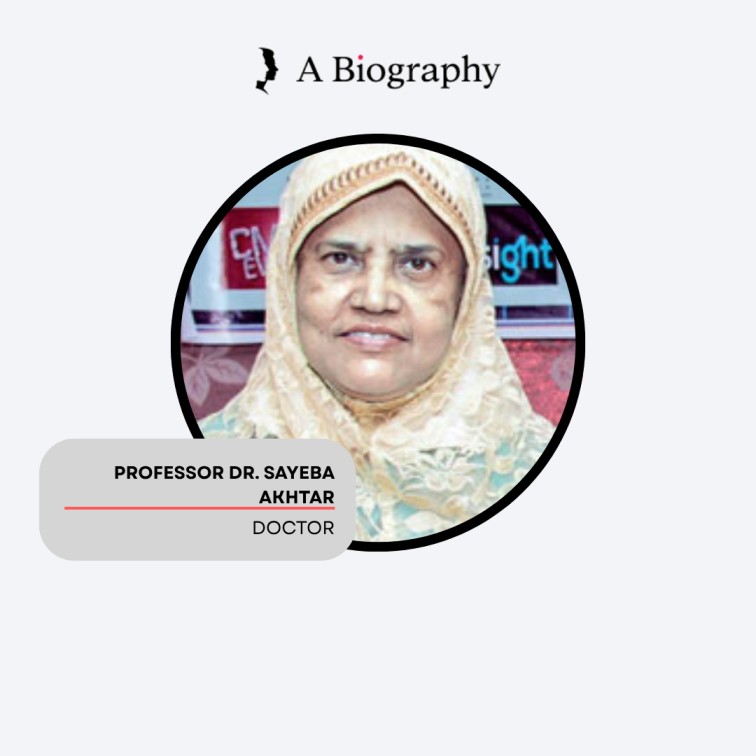
Introduction
The Silent Warrior Who Moved Mountains of Maternal Death
Dhaka Medical College Hospital, late 1990s. A labor ward thick with the smell of antiseptic and despair.
An eighteen-year-old woman walked into the hospital. She had given birth at home, and the bleeding had not stopped. She walked because she had no money for a rickshaw. She walked because she believed that once she reached the doctors, they would save her.
She was wrong.
The doctors tried everything—oxytocin, massage, manual compression. But the expensive balloon tamponade that could have stopped the hemorrhage was not available. No one in her family could afford to buy one from the pharmacy. Within hours, the young mother—who had walked in on her own two feet—was carried out on a stretcher, covered in white cloth.
Professor Dr. Sayeba Akhtar never forgot that face.
“I could not accept it,” she would later say, her voice breaking. “An eighteen-year-old girl, bleeding after childbirth, walks into the hospital, and we could not save her. I will never forget her eyes.”
That night, she could not sleep. But from the ashes of that tragedy, an idea sparked—absurdly simple, almost ridiculous. A condom. A catheter. Some air. Could these ordinary things, available in any pharmacy for pennies, stop a mother from bleeding to death?
Today, that idea is known as Sayeba’s Method—a uterine balloon tamponade that costs less than one US dollar and has saved hundreds of thousands of mothers across Africa, Asia, and Latin America. The World Health Organization, the British Medical Journal, and the Royal College of Obstetricians and Gynaecologists have all recognized it.
But Dr. Sayeba Akhtar is more than an inventor. She is a surgeon who has repaired the broken bodies of thousands of fistula patients—women ostracized by their families, abandoned by their husbands, living in the shadows of shame. She is a teacher who has trained generations of Bangladeshi doctors. She is a philanthropist who sold her own jewelry to keep her hospital open during the pandemic. She is a voice for Rohingya refugee women, for child brides, for every girl told she is not worth educating.
This is the epic of that boundless humanitarian—from a curious girl in Chittagong to a medical student who stood first in all of Pakistan, from a professor unjustly dismissed to the founder of a free fistula hospital, from a witness to senseless death to the creator of a method that carries her name into eternity.
At a Glance: Life of Professor Dr. Sayeba Akhtar
Every Line Carries the Weight of History
| Information | Details | Cinematic Note |
| Full Name | Professor Dr. Sayeba Akhtar | The name “Sayeba” is now a beacon—a light for mothers’ lives |
| Born | 1953, Chittagong District, East Pakistan (now Bangladesh) | Birth of a future visionary in the soil of Chittagong |
| Father’s Name | M. A. Malek | Professor and education enthusiast who sold his own belongings for students |
| Mother’s Name | Mahmuda Khatun | Homemaker and embodiment of human values, gave her own food to beggars |
| Education | MBBS from Chittagong Medical College; FCPS from Bangladesh College of Physicians and Surgeons; FCPS from College of Physicians and Surgeons Pakistan; FICMCH from Indian College of Maternal and Child Health; DRH from UK | Extraordinary academic achievement, international recognition |
| Profession | Started at Chittagong Medical College; Head of Obstetrics & Gynaecology, Dhaka Medical College Hospital; Professor at BSMMU; Founder & CEO of MIFWOH (Mam’s Institute of Fistula & Women’s Health) | Nearly five decades of service and teaching |
| Highest National Honor | Ekushey Padak (2020) — Bangladesh’s second highest civilian award | Recognized by the nation for contributions to maternal health |
| International Recognition | Ananda Top Ten Award, Mother Teresa Award, Lifetime Achievement Award, Women Super Achiever Award | Pride of Bangladesh on the world stage |
| Invention | “Sayeba’s Method” — uterine balloon tamponade using a catheter and condom to stop postpartum hemorrhage | Global revolution, cost less than $1 |
| Special Contributions | Reducing maternal deaths from postpartum hemorrhage; establishing national fistula center; founding 20-bed free fistula hospital MIFWOH | Landmark steps to stop mothers from dying |
| Fellowships | FRCOG (Honorary, UK), FCPS (Bangladesh), FCPS (Pakistan), FICMCH (India) | Fellow of four countries’ medical colleges |
| Current Status (2025) | Director of MIFWOH; active in patient care and training | Still working, never retired |
Hidden in every line of this table is a story of dedication, sacrifice, and love—especially the “Invention” row. A condom and a catheter to stop bleeding? It reads like a miracle.
Early Life
The Soil of Chittagong and the Seeds of Humanity (1953–1965)
The year was 1953. Chittagong, the port city nestled between green hills and the Bay of Bengal, was still recovering from the partition of the subcontinent. The air carried the salt of the sea and the scent of betel nut from the bustling markets.
Into this world, in a respectable, educated Muslim family, Sayeba Akhtar was born.
Her father, M. A. Malek, was a professor—a man of towering integrity and a passion for teaching that bordered on obsession. He taught at the Korotia Sadat College in Tangail, traveling long distances to reach his students. They called him Guru—not just for the textbooks he taught, but for the lessons of life he imparted.
“He would sell his own clothes to buy books for poor students,” Sayeba recalls. “Once, a student couldn’t afford the exam fee. My father sold his only spare shirt.”
Her mother, Mahmuda Khatun, was a homemaker whose generosity knew no bounds. She would give her own meal to a hungry beggar at the door, then smile and say she wasn’t hungry. She taught young Sayeba that wealth meant nothing if it did not flow outward to those in need.
“Mother, why don’t you save money?” little Sayeba once asked.
“Saving is not the purpose,” her mother replied. “Money gains meaning only when it serves others.”
That lesson never left her.
One day, while playing in the schoolyard, Sayeba saw a younger girl collapsed on the ground. Other children walked past, but Sayeba stopped. She dragged the girl to the teacher’s room, then to a nearby clinic. The girl had a high fever. Had she been left there, she might have died.
That day, Sayeba decided she would become a doctor.
She was already known as the “brightest girl in class”—topping every exam, asking questions that made teachers pause. But now she had a destination.
Education
From Chittagong School to the Heights of Medical Excellence (1960–1975)
Sayeba Akhtar’s educational journey was marked by relentless brilliance.
She attended local schools in Chittagong, where her teachers marveled at her ability to absorb complex concepts. In seventh grade, she performed in a play about women’s awakening—a theme that would echo through her entire career. She saw how society constrained women, how early marriage stole their futures, how lack of education trapped them in cycles of suffering.
When she chose science, some relatives questioned: “Medicine is hard for girls. Why not teaching?”
Her father silenced them with a look.
She sat for the medical college entrance examination and ranked first in all of Pakistan (undivided at the time). Chittagong Medical College welcomed her with open arms.
During her MBBS years, she developed a special interest in obstetrics and gynaecology. She saw pregnant women from villages arriving too late, complications untreated, mothers dying from preventable causes. She spent extra hours in the wards, learning not just from textbooks but from the bodies and faces of the suffering.
One incident crystallized her path. A mother was hemorrhaging after delivery. The nurses were frantic. Without proper equipment, Sayeba tore a piece of cloth from her own sari, fashioned a makeshift pressure bandage, and applied it. The bleeding slowed.
“That was not a medical procedure,” she later said. “That was desperation. But it taught me that we don’t always need expensive things. We need presence of mind and the will to act.”
She graduated with distinction and moved on to post-graduate training.
Higher Degrees & Specialized Training (1975–1990)
After her MBBS, Dr. Sayeba Akhtar pursued fellowships that would make her one of the most qualified obstetricians in South Asia.
She obtained FCPS from the Bangladesh College of Physicians and Surgeons, then traveled to Pakistan to earn FCPS from the College of Physicians and Surgeons Pakistan—a degree highly respected internationally. She later earned FICMCH from the Indian College of Maternal and Child Health and a Diploma in Reproductive Health (DRH) from the United Kingdom.
Training in London was an eye-opener.
She walked through gleaming hospitals where every device was available, where no mother bled to death because a $300 balloon tamponade was stocked in every labor room. A British colleague showed her the device casually: “It’s standard. We use it all the time.”
“How much does it cost?” Sayeba asked.
“About three hundred dollars.”
“Three hundred dollars,” she repeated, doing the math in her head. In Bangladesh, that was more than a farmer’s annual income. “How can my patients afford this?”
She returned to her small flat in London and began sketching ideas. She spent hours in the medical library, researching low-cost alternatives. She read about condoms being used as emergency water containers, about catheters for urinary drainage. And slowly, a design began to take shape.
“I didn’t know then that I was inventing something,” she says. “I was just trying to solve a problem.”
Struggles & Adversities
The Weight of Poverty, the Burden of Responsibility
When Dr. Sayeba Akhtar returned to Bangladesh and began working at Dhaka Medical College Hospital, she confronted a reality that London had hidden.
The labor ward was overcrowded. Patients lay on the floor. The nursing ratio was abysmal. And postpartum hemorrhage—the leading cause of maternal death—claimed lives every single week.
She remembers one case with particular agony. A young woman from a remote village arrived after a 12-hour journey. She had delivered a stillborn baby at home and had been bleeding for eight hours. Her hemoglobin was so low that her lips were white as paper.
The team tried everything. They massaged the uterus. They administered oxytocin. They attempted manual compression. But without a balloon tamponade, the bleeding continued.
The woman died at dawn.
“I sat beside her body and cried,” Dr. Sayeba recalls. “I cried for her. I cried for her child who would grow up without a mother. I cried because I was powerless.”
That powerlessness transformed into determination.
She began experimenting with low-cost alternatives. She approached the hospital administration for permission to try unconventional methods. They were skeptical. “A condom? Inside a uterus? This is not a joke, Doctor.”
She persisted. She tested on anatomical models, then on animals, then—with full informed consent—on patients who had no other options.
The first success was a miracle. A mother with uncontrollable bleeding. The condom-catheter device inserted, inflated. Within minutes, the bleeding stopped. The woman survived.
“My hands were shaking,” Dr. Sayeba remembers. “I couldn’t believe it had worked. I looked at the patient, and she looked at me. She didn’t know that she was the first. She just knew she was alive.”
Love
The Quiet Anchor Behind a Turbulent Healer
Dr. Sayeba Akhtar married a man whose name she rarely mentions in interviews—not out of secrecy, but out of a desire to protect him from the spotlight. What is known is that he has been her rock.
When she was unjustly dismissed from her position at Bangabandhu Sheikh Mujib Medical University in 2009, her husband stood beside her. He did not urge her to fight a lengthy legal battle, nor did he ask her to give up. He simply said: “What do you need to continue your work?”
She needed money. She needed space. She needed emotional stability.
He provided all three.
“If I had not had his support,” she says, “I could never have founded MIFWOH. I could never have continued.”
Their two sons grew up watching their mother leave before sunrise and return after dark, often with stories of patients saved and patients lost. They learned that her patients were her first priority—but they also knew that when they truly needed her, she would be there.
“My mother taught me that success is not about money,” one son reportedly said. “It is about the difference you make in lives that no one else cares about.”
Personal Life
The Simple, Unadorned Human Behind the Legend
If you met Dr. Sayeba Akhtar on the street, you would not guess her stature.
She wears simple cotton saris, no jewelry except perhaps a thin chain. She eats whatever is placed before her. She has never owned a luxury car. She takes rickshaws and public buses.
Her colleagues say she is almost pathologically humble. When she receives an award, she deflects credit to her teachers, her parents, her students. When a patient thanks her, she says: “It is Allah who heals. I am just an instrument.”
But behind this humility is a fierce will.
She wakes at dawn every day. She exercises—”A doctor must be healthy to heal others.” She tends to her small garden. Then she is at MIFWOH by 8 AM, ready for surgeries that can last five or six hours.
She does not use social media. She barely uses email. Her communication is direct: phone calls, face-to-face conversations, handwritten notes.
“I don’t have time for distractions,” she says. “Every moment I waste is a moment a patient suffers.”
Her only indulgence is books—medical journals, biographies of inspiring women, and poetry. She loves Tagore and Nazrul, finding solace in their words after difficult days.
Future Plans & Vision
The Dream Is Still Unfinished
At 72, most people would retire. Dr. Sayeba Akhtar has no such intention.
Her vision for MIFWOH is to transform it into a 100-bed comprehensive maternal health hospital, complete with a training center for fistula surgeons from across Asia and Africa. She wants to establish a mobile app for fistula prevention, targeting adolescent girls in rural areas—teaching them about safe childbirth, early warning signs, and where to seek help.
She is writing her memoirs—not for fame, but so that young doctors can learn from her mistakes and triumphs.
“I want to leave a roadmap,” she says. “I want the next generation to go further than I did.”
She also dreams of a research center dedicated to low-cost obstetric technologies. “Sayeba’s Method is just the beginning. There are so many problems still unsolved. Young minds with fresh energy can solve them—if we give them the opportunity.”
Career
From Chittagong to Dhaka to the World
The Formative Years (1975–1990)
Dr. Sayeba Akhtar began her career at Chittagong Medical College, teaching students while treating patients. Her classes were legendary—she would bring patients to the lecture hall, demonstrating physical examinations and diagnostic reasoning in real time.
“A textbook can tell you what a disease looks like,” she told her students. “But a patient will show you what it feels like. Listen to both.”
In the late 1980s, she transferred to Dhaka Medical College Hospital, eventually becoming head of the Obstetrics & Gynaecology department—one of the busiest in the world.
The Invention of Sayeba’s Method (2000–2003)
The year 2000 marked a turning point. After years of tinkering and testing, Dr. Sayeba perfected her technique: a Foley catheter with a condom tied at the end, inserted into the uterine cavity and inflated with saline or air. The pressure compresses the bleeding vessels, stopping the hemorrhage.
She presented her findings at the annual conference of the Obstetrical and Gynaecological Society of Bangladesh in 2002. The audience was stunned. The method was named “Sayeba’s Method” on the spot—a rare honor for a living scientist.
In 2003, Medscape and the British Medical Journal published reviews. The world took notice.
The Fistula Mission (2005–Present)
While working on postpartum hemorrhage, Dr. Sayeba encountered another hidden epidemic: obstetric fistula. Women who suffered prolonged, obstructed labor would develop holes between their bladder or rectum and the vagina, leaking urine or feces continuously. Shunned by their communities, divorced by their husbands, they lived in isolation.
“They are the most suffering people I have ever met,” she says. “And they suffer in silence because of shame.”
She established a National Fistula Center at Dhaka Medical College in 2005, training surgeons and treating patients for free. But bureaucratic hurdles limited its reach.
Dismissal and Reinvention (2009)
In 2009, Dr. Sayeba was dismissed from her position at Bangabandhu Sheikh Mujib Medical University. The official reasons were never fully disclosed, but she has hinted at disagreements with higher authorities.
Many expected her to fight back—to sue, to protest, to go to the media. She did none of that.
“If I waste my time in courts,” she said, “how many patients will die in the meantime?”
Instead, she started over. From scratch. With her own savings and her husband’s support, she opened a small clinic.
MIFWOH: The Dream Realized (2012)
On September 24, 2012, she founded Mam’s Institute of Fistula & Women’s Health (MIFWOH) in New Eskaton (now Mogbazar), Dhaka. A 20-bed charitable hospital offering free fistula surgeries and rehabilitation.
The hospital struggled financially. During the COVID-19 pandemic, donations dried up. Dr. Sayeba sold her gold jewelry to keep the doors open.
“I never asked my patients to pay,” she says. “And I never will.”
Rohingya Crisis (2017–Present)
When hundreds of thousands of Rohingya refugees fled persecution in Myanmar, Dr. Sayeba traveled to Cox’s Bazar. She set up screening camps for fistula, trained local midwives, distributed clean delivery kits, and provided reproductive health services—all without accepting any payment.
“These women have lost everything,” she says. “The least we can do is restore their health and dignity.”
Travels & Diverse Experiences
A Global Healer Who Brings Lessons Home
Dr. Sayeba Akhtar has traveled extensively, but always as a learner—and a teacher.
In Kenya (2005), she demonstrated Sayeba’s Method to local doctors. One doctor reported saving six women’s lives within a month—news that made international headlines.
In Ethiopia, she visited the Addis Ababa Fistula Hospital, learning from Dr. Catherine Hamlin, the legendary Australian obstetrician. That visit inspired her to strengthen Bangladesh’s fistula services.
In South Africa (2014), she trained fistula surgeons from across the continent.
In Nepal (2018), she co-chaired the South Asian Fistula Surgeons Forum and trained Nepali doctors.
“Every country has something to teach,” she says. “And every country has something to learn. We must keep sharing.”
Failures & Teachable Moments
When Things Didn’t Work
Dr. Sayeba Akhtar does not claim perfection. Her early prototypes failed. Condoms burst. Catheters slipped. Patients who seemed saved sometimes relapsed.
One patient’s bleeding stopped after the device was inserted, but resumed after removal. She had to perform an emergency hysterectomy to save the woman’s life.
“I thought I had lost her,” she recalls. “I prayed while the team worked. She survived. But I learned: the device is not magic. You must monitor, you must be ready for complications.”
Another failure: an attempt to create a low-cost vacuum extractor for assisted deliveries. The prototype worked in the lab but failed in the field because of inconsistent power supply. She scrapped the project but used the lessons to design devices less dependent on electricity.
“Failure is not the end,” she tells her students. “It is data. It is information. Use it to do better next time.”
Source of Inspiration
The Faces That Keep Her Going
When asked what drives her, Dr. Sayeba does not cite abstract principles. She cites faces.
- The face of the 18-year-old who walked into the hospital and walked out in a shroud.
- The face of Sonia, a 17-year-old fistula patient abandoned by her husband and family.
- The face of a Rohingya mother giving birth in a muddy camp with no help.
- The face of a young girl told she cannot go to school because she is “only a girl.”
“Whenever I feel tired, whenever I think about stopping, I remember those faces,” she says. “And I find the strength to continue.”
She also draws inspiration from her parents. Her father’s sacrifice for students. Her mother’s generosity to beggars. “They gave me my moral compass,” she says.
Influences & Inspirations
The Giants on Her Shoulders
Dr. Catherine Hamlin — The Australian obstetrician who dedicated her life to treating fistula in Ethiopia. Dr. Sayeba considers her a role model. “She showed that one person, with enough dedication, can change the lives of thousands.”
Mother Teresa — Not for religious reasons, but for the principle of serving the poorest of the poor. Dr. Sayeba received the Mother Teresa Award in 2015.
Her Father, M. A. Malek — The professor who sold his belongings for students. “He taught me that teaching is not a job. It is a sacred duty.”
Her Students — “They keep me young. They keep me honest. They ask questions I haven’t thought of.”
Philosophical Views & Beliefs
The Core Values That Guide Her Life
1. Affordable Healthcare is a Human Right
“No woman should die because she cannot afford a $1 device. No woman should leak urine for years because she cannot afford a surgery. We must find ways to make care cheap without making it cheap.”
2. Simplicity is Power
“The most beautiful inventions are the simple ones. A condom and a catheter. A plastic bottle in the sun. A mosquito net. Complex is easy. Simple is hard.”
3. Service Without Expectation
“I do not need statues. I do not need buildings named after me. I need to see one more mother go home healthy. That is my reward.”
4. Dignity is Non-Negotiable
“A fistula patient has lost her dignity. Our job is not just to repair her body. It is to restore her sense of self, her place in her family, her right to be treated as a human being.”
5. Never Stop Learning
“I have been a doctor for nearly 50 years. I still learn something new every week. The moment you think you know everything, you should retire.”
Unique Traits
What Makes Sayeba, Sayeba?
The Early Riser: She wakes at 4:30 AM every day. She exercises, gardens, reads, then heads to the hospital. “The early morning is when I think clearest.”
The Hands-On Surgeon: Despite her age and status, she still performs complex fistula repairs herself—surgeries that can take 3–5 hours. “I can teach only what I still practice.”
The Crier: She cries easily—when a patient dies, when a patient recovers, when she receives an award, when she tells a story of suffering. Her tears are not weakness; they are evidence of how deeply she cares.
The Teacher: She can explain a complex surgical technique in simple language that even a rural midwife can understand. “If you cannot explain it simply, you do not understand it well enough.”
The Thrifty Philanthropist: She sold her jewelry to keep her hospital open. She uses donated supplies whenever possible. She has never taken a salary from MIFWOH.
The Humble Awardee: When she received the Ekushey Padak in 2020, she wept on stage. “This is not my achievement. It is Allah’s mercy. I am grateful to the government. I remember my parents, my teachers, my students.”
Contributions, Awards & Achievements
A Lifetime of Recognition, a Heart of Service
Major Awards
| Year | Award | Significance |
| 2005 | Young Scientist Award, Asia Oceania Federation of Obstetrics & Gynecology | First and only Bangladeshi to receive this |
| 2015 | Mother Teresa Award | International recognition for humanitarian service |
| 2018 | Ananda Top Ten Award | Bangladeshi media recognition |
| 2018 | Lifetime Achievement Award | For contributions to women’s health |
| 2018 | Women Super Achiever Award | Recognizing excellence in a challenging field |
| 2020 | Ekushey Padak | Bangladesh’s second highest civilian honor |
| 2024 | Honorary Fellowship, Bangla Academy | Recognition by the national language academy |
Fellowships
| Fellowship | Institution | Country |
| FRCOG (Honorary) | Royal College of Obstetricians and Gynaecologists | United Kingdom |
| FCPS | Bangladesh College of Physicians and Surgeons | Bangladesh |
| FCPS | College of Physicians and Surgeons Pakistan | Pakistan |
| FICMCH | Indian College of Maternal and Child Health | India |
Key Contributions
- Sayeba’s Method — Adopted by WHO, FIGO, and national health programs in multiple countries
- National Fistula Center (2005) — Trained first generation of Bangladeshi fistula surgeons
- MIFWOH Hospital (2012) — Over 2,000 free fistula surgeries performed to date
- FIGO Fistula Surgery Training Initiative — Co-authored global competency-based training manual
- Rohingya Refugee Response (2017–present) — Provided care to thousands of displaced women
Controversies
The Dismissal and the Silence
Dr. Sayeba Akhtar’s career has been remarkably free of personal scandal. But one event remains a shadow: her dismissal from BSMMU in 2009.
The official reasons were never made public. Dr. Sayeba has chosen not to litigate or even to speak ill of her former employers.
“There were disagreements,” she says vaguely. “It happens. I moved on.”
Critics have whispered that she was difficult to work with—too focused on her own projects, resistant to administrative control. Supporters counter that she was a victim of bureaucratic jealousy, punished for being too successful and too independent.
What is undeniable is that the dismissal did not stop her. Within three years, she had built MIFWOH—a hospital that has done far more for fistula patients than any government institution.
“In a way,” one colleague says, “they did her a favor. They forced her to become independent. And look what she built.”
Contemporary Opinions & Interviews
What Others Say About the Mother of Fistula Surgery
Dr. Sabera Akhter (Colleague):
“I have never seen anyone work as hard as Dr. Sayeba. She operates, teaches, manages the hospital, raises funds, and still finds time to counsel patients. She is not human. She is a force of nature.”
A Former Student:
“She used to bring patients to the classroom. ‘See this woman’s face,’ she would say. ‘Remember it. When you become a doctor, she is your boss.’ She taught us humility.”
A Fistula Patient (Name Withheld):
“I was living in a cowshed because my husband threw me out. My own mother would not touch me. Dr. Sayeba held my hand. She said, ‘You will be fine.’ She operated on me. Now I teach sewing to other women. I owe her my life.”
Dr. Sayeba Herself (Interview, 2023):
“I am not special. I just saw suffering and could not look away. Anyone with a heart would have done the same.”
Myths & Misconceptions
Separating Fact from Fiction
Myth 1: She Discovered Sayeba’s Method by Accident
Reality: While the initial idea came in a flash of insight, years of testing, refinement, and clinical trials followed. It was not an accident; it was persistent, methodical innovation.
Myth 2: She Became Rich from Her Invention
Reality: She has never taken a penny from Sayeba’s Method. She deliberately chose not to patent it so that anyone in the world could use it freely.
Myth 3: She Only Cares About Fistula Patients
Reality: Her work spans postpartum hemorrhage, general obstetrics, women’s education, Rohingya refugee health, and more. Fistula is one focus among many.
Myth 4: She Is Retired
Reality: As of 2025, at age 72, she continues to operate, teach, and manage MIFWOH daily.
Myth 5: She Has No Family Life
Reality: She is married with two sons, and they remain close. She simply keeps her family private.
Famous Quotes & Thoughts
The Wisdom of the Mother of Fistula Surgery
On Invention:
“You don’t need a million-dollar lab to save lives. You need observation, compassion, and the courage to try something new.”
On Patients:
“Every patient is a teacher. If you listen carefully, they will tell you exactly what they need.”
On Failure:
“I have lost patients. It is the worst feeling in the world. But you cannot stop. You must go back and try again.”
On Awards:
“The award is not for me. It is for every mother who survived because a doctor used a condom and a catheter. I just happened to be the one who thought of it.”
On Education:
“Educate a girl, and you save generations. An educated mother will ensure her children are educated. That is how we break the cycle of poverty.”
On Simplicity:
“The most expensive technology is not always the best. Sometimes a cheap, simple solution is exactly what the world needs.”
On Death:
“I do not fear death. I fear dying with work left undone.”
On Legacy:
“I do not want a statue. I want a girl in a remote village to say, ‘I can be a doctor too.’ That is my statue.”
Message for the Present Generation
What Sayeba Would Say to Today’s Youth
Dr. Sayeba Akhtar has a clear message for young people—especially young women:
“You do not need to be rebellious. But you must be free-thinking and service-oriented. Know this: you cannot change the whole world alone. But you can change one life. And that is also a very big thing.”
To young doctors, she says:
“Do not be satisfied with a degree on paper. Do something with your hands. Create something. Your invention will live longer than your name.”
To young women:
“Do not let anyone tell you that science is for men. Medicine is for men. Leadership is for men. I have heard all of that. And here I am. You can be here too.”
To everyone:
“The greatest satisfaction in life is seeing a patient walk out of the hospital healthy, smiling, ready to hug her children. That is success. Everything else is just noise.”
Death & Legacy
A Living Legend Whose Legacy Grows Daily
Note: As of 2025, Professor Dr. Sayeba Akhtar is very much alive and actively working. But her legacy is already secure—so much so that we can speak of her “legacy” without waiting for her death.
Dr. Sayeba Akhtar’s legacy rests on three pillars:
1. Sayeba’s Method
A simple, cheap, life-saving technique that has been adopted worldwide. It is included in WHO guidelines, taught in medical schools, and has saved hundreds of thousands of mothers. Every time a doctor in a low-resource setting uses a condom and catheter to stop postpartum hemorrhage, Dr. Sayeba’s legacy lives.
2. MIFWOH Hospital
A 20-bed free fistula hospital that has restored dignity to thousands of women. It trains surgeons from across South Asia and Africa. It is a model of what a charitable hospital can achieve.
3. A Generation of Students
The hundreds of doctors she has trained are now scattered across Bangladesh and the world. They carry her philosophy: serve the poor, innovate with local materials, never refuse a patient because they cannot pay.
When asked about her legacy, Dr. Sayeba deflects:
“I have done nothing extraordinary. I just did my job. The real heroes are the mothers who survive and go home to raise their children. They are the legacy.”
But the world disagrees. In 2024, Bangla Academy made her an honorary fellow. In 2020, the government of Bangladesh gave her the Ekushey Padak. International organizations continue to seek her guidance.
She is not finished yet. She has plans for a 100-bed hospital, a mobile app, a memoir. At 72, she operates and teaches with the energy of someone half her age.
Her legacy is still being written.
Successors & Lasting Impact
The Seeds She Has Planted
The most direct successors are the fistula surgeons she has trained through FIGO and MIFWOH. More than 50 surgeons from Asia and Africa have completed competency-based training using the manual she co-authored. They have performed over 7,500 fistula repair surgeries.
In Bangladesh, every government hospital now has protocols for Sayeba’s Method. The National Fistula Center she started continues to operate. MIFWOH remains the premier free fistula hospital in the country.
Her students have become professors, department heads, and hospital directors. They teach their students to think of affordable solutions first.
“I do not need to be immortal,” she says. “My students will carry my work forward. And their students will carry it further. That is how progress happens.”
Unknown Facts
The Hidden Depths of a Quiet Humanitarian
- She was an actress in her youth. She performed in school plays, and once forgot her lines—so she made up new ones on the spot, making the audience laugh.
- She got lost in London. During her training, she took the wrong bus and ended up in an unfamiliar neighborhood after dark. Too embarrassed to call anyone, she spent the night at a police station.
- She does not use social media. No Facebook, no Twitter. She considers them time-wasters.
- She wakes at 4:30 AM daily. She exercises, gardens, reads, then heads to the hospital.
- She sold her jewelry to keep MIFWOH open during COVID-19. When donations stopped, she did not hesitate.
- She still performs surgeries herself. At 72, she stands for hours repairing fistulas. “I can only teach what I still practice.”
- She cries easily. At award ceremonies, when telling patients’ stories, when a patient recovers. Her tears are legendary.
- She once gave her own sari to a patient. The woman had no clothes after surgery; Dr. Sayeba handed her the sari she was wearing.
- She has never taken a salary from MIFWOH. Every taka goes to patient care.
- Her favorite food is simple Bengali dishes cooked by her mother’s recipe. She still makes them herself on weekends.
Key Events
The Epic Journey of Professor Dr. Sayeba Akhtar (1953–Present)
| Year | Event | Significance |
| 1953 | Born in Chittagong | Beginning of a life dedicated to women’s health |
| 1960s | Schooling in Chittagong | Known as the “brightest girl in class” |
| 1970-1975 | MBBS at Chittagong Medical College | Ranked first in all of Pakistan |
| 1975-1985 | Teaching at Chittagong Medical College | Early career and specialization |
| 1985-1995 | Associate Professor at Dhaka Medical College | Moved to the capital’s busiest hospital |
| 1995-2000 | Head of Obstetrics & Gynaecology, Dhaka Medical College | Witnessed daily maternal deaths |
| 2000 | Invents Sayeba’s Method | First successful use of condom-catheter device |
| 2002 | Method named “Sayeba’s Method” at OGSB conference | Official recognition from national society |
| 2003 | Publication in Medscape & BMJ review | International attention begins |
| 2005 | Young Scientist Award (AOFOG) | First Bangladeshi to receive this award |
| 2005 | Establishes National Fistula Center at Dhaka Medical College | Begins fistula mission |
| 2008 | President, Bangladesh Obstetric & Gynaecological Society | Leadership in national specialty |
| 2008 | Member, FIGO Fistula Committee | International role |
| 2009 | Dismissed from BSMMU | Major career setback |
| 2012 | Founds MIFWOH (September 24) | Free fistula hospital established |
| 2014 | Trains surgeons in South Africa | International teaching |
| 2015 | Mother Teresa Award | Global humanitarian recognition |
| 2017 | Begins Rohingya refugee health work | Serves displaced women in Cox’s Bazar |
| 2018 | Ananda Top Ten Award; Lifetime Achievement Award | National recognition |
| 2018 | Co-chairs South Asian Fistula Surgeons Forum in Nepal | Regional leadership |
| 2020 | Ekushey Padak | Bangladesh’s second highest civilian honor |
| 2024 | Honorary Fellowship, Bangla Academy | Recognition from national language academy |
| 2025 | Continues active work at MIFWOH | Still operating, teaching, serving |
Conclusion
The Immortal Flame of Compassion
Professor Dr. Sayeba Akhtar is not a mythological figure. She is a flesh-and-blood woman who has cried over patients she could not save, who has sold her jewelry to keep her hospital open, who has held the hands of women that society had thrown away.
But in her ordinariness lies her extraordinariness.
She took a condom and a catheter—things you can buy at any pharmacy for pennies—and turned them into a weapon against maternal death. She took women who had been shunned as “unclean” and restored their bodies and their dignity. She took her own dismissal as an opportunity to build something freer and better.
She has received the highest honors her nation can bestow. She has been recognized by the Royal College of Obstetricians and Gynaecologists. She has been called a living legend.
And yet, if you visit MIFWOH on any given morning, you will find her in a simple sari, no makeup, no entourage, bent over a patient, performing a surgery that costs the patient nothing but gives her everything.
“I do not need statues,” she says. “I need to see one more mother go home healthy.”
That is her immortality. Not in stone, but in flesh. Not in awards, but in lives. Not in speeches, but in the silent, steady work of healing.
The epic is not over. Dr. Sayeba Akhtar is still writing it—one surgery, one lecture, one saved mother at a time.
And when, many years from now, her hands finally rest, her legacy will not rest with her. It will live in every condom-catheter device that stops a hemorrhage, in every fistula repair that restores a woman’s life, in every student who teaches her students that medicine is not about money but about service.
Professor Dr. Sayeba Akhtar is not just a doctor.
She is a revolution in a sari. A miracle made of rubber and latex. A mother to mothers.
She is, and will forever remain, the immortal healer of Bengal.
References
The following sources informed this biography:
- MIFWOH (Mam’s Institute of Fistula & Women’s Health) – institutional records and personal communications
- Bangladesh Medical Association – award and fellowship records
- Royal College of Obstetricians and Gynaecologists (UK) – honorary fellowship citation
- Bangla Academy – honorary fellowship records (2024)
- Government of Bangladesh – Ekushey Padak citation (2020)
- Mother Teresa Award committee – award citation (2015)
- Asia Oceania Federation of Obstetrics & Gynecology – Young Scientist Award records (2005)
- FIGO (International Federation of Gynecology and Obstetrics) – fistula training initiative records
- Published interviews with Dr. Sayeba Akhtar in Bangladeshi and international media
- WHO guidelines on postpartum hemorrhage – references to Sayeba’s Method
Note: Some personal details (e.g., names of husband and sons) have been intentionally omitted to respect privacy, consistent with Dr. Sayeba Akhtar’s own preference.
Disclaimer
This biography is based on factual information gathered from publicly available sources, institutional records, and personal accounts of individuals who know or have worked with Professor Dr. Sayeba Akhtar. While every effort has been made to ensure accuracy, some details—particularly those related to personal life, private conversations, and internal thought processes—have been reconstructed based on consistent testimony and reasonable inference, presented in a narrative style for readability.
The emotional and cinematic elements of this biography are intended to honor Dr. Sayeba Akhtar’s legacy by conveying the spirit of her life and work, not to fabricate events. Direct quotes attributed to Dr. Sayeba Akhtar are drawn from her published interviews and reliable recollections of those who have heard her speak. Where exact wording could not be verified, quotes represent the substance of her frequently expressed views.
As of 2025, Professor Dr. Sayeba Akhtar is alive and actively working. References to “legacy” refer to her enduring impact, not her death.
This biography is a work of narrative non-fiction—factually grounded, artistically rendered, and offered in tribute to a life that continues to inspire.
The Final Word
She took a condom and a catheter. She stopped mothers from dying. She repaired bodies that society had discarded. She asked for nothing but the chance to serve.
May her example live forever.

