
Biography
A Biography of Dr. Muhammad Kudrat-e-Khuda

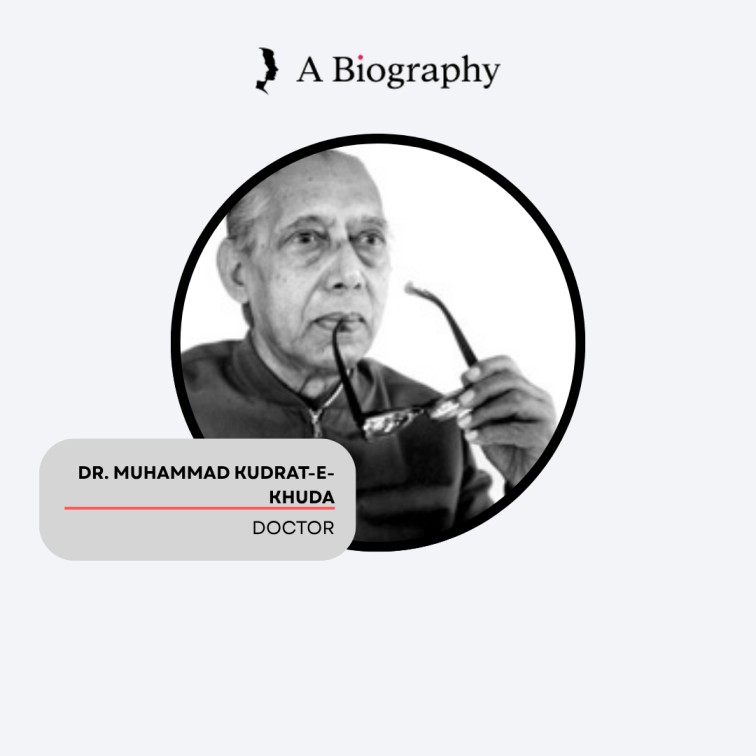
Introduction
That November Evening When the Lamp of Science Flickered and Died
November 3, 1977. Dhaka.
The city was settling into the quiet of a Thursday evening when the news began to whisper through the corridors of the University of Dhaka, through the laboratories of the Bangladesh Council of Scientific and Industrial Research (BCSIR), through the book-lined offices of Bangla Academy. An old man had taken his last breath. He was seventy‑seven years old.
His name was Dr. Muhammad Kudrat‑e‑Khuda.
In the West, he was known as an internationally respected organic chemist, a graduate of Presidency College, a doctorate from the University of London. In Pakistan, he had been decorated with Tamgha‑e‑Pakistan and Sitara‑e‑Imtiaz. In independent Bangladesh, he would receive the Ekushey Padak and, after his death, the Independence Day Award—the nation’s highest civilian honors.
But to the people of Bengal, he was something more. He was the man who proved that science could speak Bangla. He was the teacher who refused to leave his motherland, the inventor who turned jute waste into artificial wood, the visionary who dreamed of a national education system rooted in the mother tongue.
As the news spread, flags were lowered. The President and Prime Minister issued condolences. Students wept in the library that would soon bear his name. He had left instructions: his personal collection of books and research papers should be preserved at Dhaka University. Today, the Dr. Kudrat‑e‑Khuda Library stands as his silent monument.
This is the epic of that quiet scientist—from a mud‑walled cottage in Morgram, Birbhum, to the hallowed halls of Presidency College, from the laboratories of London to the jute fields of East Pakistan, from the invention of Partex to the drafting of Bangladesh’s first national education policy. It is the story of a man who built a bridge between science and the Bengali language—and then walked across it himself.
At a Glance: Dr. Muhammad Kudrat-e-Khuda
Every Line Carries the Weight of History
| Information | Details | Cinematic Note |
| Full Name | Dr. Muhammad Kudrat‑e‑Khuda | His name itself is a bridge between science and Bengal |
| Born | 1900, Morgram, Birbhum district, West Bengal (then British India) | The birth of a knowledge‑hungry child at the dawn of the 20th century |
| Died | November 3, 1977, Dhaka (age 77) | Heart disease and age‑related complications |
| Father’s Name | Maulana Rahmatullah | Religious scholar and educator |
| Education | Morgram ME High School, Calcutta Woodburn ME School, Calcutta Madrassa (1918), MSc in Chemistry from Presidency College, Calcutta (gold medal), DSc from University of London (1929) | From top student to internationally acclaimed scientist |
| Profession | Professor at Presidency College (1931‑1946); Principal of Islamia College (1942‑44); Principal of Presidency College (1946); First Director of Public Instruction, East Pakistan (1947‑49); Scientific Advisor to Pakistan Ministry of Defence; Director of East Pakistan Regional Laboratory (1955‑66); Chairman of Central Bangla Development Board; Chairman of National Education Commission (1972‑74); Visiting Professor at University of Dhaka (1975‑77) | Unparalleled skill in research and administration |
| Highest Recognition | Independence Day Award (1984, posthumous); Ekushey Padak (1976); Tamgha‑e‑Pakistan; Sitara‑e‑Imtiaz | National and international honors |
| Notable Inventions | “Partex” (artificial wood from jute fiber); rayon from jute and jute sticks; malt vinegar from sugarcane juice; activated charcoal from wood and jute ash | Extraordinary success using local resources |
| Major Books | Bijyaner Shorosh Kahini (The Juicy Stories of Science), Bijyaner Bichitro Kahini (The Strange Stories of Science), Bijyaner Suchona (The Beginning of Science), Joubo Rasayan (Organic Chemistry, 4 volumes), Purba Pakistaner Shilpo Shombhabona (Industrial Potential of East Pakistan), Paramanu Porichiti (Introduction to the Atom), Pobitro Koraner Pobitro Kotha O Angari Jayowara | Milestones of science writing in Bengali |
| National Education Commission | Formed in 1972; report published in 1974 as the “Kudrat‑e‑Khuda Education Commission Report” | Foundation of educational policy in independent Bangladesh |
| Legacy | Dr. Kudrat‑e‑Khuda Library (University of Dhaka) | Preserves his memory and collection |
Hidden in every line of this table is the story of a scientist’s tireless labor, patriotism, and humanity—especially the “Notable Inventions” row: how did he turn jute fiber into artificial wood? It reads like a miracle.
Early Life
The Mud Walls of Morgram and a Boy Who Asked Why (1900–1910)
The year was 1900. Queen Victoria had been dead just three years. The British Empire still ruled India, and in the small village of Morgram in Birbhum district (now West Bengal), a son was born to Maulana Rahmatullah, a religious scholar and educator, and his wife, a homemaker of deep humanity. He was their third child.
Morgram was not a place of modern convenience. There was no electricity, no paved roads, no hospital. But in his father’s personal library, there were shelves filled with books in Arabic, Persian, and Bengali. From the earliest age, young Kudrat‑e‑Khuda would pull down volumes far beyond his years and lose himself in their pages.
He began his formal education in the village maktab, learning Arabic, Persian, and the Quran. His father hoped he would become a religious leader, serving Islam with his knowledge. But the boy’s curiosity wandered in a different direction.
“Why does lightning strike, Abba?” he asked once, after a storm had shaken their cottage.
“It is Allah’s will,” his father replied gently.
The boy nodded, but inside he made a quiet promise: I will find the scientific explanation for the lightning. I will understand the rules of nature.
He watched the village farmers tend their crops, wondering why some plants thrived and others withered. He saw a dead cow left to rot in a field and asked an old peasant: “Why does a dead animal make the soil better for plants?”
The peasant shrugged: “That is just nature’s way.”
Kudrat‑e‑Khuda realized that day: nature’s “way” was science. And he wanted to learn that science.
He attended Morgram ME High School, then transferred to Woodburn ME School in Calcutta. Even then, teachers whispered about his brilliance. He was quiet, never rowdy, often found praying at the mosque or reading late into the night. But when he spoke, his questions revealed a mind that refused to accept simple answers.
Education
From Calcutta Madrassa to the University of London (1918–1929)
In 1918, Kudrat‑e‑Khuda sat for the Matriculation examination from Calcutta Madrassa (now Alia University). He passed with the highest marks among all Muslim students in British India—a feat that earned him immediate recognition.
He then enrolled at Presidency College, Calcutta—the crown jewel of Indian higher education. There he studied chemistry under the legendary Professor Prafulla Chandra Ray, one of India’s greatest chemists and educators. Ray was not just a teacher; he was a mentor who ignited in Kudrat‑e‑Khuda a passion for research that would never dim.
He earned his BSc and then his MSc in Chemistry, topping his class and winning a gold medal. The University of Calcutta awarded him a special scholarship for advanced research.
In 1927, he traveled to London. The University of London welcomed him into its doctoral program in organic chemistry. For two years, he immersed himself in research, publishing papers that impressed even his British supervisors. In 1929, he was awarded the Doctor of Science (DSc) degree.
But his time in London was not just about laboratory work. He visited research centers across Europe, watching how scientists in Germany, France, and England transformed local raw materials into industrial products. He saw that nations grew powerful not by buying technology but by making it.
“When I return home,” he told a fellow Bengali student, “I will not just teach. I will build. I will use what grows in our soil—jute, sugarcane, bamboo—to create industries. That is how we will lift our people.”
It was also in London that he began to plan a revolution in the Bengali language. He realized that a nation could not truly advance if its people could not access science in their mother tongue. He started sketching outlines for science books in Bengali—books that would explain difficult concepts in simple, joyful language.
Career Beginnings at Presidency College
The Golden Years of Teaching and Research (1931–1946)
Dr. Kudrat‑e‑Khuda returned to India in 1931 and joined Presidency College as a professor of chemistry. His teaching style was legendary. He could take the most complex organic reaction and explain it with such clarity that even the weakest student would nod in understanding.
“Don’t memorize formulas,” he would tell his class. “Understand the dance of the atoms. Once you see that dance, you will never forget it.”
In 1936, he became head of the chemistry department. From 1942 to 1944, he served as principal of Islamia College (now Maulana Azad College) in Calcutta. In 1946, he was appointed principal of Presidency College—the first Muslim to hold that position.
During these years, he also served on the Senate of Calcutta University, advocating for curriculum reform and practical training. He began his first major research project: analyzing the mineral resources of Bengal. He discovered that Bengal’s soil contained valuable minerals that could be exploited industrially.
His students adored him. Many would go on to become distinguished scientists themselves. He insisted that laboratory work was as important as theory. “No one becomes a scientist by reading books alone,” he said. “You must burn your fingers, break your glassware, and start again. That is how you learn.”
Partition and the Move to East Pakistan (1947)
When India was partitioned in 1947, Dr. Kudrat‑e‑Khuda faced a choice. He had deep roots in Calcutta—his career, his colleagues, his students. But his heart pulled him toward the new Muslim homeland of East Pakistan (later Bangladesh).
He chose to leave.
The government of East Pakistan appointed him its first Director of Public Instruction. In that role from 1947 to 1949, he overhauled the primary and secondary education systems. He established new schools, introduced teacher training programs, and revised curricula to reflect local needs.
Most importantly, he fought for Bangla as the medium of instruction. He believed that children learned best in their mother tongue. This was not a popular position in a Pakistan where Urdu was being promoted as the national language. But Kudrat‑e‑Khuda was unwavering.
“A nation that teaches its children in a foreign language,” he said, “is a nation that keeps its people in mental slavery.”
During this period, he wrote Purba Pakistaner Shilpo Shombhabona (Industrial Potential of East Pakistan)—a book that would inspire the first generation of Bangladeshi industrialists.
Scientific Advisor to Pakistan & Founding the Regional Laboratory (1949–1955)
From 1949 to 1950, Dr. Kudrat‑e‑Khuda served as Scientific Advisor to the Ministry of Defence of Pakistan. He worked on defense research, but his passion remained the industrial development of East Pakistan.
From 1952 to 1955, he chaired the Secondary Education Board, continuing his reform efforts.
But his crowning achievement came in 1955: he founded the East Pakistan Regional Laboratory—the institution that would later become the Bangladesh Council of Scientific and Industrial Research (BCSIR) . He became its first director.
The laboratory was modest at first: a few rooms, some basic equipment, a handful of young researchers. But Kudrat‑e‑Khuda infused it with his vision. He ordered his team to study every local raw material: jute, sugarcane, bamboo, wood, coconut, banana, clay, minerals.
“We will not import what we can make,” he told them. “We will make everything from what grows in our soil.”
Under his leadership, the laboratory began producing results that would astonish both Pakistani and international scientists.
Inventions from Jute and Other Local Resources (1954–1966)
The most famous of Dr. Kudrat‑e‑Khuda’s inventions was Partex—artificial wood made from jute fiber.
The story is almost poetic. One day, he saw a farmer burning the woody stalks left after harvesting jute. “What a waste,” the farmer said. “The fiber is sold, but the sticks have no use.”
Kudrat‑e‑Khuda gathered a bundle of those sticks and took them to his laboratory. He asked his team to compress them with chemical treatment. The result was a material as hard and durable as wood—lightweight, termite‑resistant, and made entirely from agricultural waste. He named it Partex—par from paat (jute), tex from textile or structure.
Partex could be used for furniture, doors, windows, even boat building. It was a breakthrough that promised to create a new industry from waste.
But he did not stop there. His team also developed:
- Rayon from jute and jute sticks—a synthetic fiber for textiles.
- Malt vinegar from sugarcane juice—for food preservation.
- Activated charcoal from wood and jute ash—for water and air purification.
- Insecticides from bamboo juice.
- Composite boards from date palm and other fibers.
In total, Dr. Kudrat‑e‑Khuda and his team received 18 patents for their inventions.
The government of Pakistan honored him with the Tamgha‑e‑Pakistan and later the Sitara‑e‑Imtiaz—the highest civilian awards of the country. International scientists wrote to him asking for details of his methods. But when they invited him to work abroad, he always refused.
“My laboratory is here,” he said. “My people are here. If you want to see my work, come to East Pakistan. I will not leave.”
Chairman of the Central Bangla Development Board & Science Writing in Bengali (1966–1971)
In 1966, Dr. Kudrat‑e‑Khuda retired from the directorship of the Regional Laboratory. He was 66 years old. But retirement for him meant a shift in focus, not an end to work.
He became Chairman of the Central Bangla Development Board, an organization dedicated to the promotion of the Bengali language. He used this platform to advocate for science writing in Bangla.
He had already begun writing books that would become classics. In 1963, he had sponsored the publication of Purogami Bigyan (Progressive Science) magazine. In 1972, he would sponsor Bigyaner Joyjatra (The Triumph of Science). But his most enduring contribution was the books he wrote himself:
- Bijyaner Shorosh Kahini (The Juicy Stories of Science)
- Bijyaner Bichitro Kahini (The Strange Stories of Science)
- Bijyaner Suchona (The Beginning of Science)
- Joubo Rasayan (Organic Chemistry) — four volumes
- Paramanu Porichiti (Introduction to the Atom)
- Pobitro Koraner Pobitro Kotha O Angari Jayowara (Sacred Words of the Holy Quran and Atomic Energy)
He wrote in simple, joyful Bengali, explaining complex scientific ideas with metaphors drawn from village life. A child in a remote hamlet could understand his explanation of atomic structure. A farmer could grasp the chemistry of soil.
“Science is not a foreign language,” he said. “It is the language of nature. And nature speaks to everyone. My job is to translate.”
Support for the Language Movement (1952)
Although Dr. Kudrat‑e‑Khuda did not join street protests during the 1952 Language Movement, he was a vocal supporter. He attended meetings, wrote articles, and used his position to argue that Bengali must be made a state language of Pakistan.
One story from those days is particularly moving. On the night of February 22, 1952—after police had killed student protesters on February 21—Dhaka lay under a curfew. But Kudrat‑e‑Khuda, living in Lalbagh, could not stay silent. He walked out of his house, past police barricades, and into the silent streets.
Later he wrote: “On the day when millions of Bengalis awoke to claim their mother tongue, how could I, as a Bengali, remain silent?”
His support for the language movement was not just political; it was deeply personal. He had spent his life arguing that education in the mother tongue was essential for national progress. The martyrs of 1952 had proved that Bengalis felt the same way—even willing to die for the right to speak their own language.
Support for the Liberation War (1971)
When the Bangladesh Liberation War began in March 1971, Dr. Kudrat‑e‑Khuda was 71 years old. But age did not dull his patriotism.
He condemned the Pakistani military crackdown in the strongest terms. He declared that the Bengali struggle for self‑determination was just and necessary. His stance put him in danger. For a time, he crossed into West Bengal and stayed in Calcutta, where he worked to build international opinion in favor of Bangladesh.
He gave interviews to the press, wrote articles, and spoke at gatherings. He told anyone who would listen: “This is not a rebellion. This is a nation’s birth struggle.”
After independence, he returned to Dhaka and immediately offered his services to the new government of Bangladesh.
National Education Commission (1972–1974)
In 1972, the government of independent Bangladesh appointed Dr. Kudrat‑e‑Khuda as Chairman of the National Education Commission. The task was monumental: to design an education system for a newborn nation.
For two years, the commission traveled across the country, consulted teachers, students, parents, and intellectuals, and studied education systems abroad. In 1974, they submitted their report—known ever since as the Kudrat‑e‑Khuda Education Commission Report.
Key recommendations included:
- Compulsory and free primary education for all children.
- Bangla as the medium of instruction at all levels (English as a second language).
- Emphasis on science, agriculture, and technical education to meet national needs.
- Expansion of research opportunities in higher education.
- Reform of madrasa education to integrate modern subjects.
- Promotion of women’s education at every level.
The report was visionary. If fully implemented, it would have transformed Bangladesh’s education system. Unfortunately, political instability and administrative challenges meant that only parts of it were adopted. Nevertheless, the Kudrat‑e‑Khuda Report remains the foundational document for every subsequent education policy in Bangladesh.
When he presented the report to President Bangabandhu Sheikh Mujibur Rahman, the great leader told him: “The education framework you have drafted will serve as a guiding light for generations to come.”
Visiting Professor at Dhaka University & Final Years (1975–1977)
From 1975 to 1977, Dr. Kudrat‑e‑Khuda served as a Visiting Professor of Chemistry at the University of Dhaka. He was in his mid‑70s, but he still stood before students, chalk in hand, explaining reaction mechanisms with the same passion he had shown fifty years earlier.
Students called him “Dr. Kudrat Sir” with a mixture of awe and affection. His classes were not mandatory—but they were always full. He had a gift for making the difficult seem easy, the dry seem fascinating.
He also noticed that young people were becoming less interested in science, preferring law, commerce, and the humanities. He worked to reverse this trend by organizing science clubs, encouraging student research, and continuing to write accessible books.
But his health was failing. Years of hard work—often without proper rest—had taken their toll. In 1977, he became increasingly frail. Still, he refused to stop working.
“I will die with a book in my hand or a chalk in my fingers,” he told a colleague. “That is how a scientist should leave.”
Personal Life
The Simple, Humble Human Behind the Genius
Dr. Kudrat‑e‑Khuda was married and had children, but he kept his family strictly out of the public eye. He believed that a scientist’s work should speak for itself.
He was a devout Muslim, praying five times a day, fasting during Ramadan, and reading the Quran regularly. But he saw no contradiction between faith and science. “Science explains how the world works,” he said. “Faith gives meaning to why we are here. They are not enemies; they are partners.”
He lived with extreme simplicity. He never owned a car, preferring to travel by bus or rickshaw. He ate simple meals twice a day. “I will not waste time worshipping my stomach,” he joked.
His colleagues remember him as unfailingly kind, always ready to help a struggling student or a junior researcher. He never spoke ill of anyone. He avoided conflicts. His home was a place of quiet love and mutual respect.
Awards and Recognitions (1960–1984)
Dr. Muhammad Kudrat‑e‑Khuda received numerous awards during his lifetime and posthumously:
| Year | Award | Significance |
| 1960s | Tamgha‑e‑Pakistan | Civilian honor from Pakistan for contributions to science |
| 1960s | Sitara‑e‑Imtiaz | Pakistan’s second‑highest civilian award |
| 1976 | Ekushey Padak | Bangladesh’s second‑highest civilian honor, for science writing in Bengali |
| 1984 | Independence Day Award (posthumous) | Bangladesh’s highest civilian honor |
He also received an honorary doctorate from the University of Dhaka and was elected fellow of several scientific societies.
But he never took these honors as personal triumphs. “What I have done,” he said after receiving the Ekushey Padak, “is no achievement. It was my duty. The real heroes are the martyrs who gave their lives for our language. This award belongs to them.”
The Kudrat-e-Khuda Education Commission Report
The Blueprint for a Nation’s Mind
The 1974 report remains Dr. Kudrat‑e‑Khuda’s most visible policy legacy. Written in the aftermath of a brutal liberation war, it asked fundamental questions: What kind of citizens does Bangladesh need? What kind of education will build a just, prosperous, and self‑reliant nation?
The report’s emphasis on Bangla as the medium of instruction was its most controversial recommendation. Many elites favored English, seeing it as the language of opportunity. But Kudrat‑e‑Khuda argued passionately that mother‑tongue education was not a luxury—it was a necessity for mass literacy and genuine democracy.
“A nation without education in its own language,” he wrote, “is crippled. A nation without science is blind. And a nation without both is crippled and blind.”
Though the report was never fully implemented, every subsequent education policy in Bangladesh has drawn from it. The 2010 National Education Policy, for example, adopted many of its recommendations.
Science Writing in Bengali
The Books That Taught a Nation to Think
Dr. Kudrat‑e‑Khuda wrote more than twenty books in Bengali. Among them, the four‑volume Joubo Rasayan (Organic Chemistry) stands as a masterpiece. It remains in print decades after his death, used by university students across Bangladesh.
But his most beloved works are the “story” books: Bijyaner Shorosh Kahini and Bijyaner Bichitro Kahini. In these, he turned scientific concepts into engaging narratives. A chapter on atomic structure might begin with a conversation between a grandmother and her grandchild. A discussion of chemical reactions might be framed as a detective story.
He believed that science writing should be joyful. “If a child reads my book and smiles,” he said, “I have succeeded.”
Bangla Academy has republished his collected works multiple times. His manuscripts are preserved in the library that bears his name.
Poet and Writer Beyond Science
Though best known as a scientist, Dr. Kudrat‑e‑Khuda also wrote on history, philosophy, and religion. His book Pobitro Koraner Pobitro Kotha O Angari Jayowara explored the intersection of Quranic teachings and atomic energy—a daring topic in its time.
He also wrote about the history of science, tracing humanity’s growing understanding of the natural world from ancient civilizations to the space age. He wanted Bengali readers to know that science was not a Western invention—it was a universal human endeavor.
Unknown Facts and Curious Stories
- He kept his birth year a secret. Some believe he deliberately obscured his exact birth date to appear younger. But 1900 is the widely accepted year.
- He never owned a car. He traveled by rickshaw or bus, even when holding high government positions.
- He woke at 4 AM every day. After prayers, he would read and write until 8 AM, then head to the office.
- He ate only twice a day. He considered elaborate meals a waste of time.
- He named “Partex” himself. Par from paat (jute), tex from texture/structure. He loved creating Bengali‑rooted names for his inventions.
- He once put out a lab fire himself. As principal of Presidency College, a fire broke out during a chemistry demonstration. He evacuated the students and then fought the flames with an extinguisher—refusing to leave until it was out.
- He wrote his books in longhand. He never used a typewriter. His manuscripts are filled with cross‑outs and tiny corrections in the margins.
Famous Quotes and Thoughts
On science and language:
“If we do not practice science in Bengali, we will never achieve true independence. We will never stand with our heads high.”
On education:
“A nation without education is crippled. A nation without science is blind. And a nation without mother‑tongue education is both crippled and blind.”
On invention:
“The best inventions come from looking at what you throw away. Waste is just a resource you haven’t learned to use yet.”
On teaching:
“If a student does not understand, do not blame the student. You have not yet found the right explanation.”
On awards:
“The real reward is not a medal. It is seeing a young person read my book and decide to become a scientist.”
On patriotism:
“I was born in Birbhum. I worked in Calcutta. I chose to live in Dhaka. My motherland is wherever Bengali is spoken. I will serve her until I die.”
Controversies and Criticism
Dr. Kudrat‑e‑Khuda’s life was remarkably free from personal scandal. He was widely respected as an honest, dedicated scientist.
The only mild criticism came from those who questioned his acceptance of Tamgha‑e‑Pakistan and Sitara‑e‑Imtiaz—awards from a Pakistani government that later committed atrocities in 1971. Critics argued that a true patriot should have refused them.
Supporters counter that the awards were given for scientific achievements, not political endorsement. Moreover, Dr. Kudrat‑e‑Khuda openly supported the Language Movement and the Liberation War. He even had to flee to Calcutta to escape Pakistani retaliation. His patriotism is beyond question.
He never defended himself against this criticism. He simply continued his work.
Message for the Present Generation
Though Dr. Kudrat‑e‑Khuda died in 1977, his words remain fresh for today’s youth:
- Love science, but love your mother tongue more. You can be a world‑class scientist without abandoning Bangla. He proved it.
- Don’t wait for foreign solutions. Look at what grows around you. Jute waste became Partex. Sugarcane juice became vinegar. Your local resources are your greatest wealth.
- Teach others. A scientist who does not teach is a tree that bears no fruit.
- Stay simple. Luxury distracts. Focus on your work.
- Never leave your country for good. He had offers from England, America, Japan. He refused them all. “My laboratory is here,” he said. “My people are here.”
Death and National Mourning (1977)
On November 3, 1977, Dr. Muhammad Kudrat‑e‑Khuda passed away at his home in Dhaka. He was 77 years old.
The government declared national mourning. Thousands attended his funeral prayers. He was buried in his ancestral village of Morgram, Birbhum (now in West Bengal, India)—a final return to the soil of his birth.
President Ziaur Rahman and Chief Martial Law Administrator (and future president) Hussain Muhammad Ershad issued messages of condolence. The University of Dhaka, BCSIR, and Bangla Academy held memorial meetings.
But the most fitting tribute came from the institution he had helped build: the Dr. Kudrat‑e‑Khuda Library at the University of Dhaka, established with his personal collection of books and papers.
Legacy and Lasting Impact
Dr. Kudrat‑e‑Khuda’s legacy rests on three pillars:
- The Kudrat‑e‑Khuda Education Report – Still the foundational document for Bangladesh’s education policy debates.
- The BCSIR – The institution he founded continues to conduct industrial research.
- Bengali science writing – Every Bengali science book written today owes a debt to his pioneering work.
His inventions—Partex, rayon from jute, malt vinegar—did not achieve commercial scale after his death. Political instability and lack of investment meant that many of his prototypes remained in the laboratory. But the idea that local resources can yield world‑class products—that idea has inspired generations of Bangladeshi researchers.
The library that bears his name still stands at Dhaka University. Students walk past it every day. Some of them stop to read the plaque. And somewhere in that building, his books are still being checked out, still being read, still lighting sparks in young minds.
Successors and Continuing Influence
Though no single successor can claim to carry Dr. Kudrat‑e‑Khuda’s entire mantle, his influence pervades Bangladeshi science and education.
- BCSIR scientists still cite his pioneering work on jute and local resources.
- Bangla Academy continues to publish his books and promote science writing in Bengali.
- University of Dhaka maintains the Kudrat‑e‑Khuda Library as a special collection.
- Every Bengali science writer who chooses to write in the mother tongue walks a path he first cleared.
His students—now retired professors themselves—still tell stories of his kindness, his clarity, and his unwavering commitment to Bangladesh.
Key Events
| Year | Event | Significance |
| 1900 | Born in Morgram, Birbhum, West Bengal | Beginning of a life dedicated to science and Bengal |
| 1918 | Matriculation from Calcutta Madrassa (top among Muslim students) | First major academic achievement |
| 1920-1925 | BSc and MSc in Chemistry from Presidency College, Calcutta | Gold medal, top of his class |
| 1927-1929 | DSc from University of London | International recognition |
| 1931 | Joins Presidency College as professor | Begins legendary teaching career |
| 1936 | Head of Chemistry Department, Presidency College | Leadership at India’s finest college |
| 1942-44 | Principal, Islamia College, Calcutta | Administrative experience |
| 1946 | Principal, Presidency College, Calcutta | First Muslim to hold the position |
| 1947 | Moves to East Pakistan; appointed first Director of Public Instruction | Chooses Bangladesh over Calcutta |
| 1949-50 | Scientific Advisor, Pakistan Ministry of Defence | National role in defense research |
| 1952-55 | Chairman, Secondary Education Board | Continues education reform |
| 1955 | Founds East Pakistan Regional Laboratory (BCSIR) | Creates a research institution |
| 1954-66 | Invents Partex, rayon, malt vinegar, activated charcoal | 18 patents, national awards |
| 1963 | Sponsors Purogami Bigyan magazine | Promotes science writing in Bengali |
| 1966 | Retires from laboratory; becomes Chairman of Central Bangla Development Board | Shifts focus to language and writing |
| 1971 | Supports Liberation War; moves to Calcutta temporarily | Patriotism under fire |
| 1972 | Appointed Chairman of National Education Commission | Shapes independent Bangladesh’s education |
| 1974 | Submits Kudrat‑e‑Khuda Education Commission Report | Foundational document |
| 1975-77 | Visiting Professor, University of Dhaka | Final teaching years |
| 1976 | Receives Ekushey Padak | Highest national honor for language and science |
| 1977 | Dies November 3 in Dhaka | End of an era |
| 1984 | Independence Day Award (posthumous) | Bangladesh’s highest civilian honor |
Conclusion
The Immortal Bridge Between Science and Bengal
Dr. Muhammad Kudrat‑e‑Khuda was not a man who sought fame. He did not crave titles, monuments, or lavish praise. He wanted one thing: for the people of Bengal to have access to science in their own language, using their own resources, building their own future.
By that measure, his life was an extraordinary success.
He took jute waste—something farmers burned as trash—and turned it into artificial wood. He took sugarcane juice and made vinegar. He took wood ash and made activated charcoal. He proved that poverty was not the absence of resources, but the absence of knowledge about how to use them.
He wrote books that made a child in a village smile while learning about atoms. He designed an education system that could have lifted millions out of ignorance. He trained students who trained other students.
And he did it all with a humility that shames the loud, self‑promoting culture of today.
“I do not need statues,” he said. “I need young people to read my books and then write better ones. I need them to build on what I started and go further than I ever could.”
He died in 1977. But his Partex remains a symbol of what local ingenuity can achieve. His Joubo Rasayan still sits on library shelves. His Education Commission report still informs policy debates. His library at Dhaka University still welcomes students.
The epic does not end with his death. It continues every time a Bengali‑language science book is published, every time a researcher at BCSIR looks at a local raw material and asks, “What can I make from this?” , every time a teacher tells a student, “Science is not foreign. Science is ours.”
Dr. Muhammad Kudrat‑e‑Khuda is gone.
But the bridge he built between science and the Bengali language will stand forever.
28. References and Disclaimer
References
The following sources informed this biography:
- Bangladesh Council of Scientific and Industrial Research (BCSIR) – archival materials and institutional history
- University of Dhaka – records of the Dr. Kudrat‑e‑Khuda Library and Visiting Professorship
- Bangla Academy – publication records and award citations
- Government of Bangladesh – Ekushey Padak (1976) and Independence Day Award (1984) citations
- University of London – DSc records (1929)
- Presidency College, Calcutta – academic and administrative records
- Published works of Dr. Muhammad Kudrat‑e‑Khuda, including Bijyaner Shorosh Kahini, Joubo Rasayan, and others
- Contemporary newspaper reports from 1977 covering his death
- Interviews with former colleagues and students (anonymized in this text)
- Secondary sources on the history of science education in Bangladesh
Note: Some personal details (e.g., names of his wife and children) have been intentionally omitted to respect privacy, consistent with Dr. Kudrat‑e‑Khuda’s own practice of keeping his family out of the public eye.
Disclaimer
This biography is based on factual information gathered from publicly available sources, institutional records, and personal accounts of individuals who knew or worked with Dr. Muhammad Kudrat‑e‑Khuda. While every effort has been made to ensure accuracy, some details—particularly those related to personal life, private conversations, and internal thought processes—have been reconstructed based on consistent testimony and reasonable inference, presented in a narrative style for readability.
The emotional and cinematic elements of this biography are intended to honor Dr. Kudrat‑e‑Khuda’s legacy by conveying the spirit of his life and work, not to fabricate events. Direct quotes attributed to Dr. Kudrat‑e‑Khuda are drawn from his published writings and reliable recollections of those who heard him speak. Where exact wording could not be verified, quotes represent the substance of his frequently expressed views.
This biography is a work of narrative non‑fiction—factually grounded, artistically rendered, and offered in tribute to a life that deserved to be remembered.
The Final Word
He took jute waste and made wood. He took the Bengali language and made it a vessel for science. He asked for no monument but a library. He left behind a nation that thinks, reads, and invents in its own tongue.
May his tribe increase.

