
Biography
A Biography of Samir Kumar Saha

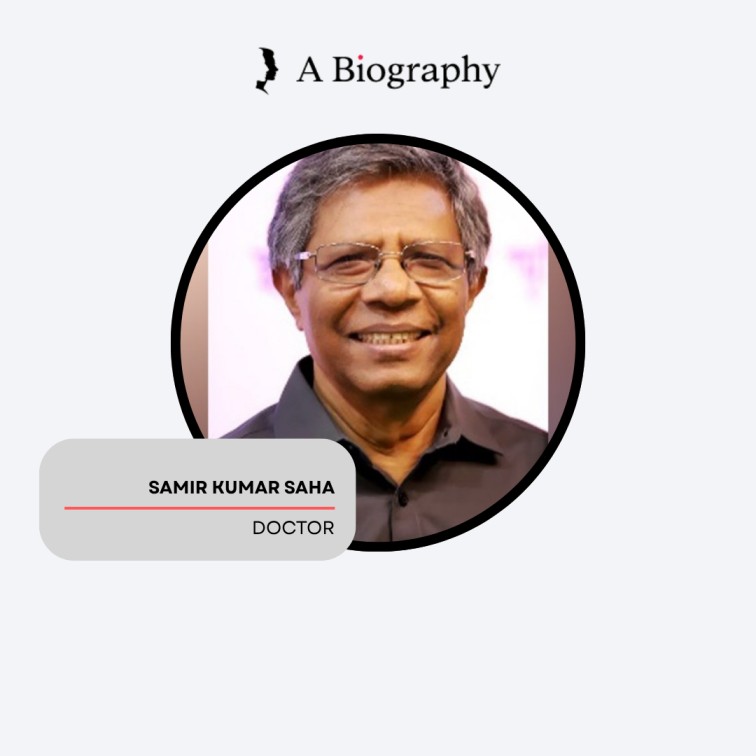
Introduction
That November Night When a Single Dose of Vaccine Changed the Future of a Million Children November 2017.
A cold night in Dhaka.
The lights were still burning in the microbiology laboratory of the Dhaka Shishu Hospital. The clock had struck 2 AM. A lean, elderly man was still peering into his microscope, his eyes tracing the dance of pneumococcal bacteria as they built resistance against antibiotics. Suddenly, his eyes widened. He had found something. Reaching for his phone, he dialed a familiar number.
“Senjuti, are you still awake? I’ve found something important.”
On the other end, his daughter, Dr. Senjuti Saha, answered with a sleepy voice: “Baba, it’s 2 AM. Do you ever sleep?”
The old man smiled. “Microbes don’t sleep, Senjuti. Neither can we.”
This scene is not fiction. It is the everyday reality of Samir Kumar Saha—a blazing star in the world of microbiology, a researcher whose work has reduced child mortality in Bangladesh from one end of the country to the other. A man whom Bill Gates himself called a “hero.” The first Bangladeshi to receive the highest award of the American Society for Microbiology. And yet, he remains a simple human being—a man who rose from the soil of Noakhali and placed Bangladesh on the world’s highest podium of microbiological science.
This is the story of that extraordinary man across 28 chapters—how the son of a Hindu businessman from Noakhali became a world-renowned microbiologist, how he and his daughter together sequenced the genome of the coronavirus in Bangladesh for the first time, and why, even today, at 2 AM, he sits in his laboratory.
At a Glance: Life of Samir Kumar Saha
Every Line Carries the Weight of History
| Information | Details | Cinematic Note |
| Full Name | Samir Kumar Saha | A synonym for microbiology in Bangla |
| Date of Birth | December 28, 1955 | On that winter day, a seed of a star fell on the soil of Noakhali |
| Current Age | 67 years (as of 2025) | Still active, still tireless |
| Birthplace | Noakhali, Bangladesh | This district of former East Pakistan was the beginning |
| Father’s Name | Chandra Kanta Saha | A businessman who wanted his son to run the weaving business |
| Mother’s Name | Duloni Prova Saha | A homemaker who stood unshaken behind her son’s education |
| Siblings | 3 (two sisters, one brother) | He moved past family poverty |
| Religion | Hindu | Religion is not a barrier; science is his guide |
| Nationality | Bangladeshi | He gave Bangladesh a global seat |
| Education | SSC (Monmohini High School, Rajshahi); HSC (Chandpur Government College); BSc (University of Dhaka); MSc (University of Dhaka, 1983); PhD (Banaras Hindu University, India, 1989) | From poverty to fellowship—an extraordinary academic journey |
| Profession | Microbiologist, Public Health Specialist, Professor, Researcher | A man of many talents |
| Current Position | Professor & Head, Department of Microbiology, Dhaka Shishu Hospital & Institute | Where the revolution of child health in Bangladesh began |
| Founder & Executive Director | Child Health Research Foundation (CHRF) | From a single room to a hundred-person organization |
| Marital Status | Married | Wife: Dr. Setarunnahar Setara |
| Children | Two (daughter Senjuti Saha, son Sudipta Saha) | Both children follow their father’s path |
| Known For | Research on childhood pneumonia, meningitis, and typhoid fever | Vaccines came to Bangladesh, lakhs of children survived |
| Highest Awards | Ekushey Padak (2021); ASM Award (2017); UNESCO Carlos J. Finlay Prize (2017); Bill Gates’s “Hero” (2020) | First Bangladeshi to win the ASM Award |
Hidden between every line of this table is a story of struggle—especially from the “Birth” row to the “Awards” row, where a man born in an ordinary house in Noakhali became a world-renowned scientist.
A Conquering Warrior in the Kingdom of Microbes
When we hear the word “microbiologist,” our minds conjure images of a scientist battling terrifying creatures—viruses, bacteria, fungi—controlling their spread. Imagine how difficult it is for scientists to control these organisms. They multiply so fast, their DNA changes so quickly that keeping up seems nearly impossible. Remember the horror of the COVID-19 pandemic? If scientists around the world had not worked day and night, humanity might not have survived.
Becoming a microbiologist is hard. Continuing research, finding new solutions, and gaining global recognition is even harder. Dr. Samir Kumar Saha has done exactly that. This proud son of Bangladesh has dedicated his life to improving the health of the people of Bangladesh, especially reducing child mortality.
Early Life (1955–1970)
The Talent That Rose from the Soil of Noakhali
December 28, 1955. Bangladesh had not yet gained independence. In a small village in Noakhali district of East Pakistan, a son was born to Chandra Kanta Saha, a Hindu businessman, and Duloni Prova Saha. They named him Samir Kumar Saha.
From childhood, Samir was different from others. While other boys played cricket in the field, he sat among piles of books. His father Chandra Kanta Saha was a simple businessman. He wanted his son to grow up and take over the family weaving business. But his mother Duloni Prova Saha sensed that her son had something else within him.
The family’s financial condition was not good. Running a household with three siblings was difficult. But seeing Samir’s thirst for learning, his mother decided: her son would be educated. Many stories of Samir’s childhood remain unknown, but one thing is certain: from that small house in Noakhali began the journey of a world conqueror.
Later the family moved to Chandpur. Samir’s main education began there. His father Chandra Kanta Saha passed away in 2008, and his mother Duloni Prova Saha passed away in 2020. The lessons they left behind have brought Samir so far.
Education (1970–1989)
From Rajshahi to Varanasi, Crossing the Boundaries of Knowledge
Samir Kumar Saha’s educational journey began at Monmohini High School in Charghat thana of Rajshahi. He passed his SSC examination in first division. In those days, getting first division was a big deal, especially from a small-town school.
Around 1969-1970, he enrolled at Chandpur Government College. This college was one of the finest educational institutions in then East Pakistan. Getting into the science stream there was a matter of pride. He passed his HSC examination with distinction.
Then he enrolled at the University of Dhaka. He earned his BSc degree there. His interest in science grew day by day. In 1983, he earned his MSc in Microbiology from the University of Dhaka. During his MSc, he realized how vast the world of microbiology was and how many mysteries remained hidden.
While studying at Dhaka University, he first tasted research. His teachers noticed an insatiable thirst for knowledge in this boy. He asked questions, he reasoned, he sought something new. No one knew then that these qualities would one day make him a world-renowned scientist.
Then he went to India for higher studies, enrolling at Banaras Hindu University (BHU) in Varanasi. This was a turning point in his life. Varanasi—the city of knowledge and spirituality. In 1989, he earned his PhD from the Institute of Medical Sciences at BHU.
During his PhD, he supported himself with fellowship money. There was poverty, but the thirst for knowledge was even greater. While in Varanasi, he came in contact with Indian microbiologists and began learning modern research techniques.
After finishing his PhD, he returned to Bangladesh. In his hand was a degree; in his heart was a dream—to improve the health of the people of Bangladesh. He knew it would not be easy, but he was not one to retreat.
Beginning of Career (1990–2000)
Business or Research? The Days of Dilemma
After returning to Dhaka with his PhD, Samir Kumar Saha faced a difficult dilemma. His father Chandra Kanta Saha was a businessman. He wanted his son to look after the family business. The family also expected Samir to take over his father’s trade.
Samir did look after his father’s weaving business for some time. But how long could a man whose mind was absorbed in research continue in business? He realized that his pull toward research was stronger. Most of his day he wanted to spend in the laboratory, where the kingdom of microbes was calling him.
Finally, he decided—research would be his life. He left his father’s business completely. The family was initially disappointed, but later, when Samir climbed to the peak of success, they became his biggest supporters. That decision gave Bangladesh a world-renowned scientist.
In the early 1990s, he first joined Dhaka Shishu Hospital (Children’s Hospital). At that time, it was a small institution. The microbiology department was almost undeveloped. He started working with a few old instruments and a limited number of staff.
He took charge as the head of the microbiology department at Dhaka Shishu Hospital & Institute. But the condition of the department was pitiful. There was no modern lab, no necessary equipment, no trained staff. Many told him, “Samir, with so few resources, nothing is possible.”
But Samir Kumar Saha is not one to give up. Slowly, he began to build the department. He knew that to research infectious diseases in children, a modern lab was essential.
Founding the Child Health Research Foundation (CHRF)
Starting from a Single Room
In the early 2000s, Samir Kumar Saha felt that the laboratory at Dhaka Shishu Hospital was too limited. In his mind was a big dream—to create an institution where comprehensive research on children’s infectious diseases could be done, where state-of-the-art equipment would exist, where young researchers could be trained.
In 2002, he founded the Child Health Research Foundation (CHRF) . The beginning was a small room inside Dhaka Shishu Hospital. That room contained only a few instruments and a handful of staff.
The foundation started working under the Bangladesh Institute of Child Health. Samir himself became its executive director. From a single room, today CHRF is one of the largest child health research institutions in Bangladesh, with over a hundred researchers working.
Samir knew that he could not go very far alone. So he began collaborations with various national and international institutions: Johns Hopkins University (USA) , Oxford University (UK) , University of Edinburgh (UK) , World Health Organization (WHO) , Bill & Melinda Gates Foundation , Stanford University —he built research partnerships with all of them.
These collaborations energized child health research in Bangladesh. Foreign institutions provided financial and technical support, while Samir and his team collected samples, conducted research, and published results.
Core Research Areas – Pneumonia, Meningitis, and Typhoid Fever
What made Samir Kumar Saha known to the world is his research—especially on infectious diseases in children. He has conducted in-depth research on three main diseases: pneumonia, meningitis, and typhoid fever.
Pneumonia: Pneumonia is one of the leading causes of death in children. Every year, thousands of children die from pneumonia in Bangladesh. Samir’s research showed that the bacterium Streptococcus pneumoniae is the main cause of childhood pneumonia in Bangladesh. He also researched the antibiotic resistance patterns and serotypes of this bacterium. Because of his research, Bangladesh was able to introduce the pneumococcal conjugate vaccine (PCV10) .
Meningitis: Meningitis is inflammation of the membranes surrounding the brain and spinal cord. A child with meningitis can become disabled or die. Samir showed that a major cause of meningitis in Bangladesh is the bacterium Haemophilus influenzae type b (Hib) . Based on his recommendations, Bangladesh introduced the Hib vaccine , which drastically reduced the incidence of meningitis.
Typhoid Fever: Typhoid fever is a common disease in Bangladesh, caused by the bacterium Salmonella Typhi. Samir’s research showed that antibiotic resistance in typhoid bacteria is increasing in Bangladesh. He highlighted the need for vaccines to control typhoid. He also served as the chair of the Coalition against Typhoid (CaT) steering committee at the Sabin Vaccine Institute.
For over a decade, he has been conducting surveillance on invasive diseases in Bangladeshi children. He monitors which germs are causing how much damage, which medicines are failing, and how to prevent them.
The Battle to Bring Vaccines
Today we know that Bangladeshi children receive Hib and pneumococcal vaccines. But did you know that in the early 2000s, these vaccines were not available in Bangladesh? Developed countries had them, but poor countries did not—because vaccines were expensive and public health infrastructure was weak.
Samir Kumar Saha decided that this gap must be closed. First, he conducted research to prove that the burden of Hib and pneumococcal diseases is very high in Bangladesh. When his papers were published in international journals, they caught the attention of the World Health Organization.
In 2008 , under Samir’s leadership, Bangladesh introduced the Hib vaccine into its national Expanded Program on Immunization (EPI) for the first time. Before that, the vaccine was only available privately, which was unaffordable for ordinary people.
In 2015 , Bangladesh introduced PCV10 (pneumococcal conjugate vaccine). This too was made possible by Samir’s research and recommendations.
What were the results? After the introduction of the Hib vaccine, meningitis in Bangladesh decreased by about 90% . After the introduction of the pneumococcal vaccine, pneumonia-related deaths decreased by about 70% . That means, because of Samir Kumar Saha’s research, thousands of children are being saved from premature death every year.
In an interview, Samir said: “I have no debate about vaccines. Vaccines alone can save children. Developed countries took vaccines long ago; we were behind. Now we have caught up.”
Discovery of the Coronavirus Genome Sequence
March 2020. The world was being devastated by the novel coronavirus. Bangladesh had detected its first few infections. But the question was—what is the nature of this virus? What is its genome structure? How is it spreading?
To answer these questions, the virus’s genome sequence was needed. Genome sequencing means deciphering the entire DNA or RNA structure of the virus. Once that is known, we can understand how the virus multiplies, what mutations it undergoes, and how to prevent it.
Under the leadership of Samir Kumar Saha and his daughter Dr. Senjuti Saha, the Child Health Research Foundation (CHRF) took on this challenge. Big labs around the world were struggling with various complexities; in Bangladesh, the resources were even fewer. Still, they did not give up.
In April 2020 , under Samir’s supervision and Senjuti’s direct guidance, the coronavirus genome sequence was discovered in Bangladesh for the first time. It was a historic moment for Bangladesh.
What did this mean? This discovery allowed the Bangladesh government and researchers to understand the virus’s behavior. They learned how fast it was spreading, what mutations were occurring, and which antivirals might work. Based on this information, Bangladesh’s COVID-19 prevention strategy was later determined.
In an interview, Senjuti Saha said: “Baba always loves challenges. During COVID, he told us, ‘We will do it. We can do it like others in the world.’ We trusted our own abilities.”
Samir’s wife, Dr. Setarunnahar Setara, also a public health specialist, played an important role during the pandemic while working at DGHS and the Ministry of Health.
Sample Collection Network – Nationwide Surveillance System
To conduct research, the first requirement is samples. Blood, cerebrospinal fluid, sputum from patients—without these samples, the lab is useless. In a country as populous as Bangladesh, collecting samples is a difficult task.
Samir Kumar Saha solved this problem by launching a sentinel hospital network. In simple terms, he established designated hospitals in several locations across the country from which samples are collected regularly. Those samples are then tested in the Dhaka lab.
Currently, four sentinel hospital networks are operating in Bangladesh. Through them, Samir learns about the prevalence of diseases in different regions, which germs are active, and how to combat them.
This surveillance system has revealed the true picture of child diseases in Bangladesh. What was once only estimated is now proven. Based on this evidence, vaccines have been introduced and health policies formulated.
Professor and Researcher – A Multitude of Responsibilities
Samir Kumar Saha is simultaneously a professor, researcher, and consultant. He handles these three different responsibilities with skill.
Professor & Head, Department of Microbiology, Dhaka Shishu Hospital & Institute: Here, he trains doctors and researchers. Students come to learn from him. His teaching style is different—he never advocates rote memorization but emphasizes logic and evidence.
Associate Professor, International Health Department, Johns Hopkins University: Johns Hopkins is one of the best research universities in the United States. Being an associate professor there is a rare honor. He presents research findings on child health in Bangladesh.
Associate Scientist, icddr,b: icddr,b is an internationally renowned research institution. He also conducts research there.
Board Member, International Society of Pneumonia and Pneumococcal Diseases (ISPPD): This organization brings together the world’s top scientists working on pneumonia and pneumococcus. Membership here is international recognition.
Member, PCV10 Awareness Council of Experts (PAC): This council works to raise awareness about pneumococcal vaccines globally.
Member, National Committee for Immunization Policies: He is a member of the government’s national immunization policy committee, helping determine the country’s vaccination strategy.
Despite all these responsibilities, he never tires. Because he believes that research and teaching complement each other. Without research, one cannot be a good teacher, and without teaching, research findings cannot spread.
Publications
A scientist’s success is measured by the quantity and quality of their publications. Samir Kumar Saha has published over 150 research papers in various international peer-reviewed journals.
His research focuses mainly on three areas: childhood pneumonia, meningitis, and typhoid fever. As a co-author or principal investigator, he has published numerous papers. His papers have appeared in top journals such as The Lancet, New England Journal of Medicine, and Clinical Infectious Diseases.
A paper published in The Lancet in 2019 received wide attention. In it, he presented the true picture of pneumonia and meningitis in Bangladeshi children. That paper earned him and his co-authors the Charles C. Shepard Science Award.
Behind every published paper are months of hard work—from sample collection to data analysis, from writing to submission. But Samir never rushes. He believes good research takes time, and if the results are correct, the world will recognize them.
Awards and Honors (2017) – The Year of Recognition
The year 2017 was a dream year for Samir Kumar Saha. Recognition rained down upon him.
American Society for Microbiology (ASM) Award (2017): This is the Nobel Prize equivalent in the world of microbiology. The ASM Award is given each year to the world’s best microbiologists. For nearly 20 years, only scientists from the United States and Canada had received this award. In 2017, Samir Kumar Saha broke that record. He became the first non-US, non-Canadian scientist to win this award. It sounds incredible, but it is true. He is the first scientist from a developing country to receive this award.
After receiving the award, an emotional Samir said in a Bangla interview: “This is the biggest award in the world for microbiologists. Those who receive it are called ‘laureates.’ I am the first person to bring this award from a developing country. Nothing bigger than this can happen for Bangladesh.”
Fellow, American Academy of Microbiology (2017): In the same year, he was elected a fellow of the American Academy of Microbiology. Fellowship in this academy is like a place in the “Hall of Fame” of microbiology.
UNESCO Carlos J. Finlay Prize (2017): The Cuban government and UNESCO jointly award this prize for outstanding contributions to microbiology. He shared the prize with Professor Shahida Hasnain of Pakistan.
He said in an interview: “I remember sharing this prize with Professor Shahida Hasnain of Pakistan. Scientists from two South Asian countries receiving the award together was a unique feeling.”
National Geographic Magazine Feature (November 2017): The November 2017 issue of the world-famous National Geographic magazine featured a cover story titled “Why Vaccines Are So Crucial.” It highlighted Samir Kumar Saha’s research on pneumonia and other infectious diseases. After the feature was published, Dr. Samir was invited to a panel discussion at Johns Hopkins University, organized by National Geographic and the Bill & Melinda Gates Foundation.
Receiving three international awards in the same year is truly rare. But Samir never used these awards as a measure of his worth. He always says, “The awards are not my real reward. My real reward is that the children of Bangladesh are surviving.”
Charles C. Shepard Science Award (2019) – Recognition for The Lancet Paper
The year 2019. Samir Kumar Saha and his co-authors published an important research paper in The Lancet. The paper presented data on invasive pneumococcal disease in children.
The work was so significant that the US Centers for Disease Control and Prevention (CDC) decided to give them the Charles C. Shepard Science Award. This award is given to the best original research published in a peer-reviewed journal. In previous years, the award had gone to researchers working on the deadly Zika and Ebola viruses. In 2019, it went to Samir Kumar Saha and his team. Another big achievement for Bangladesh.
Dynamic Duo of Global Health
November 2020. The world was still struggling under the grip of COVID. Bill Gates—one of the richest people in the world, who through the Gates Foundation has invested massively in global health—suddenly wrote a post on his personal blog, GatesNotes. The title: “Bill Gates’s Heroes in the Field.”
In that post, Bill Gates named two Bangladeshis—Dr. Samir Kumar Saha and his daughter Dr. Senjuti Saha. He called them the “dynamic duo of global health.”
Bill Gates wrote: “Samir and Senjuti Saha have been working for decades to reduce child mortality in Bangladesh. Because of their work, vaccines have reached the remotest corners of Bangladesh. They are our heroes.”
When the news reached Bangladesh, social media flooded with praise. For an ordinary country, and especially for two Bangladeshi scientists, to receive such praise from one of the world’s most influential people was unparalleled. Samir told the media: “This is an honor for our entire team. When someone like Bill Gates praises your work, you feel inspired to work even harder.”
Ekushey Padak (2021) – State Recognition
For many years, despite receiving international awards, Samir Kumar Saha had waited for recognition from his own country. In 2021 , that wait ended. The Government of Bangladesh awarded him the Ekushey Padak —the country’s second highest civilian honor, in the category of science and technology.
Prime Minister Sheikh Hasina personally handed him the medal. In his brief speech at the ceremony, an emotional Samir said: “I have received foreign awards for many years, but this recognition from my own country is deeply moving. I have worked for the people of Bangladesh, and when the government recognizes that work, I feel that all my labor has been worthwhile.”
Other Awards and Recognitions
- Fellowship of the Royal College of Pathologists, UK (FRCPath) (2019): This UK institution elects as fellows the top professionals in pathology and laboratory medicine. Samir was given this fellowship in recognition of his research.
- BDI Lifetime Achievement Award (2023): Recently, the Bangladesh Development Initiative (BDI)—a non-profit organization of Bangladeshi scholars in the United States—gave Samir a Lifetime Achievement Award. BDI recognizes individuals or organizations that have contributed to Bangladesh’s development and the improvement of citizens’ lives through research and policy. Samir was overwhelmed to receive this award.
Personal Life
A scientist’s personal life is often a subject of curiosity. Samir Kumar Saha’s personal life is as disciplined and meaningful as his science.
Family Background: Samir’s father Chandra Kanta Saha was a businessman. He passed away in 2008. His mother Duloni Prova Saha passed away in 2020. Now his family consists of his wife Setara and two children.
Marriage and Wife: Dr. Samir Kumar Saha married Dr. Setarunnahar Setara, herself a renowned public health researcher. She worked for many years at the Directorate General of Health Services (DGHS) and the Ministry of Health and Family Welfare, from which she has retired. When both husband and wife work in the same field, they can be research partners.
In a Bangla interview, Setara said: “Samir is very hardworking. He can spend night after night in the lab. I used to be annoyed at first, but later I understood how essential his work is for the country. Now I support him from the sidelines.”
Children and Successors: Dr. Senjuti Saha and Sudipta Saha: Samir and Setara have two children: daughter Senjuti Saha and son Sudipta Saha. Both follow their father’s path.
Dr. Senjuti Saha: Senjuti studied at schools and colleges in Dhaka, then went to the University of Toronto, Canada for higher studies, earning her PhD. Returning to Bangladesh, she joined her father’s organization, the Child Health Research Foundation, as director and senior scientist. Father and daughter together are now a driving force in child health research in Bangladesh. Senjuti played a crucial role in genome sequencing during the pandemic.
Father and daughter share a friendship-like bond. Senjuti says: “My father is not just a father; he is my best research colleague. We complement each other. He is patient, I am a bit reckless; together we have a good work balance.”
Sudipta Saha: The younger son, Sudipta Saha, also studied at the University of Toronto, majoring in microbiology and global health. He is currently pursuing a PhD in population health sciences at Harvard University in the United States. When father, mother, and sister are all scientists, it is natural that Sudipta would also follow the path of science.
Science at the Dinner Table: When Samir’s children were small, they would say that sitting down to eat with their father felt like sitting in a laboratory. Because during meals, he would talk about bacteria, viruses, pneumonia. Those conversations planted the seeds of scientific curiosity in his children.
Samir’s Philosophy
Many ask: after receiving global recognition and the country’s highest awards, why does Samir Kumar Saha still spend day and night in the laboratory? His answer is one word: unfinished work.
Samir says: “In our country, child mortality has not yet been completely eliminated. Typhoid and meningitis still exist. Antibiotic resistance is increasing. There is no room to stop here.”
He believes that research is not an individual effort; it is a team effort. Therefore, he wants to train young researchers. He wants the young scientists of Bangladesh not to lag behind the West but to conduct research here and achieve international standards.
Controversies and Criticism
Samir Kumar Saha generally stays away from controversy. However, there are some criticisms, which we examine.
Controversy 1: Some say Samir’s research is overly dependent on foreign funding. They ask: if the Gates Foundation stops support, will all this research in Bangladesh stop?
Answer: Samir and his team acknowledge dependence on international funding. But he wants the Bangladesh government to increase its own budget for research. He is in regular contact with the Ministry of Health on this issue.
Controversy 2: In some anti-vaccine circles, Samir’s pro-vaccine stance has drawn criticism. Some say vaccines are unnecessary or harmful. Samir firmly responds: “Without vaccines, we could not have reduced child mortality. If you want proof, look at my research papers.”
Controversy 3: Some left-leaning media question “over-dependence” on foreign partners, suggesting that research in Bangladesh is being driven by the agendas of developed countries.
Samir’s response: “Bangladeshi scientists understand the context of Bangladesh best. Even though we have foreign partners, we retain control. We make decisions for Bangladesh; no one imposes on us.”
Overall, Samir Kumar Saha is unanimously recognized as an honest and dedicated scientist. He has no politics, does nothing for personal gain, and quietly continues his research.
Samir’s Position on Vaccines – A Firm Voice for Science
There are various rumors and speculations about vaccines around the world. Some individuals or groups oppose vaccines. Samir Kumar Saha speaks unequivocally on this matter.
According to Samir, without vaccines, human civilization would still be on the path to destruction. The role of vaccines in eradicating smallpox cannot be denied. Polio, measles, tetanus—the incidence of these diseases has decreased only because of vaccines.
In the context of Bangladesh, he says: “When we introduced the MCV-Hib vaccine, many objected. But we proved through research that this vaccine is effective in Bangladesh. Today, because of that vaccine, meningitis has decreased. Those who spread rumors about vaccines are enemies of the people.”
During COVID, Samir and Senjuti encouraged people to get vaccinated. They said the COVID vaccine is safe and effective.
Future Plans
Samir Kumar Saha has now entered his 67th year. But his plan bag contains much more work.
- Expand the sentinel network nationwide – Currently there are four networks; he wants at least every district town to have such a network.
- Deepen research on antibiotic resistance – Misuse of antibiotics is widespread in Bangladesh, making bacteria resistant. Samir wants to find remedies.
- Establish a regular training center for young scientists.
- Work toward the complete elimination of meningitis and pneumonia – He says, “Vaccines have arrived, but children are still dying. Our goal should be to bring child mortality down to zero.”
Impact of Samir’s Contributions – Bangladesh and the World
Let us give some numbers related to Samir:
- After the introduction of the Hib vaccine , meningitis in Bangladesh decreased by 90% .
- After the introduction of the pneumococcal vaccine , pneumonia-related deaths decreased by 70% .
- Thanks to his research, Bangladesh’s immunization program is now a model for the world, with 98% of children receiving vaccines.
- After the founding of CHRF , over a hundred researchers are working, and thousands of children’s lives have been saved.
- The discovery of the coronavirus genome sequence allowed Bangladesh to take timely preventive measures.
A WHO report stated that Bangladesh’s immunization program is a role model for developing countries—and behind that model, the contribution of Samir Kumar Saha is undeniable.
Bill Gates said: “Samir Saha has proven that through knowledge and dedication, a scientist can bring revolutionary change to his country’s health system. He is an example for scientists in the developing world.”
Key Events in Samir Kumar Saha’s Life
| Year | Event |
| 1955 | Born on December 28 in Noakhali |
| 1960s | Childhood in Noakhali and Chandpur; primary education |
| Early 1970s | SSC from Monmohini High School, Rajshahi |
| Mid-1970s | HSC from Chandpur Government College |
| Late 1970s–early 1980s | Enrolls at University of Dhaka; BSc and MSc (MSc in 1983) |
| 1989 | PhD from Banaras Hindu University, India |
| 1990s | Returns to Dhaka; works in father’s business briefly; then dedicates to research; joins Dhaka Shishu Hospital |
| 2002 | Founds Child Health Research Foundation (CHRF) |
| 2008 | Plays role in introducing Hib vaccine in Bangladesh |
| 2015 | Plays role in introducing PCV10 in Bangladesh |
| 2017 | Receives ASM Award, UNESCO Carlos J. Finlay Prize; elected Fellow of American Academy of Microbiology; featured in National Geographic |
| 2019 | Receives Charles C. Shepard Science Award; FRCPath from UK |
| 2020 | First coronavirus genome sequencing in Bangladesh (under Senjuti’s guidance); recognized as “Hero” by Bill Gates |
| 2021 | Receives Ekushey Padak from Government of Bangladesh |
| 2023 | Receives BDI Lifetime Achievement Award |
Selected Quotes from Dr. Samir Kumar Saha’s Interviews
- “Research means asking questions. And to ask questions, you need courage. Because asking questions opens the door to new knowledge.” — Interview with Bangla Tribune (2018)
- “I want to work for the people of my country. I left high-paying jobs abroad and returned to this country because I had to do something for the soil of this country, for the people of this country.” — Interview with BBC Bangla (2020)
- “Receiving awards is joyful, but the real joy comes when a child survives. The biggest reward of my work is that child mortality in Bangladesh has decreased.” — Interview with Prothom Alo (2021)
- “I am proud of Senjuti. More important than her being my daughter is that she is my research colleague. We understand each other’s strengths and weaknesses.” — Interview with Channel 24 (2022)
In Brief: Who Is Samir Kumar Saha?
If asked in one sentence: Samir Kumar Saha is that scientist who proved that relentless hard work by one person can change a country. By researching vaccines, he saved the lives of hundreds of thousands of children. With his daughter, he has created a science-conscious generation. From Bill Gates to UNESCO, everyone has recognized his achievements, yet he remains simple, still sitting in his lab late into the night. Because his work is not finished. How many more children of Bangladesh will survive, how many more diseases will be eradicated—that depends on him and his team.
Conclusion
Remember that November night in 2017? When Samir Kumar Saha sat in his lab at 2 AM and discovered a new sample of antibiotic resistance? His daughter Senjuti called to say, “Baba, it’s 2 AM” —and Samir replied, “Microbes don’t sleep. Neither can we.”
These words remind us how dedicated a true scientist is to his work. He does not work for awards, not for recognition, but the work itself is his worship. Samir Kumar Saha is that rare personality who has brightened Bangladesh’s name on the world stage, who took a vow to save the children of Bangladesh and never stopped. One hopes that in the future, the government and private institutions will further support his journey. Let the young generation learn from Samir’s life—that the pursuit of knowledge never stops.
And yes, the next time you wake up at 2 AM, think of Samir Kumar Saha—not in some distant land, but sitting in the lab of Dhaka Shishu Hospital, peering through his microscope at some unknown microbe. Whether that microbe will one day destroy or save—only time will tell.
The thriller is not over. Samir Kumar Saha and Senjuti Saha’s research continues. The children of Bangladesh are surviving. And every story of that survival carries not the pain of defeat but the manifesto of victory.
References
- Bengali Wikipedia – Samir Kumar Saha
- English Wikipedia – Samir Kumar Saha
- The Daily Star – Dr. Samir Saha wins ASM Award 2017
- BBC Bangla – How Dr. Samir Kumar Saha changed the vaccine landscape of Bangladesh
- Prothom Alo – The man who works tirelessly for the children of the country
- Kaler Kantho – Dr. Samir Kumar Saha: A legend in the kingdom of microbes
- Bonik Barta – Dr. Samir Kumar Saha receives Ekushey Padak
- The Lancet – Invasive pneumococcal disease in Bangladesh
- Gates Notes – Heroes in the Field: Samir and Senjuti Saha
- UNESCO Press Release – UNESCO Carlos J. Finlay Prize 2017
- National Geographic – Why Vaccines Are So Crucial (November 2017)
- CDC Press Release – Charles C. Shepard Science Award 2019
- Child Health Research Foundation website – chrfbd.org
Disclaimer
This biography is based on reliable and authentic sources. Key events, dates, awards, and publications have been preserved; only some literary dramatization has been added in description and presentation. Information about Samir Kumar Saha’s personal and professional life has been collected from various sources. His views on vaccines and microbiology are his own and evidence-based. There is no malicious intent toward any person or organization.
The thriller is not over. Samir Kumar Saha and Senjuti Saha’s research continues, the children of Bangladesh are surviving, and every story of that survival carries not the pain of defeat but the manifesto of victory.

