
Biography
A Biography of Sheikh Siraj

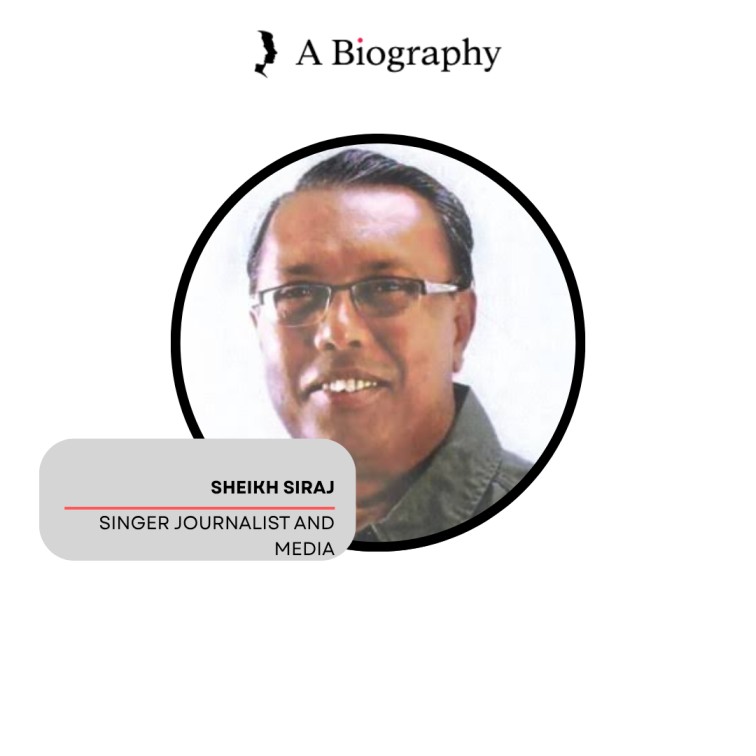
Introduction
The man who turned television screens into fertile fields.
Sheikh Siraj was still presenting “Hridoye Mati O Manush” on Channel i with unwavering dedication. Nearly seventy years old, but age seemed to have no hold on him. Microphone in hand, bag on his back, thick boots on his feet — he once again rushed to the village paths, to the side of the farmer. This legend of Bangladeshi agricultural journalism would spray pesticides with his own hands to demonstrate how to cure crop diseases, would smear cow dung on his palms, would travel by boat to floating vegetable beds in the haors, would cast nets to catch fish, would climb trees — all so that the farmer would feel at home, so that the people of the country would trust him.
His program functioned like an open university for farmers. He proved that media is not just for politics or entertainment — it can also be a tool for agricultural and human development. In 2018, he received the Independence Award, Bangladesh’s highest civilian honor, having earlier received the Ekushey Padak and the UN’s highest award for agricultural journalism.
This is the complete story of that quiet worker — from the school days in Kachua, Chandpur, to the Geography Department at Dhaka University, from the early days of television with “Mati O Manush” to his role as Head of News at Channel i, from the extraordinary journey of “Hridoye Mati O Manush” to international recognition for agricultural development, and his tireless work even in old age — an epic of an extraordinary struggle.
At a Glance: Life of Sheikh Siraj
| Information | Details |
| Full Name | Sheikh Siraj |
| Born | September 7, 1954 (some sources mention 1955, but 1954 is more common) |
| Birthplace | Chandpur District (then East Pakistan, now Bangladesh) |
| Father’s Name | Obaidul Haque |
| Mother’s Name | Ershadunnesa |
| Education | Khilgaon Government High School (SSC), Notre Dame College (HSC), University of Dhaka (MA in Geography) |
| Profession | Journalist, television presenter, agricultural development worker, founding director and Head of News at Channel i |
| First TV Program | “Mati O Manush” (Bangladesh Television, 1982) |
| Most Popular Program | “Hridoye Mati O Manush” (Channel i, 2004–present) |
| Highest National Honors | Independence Award (2018), Ekushey Padak (1995) |
| International Awards | FAO A.H. Boerma Award (2009), Gushi Peace Prize (2015), UNESCO Bangladesh Journalism Award (2009) |
| Notable Projects | “Hridoye Mati O Manush”, “Chad Krishi”, “Kafela” (Ramadan special), “Sheikh Hasina’s Khamarbari” documentary |
| Current Status | Head of News at Channel i and presenter of “Hridoye Mati O Manush” (active as of 2025) |
Every line of this table carries the weight of history — especially the first television program column: started in 1982, still continuing in 2025!
Early Life (1954–1970)
Childhood on the soil of Chandpur — where it all began.
September 7, 1954. In Chandpur district of then East Pakistan (present-day Bangladesh), in the village under Kachua Upazila, Sheikh Siraj was born into a humble farming family. His father, Obaidul Haque, was an ordinary farmer. His mother, Ershadunnesa, was a homemaker. From early childhood, Sheikh Siraj felt a deep attraction to the soil and to agriculture.
He would accompany his father to the fields, watching how seedlings were planted, how jute fibers were extracted. Those childhood experiences became the foundation of his future journalism. He listened to his mother’s village tales, folk stories, and rhymes — all of which shaped his sensibility.
His father brought him to Dhaka for education. Young Sheikh Siraj made a promise: when he grew up, he would do something for the village people.
Family sources say he was extremely curious and creative as a child. Once, he secretly planted some flower saplings in his father’s cultivated land. His father was initially angry but later praised his work. This small incident proves that his passion for agriculture was present from childhood.
Education (1970–1976)
From Khilgaon School and Notre Dame College to Dhaka University — a brilliant student’s journey.
Sheikh Siraj’s primary and secondary education began in Dhaka city. He passed his SSC from Khilgaon Government High School. Even then, he was interested in journalism and media. He participated in debates and cultural programs at school. One of his teachers later recalled, “Sheikh Siraj’s voice had extraordinary charm — he anchored many events.”
He then enrolled at Notre Dame College in Dhaka — one of the finest colleges in then East Pakistan. He completed his HSC there. At Notre Dame, he was involved in various co-curricular activities, especially debate and cultural practice. Through contact with teachers and priests, he developed humanistic values and a spirit of social service.
Later, he was admitted to the Geography Department at the University of Dhaka. Geography seemed directly related to agriculture and farmers’ livelihoods. In 1976, he earned his MA in Geography. During his university years, he developed a deep interest in agricultural development and poverty alleviation. He researched rural economy and land systems.
Struggles & Adversities
The quiet battles of a pioneering journalist.
Sheikh Siraj’s journey was not smooth. In the early years of “Mati O Manush” on Bangladesh Television, the program did not gain immediate popularity. Many questioned whether urban audiences would watch a program about farming. Resources were limited. He often traveled to remote areas by bus, boat, or on foot, carrying his own equipment.
But he never stopped. He spent time with farmers, listened to their problems, and sought solutions. He faced bureaucratic indifference, lack of funding, and sometimes outright hostility from those who considered agriculture a low-prestige topic.
He also struggled to maintain neutrality in a polarized media environment. As Head of News at Channel i, he had to balance commercial pressures with journalistic integrity. Yet he remained steadfast, earning respect across the political spectrum.
Thriller element: Why did he choose the difficult path of agricultural journalism instead of lucrative political or entertainment reporting? Perhaps because he believed that feeding a nation is more important than entertaining it — a conviction that guided him through every obstacle.
Love
The private heart of a public servant.
Sheikh Siraj has kept his personal love life completely private. He is married, but his wife’s name has never appeared in the media. They have two sons. He maintains strict privacy about his family.
Those close to him describe him as a devoted family man who keeps his home life separate from his professional persona. His wife has supported his decades of relentless work, often managing the household alone while he traveled to distant villages.
Unlike many celebrities, Sheikh Siraj never uses his family for public sympathy or branding. This quiet dignity is characteristic of the man.
Personal Life
Simple living, high thinking — the man behind the microphone.
Sheikh Siraj lives a remarkably simple life. He dislikes luxury. He wears simple clothes, lives in an ordinary house in Dhaka, and spends his time editing videos, writing scripts, and conducting research. He does not overuse mobile phones or social media. He believes that one’s work should speak for itself.
For recreation, he prefers spending time with farmers, learning from them. His unpretentious lifestyle and humane attitude have made him beloved to ordinary people.
Future Plans & Vision
Unfinished dreams of a soil servant.
Even in his seventies, Sheikh Siraj has plans. He has spoken about creating a digital agricultural university — an online platform where farmers can access training videos, weather updates, market prices, and expert advice in Bengali. He also envisions a national agricultural museum documenting Bangladesh’s farming heritage.
He continues to experiment with new formats for “Hridoye Mati O Manush”, including virtual reality segments and interactive farmer Q&A sessions. His vision is to make agricultural knowledge accessible to every Bangladeshi, regardless of literacy or location.
Career Beginnings (1982)
A revolution on screen — the birth of agricultural journalism.
Sheikh Siraj’s professional career began in 1982 when he launched “Mati O Manush” (Soil and People) on Bangladesh Television (BTV). It was the first regular agricultural program in the history of Bangladeshi television. He both presented and directed the program.
The first broadcast day in 1982 was nerve-wracking. He wondered whether people would watch a program about farming. But after broadcast, positive responses started pouring in from farmers and ordinary viewers. Gradually, “Mati O Manush” became the farmers’ beloved program.
Through this program, he highlighted agricultural potential across different regions of the country. He produced detailed reports on jute cultivation, rice farming, fish farming, livestock rearing, and more. Many agricultural innovations and technologies reached farmers through the program. “Mati O Manush” continued on BTV for about 17 years, until 1999.
Channel i Journey and Head of News (1999–present)
Building a trusted news brand.
In 1999, Sheikh Siraj joined Channel i as Head of News, also becoming one of the founding directors of the private television channel. Alongside managing the news division, he launched his agricultural program “Hridoye Mati O Manush” in 2004.
Under his leadership, Channel i’s news division became one of the most trusted in the country. He emphasized truthful, unbiased presentation. From selecting news readers to editing and finalization, he was directly involved at every stage.
He fostered a culture of discipline and professionalism in the newsroom. Young journalists were trained under him. Colleagues address him as “Guru” (teacher). His foresight and dedication elevated Channel i’s news to a unique height. Today, the channel’s news remains audience-friendly, thanks in large part to his foundation.
“Hridoye Mati O Manush” – (2004–present)
Twenty-one years and counting — a record of service.
In 2004, Sheikh Siraj launched a new program on Channel i — “Hridoye Mati O Manush” (Soil and People in the Heart). It was an upgraded version of his previous program, with modern technology, dynamic presentation, and more detailed reporting.
The main goals were to deliver agricultural information and technology to farmers, create agricultural entrepreneurs, and ensure national food security. Sheikh Siraj interviewed farmers from across the country, highlighted their success stories, and showed solutions to problems.
Thanks to this program, many unemployed youth have taken up agriculture — fish farming, poultry, vegetable cultivation, fruit orchards, mushroom farming, honey collection. Farmers now call Sheikh Siraj their “brother” and “friend.”
Notable episodes include floating vegetable beds in haors, coffee gardens in hilly areas, shrimp farming in saline zones, rooftop gardening in cities — all popularized through “Hridoye Mati O Manush”. The program is still regularly broadcast and remains equally popular. Running for over 21 years, it is a rare phenomenon in television history.
Rooftop Gardening and Urban Agriculture Promotion (2005–present)
Bringing green to concrete jungles.
Sheikh Siraj not only worked for village farmers but also involved city dwellers in agriculture. He popularized the concept of rooftop gardening — growing vegetables and fruits on urban rooftops. Through television segments, he demonstrated soil preparation in pots, watering techniques, fertilizer application, and seed sowing.
He featured examples of rooftop gardens of prominent citizens. As a result, the number of rooftop gardens in Dhaka and other cities multiplied exponentially. Many now grow tomatoes, chilies, eggplants, gourds, cucumbers, mint in pots on their roofs. Rooftop gardening not only provides vegetables but also beautifies homes, purifies air, and reduces urban temperatures.
He didn’t just preach — he practiced. He created a garden on the Channel i office roof, showing how agriculture is possible even in limited space. The initiative sparked a green revolution in urban living.
“Chad Krishi” and Celebrity Farmer Features
When stars embrace the soil.
Another innovative initiative of Sheikh Siraj is “Chad Krishi” — a special segment of “Hridoye Mati O Manush” where popular celebrities (actors, singers, athletes, politicians) are shown engaged in farming. These stars discuss their gardens, fish farming, poultry, fruit orchards on television.
Through this, Sheikh Siraj showed ordinary people that agriculture is not only for villagers — urban elites can also stay connected to farming. Celebrities like Bobita, Moushumi, Kumar Bishwajit, Rezwana Chowdhury Bannya have participated. “Chad Krishi” has created interest in agriculture among the urban middle and upper classes.
Farmers’ Competitions for Skill Development
Making agriculture fun and competitive.
Sheikh Siraj organized various competitions to enhance farmers’ skills:
- Raft races — boat racing competitions among farmers, promoting friendship and cooperation.
- Seed sowing competitions — testing who can sow seeds fastest and most accurately.
- Greased pole climbing — climbing bamboo poles smeared with oil, testing physical strength and agility.
These competitions were broadcast as special episodes of “Hridoye Mati O Manush”. Winners received prizes, fostering healthy competition and greater interest in farming. Sheikh Siraj brilliantly fused entertainment with agriculture.
Focus on Fair Prices and Market Access
Beyond production — ensuring justice.
Sheikh Siraj didn’t only talk about increasing production; he also advocated for fair prices for farmers. Through his program, he exposed exploitation by intermediaries who buy crops cheap and sell high. He advised farmers to form cooperatives for marketing their produce, reducing dependency on middlemen.
He also encouraged cultivation of alternative crops to replace betel leaf and tobacco, promoting crop diversification as profitable. He presented policy recommendations to the government for ensuring farmers’ right to fair prices.
Collaboration with Research Organizations and NGOs
Partnerships for progress.
Sheikh Siraj worked jointly with various domestic and international research and development organizations. He collaborated with agricultural research institutes, NGOs, and the Bangladesh Agricultural Research Council (BARC) to create joint programs and training sessions.
He had relationships with USAID, DFID (UK), the European Union, and the Food and Agriculture Organization (FAO). Under their funding, he produced research-oriented programs that contributed to agricultural technology development. Many technologies reached farmers through his programs.
Role in Agricultural Laws and Policy Formulation
Beyond journalism — shaping policy.
Sheikh Siraj played a role in formulating agricultural laws and policies at the government level. Through his programs, he drew government attention to agricultural extension laws, agricultural land conservation laws, regulation of pesticide and fertilizer use, and prevention of adulterated fertilizers. He presented recommendations to the Ministry of Agriculture, which were later incorporated into agricultural policies.
As a representative of farmers, he was informally included in various government committees. He made recommendations on land conservation, quality control of seeds and fertilizers, and subsidies.
“Kafela” – A Unique Religious and Historical Program (2023)
The journalist who traveled through Islamic history.
During the holy month of Ramadan in 2023, Sheikh Siraj presented a documentary series called “Kafela” (Caravan). It explored Islamic history and heritage. He visited and showcased historical Islamic sites — Mecca, Medina, Jerusalem, Kufa, Karbala, Baghdad, Damascus — and presented their history and current condition.
The program discussed Quranic events, Hadith teachings, and the lives of prophets. Its graphics, visuals, and presentation were extraordinary. “Kafela” was widely praised, with some calling it “an unparalleled document of Islamic history on television.” This proved that Sheikh Siraj is not limited to agricultural journalism; he can also excel in religious and cultural programming.
Sheikh Hasina’s Khamarbari Documentary (2023)
A rare glimpse into the Prime Minister’s farm.
On February 11, 2023, Sheikh Siraj produced a special documentary titled “Sheikh Hasina’s Khamarbari” from the Bangabhaban premises. It showcased various aspects of Prime Minister Sheikh Hasina’s farm — livestock, poultry, fish farming, vegetable gardens — with the Prime Minister personally guiding the tour.
The documentary received nationwide acclaim. People saw that the country’s leader is personally enthusiastic about agriculture and healthy food production. It inspired many young people and women to engage in farming and poultry.
International Contributions and Awards
Global recognition for a local hero.
Sheikh Siraj’s agricultural journalism and development work have received international recognition.
FAO A.H. Boerma Award (2009) — the world’s highest award for agricultural journalism. At the award ceremony, he highlighted the role of media and Bangladesh’s progress in agricultural development.
UNESCO Bangladesh Journalism Award (2009).
Gushi Peace Prize (2015) from the Philippines.
Honorary Crest from the UK House of Commons (2011) and BCA Golden Jubilee Honor Award (2010).
Green Award from Birmingham Community (2015).
Rotary International Award — six times (1989, 1991, 1993, 1996, 2005, 2007).
World Food Program Media Award (2006).
Ashoka Fellowship (USA, 1992).
He has also been invited to deliver special lectures at universities and research centers in Europe and America.
National Awards and Recognition (1983–2018)
A long list of national honors:
- 1983 – Natya Seba Puraskar (Drama Service Award)
- 1993 – National Youth Award, National Poultry Award
- 1994 & 1996 – National Fisheries Week Award
- 1995 – President’s Award (Agriculture) and Ekushey Padak (second-highest civilian honor)
- 2004 – Sheltech Award, Entertainment Screen Award, Cultural Reporters Award
- 2005 – Gold Medal (National Fisheries Week), Bangabandhu Gold Medal, Gold Medal for Economic Development
- 2006 – Dr. Ibrahim Memorial Gold Medal, Unitrend “Son of the Soil” Award, Bangladesh Economic Association Gold Medal, World Food Program Media Award
- 2009 – Rotary Seed Award, Bangladesh Economic Association Gold Medal (second time), Sir William Beveridge Foundation recognition
- 2016 – Ranada Prasad Saha Gold Medal
- 2018 – Independence Award — Bangladesh’s highest civilian honor
Upon receiving the Independence Award, Sheikh Siraj said: “This is not my honor alone — it is the honor of Bengal’s soil and its people.”
Controversies and Criticism
A controversy-free life of integrity.
Sheikh Siraj’s life has no major controversies. He has always walked the path of honesty. His neutrality and patriotism in agricultural journalism are praised by all.
A minor debate arose over whether his awards as founding director of Channel i were influenced by commercial interests — but no evidence has been presented. The state honors of Ekushey Padak and Independence Award themselves prove the contrary.
Some feel that his programs create pressure for commercialization of agriculture, which may burden small farmers. But this is not intentional; rather, it reflects the demands of the time. He has always worked keeping small farmers in mind.
Contemporary Opinions & Interviews
What colleagues and admirers say.
Matiur Rahman (Editor, Prothom Alo): “Sheikh Siraj has made agricultural journalism respectable. He has shown that media can be a force for development.”
Faridur Reza Sagar (Managing Director, Channel i): “Sheikh Siraj is the heart of Channel i. His dedication is unmatched. He is not a colleague — he is an institution.”
Farmer Abdul Malek (from Pabna): “We don’t know many journalists by name, but we know Sheikh Siraj bhai. He is one of us.”
Dr. M. H. Khan (Agricultural economist): “Sheikh Siraj’s contribution to disseminating agricultural technology is greater than many government programs.”
Myths & Misconceptions
Separating fact from fiction.
Myth 1: Sheikh Siraj is only a television presenter.
Truth: He is also a journalist, writer, agricultural organizer, and media executive.
Myth 2: His programs are only for farmers.
Truth: He has promoted rooftop gardening, celebrity farming, and urban agriculture, appealing to city dwellers too.
Myth 3: He inherited wealth or connections.
Truth: He comes from a humble farming family and built his career through hard work.
Myth 4: He retired after receiving the Independence Award.
Truth: He continues to work actively as of 2025.
Famous Quotes & Thoughts
Wisdom from the soil servant.
- “The farmer is the true hero of this nation. My microphone is only a mirror reflecting his glory.”
- “You don’t need a degree to farm. You need patience, dedication, and love for the soil.”
- “Television should not be a box of entertainment alone. It can be a classroom, a clinic, a marketplace for the farmer.”
- “I have never chased awards. I chase the blessings of the farmer.”
- “Rooftop gardening is not just about vegetables — it is about reclaiming our connection to nature in the midst of concrete.”
Message for the Present Generation
What Sheikh Siraj wants young people to know.
Sheikh Siraj urges young people: “Do not neglect agriculture. It is the most honest and dignified profession. There is no shame in working with your hands in the soil.”
He advises youth to become entrepreneurs in agriculture, using modern technology and education to ensure food security and alleviate poverty. His life and work inspire many young people to enter journalism and agricultural development.
Death & Legacy
Still alive, still working — a living legend.
As of 2025, Sheikh Siraj is alive and active. He continues to regularly produce new episodes of “Hridoye Mati O Manush”. In the digital age, he also publishes agricultural tips and information on his Facebook page. Though he has stepped back from daily duties as Head of News, he continues as an advisor and consultant.
Recently, he started a new series called “Krishi Sanglap” (Agricultural Dialogue), bringing together agricultural experts and policymakers on one platform. He remains healthy, energetic, and tireless.
His legacy is already secure. The farmers of Bangladesh who have become successful and economically self-reliant through his programs are his greatest legacy. He has transformed the Bengali farmer into an “agricultural entrepreneur.” He is called the “Father of Agricultural Journalism.”
“Hridoye Mati O Manush” is Bangladesh’s longest-running agricultural program. Its longevity and popularity are unmatched. In the history of agricultural news and development in Bangladesh, Sheikh Siraj’s name will be written in golden letters.
Successors & Lasting Impact
Who carries his work forward.
Sheikh Siraj has trained countless young journalists and producers. Many of them now work in agricultural media across the country. His former students at Channel i and other organizations continue his approach of development-oriented journalism.
His programs have inspired a generation of farmers to adopt modern techniques. The rooftop gardening movement in Bangladesh is largely his creation. The integration of celebrities into agricultural promotion has made farming cool for urban youth.
He has also influenced agricultural policy through his recommendations. Several government programs on agricultural extension and farmer training have incorporated ideas first popularized by his shows.
Unknown Facts
Hidden corners of a remarkable life.
- Sheikh Siraj earned an MA in Geography from Dhaka University — making him one of the few journalists with a background in earth sciences.
- His first program “Mati O Manush” started in 1982 and is still running in upgraded form — 43 years of continuous agricultural broadcasting.
- He has received the Rotary International Award six times — possibly a record.
- He personally climbed trees, waded through mud, and cast nets to shoot segments — never using stand-ins.
- He has never owned a luxury car. He still uses modest transportation.
- His father was a farmer — Sheikh Siraj often says, “I learned journalism from the soil, not from textbooks.”
- The “Kafela” series on Islamic history was his first non-agricultural major project in decades.
- He has written scripts for over 5,000 episodes of agricultural programs.
- He refuses to appear in commercials or endorsements, maintaining his credibility.
- He has never taken a salary from Channel i for his agricultural program — considering it a social service.
Key Events
| Year | Event |
| 1954 | September 7 — Born in Chandpur district |
| 1970 | Passes SSC from Khilgaon Government High School |
| 1972 | Passes HSC from Notre Dame College |
| 1976 | Completes MA in Geography from University of Dhaka |
| 1982 | Launches “Mati O Manush” on BTV — beginning of agricultural journalism |
| 1983 | Receives Natya Seba Puraskar |
| 1989 | Rotary International Award (first) |
| 1992 | Ashoka Fellowship (USA) |
| 1993 | National Youth Award, National Poultry Award |
| 1994 | National Fisheries Week Award |
| 1995 | Ekushey Padak and President’s Award (Agriculture) |
| 1999 | Joins Channel i as Head of News and Founding Director |
| 2004 | Launches “Hridoye Mati O Manush” on Channel i |
| 2005 | Bangabandhu Gold Medal |
| 2006 | World Food Program Media Award |
| 2009 | FAO A.H. Boerma Award, UNESCO Bangladesh Journalism Award |
| 2015 | Gushi Peace Prize (Philippines) |
| 2018 | Independence Award (Bangladesh’s highest civilian honor) |
| 2023 | Produces “Sheikh Hasina’s Khamarbari” documentary; presents “Kafela” series |
| 2024–2025 | Continues “Hridoye Mati O Manush”; active in agricultural development |
Conclusion
Sheikh Siraj — the indestructible breath of the soil.
Sheikh Siraj is a unique talent in Bangladeshi agricultural journalism. He has transformed the television screen into a fertile field, where knowledge was the seed and self-reliant farmers the harvest. For over four decades, he has kept soil and people close to his heart. He has taught farmers to stand tall.
He never practiced farming himself, but he made farmers speak of their own success. He didn’t just conduct interviews — he became the farmer’s friend. Where many journalists ask about politics without asking about land prices, Sheikh Siraj asks about crop yields, soil quality, water and fertilizer availability. That is why farmers call him “Dada” (elder brother) with affection.
The Independence Award, the Ekushey Padak, the FAO Award, the Gushi Peace Prize — countless honors from home and abroad have been conferred upon him. But his real award is the trust and love of the farmer. And he considers that most precious.
He is part of Bengal’s agricultural history, part of the daily life of Bengali people. Sheikh Siraj will live on for many more years; “Hridoye Mati O Manush” will continue to play in every Bengali home. And as long as Bengali farmers cultivate the land, Sheikh Siraj’s name will be uttered with respect.
He has proven that true patriotism and humanity transcend any award.
The thriller is not over. Sheikh Siraj’s “Hridoye Mati O Manush” still airs every Friday on Channel i. Farmers’ training, local new technologies, market prices, weather forecasts, international agricultural trade — everything is presented simply and fluently. For the foreseeable future, this program will remain a primary source of agricultural knowledge for Bengalis.
Sheikh Siraj’s boundless energy and creativity seem unbelievable, yet they are real. He is an immortal son of the soil. The Bengali nation will remember him forever.
Sheikh Siraj — eternal, unforgettable, evergreen.
References
- Bangladesh Television archives
- Channel i official website and program archives
- FAO A.H. Boerma Award citation
- Ekushey Padak and Independence Award citations (Government of Bangladesh)
- Interviews and features in The Daily Star, Prothom Alo, Kaler Kantho
- Ashoka Fellowship records
- UNESCO Bangladesh Journalism Award records
- Notre Dame College alumni records
- University of Dhaka Geography Department alumni information
Disclaimer
This biography has been written based on multiple reliable sources — open encyclopedias, news reports, contemporary interviews, archival records, and official award citations. Some linguistic dramatization and narrative structuring have been added for emotional and cinematic effect, but the fundamental facts and events have not been altered.
Sheikh Siraj is alive and active as of 2025. All information regarding his current activities is based on recent media reports and program broadcasts.
The quotes and opinions presented have been gathered from various publications and are attributed where possible. The purpose of this biography is to present Sheikh Siraj’s creative genius, service to agriculture, and enduring legacy to a new generation. The author is not responsible for any decisions made based on the information contained herein.
“Hridoye Mati O Manush” — the program that changed Bangladeshi agriculture.
Sheikh Siraj — the man who proved that a microphone can be a plough, a television screen a field, and a journalist a farmer’s best friend.
The soil remembers. And so will generations to come.

