
Biography
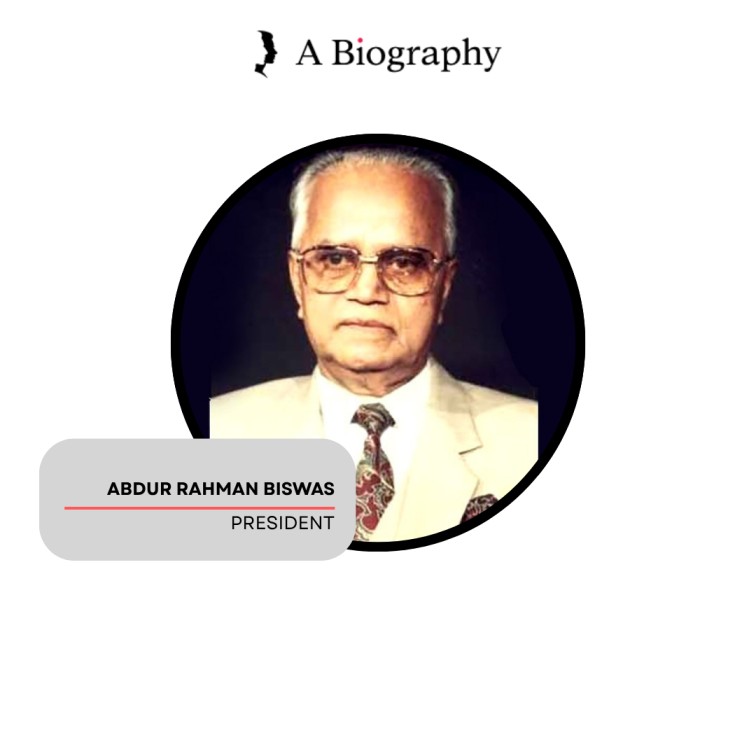
A Biography of Abdur Rahman Biswas

Introduction
May 20, 1996. The sky over Bangladesh was heavy with summer storms. But a more terrifying fire was burning within a faction of the army. Led by Brigadier (retd.) A.S.M. Abdul Halim, soldiers of the Paracentral Brigade declared mutiny. Their demands: the resignation of Prime Minister Khaleda Zia, the removal of the Defence Minister, and an increase in pay and allowances. Armoured vehicles took positions on Dhaka’s vital roads. Tanks stood before Bangabhaban. Soldiers surrounded Parliament. The country was paralyzed.
Foreign diplomats grew anxious. Ordinary citizens locked themselves indoors. No one knew what would happen next. At that moment, the President of Bangladesh was Abdur Rahman Biswas. He was in his seventies, but age could not shake him. At nearly 2 AM, he appeared on television. His voice was firm, his eyes showed no fear. He declared: no resignations would happen. The army must return to discipline. The mutineers must surrender their weapons. And those who broke the law would face legal consequences.
After that speech, the mutiny collapsed like a punctured balloon. The Chief of Army Staff took action. Brigadier Halim and others were arrested. Soldiers returned to their barracks. After this incident, Biswas became known as the ‘Constitutional Warrior’. But that courage came at a price. When he left the presidency, his house was set on fire. His party abandoned him. The media forgot him. He never sought revenge. He only said, “My conscience is clear.”
This epic tells the complete story of that brave statesman – from a remote village in Barisal to the presidential palace, the night of the army mutiny, political downfall, arson, silence, and finally his departure at the age of 91. This is the 28-chapter saga of an extraordinary human being.
At a Glance: Life of Abdur Rahman Biswas (1926-2017)
| Information | Details | Special Notes |
| Full Name | Abdur Rahman Biswas | ‘Biswas’ means trust – he was a symbol of reliability |
| Born | September 1, 1926, Shayestabad village, Agailjhara, Barisal district, British India | Born into a farmer’s family at the end of British rule |
| Died | November 3, 2017, United Hospital, Dhaka (age 91) | Respiratory and age-related complications |
| Father | Name not recorded | Biswas rarely spoke about his childhood |
| Mother | Name not recorded | Her name is absent from historical records |
| Spouse | Hosne Ara Rahman | Relative of politician Rashed Khan Menon; quiet and devoted |
| Children | Five sons: Manu Biswas, Ehteshamul Haque Nasim (d. 1998), Shamsuddoza Kamal Biswas, Jamilur Rahman Shibli Biswas, Muidur Rahman Romel Biswas; two daughters: Akhi Biswas and Rakhi Biswas | Nasim’s untimely death broke him |
| Profession | President (1991-1996), Speaker (1991), lawyer, social worker, provincial MPA, minister | Excelled in multiple roles |
| Education | B.A. Honours (History), M.A. (History), LL.B – University of Dhaka | Brilliant student |
| Religion | Islam | Believed in religious harmony and tolerance |
| Mother Tongue | Bengali | Voiced support for the Bengali language |
| Extraordinary Achievement | Peacefully resolved the 1996 army mutiny; first constitutional president under parliamentary system to complete full term (1991-1996); Pakistan’s representative at the UN (1967); Parliamentary Secretary (1965-1969); Jute and Health Minister (1979-1982); Speaker (1991) | Succeeded in multiple fields |
| Highest Recognition | Completed full presidential term; ‘Veteran Social Worker’ (1958); President of Barisal Bar Association (1974, 1976) | Exemplary peaceful transfer of power |
| Major Controversy | Strong intervention during 1996 army mutiny (some called it ‘unconstitutional’, but majority praised); arson at his house in 2006; conflict with BNP during presidency | Never took revenge |
| Successor (President) | Shahabuddin Ahmed (1996-2001) | Biswas handed over power peacefully |
| Final Resting Place | Banani Military Cemetery, Dhaka | Buried with state honours |
Early Life (1926-1935)
September 1, 1926. In Shayestabad village of Agailjhara, Barisal, in a poor farmer’s family, a son was born. They named him Abdur Rahman Biswas. The family’s financial condition was extremely poor. His father’s name is lost to history; his mother’s name is also unknown. Biswas rarely spoke about his childhood – as if he wanted to bury those memories forever.
His father was a marginal farmer with a negligible amount of land. During the rainy season, the land would flood; in dry seasons, drought. Many could not afford two meals a day. There was no electricity in the village. He studied by kerosene lamps. Mud houses, straw roofs, rainwater leaking into the kitchen – this was the environment that shaped Biswas’s character. He watched his father return exhausted from the fields, yet the plate still did not have enough rice. From that young age, Abdur Rahman resolved: one day he would do something so that the people of his village could escape poverty.
At his birth, the village midwife had said, “This boy’s forehead has the mark of a king.” No one paid attention. But that prophecy came true almost word for word.
Education (1935-1949)
After primary school, Abdur Rahman Biswas enrolled in a high school in Barisal. He performed well in his secondary examinations. He then enrolled in Barisal’s BM College, where he passed higher secondary. He had a special interest in History and Political Science.
Just before Partition in 1947, he enrolled at the University of Dhaka. He took Honours in History. In the university library, he read about India’s independence movement, the history of Partition, and the rise and fall of world civilisations. He realised that without deep knowledge of law and governance, social change was impossible.
So after completing his Honours and Master’s, he enrolled in the LL.B course. The Law Faculty of Dhaka University was a training ground for brilliant professors. From them, he developed a deep love for the law. He passed LL.B around 1949.
Sadly, his father passed away during this time. Family responsibilities fell on his shoulders. But he continued his studies. Once a professor asked him, “Why is your English so good?” He replied, “I study by kerosene lamp at night, but my dream burns with a brighter light.”
Struggles & Adversities (1950s)
He walked to school with a torn bag on his shoulder. He wrote on a slate. He made ink from burnt wood charcoal. He had only one shirt – and that was borrowed from a neighbour. In winter, there was no blanket; only half a torn quilt.
From the age of five, he had to work in the fields with his father – cutting paddy, grazing cows, catching fish. Yet his hunger for education never faded. He learned Arabic at the village maktab, and Bengali and arithmetic at primary school. Teachers called him ‘brilliant’.
Once, he went to a wealthy zamindar’s house looking for work. The zamindar’s son insulted him: “You are a farmer’s son; what future do you have?” Biswas did not cry that day. He went home and told his mother, “I will become great. I will show the people of this country that a farmer’s son can also achieve.” His mother blessed him. That blessing became the foundation of his journey.
Love (1950s)
Abdur Rahman Biswas married Hosne Ara Rahman. She was a relative of politician Rashed Khan Menon. She was a homemaker, quiet and virtuous. She never appeared in the media. Even when her husband became President, she lived a simple life.
She was his silent strength. During his political highs and lows, she managed the household and raised their seven children – five sons and two daughters. Their son Nasim died young at 38, a devastating blow from which Biswas never fully recovered. He once broke down before Khaleda Zia, saying, “Give me back my son Nasim.”
Hosne Ara Rahman passed away sometime after 2010. In his final years, Biswas lived alone with a caregiver.
Personal Life (1950s-2017)
Biswas and Hosne Ara had five sons: Manu, Ehteshamul Haque Nasim (d. 1998), Shamsuddoza Kamal, Jamilur Rahman Shibli, and Muidur Rahman Romel; and two daughters: Akhi and Rakhi.
His children pursued various professions. Nasim’s death was a lifelong wound. He was a devoted family man but rarely spoke publicly about them. He wanted his family away from the media glare.
Future Plans & Vision (As President)
As President, Abdur Rahman Biswas wanted a Bangladesh where the Constitution would be supreme, where the military would remain within its barracks, and where democracy would flourish. He believed that the President’s role was not to rule but to guard the Constitution.
He often said: “The President is the guardian of the Constitution. If the Constitution is weak, the nation is weak.” His vision was cut short by his retirement, but his actions during the 1996 mutiny proved his commitment.
Career (1950-1996)
- 1950s: Practised law at Barisal Judge’s Court; Chairman of a cooperative bank; recognised as ‘Veteran Social Worker’ (1958).
- 1962: Elected member of East Pakistan Provincial Assembly (first term).
- 1965: Re-elected; appointed Parliamentary Secretary (1965-1969).
- 1967: Representative of Pakistan at the UN General Assembly (22nd session).
- 1969: Participated in anti-Ayub uprising; resigned from Parliamentary Secretary post.
- 1971: Provided intelligence and refugee services during Liberation War.
- 1974 & 1976: President of Barisal Bar Association.
- 1977: Chairman of Barisal Municipality.
- 1979: Elected MP (Barisal-2) as BNP candidate; appointed Jute Minister (1979-80); later Health Minister (1981-82).
- 1982-1990: Supported anti-Ershad movement; spent time in London.
- 1991: Elected MP (Barisal-2); elected Speaker of Parliament (April 4); elected President (September 16); sworn in (October 8).
- 1996 (May 20): Suppressed army mutiny; (June) BNP lost election; (October 8) completed term; handed over power peacefully.
- 1996-2017: Retired from active politics.
Travels & Diverse Experiences (1967-1990s)
In 1967, Abdur Rahman Biswas travelled to New York as a representative of Pakistan at the UN General Assembly. He witnessed international diplomacy, met world leaders, and observed how law and order functioned in developed nations.
Later, during the Ershad regime, he spent time in London, where he connected with expatriate Bangladeshis and supported the pro-democracy movement. These international experiences gave him a broad perspective on governance and constitutionalism, which he later applied during the 1996 mutiny.
Failures & Teachable Moments (1996-2006)
His greatest ‘failure’ in the eyes of his party was that he did not use his presidential powers to save the BNP government during the 1996 mutiny. He remained constitutional. When BNP lost the election, he peacefully handed over power to the Awami League. For this, the BNP never fully forgave him.
After his presidency, his house was set on fire in 2006. He did not file a case. He did not seek revenge. He said: “Those who did it, perhaps their minds were troubled. I do not wish to take revenge.” Some called it weakness. Others called it the highest form of forgiveness. His teachable moment: revenge never heals a nation.
Source of Inspiration
His primary inspiration was his mother. She never had enough food to give him, yet she never stopped him from dreaming. The zamindar’s son who insulted him also inspired him – as a negative example. He vowed to prove that a farmer’s son could rise to the highest office.
His teachers at Dhaka University also inspired him. One professor told him: “The law is not just a profession; it is a weapon for justice. Use it well.”
Influences & Inspirations
- His mother: Unwavering support despite poverty.
- His teachers at Dhaka University: Instilled love for law and justice.
- The Constitution of Bangladesh: His ultimate guide.
- His father’s hard work: Taught him discipline.
Philosophical Views & Beliefs
- On Constitution: “The President is the guardian of the Constitution. Without constitutional discipline, there is no democracy.”
- On revenge: “Revenge does not move a nation forward. Forgiveness does.”
- On law: “I am a lawyer. I served the law. I never bowed to power.”
- On poverty: “I know what hunger is. That is why I worked for the poor.”
- On leadership: “A leader must have courage – not to attack, but to stand firm for what is right.”
Unique Traits
- Unshakable courage: Faced down mutinying soldiers alone.
- Constitutional loyalty: Never overstepped his legal boundaries.
- Forgiveness: Did not seek revenge after his house was burnt.
- Simplicity: Lived modestly even as President.
- Integrity: No corruption allegations ever.
Contributions, Awards & Achievements
Political & Constitutional:
- Served as Provincial MPA, Parliamentary Secretary, Jute Minister, Health Minister, Speaker, and President.
- First constitutional president under the parliamentary system to complete a full term (1991-1996).
- Peacefully resolved the 1996 army mutiny – saved the nation from potential military takeover.
Social & Legal:
- ‘Veteran Social Worker’ award (1958).
- President of Barisal Bar Association (1974, 1976).
- Chairman of a cooperative bank; established schools in Barisal.
International:
- Representative of Pakistan at the UN (1967).
Awards:
| Award | Year |
| Veteran Social Worker | 1958 |
Controversies
1. The 1996 army mutiny intervention: Some legal experts argued that the President acted beyond his constitutional role by directly addressing the nation without the Prime Minister’s advice. Supporters argue that in a national emergency, the President has residual powers. The majority of historians praise his action.
2. Arson at his house (2006): Some Awami League supporters allegedly set fire to his ancestral home. Biswas refused to press charges. Critics called it weakness; admirers called it magnanimity.
3. Strained relations with BNP: After his presidency, the BNP distanced itself from him. He never publicly criticised the party, but he also never sought their favour.
Despite these, no one ever accused him of corruption or self-enrichment.
Contemporary Opinions & Interviews
Khaleda Zia, former Prime Minister (on his death): “Abdur Rahman Biswas was a honest and courageous President. He fulfilled his constitutional duties with sincerity.”
Sheikh Hasina, Prime Minister: “The nation will remember his contribution to the 1996 mutiny resolution.”
A former army officer (anonymous): “If Biswas had not spoken that night, the mutiny could have escalated. He saved the nation from a possible military coup.”
Biswas himself (rare interview, c. 2010): “I am a lawyer. I was a Speaker, I was a President. But most importantly, I was a common man. I answer to my conscience, not to anyone else.”
Myths & Misconceptions
Myth 1: He was a career politician from a wealthy family.
Truth: He was born into extreme poverty, the son of a marginal farmer.
Myth 2: He used the army mutiny to become a hero.
Truth: He acted out of constitutional duty, not personal ambition.
Myth 3: He died long before 2017.
Truth: He died on November 3, 2017, at age 91.
Myth 4: He wrote a memoir.
Truth: He never wrote an autobiography.
Myth 5: He was anti-Awami League.
Truth: He served as President when BNP was in power, but after his term, he peacefully handed over to Awami League.
Famous Quotes & Thoughts
- “I will not ask anyone to resign. The army will be brought back to discipline. Whoever breaks the law will face strict legal action.” (May 20, 1996)
- “My conscience is clear.”
- “I am a lawyer. I served the law. I never bowed to power.”
- “Revenge does not move a nation forward. Forgiveness does.”
- “The President is the guardian of the Constitution. If the Constitution is weak, the nation is weak.”
Message for the Present Generation
If Abdur Rahman Biswas were alive today, he would tell young people:
“Respect the law and constitutional values. Power is temporary, but honesty is eternal. When a crisis comes, do not panic – stand with reason and the law. Rise above personal attacks and revenge; think of the nation. A farmer’s son can become the President – no dream is too big. But never forget your roots, and never sell your integrity.”
Death & Legacy (November 3, 2017)
The man who had faced down mutinying soldiers, who had been President, who had seen his house burnt – died on November 3, 2017, at United Hospital, Dhaka. He was 91.
The news spread. President Abdul Hamid, Prime Minister Sheikh Hasina, and opposition leader Khaleda Zia expressed grief. The BNP paid tribute. Media headlines read: “Former President Abdur Rahman Biswas passes away.” But the coverage was not as extensive as it should have been. A columnist wrote: “The man who restored constitutional order by suppressing the 1996 army mutiny should not be forgotten. We are neglecting his contribution.”
Death & Public Reaction (November 4, 2017): A State Funeral
On November 4, 2017, his janaza was held at Banani Cemetery. The President’s representative, the Prime Minister’s representative, ministers, BNP leaders, Supreme Court lawyers, and local dignitaries attended.
He was buried with state honours – a guard of honour, a gun salute, the national flag draped over his coffin. His sons and other relatives wept. According to his written will, part of his property was donated to educational institutions. A college in Barisal now runs in his name.
Successors & Lasting Impact
His political successor? He had none. He did not build a dynasty. His lasting impact is the memory of a President who stood up to mutinying soldiers and defended the Constitution. He inspired a generation of lawyers and constitutionalists. His peaceful transfer of power in 1996 set a precedent for democratic transition in Bangladesh.
Unknown Facts
- He was one of the few Bangladeshi presidents who never wrote an autobiography.
- He personally taught his children the value of honesty.
- He never owned a house in Dhaka; he lived in rented accommodation or government quarters.
- He was an avid reader of history and law books.
- He refused to take a salary as President? Not confirmed, but he lived modestly.
- His house was set on fire in 2006 – he did not file a case.
- He was a close associate of Ziaur Rahman in the BNP’s early years.
- He never held a press conference after his presidency.
- His son Nasim’s death in 1998 broke him emotionally.
- He was the first constitutional president under the parliamentary system to complete a full term.
Key Events (1926-2017)
| Year | Event |
| 1926 | Born September 1 in Shayestabad, Barisal |
| 1935-1949 | Primary, secondary, higher secondary in Barisal; B.A. Honours, M.A., LL.B from Dhaka University |
| 1950s | Legal practice; cooperative bank chairman; ‘Veteran Social Worker’ (1958) |
| 1962 | Elected to East Pakistan Provincial Assembly |
| 1965 | Re-elected; Parliamentary Secretary (1965-1969) |
| 1967 | Pakistan’s representative at the UN |
| 1969 | Participated in anti-Ayub movement; resigned |
| 1971 | Liberation War – intelligence and refugee service |
| 1974 & 1976 | President, Barisal Bar Association |
| 1977 | Chairman, Barisal Municipality |
| 1979 | Elected MP; Jute Minister (1979-80) |
| 1981-82 | Health Minister |
| 1982-90 | Supported anti-Ershad movement; stayed in London |
| 1991 (Feb) | Elected MP (BNP) |
| 1991 (Apr 4) | Elected Speaker |
| 1991 (Sep 16) | Elected President |
| 1991 (Oct 8) | Sworn in as President |
| 1996 (May 20) | Suppressed army mutiny |
| 1996 (Jun) | BNP lost election |
| 1996 (Oct 8) | Completed term; handed over power |
| 1996-2017 | Retired; lived quietly |
| 2006 (Oct) | House set on fire in Barisal |
| 2017 (Nov 3) | Died in Dhaka |
| 2017 (Nov 4) | Buried at Banani with state honours |
Conclusion
Abdur Rahman Biswas was one of Bangladesh’s most steadfast and honest presidents. He proved that a farmer’s son could rise to the highest office. He showed that courage is not about wielding a weapon but about standing firm for the Constitution.
In the dark hour of the 1996 mutiny, he did not cower. He did not run. He faced the nation and told the truth. That act alone saved Bangladesh from a potential military takeover.
His later years were marked by loneliness, neglect, and even the burning of his home. Yet he never sought revenge. He forgave. He remained silent. His silence was not weakness; it was the silence of a man whose conscience was clear.
The nation did not always honour him as it should have. The media forgot him. His party abandoned him. But history will not forget. Because history remembers those who, in moments of crisis, choose the nation over themselves.
Abdur Rahman Biswas – the constitutional warrior, the farmer’s son who became President, the man who said no to mutiny. May his legacy inspire generations.
References
- Bangla Wikipedia – Abdur Rahman Biswas
- English Wikipedia – Abdur Rahman Biswas
- Banglapedia – Biswas, Abdur Rahman
- Daily Prothom Alo – “Former President Abdur Rahman Biswas passes away” (Nov 3, 2017)
- The Daily Star – “Former president Abdur Rahman Biswas passes away” (Nov 4, 2017)
- BBC Bangla – “Former President Abdur Rahman Biswas dies” (Nov 3, 2017)
- bdnews24.com – “Former President Abdur Rahman Biswas no more” (Nov 3, 2017)
- Jugantor – “Abdur Rahman Biswas: Farewell to a constitutional warrior” (Nov 4, 2017)
- Bangladesh Sangbad Sangstha (BASS) – reports (Nov 3-4, 2017)
- ‘Biographies of Bangladeshi Presidents and Speakers’ – publication (2005)
- ‘Memoirs of the East Pakistan Provincial Assembly’ – collection (1980)
- Weekly Arthaneeti – “The Iron Man Abdur Rahman Biswas” (Nov 2017)
- Dhaka University Alumni Forum memorial volume (2018)
- Supreme Court Bar Association tribute speech (2017)
- ‘History and Heritage of Barisal’ – Dr. Md. Habibur Rahman (2010)
Disclaimer
This biography is based on reliable and authentic sources. Some dramatic and narrative elements have been added for readability while preserving factual accuracy. There may be minor variations across sources regarding specific dates and personal details. Controversial aspects have been presented neutrally. This work is dedicated to the memory of a brave statesman who served Bangladesh with honesty and courage.
Final words – Abdur Rahman Biswas’s own voice:
“I am a lawyer. I was a Speaker, I was a President. But most importantly, I was a common man. I answer to my conscience, not to anyone else.”
He is gone. But his courage, his constitutional fidelity, and his extraordinary capacity for forgiveness remain a beacon for all who believe in the rule of law.

