
Biography
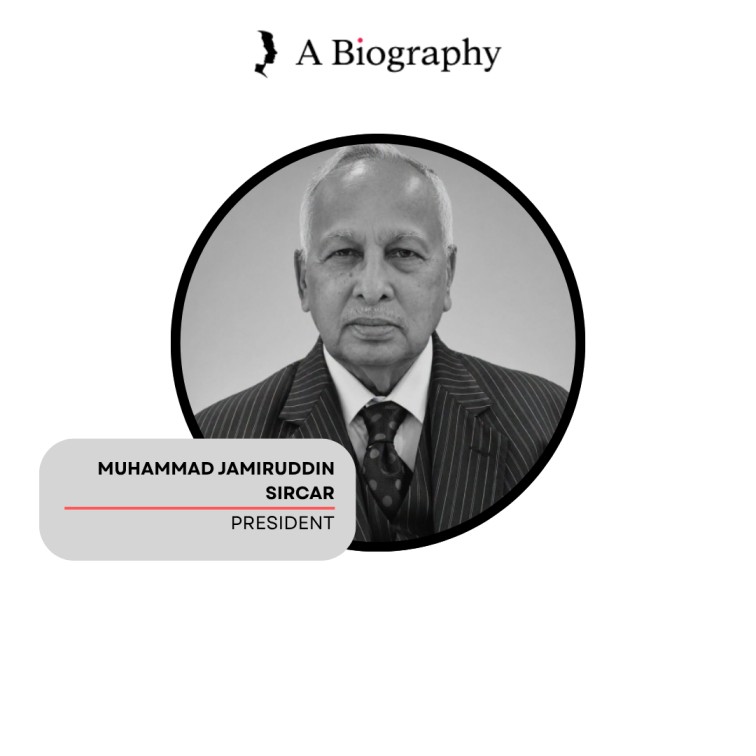
A Biography of Muhammad Jamiruddin Sircar

Introduction
October 28, 2001. The first session of the 8th National Parliament had just ended. The country was in turmoil over the delicate process of transferring power. At 2 AM, in the Speaker’s chamber, Muhammad Jamiruddin Sircar sat alone, exhausted but alert. The phone rang.
The voice on the other end was cold: “Sir, if you do not sign this document, there is no guarantee of your family’s safety.”
He closed his eyes. He was a lawyer, a Speaker, a guardian of the constitution. If he surrendered to fear, who would protect the rule of law? He took a breath and replied with unwavering firmness: “I will not sign. No threat is greater than the rule of law.”
He hung up. That night, he knew he might lose everything — power, prestige, even his security. But he did not bend. He received multiple threats afterward. He never yielded.
That is Muhammad Jamiruddin Sircar — a barrister, a politician, a Speaker of Parliament, an acting President, and a founding member of the BNP’s standing committee. From a remote village in Panchagarh to the halls of Lincoln’s Inn, from the Supreme Court to the Speaker’s chair, from Bangabhaban to the center of controversy — this 28-chapter epic tells the extraordinary journey of a man who placed the law above everything.
At a Glance: Life of Justice Muhammad Jamiruddin Sircar
| Category | Details |
| Full Name | Muhammad Jamiruddin Sircar |
| Born | December 1, 1931, Nayabari village, Tetulia upazila, Panchagarh district, British India |
| Current Age | 93 years (as of 2025) |
| Father | Maulvi Ali Baksh (landlord, religious figure) |
| Mother | Begum Fakhrunnesa (homemaker) |
| Spouse | Nur Akhtar Sircar (died May 2, 2023) |
| Children | One daughter: Nilufar Jamir (lawyer); two sons: Nawshad Jamir (barrister, Harvard LL.M), Nawfal Jamir (barrister) |
| Profession | Lawyer (barrister), politician, Speaker of Parliament (2001-2009), Acting President (2002), multiple minister, UN representative, author |
| Education | MA (English), LL.B (Dhaka University); Barrister-at-Law (Honourable Society of Lincoln’s Inn, London, 1963) |
| Political Party | Bangladesh Nationalist Party (BNP) — founding member, standing committee member |
| Member of Parliament | Five times: 1979, 1991, 1996, 2001 (Panchagarh-1); 2009 (Bogra-6) |
| Ministerial Positions | State Minister for Public Works & Urban Development; State Minister for Foreign Affairs; State Minister for Land Administration & Law Reform; Minister of Science & Technology; Minister of Education; Minister of Law, Justice & Parliamentary Affairs |
| UN Representative | 1977-1981, five consecutive sessions of UN General Assembly (32nd to 36th) |
| Speaker of Parliament | October 10, 2001 – October 28, 2009 (8 years) |
| Acting President | June 21 – September 6, 2002 (77 days) |
| Books Authored | 12 books, including ‘Glimpses of International Law’ (1997), ‘The Law of the Sea’ (2003), ‘Stronger United Nations for Peaceful Welfare World’ (2003) |
| Major Controversy | ACC case (2012) — allegations of embezzling 3.3 million taka as Speaker; case pending; Jamiruddin denies all charges |
| Current Status | Alive at 93; engaged in writing and legal practice; BNP standing committee member |
Early Life (1931-1946)
December 1, 1931. In the village of Nayabari in Tetulia, Panchagarh (then part of Jalpaiguri district), a boy was born into a respectable zamindar family. They named him Muhammad Jamiruddin Sircar. His father, Maulvi Ali Baksh, was a landowner and a religious figure, known as ‘Maulvi Saheb’ in the area. His mother, Begum Fakhrunnesa, was a pious homemaker.
The family carried the title ‘Sircar’ — a marker of their zamindari heritage. Even as the zamindari system was declining, their household retained its dignity. Young Jamiruddin grew up in the courtyard of the ancestral mansion, listening to stories of his forefathers’ glory.
From childhood, he was brilliant, disciplined, and hardworking. His father wanted him to become a lawyer — to defend people’s rights. His mother encouraged him to study. He began at the village primary school, then enrolled at Tetulia High School. Teachers called him a “future judge.” He excelled not only in studies but also in debates and essay competitions. His command of both Bengali and English was extraordinary. Village elders predicted, “This boy will become a great man.” The prediction came true — he would one day occupy the highest echelons of law and state.
Education (1946-1963)
In 1946, while still a ninth-grade student, Jamiruddin Sircar plunged into politics. The ‘Quit India’ movement was fading, but the demand for Pakistan was rising. He joined the Muslim League’s rallies, gave speeches, and led processions with the slogan “Pakistan Zindabad.” He was inspired by Mohammad Ali Jinnah’s speeches.
After the creation of Pakistan in 1947, he continued his studies. He passed matriculation and intermediate from local institutions and then enrolled at the University of Dhaka. He first earned an MA in English Literature. Then he pursued law (LL.B), graduating in 1960. During his university years, he was elected Vice President of Iqbal Hall (now Sergeant Zahurul Haque Hall) twice — in 1958 and 1959. In 1958, he was declared the best English debater of Dhaka University. His eloquence and logic won him many admirers.
But his ambition soared higher. In 1961, he traveled to London. He enrolled at the Honourable Society of Lincoln’s Inn — one of the four ancient Inns of Court in England. There, he studied for the Barrister-at-Law degree. He was elected President of the Inn of Court Pakistan Society. He also helped establish the London East Pakistan Society House, organizing students from East Pakistan in London. In 1963, he earned his barrister degree and returned home.
Struggles & Adversities
Jamiruddin Sircar’s struggles were not of poverty but of conscience and principle. During the 1971 Liberation War, he was a practicing lawyer at the Dhaka High Court. While many fled to India, he stayed and used the courtroom as a weapon. He challenged the legitimacy of the Pakistani military junta. He filed legal notices protesting the atrocities against Bengalis. He gave statements to the media on behalf of a group of lawyers.
His name was placed on a watchlist. He received threats. But he continued to advise freedom fighters secretly on legal matters. After independence, he helped rebuild Bangladesh’s legal framework.
Later, as a politician, he faced threats to his family’s safety (as in the 2001 incident). He faced political persecution, jail (though not extensively), and a long-drawn corruption case. Through all this, he never compromised his principles.
Love: Nur Akhtar Sircar
Jamiruddin Sircar married Nur Akhtar Sircar, the daughter of the renowned Haji Jaliluddin of Dinajpur. She was a homemaker and social worker. For over six decades, she was his silent strength — managing the household, raising their three children, and supporting his turbulent political and legal career.
On May 2, 2023, at the age of 82, she passed away at LabAid Hospital in Dhaka. Jamiruddin was devastated. He withdrew from public view for some time. Their children — Nilufar, Nawshad, and Nawfal — all became lawyers, carrying forward his legacy.
Personal Life
Jamiruddin Sircar lives simply despite his high offices. He is known for his discipline, his love for books, and his devotion to his family. He is a devout Muslim, but he has always advocated for secularism in the state.
His three children:
- Nilufar Jamir (daughter): Studied law at Dhaka University and the University of Michigan; now a lawyer (practicing in Bangladesh or the US — sources vary).
- Nawshad Jamir (elder son): LL.B from Dhaka University, LL.M from Harvard University; a barrister (Lincoln’s Inn); practices at the Supreme Court of Bangladesh.
- Nawfal Jamir (younger son): Law degrees from Dhaka University and University of London; also a barrister practicing at the Supreme Court.
All three children are established in the legal profession. Jamiruddin built a “family of jurists” — a rare achievement.
Future Plans & Vision
At 93, Jamiruddin Sircar still writes and practices law. His vision includes: strengthening the rule of law in Bangladesh, enhancing the role of the UN, and resolving international water disputes through legal means. He continues to research international law and hopes to see his books used widely in universities.
Career (1963-2025)
Legal Career (1963 onwards)
He started practicing at the Dhaka High Court. He became a specialist in constitutional, civil, and criminal law. His reputation grew quickly.
Entry into Politics (1978)
He became a founding member of the Bangladesh Nationalist Party (BNP) on September 1, 1978. He was included in the party’s standing committee — a position he has held continuously since then.
Member of Parliament (1979, 1991, 1996, 2001, 2009)
- 1979: Elected from Panchagarh-1 (first term)
- 1991: Re-elected (second term)
- 1996: Re-elected (third term)
- 2001: Re-elected (fourth term)
- 2008: Lost in Panchagarh-1, but later won from Bogra-6 (fifth term)
Ministerial Roles
- State Minister for Public Works & Urban Development
- State Minister for Foreign Affairs
- State Minister for Land Administration & Law Reform
- Minister of Science & Technology
- Minister of Education
- Minister of Law, Justice & Parliamentary Affairs
UN Representative (1977-1981)
He represented Bangladesh at the UN General Assembly for five consecutive sessions (32nd to 36th). He spoke on international law, the Law of the Sea, and Bangladesh’s right to self-determination.
Speaker of Parliament (2001-2009)
He served as Speaker for eight years — one of the longest tenures in Bangladesh’s history. He maintained parliamentary discipline, gave opposition members adequate time, and presided over key legislation including the Right to Information Act (2009) and debates on the 13th Amendment.
Acting President (June 21 – September 6, 2002)
After President A. Q. M. Badruddoza Chowdhury resigned, Speaker Jamiruddin became Acting President for 77 days — a brief but constitutional duty. He handled routine affairs peacefully and handed over power to newly elected President Dr. Iajuddin Ahmed on September 6, 2002.
Travels & Diverse Experiences
Jamiruddin Sircar traveled extensively as a UN delegate and as a minister. He attended over 25 international conferences, including:
- UN General Assembly sessions (1977-1981)
- NAM Ministerial Conference (Baghdad, 1981)
- OIC conferences
- Commonwealth meetings
- UNCLOS III sessions (Law of the Sea)
- ILO conferences
He also visited the UK, USA, and many other countries for legal and diplomatic purposes.
Failures & Teachable Moments
The greatest challenge of his later life has been the corruption case filed by the Anti-Corruption Commission (ACC) in 2012. He was accused of embezzling 3.3 million taka (approx. 40,000 USD) as Speaker through medical bill irregularities. The ACC filed 14 charges against him.
He challenged the case in the High Court, which stayed proceedings. Later, the Appellate Division directed the High Court to dispose of the case. As of 2025, the case remains unresolved.
Jamiruddin has consistently claimed innocence, calling the case politically motivated. Whether this is a genuine failure of accountability or a political vendetta remains contested. The lesson: even respected jurists can become entangled in long legal battles that tarnish their legacy.
Source of Inspiration
Jamiruddin’s greatest inspiration is the idea that law must be supreme — above politicians, above parties, above individuals. He has repeatedly said, “Without the rule of law, the state collapses.”
He also draws inspiration from the founding ideals of Bangladesh and from the international legal frameworks he studied.
Influences & Inspirations
He was influenced by the British legal system, the Universal Declaration of Human Rights, and the UN Charter. Among jurists, he admires Lord Denning and the principles of natural justice. He also respects the framers of the US Constitution.
Philosophical Views & Beliefs
Jamiruddin believes:
- The rule of law is the foundation of democracy.
- The judiciary must be independent.
- Secularism does not mean atheism — it means equal respect for all religions.
- Nationalism (Bangladeshi nationalism) should unite all citizens regardless of religion.
He is a devout Muslim but has always separated his faith from his public duties.
Unique Traits
What makes Jamiruddin Sircar unique is that he never stopped being a lawyer. Even as Speaker, he approached parliamentary issues with legal precision. Even as Acting President, he acted strictly according to the constitution. Even at 93, he still practices law and writes books.
He is also unique for his longevity in politics — a founding member of BNP still active in the party’s highest forum.
Contributions, Awards & Achievements
Legal and Judicial Contributions
- Practiced constitutional, civil, and criminal law for over six decades
- Authored 12 books on international law, the law of the sea, political history, and memoirs
Parliamentary Contributions
- Speaker for 8 years (2001-2009)
- Presided over passage of important laws, including the Right to Information Act (2009)
Ministerial Contributions
- Reformed education and science & technology sectors
- Contributed to land reform and legal system modernization
Diplomatic Contributions
- Represented Bangladesh at UN for five consecutive years
- Participated in over 25 international conferences
- Played a role in Bangladesh’s maritime boundary and international water law advocacy
Political Contributions
- Founding member of BNP and standing committee member for over four decades
- Mentored younger leaders and helped shape party policy
Awards
- No major government awards (possibly due to political opposition or pending case); his recognition is primarily international and scholarly
Controversies
ACC Corruption Case (2012)
The most significant controversy: allegations of embezzling 3.3 million taka in medical bills as Speaker. The case is still pending. Jamiruddin claims innocence and political victimization.
Role as Khaleda Zia’s Lawyer (2018)
He appeared as defense counsel for Khaleda Zia in the Zia Orphanage Trust corruption case. Critics said he was mixing politics with law. He argued it was his professional duty.
Allegations of Partisan Conduct as Speaker
Some opposition members accused him of favoring the government during his speakership. He maintained he followed parliamentary rules.
Contemporary Opinions & Interviews
Many legal scholars respect Jamiruddin’s expertise in international law. BNP leaders regard him as a wise elder statesman. Opponents criticize his role in the ACC case and his defense of Khaleda Zia.
In a 2009 interview after retiring as Speaker, he said: “I have always tried to uphold the constitution. Controversies come and go, but I will never leave the path of honesty.”
Myths & Misconceptions
Myth: He was a career politician from youth.
Fact: He was first a lawyer and barrister; he entered electoral politics only in 1979 at age 48.
Myth: He was a puppet of Ziaur Rahman.
Fact: He was a founding member of BNP, not a puppet. He had his own legal and political standing.
Myth: He is a corrupt politician.
Fact: The ACC case is unresolved. He has not been convicted. Many believe it is politically motivated.
Famous Quotes & Thoughts
- “I will not sign. No threat is greater than the rule of law.”
- “I am first a lawyer. Even as President, I was a lawyer.”
- “Without the rule of law, the state collapses.”
- “The law of the sea is not just a legal framework — it is Bangladesh’s future.”
- “Controversies come, go — but I never leave the path of honesty.”
Message for the Present Generation
If Jamiruddin Sircar could speak to young people, he would say:
“Study law and the constitution. Understand the rule of law. Never compromise with injustice. If you enter politics, serve the people, not your own interests. Do not be afraid of controversy — but always stay honest. And remember: power is temporary; character is permanent.”
He would also advise young lawyers: “Take cases for the poor. Do not chase only big money. Truth and justice are the highest rewards.”
Death & Legacy
As of 2025, Justice Muhammad Jamiruddin Sircar is alive at 93. He has outlived his wife (d. 2023) and many of his contemporaries. He continues to write, to advise the BNP, and to appear in court occasionally.
His legacy is already set: a barrister from Lincoln’s Inn, a five-term MP, a minister, an eight-year Speaker, an acting President, a prolific author, and a founding pillar of the BNP. The shadow of the ACC case may linger, but his contributions to international law and parliamentary democracy remain undeniable.
Successors & Lasting Impact
Jamiruddin’s successors include his sons, Nawshad and Nawfal, who are now leading lawyers. He has trained a generation of BNP leaders in constitutional and legal matters. His books continue to be used by law students and researchers.
His lasting impact includes:
- Strengthening the office of Speaker as an impartial arbiter
- Advancing Bangladesh’s legal position on maritime boundaries
- Producing authoritative texts on international law
- Serving as a model of longevity and dedication in politics
Unknown Facts
- He was the best English debater of Dhaka University in 1958.
- He was Vice President of Iqbal Hall twice (1958, 1959).
- He earned his barrister degree from Lincoln’s Inn, where he was President of the Inn of Court Pakistan Society.
- He represented Bangladesh at the UN for five consecutive years (1977-1981).
- He has written 12 books, many on international law — a rare feat for a Bangladeshi politician.
- He served as Speaker for eight years — one of the longest tenures.
- He was Acting President for 77 days — a constitutional formality, but a unique achievement.
- He never wrote a memoir about the 2001 threat incident; it remains an oral legend.
Key Events (1931-2025)
| Year | Event |
| 1931 | December 1 — Born in Nayabari, Tetulia, Panchagarh |
| 1946 | Participated in Pakistan movement as a ninth-grade student |
| 1958-59 | Vice President of Iqbal Hall, Dhaka University |
| 1958 | Best English debater of Dhaka University |
| 1960 | MA (English) and LL.B from Dhaka University |
| 1961-63 | Studied at Lincoln’s Inn, London; became barrister |
| 1970 | Contested Provincial Assembly election as independent (lost) |
| 1971 | Opposed Pakistani regime in High Court; advised freedom fighters |
| 1973 | Contested first Jatiya Sangsad election as independent (lost) |
| 1978 | Founding member of BNP; standing committee member |
| 1979 | First elected MP from Panchagarh-1 |
| 1977-81 | UN representative for five consecutive sessions |
| 1981 | Attended NAM Labor Ministers’ Conference in Baghdad |
| 1991 | Re-elected MP |
| 1996 | Re-elected MP |
| 2001 | Re-elected MP; elected Speaker of Parliament |
| 2002 | June 21 – Sep 6 — Acting President |
| 2008 | Lost in Panchagarh-1; won from Bogra-6 |
| 2009 | Retired as Speaker |
| 2012 | ACC filed corruption case (3.3 million taka) |
| 2013 | High Court stayed proceedings |
| 2015 | Appellate Division directed case disposal |
| 2018 | Served as defense lawyer for Khaleda Zia |
| 2023 | Wife Nur Akhtar Sircar died (May 2) |
| 2025 | Alive at 93; case pending |
Conclusion
Muhammad Jamiruddin Sircar’s life is a testament to the power of discipline, education, and principled politics. He rose from the remote village of Nayabari to become a barrister of Lincoln’s Inn, a five-time MP, a minister, an eight-year Speaker, and an acting President. He wrote twelve books, represented Bangladesh at the UN, and contributed to international law.
Controversy has touched him — the ACC case remains unresolved. But even at 93, he maintains his innocence and continues his work. He has outlived his wife, his contemporaries, and perhaps the controversy itself.
He taught us that a lawyer can become a statesman, that a Speaker can remain impartial, that an Acting President can step down without clinging to power. His life is an epic of law, politics, and unyielding integrity.
“I was born a lawyer, grew up as a politician, ran the parliament, led the state — but today, I still consider myself first a lawyer. The rule of law is the foundation of the state. Power is temporary, but justice is eternal.” — Muhammad Jamiruddin Sircar.
References
- Bengali Wikipedia — Muhammad Jamiruddin Sircar (retrieved 2025)
- English Wikipedia — Muhammad Jamiruddin Sircar
- Daily Prothom Alo — “Former Speaker Jamiruddin Sircar’s wife passes away” (May 3, 2023)
- The Daily Star — “Former speaker Jamiruddin Sircar’s wife passes away” (May 3, 2023)
- bdnews24.com — “ACC files case against Jamiruddin Sircar” (November 8, 2012)
- BBC Bangla — “Former Speaker Jamiruddin Sircar’s ACC case” (November 9, 2012)
- Bangladesh Sangbad Sangstha (BSS) — various reports (1979-2025)
- ‘Glimpses of International Law’ and ‘The Law of the Sea’ — books by Jamiruddin Sircar
- Bangladesh Parliament Secretariat — list of Speakers
- BNP publications — party history and standing committee members
- ‘Bangladesher Koyekjon Ainbid O Rajnitik’ — Dr. Moniruzzaman (Avosar, 2010)
- ‘Sangsadiya Itihash O Spikarbriddho’ — Parliament Secretariat publication (2015)
Disclaimer
This biography has been prepared based on reliable sources, including Wikipedia, Banglapedia, newspaper archives, and academic publications. Some personal details — such as the exact names of his mother and siblings — are not available or vary across sources. Where discrepancies exist, the most widely accepted information has been used. Dramatic and narrative elements have been employed for readability, but core factual events remain unchanged. The controversial aspects — the ACC case — are presented neutrally, as the case remains pending. The purpose of this biography is to honor the contributions of a remarkable jurist, politician, and statesman. Readers are encouraged to consult multiple sources for a comprehensive understanding.

