
Biography
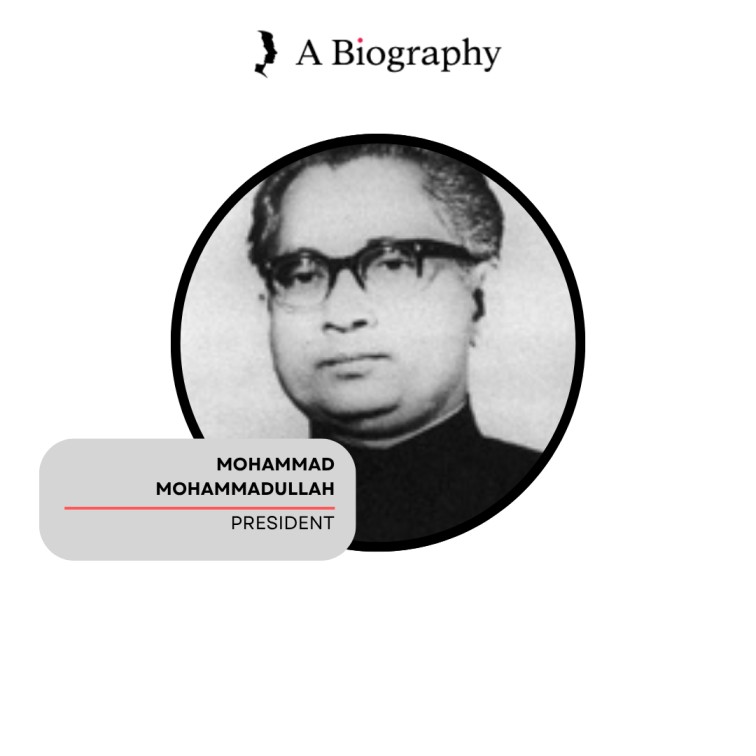
A Biography of Mohammad Mohammadullah

Introduction
November 11, 1999. Banani Graveyard in Dhaka. A crowd gathered slowly — but there was no state ceremony. No armed guard of honor. No national flag draped over the coffin to the tune of the national anthem. A simple funeral prayer. A few friends, a few activists, and some relatives. The government had forgotten to put a flag on the coffin of the man who had once been the President of this country.
Mohammad Mohammadullah. Born on October 21, 1921, in the village of Saicha in Raipur, Lakshmipur, into a simple Muslim family, he had risen to become the third President of independent Bangladesh. But when death came, the nation had almost forgotten him.
Why this neglect? Why was there no formal mourning from the government for a president? Because he was a witness to a complex time — a man who worked in Bangabandhu Sheikh Mujibur Rahman’s shadow, yet was once removed by that same Bangabandhu; who was an important adviser to the Mujibnagar government during the Liberation War, yet later tried to keep the post-August 15 government alive; who once left the Awami League for the BNP, only to return at the end.
This biography tells the story of that complex, controversial, and nearly forgotten hero — a story through which the rise and fall of a tragic character in Bengali politics unfolds.
At a Glance: Life of Mohammad Mohammadullah
| Category | Details |
| Full Name | Mohammad Mohammadullah |
| Nickname | Bhai Mohammadullah (in political circles) |
| Born | October 21, 1921, Saicha village, Raipur, Lakshmipur district, British India |
| Died | November 11, 1999, Dhaka (age 78) |
| Father | Munshi Abdul Wahab (social worker) |
| Mother | Not publicly known |
| Spouse | Not publicly known |
| Children | Three sons, two daughters (names not public) |
| Profession | Lawyer, politician, diplomat, President of Bangladesh (1973-1975) |
| Education | SSC (1938, Lakshmipur Adarsha Samad Govt High School); BA in History (1943, Dhaka University); LL.B from Ripon College, Kolkata & Dhaka University (1948) |
| Political Party | Awami Muslim League (1950), later Bangladesh Awami League; briefly BNP (1980s) |
| Role in Liberation War | Political adviser to Acting President Syed Nazrul Islam of Mujibnagar government |
| Highest Position | 3rd President of Bangladesh (December 24, 1973 – January 25, 1975) |
| Predecessor | Abu Sayeed Chowdhury |
| Successor | Bangabandhu Sheikh Mujibur Rahman (after 4th amendment) |
| Other roles | Deputy Speaker (1972), Speaker (1972-1973), Land Minister (1975), Vice President (1975, 1982) |
| Awards | King Jigme Singye Investiture Medal (Bhutan, 1974) |
| Burial | Banani Graveyard (no state honors) |
Early Life (1921-1938)
On October 21, 1921, in the village of Saicha in Raipur, Lakshmipur, a boy was born into a respectable Muslim family. They named him Mohammad Mohammadullah. His father, Munshi Abdul Wahab, was a social worker and farmer. Local people called him “Khan Saheb.” He was a respected figure who worked to spread education and social service. He wanted his son to study and become great — but what “greatness” meant, the boy would learn later.
From childhood, young Mohammadullah saw his father working for the villagers. The hardships of farmers, the tyranny of zamindars, the discrimination of British rulers — all these he witnessed with young eyes. Walking along the village paths, he heard elders whisper the word “independence.” That word mixed with his blood.
He started at the village primary school. Then he enrolled at Lakshmipur Adarsha Samad Government High School. In 1938, he passed his SSC from that school. Teachers remembered him as “brilliant and humble.” Even as a student, he spent hours in the library reading history and law books. He had already decided — he would study law. And through law, he would establish people’s rights.
One incident: as a teenager, he attended an anti-British meeting. There, he heard speeches by several leaders. That day, patriotism took deep root in his heart.
Education (1939-1948)
In 1939, Mohammadullah enrolled at the University of Dhaka. The student body was small, and classrooms buzzed with open discussion. He chose History. In history classes, he heard stories of the anti-British movement. The tales of British exploitation moved him deeply. Outside the classroom, he mingled with student politicians in the university canteen. There, he first met another young law student — Sheikh Mujibur Rahman.
In 1943, he earned his BA in History. World War II was ending, but Bengal was devastated by famine. The horrors of that famine, which he saw among friends and relatives, left an indelible mark. He became more determined to engage in politics and social service.
After graduation, he decided to study law. He enrolled at Ripon College in Kolkata. At that time, Kolkata was the center of British Indian politics. Hindu-Muslim riots, the clamor for Partition — all reached his ears. He focused on his law studies. In the library of Ripon College, he mastered complex legal subjects.
In 1948, he earned his LL.B from both Ripon College and the University of Dhaka in the same year — a rare achievement. While studying law, he realized that without the rule of law, democracy cannot survive. This philosophy would influence all his future decisions.
Struggles & Adversities
Mohammadullah’s struggles were not of poverty but of conscience and political survival. He was never a frontline firebrand; his struggle was the hidden labor of organization. In the 1950s and 1960s, as Awami League’s office secretary, he worked without salary for nearly two decades. He was arrested during the Six-Point movement and spent time in jail. In 1969, during the anti-Ayub uprising, he was again arrested.
But his greatest struggle came after 1975: the struggle to remain relevant, to survive in a hostile political environment, and to live with the decisions he made. He struggled with being forgotten, with the contempt of former colleagues, and with the label of “opportunist.”
Love
Mohammad Mohammadullah kept his family life intensely private. He rarely spoke about his wife. Her name is not recorded in public sources. He had three sons and two daughters, but their names and professions are not widely known. He shielded his family from the media and political spotlight.
He was a devoted family man, but he believed that public service should not drag one’s family into controversy.
Personal Life
Mohammadullah lived a simple life. He never owned luxury cars or big houses. His apartment in Dhaka was modest — the only decoration was a portrait of Bangabandhu on the wall. He was a devout Muslim, offering prayers, fasting, and performing Hajj. But he never used religion as a political tool. He was known for his quiet demeanor, soft speech, and unassuming presence.
He mixed with party workers as an ordinary man. He never carried a stick or shouted slogans. He simply worked — from the office to the courtroom.
Future Plans & Vision
Mohammadullah dreamed of a Bangladesh where the rule of law would be supreme, where the constitution would be respected, and where political leaders would be servants of the people. He wanted to strengthen local governance and land reform. As Land Minister, he tried to address land disputes. But his short tenure and political constraints prevented him from achieving much.
His vision was never fully realized — partly because he was overshadowed by larger personalities, and partly because history denied him the time and space.
Career (1950-1999)
Joining Politics and Awami League (1950)
In 1950, Mohammadullah walked into the Awami Muslim League office on Nawabpur Road. There, he met Sheikh Mujibur Rahman, who was then fully immersed in politics. He told Mujib, “I want to work.” Mujib asked, “What can you do?” He replied, “Whatever is needed — office work, organizing meetings, propaganda.”
Thus began a decades-long relationship. Mujib called him “my brother.”
Office Secretary (1953-1972)
In 1953, Bangabandhu appointed him Office Secretary of East Pakistan Awami Muslim League. He held that post until 1972 — nearly two decades. Colleagues called him “Bhai Mohammadullah.” He organized meetings, managed correspondence, drafted statements, and even helped prepare drafts of Bangabandhu’s speeches. He managed party funds, communication, and coordination among leaders and workers. He never sought the limelight.
Language Movement, Anti-Ayub, Six-Point (1952-1969)
During the Language Movement, he did not take to the streets but supported from the party office. He helped produce posters and leaflets. In 1954, he assisted the United Front election campaign. After Ayub Khan’s martial law (1958), he secretly kept the party office running. During the Six-Point movement, he copied and distributed the Six-Point document across the country. He was arrested during the Agartala Conspiracy Case protests.
1970 Election and Provincial Assembly
He was elected to the Provincial Assembly from Raipur-Lakshmipur in 1970 on an Awami League ticket.
Liberation War and Mujibnagar Government (1971)
After March 25, he escaped to India. He became a political adviser to Acting President Syed Nazrul Islam of the Mujibnagar government. He helped shape post-war governance plans and provided input on the constitution.
Deputy Speaker and Speaker (1972-1973)
After independence, he was elected Deputy Speaker of the Constituent Assembly on April 10, 1972. When Speaker Shah Abdul Hamid died on October 11, 1972, Mohammadullah became acting Speaker, then Speaker in November. He was re-elected Speaker after the first general election in 1973.
President of Bangladesh (December 24, 1973 – January 25, 1975)
When President Abu Sayeed Chowdhury resigned in December 1973, Mohammadullah became acting President. On January 24, 1974, he was elected unopposed as President in Bangladesh’s first indirect presidential election. He served until the 4th Amendment was passed on January 25, 1975, which changed the system to a presidential one and made Bangabandhu the President.
Land Minister (January 26 – August 15, 1975)
After being removed from the presidency, he was appointed Minister of Land Administration and Land Reform.
Vice President under Khondaker Mostaq (August 1975)
After Bangabandhu’s assassination on August 15, 1975, the new government of Khondaker Mostaq Ahmed appointed Mohammadullah as Vice President. This decision became the biggest controversy of his life.
Switch to BNP (1980s) and Return to Awami League
In the 1980s, he briefly joined the BNP. He contested and won a parliamentary seat from Raipur-Lakshmipur as a BNP candidate in 1991. Later, before the 1996 elections, he returned to the Awami League, but by then he was sidelined.
Death (November 11, 1999)
He died in Dhaka at age 78, without state honors.
Travels & Diverse Experiences
As President, Mohammadullah traveled to Pakistan, India, and Bhutan. He attended the Islamic Conference in Islamabad in February 1974. He visited Bhutan in June 1974, receiving the King Jigme Singye Investiture Medal. He also visited India, meeting Indira Gandhi. He did not travel extensively; his world was mostly Bangladesh’s politics and law.
Failures & Teachable Moments
Mohammadullah’s greatest failure was accepting the Vice Presidency under Khondaker Mostaq Ahmed’s government, which came to power after Bangabandhu’s assassination. By joining that government, he lent legitimacy to the killers of his own leader. He later explained that he wanted to prevent further chaos and work from within, but this justification has never been widely accepted.
The lesson: in times of moral crisis, silence and compromise can destroy a lifetime of service.
Source of Inspiration
Mohammadullah’s greatest inspiration was Bangabandhu. He served him loyally for decades. Bangabandhu once said, “Mohammadullah is the backbone of our party.” He carried that compliment with him always.
He also drew inspiration from the ideals of the Language Movement and the Liberation War.
Influences & Inspirations
He was influenced by the British legal system and the need for a strong, impartial judiciary. He was also influenced by the organizational methods of the Indian National Congress and the efficiency of the Muslim League’s early structure.
Philosophical Views & Beliefs
Mohammadullah believed that loyalty to the leader and party was paramount. He valued service over publicity. He believed in the rule of law and the separation of powers. He was a secular Muslim who kept religion private. However, his philosophy of loyalty sometimes led him to remain silent when he should have spoken.
Unique Traits: The Invisible Organizer
What made Mohammadullah unique was his complete lack of personal ambition. He worked for two decades as office secretary without salary or public recognition. He never gave a press conference about his own role. He never wrote a memoir. He was the man behind the curtain — and that was both his strength and his weakness.
Contributions, Awards & Achievements
Contributions
- Served as office secretary of Awami League for nearly 20 years (1953-1972)
- Organized the party during the Language Movement and Six-Point movement
- Served as political adviser to Mujibnagar government
- Deputy Speaker and Speaker of the first parliament
- Third President of Bangladesh (1973-1975)
- Land Minister and Vice President (1975)
Awards
- King Jigme Singye Investiture Medal from Bhutan (June 2, 1974)
Controversies
Vice Presidency after Bangabandhu’s assassination
The biggest stain on his legacy: accepting the Vice Presidency under Khondaker Mostaq Ahmed, who came to power through the coup that killed Bangabandhu. Many consider this a betrayal of the Liberation War ideals.
Switching parties
He left Awami League for BNP in the 1980s and then returned. Critics called him an opportunist. Supporters argued he was trying to remain politically relevant in a hostile environment.
Inaction during the 1974 famine
As President during the 1974 famine, he could not effectively coordinate with the Prime Minister to mitigate the crisis. Critics say he was a weak president who failed to exert his constitutional authority.
Contemporary Opinions & Interviews
Historian Dr. Sirajul Islam wrote: “Mohammadullah’s weakness was that he lacked the courage to protest at the right time. He remained silent and tried to preserve his own existence.”
After his death, Prime Minister Sheikh Hasina issued a condolence message, but there was no state funeral. His former colleagues in the Awami League largely ignored his passing.
Myths & Misconceptions
Myth: He was a puppet of Bangabandhu.
Fact: He was a loyal party man, but he had his own judgment. He accepted the 4th amendment without protest — that was his choice, not coercion.
Myth: He was never arrested.
Fact: He was arrested during the Six-Point movement and in 1969.
Myth: He was rich.
Fact: He lived a simple life and died without wealth.
Famous Quotes & Thoughts
- “I have never compromised with my principles.” (But his actions contradicted this for many.)
- “The party is above the individual.”
- “I worked for the country, not for position.”
No extensive collection of his quotes exists — he was not a public orator.
Message for the Present Generation
If Mohammad Mohammadullah were alive today, he would say:
“Young people, never compromise with injustice. When you see wrong, raise your voice. Do not remain silent for fear of losing power or position. Loyalty to a leader is good, but loyalty to the truth is greater. Do not switch parties for personal gain. And remember: history forgets those who do not take a stand.”
22. Death & Legacy (November 11, 1999)
Mohammad Mohammadullah died on November 11, 1999, in Dhaka. He was 78. His death received little attention. The government issued a brief condolence message, but there was no state honor. His coffin was not draped in the national flag. He was buried in Banani Graveyard, near the naval headquarters, in a common grave.
The man who had once been the President of Bangladesh was laid to rest in near anonymity.
Successors & Lasting Impact
Mohammadullah had no political successors. His children did not enter politics. His lasting impact is minimal in public memory. However, scholars of Bangladesh’s political history remember him as a diligent organizer who was eclipsed by larger figures and whose moral failures overshadowed his contributions.
Unknown Facts
- He worked as Awami League office secretary for almost 20 years without salary.
- He earned LL.B from both Ripon College (Kolkata) and Dhaka University in the same year — 1948.
- He was the first and only person to become President of Bangladesh through an indirect parliamentary election.
- He was Vice President under two different governments (1975 and 1982).
- His wife’s name is not recorded in any public document.
- He never wrote a memoir or autobiography.
- His son’s names are not publicly known.
- He was buried without state honors — the only former president of Bangladesh (except those assassinated) to be denied such respect.
Key Events (1921-1999)
| Year | Event |
| 1921 | October 21 — Born in Saicha, Raipur, Lakshmipur |
| 1938 | SSC from Lakshmipur Adarsha Samad Govt High School |
| 1943 | BA in History from Dhaka University |
| 1948 | LL.B from Ripon College and Dhaka University |
| 1950 | Joined Awami Muslim League; enrolled in Dhaka Bar |
| 1953 | Appointed Office Secretary of East Pakistan Awami League (served until 1972) |
| 1964 | Became advocate of Dhaka High Court Bar |
| 1966 | Arrested during Six-Point movement |
| 1970 | Elected to Provincial Assembly from Raipur-Lakshmipur |
| 1971 | Liberation War; adviser to Mujibnagar government |
| 1972 | April 10 — Deputy Speaker of Constituent Assembly; November — Speaker |
| 1973 | Re-elected as MP and Speaker |
| 1973 (Dec 24) | Became Acting President after Abu Sayeed Chowdhury’s resignation |
| 1974 (Jan 24) | Elected President unopposed; Jan 27 — sworn in; June 2 — received Bhutanese medal |
| 1975 (Jan 25) | 4th Amendment passed; removed from presidency |
| 1975 (Jan 26) | Appointed Land Minister |
| 1975 (Aug 15) | Bangabandhu assassinated; appointed Vice President by Khondaker Mostaq |
| 1980 | Joined BNP |
| 1982 (Mar 23) | Appointed Vice President by President Abdus Sattar (briefly) |
| 1991 | Elected MP as BNP candidate from Raipur-Lakshmipur |
| 1996 | Returned to Awami League |
| 1999 | November 11 — Died in Dhaka; buried at Banani Graveyard |
Conclusion
Mohammad Mohammadullah was a complex figure in Bangladesh’s political history. He started with immense integrity and dedication, serving the Awami League for decades without pay. He contributed to the Liberation War as an adviser to the Mujibnagar government. He rose to become Speaker and then President. But the 4th amendment cut short his presidency. Then, after Bangabandhu’s assassination, he made a fateful decision — to accept the Vice Presidency under the regime that had killed his leader. That decision haunted him forever.
He switched parties, was ridiculed, and eventually forgotten. His death was not honored with state ceremony. His name is barely mentioned in textbooks. He is a cautionary tale: that loyalty without moral courage can lead to ruin; that silence in the face of injustice is a betrayal.
But he was also a man of genuine service. He worked tirelessly behind the scenes. He never enriched himself. He remained simple and devout. History’s judgment is mixed — yet it is a judgment that must be made.
Mohammad Mohammadullah — a story of a star whose light was brief, but whose darkness was eternal. He never wanted to present himself large; he was Bangabandhu’s shadow. That shadow failed to create its own identity. Today he lies in a common grave in Banani. Will history do justice to him? Or will he remain neglected? Only time can tell.
References
- Bengali Wikipedia — Mohammad Mohammadullah
- English Wikipedia — Mohammad Mohammadullah
- Fourth Amendment to the Constitution of Bangladesh, Government of Bangladesh, 1975
- ‘Bangladesher Roshtropoti: Itihash O Dayitto’ — Hasan Hafizur Rahman (Bishyashitya Bhaban, 2005)
- ‘Muktijuddher Itihash’ — Dr. Muntassir Mamun (Bangla Academy, 2000)
- ‘Bangabandhu O Choturtho Sonshodhon Bitorko’ — Dr. Kamal Hossain
- Parliamentary reports on 1974 famine
- ‘Muktijuddho Theke 15 August’ — A. K. Khondakar (Bangla Academy, 2010)
- Daily Ittefaq, November 12, 1999
- Daily Prothom Alo, November 12, 1999
- ‘Bangladesher Jatio Sangsader Itihash’ — Parliament Secretariat publication
- ‘Lakshmipur Itihash O Oitijjo’ — Lakshmipur District Council, 2005
Disclaimer
This biography has been prepared based on reliable sources, including Wikipedia, Banglapedia, newspaper archives, and academic publications. Some personal details — such as the names of his wife and children, minor dates, and some family information — are not available or vary across sources. Where discrepancies exist, the most widely accepted information has been used. Dramatic and narrative elements have been employed for readability, but core factual events remain unchanged. The controversial aspects — his role as Vice President after August 15, 1975, and his party switching — are presented neutrally, reflecting both criticism and possible defenses. The purpose of this biography is to honor the memory of a complex figure and to encourage reflection on political ethics. Readers are encouraged to consult multiple sources for a comprehensive understanding.
End of Biography
The story does not end. Mohammad Mohammadullah’s life teaches us that a quiet worker can reach the highest office, but one wrong decision can erase a lifetime of service. The neglected president of Bangladesh remains a lesson in moral courage — or the lack of it.

