
Biography
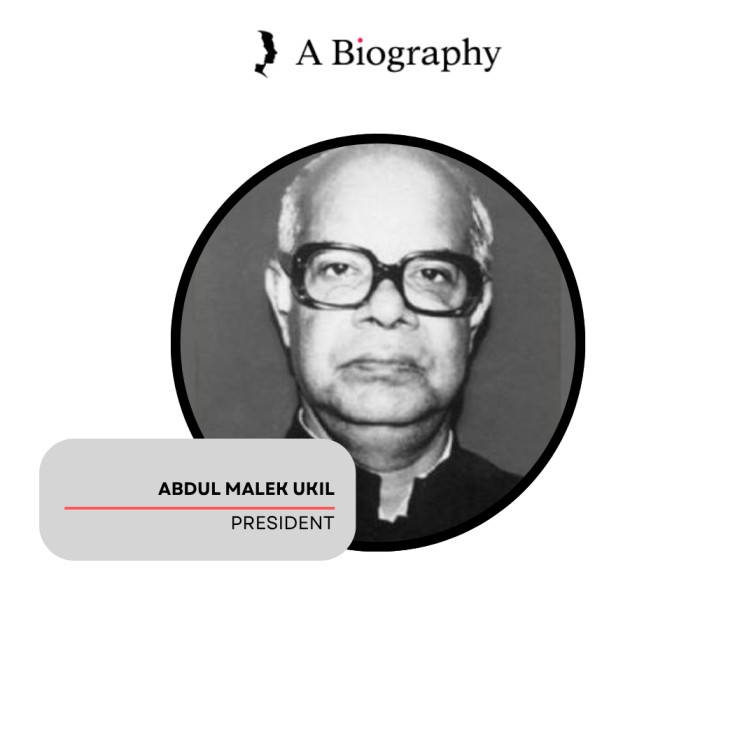
A Biography of Abdul Malek Ukil

Introduction
The Constituent Assembly chamber in Dhaka was silent. The air was thick with history. In the hands of every member was a document that would define the future of a newborn nation — the draft constitution of Bangladesh. On its pages, among the signatures of the nation’s founding fathers, was the name of Abdul Malek Ukil.
He was not the loudest voice in the room. But when he spoke about secularism, about the rights of minorities, about the separation of powers, the assembly listened. He had argued passionately: “Bangladesh will be a sanctuary for people of all religions. The constitution must declare that.” His words became the bedrock of the nation’s founding principles.
That night, he knew he was not just writing laws. He was writing the soul of a country.
Abdul Malek Ukil was a man of many roles: lawyer, language activist, freedom fighter, constitution-maker, health minister, home minister, speaker of parliament, and president of the Awami League. But above all, he was a loyal soldier of Bangabandhu Sheikh Mujibur Rahman. He spent nearly five years in Pakistani jails. He never compromised. He never sought personal gain. He built schools and colleges in his home district of Noakhali from his own land and resources. He died on October 17, 1987, leaving behind a legacy of service, integrity, and unwavering dedication.
This biography takes you through the epic journey of a peasant’s son from Noakhali who became one of the architects of independent Bangladesh.
At a Glance: Life of Abdul Malek Ukil
| Category | Details |
| Full Name | Abdul Malek Ukil (Abdul Malek) |
| Nickname | Ukil Saheb (lawyer), Malek Bhai (political), ‘Damal Chhele of Noakhali’ |
| Born | October 1, 1924, Rajapur village, Sadar upazila, Noakhali district, British India |
| Died | October 17, 1987, Dhaka (age 63) |
| Father | Maulana Mohammad Munshi Chand Mia (religious figure, farmer, social worker) |
| Mother | Nurunnisa (homemaker, deeply pious) |
| Spouse | Sabura Khatun (married 1952) |
| Children | Two sons: Golam Mohiuddin Latu (d. 2014), Baharuddin Khelon (alive); five daughters: Fatema Begum Rubi, Amena Begum Baby, Nurunnahar Lili, Nurunnisa Maya, Lima Malek |
| Profession | Lawyer (enrolled in Noakhali Bar 1952, Dhaka High Court Bar 1962), politician |
| Education | Passed Madrasa exam from Noakhali Ahmadia High Madrasa; IA from Magura College, Jessore (1947); BA (History) from Dhaka University (1949); MA (History) from Dhaka University (1950); LL.B from Dhaka University (1952) |
| Political Party | Awami Muslim League (1949), later Awami League |
| Role in Language Movement | Arrested on March 11, 1948, and again on February 22, 1952 |
| Prison Terms | Approximately 5 years total (1948, 1952, 1954, 1962, 1966, 1969, 1975) |
| Provincial Assembly Member | 1954, 1956, 1962, 1965 — from Noakhali |
| National Assembly Member | 1970 — from Noakhali-3 |
| Constituent Assembly Member | 1972-1973 |
| Member of Constitution Drafting Committee | 1972 |
| Minister of Health & Family Planning | 1972-1973 |
| Minister of Home Affairs | 1973-1975 |
| Speaker of the National Parliament | January – August 1975 (7 months) |
| President of Awami League | 1978-1981 |
| Acting President of Awami League | 1981-1987 (after Sheikh Hasina became president) |
| Hajj | Performed Hajj in 1983; Umrah in 1979 |
| Major Educational Institutions Founded | Noakhali College, Maijdee Girls’ High School (1963), Maijdee Ideal High School (1965), Baderhat Abdul Malek College (1984) |
| Awards & Recognition | Posthumous: Abdul Malek Ukil Medical College (2010), Abdul Malek Ukil Hall (Noakhali University of Science & Technology), Abdul Malek Ukil Road (Noakhali town) |
| Burial | Rajapur village, Noakhali, in family graveyard |
Early Life (1924-1938): The Peasant’s Son Who Dreamed of Justice
On October 1, 1924, in the village of Rajapur in Noakhali’s Sadar upazila, a boy was born into a modest farming family. They named him Abdul Malek Ukil. His father, Maulana Mohammad Munshi Chand Mia, was a respected religious figure and farmer. He worked the land in the morning and taught in the local maktab in the afternoon. His mother, Nurunnisa, was a homemaker and deeply pious.
Young Abdul Malek grew up watching the struggles of peasants — the tyranny of zamindars, the indifference of British rulers, the poverty that gripped the village. He saw how illiteracy kept people enslaved. He made a silent vow: he would study, he would become a lawyer, and he would fight for the rights of ordinary people.
One incident from his childhood is still told in Rajapur. When he was about ten years old, British police harassed a farmer. Abdul Malek gathered the village children and led a protest march. The adults were amazed — such courage in such a small boy. The elders said, “This boy will become a great leader.”
His father wanted him to be a good human being above all else. That lesson never left him.
Education (1938-1952)
Abdul Malek’s early education began in the village maktab, where he learned the Quran and basic Bengali, Arabic, and Persian. He then enrolled at Noakhali Ahmadia High Madrasa, where he excelled in religious and modern studies. He passed the madrasa examination with first division — a rare achievement.
He then moved to Magura College in Jessore for higher secondary education. In 1947, he passed his IA in first division. The country was being partitioned; chaos reigned. But Abdul Malek focused on his studies.
He was admitted to the University of Dhaka, choosing History. In 1949, he earned his BA Honours in History. His professors, including the renowned Dr. Ramesh Chandra Majumdar, praised his intellect. He then completed his MA in History from Dhaka University in 1950.
But he was not satisfied. He wanted to practice law — to become a voice for the voiceless. So he enrolled in the LL.B program at Dhaka University. In 1952, he earned his law degree. During his law studies, he first met Sheikh Mujibur Rahman in the university canteen. Mujib was also a law student. That meeting sparked a friendship that would last a lifetime.
During the Language Movement in 1952, his LL.B exams were ongoing. He chose to boycott the exams and join the protests. He was arrested. Later, he was allowed to take the exams and passed.
Struggles & Adversities
Abdul Malek Ukil spent approximately five years of his life in Pakistani jails. He was arrested multiple times: in 1948 for the Language Movement, in 1952 again, in 1954 during the United Front election campaign, in 1962 during the education movement, in 1966 for the Six-Point Movement, in 1969 during the anti-Ayub uprising, and in 1975 after Bangabandhu’s assassination.
In jail, he was beaten, tortured, and kept in solitary confinement. But he never signed any statement against Bangabandhu. He never abandoned the demand for Bengali rights. He organized hunger strikes inside prison and kept the morale of other political prisoners high.
He once wrote from jail: “The prison walls cannot confine my soul. I will fight until Bengal is free.”
Love:
Abdul Malek Ukil married Sabura Khatun in 1952. She was from a respectable family in Noakhali. She was a homemaker and a woman of quiet strength. During his long absences in jail, she raised their children alone. She managed the household, kept the family together, and never complained.
He often said, “My wife is my greatest support. Without her, I could not have devoted myself to politics.”
They had two sons and five daughters. His eldest son, Golam Mohiuddin Latu, passed away in 2014. His other son, Baharuddin Khelon, is alive. His daughters — Fatema, Amena, Nurunnahar, Nurunnisa, and Lima — are all educated and married.
He never used his political position to favor his children. He wanted them to earn their own place in the world.
Personal Life
Abdul Malek Ukil lived with remarkable simplicity. Even as a minister, he did not build a large house. His home in Noakhali was a modest tin-roofed structure — visitors could not believe it was the residence of a central minister.
He dressed in simple clothes. He ate simple food. He never owned luxury cars. He gave away much of his income to educational institutions and the poor. He donated his own land to build schools and colleges.
He was a devout Muslim. He prayed five times a day, fasted during Ramadan, performed Umrah in 1979, and Hajj in 1983. But he never mixed religion with politics. He believed that the state must be secular, treating all religions equally.
Future Plans & Vision
Abdul Malek Ukil dreamed of a Bangladesh where every child would have access to education, where healthcare would be free for the poor, where the rule of law would prevail, and where people of all religions would live in harmony.
He worked to establish schools and colleges in Noakhali — often with his own money and land. He wanted to break the cycle of poverty through education. He also wanted to strengthen local government and ensure that development reached the villages.
He did not live to see all his dreams fulfilled. But his institutions continue to educate thousands of students every year.
Career (1952-1987)
Early Legal Career (1952)
He enrolled in the Noakhali District Bar in 1952 and began practicing law. He became known for taking cases of the poor for free. In 1962, he became a member of the Dhaka High Court Bar.
Student Politics and Founding of Student League (1948)
On January 4, 1948, he was among the founding members of the East Pakistan Muslim Student League. He became an active student leader at Dhaka University.
Language Movement (1948, 1952)
He was arrested on March 11, 1948, for leading a procession demanding Bengali as a state language. Again on February 22, 1952, he was arrested in Noakhali for protesting the killings of February 21. In jail, he went on hunger strike.
Provincial Assembly Member (1954, 1956, 1962, 1965)
He was elected to the East Pakistan Provincial Assembly four times from Noakhali. He spoke forcefully for autonomy and against the dictatorship of Ayub Khan.
Six-Point Movement (1966) and Arrest
When Bangabandhu declared the Six-Point program, Abdul Malek campaigned across Noakhali, going door to door. He was arrested and spent months in jail.
1969 Mass Uprising and Round Table Conference
He played a key role in the anti-Ayub movement. After Ayub’s fall, he attended the Round Table Conference in Rawalpindi as part of the Awami League delegation. He demanded full autonomy for East Pakistan.
1970 Election and National Assembly
He was elected to the Pakistan National Assembly from Noakhali-3 in 1970.
Liberation War (1971)
After March 25, he did not flee to India. He stayed inside the country, organizing relief and resistance. He avoided Pakistani intelligence and helped freedom fighters with food and shelter. After independence, he worked on refugee rehabilitation.
Member of Constituent Assembly and Constitution Drafting Committee (1972)
He became a member of the Constituent Assembly and was appointed to the Constitution Drafting Committee, chaired by Dr. Kamal Hossain. He argued for secularism, minority rights, and the separation of powers. The constitution was passed on November 4, 1972.
Minister of Health & Family Planning (1972-1973)
He rebuilt war-damaged hospitals, recruited doctors and nurses, and launched vaccination programs against smallpox and tuberculosis. He promoted family planning with the slogan “Not more than two children.”
Minister of Home Affairs (1973-1975)
He cracked down on post-war crime, illegal arms, and terrorism. He reformed the police administration. Critics say he was tough, but he maintained that law and order was essential for democracy.
Speaker of Parliament (January – August 1975)
After the 4th amendment (January 25, 1975), he was elected Speaker. He conducted parliamentary proceedings with fairness. After Bangabandhu’s assassination on August 15, he was arrested on August 23.
President of Awami League (1978-1981)
After his release, he worked to rebuild the shattered party. In 1978, he was elected President of Awami League. He reorganized the party from the grassroots and called for Sheikh Hasina’s return.
Acting President of Awami League (1981-1987)
When Sheikh Hasina was elected President of the party in 1981, Abdul Malek became the Acting President (sometimes called “Adviser” or “Convener”). He mentored Hasina, guided her through party politics, and stood by her during the Ershad regime.
Travels & Diverse Experiences: A Diplomat’s Limited World
As Health Minister, he attended WHO and UNICEF meetings. He addressed the UN Population Commission. He visited several countries in South Asia and the Middle East. However, he was not an extensive traveler; his world was primarily Bangladesh — its villages, its people, its struggle.
Failures & Teachable Moments
Abdul Malek Ukil supported the one-party BAKSAL system introduced by Bangabandhu in 1975. Critics argue that this was undemocratic. His defense: he was loyal to Bangabandhu, and in the post-war chaos, a strong central system was needed. He learned that even loyalty has its limits — and that history judges leaders by their commitment to democracy.
Another failure: during the post-1975 period, he could not prevent the assassination of Bangabandhu or the subsequent military takeover. But no one could.
Source of Inspiration
Abdul Malek’s greatest inspiration was Bangabandhu. He first met him at Dhaka University in the late 1940s and remained devoted until his own death. Bangabandhu called him “my right hand.” He once said, “If Bangabandhu asks me to jump into fire, I will do it without hesitation.”
He also drew inspiration from the people of Noakhali — their struggles, their resilience, their love for the land.
Influences & Inspirations
He was influenced by the Indian Constitution’s commitment to secularism and fundamental rights. He was also influenced by the Universal Declaration of Human Rights. He believed that a constitution must protect minorities and guarantee equality for all.
Philosophical Views & Beliefs
Abdul Malek believed in three core principles:
- Secularism: The state must treat all religions equally. Religion is personal, governance is for all.
- Democracy: Power must come from the people through free and fair elections.
- Service: Politics is not for personal gain; it is for serving the people.
He was a devout Muslim but a secular politician. He prayed regularly but never imposed his faith on others.
Unique Traits
What made Abdul Malek unique was his absolute lack of vanity. As a minister, he lived in a tin-roofed house. He traveled in simple cars. He refused special treatment. He donated his land and salary to build schools.
He was also unique for his courage. He spent nearly five years in prison. He was tortured. But he never broke. He never betrayed his leader.
Contributions, Awards & Achievements
Constitutional Contributions
- Member of the Constitution Drafting Committee (1972)
- Helped shape the secular, democratic character of Bangladesh’s constitution
Ministerial Contributions
- Rebuilt health sector after Liberation War
- Established vaccination programs
- Restored law and order as Home Minister
Educational Contributions
- Founded Noakhali College
- Founded Maijdee Girls’ High School (1963) — first girls’ school in Noakhali
- Founded Maijdee Ideal High School (1965)
- Founded Baderhat Abdul Malek College (1984) — donated his own land
Political Contributions
- Helped rebuild Awami League after 1975
- Mentored Sheikh Hasina in her early years as party leader
- Served as Speaker, Minister, and President of the party
Awards (Posthumous)
- Abdul Malek Ukil Medical College (Noakhali, 2010)
- Abdul Malek Ukil Hall (Noakhali University of Science & Technology)
- Abdul Malek Ukil Road (Noakhali town)
Controversies
Abdul Malek Ukil is one of the few Bangladeshi politicians who remained virtually controversy-free. No allegation of corruption was ever proven against him. He did not favor his relatives. He did not use his position to amass wealth.
The only criticisms:
- Support for BAKSAL: Some see this as anti-democratic. Others see it as loyalty to Bangabandhu in a crisis.
- Toughness as Home Minister: Some accused him of being harsh on opposition. But given the post-war chaos, his actions were within the law.
Overall, he is remembered as an honest, dedicated, and incorruptible leader.
Contemporary Opinions & Interviews
After his death, Sheikh Hasina said: “Abdul Malek Ukil was a pillar of the Awami League. He held the party together during the darkest days.”
Dr. Kamal Hossain, his colleague on the Constitution Drafting Committee, said: “He was a man of deep conviction. When he spoke about secularism, he meant it from the heart.”
A fellow prisoner from 1966 recalled: “In jail, Ukil never lost his spirit. He organized study circles and kept us united.”
Myths & Misconceptions
Myth: He was a puppet of Bangabandhu.
Fact: He was a leader in his own right. He took independent decisions but always remained loyal to the party.
Myth: He was anti-religion because he supported secularism.
Fact: He was a devout Muslim who performed Hajj and Umrah. Secularism for him meant equal respect for all religions.
Myth: He was rich.
Fact: He lived a simple life and donated most of his assets to educational institutions.
Famous Quotes & Thoughts
- “I have fought for Bengal’s independence. My strength is uncompromising commitment to truth and justice.”
- “Bangladesh will be a sanctuary for people of all religions.”
- “If Bangabandhu asks me to jump into fire, I will do it without hesitation.”
- “Politics is not for power. Politics is for service.”
- “An educated nation is a strong nation.”
Message for the Present Generation
If Abdul Malek Ukil were alive today, he would tell young people:
“Be honest. Be dedicated. Never sacrifice your principles for temporary gain. Study hard, serve your people, and never forget that the country is bigger than any individual. Do not be corrupted by power. And always remember: secularism is the foundation of Bangladesh’s constitution — protect it.”
He would also say: “I spent five years in jail for this country. Do not waste the freedom that was earned with blood.”
Death & Legacy (October 17, 1987)
On October 17, 1987, Abdul Malek Ukil died in Dhaka at the age of 63. He had been suffering from heart and kidney ailments. His death was mourned across Noakhali and throughout Bangladesh’s political circles.
Thousands of people attended his funeral. He was buried in his family graveyard in Rajapur village, Noakhali. A small mausoleum was built beside his grave.
His death was not marked by state honors — the military regime of Ershad was in power, and he was a vocal opposition leader. But the people of Noakhali gave him a farewell that no state ceremony could match.
Successors & Lasting Impact
Abdul Malek Ukil’s successors in politics include his son Baharuddin Khelon and other family members who remain involved in local politics. However, his true successors are the thousands of students educated in the institutions he founded.
His lasting impact includes:
- The constitution of Bangladesh, which still bears his imprint
- The educational institutions in Noakhali that continue to serve the community
- The Abdul Malek Ukil Medical College and other memorials
- The example of an honest, incorruptible, and dedicated public servant
Unknown Facts
- He was one of the founding members of the East Pakistan Muslim Student League (January 4, 1948).
- He donated his own land to build Baderhat Abdul Malek College.
- He performed Umrah in 1979 and Hajj in 1983.
- He spent nearly five years in Pakistani jails — one of the longest-serving political prisoners.
- He did not flee to India during the Liberation War; he stayed inside the country and organized resistance.
- He never built a large house. His home in Noakhali was a simple tin-roofed structure.
- He was the first Speaker of the Bangladesh Parliament after the 4th amendment.
- He never wrote a memoir or autobiography, despite repeated requests.
Key Events (1924-1987)
| Year | Event |
| 1924 | October 1 — Born in Rajapur, Noakhali |
| 1938 | Passed madrasa examination from Noakhali Ahmadia High Madrasa |
| 1947 | IA from Magura College, Jessore |
| 1948 | January 4 — Founding member of East Pakistan Muslim Student League; March 11 — arrested for Language Movement; BA from Dhaka University |
| 1949 | Joined Awami Muslim League |
| 1950 | MA in History from Dhaka University |
| 1952 | LL.B from Dhaka University; married Sabura Khatun; arrested again for Language Movement; enrolled in Noakhali Bar |
| 1954 | Elected to Provincial Assembly; arrested during election campaign |
| 1956 | Re-elected to Provincial Assembly |
| 1962 | Elected to Provincial Assembly; arrested during education movement; became member of Dhaka High Court Bar |
| 1965 | Re-elected to Provincial Assembly |
| 1966 | Arrested for Six-Point Movement |
| 1969 | Participated in mass uprising; attended Round Table Conference; arrested and released |
| 1970 | Elected to Pakistan National Assembly from Noakhali-3 |
| 1971 | Liberation War; organized resistance and relief; arrested by Pakistani forces (escaped) |
| 1972 | Member of Constituent Assembly and Constitution Drafting Committee; appointed Health & Family Planning Minister |
| 1972 (Nov 4) | Constitution passed |
| 1973 | Re-elected as MP; appointed Home Minister |
| 1975 (Jan) | Elected Speaker of Parliament |
| 1975 (Aug 15) | Bangabandhu assassinated |
| 1975 (Aug 23) | Arrested |
| 1976 | Released from jail |
| 1978 | Elected President of Awami League |
| 1979 | Performed Umrah |
| 1981 | Sheikh Hasina elected party president; Abdul Malek becomes Acting President |
| 1983 | Performed Hajj |
| 1987 | October 17 — Died in Dhaka; buried in Rajapur |
Conclusion
Abdul Malek Ukil was not a man who sought the limelight. He was a man who sought to serve. He worked quietly, endured prison without complaint, and built institutions that would outlast him. He helped draft the constitution that still governs Bangladesh. He rebuilt the health sector after a devastating war. He served as Speaker and Home Minister with integrity. He held the Awami League together when it was shattered.
And when he died, he left behind no fortune — only schools, colleges, and the respect of those who knew him.
He was not perfect. He made mistakes — supporting BAKSAL, perhaps being too loyal to Bangabandhu. But his loyalty was not for personal gain. It was for a cause he believed in: a secular, democratic, and just Bangladesh.
The people of Noakhali remember him as the “Ukil Saheb” who walked among them, who listened to their problems, who built their schools. The nation remembers him as a constitution-maker, a minister, and a patriot.
He rests in the soil of his beloved Noakhali, next to the institutions he built. His name may not be as famous as some of his contemporaries. But those who know history know that Abdul Malek Ukil was a giant — a quiet giant who helped build a nation.
“Abdul Malek Ukil — a life of struggle, a legacy of service. He never sought glory; he sought only justice. And that is why he is remembered.”
References
- Bengali Wikipedia — Abdul Malek Ukil (retrieved 2025)
- English Wikipedia — Abdul Malek Ukil
- ‘Bangladesher Sambidhan Pronoyoner Itihash’ — Dr. Kamal Hossain (Dhaka University Press, 1998)
- ‘Awami Leegher Itihash: Prothom Porbo’ — Professor Rafiqul Islam (Bangla Academy, 2005)
- ‘Muktijuddher Ovhidhan’ — edited by Dr. Muntassir Mamun (Bangla Academy, 2006)
- ‘Noakhalir Rajnitee Abdul Malek Ukiler Bhumika’ — Professor Nurul Islam (local publication, 1998)
- ‘Bangabandhur Sochorodera’ — Maulana Abdul Mannan (Islamic Foundation, 1995)
- Daily Ittefaq, October 18, 1987
- Daily Prothom Alo, October 18, 1987
- Family memoirs and interviews
- Government of Bangladesh gazette, Constituent Assembly records (1972)
- Abdul Malek Ukil Medical College establishment documents (Noakhali District Administration, 2010)
- East Pakistan Provincial Assembly election results (1954-1965) — Pakistan National Archives, Karachi
- WHO reports — Health Minister Abdul Malek Ukil’s speeches (1972-1973)
Disclaimer
This biography has been prepared based on reliable sources, including Wikipedia, Banglapedia, newspaper archives, academic publications, and government records. Some personal details — such as the exact dates of certain arrests and minor family information — may vary across sources. Where discrepancies exist, the most widely accepted information has been used. Dramatic and narrative elements have been employed for readability, but core factual events remain unchanged. The controversial aspects — support for BAKSAL — are presented neutrally, reflecting both the criticism and the defense. The purpose of this biography is to honor the memory of a great patriot and inspire readers. Readers are encouraged to consult multiple sources for a comprehensive understanding.
End of Biography
The story does not end. Abdul Malek Ukil’s life teaches us that dedication, honesty, and service are the true measures of a leader. He helped write the constitution of a nation; he helped build its institutions; he suffered in prison; he served without seeking reward. The schools he built still stand. The constitution he helped draft still guides the nation. His legacy is not in statues but in the lives he touched and the institutions he created. He is remembered — and he will not be forgotten.

