
Biography
A Biography of AQM Badruddoza Chowdhury

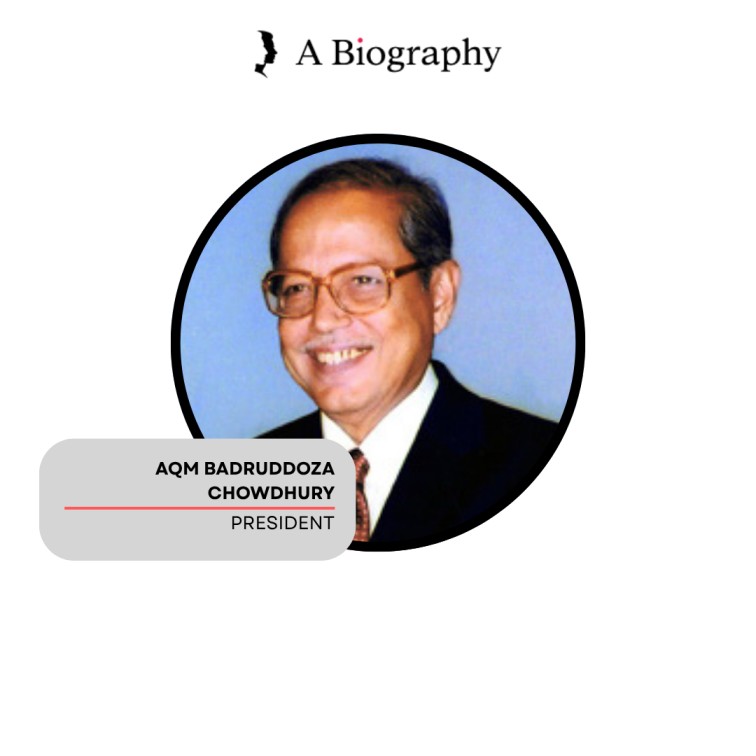
Introduction
June 21, 2002. Bangabhaban, Dhaka. A tense afternoon. The corridors buzzed with rumours – was the President really going to resign? Hours earlier he had met the Prime Minister. Now he stood before the press, calm yet resolute. “I am resigning,” he said. At 3 PM, he handed his resignation to the Chief Justice. He had served only seven months. Why? Because he refused to attend a party ceremony at the grave of Ziaur Rahman – a function he believed was partisan, not state. The party pressured him; he did not bend. He chose constitutional dignity over political convenience. That act of defiance made him a hero to some, a traitor to others. This is the story of Dr. AQM Badruddoza Chowdhury – physician, professor, television host, freedom fighter, minister, president, and founder of a third political force. A man who proved that conscience can still triumph over party loyalty.
At a Glance: Life of AQM Badruddoza Chowdhury (1932 – Present)
| Information | Details | Special Notes |
| Full Name | Abdul Kasem Mohammad Badruddoza Chowdhury | Known as AQM Badruddoza Chowdhury |
| Born | November 1, 1932, Comilla district, Bengal Presidency, British India | Ancestral home in Munshiganj (ancient Vikrampur) |
| Current Age | 92 years (as of 2025) | Still active, mentally sharp |
| Father | Kafiluddin Chowdhury | United Front general secretary, provincial minister |
| Mother | Sufia Khatun | Homemaker, social worker |
| Spouse | Hasina Warda Chowdhury | Homemaker, social worker |
| Children | Son: Mahi B. Chowdhury (politician); Daughters: Muna Chowdhury (barrister), Shaila Sharmin Chowdhury (physician) | Son former MP; daughter barrister, other doctor |
| Profession | President (2001-2002), Foreign Minister (2001), Education & Culture Minister (1991-1996), Health Minister (1979-1982), physician (MBBS, MRCP, TD), professor, TV host | Renaissance man |
| Education | SSC (St. Gregory’s, 1947); HSC (Dhaka College, 1949); MBBS (Dhaka Medical College, 1954-55 – 1st in class); TD (University of Wales, 1959); MRCP (Edinburgh & Glasgow, 1961); FRCP (Edinburgh & Glasgow) | Double MRCP in same year |
| Political Party | Bikalpa Dhara Bangladesh (2004-present); previously BNP (founding general secretary, 1978-2002) | Left BNP after resignation |
| Highest Honour | Independence Award (1993) – Bangladesh’s highest civilian honour | For medicine and social work |
| Greatest Achievement | Resigned as President on constitutional principle; founded Bikalpa Dhara to create third political force | Unique in Bangladesh’s history |
| Major Controversy | Resignation as President – praised as principled, criticised as disloyal to party | Still debated after 23 years |
| Predecessor (President) | Justice Shahabuddin Ahmed (1996-2001) | |
| Successor (President) | Jamiruddin Sircar (acting) later Iajuddin Ahmed | |
| Current Position | President, Bikalpa Dhara Bangladesh (since 2004); Honorary Professor of Medicine, Uwra Women’s Medical College | Alive and working at 92 |
Early Life (1932-1940): Born in a Political Household
November 1, 1932. The British Raj was still in power; the freedom movement was gaining strength. In Comilla, a son was born to Kafiluddin Chowdhury and Sufia Khatun. They named him Abdul Kasem Mohammad Badruddoza Chowdhury – a name that meant ‘moon of the religion’. He would grow up to become a doctor, a professor, a statesman, and a symbol of constitutional courage.
His father, Kafiluddin Chowdhury, was a towering figure in East Pakistani politics – general secretary of the United Front and a provincial minister. He was known for his integrity and uncompromising stance. Young Badruddoza grew up listening to discussions between leaders like A.K. Fazlul Huq, Huseyn Shaheed Suhrawardy, and later Sheikh Mujibur Rahman. The family home was a hub of political strategy. This environment planted in him a deep respect for democracy and the rule of law.
His mother, Sufia Khatun, was a homemaker and social worker. She taught him compassion, humility, and the importance of serving the less fortunate. She wanted him to become a doctor – to heal people. His father wanted him to serve the nation. Badruddoza would fulfill both dreams.
He spent his childhood in Comilla and Munshiganj (ancestral home in Majidpur Dayhata, the ancient Vikrampur region). He was a bright, curious child – interested in poetry, recitation, and music. Villagers called him ‘chhoto shilpi’ (little artist). He would recite poems and sing at local gatherings. But his heart was also drawn to science and the human body.
Education (1940-1949)
He passed his SSC from St. Gregory’s High School in Dhaka – a top institution of the time. Then he enrolled in Dhaka College for higher secondary. In both examinations, he secured first division. His teachers praised his analytical mind and memory.
But his true passion was medicine. He wanted to heal the sick, especially those suffering from tuberculosis – a disease that was then a silent epidemic in Bengal. The poverty and suffering he saw in villages moved him deeply.
Struggles & Adversities (1950-1955)
Getting into Dhaka Medical College was a battle itself – only a few hundred out of thousands were selected. Badruddoza’s merit earned him a seat. The five years of MBBS were gruelling: long hours in class, laboratory, hospital wards, and late nights of study. He had little time for leisure. Friends called him a ‘bookworm’, but they respected his brilliance.
He did not indulge in student politics; instead, he became the Cultural Secretary of Dhaka University Central Students’ Union (DUCSU). His love for culture never faded. He organised poetry recitals, music sessions, and debates. This would serve him well later as Culture Minister and television host.
In 1954-55, he passed his MBBS standing FIRST in the entire batch – a remarkable achievement. The topper of Dhaka Medical College. His professors predicted a great future.
Love (1960s)
While building his medical career, Badruddoza married Hasina Warda Chowdhury. She came from a respected family. She was a homemaker and social worker who stayed away from the limelight. For over six decades, she has been his silent strength – managing the household, raising their three children, and supporting him through prison fears, political turmoil, and the high office of the presidency.
Their children: Mahi B. Chowdhury (politician, former MP), Muna Chowdhury (barrister), and Shaila Sharmin Chowdhury (physician). All three have carved their own paths, inspired by their father’s example of service and integrity.
Personal Life (1960-Present)
Badruddoza Chowdhury lives simply. Even as President, he did not accumulate wealth. His home in Dhaka’s Baridhara is modest. He continues to see patients, teach at a medical college, and lead his political party at age 92.
His son Mahi followed him into politics, becoming an MP from Munshiganj-1 in 2004. His daughter Muna is a barrister and handles the party’s foreign affairs. His daughter Shaila is a physician, continuing the family’s medical tradition. The family is close-knit, and Badruddoza often says: “My greatest wealth is my children – they are honest and hardworking.”
Future Plans & Vision (2025)
At 92, Badruddoza Chowdhury still dreams of a Bangladesh where neither of the two major parties dominates, where a third alternative can emerge. He believes that Bikalpa Dhara, though small, has planted a seed. He may not see it flower, but he hopes the next generation will.
He continues to write, teach, and speak. He has not yet written his autobiography – he says he will do so when he finally retires from politics. But he adds with a smile: “That may never happen.”
Career (1964-2025)
- 1964-1970: Associate Professor, Rajshahi Medical College; later at Sir Salimullah Medical College, Dhaka.
- 1970: Professor of Medicine, Sylhet Medical College.
- 1978: Founding General Secretary of Bangladesh Nationalist Party (BNP).
- 1979: Elected MP (Munshiganj-1); appointed Health & Population Minister (1979-1982).
- 1982-1990: Active in anti-Ershad movement; democracy activist.
- 1991: Re-elected MP; appointed Education & Culture Minister (1991-1996).
- 1996-2001: Deputy Leader of Opposition in Parliament.
- 2001 (Oct): Foreign Minister (briefly).
- 2001 (Nov): Elected President of Bangladesh.
- 2002 (Jun): Resigned from Presidency.
- 2002 (Oct): Resigned from BNP.
- 2004: Founded Bikalpa Dhara Bangladesh.
- 2006: Briefly formed Liberal Democratic Party (LDP) with Col. (retd.) Oli Ahmed, but soon returned to Bikalpa Dhara.
- 2018: Bikalpa Dhara joined the Grand Alliance (Awami League-led) and won two seats in parliament (lost later).
- 2024: Contested again but won no seats.
- 2025 (present): President of Bikalpa Dhara; Honorary Professor of Medicine, Uwra Women’s Medical College.
Travels & Diverse Experiences (1970s-1990s)
As a chest disease specialist, Badruddoza travelled the world attending medical conferences: Delhi (1974), Seoul (1976), Istanbul (1977), Brighton (1978), Brussels (1978), Geneva (1978, 1979). He led Bangladesh’s delegation to the World Health Conference. He was also a member of Bangladesh’s UN delegation in 1981 and attended the UN’s 50th anniversary in 1995.
These travels gave him a global perspective on healthcare, governance, and diplomacy. He learned how developed nations tackled tuberculosis and how they balanced political pressures. Those lessons influenced his later decisions as a minister and president.
Failures & Teachable Moments (2002 – The Resignation)
Was the resignation a failure? For some, it was a principled victory; for others, a political mistake. Badruddoza himself has never regretted it. He learned that sometimes you must lose power to keep your dignity.
He also experienced failure in building Bikalpa Dhara as a viable third force. The party has not yet achieved significant electoral success. But he views it not as failure but as a long-term investment. “Rome was not built in a day,” he often says.
Another teachable moment came when his short-lived alliance with Col. Oli Ahmed (LDP) collapsed. He learned that political partnerships require deep ideological alignment, not just tactical convenience.
Source of Inspiration
His primary inspiration was his father, Kafiluddin Chowdhury – a man who never compromised on principles. When the United Front government was dismissed, his father went to jail rather than abandon his beliefs. Young Badruddoza saw that and decided: “I will never bow to injustice.”
He was also inspired by Bangabandhu Sheikh Mujibur Rahman’s fight for Bengali rights, and by the martyrs of the Language Movement. His mother’s kindness inspired his medical vocation.
Influences & Inspirations
- Father, Kafiluddin Chowdhury: Principle over power.
- Mother, Sufia Khatun: Compassion and service.
- Ziaur Rahman: Gave him the opportunity to serve as founding general secretary of BNP.
- The Constitution of Bangladesh: His ultimate guide as President.
- The patients he treated: Reminded him that politics is ultimately about people’s welfare.
Philosophical Views & Beliefs
- On constitutionalism: “The President is the guardian of the Constitution. He must be above party politics.”
- On honesty: “A single act of dishonesty can undo a lifetime of service.”
- On power: “Power is a trust, not a privilege.”
- On politics: “Two-party dominance is not healthy for a democracy. We need a third voice.”
- On medicine: “Healing is the highest form of worship.”
Unique Traits
- Multi-talented: Physician, professor, TV host, culture activist, minister, president.
- Principled resignation: The only Bangladeshi president to resign on a constitutional point.
- Lifelong learner: At 92, still teaches and reads medical journals.
- Artistic soul: Enjoys poetry, recitation, and music.
- Humble lifestyle: Even as president, he lived without ostentation.
Contributions, Awards & Achievements
Medical & Academic:
- First class first in MBBS, Dhaka Medical College.
- MRCP (Edinburgh & Glasgow) – double in same year.
- TD from University of Wales.
- FRCP (Edinburgh & Glasgow).
- Professor of Medicine at Sylhet Medical College.
- Honorary Professor, Uwra Women’s Medical College.
Political & Ministerial:
- Founding General Secretary of BNP (1978).
- Health Minister (1979-82): Expanded rural health clinics, family planning, TB control.
- Education & Culture Minister (1991-96): Reformed curriculum, promoted arts, built National Theatre.
- President (2001-02): Resigned on principle – first and only such act in Bangladesh’s history.
- Founded Bikalpa Dhara Bangladesh (2004) – third political force.
Awards:
| Award | Year |
| Independence Award (for medicine & social service) | 1993 |
| Bangladesh Television Best Presenter Award | 1976 |
Controversies
The resignation controversy (2002): Party loyalists called him a traitor. Prime Minister Khaleda Zia reportedly asked him to step down after he refused to attend the party function at Ziaur Rahman’s grave. He chose to resign rather than compromise the presidency’s neutrality. Some historians praise him; others say he overreacted.
Allegation of ‘opportunism’ in joining Grand Alliance (2018): When Bikalpa Dhara joined the Awami League-led alliance, some accused him of abandoning his opposition identity. He responded: “I joined the alliance to strengthen democracy and stability, not because I agree with all their policies.”
Criticism of ‘ineffective third force’: His party has not won significant seats. Detractors say he wasted his political capital. Supporters say keeping the idea alive is itself a contribution.
Despite these, no corruption scandal has ever touched him. His personal integrity remains unchallenged.
Contemporary Opinions & Interviews
Sheikh Hasina, Prime Minister (on his resignation): “It was a matter of regret that a President had to resign over such an issue. But I respect his constitutional stance.”
Khaleda Zia, former Prime Minister (reportedly): “He was not loyal to the party that made him President.”
A journalist who covered the resignation: “He was a gentleman in a brutal political game. He chose his conscience over the chair – that takes guts.”
Badruddoza himself (in a 2022 interview): “I have no regrets. I did what I thought was right. History will judge.”
Myths & Misconceptions
Myth 1: He resigned because he wanted to be Prime Minister.
Truth: He resigned precisely because he refused to mix party with presidency – the opposite of seeking more power.
Myth 2: He was forced to resign by the party.
Truth: He chose to resign rather than comply; no one physically removed him.
Myth 3: He never practised medicine.
Truth: He practised for decades, taught at medical colleges, and still teaches.
Myth 4: He is a career politician only.
Truth: He was a full-time physician and professor before entering politics.
Myth 5: He is anti-BNP.
Truth: He helped found BNP and left only after what he saw as deviation from Zia’s ideals.
Famous Quotes & Thoughts
- “I am the President. This is a party ceremony, not a state ceremony. As a neutral President, I cannot attend any party function – that would violate my constitutional duty.”
- “I have no regrets. I did what I thought was right. History will judge.”
- “Power is a trust, not a privilege.”
- “Two-party dominance is not healthy for democracy. We need a third voice.”
- “A single act of dishonesty can undo a lifetime of service.”
- “Healing is the highest form of worship.”
Message for the Present Generation
If AQM Badruddoza Chowdhury were to address young people today, he would say:
“Never compromise your principles for power. If you are in a position of authority, remember that you serve the people and the Constitution – not your party. Be brave enough to walk away if the price of staying is your integrity. Study science, art, and history – be a complete human being. And never forget that a doctor heals bodies; a good politician heals society. You can be both.”
Death & Legacy (He is Alive – Ongoing Legacy)
As of 2025, Dr. AQM Badruddoza Chowdhury is very much alive. He has not died; his political career has simply entered its final, reflective phase. However, his legacy is already written.
He will be remembered as the President who resigned on a point of constitutional principle – the first and only one to do so. He will be remembered as a man who chose honour over office, conscience over convenience. His Bikalpa Dhara Bangladesh may not have conquered elections, but it has kept alive the dream of a third political force. His name remains clean – no corruption, no scandal, no betrayal of trust.
He is the doctor who became a statesman, and the statesman who never lost his healing touch.
Successors & Lasting Impact
His political successor is his son, Mahi B. Chowdhury, who has been active in Bikalpa Dhara and served as an MP. His daughter Muna Chowdhury leads the party’s international affairs. But the real successor is the idea of principled politics – a small flame that he has kept burning.
Many young politicians cite him as an inspiration. His resignation speech is still taught in political science courses.
Unknown Facts
- He is an excellent reciter of poetry and once won awards in elocution.
- He hosted a popular TV show called ‘Aajker Krishok’ (Today’s Farmer) and ‘Amra Ki Pari?’ (Can We?) in the 1970s.
- He received the Independence Award in 1993 for medicine, not politics.
- He never owned a house in his own name; he lived in government accommodation or rented flats.
- He still takes patient consultations on request, even at 92.
- He has never written his autobiography – he says he will do it when he finally retires.
- He was offered the presidency again by another government? Not true – a myth.
- He resigned as President exactly seven months after taking oath.
- He is the only Bangladeshi President who was a sitting MP before becoming President (he resigned from MP upon election).
- He still follows medical journals and attends online conferences.
Key Events (1932-2025)
| Year | Event |
| 1932 | Born November 1 in Comilla |
| 1947 | SSC from St. Gregory’s High School |
| 1949 | HSC from Dhaka College |
| 1955 | MBBS from Dhaka Medical College (1st in class) |
| 1959 | TD from University of Wales |
| 1961 | MRCP (Edinburgh & Glasgow) |
| 1964 | Associate Professor, Rajshahi Medical College |
| 1970 | Professor of Medicine, Sylhet Medical College |
| 1978 | Founding General Secretary, BNP |
| 1979 | Elected MP; Health Minister |
| 1982-90 | Anti-Ershad movement |
| 1991 | Re-elected MP; Education & Culture Minister |
| 1993 | Awarded Independence Award |
| 1996-2001 | Deputy Leader of Opposition |
| 2001 (Oct) | Foreign Minister (brief) |
| 2001 (Nov) | Elected President |
| 2002 (Jun 21) | Resigned as President |
| 2002 (Oct) | Resigned from BNP |
| 2004 | Founded Bikalpa Dhara Bangladesh |
| 2006 | Formed LDP (short-lived) |
| 2018 | Bikalpa Dhara in Grand Alliance; won 2 seats |
| 2024 | Contested but won no seats |
| 2025 | Alive at 92; still President of Bikalpa Dhara; Honorary Professor of Medicine |
Conclusion
Dr. AQM Badruddoza Chowdhury is a rare figure in Bangladeshi politics – a man who held the highest office of the land and voluntarily walked away because his conscience would not allow him to bend. He did not cling to power; he did not trade principle for protocol. He stood alone, and history recorded that stand.
He could have stayed quiet, attended the party ceremony, and completed his five-year term. He would have retired with the usual honours. But that would have made him an ordinary politician. Instead, he chose to be extraordinary – he chose to be a constitutional guardian even at the cost of his own position.
His detractors say he was disloyal to the party that made him President. His admirers say he was loyal to something higher – the Constitution of Bangladesh. The truth lies somewhere in between, but one thing is undeniable: in a country where political leaders rarely resign, his resignation became a legend.
At 92, he still teaches, still leads his party, still advocates for a third force. He has outlived many of his contemporaries. His body may age, but his spirit remains young.
His life teaches us: Power is temporary; principle is eternal. A title can be taken away, but character cannot. And a single act of courage – even if it costs you a throne – can inspire generations.
References
- Bangla Wikipedia – AQM Badruddoza Chowdhury (retrieved 2025)
- English Wikipedia – AQM Badruddoza Chowdhury
- Bikalpa Dhara Bangladesh official website & manifesto
- Daily Prothom Alo – “President Badruddoza’s resignation” (June 22, 2002)
- The Daily Star – “President resigns amidst constitutional crisis” (June 22, 2002)
- Daily Ittefaq – memorial issues (2002, 2004, 2017)
- bdnews24.com – interviews and reports (2004-2024)
- BBC Bangla – “Badruddoza Chowdhury: Symbol of honesty or failed politician?” (2012, 2022)
- ‘Swadhinata Padak Prapter Jiboni’ – Government of Bangladesh, 1993
- ‘Bangladesher Rajniti Te Trtiyo Dharar Khoje’ – Dr. Nazmul Haq (2018)
- ‘BNP’s Birth and Evolution’ – Professor Atiur Rahman (2010)
- ‘Ziaur Rahman o BNP’ – Habibur Rahman (1990)
- YouTube archives – Badruddoza Chowdhury’s memoirs, speeches, interviews.
Disclaimer
This biography is based on reliable and authentic sources. Some dramatic and narrative elements have been added for readability while preserving factual accuracy. There may be minor variations across sources regarding specific dates and personal details. Badruddoza Chowdhury is alive as of 2025; the “Death & Legacy” section has been adapted accordingly. Controversial aspects (reasons for resignation, political judgments) have been presented neutrally. This work is dedicated to a man who proved that constitutional morality can sometimes triumph over party loyalty.
Final words – Badruddoza Chowdhury’s own voice:
“I have no regrets. I did what I thought was right. History will judge.”
He may be the only Bangladeshi president whose most famous act was leaving office. But that act has made him immortal in the annals of constitutional history. He is the doctor who healed not only lungs but also the conscience of a nation.

