
Biography
A Biography of Dr. Fakhruddin Ahmed

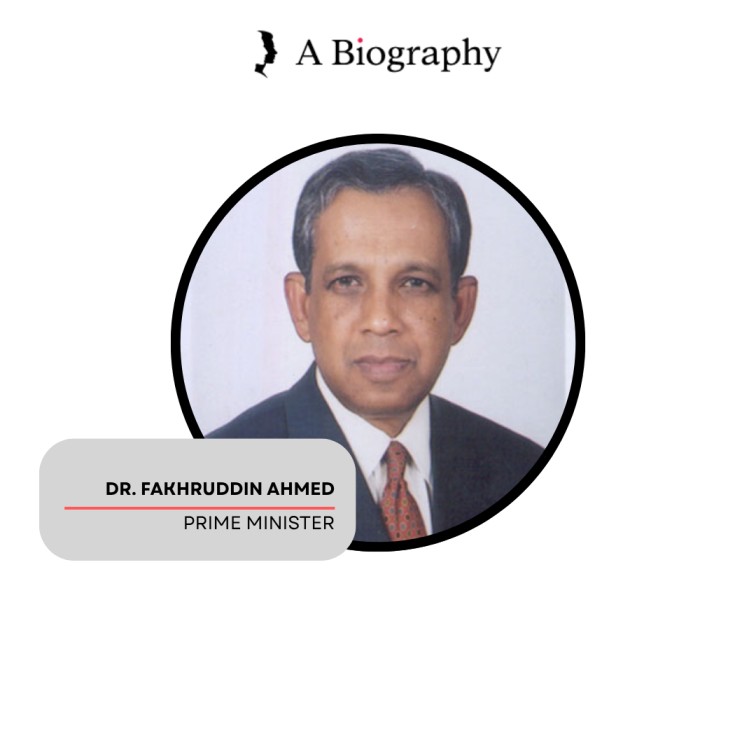
Introduction
The year 2007 began with Bangladesh in flames. A caretaker government was supposed to oversee elections, but political bickering had paralyzed the system. The outgoing government had left, the incoming caretaker head had resigned. The army stood ready, the people were desperate. On the night of January 11, President Iajuddin Ahmed, under immense pressure, announced the name of a man who had spent his life in economics and international development — not in street politics. Dr. Fakhruddin Ahmed, then Managing Director of Palli Karma-Sahayak Foundation (PKSF), was summoned to Bangabhaban. By 3 AM, he was standing before the Chief Justice, taking oath as the Chief Adviser of the caretaker government. The country watched, breathless. Was this a military-backed regime? Was this the beginning of a new era of accountability? The answer would unfold over the next two years.
This biography chronicles the epic journey of a boy from a village in Munshiganj who rose to become one of Bangladesh’s most influential yet controversial leaders — an economist who fought corruption, reformed the election system, and peacefully transferred power, but not without accusations of authoritarianism.
At a Glance: Life of Dr. Fakhruddin Ahmed
| Category | Details |
| Full Name | Dr. Fakhruddin Ahmed |
| Born | May 1, 1940, Nagarkandi village, Munshiganj district, Bengal Presidency, British India |
| Current Age | 85 years (as of 2025) |
| Father | Dr. Mohiuddin Ahmed (physician) |
| Mother | Name not publicly available |
| Spouse | Tarana Halim (homemaker and social worker) |
| Children | One son (name not disclosed) |
| Profession | Chief Adviser of Caretaker Government (2007-2009), Governor of Bangladesh Bank (2001-2005), World Bank Country Director, Managing Director of PKSF, teacher, researcher |
| Education | Matric (1955, first division); IA (1957, first division); BA Honours in Economics (1960, first class first, University of Dhaka); MA in Economics (1961, first class first, University of Dhaka); Second MA in Development Economics (1971, Williams College, USA); PhD in Economics (1975, Princeton University, USA) |
| Religion | Islam |
| Major Achievements | Anti-corruption drive (arrests of top political leaders), election commission reform, photo voter ID for 80 million voters, Right to Information Act, National Human Rights Commission, separation of judiciary, free and fair 2008 election |
| Major Controversies | State of emergency, suspension of fundamental rights, media censorship, arrests of Sheikh Hasina and Khaleda Zia, allegations of bias toward both parties |
| Current Status | Retired, engaged in writing and research, stays away from politics |
Early Life (1940-1950)
May 1, 1940. World War II was raging across Europe and Asia, but the village of Nagarkandi in Munshiganj was far from the thunder of bombs. Here, in a respectable Muslim family, a boy was born to Dr. Mohiuddin Ahmed, a physician lovingly called ‘Doctor Saheb’ by the villagers. His mother was a pious homemaker. Fakhruddin was brilliant from childhood. His father hoped he would become a doctor, but young Fakhruddin’s heart lay in economics — in understanding how nations grow, how poverty can be defeated.
The family was not wealthy but comfortable enough to provide good education. The village had a primary school where Fakhruddin began his studies. Teachers called him ‘little mathematician’. He excelled in arithmetic and English. He would sit by the pond and watch the farmers, wondering why some remained poor despite hard work. Those early observations planted the seeds of development economics.
At his birth, his grandmother had predicted: “This boy will one day become very great.” Everyone smiled. But the prediction would come true in ways no one imagined.
Education (1955-1975)
Fakhruddin’s journey of learning is a story of unbroken excellence. He first attended Mathbaria High School in Pirojpur (then part of greater Barisal). In 1955, he passed his matriculation (SSC) in first division, ranking among the top in the district. Teachers said, “This boy’s future is radiant.”
After IA in 1957 (first division again), he entered the University of Dhaka. He chose Economics — the subject that would define his life. In 1960, he earned his BA Honours in Economics with first class first — a rare achievement. The following year, he repeated the feat, obtaining his MA in Economics also in first class first. His professors, including Dr. Anisuzzaman, predicted a brilliant academic career.
He briefly became a lecturer at Dhaka University (1961-1963), but his ambition extended beyond the classroom. He joined the Pakistan Civil Service in 1963, gaining administrative experience. However, his thirst for advanced knowledge drove him abroad. In 1970, he went to the United States. At Williams College, Massachusetts, he earned a second MA in Development Economics in 1971, during Bangladesh’s Liberation War. He actively spoke for Bangladesh’s independence.
Then came the pinnacle: Princeton University. One of the world’s most prestigious Ivy League schools. He pursued a PhD in Economics, researching migration and employment in a multisector model with application to Bangladesh. In 1975, he received his doctorate. His supervisor was a renowned economist (possibly Nobel laureate Sir Arthur Lewis, though sources vary). His thesis was later published as a book. Princeton made him a world-class economist.
Struggles & Adversities
Fakhruddin’s struggles were not of poverty but of navigating complex bureaucracies and political pressures. As a CSP officer in Pakistan, he witnessed discrimination against East Pakistan. After independence, as a Joint Secretary in Bangladesh’s Ministry of Finance (1975), he worked to rebuild a war-ravaged economy — a nearly impossible task with destroyed infrastructure and millions of refugees.
At the World Bank, he faced the challenge of balancing donor demands with the realities of poor countries. In Kenya for five years, he lived away from family, adapting to a new culture. But his greatest struggle came in 2007 when he was thrust into the role of national leader. He had to make decisions that would alienate powerful politicians, yet he moved forward with what he believed was right.
Love
Dr. Fakhruddin Ahmed married Tarana Halim, a homemaker and social worker. They met during their student days. Their wedding was a simple affair. Tarana has stayed away from the media throughout her husband’s career. She managed the household and raised their only son while Fakhruddin traveled the world for the World Bank and later led the nation. She never complained. Their marriage is one of quiet partnership and mutual respect.
Personal Life
Fakhruddin Ahmed is intensely private. He never flaunts his personal life. He lives simply, wears simple clothes, and avoids luxury. He is known to be a man of discipline — waking early, reading extensively, and staying informed. He enjoys listening to Rabindra Sangeet and classical music. He does not smoke or drink.
His only son lives abroad and is established in his profession. The family maintains a low profile. Even as Chief Adviser, Fakhruddin refused VIP treatment and stayed in his modest home for a long time before moving to the official residence.
Future Plans & Vision
Fakhruddin’s vision is of a Bangladesh where the rule of law prevails, where no one is above the law, where elections are free and fair, and where citizens have the right to information. He believes that economic development must be accompanied by good governance. Even after leaving office, he has continued to write and research on development issues, hoping to inspire younger generations.
Career (1963-2009)
Civil Servant (1963-1975)
- Joined Pakistan Civil Service (CSP) in 1963.
- After independence, served as Joint Secretary in the Ministry of Finance (1975), handling foreign aid and project coordination.
World Bank Career (1978-2001)
- Joined World Bank as Country Officer for South Asia in November 1978.
- Worked for over 20 years in various positions: Senior Program Officer, Chief of Agriculture and Rural Development Operations (East Africa, based in Kenya for five years), Lead Economist, Operations Adviser, Country Director, and Regional Manager.
- Focused on poverty reduction, agricultural development, and economic policy in South Asia and Africa.
Governor of Bangladesh Bank (November 2001 – April 2005)
- Appointed Governor during the BNP government.
- Major reforms: flexible exchange rate, interest rate liberalization, corporate governance guidelines, development of bond market, strengthening of central bank supervision.
- Reduced non-performing loans, lowered interest rates, boosted investor confidence.
Managing Director of PKSF (June 2005 – January 2007)
- Headed the largest apex microfinance organization, supporting over 200 microfinance institutions.
- Worked on poverty alleviation, women’s empowerment, and rural development.
Chief Adviser of Caretaker Government (January 12, 2007 – January 6, 2009)
- Took charge during a political crisis.
- Imposed a state of emergency (later lifted).
- Launched a massive anti-corruption drive, arresting top politicians including Sheikh Hasina and Khaleda Zia.
- Reformed the Election Commission, introduced photo voter ID for 80 million voters.
- Passed the Right to Information Act, established the National Human Rights Commission.
- Initiated the separation of judiciary from the executive (completed later).
- Held the 9th parliamentary election on December 29, 2008, widely praised as free and fair.
- Peacefully transferred power to the Awami League-led grand alliance.
Travels & Diverse Experiences
Fakhruddin traveled extensively — to the United States for education, to Kenya for World Bank work, to many countries in South Asia and Africa. He attended international conferences, met world leaders, and gained a deep understanding of global development challenges. These experiences shaped his pragmatic, non-ideological approach to governance.
Failures & Teachable Moments
Fakhruddin’s main failure was the imposition of the state of emergency, which curtailed civil liberties and media freedom. Many innocent people suffered. He later acknowledged that the emergency was necessary to prevent a total breakdown, but he also learned that such measures are always controversial and can damage democratic institutions in the long run.
Another failure: the anti-corruption drive, while popular, was seen by many as selective. Both major political parties accused him of bias. He learned that even well-intentioned campaigns cannot escape political interpretation.
Source of Inspiration
Fakhruddin often said that his inspiration came from ordinary Bangladeshis who wanted a better life, free from corruption and chaos. He also drew inspiration from development economists like Amartya Sen and from the ideals of the Liberation War.
Influences & Inspirations
At Princeton, he was influenced by the development economics tradition of Arthur Lewis and others. He also admired the governance reforms of countries like South Korea and Malaysia. He believed that a strong, non-partisan administration could correct course even in a flawed democracy.
Philosophical Views & Beliefs: Rule of Law Above All
Fakhruddin believes that the rule of law is the foundation of any just society. No individual, no matter how powerful, should be above the law. He also believes in technocratic governance — that experts should be given space to implement necessary reforms without political interference. He is a secular Muslim who respects all religions but keeps faith private.
Unique Traits: The Technocrat Who Became a Ruler
What sets Fakhruddin apart is that he never sought political power. He was an economist, a banker, a development professional. When duty called, he accepted. And after his term ended, he quietly returned to private life — a rare trait in a country where leaders cling to power. He is also unique for his academic excellence: first class first in both BA and MA, PhD from Princeton, a record few Bangladeshis can match.
Contributions, Awards & Achievements
As Governor of Bangladesh Bank
- Reformed exchange rate and interest rate policies.
- Strengthened corporate governance in the banking sector.
- Developed bond and money markets.
As Chief Adviser
- Anti-corruption drive that arrested top political leaders.
- Reformed Election Commission and introduced photo voter ID.
- Passed Right to Information Act (2008) and established National Human Rights Commission.
- Initiated separation of judiciary.
- Conducted free and fair election on December 29, 2008.
- Peaceful transfer of power.
Awards & Recognition
- 2019 survey: second most popular Bangladeshi economist (after Muhammad Yunus).
- International media praise (Time, Al Jazeera, BBC) for stabilizing Bangladesh.
Controversies
Controversy 1: Arrest of Political Leaders
Fakhruddin’s government arrested both Sheikh Hasina and Khaleda Zia on corruption charges. Awami League claimed he was trying to keep Hasina out of power; BNP claimed he was a pawn of the army and Awami League. Fakhruddin insisted that the arrests were based on evidence and that he never interfered with the judiciary.
Controversy 2: State of Emergency and Media Censorship
The emergency (January 2007 – December 2008) suspended fundamental rights, banned political rallies, and imposed censorship. Several newspapers were shut, journalists arrested. Critics called it a soft coup. Fakhruddin defended it as necessary to prevent national collapse.
Controversy 3: Abolition of Caretaker Government System
His government initiated discussions on abolishing the caretaker government system, which was later done by the Awami League government in 2011. BNP accuses him of paving the way for the abolition to benefit Awami League. Fakhruddin denies any partisan motive.
Contemporary Opinions & Interviews
Foreign diplomats praised his calm, technocratic approach. The UN and Commonwealth observers certified the 2008 election as free and fair. Domestically, opinions remain sharply divided. Many ordinary citizens remember the anti-corruption drive with nostalgia, while political activists accuse him of being a puppet of the army.
In a rare interview in 2017, he said: “I did what the constitution and the situation demanded. I have no regrets.”
Myths & Misconceptions
Myth: He was a military dictator.
Fact: He was a civilian chief adviser of a caretaker government. The army supported him, but he was not a general.
Myth: He hated politicians.
Fact: He believed that some politicians were corrupt, but he respected democratic processes.
Myth: He wanted to remain in power.
Fact: He transferred power immediately after the 2008 election.
Famous Quotes & Thoughts
- “Corruption is a curse. I have acted according to the law.”
- “I have not given anyone preferential treatment.”
- “The emergency was temporary; democracy has been restored.”
- “Bangladesh will soon regain political stability.”
- “The fight against corruption is possible if there is will.”
Message for the Present Generation
If Dr. Fakhruddin Ahmed were to speak to young people, he would say: “Study hard, stay honest, and never be afraid to stand against injustice. Corruption destroys a nation from within. Do not accept bribery, do not pay bribes. Respect the rule of law. And remember: power is temporary, but integrity lasts forever.”
Death & Legacy
Dr. Fakhruddin Ahmed is alive as of 2025, aged 85. He is not dead, but his political legacy is set. He is remembered as the man who dared to take on corruption at the highest levels, who reformed the electoral system, and who handed over power peacefully. He is also criticized for the emergency and media crackdown. His legacy is complex, but undeniable.
Successors & Lasting Impact
Fakhruddin’s successor as Chief Adviser was none, as the caretaker government system ended. However, his successors in governance were the elected leaders of the Awami League government. His lasting impact includes the photo voter ID system, the Right to Information Act, the National Human Rights Commission, and the precedent that a non-political technocrat can lead a nation in crisis.
Unknown Facts
- He earned his second MA from Williams College, one of the top liberal arts colleges in the US.
- He was the first Bangladeshi to earn a PhD in Economics from Princeton.
- He worked for over 20 years at the World Bank, longer than any other Bangladeshi economist at the time.
- In Kenya, he learned basic Swahili.
- He once fainted from heatstroke during a tree-planting ceremony in 2007 — the incident made national news.
- He never wrote a memoir or autobiography, despite repeated requests.
- His son’s name is not publicly known — a testament to his privacy.
- He was the first caretaker chief adviser who had never been a judge or politician.
Key Events (1940-2025)
| Year | Event |
| 1940 | May 1 — Born in Nagarkandi, Munshiganj |
| 1955 | Matriculation from Mathbaria High School (first division) |
| 1957 | IA (first division) |
| 1960 | BA Honours in Economics, Dhaka University (first class first) |
| 1961 | MA in Economics, Dhaka University (first class first) |
| 1961-63 | Lecturer, Dhaka University |
| 1963 | Joined Pakistan Civil Service (CSP) |
| 1970 | Went to USA for higher studies |
| 1971 | Second MA in Development Economics, Williams College |
| 1975 | PhD in Economics, Princeton University |
| 1975 | Joint Secretary, Ministry of Finance, Bangladesh |
| 1978 | Joined World Bank as Country Officer |
| 1978-2001 | Various positions at World Bank, including five years in Kenya |
| 2001 | November — Governor of Bangladesh Bank |
| 2005 | April 30 — Retired as Governor; June — MD of PKSF |
| 2006-07 | Political crisis |
| 2007 | Jan 11 — President Iajuddin Ahmed resigns; Jan 12 — Fakhruddin sworn in as Chief Adviser; state of emergency imposed; anti-corruption drive begins; arrests of Hasina and Zia |
| 2008 | Election Commission reform; photo voter ID; Right to Information Act; National Human Rights Commission; Dhaka-Kolkata rail link inaugurated; Dec 29 — national election |
| 2009 | Jan 6 — Transferred power to newly elected government |
| 2019 | Ranked second most popular Bangladeshi economist |
| 2025 | Alive at 85; retired from public life |
Conclusion
Dr. Fakhruddin Ahmed’s life is a study in contrasts. An economist who became the de facto ruler; a man of integrity accused of bias; a democrat who imposed emergency; a reformer whose reforms outlasted his tenure. He did not dream of becoming a leader. When duty called, he answered. He fought corruption, faced down the most powerful politicians, and left office without clinging to power.
His critics see him as a symbol of authoritarian intervention. His admirers see him as the man who gave Bangladesh a clean election and a chance to reset. History will remember him as the reluctant ruler who stood in the eye of the storm, steadying the ship, and then stepping away. He remains alive, writing, observing, and perhaps reflecting on the impossible choices he made.
“Corruption is a curse. I have walked the path of law and justice. Controversies did not disturb me. I did what was right.” — Dr. Fakhruddin Ahmed.
References
- Bengali Wikipedia — Fakhruddin Ahmed (retrieved 2025)
- English Wikipedia — Fakhruddin Ahmed
- Daily Prothom Alo — various reports (2007-2009, 2017, 2022)
- The Daily Star — “Fakhruddin Ahmed’s caretaker government: A review” (2009, 2016, 2022)
- BBC Bangla — “Bangladesh’s caretaker government and Fakhruddin Ahmed” (2007, 2017)
- Bangladesh Bank annual reports (2001-2005)
- World Bank official website — list of former officials
- Princeton University doctoral degree list
- ‘Durnee Daman Ovijjan O Joruri Obostha’ — Dr. Mizanur Rahman (2015)
- ‘Tattabodhayak Sarkar Byabostha O Bangladesh Rajniti’ — Professor Alamgir Kabir (2012)
- ‘Bangladesher Krantikalin Shason’ — Dr. Mahfuz Ullah (2018)
- Election Commission report — 9th parliamentary election (2008)
- Time Magazine archives — “Keeping Bangladesh Stable” (2007)
- Al Jazeera report — “Bangladesh’s caretaker government” (2008)
Disclaimer
This biography has been prepared based on reliable sources, including Wikipedia, Banglapedia, newspaper archives, academic publications, and official documents. Some personal details — such as the name of his mother, his son, and exact dates of some early postings — may vary across sources. Where discrepancies exist, the most widely accepted information has been used. Dramatic and narrative elements have been employed for readability, but core factual events remain unchanged. Controversial aspects are presented neutrally, reflecting both criticism and defense. The purpose is to honor the contributions of a remarkable economist and leader. Readers are encouraged to consult multiple sources for a comprehensive understanding.
End of Biography
The story does not end. Dr. Fakhruddin Ahmed’s life teaches us that in a nation’s most desperate hour, an honest and capable person can rise to the occasion. Controversies will remain, but history will judge his work. He was ‘the honest ruler of a difficult time’ — a man who proved that fighting corruption is possible, if there is will.

