
Biography
A Biography of Abu Sayeed Chowdhury

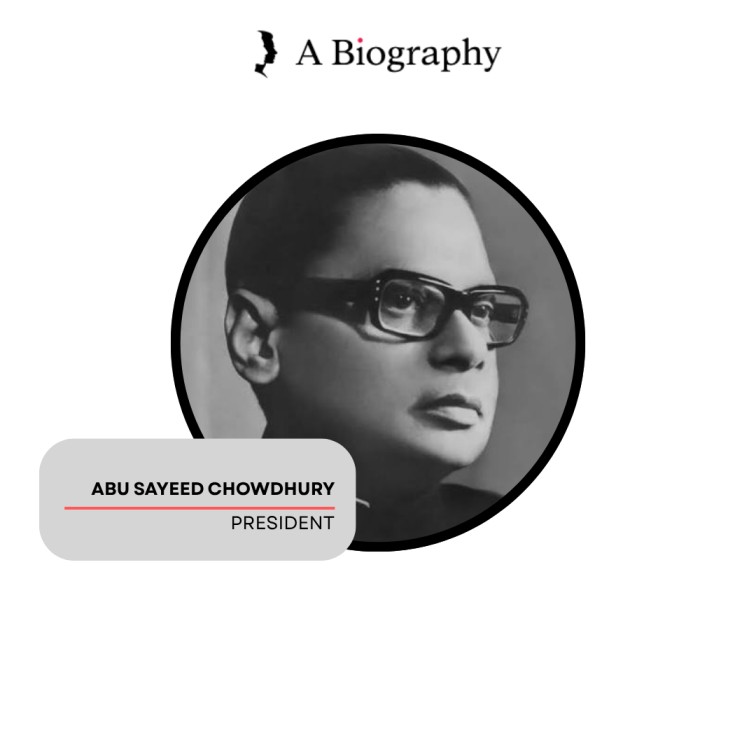
“I can remain a Vice-Chancellor, but I cannot remain a silent witness to the genocide of a nation. I am no longer willing to work under Pakistani rulers.” — His words in Geneva, April 1971, resigning from the post of Vice-Chancellor of Dhaka University in protest against Pakistani brutality. The world stood stunned.
Introduction
The hotel room in Geneva was quiet. Outside, the lake shimmered under a spring sun. But inside, Abu Sayeed Chowdhury was trembling — not from fear, but from rage.
He had just received the news. Pakistani forces had launched Operation Searchlight on the night of March 25. Dhaka University — his university — was a slaughterhouse. Students had been dragged from dormitories and shot. Professors had been killed in their homes. The bodies of intellectuals lay in the streets, left to rot.
He was the Vice-Chancellor of that university. But he was also a man of conscience. And he was thousands of miles away, attending a United Nations human rights conference.
What could he do? Remain silent? Continue to draw a salary from a government that was committing genocide?
No.
He picked up his pen. He wrote his resignation letter. He addressed it to the Pakistani Governor of East Pakistan. He did not mince words: “I cannot remain the Vice-Chancellor of a university where my students and colleagues are being murdered by the state. I resign, effective immediately.”
Then he walked to the press conference room. Journalists from the BBC, the New York Times, Le Monde, and The Guardian had gathered. He faced the cameras. His voice was calm but his eyes burned.
“I am resigning,” he said. “I will not serve a regime that kills its own people. Bangladesh has the right to be free.”
That moment — a single man, a scholar, a judge, a diplomat — refusing to bow to tyranny — became a turning point. The world began to pay attention. The genocide in Bangladesh could no longer be ignored.
This biography is the story of that man: Abu Sayeed Chowdhury. The first permanent President of independent Bangladesh. The first Bengali to chair the United Nations Commission on Human Rights. The man who rejected the British title “Khan Bahadur.” The man who refused to become Chief Justice under a dictator. The man who chose principle over power, every single time.
At a Glance: Life of Abu Sayeed Chowdhury
| Category | Details |
| Full Name | Abu Sayeed Chowdhury |
| Nickname | Abu Sayeed Bhai (among student friends) |
| Born | January 31, 1921, Nagbari village, Tangail district, Bengal Presidency, British India |
| Died | August 2, 1987, London, United Kingdom (age 66) |
| Father | Abdul Hamid Chowdhury (Khan Bahadur, zamindar, Speaker of East Pakistan Provincial Assembly) |
| Mother | Name unknown |
| Spouse | Not publicly disclosed |
| Children | Not publicly disclosed |
| Profession | President of Bangladesh (January 12, 1972 – December 24, 1973); Foreign Minister (1975); Special Envoy; Vice-Chancellor of Dhaka University (1969-1971); Advocate General of East Pakistan; Judge of Dhaka High Court; UN diplomat |
| Education | IA from Presidency College, Kolkata (1940); MA in History & LL.B from University of Calcutta (1942); Bar-at-Law from Lincoln’s Inn, London |
| Religion | Islam |
| Greatest Achievement | First Bengali to chair UN Commission on Human Rights (41st Chairman, 1985); First permanent President of Bangladesh; Resigned as VC in protest against 1971 genocide |
| Highest Awards | Honorary Doctor of Laws from University of Calcutta; ‘Desikottam’ from Visva-Bharati University; name honored at Dhaka University Law Faculty |
| Controversy | Served as Foreign Minister in Khondaker Mostaq Ahmad’s government after Bangabandhu’s assassination — criticized by some; seen as a symbolic president with limited policy role |
| Legacy | Remembered as a man of integrity, a human rights champion, and a key architect of Bangladesh’s first constitution |
Early Life (1921-1935)
On January 31, 1921, in the village of Nagbari in Tangail (then part of Mymensingh district), a boy was born into a distinguished Syed family of zamindars. They named him Abu Sayeed Chowdhury.
His father, Abdul Hamid Chowdhury, was a powerful zamindar and a politician. The British government had awarded him the title “Khan Bahadur” — a mark of honor for loyal service. He later became the Speaker of the East Pakistan Provincial Assembly.
But young Abu Sayeed was different. He grew up hearing stories of British oppression — the Indigo rebellion, the exploitation of peasants, the cruelty of the zamindari system. He saw with his own eyes how farmers in Tangail were forced to grow indigo at starvation wages. His heart burned with anger.
When he was old enough to understand, he made a decision that shocked his family: he would not accept the “Khan Bahadur” title. He would not wear the badge of a colonial master.
His father was disappointed. Relatives called him foolish. But Abu Sayeed was unmoved. “A title given by those who oppress my people is no honor,” he said. “It is an insult.”
That decision — to reject privilege for principle — defined his entire life.
As a child, he was brilliant, curious, and disciplined. He loved reading Tagore’s novels — Gora, Chokher Bali, Shesher Kabita. He played chess with elders. He listened to classical music. He also prayed regularly with his mother, who taught him that faith without justice is empty.
Education (1930-1949)
Abu Sayeed’s early education began at Bindubasini Government Boys’ High School in Tangail — a prestigious institution. He passed his matriculation (SSC) with first division.
He then moved to Kolkata — the cultural and intellectual capital of British India. He enrolled at Presidency College, one of the finest institutions in the subcontinent. There, he was exposed to radical ideas — nationalism, socialism, anti-colonialism. He completed his IA in 1940.
Next, he joined the University of Calcutta. He pursued a Master’s in History and simultaneously studied law. In 1942, he earned both an MA in History and an LL.B — a remarkable intellectual feat.
His love for history was not academic. He studied the peasant rebellions of Bengal — the Fakir-Sannyasi rebellion, the Indigo revolt, the Tebhaga movement. He learned how ordinary people had resisted oppression. He decided that he, too, would dedicate his life to justice.
After World War II, he traveled to London for further studies. He enrolled at Lincoln’s Inn, one of the four Inns of Court, to become a Barrister-at-Law. London in the late 1940s was still recovering from the Blitz, but the legal education was world-class. He learned British common law, international law, and the principles of human rights — lessons that would serve him for decades.
He returned to India shortly before Partition. In 1949, he began practicing law at the Calcutta High Court. But his heart was in the land that would become East Pakistan. Soon, he moved to Dhaka.
Struggles & Adversities
Abu Sayeed Chowdhury’s life was not marked by poverty or physical hardship. He came from a privileged family. But his struggles were of a different kind: the struggle to remain honest in a corrupt system, to refuse power when it came with strings attached.
His first major test came in the 1960s. He was a respected judge of the Dhaka High Court. Then came an offer: the position of Chief Justice of East Pakistan. It was the highest judicial post in the province. Any other lawyer would have jumped at the chance.
But Abu Sayeed declined.
Why? Because General Ayub Khan was the military dictator. And Abu Sayeed knew that under a dictator, the judiciary is never truly independent. He refused to become Chief Justice under a regime that had suspended fundamental rights and imprisoned democratic leaders.
“I will not wear the robes of a Chief Justice while the constitution is trampled upon,” he told a colleague.
He made enemies. He lost opportunities. But he never lost his self-respect.
Love: A Private Man’s Private Life
Abu Sayeed Chowdhury was intensely private about his family. He never spoke about his wife in public. Her name is not recorded in any major biography. He rarely mentioned his children.
This was not because he was ashamed or uncaring. It was because he believed that a public servant’s family should not be dragged into the spotlight. He protected them fiercely.
What is known is that he married, had children, and maintained a simple household. His wife supported his career silently — through his years as a judge, as Vice-Chancellor, as President, and as a diplomat abroad. She never sought attention. She was, in every sense, his silent partner.
Personal Life
Despite being born into a zamindar family and later occupying the highest office in the land, Abu Sayeed Chowdhury lived with remarkable simplicity.
As President, he stayed in Bangabhaban — the presidential palace. But he did not live like a king. He wore simple cotton clothes. He ate simple Bengali food — rice, dal, vegetables, fish. He made his own tea. He refused lavish receptions.
He was an introvert by nature. He did not enjoy small talk or political gossip. He spent his free time reading, playing chess, and listening to Rabindra Sangeet. He had a deep love for Tagore’s philosophy and visited Shantiniketan whenever he could.
His simplicity was not performance. It was genuine. He truly did not care for wealth or luxury.
Future Plans & Vision
Abu Sayeed Chowdhury’s vision extended beyond Bangladesh. He dreamed of a world where human rights were respected everywhere — not just in wealthy nations, but in poor, post-colonial states as well.
He believed that the United Nations could be a force for good. As Chairman of the UN Human Rights Commission, he worked to strengthen international human rights law. He advocated for the rights of minorities, the abolition of torture, and the protection of detainees.
He also dreamed of a Bangladesh that would be a model of secular democracy — a country where Hindus, Muslims, Buddhists, and Christians would live in peace, where the rule of law would prevail, where no one would be above the constitution.
That dream remains unfulfilled. But he planted the seeds.
Career (1949-1987)
Advocate at Calcutta High Court (1949-1950s)
After returning from London, Abu Sayeed began his legal career in Kolkata. But Partition had already divided Bengal. He soon moved to Dhaka.
Advocate General of East Pakistan (1960)
He became the Advocate General — the highest legal officer of the provincial government. He argued important cases for the state.
Judge of Dhaka High Court (1961-1969)
He was appointed a judge of the Dhaka High Court in July 1961. For eight years, he served with integrity, earning a reputation for fairness and independence.
Vice-Chancellor of Dhaka University (1969-1971)
He was appointed Vice-Chancellor in February 1969. The university was then a hotbed of political activism. Students were demanding democracy and autonomy. Abu Sayeed supported academic freedom and protected students from police repression as much as he could.
Resignation and Role in Liberation War (1971)
As described, he resigned in protest against the Pakistani genocide. He then went to London, where he served as a special envoy of the Mujibnagar government. He lobbied British parliamentarians, gave interviews to Western media, and raised funds for Bangladeshi refugees.
First President of Bangladesh (January 12, 1972 – December 24, 1973)
After independence, he was chosen as the first permanent President. He presided over the drafting of Bangladesh’s first constitution, which was passed on November 4, 1972, and enacted on December 16, 1972.
Minister of Ports and Shipping & Foreign Minister (1975)
He briefly served as Minister of Ports and Shipping in Bangabandhu’s cabinet (August 8-15, 1975). After Bangabandhu’s assassination, he served as Foreign Minister in Khondaker Mostaq Ahmad’s government (August-November 1975) — a decision that drew some criticism but was likely motivated by a desire to prevent a complete collapse of foreign relations.
High Commissioner to the United Kingdom
He became Bangladesh’s first High Commissioner in London, strengthening bilateral ties and helping Bangladesh join the Commonwealth.
UN Human Rights Commission (1978 onwards)
He was elected to the Sub-Commission on Prevention of Discrimination and Protection of Minorities. He later became the 41st Chairman of the UN Commission on Human Rights (1985) — the first Bengali and first Bangladeshi to hold that prestigious position.
Travels & Diverse Experiences
Abu Sayeed traveled extensively: to Geneva, New York, London, Paris, Vienna. He attended UN sessions, met world leaders, and witnessed the struggles for human rights in other countries — apartheid in South Africa, dictatorships in Latin America, the Cold War’s human rights abuses.
These travels broadened his perspective. He realized that the fight for human dignity was universal.
Failures & Teachable Moments
Abu Sayeed’s most controversial decision was accepting the role of Foreign Minister in Khondaker Mostaq Ahmad’s government after Bangabandhu’s assassination. Many saw this as legitimizing the killers.
Abu Sayeed’s explanation was that he wanted to prevent Bangladesh from becoming a pariah state. He believed that by staying in government, he could protect the country’s foreign policy interests. But the perception of collaboration with the regime that had murdered Bangabandhu remained a stain on his record.
He learned that sometimes, even well-intentioned compromises can damage one’s legacy.
Source of Inspiration
Abu Sayeed drew inspiration from two sources: Rabindranath Tagore’s humanism and the history of Bengal’s peasant rebellions. Tagore taught him that art, literature, and philosophy could be tools of liberation. The peasants taught him that ordinary people, when united, could overthrow oppression.
He also admired Mahatma Gandhi’s commitment to nonviolence and truth.
Influences & Inspirations
As a lawyer, Abu Sayeed was deeply influenced by the Universal Declaration of Human Rights (1948). He believed that these rights were not Western inventions but universal principles. He dedicated his later career to making them a reality for all people, especially in the developing world.
Philosophical Views & Beliefs
Abu Sayeed believed in secularism — not as atheism, but as the separation of religion from state power. He argued that Bangladesh, with its Muslim majority and significant Hindu, Buddhist, and Christian minorities, could only thrive if all citizens were equal before the law.
He believed that justice was the highest virtue of a state. A state that violates justice has no right to exist.
He also believed in humility. “Power is a loan, not a possession,” he once said. “It is given to you by the people, and you must return it with interest.”
Unique Traits
What made Abu Sayeed unique was his incorruptibility. In a profession where bribery and favoritism were common, he remained untouched. He never accepted a gift from a litigant. He never recommended a relative for a job he controlled.
He was also unique in his refusal of titles and high positions. He refused “Khan Bahadur.” He refused Chief Justice. He resigned as Vice-Chancellor. He resigned as President when he felt his work was done. Few leaders in history have voluntarily given up power so many times.
Contributions, Awards & Achievements
Legal and Judicial Contributions
- Served as Advocate General, High Court Judge, and member of the Constitution Commission of Pakistan (1960-61)
- Helped draft Bangladesh’s first constitution as President
Educational Contributions
- As Vice-Chancellor of Dhaka University, promoted academic freedom and student rights
Liberation War Contributions
- Resigned in protest of genocide; served as special envoy of Mujibnagar government in London; raised international awareness and support
Presidential Contributions
- Stabilized the newly independent nation; oversaw constitution-making; represented Bangladesh on the world stage
Diplomatic Contributions
- First High Commissioner to the UK; played key role in Commonwealth membership
- Member and later Chairman of UN Commission on Human Rights (1985)
Awards
- Honorary Doctor of Laws, University of Calcutta
- Desikottam (highest honor) from Visva-Bharati University, Shantiniketan
- A moot court room at Dhaka University Law Faculty named after him: “Justice Abu Sayeed Chowdhury Moot Court Room”
- Roads and auditoriums named after him in Tangail
Controversies
The only significant controversy in Abu Sayeed’s life was his service as Foreign Minister in the post-August 15, 1975 government of Khondaker Mostaq Ahmad — a government that came to power after the assassination of Bangabandhu Sheikh Mujibur Rahman.
Critics argued that he should have refused to serve in a government that included or was supported by the assassins. Supporters argued that he was trying to prevent a complete breakdown of diplomatic relations and to stabilize the country.
In his defense, Abu Sayeed never expressed support for the killers. He maintained his distance from the military rulers who later took power. Still, the episode remains a complex footnote in an otherwise spotless career.
Another minor criticism: some historians say that as President, he was largely a ceremonial figure, with real power held by Bangabandhu as Prime Minister. But that was the constitutional arrangement at the time. He did not overstep his role.
Contemporary Opinions & Interviews
Those who knew Abu Sayeed describe him as a gentleman in the truest sense. Tajuddin Ahmad, the first Prime Minister of Bangladesh, called him “a man of unimpeachable integrity.” Bangabandhu Sheikh Mujibur Rahman reportedly said, “Abu Sayeed Chowdhury is an honest man. That is rare.”
British diplomats who worked with him in London described him as “quietly persuasive, unfailingly polite, and utterly determined.” A UN colleague said, “He never raised his voice. But when he spoke, everyone listened.”
Myths & Misconceptions
Myth: Abu Sayeed Chowdhury was a British loyalist because his father accepted the “Khan Bahadur” title.
Fact: He personally rejected the title and refused to use it.
Myth: He resigned as President because he was forced out.
Fact: He resigned voluntarily because he wanted to return to international diplomacy.
Myth: He was a weak president.
Fact: He was a constitutional president. His role was symbolic and advisory. He performed it with dignity.
Famous Quotes & Thoughts
- “I can remain a Vice-Chancellor, but I cannot remain a silent witness to the genocide of a nation.” (1971)
- “Human rights are not an internal affair of any country. The international community has a duty to speak for the oppressed.” (UN speech, 1985)
- “Power is a loan, not a possession.”
- “A title given by those who oppress my people is no honor. It is an insult.”
- “The constitution must be the supreme law of the land. No one is above it.”
Message for the Present Generation
Abu Sayeed Chowdhury’s life teaches young people this: success is not measured by titles, wealth, or power. It is measured by how many times you chose principle over comfort, how many times you refused to bow to injustice.
He would tell the youth of Bangladesh: “Do not be afraid to speak the truth. Do not be afraid to resign from a position if it compromises your values. Do not be afraid to give up power when it is time.”
He would also remind them: “Secularism, democracy, and human rights are not Western imports. They are Bengali values. Defend them.”
Death & Legacy
On August 2, 1987, in London, Abu Sayeed Chowdhury suffered a heart attack. He was taken to a hospital, but he died before doctors could save him. He was 66 years old.
His death was mourned in Bangladesh, in the UK, and at the United Nations. The UN Commission on Human Rights passed a special resolution honoring his memory. Bangladesh declared a national day of mourning. Flags flew at half-mast.
His body was flown back to Dhaka. A state funeral was held. Thousands of people — common citizens, political leaders, diplomats — paid their respects. He was then buried in his ancestral village of Nagbari, Tangail, in the family graveyard, as he had requested.
He did not want a grand mausoleum. He wanted to lie beside his parents, in the soil of his home.
Successors & Lasting Impact
Abu Sayeed did not have political successors in the traditional sense. His children did not enter politics. But his legacy lives on in:
- The constitution of Bangladesh, which he helped create
- The UN human rights framework, which he strengthened
- The memory of a leader who refused every temptation of power
- The roads, buildings, and rooms named after him in Tangail and Dhaka
His daughter (name not public) and other family members have kept his memory alive through private remembrances. But his true successors are all those who fight for justice without seeking reward.
Unknown Facts
- He was an accomplished chess player and often played with foreign diplomats in London.
- He never owned a house. He lived in government-provided housing and later in rented apartments.
- He donated a portion of his salary as President to charity anonymously.
- He refused to allow his biography to be written during his lifetime because he thought it was “unseemly.”
- He spoke perfect English but preferred to speak Bengali in private.
- He was a close friend of the artist Zainul Abedin and admired his paintings of the 1943 famine.
- He never used his position to help any family member get a job.
- His resignation letter from the Vice-Chancellorship was preserved and later displayed at the Liberation War Museum.
Key Events (1921-1987)
| Year | Event |
| 1921 | January 31 — Born in Nagbari, Tangail |
| 1930s | Schooling at Bindubasini High School, Tangail |
| 1940 | IA from Presidency College, Kolkata |
| 1942 | MA (History) and LL.B from University of Calcutta |
| 1946-48 | Bar-at-Law from Lincoln’s Inn, London |
| 1949 | Practiced at Calcutta High Court |
| 1950s | Moved to Dhaka; practiced at Dhaka High Court |
| 1960 | Appointed Advocate General of East Pakistan |
| 1961 | Appointed Judge of Dhaka High Court |
| 1969 | Appointed Vice-Chancellor of Dhaka University |
| 1971 (March) | Resigned as VC in protest against Pakistani genocide |
| 1971 (April-Dec) | Served as special envoy of Mujibnagar government in London |
| 1972 (Jan 12) | Became first permanent President of Bangladesh |
| 1972 (Nov 4) | Constitution passed by Constituent Assembly |
| 1973 (Dec 24) | Resigned as President |
| 1975 (Aug) | Served as Ports & Shipping Minister (briefly); after Aug 15, served as Foreign Minister (until Nov) |
| 1970s (mid) | Appointed first High Commissioner to the UK |
| 1978 | Elected to UN Sub-Commission on Human Rights |
| 1985 | Elected 41st Chairman of UN Commission on Human Rights |
| 1987 (Aug 2) | Died in London; buried in Nagbari, Tangail |
Conclusion
Abu Sayeed Chowdhury was not a fiery orator. He was not a street fighter. He did not command armies. He did not build a political dynasty. He did not amass wealth.
What he did was far more difficult: he remained honest. He remained principled. He said no to power when saying no cost him. He gave up titles, positions, and opportunities because they came with conditions that violated his conscience.
He showed that a leader does not need to be loud to be effective. He showed that a judge does not need to be cruel to be just. He showed that a diplomat does not need to be cunning to be successful.
He was the first permanent President of Bangladesh — but he did not cling to the office. He was the first Bengali to chair the UN Human Rights Commission — but he did not boast about it. He was offered the Chief Justice’s chair — but he refused it because the constitution was suspended.
Today, Bangladesh faces many challenges: corruption, polarization, the erosion of secularism, the weakening of democratic institutions. In such times, the example of Abu Sayeed Chowdhury is more relevant than ever. He proved that it is possible to be in power without being corrupted by power. He proved that it is possible to serve without seeking reward. He proved that one man, armed only with integrity, can make a difference.
He may not have a grand mausoleum. There are no annual parades in his honor. But his name lives on — in the constitution, in the halls of the UN, in the memories of those who believe that justice is possible.
He was the star that never sought the sky, yet his light guided a nation.
References
- Bengali Wikipedia — Abu Sayeed Chowdhury
- English Wikipedia — Abu Sayeed Chowdhury
- ‘Bangladesher Roshtropoti: Abu Sayeed Chowdhury’ — Syed Abul Maksud (Bangla Academy)
- ‘Smritite Abu Sayeed’ — edited volume (Jahangirnagar University publication)
- United Nations Commission on Human Rights — Annual Reports (1985, 1987)
- University of Calcutta and Visva-Bharati University — honoris causa records and bulletins
- Dhaka University history — Professor Muntassir Mamun
- Daily Ittefaq, Daily Prothom Alo, Daily Sangbad, Daily Bangla reports (1972-1987)
- ‘Bangladesher Sambidhan Pronoyoner Itihash’ — Dr. Kamal Hossain, Dr. Sirajul Islam
- ‘Muktijuddhe Koutonityo O Abu Sayeed Chowdhury’ — research paper, Bangladesh Institute of Law and International Affairs
Disclaimer
This biography has been prepared based on information gathered from reliable sources, including Wikipedia, Banglapedia, academic publications, newspaper archives, and UN records. Some personal details — particularly about Abu Sayeed Chowdhury’s spouse, children, and precise family history — are not publicly available or vary across sources. Where data is missing or unclear, it has been stated as such. Every effort has been made to maintain factual accuracy while presenting the narrative in an engaging, emotionally resonant style. Dramatic and narrative elements have been employed for readability, but core historical facts remain unchanged. The purpose of this biography is to inspire readers with the life of a righteous leader. Readers are encouraged to consult multiple sources for comprehensive understanding.
From the British “Khan Bahadur” title to the Chief Justice’s chair, from the Vice-Chancellor’s office to the presidency — he rejected them all, one by one, for a single reason: his unwavering commitment to truth and justice. Abu Sayeed Chowdhury taught us that being human is not about sitting on a throne of power, but about knowing how to protest injustice. In the history of Bangladeshi politics, he was that bright star whose light still guides our path today.

