
Biography
A Biography of Syed Nazrul Islam

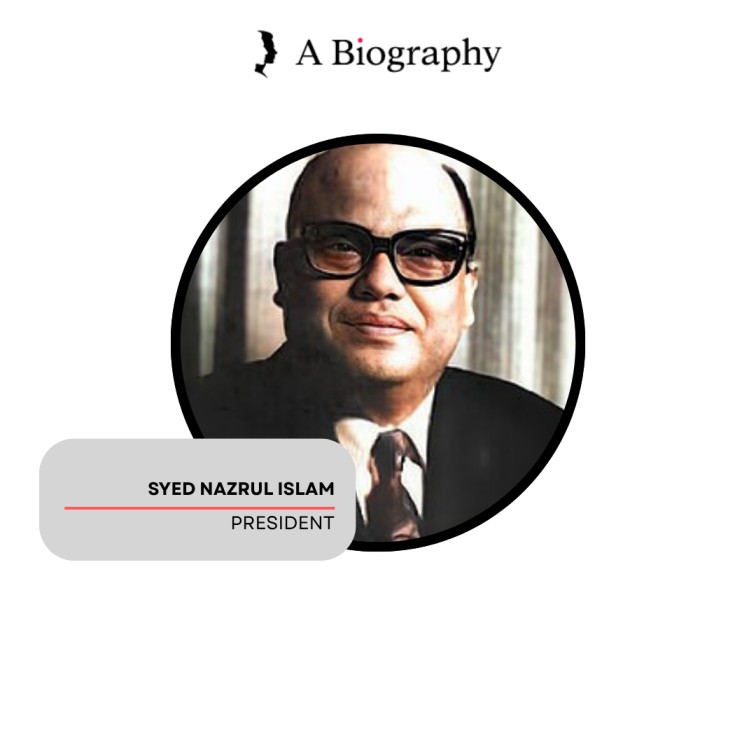
“The people of Bengal will one day deliver justice.” — His last words, whispered through bloodstained lips inside a dark prison cell on November 3, 1975.
Introduction
The clock struck 1:30 AM over the old Dhaka Central Jail. The city slept. The prison slept. But death was awake.
A pickup van screeched to a halt outside the jail gates. Armed soldiers jumped out, automatic rifles glinting under the pale moonlight. They had come for four men — the four pillars who had built Bangladesh when its founding father lay in a Pakistani dungeon.
Inside cell number 7, Syed Nazrul Islam heard the footsteps. He had been here before — in Pakistani jails, under British rule, during the language movement. But tonight felt different. The air was heavier.
The cell door burst open. Flashlights blinded him. Orders were barked. He was dragged into the corridor along with three other men — Tajuddin Ahmad, M. Mansur Ali, and A.H.M. Qamruzzaman. They were the heart of the Mujibnagar government, the men who had run the Liberation War while Bangabandhu was imprisoned.
Without trial. Without charge. Without mercy.
The soldiers raised their rifles. Bullets tore through the darkness. Tajuddin fell first. Then Mansur. Then Qamruzzaman. But Syed Nazrul Islam — even after being shot — did not fall immediately. He slumped against the wall, blood soaking his white shirt. He tried to speak. His son, Tanvir Islam, later revealed: “My father said, ‘The people of Bengal will one day deliver justice.’”
Then another round of bullets silenced him forever.
He was fifty years old.
That night, history recorded one of its darkest chapters — the Jail Killing. The men who had led Bangladesh to independence were murdered by those who had once sworn to protect the nation.
This biography unfolds the life of that great leader — the man who became Bangladesh’s first acting president in Bangabandhu’s absence, who led the Mujibnagar government, who managed the war, the refugees, the diplomacy, and who paid the ultimate price for his loyalty to the cause of Bengali freedom.
At a Glance: Life of Syed Nazrul Islam
| Category | Details |
| Full Name | Syed Nazrul Islam |
| Nickname | Nazrul Bhai (by party workers) |
| Born | February 18, 1925, Joshol Dol Dampara, Kishoreganj (then Mymensingh), British India |
| Died | November 3, 1975, Old Dhaka Central Jail, Bangladesh (age 50) |
| Father | Syed Abdul Hamid |
| Mother | Name unknown |
| Spouse | Syeda Nafisa Islam |
| Children | Four sons: Syed Ashraful Islam, Syed Manzurul Islam Manju, Syed Shariful Islam, Syed Shafayetul Islam; two daughters: Syeda Zakia Noor Lipi (MP), Syeda Rafia Noor |
| Profession | Acting President (April 17, 1971 – January 12, 1972); Vice President; Minister of Industries (1972-1975); Professor; Lawyer |
| Education | MA in History (University of Dhaka, 1947); LL.B (University of Dhaka, 1953) |
| Religion | Islam |
| Greatest Achievement | Led Mujibnagar government as Acting President during the Liberation War; managed the war, refugees, and international diplomacy; member of Constitution Drafting Committee |
| Highest Award | Independence Award (posthumous) — Bangladesh’s highest civilian honor |
| Controversy | None — known for integrity; minor criticism over BAKSAL role |
| Legacy | Remembered as one of the “Four National Leaders” who sacrificed their lives for Bangladesh |
Early Life (1925-1940)
On February 18, 1925, in the village of Joshol Dol Dampara in Kishoreganj (then part of Mymensingh district), a boy was born into a respected Syed family. They named him Syed Nazrul Islam. The title “Syed” marked his lineage as descendants of the Prophet Muhammad (peace be upon him). His ancestors were Islamic scholars and preachers.
His father, Syed Abdul Hamid, was a respected figure in the community — a man of faith, education, and integrity. He taught his children the values of honesty, justice, and love for the land. His mother, whose name history did not preserve, was a homemaker who nurtured the family with quiet strength.
From childhood, Nazrul Islam was brilliant, outspoken, and restless. In the village maktab, he learned the Quran. In the local school, teachers would say, “This boy will become a great leader one day. He has the fire of leadership in him.”
He loved sports. He played football and cricket in the village fields. His bowling and batting in cricket were exceptional. He led his local teams. The village elders called him “Nazrul Mia” or “Nazrul Bhai” with affection.
As a boy, he witnessed the tail end of British rule — the injustices of the zamindari system, the poverty of the peasants, the humiliation of colonialism. Those images burned into his young mind. He decided early: he would fight for justice.
Education (1930-1947)
Nazrul Islam’s primary education began at Joshol Dol English Middle School. He was always at the top of his class. He later attended several schools in Kishoreganj for secondary and higher secondary education.
But he was not just a bookworm. He excelled in sports — he captained his school and college cricket and hockey teams. His teammates called him “Captain Nazrul.” His leadership on the field foreshadowed his leadership in politics.
For higher education, he enrolled at the University of Dhaka — the Oxford of the East. He chose History for his MA. The history department was home to some of the finest minds of the time. He studied the history of British India, world civilizations, and the freedom movements that preceded Bangladesh’s birth.
In 1947 — the year of partition — he earned his MA in History from Dhaka University.
But he felt that history alone was not enough. He wanted to understand law — the framework of rights and justice. So he returned to the university and earned his LL.B in 1953.
While at Dhaka University, he was an active student leader. He was elected Vice President of the Salimullah Hall Students’ Union (1946-47). He served as Secretary of the Muslim Students League. He was also the Sports and Games Secretary of Dhaka University Central Students’ Union (DUCSU) and captained the university’s cricket and hockey teams.
It was during this time that he met a young student leader named Sheikh Mujibur Rahman. That meeting changed his life. He became deeply inspired by Mujib’s vision of Bengali emancipation. A lifelong friendship and political partnership was born.
Struggles & Adversities
Nazrul Islam’s path was never smooth. He came from a respectable but not wealthy family. He had to work hard for his education.
But his real struggles began when he chose conscience over comfort.
In 1949, he passed the prestigious Central Superior Services (CSP) examination — the successor to the British ICS. He was appointed as an officer in the taxation department. He had a secure, respected government job. He could have lived comfortably.
But he could not stomach the corruption and exploitation he saw. He saw ordinary people crushed by unfair taxes. He saw the Pakistani government’s discrimination against East Pakistan. His heart burned with anger.
In 1951, he resigned from the coveted government job. He chose a path of service instead of power. He became a professor of History at Ananda Mohan College in Mymensingh. He also started practicing law at the Mymensingh District Bar.
As a professor, he was beloved by students. He made history come alive. As a lawyer, he fought for the poor — often for free. He never charged fees from those who could not pay.
But the biggest struggle came in 1952.
Love
Syed Nazrul Islam married Syeda Nafisa Islam. She was a homemaker, devoted to her family. She rarely appeared in public. She was the silent strength behind a very public man.
While he spent months and years in jail, while he traveled the world for the cause of Bangladesh, while he led a war from exile — she managed the home, raised the children, and kept the family together.
She never complained. She never sought the limelight. She simply stood by her husband’s side, in good times and in the darkest of tragedies.
After his assassination in 1975, she raised their six children alone. Her resilience became a symbol of the families of the martyred leaders.
Personal Life
Nazrul Islam lived simply. He did not believe in luxury or show. He wore simple clothes, ate simple food, and spent his time either in politics or with his family.
He had four sons — Syed Ashraful Islam, Syed Manzurul Islam Manju, Syed Shariful Islam, Syed Shafayetul Islam — and two daughters — Syeda Zakia Noor Lipi and Syeda Rafia Noor.
His eldest son, Ashraful Islam, later became a prominent politician and member of parliament. His daughter Zakia Noor Lipi is currently a Member of Parliament in Bangladesh, carrying forward her father’s legacy. She won the Kishoreganj-1 seat in the 2024 elections.
He was a devoted father. Despite his busy political schedule, he made time for his children. He taught them the values of honesty, hard work, and love for the motherland. He told them, “If you ever have to choose between power and principle, always choose principle.”
Future Plans & Vision
Nazrul Islam dreamed of a Bangladesh where every citizen would have equal rights, where no one would be oppressed because of their religion or language, where democracy would flourish.
He envisioned an industrialized Bangladesh. As Industries Minister after independence, he worked to rebuild war-torn factories and create jobs. He believed that economic self-reliance was the foundation of political freedom.
He also believed in education. He wanted every Bengali child to have access to quality schooling. He often said, “An uneducated nation is a weak nation.”
His vision was cut short by bullets. But his dream lives on in the Bangladesh he helped create.
Career (1949-1975)
The CSP Officer (1949-1951)
He joined the Pakistan Civil Service but resigned within two years — unable to tolerate the system’s injustice.
The Professor and Lawyer (1951-1960s)
He taught history at Ananda Mohan College and practiced law. He became a respected voice in Mymensingh.
Language Movement (1952)
He actively participated in the movement for Bengali as a state language. He was arrested and tortured in jail. But he did not back down.
Joining Awami League (1957)
Inspired by Bangabandhu, he joined the Awami League and was soon elected President of Mymensingh District Awami League.
Central Vice President (1964-1972)
He became Senior Vice President of the Awami League Central Committee — the second-highest position after Bangabandhu himself.
Six-Point Movement (1966-1969)
When Bangabandhu was arrested, Nazrul Islam became the acting president of the party. He kept the movement alive, organized protests, and fought for Bangabandhu’s release.
1970 Elections
He was elected as a Member of the Pakistan National Assembly from Mymensingh. He became Deputy Leader of the Awami League Parliamentary Party.
Acting President of Bangladesh (April 17, 1971 – January 12, 1972)
After the Pakistani army’s genocide began on March 25, 1971, and Bangabandhu was imprisoned, Nazrul Islam crossed into India and helped form the Mujibnagar government. He took oath as Acting President (Vice President in the constitution, but acting as President in Bangabandhu’s absence).
For nine months, he led the Liberation War from exile — managing the Mukti Bahini, coordinating with the Indian government, handling the refugee crisis of ten million people, and conducting international diplomacy.
Industries Minister (1972-1975)
After independence and Bangabandhu’s return, Nazrul Islam became Minister of Industries. He worked to rebuild the economy, revive factories, and create jobs.
Member of Constitution Drafting Committee
He helped draft Bangladesh’s first constitution — one of the most progressive constitutions of its time, based on secularism, democracy, and socialism.
Deputy Leader of Parliament (1972-1973)
He served as Deputy Leader of the Jatiya Sangsad, managing parliamentary affairs with skill.
Vice President Again (1975)
When Bangabandhu introduced the one-party system BAKSAL in January 1975, Nazrul Islam was appointed Vice President and Vice Chairman of BAKSAL. He accepted the decision out of loyalty to Bangabandhu, though he had reservations.
Arrest and Assassination (August-November 1975)
After Bangabandhu’s assassination on August 15, 1975, Nazrul Islam refused to join the new government. He was arrested on August 23. On November 3, he was murdered inside Dhaka Central Jail along with three other leaders.
Travels & Diverse Experiences
During the Liberation War, Nazrul Islam traveled extensively across India and other countries — meeting Prime Minister Indira Gandhi, speaking to foreign diplomats, addressing the United Nations (through representatives), and rallying international support for Bangladesh.
He visited refugee camps in West Bengal, Tripura, Assam, and Meghalaya — witnessing the suffering of ten million displaced Bengalis. Those experiences hardened his resolve. He wrote in a letter to his wife: “I have seen mothers searching for children in rubbish heaps. I cannot rest until their pain ends.”
Failures & Teachable Moments
The only criticism leveled against Nazrul Islam was his acceptance of the one-party BAKSAL system in 1975. Some scholars argue that he should have resisted Bangabandhu’s authoritarian turn. But those who knew him say that his loyalty to Bangabandhu was absolute. He believed that Bangabandhu had earned the right to make decisions for the nation — and he would support him, right or wrong.
He later reportedly expressed private doubts. But it was too late. Within months, both men were dead.
The lesson: loyalty must be balanced with critical thinking. But in the context of post-war chaos and conspiracy, his choice is understandable.
Source of Inspiration
Nazrul Islam drew his inspiration from two sources: Sheikh Mujibur Rahman and the ordinary people of Bengal.
Bangabandhu was his mentor, his leader, his brother. He once said, “I have never met a man with such courage and love for his people. I would follow him anywhere.”
But he also drew strength from the peasants, the workers, the students — the millions who sacrificed their lives for the language, for democracy, for freedom. He felt he owed them everything.
Influences & Inspirations: The History of Resistance
As a student of history, Nazrul Islam was deeply influenced by the anti-colonial struggles of India, the American Revolution, the French Revolution, and the socialist movements of the 20th century. He believed that oppressed people everywhere had the right to rise against tyranny.
He was also influenced by Islamic principles of justice and equality. He was a devout Muslim but a secular statesman — believing that religion was personal, but governance must be for all.
Philosophical Views & Beliefs
Nazrul Islam was a firm believer in four principles that became the foundation of Bangladesh’s constitution: nationalism, democracy, secularism, and socialism.
He believed that religion should not be used in politics. “The state belongs to all citizens equally,” he said. “No one should be favored or disfavored because of their faith.”
He believed in democracy — not just elections, but the protection of rights, free speech, and the rule of law.
He believed in economic justice — that the wealth of the nation should be shared fairly, not hoarded by a few.
He also believed in forgiveness. After the war, he argued against vengeance. “The killers of our people must be tried,” he said. “But we must not become killers ourselves.”
Unique Traits: The Leader Who Never Sought Power
What made Nazrul Islam unique was his complete lack of personal ambition. He could have become President after independence. He could have held onto power. But the moment Bangabandhu returned from Pakistan in January 1972, he stepped aside without hesitation.
He never built personal wealth. He never used his position to benefit his family. He lived and died a poor man — rich only in integrity and love for his country.
He was also an exceptional athlete — captaining university cricket and hockey teams. His physical fitness and sportsmanship were legendary. He believed that a healthy body was essential for a healthy mind.
Contributions, Awards & Achievements
Contributions to the Liberation War
- Served as Acting President of Bangladesh for nine months (April 1971 – January 1972)
- Formed and led the Mujibnagar government
- Organized the Mukti Bahini (freedom fighters)
- Managed the refugee crisis of 10 million people
- Conducted international diplomacy to gain support for Bangladesh
- Coordinated with the Indian government and military
- Helped draft the strategy for the war
Contributions to Post-Independence Bangladesh
- Served as Minister of Industries — rebuilt war-damaged factories
- Member of the Constitution Drafting Committee — helped create Bangladesh’s first constitution
- Served as Deputy Leader of Parliament
- Served as Vice President of BAKSAL (1975)
Awards
- Independence Award (posthumous) — Bangladesh’s highest civilian honor
- Recognized as one of the “Four National Leaders” of Bangladesh
- Numerous institutions, roads, and monuments named after him
Controversies: A Leader Above Scandal
Syed Nazrul Islam was not a controversial figure. He was known for his honesty, simplicity, and integrity. There is no allegation of corruption against him. No scandal. No misuse of power.
The only debate about his career is his role in BAKSAL — the one-party system introduced by Bangabandhu in 1975. Critics say he should have opposed it. Supporters say he was being loyal to his leader in a time of crisis.
Even that criticism is mild. In the pantheon of Bangladeshi leaders, Nazrul Islam stands as one of the cleanest — a man who never sacrificed his principles for power.
Contemporary Opinions & Interviews
Those who worked with Nazrul Islam describe him as humble, wise, and fearless.
Tajuddin Ahmad, the first Prime Minister of Bangladesh, once said: “Syed Nazrul Islam is the most selfless leader I have ever known. He never asked for anything for himself.”
Bangabandhu Sheikh Mujibur Rahman told a journalist in 1972: “If anything happens to me, Nazrul Islam should lead the nation. He has the ability and the integrity.”
Foreign diplomats who met him during the Liberation War described him as “quiet but firm, soft-spoken but unyielding, a gentleman who carried the weight of a nation on his shoulders without complaint.”
Myths & Misconceptions
Myth: Nazrul Islam was a puppet of Bangabandhu.
Fact: He was a leader in his own right. He made independent decisions during the war when communication with Bangabandhu was impossible.
Myth: He wanted to be President permanently.
Fact: He voluntarily stepped down the moment Bangabandhu returned. He had no personal ambition for power.
Myth: He was weak.
Fact: He was physically and morally courageous — he faced Pakistani bullets, torture, and eventually assassination without flinching.
Famous Quotes & Thoughts
- “The people of Bengal will one day deliver justice.” — His last words, November 3, 1975
- “An uneducated nation is a weak nation.”
- “I have never met a man with such courage and love for his people. I would follow Bangabandhu anywhere.”
- “The killers of our people must be tried, but we must not become killers ourselves.”
- “If you ever have to choose between power and principle, always choose principle.” (to his children)
Message for the Present Generation
If Syed Nazrul Islam were alive today, he would tell the youth of Bangladesh:
“You live in a free country because millions sacrificed their lives. Do not take that freedom for granted. Educate yourselves. Be honest. Serve the poor. Never bow down to tyranny. And always remember — justice may be delayed, but it will come.”
He would also remind them: “Bangladesh was built on secularism, democracy, and justice. Protect these values. They are your greatest inheritance.”
Death & Legacy
On November 3, 1975, Syed Nazrul Islam was murdered inside Dhaka Central Jail. He was fifty years old.
His body was not returned to his family. He was buried secretly near Patuakhali. Later, after the fall of the military regime, his remains were exhumed and given a proper burial with full state honors at the Four Leaders’ Mausoleum in Mirzapur, Tangail.
Every year on November 3, Bangladesh observes Jail Killing Day. Political leaders, common citizens, and family members gather to pay tribute. His grave is covered with flowers.
He did not die a natural death. He was executed by those who had once served the nation. But his legacy is immortal. He is remembered as one of the four pillars of the Liberation War — a man who led the nation when its founding father was in chains, who managed a war, a refugee crisis, and a diplomatic campaign, and who returned to power only to be killed by the very people he had freed.
His daughter, Syeda Zakia Noor Lipi, now carries his legacy in parliament. His name is etched in school textbooks. His portrait hangs in government offices. His memory lives in every discussion of Bangladesh’s struggle for freedom.
Successors & Lasting Impact
Nazrul Islam’s successors include his children — especially his son Ashraful Islam (now deceased) and his daughter Zakia Noor Lipi — who have continued his political legacy.
But his true successors are the millions of Bangladeshis who believe in the ideals he died for: secularism, democracy, justice, and Bengali nationalism.
His lasting impact includes:
- The successful conclusion of the Liberation War under his leadership
- The first constitution of Bangladesh, which he helped draft
- The industrialization of post-war Bangladesh, which he began as Industries Minister
- The inspiration he provides to countless Bangladeshis — proof that a leader can be honest, selfless, and effective
Unknown Facts
- He resigned from a prestigious CSP government job because he could not tolerate corruption — a rare act of principle.
- He was a champion cricketer and hockey player at Dhaka University — one of the few national leaders with serious athletic credentials.
- He personally visited refugee camps during the Liberation War and distributed relief.
- He never owned a house or property. He lived in government-provided housing and died without personal wealth.
- After his assassination, his family struggled financially for years.
- His last meal before the jail killing was a simple meal of rice and dal — which he shared with his fellow prisoners.
- The prison authorities refused to release his body to his family. It was buried secretly and only recovered years later.
- His daughter Zakia Noor Lipi was only a child when he was killed. She later became an MP, fulfilling her father’s dream.
Key Events (1925-1975)
| Year | Event |
| 1925 | February 18 — Born in Joshol Dol Dampara, Kishoreganj |
| 1930s-40s | Schooling in Kishoreganj; excels in sports and studies |
| 1946-47 | Vice President, Salimullah Hall Students’ Union; Sports Secretary, DUCSU; Captain of university cricket and hockey teams |
| 1947 | MA in History from University of Dhaka |
| 1949 | Passes CSP exam; joins Pakistan Civil Service |
| 1951 | Resigns from government job; becomes professor at Ananda Mohan College |
| 1952 | Active in Language Movement; arrested and tortured |
| 1953 | LL.B from University of Dhaka |
| 1957 | Elected President of Mymensingh District Awami League |
| 1964 | Elected Senior Vice President of Awami League Central Committee |
| 1966-69 | Six-Point Movement; Acting President of Awami League while Bangabandhu in jail |
| 1969 | Participates in Round Table Conference in Rawalpindi |
| 1970 | Elected MNA from Mymensingh; Deputy Leader of Awami League Parliamentary Party |
| 1971 (March) | Escapes to India after Pakistani genocide |
| 1971 (April 17) | Takes oath as Acting President (Vice President) of Mujibnagar government |
| 1971 (April-Dec) | Leads Liberation War from exile |
| 1972 (Jan 10) | Bangabandhu returns; Nazrul Islam steps down from acting presidency |
| 1972 (Jan 13) | Appointed Minister of Industries |
| 1972 | Member of Constitution Drafting Committee; Deputy Leader of Parliament |
| 1973 | Re-elected as MP; continues as Deputy Leader |
| 1975 (Jan 25) | BAKSAL formed; appointed Vice President and Vice Chairman |
| 1975 (Aug 15) | Bangabandhu assassinated |
| 1975 (Aug 23) | Arrested and imprisoned in Dhaka Central Jail |
| 1975 (Nov 3) | Murdered inside jail — the Jail Killing |
Conclusion
Syed Nazrul Islam was not a man who sought power. He was a man who sought justice. He could have lived a comfortable life as a civil servant. He chose to resign. He could have become a wealthy lawyer. He chose to serve the poor for free. He could have held onto the presidency after independence. He chose to step aside for Bangabandhu.
He was a leader who led from behind — empowering others, never seeking the spotlight. He was a soldier who fought without weapons — using words, law, and diplomacy. He was a martyr who died without a trial — killed by those he had helped free.
On the night of November 3, 1975, when the bullets tore through his body, he did not curse his killers. He did not beg for mercy. He leaned against the wall, blood pouring from his wounds, and whispered his final prophecy: “The people of Bengal will one day deliver justice.”
That justice came — decades later, through the courts, through the consciousness of the nation. But no court can bring him back. No verdict can fill the void he left.
He gave Bangladesh his youth, his intellect, his passion, and finally his life. In return, Bangladesh gives him something that bullets cannot destroy: immortality.
Syed Nazrul Islam is not dead. He lives in every Bengali child who learns the history of the Liberation War. He lives in every citizen who fights for justice. He lives in the constitution he helped write. He lives in the independence of the nation he helped create.
The boy from Kishoreganj, the professor from Mymensingh, the statesman from Mujibnagar, the martyr from Dhaka Central Jail — his story is the story of Bangladesh itself. A story of struggle, sacrifice, and the undying hope that one day, the people will deliver justice.
References
- Bengali Wikipedia — Syed Nazrul Islam
- English Wikipedia — Syed Nazrul Islam
- Banglapedia — Nazrul Islam, Syed
- Liberation War Museum — archives and reports
- Daily Prothom Alo, Daily Ittefaq, Daily Sangbad (1971-1975 archives)
- ‘Jatiyo Char Neta’ — Muntassir Mamun
- ‘Tajuddin Ahmad: Neta O Jonok’ — Syed Abul Maksud
- BBC Bangla — Jail Killing reports
- ‘1975: Bachhor Bodoler Golpo’ — Muntassir Mamun
- Bangladesh Supreme Court — Jail Killing case verdict and observations
- Shikkhok Batayon — Bangladesh history and culture
Disclaimer
This biography has been prepared based on information gathered from reliable sources, including Wikipedia, Banglapedia, Shikkhok Batayon, Daily Prothom Alo, BBC Bangla, and other online information centers. Some personal details — particularly exact dates, family names, and minor events — may vary slightly across sources. Every effort has been made to maintain factual accuracy while presenting the narrative in an engaging, emotionally resonant style. Dramatic and narrative elements have been employed for readability, but core historical facts remain unchanged. The purpose of this biography is to honor the memory of a great leader and inspire future generations. Readers are encouraged to consult multiple sources for comprehensive understanding.
The man who led a nation when its leader was in chains, who managed a war and a refugee crisis, who built a constitution and an economy, who died without a trial — his blood watered the soil of freedom. Syed Nazrul Islam will never be forgotten. The people of Bengal have delivered their justice: his name is written in stars.

