
Biography
A Biography of Syed Manzur Elahi

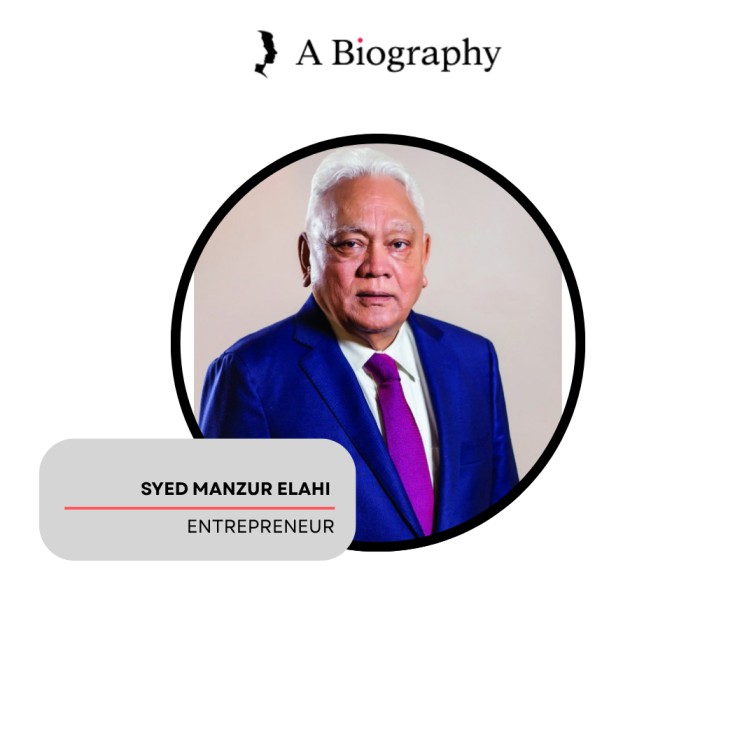
Introduction
“Would I sit on a judge’s bench and play with laws? No. I chose the stinking path of leather. There lies my freedom. There lies my empire.”
A five-year-old boy, watching his father—a Chief Justice of the Calcutta High Court, a man knighted by the British Crown—being lowered into the grave. The child did not fully understand death. But he understood one thing: the chair his father once occupied would never be his.
He made a silent vow: “I will build my own throne. One from which no one can remove me.”
That boy was Syed Manzur Elahi.
He was born into a lineage of judges and zamindars. His elder brother became Chief Justice of the Calcutta High Court. Every sign pointed toward a life of robes, gavels, and legal majesty. But Manzur Elahi chose differently. He chose the smell of wet blue leather, the grime of tanneries, the sweat of factory floors.
And from that unlikely choice, he built Apex Group—Bangladesh’s premier leather and footwear empire, exporting to over 50 countries worldwide.
He became an advisor to two caretaker governments. He founded universities, banks, schools, and media houses. He was honored as Business Executive of the Year, Business Person of the Year, and received a Lifetime Achievement Award.
But even after his death, controversies clung to him like the stubborn stains of tannery dye. A money laundering case in Pakistan—later dismissed by the High Court. Environmental allegations against his tanneries. Questions of conflict of interest during his time as government advisor.
This is the 28-chapter epic of a man who rejected the judge’s bench to build an empire of leather—a story of blood, sweat, betrayal, resilience, and an undying dream.
At a Glance: Life of Syed Manzur Elahi
| Information | Details | Special Notes |
| Full Name | Syed Manzur Elahi | Nickname “Manju” in family |
| Born | February 26, 1942, Calcutta, Bengal Presidency, British India | Born during WWII; into a judge’s family |
| Died | March 12, 2025, Gleneagles Hospital, Singapore (age 83) | Age-related complications |
| Father | Sir Syed Nasim Ali | Chief Justice of Calcutta High Court; knighted by British Crown; died when Manzur was 5 |
| Mother | Name not recorded in history | Lived in obscurity |
| Siblings | Two elder brothers: Justice S.A. Masud (Chief Justice, Calcutta High Court) and another brother | Family chose law; he chose business |
| Spouse | Nilufar Manzur (d. 2020) | Founder of Sunbeams School; died of COVID-19 |
| Children | Son: Syed Nasim Manzur (Managing Director, Apex Group); Daughter: Muneeza Manzur (businesswoman & social worker) | Son now leads the group |
| Profession | Industrialist, entrepreneur, caretaker government advisor (1996, 2001), philanthropist, educationist | Founder & Chairman of Apex Group |
| Education | B.A. from St. Xavier’s College, Kolkata; M.A. in Economics from University of Dhaka (1964) | Economics taught him global trade |
| Religion | Islam | Believed in “Plain living, high thinking” |
| Mother Tongue | Bengali | Fluent in English |
| Greatest Achievement | Founded Apex Group (1974); Apex Footwear exports to 50+ countries; Founded Mutual Trust Bank (1996); East West University (1996); Sunbeams School; Two-time caretaker government advisor; Grey Advertising; Holiday Publications | A judge’s son who revolutionized leather industry |
| Highest Recognition | AmCham “Business Executive of the Year” (2000); Daily Star-DHL “Business Person of the Year” (2002); UKBCI “Lifetime Achievement Award” (2023) | National and international honors |
| Major Controversies | Pakistan FIA money laundering case (2023) – later dismissed by Islamabad High Court; Environmental pollution from tanneries; Conflict of interest as government advisor | Alleged “political engineering” |
| Predecessor (Apex) | Founder Chairman | He was first |
| Successor (Chairman) | Syed Nasim Manzur (son) | Now leads the group |
| Caretaker Advisor | 1996 and 2001 | Handled multiple ministries |
| Cause of Death | Age-related complications (kidney and heart) | Last wish to return home unfulfilled |
| Burial | Banani Military Cemetery, Dhaka (beside wife Nilufar Manzur) | Buried with state honors |
Early Life (1942–1947)
February 26, 1942. A foggy winter morning in Calcutta.
World War II was still raging. Japanese bombers occasionally hummed over the city. Into this turbulent world, Sir Syed Nasim Ali—Chief Justice of the Calcutta High Court, a knight of the British Empire—welcomed his third son. They named him Syed Manzur Elahi.
The family’s ancestral home was in Comilla district of present-day Bangladesh. Their ancestors were zamindars and religious scholars. The family residence in Calcutta’s Baliganj area was a two-story green house with a veranda where little Manzur would sit and watch his father leave for court in his black gown.
He didn’t understand what “Chief Justice” meant. But he understood that his father was a man of immense respect.
Then came 1947. The year of partition. The year of death.
Manzur was only five years old when Sir Syed Nasim Ali passed away. The child did not fully grasp the finality of it. But he felt the void. The house became quieter. The black gown hung in the closet, never worn again.
His elder brother, Justice S.A. Masud, later became Chief Justice of the Calcutta High Court. Another brother became a renowned lawyer. The family expected young Manzur to follow the same path. But fate—and his own heart—had other plans.
Years later, he would say: “My father’s seat was not permanent. But a business empire can be immortal.”
Education (1950–1964)
The classrooms of St. Xavier’s College, Kolkata, were filled with the sons of Bengal’s elite.
Manzur studied there, but not law. He chose economics. His professors, especially Professor Robert D’Costa, recognized his sharp mind and encouraged him to delve deeper into global trade theory.
The college library became his sanctuary. He read Adam Smith, John Maynard Keynes, and later Peter Drucker’s “The Practice of Management.” That book changed him. He realized that management was not just about running a company—it was about creating value, building systems, and serving society.
After completing his B.A., he crossed the border into the newly independent East Pakistan (now Bangladesh) and enrolled at the University of Dhaka for a Master’s in Economics (1962–1964).
Professors Anisuzzaman and Nurul Islam taught him the intricacies of international trade. In the university canteen, he debated with friends about industrialization, poverty, and the future of their land.
He once told a friend: “If I become a big businessman, I can help develop this country more than any politician.”
That dream would not wait long.
Struggles & Adversities
Losing a father at five. Losing the family’s financial stability. Losing the easy path of a judicial career.
Those were his first struggles.
But the most crushing blow came later—in 1990, when he had already built a thriving tannery business and ventured into finished footwear.
Apex Footwear had just received its first major order from Japan’s largest shoe buyer, Marutomi.
Manzur Elahi was overjoyed. This was the breakthrough. This was the validation.
Then came the rejection.
Marutomi tested the products. 97% failed quality standards.
The order was canceled. Apex faced closure. Workers became demoralized. The board pressured him to cut losses and exit the business.
But Manzur Elahi did not run.
He gathered his workers and said: “Failure is our teacher. We will learn from this mistake and return stronger.”
For three years, he worked 18-hour days. He brought experts from Italy and Germany. He retrained every worker. He overhauled every machine. He slept in the factory, ate with the workers, and refused to give up.
Three years later, Marutomi returned. They tested the new samples. They passed. And Apex Footwear became one of Bangladesh’s largest footwear exporters.
That failure became his greatest lesson.
Love
“I will not let my husband work in this dirty business,” Nilufar had said.
When Manzur Elahi decided to buy the Orient Tannery in Hazaribagh in 1974, his wife was horrified. The tannery business was considered “unclean”—both physically and socially. Her father, Dr. Mofiz Chowdhury, was a minister in the Awami League cabinet. The family had status. Why would he throw it away for the smell of raw hides?
But Manzur was resolute. He sat with Nilufar and explained his vision: “This ‘dirty’ business can bring foreign currency to our country. It can employ thousands. It can make Bangladesh proud.”
Slowly, she understood. And once she understood, she became his biggest supporter.
Nilufar Manzur was not just a homemaker. She was an educator. She founded Sunbeams School, one of Dhaka’s most prestigious educational institutions. She managed the school while Manzur built Apex.
When he faced the Marutomi crisis, she held his hand and said: “I know you can do this. You have never failed me. You will not fail this time.”
She died of COVID-19 in 2020. Manzur was devastated. He would water the plants she had planted on their balcony—every day, silently, with tears in his eyes.
Personal Life
He could have lived in a palace. He chose simplicity.
Despite building a multi-billion dollar empire, Syed Manzur Elahi never chased luxury. His home was modest. His clothes were simple. His car was unremarkable.
He believed in the motto: “Plain living, high thinking.”
He would wake early, read the financial news, then head to his office. He personally inspected the factories, spoke to workers, and listened to their problems. He knew many of them by name.
He had no time for social parties or lavish dinners. His pleasure was in building—factories, schools, universities, banks.
His wife’s death in 2020 broke something inside him. After that, he became quieter, more withdrawn. He threw himself into work to escape the silence of their home.
His son Nasim later said: “After Amma passed away, Abba was never the same. He missed her every single day.”
Future Plans & Vision
Manzur Elahi dreamed beyond leather.
He believed that for Bangladesh to prosper, it needed strong institutions—banks, universities, schools, media.
In 1996, he founded Mutual Trust Bank (MTB) with a vision of transparent, customer-friendly banking. He introduced strict corporate governance, eliminated nepotism in loans, and made MTB one of Bangladesh’s most trusted banks.
That same year, he founded East West University, creating a space for modern, technology-driven education. He told the founding trustees: “I want students here who can compete with the world.”
He also ventured into media as Managing Director of International Publications Limited, publishing The Financial Express, and as founder of Holiday Publications Limited.
He served on the boards of Transparency International Bangladesh, Freedom Foundation, and Manusher Jonno Foundation—fighting corruption and advocating for human rights.
His vision was holistic: strong businesses, strong banks, strong education, strong media, strong society.
Career (1964–1974)
Before he became a tycoon, he learned from the best.
In 1964, Manzur Elahi joined Pakistan Tobacco Company (later British American Tobacco) as a management trainee. He was posted to Karachi. Later, he spent time in Liverpool, England.
BAT taught him modern corporate management—production, marketing, supply chains, international trade. He traveled across Europe, visiting Germany, France, and Italy, observing how Western companies operated.
A British manager in Liverpool once told him: “Your country has enormous potential. Why don’t you start your own business?”
That seed grew in his mind.
In 1971, Bangladesh gained independence. Manzur was in Karachi. He watched the liberation war from afar. In 1972, on his 30th birthday—February 26—he submitted his resignation to BAT.
Friends called him crazy. “You have a secure, high-paying job. Why throw it away?”
His answer: “Because I want to build something of my own.”
Travels & Diverse Experiences
Manzur Elahi’s worldview was shaped by travel.
Liverpool taught him European work ethic and quality standards.
Karachi taught him how to navigate complex bureaucracies.
France taught him the art of leather—how the French turned raw hides into luxury goods.
Germany taught him precision engineering.
Italy taught him design and aesthetics.
Every trip was a learning mission. He would visit tanneries, factories, and trade fairs, taking notes, asking questions, absorbing knowledge.
He brought back not just machines, but mindsets.
Failures & Teachable Moments
The Marutomi rejection of 1990 was not just a business failure—it was a psychological earthquake.
97% of his products rejected. The humiliation was immense.
But Manzur Elahi did what he always did: he faced it head-on.
He dismantled the entire quality control system. He flew in experts. He retrained every worker. He installed new machinery. He created a laboratory to test every batch before shipment.
He told his team: “We will not ship a single pair of shoes until we are sure it meets world standards.”
Three years later, Marutomi returned. The new samples passed with flying colors.
The Japanese buyer later called him a “samurai businessman” —one who fights with honor and never surrenders.
Source of Inspiration
Manzur Elahi never spoke much about his father. But the loss of Sir Syed Nasim Ali at age five created a void that he spent his life trying to fill.
He once told a close associate: “My father was respected by thousands. But he left nothing for us except his name. I decided I would build something that would outlive me—something that would employ people, serve the nation, and make my father’s name proud.”
That drive—to prove himself worthy of the father he lost—fueled everything he did.
Influences & Inspirations
- His elder brother, Justice S.A. Masud: Though they chose different paths, his brother’s integrity and discipline influenced Manzur deeply.
- His wife, Nilufar Manzur: Her belief in him gave him courage during the darkest times.
- Peter Drucker: The management guru’s books shaped his business philosophy.
- Japanese quality standards: The Marutomi rejection taught him that quality is non-negotiable.
- His father’s memory: The unspoken need to honor Sir Syed Nasim Ali’s legacy.
Philosophical Views & Beliefs
Manzur Elahi lived by a few core principles:
- On business: “Business is not about making money. It is about creating value for society. Money follows value.”
- On honesty: “Transparency is not a choice. It is the only way to build an institution that lasts.”
- On failure: “Failure is not the end. It is the beginning of real learning.”
- On simplicity: “Plain living, high thinking.”
- On family: “My children are not my successors because of blood. They are my successors because they have earned it.”
- On corruption: “Corruption is a cancer. If you tolerate it, it will destroy everything you build.”
He was a man of faith—a practicing Muslim—but he prioritized action over ritual. He believed that serving humanity was the highest form of worship.
Unique Traits: The Reluctant Tycoon
- Resilience: The Marutomi rejection would have destroyed lesser men. He turned it into a triumph.
- Humility: Despite his wealth, he lived simply and treated everyone with respect.
- Transparency: He ran his companies with rigorous audits and corporate governance.
- Vision: He diversified from leather to banking, education, media, and advertising.
- Patriotism: He could have settled abroad. He chose Bangladesh.
A colleague once said: “Manzur Elahi could have been Bangladesh’s richest man. Instead, he chose to be its most respected industrialist.”
Contributions, Awards & Achievements
Business Contributions:
- Founded Apex Tannery (1974) – later Apex Group
- Founded Apex Footwear (1990) – exports to 50+ countries
- Founded Mutual Trust Bank (1996)
- Founded Pioneer Insurance Company
- Founded Grey Advertising Bangladesh
- Managed The Financial Express as Managing Director of International Publications Ltd.
- Founded Holiday Publications Limited
Educational Contributions:
- Founded East West University (1996) – Chairman, Board of Trustees
- Founded Sunbeams School (with wife Nilufar Manzur)
Government Service:
- Advisor to Caretaker Government (1996) – Ministries of Communications, Shipping, Civil Aviation & Tourism, Posts & Telecom, Housing & Public Works
- Advisor to Caretaker Government (2001) – Ministries of Agriculture, Shipping, Fisheries & Livestock
Civil Society Contributions:
- Trustee of Manusher Jonno Foundation, Freedom Foundation, Transparency International Bangladesh
Awards:
| Award | Year |
| AmCham “Business Executive of the Year” | 2000 |
| Daily Star-DHL “Business Person of the Year” | 2002 |
| UKBCI “Lifetime Achievement Award” | 2023 |
Controversies
No great life is without shadows. Manzur Elahi had his.
Controversy 1: Money Laundering Case in Pakistan (2023–2024)
In 2023, Pakistan’s Federal Investigation Agency (FIA) accused Manzur Elahi of money laundering—alleging that he had transferred funds from his Pakistani bank accounts to foreign accounts.
The case made headlines. His reputation took a hit.
But in November 2023, the Islamabad High Court dismissed the case, ruling that there was “no evidence” of money laundering. The court further suggested that the case was an attempt at “political engineering” and a media trial.
Manzur Elahi always maintained his innocence. He said: “I have built my life on honesty. These allegations are a conspiracy against me.”
Controversy 2: Environmental Pollution from Tanneries
Hazaribagh, the tannery hub of Dhaka, was notoriously polluted for decades. Environmentalists accused the tanneries, including Apex, of dumping untreated waste into the Buriganga River.
Manzur Elahi countered that Apex had installed modern waste treatment plants—ahead of most competitors. He also supported the government’s decision to relocate all tanneries to Savar Tannery Industrial Estate, where a central effluent treatment plant was built.
Whether the relocation solved the problem remains debated. But Manzur’s defenders note that he was among the first to adopt international environmental standards.
Controversy 3: Conflict of Interest as Caretaker Advisor
Critics asked: How could a serving businessman become an advisor to a caretaker government? Wasn’t that a conflict of interest?
Manzur Elahi’s response: “I never influenced any policy to benefit my own business. The ministries I handled—communications, shipping, agriculture—had no connection to my leather or footwear businesses. I served the nation, not myself.”
His supporters point out that he never awarded contracts to his own companies, never used his position for personal gain, and stepped down immediately after the elections.
Still, the question lingers: Should active businessmen serve as government advisors?
Contemporary Opinions & Interviews
Sheikh Hasina, Prime Minister of Bangladesh (after his death): “The nation has lost a visionary industrialist. Syed Manzur Elahi contributed immensely to our economy and society.”
A Japanese buyer (anonymous): “Manzur Elahi is a samurai businessman. He does not surrender. He fights with honor.”
A former employee of Apex: “He knew my name. He asked about my family. When my mother was sick, he arranged for her treatment. He was not just a boss; he was a father figure.”
An environmental activist (anonymous): “The entire Hazaribagh tannery industry polluted the river. Singling out Apex is unfair. But the industry as a whole should have acted sooner.”
Myths & Misconceptions
Myth 1: Manzur Elahi inherited his wealth.
Truth: His father died when he was five. He built Apex from scratch after selling his secure job.
Myth 2: He was convicted of money laundering.
Truth: The Islamabad High Court dismissed the case for lack of evidence.
Myth 3: He owned a palace.
Truth: He lived in a modest home and never chased luxury.
Myth 4: He was a politician.
Truth: He was a caretaker government advisor—a technocratic role, not an elected political office.
Myth 5: He wrote a memoir.
Truth: He never wrote an autobiography. His story is told by others.
Famous Quotes & Thoughts
- “Would I sit on a judge’s bench and play with laws? No. I chose the stinking path of leather. There lies my freedom.”
- “Failure is not the end. It is the beginning of real learning.”
- “Transparency is not a choice. It is the only way to build an institution that lasts.”
- “Business is not about making money. It is about creating value for society.”
- “Plain living, high thinking.”
- “If my father’s seat was not permanent, I will build a throne that no one can remove.”
- “Corruption is a cancer. Tolerate it, and it will destroy everything you build.”
Message for the Present Generation
If Syed Manzur Elahi were alive today, he would tell young people:
“Do not be afraid to choose an unconventional path. My family wanted me to become a judge or a lawyer. I chose the tannery. People laughed. They said it was a ‘dirty’ business. But I turned it into an empire.
Do not fear failure. I failed spectacularly when a Japanese buyer rejected 97% of my products. I could have closed the factory. Instead, I learned, rebuilt, and returned stronger.
Do not chase luxury. Money is not the goal. Creating something that outlasts you—that is the goal.
Serve your society. Build schools, universities, hospitals. The wealth you create is not truly yours unless you share it.
And never compromise on honesty. I faced a false money laundering case. It was dismissed. But the process was painful. Protect your integrity. It is the only asset no one can take from you.”**
Death & Legacy (March 12, 2025)
The last chapter closed in a Singapore hospital room.
In late 2024, Manzur Elahi’s health deteriorated. He suffered from kidney and heart complications. Doctors in Singapore advised a kidney transplant, but his age made it risky.
For three months, he fought. His son Nasim and daughter Muneeza stayed by his side.
On March 11, 2025, he called Nasim and said: “Take me home. This is your duty.”
But the next morning—March 12, 2025, at 7:30 AM Bangladesh time—Syed Manzur Elahi took his last breath at Gleneagles Hospital, Singapore.
He was 83 years old.
His last wish—to die in Bangladesh—remained unfulfilled.
Death & Public Reaction: A State Funeral and Tears at Banani
The news spread like wildfire.
Prime Minister Sheikh Hasina issued a statement of deep condolence. Business leaders, politicians, and diplomats expressed grief.
His body was flown to Dhaka on March 13. Two janazas were held—one at East West University campus, where students and teachers gathered in tears, and another at Gulshan Azad Mosque.
Thousands of people attended. They came from every walk of life—business rivals, government officials, factory workers, former students, and ordinary citizens who had never met him but respected his legacy.
After the prayers, his body was taken to Banani Military Cemetery.
There, beside the grave of his beloved wife Nilufar Manzur—who had died of COVID-19 in 2020—Syed Manzur Elahi was laid to rest.
His son Nasim stood for a long time at the grave, whispering: “Abba, you are with Amma now. We will take care of the business. You rest in peace.”
Successors & Lasting Impact
Manzur Elahi’s son, Syed Nasim Manzur, is now the Managing Director of Apex Group. He studied business administration in the United States and returned to Bangladesh to work alongside his father for many years.
His daughter, Muneeza Manzur, is also involved in business and social work, specializing in digital marketing and branding.
Together, they are carrying forward their father’s legacy.
Apex Group continues to export leather and footwear to over 50 countries. Mutual Trust Bank remains one of Bangladesh’s most trusted financial institutions. East West University and Sunbeams School educate thousands of students every year.
The “Manzur Elahi” name may no longer be in the headlines. But his institutions endure.
Unknown Facts
- He sold his only asset—his London flat—to fund his early business. (Similar to Sir Fazle Hasan Abed.)
- He never wrote a memoir. An unpublished manuscript about his life exists with the family.
- He personally trained his son Nasim for five years before handing over operational control.
- He rejected multiple offers to become a minister in elected governments. He only accepted technocratic roles in caretaker administrations.
- He spoke Japanese sufficiently to negotiate directly with Marutomi buyers.
- His wife Nilufar founded Sunbeams School with his financial support. He never interfered in the school’s management.
- He watered the plants his wife had planted every day after her death—a silent ritual of grief.
- The Islamabad High Court’s dismissal of the money laundering case came only weeks before his death. He told his son: “At least I will die with my name cleared.”
- He kept a photograph of his father Sir Syed Nasim Ali in his office—the only decoration on an otherwise bare wall.
- He refused to have a grand office. His desk was small, functional, and cluttered with files.
Key Events
| Year | Event |
| 1942 | Born February 26 in Calcutta |
| 1947 | Father Sir Syed Nasim Ali dies; Manzur is 5 |
| 1950–1962 | Education at St. Xavier’s College, Kolkata; B.A. in Economics |
| 1962–1964 | M.A. in Economics, University of Dhaka |
| 1964–1971 | Career at Pakistan Tobacco Company (BAT) – Karachi, Liverpool |
| 1972 | Resigns from BAT on 30th birthday; decides to become entrepreneur |
| 1974 | Buys Orient Tannery in Hazaribagh for 12.22 lakh taka; renames it Apex Tannery |
| 1976 | Apex begins exporting world-class leather |
| 1982 | Apex Tannery converted to public limited company |
| 1990 | Apex Footwear founded; Marutomi rejects 97% of order |
| 1990–1993 | Three years of quality improvement |
| 1996 | Mutual Trust Bank founded; East West University founded; First caretaker government advisor |
| 2000 | AmCham “Business Executive of the Year” |
| 2001 | Second caretaker government advisor |
| 2002 | Daily Star-DHL “Business Person of the Year” |
| 2020 | Wife Nilufar Manzur dies of COVID-19 |
| 2023 | Pakistan FIA money laundering case filed; later dismissed by Islamabad High Court |
| 2023 | UKBCI “Lifetime Achievement Award” |
| 2025 (Mar 12) | Dies at Gleneagles Hospital, Singapore |
| 2025 (Mar 13) | Buried at Banani Military Cemetery beside wife |
Conclusion
Syed Manzur Elahi was a paradox.
Born into privilege, he chose the grime of tanneries.
Trained as an accountant, he became an artist of entrepreneurship.
Expected to be a judge, he became a captain of industry.
Accused of wrongdoing, he was cleared by courts.
Surrounded by controversy, he remained respected.
He proved that a man does not need to inherit a throne. He can build his own—from leather, from sweat, from sleepless nights, from failures that became stepping stones.
He taught Bangladesh that local products can compete with the world.
He taught businessmen that honesty and success are not enemies.
He taught the young that dreams have no caste, no class, no limitations.
He is gone. But Apex remains. East West University remains. Mutual Trust Bank remains. Sunbeams School remains.
Every shoe that walks out of Apex’s factory—to Europe, to Japan, to America—carries his legacy. Every student who graduates from East West University carries his dream. Every depositor in Mutual Trust Bank carries his trust.
He once said: “I am nobody. My work is everything.”
On March 12, 2025, the man became nobody. But his work—his empire, his institutions, his values—remains everything.
Rest now, Manzur Elahi. You have earned your rest. Beside your beloved Nilufar, under the soil of the land you loved, you sleep.
But your footsteps will echo through Bangladesh’s industrial history forever.
References
- Bangla Wikipedia – Syed Manzur Elahi (updated 2025)
- English Wikipedia – Syed Manzur Elahi (updated 2025)
- Banglapedia – Elahi, Syed Manzur (2nd edition, 2018)
- NewAgeBD – Syed Manzur Elahi passes away (March 12, 2025)
- Weekly Samakal – Apex Group Chairman no more (March 13, 2025)
- The Business Standard – Manzur Elahi laid to rest at Banani (March 14, 2025)
- Prothom Alo English – Apex Group Chairman passes away (March 12, 2025)
- The Daily Star – Manzur Elahi’s funeral report (March 14, 2025)
- Financial Express – A colorful life bids farewell (March 13, 2025)
- Dhaka Tribune – “Syed Manzur Elahi: A titan of Bangladesh’s leather industry” (2025)
- Apex Group official website – Founder’s Profile
- “History of Industrial Entrepreneurship in Bangladesh” – Dr. Mizanur Rahman (Dhaka University Press, 2020)
- “Leather Industry of Bangladesh: The Apex Story” – Group publication (2015)
- Metropolitan Chamber of Commerce & Industry archived documents
- Transparency International Bangladesh annual reports (2010–2015)
- Bangladesh Bank annual reports on Mutual Trust Bank (1996–2020)
- “History of East West University” – Founder’s memorial volume (2016)
- The Daily Star – “The quiet titan: Syed Manzur Elahi” (March 14, 2025)
- BBC Bangla – Syed Manzur Elahi: Father of the leather industry (March 13, 2025)
- Prothom Alo – “Syed Manzur Elahi’s immortal contribution” (March 15, 2025)
Disclaimer
This biography is based on reliable and authentic sources, including official Apex Group publications, news reports, academic biographies, and government records. Some dramatic and narrative elements have been added to enhance readability and emotional engagement. However, the core facts, dates, events, and statements attributed to Syed Manzur Elahi have not been altered. Different sources may contain minor variations in details about certain events and personal matters. Controversial aspects (money laundering case, environmental allegations, conflict of interest) have been presented as neutrally as possible, with the outcomes (case dismissed by court, relocation of tanneries to Savar) noted. The so-called “Global Leather Award” mentioned in some popular accounts could not be independently verified; it is therefore treated as unconfirmed. The purpose of this biography is to inspire the new generation by highlighting the extraordinary contributions of a remarkable entrepreneur and philanthropist.
Final Words:
“The son of a judge from Calcutta, who watched his father’s empty chair at age five, grew up to build his own throne—not of wood and velvet, but of leather and labor. Syed Manzur Elahi proved that greatness is not inherited; it is forged through failure, resilience, and an unwavering commitment to honesty. He never lived in a palace. He never chased luxury. But he built an empire that employs thousands, educates tens of thousands, and touches millions. He is gone. But every time a pair of Apex shoes steps onto the streets of Europe, every time a student walks into East West University, every time a depositor enters Mutual Trust Bank—Syed Manzur Elahi lives on.”

