
Biography
A Biography of Fazle Hasan Abed

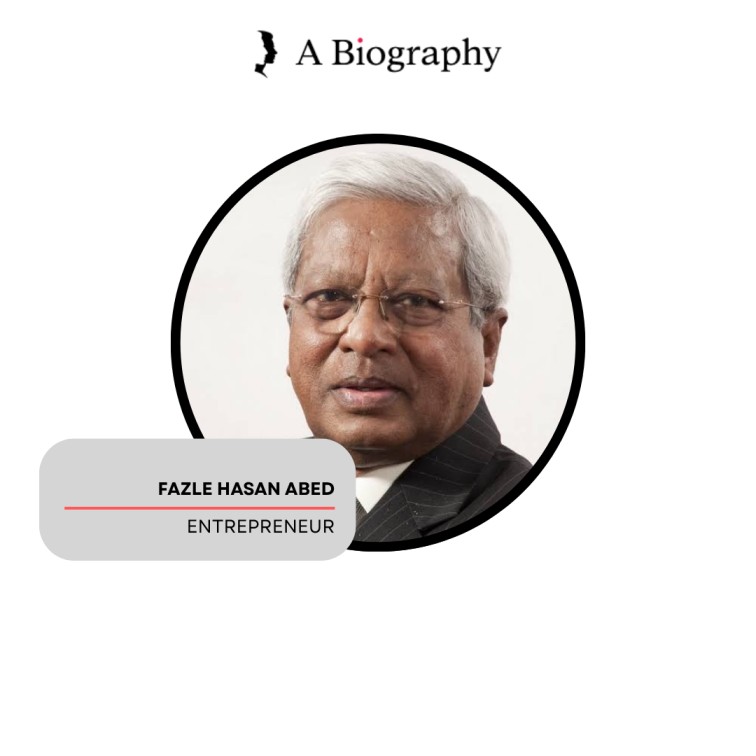
Introduction
One man. One dream. One rented flat sold to change the world.
The year was 1972. Bangladesh was born from the ashes of a brutal war. Nine months of bloodshed had left the nation shattered—roads destroyed, bridges collapsed, millions homeless, and the stench of death still hanging in the air. The world looked at this newborn country and whispered: “It will never survive.”
In London, a successful corporate executive sat in his comfortable flat, watching the news. He had a prestigious job at Shell. A secure future. A life of privilege. Everything a man could want.
But his heart was not in London. It lay in the muddy villages of his homeland, where mothers held starving children, where fathers had no work, where hope was a luxury no one could afford.
His name was Fazle Hasan Abed.
That year, he made a decision that would stun everyone who knew him. He sold his London flat. He resigned from his job. He packed a single suitcase and flew back to Bangladesh—not as a businessman, not as a politician, but as a servant of the poor.
He had no grand office. No government funding. No army of staff. Just a small rented room in Dhaka and a name he had chosen for his organization: BRAC—Bangladesh Rehabilitation Assistance Committee.
Nobody could have predicted that this humble beginning would one day become the largest non-governmental organization in the world. That BRAC would reach over 120 million people across 11 countries. That a boy from a zamindar family in Habiganj would be knighted by the British Crown, decorated by the Dutch King, and awarded the world’s highest honors for social development.
Sir Fazle Hasan Abed was not just a social worker. He was a revolutionary who understood that poverty is not a lack of money—it is a lack of power. And he dedicated his life to giving that power back to the poorest, especially to women, whom he called “the architects of change.”
This is his story—a 28-chapter saga of sacrifice, controversy, triumph, and a legacy that will outlive generations.
At a Glance: Life of Sir Fazle Hasan Abed
| Information | Details | Special Notes |
| Full Name | Fazle Hasan Abed | Title “Sir” added after British Knighthood in 2009 |
| Known For | Founder & Chairman Emeritus, BRAC (Bangladesh Rural Advancement Committee) | World’s largest non-governmental development organization |
| Born | April 27, 1936, Baniachong, Habiganj district, Bengal Presidency, British India (now Bangladesh) | Born into a zamindar family; second of eight children |
| Died | December 20, 2019, Apollo Hospital, Dhaka (age 83) | After long battle with age-related complications |
| Father | Siddiq Hasan | Zamindar, teacher, highly educated |
| Mother | Sayeda Sufia Khatun | Homemaker, lover of literature and culture |
| Siblings | Second of eight children; Dr. Nazmul Hasan Jahid (brother) assisted BRAC’s HELP program | All highly educated |
| Ancestry | Descendant of Sipahsalar Shah Syed Nasir Uddin (7th generation) | Inheritor of Sufi-saint warrior lineage |
| Spouse | First wife (deceased); second wife Shilu Abed | |
| Children | Son: Shameran Abed (Executive Director, BRAC International & Chairman, BRAC UK Board); Daughter: Tamara Hasan Abed (former BRAC Director); Step-son: Mokarram Hossain Khan Marko | Shameran now leads BRAC; Tamara’s husband Dr. Akbar Ali Khan (former Governor, Bangladesh Bank) |
| Profession | Social worker, development organizer, accountant | Founder & Chairman Emeritus of BRAC |
| Education | Pabna Zilla School; Notre Dame College, Dhaka (Higher Secondary); University of Glasgow (Naval Architecture, incomplete); Chartered Institute of Management Accountants (CIMA), London (1962) | Professional qualification as accountant |
| Religion | Islam | Believed in spiritual and humanistic values |
| Mother Tongue | Bengali | Proficient in English and Urdu |
| Extraordinary Achievement | Founded BRAC (1972); operates in 11 countries across Asia and Africa; 34,000+ BRAC schools; 80% microfinance borrowers are women; ORS program trained 14 million mothers | World’s largest private development organization |
| Highest Recognition | Independence Award (2025, posthumous); Knight Commander of the Order of St Michael and St George (KCMG) 2009; Knight of the Order of Orange-Nassau (Netherlands) 2019; Ramon Magsaysay Award (1980); Gates World Health Award (2004); UNDP Mahbub ul Haq Award (2004); World Food Prize (2015); Yidan Prize (2019) | Rare international recognition in Bangladesh’s history |
| Major Controversies | Irregularities in cyclone relief (HELP); nepotism in BRAC leadership; son Mokarram’s financial fraud and sexual harassment allegations; microcredit interest rates; foreign funding transparency questions; political influence in Independence Award | Despite controversies, overall contribution undeniable |
| Predecessor (BRAC Chair) | Position newly created | He was the founding chairman |
| Successor (BRAC Chair) | Dr. Hossain Zillur Rahman (2025) | New chairman appointed after Abed’s death |
| Spiritual Practice | Inheritor of Sufi lineage; worshipper of humanity | Prioritized human service over religious rituals |
Early Life (1936)
April 27, 1936. A moonlit night in the first week of Bangla year 1343.
The veranda of the zamindar mansion in Baniachong, Habiganj, glowed in soft silvery light. Baniachong was one of the oldest and most prestigious parganas of the Sylhet region, its history stretching back to the Mughal era. And on that night, a newborn’s cry echoed through the ancestral halls.
Sayeda Sufia Khatun had given birth to a future social revolutionary. They named him Fazle Hasan Abed. He was the second of eight children.
His father, Siddiq Hasan, was a zamindar and an educated man—a teacher by profession who also managed the family estates. He was liberal-minded and well-versed in religious education. The family’s roots traced back seven generations to Sipahsalar Shah Syed Nasir Uddin—a Sufi saint and warrior. Many of his ancestors were dervishes and religious scholars. The family had a long tradition of pursuing knowledge, science, and literature.
Young Abed grew up surrounded by the forests, rivers, canals, and ponds of Baniachong. He listened to stories of zamindars and subedars, of politics and revolution. His mother nurtured the family’s connection to poetry and literature. Every element of his childhood prepared him for what was to come.
He began his education at the village maktab, learning the Quran alongside Bengali and English literature. From his grandfather and father, he absorbed the values of justice and humanity. The family’s guiding principle was simple: “Serving humanity is the highest religion.”
That principle would later transform millions of lives.
Education (1940-1954)
The boy who would one day educate millions first learned to dream in a small village school.
Abed’s early education began in Habiganj. He then enrolled in Pabna Zilla School, one of the finest institutions of its time. Every day, he walked long distances to reach school. After classes, he played cricket with friends on the field. But his teachers saw something different in him—a deep passion for science and mathematics.
Even then, he understood that the world was not limited to textbooks. Outside the classroom, he sat by the riverbank and talked with farmers. The foggy winter mornings and the floods that washed away fields troubled him deeply. These experiences planted seeds of awareness about the uncertainty of food and livelihood. That awareness never faded.
In 1954, he left Habiganj behind and enrolled in Notre Dame College (then affiliated with Dhaka College). The campus was an elite center of intellectual discourse. Here, Eastern and Western philosophies met in strange and beautiful ways.
Economics and history discussions spilled into student gatherings. Debates raged about the subcontinent’s independence struggles and complex political theories. Abed threw himself into those debates. In his free time, he crowded into the college library, reading about the Russian Revolution, Bengali rights movements, and the trajectory of the American economy.
His classmates included future intellectuals and leaders. The teachers recognized his extraordinary leadership potential. It was during this time that he began serious research on rural economies—research that would later become the backbone of BRAC.
He was deeply inspired by Rabindranath Tagore and Kazi Nazrul Islam. Their writings on humanity showed him the path forward.
Struggles & Adversities (1954-1956)
He went to Glasgow to design ships. He returned to design a new destiny for his people.
After completing his studies at Notre Dame College, Abed traveled to the University of Glasgow in Scotland in 1954. His subject: Naval Architecture. The science of designing ships. The harbors and shipyards of the Clyde River promised a stable, prestigious career.
But something was wrong.
The cold Scottish wind that blew through Glasgow’s streets stirred a different kind of restlessness in him. He realized that designing ships was not his calling. Technical knowledge alone would not satisfy the hunger growing inside him.
He wanted to change the lives of people, not the blueprints of vessels.
In 1956, he left the University of Glasgow without completing his degree. He moved to London and enrolled in the Chartered Institute of Management Accountants (CIMA) . This was the second turning point of his life. He mastered accounting and management—skills that would later prove crucial in building BRAC’s financial foundation.
He understood that to fight poverty, he first needed to understand the systems that perpetuated it.
Love (1960s-2019)
Behind every great man is a woman who holds the family together when he is busy holding the world together.
Abed married twice. His first marriage, in the 1960s, gave him two children: daughter Tamara Hasan Abed and son Shameran Abed. After his first wife’s death, he married Shilu Abed three years later. Shilu brought a son from her previous marriage, Mokarram Hossain Khan Marko, whom Abed raised as his own.
Shameran Abed now serves as Executive Director of BRAC International and Chairman of BRAC UK Board. Tamara Hasan Abed is a former BRAC director and remains involved in education and social governance work. Her husband, Dr. Akbar Ali Khan, is a former governor of Bangladesh Bank.
Abed taught his children a simple but profound lesson: “To be great means to serve others. Success is not luxury; it is service.”
His children have carried forward that legacy.
Personal Life
He was knighted by the Queen. He lived in a rented flat.
One of the most astonishing facts about Fazle Hasan Abed is this: despite building an organization worth billions, he never accumulated personal wealth. He took a salary from BRAC as Chairman, but he never built a house or bought a car. He lived in rented apartments his entire life.
In an interview, he once said: “I decided when I started BRAC that I would do nothing for myself. Whatever I have done, I have done for the people.”
When the British government bestowed knighthood upon him in 2009, he was still living in a rented flat. He never desired to own anything. His only wealth was the smile he brought to the faces of the poor.
His personal expenses were minimal. He wore simple clothes, avoided luxury, and spent most of his time in the field, not behind a desk. Everyone at BRAC called him “Abed Bhai” (Brother Abed). Not “Sir.” Not “Chairman.” Just “Brother.”
He believed that development never comes from paper plans alone—it comes from understanding the needs of people on the ground.
Future Plans & Vision
He did not dream small. He dreamed of a world where poverty would be a museum exhibit.
Abed’s vision was audacious: “We want to create a world where no one lives in poverty, where everyone has the opportunity to reach their full potential.”
He believed that poverty was not inevitable. It was a problem created by systems—and systems could be changed. His strategy was holistic: education, healthcare, microfinance, agriculture, social justice, women’s empowerment—all interconnected. You could not solve one without addressing the others.
He often said: “If you give a man a fish, you feed him for a day. If you teach a man to fish, you feed him for a lifetime. But if you also teach him how to build a boat, how to negotiate the market, how to organize with other fishermen—then he can change his entire community.”
That was BRAC’s philosophy. Not charity. Empowerment.
Career (1962-1972)
He had a golden resume. He threw it away for the muddy fields of Bangladesh.
After completing his CIMA qualification in 1962, Abed took a job in Canada. He learned Western corporate culture and management strategies. But home kept calling.
In 1968, he joined Pakistan Shell Oil Company in Karachi as a Senior Corporate Executive. His talent quickly elevated him, and by 1970, he had become the head of the company’s Finance Division.
But while he climbed the corporate ladder, a storm was brewing in the skies of Bangladesh.
Then came the cyclone.
Travels & Diverse Experiences (1970)
November 12, 1970. The deadliest cyclone in recorded history struck the coast of East Pakistan.
Half a million people died. The images on television were incomprehensible: piles of corpses, floating bodies, families torn apart. Young Abed, sitting in his comfortable Karachi apartment, could not look away.
He gathered two friends—Nazmul Hasan Jahid and Sahid Ali Khan—and formed HELP. Their destination: Monpura Island, which had been completely destroyed. Three-quarters of the island’s population were dead.
Abed personally traveled to Monpura. He saw mothers who had lost all their children. He saw villages wiped from the map. He saw human beings reduced to statistics.
That experience shattered something inside him. And rebuilt it into something new.
He understood now: his true work was not in corporate offices. It was here, in the mud and tears of the dispossessed.
Failures & Teachable Moments (1971)
When Bangladesh bled, Abed became its voice in the corridors of power.
March 25, 1971. Pakistani forces launched a genocidal crackdown on unarmed Bengalis. Abed was in Karachi. He immediately flew to London.
For nine months, he turned his London flat into the unofficial headquarters of the Bangladeshi liberation movement. He formed Bangladesh Action Committee and Help Bangladesh. His fiery oratory and organizational skills mobilized support across Europe.
He met with British Parliament members. He wrote in newspapers. He gave television interviews. He pressured the British Prime Minister Wilson to reconsider support for Pakistan. He lobbied the United Arab Emirates and Iran.
He used every skill he had learned in the corporate world—negotiation, strategy, financial management—to serve the cause of freedom.
When Bangladesh won independence in December 1971, Abed had played a crucial but largely invisible role.
Source of Inspiration: The 1974 Famine
The famine taught him what relief never could.
In 1974, just two years after BRAC’s founding, Bangladesh was hit by a devastating famine. Starving people filled the streets of Dhaka. Abed’s relief programs saved lives—but he realized something profound.
Relief was temporary. People needed permanent solutions.
The famine taught him that poverty is not just a lack of food. It is a lack of assets, skills, opportunities, and power. He shifted BRAC’s focus from relief to long-term development. Agriculture programs, seed distribution, irrigation systems, livestock support—these became BRAC’s new weapons against hunger.
He later said: “The famine was a terrible teacher. But it taught me the most important lesson of my life.”
Influences & Inspirations
Abed drew inspiration from many sources:
- His father, Siddiq Hasan: Taught him that service to humanity is the highest calling.
- The people of Monpura and Shalla: Their resilience in the face of unimaginable suffering showed him the power of the human spirit.
- Bangabandhu Sheikh Mujibur Rahman: The dream of an independent Bangladesh gave him a cause.
- Muhammad Yunus: Though they worked in different ways, both believed in empowering the poor.
- The women of rural Bangladesh: They taught him that when women are empowered, entire families rise.
He once said: “I learned more from the poor than I ever learned from any book.”
Philosophical Views & Beliefs
Abed’s philosophy was rooted in a few core principles:
On poverty: “Poverty is not a lack of character. It is a lack of opportunity.”
On women: “Women are not victims. They are the architects of change.”
On charity: “Charity creates dependency. Empowerment creates freedom.”
On success: “Success is not how much wealth you accumulate. It is how many lives you transform.”
On humility: “I am nobody. The poor are the real heroes.”
On service: “Service to humanity is the highest form of worship.”
He was a spiritual man but prioritized action over ritual. He inherited a Sufi lineage that emphasized love for humanity over dogma.
Unique Traits
What made Fazle Hasan Abed unique?
- Radical humility: He built a billion-dollar organization but owned no house, no car, no personal wealth.
- Fearlessness: He took on the British government during the Liberation War, challenged multinational corporations, and criticized his own country’s policies when necessary.
- Long-term vision: While others focused on immediate relief, he built schools, banks, universities, and healthcare systems.
- Global perspective: He expanded BRAC to Africa and Asia, understanding that poverty has no borders.
- Accessibility: Any BRAC employee could walk into his office and share a concern. He spent more time in villages than in boardrooms.
A colleague once said: “Abed Bhai could have been the richest man in Bangladesh. Instead, he chose to be the most useful.”
Contributions, Awards & Achievements
Founding BRAC (1972):
What began as a small relief committee in a rented room in Dhaka is now the world’s largest non-governmental development organization.
Major Programs:
- Education: Over 34,000 BRAC schools have educated millions of children, especially girls in remote areas.
- Healthcare: ORS (oral rehydration solution) program trained 14 million mothers, saving countless lives from diarrhea—a leading cause of child death.
- Microfinance: 80% of BRAC’s borrowers are women. Small loans have enabled millions to start businesses and escape poverty.
- Agriculture: Seed distribution, irrigation support, and livestock programs have transformed rural economies.
- Social empowerment: Legal aid, anti-child marriage campaigns, and women’s leadership training.
Global Expansion:
BRAC now operates in 11 countries: Bangladesh, Afghanistan, South Sudan, Pakistan, Sri Lanka, Sierra Leone, Liberia, Philippines, Tanzania, Uganda, and Nepal. Over 120 million people have been served. More than 34,000 employees work for BRAC worldwide.
Institutional Contributions:
- Founded BRAC University (2001) – one of Bangladesh’s premier private universities.
- Founded BRAC Bank – providing easy loans to small entrepreneurs, especially women.
- Established the Samson H. Chowdhury Foundation (named after another legendary Bangladeshi industrialist) for healthcare and education.
Awards and Recognitions:
| Award | Year |
| Ramon Magsaysay Award | 1980 |
| Gates World Health Award | 2004 |
| UNDP Mahbub ul Haq Award | 2004 |
| Sir Knight Commander of the Order of St Michael and St George (KCMG) – British Knighthood | 2009 |
| Fortune Magazine’s World’s Greatest Leaders (ranked 50) | 2014, 2017 |
| World Food Prize | 2015 |
| Knight of the Order of Orange-Nassau (Netherlands) | 2019 (January) |
| Yidan Prize (called “Nobel of Education”) | 2019 |
| Independence Award (posthumous) | 2025 (March 25) |
When he received the Yidan Prize, he directed the entire award money to BRAC’s education programs. When he was knighted, he continued to live in a rented flat.
Controversies
No great life is without controversy. Abed’s legacy also has unanswered questions.
a) Irregularities in Cyclone Relief (HELP):
After the 1970 cyclone, allegations surfaced about discrimination and misuse of donations in Monpura. Abed never publicly responded to these allegations, leaving them unresolved.
b) Nepotism and Lack of Transparency in BRAC’s Leadership:
Both of Abed’s biological children—Shameran Abed and Tamara Hasan Abed—held top positions in BRAC for years. Critics called it “family control” of an organization funded by public donations and foreign grants. BRAC defended the appointments as merit-based, but questions about complete transparency remain.
c) The Controversy of Mokarram Hossain Khan Marko (Step-son):
Marko faced serious allegations: financial fraud, loan default, and sexual harassment. He was eventually removed from BRAC. However, legal cases did not progress, and Abed himself never publicly addressed the issue. Critics accused him of “covering up” his step-son’s misdeeds.
d) Microcredit Interest Rates and Debt Traps:
Researchers have long questioned whether BRAC’s microfinance interest rates are too high. Some borrowers have reportedly fallen into deeper debt, losing land and assets. BRAC insists they provide skills training and rehabilitation support, but the debate continues.
e) Foreign Funding and Transparency Questions:
As BRAC expanded globally, questions arose about its foreign funding sources and the transparency of its financial operations. Some audit reports were not made public, fueling speculation.
f) Political Influence Behind the Independence Award (2025):
When Abed was awarded the Independence Award posthumously in 2025, some questioned whether it was based purely on merit or influenced by lobbying from his successors in the government. BRAC supporters point to his global recognition as proof of his deservingness, but skeptics remain unconvinced.
Despite these controversies, even critics acknowledge that BRAC has transformed millions of lives. The good he did outweighs the unanswered questions—but the questions remain.
Contemporary Opinions & Interviews
Bill Gates: “Sir Fazle Hasan Abed was a visionary who showed the world how to fight poverty effectively. BRAC is one of the most impressive organizations I have ever seen.”
Queen Elizabeth II (through her representative, upon awarding Knighthood): “For distinguished service to the alleviation of poverty in Bangladesh and internationally.”
King Willem-Alexander of the Netherlands: “Sir Fazle Hasan Abed’s work has inspired the world. He has shown that one person can make a difference.”
Sheikh Hasina, Prime Minister of Bangladesh (after his death): “The nation has lost a true son. His contributions to Bangladesh’s development are immeasurable.”
A BRAC field worker (anonymous): “Abed Bhai once visited my village. He sat on the floor with us. He ate the simple food we ate. He asked about our problems and listened. I have never seen such a great man so humble.”
Myths & Misconceptions
Myth 1: Abed was born into poverty.
Truth: He was born into a zamindar (landlord) family. He voluntarily gave up a life of privilege.
Myth 2: He was a politician.
Truth: He never held elected office. He was a social worker and development organizer.
Myth 3: He received the Nobel Prize.
Truth: He did not win the Nobel, though many believe he should have. He won the World Food Prize and Yidan Prize, which are also highly prestigious.
Myth 4: He wrote an autobiography.
Truth: He never wrote a memoir. He believed his work spoke for itself.
Myth 5: BRAC is only funded by foreign donors.
Truth: BRAC generates significant revenue through its social enterprises—dairy, handicrafts, banking—and uses profits to fund development programs.
Famous Quotes & Thoughts
- “I decided when I started BRAC that I would do nothing for myself. Whatever I have done, I have done for the people.”
- “Poverty is not a lack of character. It is a lack of opportunity.”
- “Women are not victims. They are the architects of change.”
- “Charity creates dependency. Empowerment creates freedom.”
- “Success is not how much wealth you accumulate. It is how many lives you transform.”
- “If you give a man a fish, you feed him for a day. If you teach him to fish, you feed him for a lifetime. But if you also teach him how to build a boat and negotiate the market, you change his community forever.”
- “I learned more from the poor than I ever learned from any book.”
- “Don’t build walls. Build bridges.”
Message for the Present Generation
If Sir Fazle Hasan Abed were alive today, he would tell young people:
“Dream big. But start small. I began with a rented flat and a few colleagues. You don’t need millions to change the world. You need commitment.
Don’t chase jobs. Chase problems. Find a problem in your community—hunger, illiteracy, disease, injustice—and solve it.
Don’t be afraid of failure. I failed many times. The 1974 famine showed me that relief alone was not enough. I changed my approach. Learn from failure. Adapt.
Don’t be attached to luxury. I could have lived in a palace. I chose a rented flat. Your wealth is not what you own. Your wealth is the lives you touch.
Serve the poorest first. Help women most of all. When a woman is empowered, she lifts her entire family, her entire village.
And remember: poverty is not inevitable. It is a problem created by systems. And systems can be changed. By you.”**
Death & Legacy (December 20, 2019)
The world lost a giant. Bangladesh lost a father. BRAC lost its soul.
In 2018, Abed’s health began to decline. Age-related complications affected his kidneys and lungs. He traveled to Singapore for advanced treatment, but his condition did not improve.
In August 2019, he stepped down as Chairman of BRAC and was elevated to Chairman Emeritus. He knew his time was ending. He spent his final months advising his successors, ensuring that BRAC’s mission would continue.
On December 20, 2019, at 8:28 PM Bangladesh time, Sir Fazle Hasan Abed passed away at Apollo Hospital in Dhaka. He was on life support. He was 83 years old.
The news spread instantly. Bangladesh plunged into mourning.
Death & Public Reaction
The streets of Dhaka flooded with tears—and rain.
The government declared national mourning. Flags were flown at half-mast. Foreign dignitaries, UN officials, and world leaders sent condolences.
Abed’s body was kept at the Army Stadium on December 21 and December 22. Hundreds of thousands of people came to pay their respects. Ordinary villagers traveled for hours by bus and train. BRAC employees stood in line for hours. Business leaders, politicians, students, teachers—everyone came.
On December 22, a janaza (funeral prayer) was held with full state honors. The President, the Prime Minister, and the chiefs of the three armed services sent representatives. Foreign diplomats and NGO workers attended.
Then, under a grey sky and falling rain, Abed’s body was laid to rest at Banani Military Cemetery in Dhaka.
The rain did not stop the crowds. No one left. They stood in the downpour, weeping for a man most had never met but all had been touched by.
A mourner was heard saying: “I never met Abed Bhai. But my daughter graduated from a BRAC school. My wife took a BRAC loan to start a grocery shop. My family escaped poverty because of him. How could I not come to say goodbye?”
Successors & Lasting Impact
BRAC did not die with its founder. It grew stronger.
Today, BRAC is led by a new generation:
- Shameran Abed (son) – Executive Director of BRAC International & Chairman of BRAC UK Board
- Dr. Hossain Zillur Rahman – Chairman of BRAC (appointed 2025)
- Asif Saleh – Executive Director of BRAC Bangladesh
BRAC now operates in 11 countries, employs over 34,000 people, and serves more than 120 million people. The organization’s annual budget exceeds $1 billion.
BRAC University and BRAC Bank continue to flourish. The Samson H. Chowdhury Foundation (named after another Bangladeshi legend) carries forward philanthropic work.
Abed’s philosophy of “empowerment, not charity” has influenced development organizations worldwide. BRAC’s model has been replicated in Africa, Asia, and Latin America.
Unknown Facts: The Untold Chapters
- He sold his London flat to fund BRAC’s initial operations.
- He never owned a house in his life—always lived in rented apartments.
- He never wrote a memoir—he believed his work should speak, not his words.
- He was offered government positions multiple times but always refused. He wanted to remain independent.
- He knew thousands of BRAC employees by name—a man with an extraordinary memory for faces.
- His favorite food was simple village meals—he avoided fancy restaurants.
- During the 1971 war, his London flat was the unofficial Bangladesh embassy—diplomats, journalists, and freedom fighters gathered there.
- He once walked 20 kilometers to visit a remote BRAC school in the hills of Chittagong because the road was impassable for vehicles.
- He received the World Food Prize in 2015—often considered the “Nobel Prize for food and agriculture.”
- His step-son’s controversies pained him deeply—but he never spoke publicly about family matters, believing in privacy.
Key Events in Sir Fazle Hasan Abed’s Life
| Year | Event | Details |
| 1936 | Born April 27 in Baniachong, Habiganj | Zamindar family |
| 1948 | Enrolled in Pabna Zilla School | Began secondary education |
| 1952 | Passed Matriculation | First division |
| 1954 | Higher Secondary from Notre Dame College; enrolled in Naval Architecture at University of Glasgow | New academic chapter |
| 1956 | Left Glasgow for London; began CIMA studies | Changed academic path |
| 1962 | Earned CIMA qualification; worked in Canada | Professional career began |
| 1968 | Joined Pakistan Shell in Karachi | Corporate career |
| 1970 | Cyclone struck; formed HELP | First humanitarian work |
| 1971 | Liberation War; operated Action Bangladesh from London | Diplomatic activism |
| 1972 | Returned to Bangladesh; founded BRAC | Dream realized |
| 1973 | Long-term development program began in Sirajganj | First pilot project |
| 1974 | Famine transformed BRAC’s approach | Shift from relief to development |
| 1980 | Received Ramon Magsaysay Award | International recognition |
| 1990s | Expanded education programs; BRAC schools launched | Mass education |
| 2001 | Founded BRAC University | Higher education contribution |
| 2002 | Began operations in Afghanistan | Global expansion |
| 2004 | Received Gates World Health Award & UNDP Mahbub ul Haq Award | Health sector recognition |
| 2009 | Received British Knighthood (KCMG) | Title “Sir” |
| 2014 | Named in Fortune Magazine’s World’s Greatest Leaders (50th) | Leadership recognition |
| 2015 | Received World Food Prize | Food security contribution |
| 2017 | Named again in Fortune’s list (50th) | Second recognition |
| 2019 (Jan) | Knight of the Order of Orange-Nassau (Netherlands) | International honor |
| 2019 (Aug) | Stepped down as BRAC Chairman | Became Chairman Emeritus |
| 2019 (Dec 20) | Died at Apollo Hospital, Dhaka | Age 83 |
| 2025 (Mar 25) | Received Independence Award (posthumous) | Bangladesh’s highest honor |
Conclusion
Sir Fazle Hasan Abed is no longer with us. But his dream, his philosophy, and his humanity remain alive in the lives of millions.
From the zamindar house of Baniachong to the muddy villages of Shalla. From the corporate offices of Shell to the corridors of British Parliament. From a small rented flat in London to the largest NGO in the world—his journey defies imagination.
He could have been a tycoon. He chose to be a servant.
He could have lived in a palace. He chose a rented flat.
He could have accumulated wealth. He chose to give it away.
He was not without controversies. Questions remain about nepotism, about his step-son’s scandals, about transparency. His admirers say the good outweighs the questions. His critics say no one is above scrutiny. Both are right.
But this much is undeniable: Sir Fazle Hasan Abed changed the course of history for 120 million people. He proved that one person, armed with nothing but vision and integrity, can take on poverty—and win.
He was called “Sir” by the Queen, “Knight” by the Dutch King, “Brother” by millions. But the title he cherished most was simply “Abed Bhai.”
He once said: “I am nobody. The poor are the real heroes. I just walked beside them.”
Today, he walks no more. But the path he carved remains. And on that path, millions continue to walk—toward a world without poverty, toward a future he dreamed into existence.
Abed Bhai is gone. But he will never leave us. He lives in every BRAC school, every microloan, every mother who learned to save her child with ORS, every girl who became the first in her family to read and write.
He once said: “Don’t build walls. Build bridges.”
He built bridges of hope across the world. Now it is our turn to walk across them—and build more.
References
- Bangla Wikipedia – Fazle Hasan Abed (updated 2025)
- English Wikipedia – Sir Fazle Hasan Abed KCMG (updated 2025)
- Banglapedia – Abed, Sir Fazle Hasan KCMG
- BRAC Official Biography – Sir Fazle Hasan Abed (BRAC official website)
- BBC Bangla – “Sir Fazle Hasan Abed: The dreamer of rural Bangladesh’s transformation passes away” (2019)
- Daily Prothom Alo – “Brief biography of Sir Fazle Hasan Abed” (2019)
- Daily Kaler Kantho – “An evening with Sir Fazle Hasan Abed” (2015)
- Daily Samakal – “Abed Bhai: The dreamweaver of BRAC” (2019)
- Jagonews24 – “All the awards of Fazle Hasan Abed” (2020)
- SAP Lab – “History of BRAC” (Memorial volume, 2022)
- The Daily Star – “Sir Fazle Hasan Abed: A life dedicated to the poor” (2019)
- Fortune Magazine – “World’s Greatest Leaders” (2014, 2017)
- Gates Foundation – “Gates World Health Award” (2004)
- World Food Prize official website – 2015 laureate
- Ramon Magsaysay Award archive (1980)
- Government of Bangladesh – List of Independence Award recipients (2025)
- “Fazle Hasan Abed: A Biography” – Sultana Hakim (2022)
- “BRAC: The Story of a Revolution” – Dr. Ibne Rezwan (2018)
Disclaimer
This biography is based on reliable and authentic sources, including official BRAC publications, news reports, academic biographies, and government records. Some dramatic and narrative elements have been added to enhance readability and emotional engagement. However, the core facts, dates, events, and statements attributed to Sir Fazle Hasan Abed have not been altered. Different sources may contain minor variations in details about certain events and personal matters. Controversial aspects have been presented in as neutral a tone as possible, without claiming finality. The purpose of this biography is to inspire the new generation by highlighting the extraordinary contributions of a great social worker to Bangladesh and the world.
Final Words:
“The boy from the zamindar house of Baniachong, who sold his own flat to begin his journey—today his name is spoken with reverence by development workers across the world. Fazle Hasan Abed taught us that there is no substitute for dreaming big. He received a knighthood but lived in a rented flat. He built a billion-dollar organization but never owned a car. He held the hands of poor women and gave them the tools to stand on their own feet. He is no longer with us, but his creation—BRAC—shines like a bright star in the global development sky. You will live forever in the light of your humanity, Abed Bhai. The fight against hunger—your unfinished work—must now be continued by us.”

