
Biography
A Biography of Khondaker Mostaq Ahmad

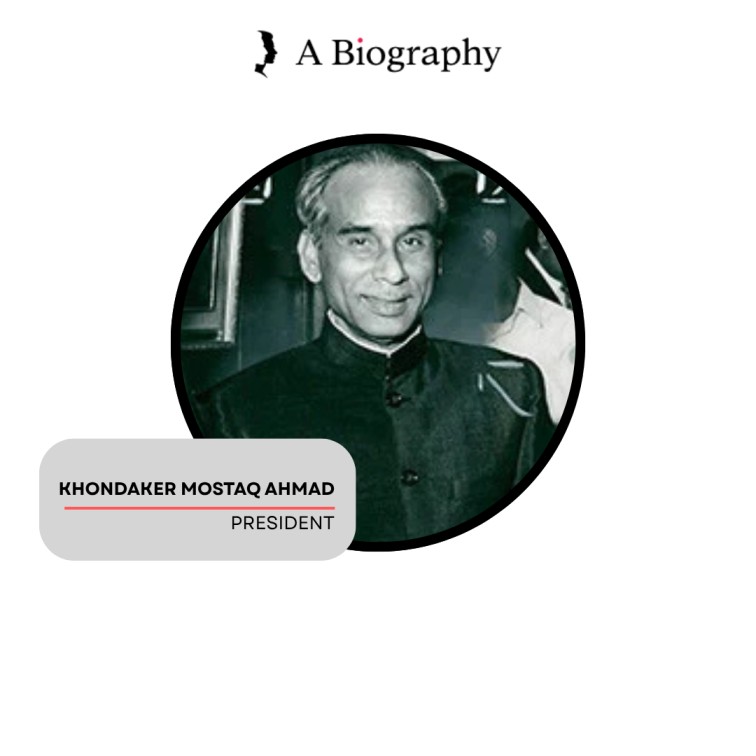
“I am not a murderer, I am a patriot. Those who killed Bangabandhu are ‘sons of the sun’.” – On the morning of August 15, 1975, Khondaker Mostaq Ahmad spoke these words. Just one day earlier, he had been a member of Bangabandhu’s cabinet. How could the same man call assassins ‘sons of the sun’? The closest companion of Bangabandhu turned into the mastermind of an anti-independence conspiracy. A mere 83 days of presidency – in which he destroyed Bangabandhu’s dreams, orchestrated the jail killings, and granted immunity to murderers through the Indemnity Ordinance. This is the brutal story of how a bright star of the liberation struggle walked the path of darkness.
Introduction
The blackest morning in Bangladesh’s history. Gunfire still echoed in the air. At 9:15 AM, Khondaker Mostaq Ahmad walked into the radio station. His voice trembled as he declared himself the new president. Then came the words that shocked the nation: the killers of Bangabandhu were ‘sons of the sun’ and ‘patriots’.
The nation stood still. How could a man who had fought alongside Bangabandhu for decades commit such betrayal? How could a freedom fighter become the chief conspirator of the nation’s greatest tragedy? Subsequent investigations and historical research proved that Khondaker Mostaq Ahmad was the principal architect and chief patron of the assassination. From his birth to his death, every chapter of his life reads like a terrifying thriller – rise, friendship, betrayal, lust for power, and ultimate fall. In these 28 chapters, we will uncover everything based on authentic sources and neutral historical analysis.
At a Glance: Life of Khondaker Mostaq Ahmad (c. 1918-1996)
| Information | Details |
| Full Name | Khondaker Mostaq Ahmad |
| Nickname | Mostaq Bhai (by Bangabandhu), Khondaker Saheb |
| Born | c. 1918 (exact date unknown; some claim Feb 27, 1919, unproven) |
| Birthplace | Daspadra village, Daudkandi, Comilla, Bengal Presidency, British India (now Bangladesh) |
| Died | March 5, 1996, Dhaka, Bangladesh (age 77-78) |
| Resting Place | Banani Graveyard, Dhaka (without state honors) |
| Father | Khondaker Abdul Hamid (name uncertain; possibly Abdul Jalil or Abdul Gani) |
| Spouse | Unknown (kept family details secret) |
| Children | Three sons (names, whereabouts unknown; believed to have fled the country) |
| Profession | President (Aug 15 – Nov 6, 1975); Minister of Commerce (1975); Minister of Power, Irrigation & Flood Control (1972-1975); Law & Parliamentary Affairs Minister (Mujibnagar Government, 1971); Lawyer |
| Education | LL.B (Law) – University of Dhaka |
| Political Party | Awami League (1949-1975); Democratic League (1976-1980) |
| Predecessor (President) | Bangabandhu Sheikh Mujibur Rahman |
| Successor (President) | Justice Abu Sadat Mohammad Sayem |
| Total Jail Time | Approximately 15 years (1954-55, 1958-62, 1966-69, 1976-81) |
| Notorious Acts | Indemnity Ordinance; ‘Son of the Sun’ statement; Jail killings (Nov 3, 1975); Abolition of ‘Joy Bangla’; Change of state symbols; Arrest of Awami League loyalists |
| Final Verdict | Most controversial and stigmatized figure in Bangladesh’s history; ‘Chief conspirator of Bangabandhu’s murder’; ‘Traitor’ |
Early Life
Born around 1918 (possibly 1919), Khondaker Mostaq Ahmad came into the world in Daspadra village, Daudkandi, Comilla. His father was a zamindar and respected farmer – the ‘Khondaker’ title indicated a wealthy landowning family.
From childhood, Mostaq was brilliant, restless, and ambitious. Teachers called him a ‘promising boy’ and ‘future leader’. His routine included playing football with friends, praying at the mosque, and studying with intense focus. His father wanted him to become a lawyer; his mother wished for him to serve the people.
Inspired by the speeches of Sher-e-Bangla A.K. Fazlul Huq, Huseyn Shaheed Suhrawardy, and Maulana Bhashani, a sense of patriotism and justice grew in his heart.
Education & Friendship with Bangabandhu (1930-1942)
He passed Matriculation and Intermediate with first division. Then he enrolled in the Law Faculty at the University of Dhaka – one of the finest institutions in the subcontinent.
There, he met Sheikh Mujibur Rahman, a young student of the History Department. Their friendship grew in Fazlul Huq Hall and Salimullah Muslim Hall. They discussed politics for hours, sat in tea stalls, and exchanged ideas. Bangabandhu affectionately called him ‘Mostaq Bhai’ and ‘Khondaker Bhai’. Mostaq called Bangabandhu ‘Mujib Bhai’.
Along with Mafizuddin, they were known as the ‘three friends’ – sitting in the same row in the same hall.
In 1942, he earned his LL.B degree. He practiced law for a while in Comilla and Dhaka, but his true passion was politics.
Student Politics & Founding Member of Awami Muslim League (1942-1949)
Mostaq became active in student politics, participating in the ‘Quit India Movement’ and the movement for Pakistan. During the 1946 Calcutta riots, he volunteered for peace committees.
After Partition in 1947, the people of East Pakistan suffered under West Pakistani exploitation. On June 23, 1949, when the East Pakistan Awami Muslim League was formed, Khondaker Mostaq was one of its founding members. He was elected joint secretary (some sources say assistant general secretary).
When Bangabandhu was imprisoned, Mostaq handled party responsibilities. He was skilled at organizational work – building branches at the grassroots, recruiting members, and raising funds.
Victory in United Front Election (1954)
In March 1954, the United Front – a coalition of Awami League, Krishak Sramik Party, and others – defeated the Muslim League. Khondaker Mostaq was elected as a member of the East Bengal Provincial Assembly from the Daudkandi constituency.
The United Front government lasted only a few weeks. On May 30, Governor General Ghulam Mohammed invoked Section 92‑A and dismissed the government. Mostaq was arrested and spent about a year in jail.
After his release in 1955, he was elected Chief Whip of the United Front parliamentary party – ensuring party discipline, attendance, and voting. He held this position until martial law was declared in 1958.
Ayub Khan’s Martial Law & Long Imprisonment (1958-1962)
On October 27, 1958, General Ayub Khan imposed martial law. All political parties and activities were banned. Mostaq was arrested and kept in jail for four years.
In prison, his closeness with Bangabandhu and other Awami League leaders grew. They shared cells, food, and suffering. During this time, Bangabandhu discussed the outlines of the Six Points movement. Mostaq participated in those discussions, learning many strategies that he would later use against Bangabandhu.
But this imprisonment also planted seeds of jealousy. He began to wonder: why does Bangabandhu always get the leading role while I remain in the shadows? Why does the people’s love belong only to him?
Six Points Movement & Re‑imprisonment (1966-1967)
In February 1966, at an opposition party conference in Lahore, Bangabandhu presented the historic Six Points – full autonomy for East Pakistan, parliamentary democracy, trade freedom, control over foreign exchange, sharing of military expenditure, and a separate navy.
Mostaq campaigned vigorously for the Six Points. He organized rallies and processions across Comilla, Noakhali, Chittagong, Sylhet, and Mymensingh. The Pakistani government arrested Bangabandhu on May 8, 1966, and Mostaq a few days later.
He was imprisoned until the mass uprising of 1969.
The Golden Chapter of Life (1969)
In January 1969, eight political parties formed the ‘Democratic Resistance Front’. Khondaker Mostaq was appointed convener of its East Pakistan chapter. This was the golden chapter of his life.
He called for protest marches, strikes, rallies, and demonstrations across East Pakistan. Under his leadership, strong movements grew in Comilla, Pabna, Sylhet, Narayanganj, and Noakhali.
In February-March 1969, Ayub Khan called a roundtable conference in Rawalpindi. Mostaq attended as Awami League’s representative, speaking forcefully for the Six Points and demanding immediate autonomy for East Pakistan. His speech was widely praised in Pakistani newspapers.
The movement forced Ayub Khan to resign on March 25, 1969. Mostaq’s role in this victory was significant.
1970 Election & Member of National Assembly
On December 7, 1970, Pakistan’s first general election was held. Awami League won an absolute majority – 167 out of 300 seats. Khondaker Mostaq was elected as a member of the National Assembly from a Comilla-based constituency.
When West Pakistani rulers refused to transfer power, the March 7, 1971, historic speech was delivered at the Racecourse Maidan. Mostaq sat on the stage beside Bangabandhu that day. He congratulated him after the speech. In the following days, he worked closely with Bangabandhu, helping to shape the movement’s strategy.
But some say that even at this time, he was thinking of something else in secret.
Liberation War & Minister in the Mujibnagar Government (1971)
After the March 25 crackdown, Mostaq fled to India to save his life. On April 10, 1971, the first provisional government of Bangladesh – the Mujibnagar Government – was formed. Khondaker Mostaq became a member of the cabinet.
He was first given the Ministry of Law and Parliamentary Affairs, and later also assigned the Foreign Ministry. He met diplomats, ambassadors, and government representatives from various countries, seeking support and recognition for Bangladesh.
Critics, however, argue that his role was limited and questionable. He never went to the battlefield, never formed a guerrilla force, never ran a training camp. He was a ‘paper minister’ – a diplomat working in an office. After independence, many questioned his actual contribution.
Minister in Independent Bangladesh (1972-1975)
After independence, Bangabandhu formed the government. Khondaker Mostaq was appointed Minister of Power, Irrigation and Flood Control (1972-1975).
He took some initiatives to increase electricity production and build flood control dams, but many projects remained incomplete or failed. Bangabandhu was reportedly dissatisfied with his work.
In January 1975, when Bangabandhu introduced the one‑party system ‘BAKSAL’ (Bangladesh Krishak Sramik Awami League), Mostaq was made Minister of Commerce. By this time, his frustration with Bangabandhu became visible. Why? Because he had wanted a bigger position – Prime Minister or President. He felt that his abilities were not being properly valued.
This frustration led him to first contact army officers and then directly join the conspiracy.
Secret Meetings & Funding Assassins (Early 1975)
In the first half of 1975, Khondaker Mostaq began meeting secretly with army officers – Faruk, Dalim, Nisad, Rashid, Sharif, Huda, Sultan and others. The meetings took place at his Motijheel residence, a safe house in Dhanmondi, and his village home in Comilla.
His goal: to remove Bangabandhu and become president himself. He assured the officers that after the assassination, he would issue an Indemnity Ordinance to protect them from legal consequences – not only that, he promised them high government positions, financial benefits, and help to go abroad. He pledged to abolish BAKSAL, remove the 4th amendment to the constitution, and give special privileges to the army.
He provided money and logistical support from his own home. His sons were also allegedly involved in the conspiracy. According to investigation commission reports, Khondaker Mostaq was the ‘chief conspirator’ and ‘principal patron’ of the assassination.
Assassination & Declaration as President
In the early hours of August 15, 1975, a group of young army officers attacked 32 Dhanmondi and killed the Father of the Nation along with his family. That night, Khondaker Mostaq appeared at the scene – eyewitnesses say he stood beside Bangabandhu’s body.
At 8:15 AM, he went to Bangladesh Betar and delivered a speech: “Dear countrymen, I am President Khondaker Mostaq Ahmad speaking. The situation is under control. Sheikh Mujibur Rahman has been killed. He had been running a dictatorship, taking the country towards destruction. Those who killed him are ‘sons of the sun’, patriots, and true friends of the nation. I am grateful to them.”
The nation was stunned. Protests broke out on the streets. International media condemned the speech. The name ‘Khondaker Mostaq Ahmad’ was forever recorded as a traitor.
The Indemnity Ordinance
After seizing power, Mostaq’s first and most heinous act was to issue the ‘Indemnity Ordinance’. It stated: “No case shall be filed for the killings, arrests, violence, and events of August 15, 1975. No court shall accept any complaint. No one shall be punished.”
This closed the door on any trial for the murder of Bangabandhu, his family, and his comrades. The killers received complete legal immunity. The Indemnity Ordinance cast a dark shadow over Bangladesh’s judicial system for 21 years. The killers walked free, some getting government jobs, some going abroad.
The trial of Bangabandhu’s murder was delayed by over two decades. In 1996, when Awami League came to power, the Indemnity Ordinance was repealed. But by then, Mostaq had already died.
Abolition of ‘Joy Bangla’, Changing State Symbols & Attacking Liberation War Spirit (Aug-Nov 1975)
Mostaq launched a full assault on the spirit of the liberation war and Bangabandhu’s memory:
- Abolished the liberation war slogan ‘Joy Bangla’ and introduced ‘Bangladesh Zindabad’ (mimicking Pakistan’s ‘Pakistan Zindabad’).
- Changed ‘Bangladesh Betar’ to ‘Radio Bangladesh’.
- Changed ‘Bangladesh Television’ to ‘BTV’.
- Imposed censorship on media – editors were told not to publish anything positive about Bangabandhu or critical of the killers.
- Ordered removal of Bangabandhu’s name, photos, and sculptures from all state institutions.
- Began process of canceling the 4th amendment (BAKSAL).
- Arrested and dismissed Bangabandhu’s loyal ministers, officials, officers, intellectuals, and lawyers.
The country experienced a reign of fear and terror.
The Jail Killings (November 3, 1975)
On the night of November 3, 1975, four national leaders were brutally murdered inside Dhaka Central Jail: Syed Nazrul Islam (acting president), Tajuddin Ahmed (prime minister), Captain M. Mansur Ali (finance minister), and A.H.M. Qamaruzzaman (home and relief minister).
They were not hanged; they were shot in a dark cell. Their bodies were cut into pieces and buried in Patuakhali (later recovered by Awami League). Investigation commissions and historians concluded that Khondaker Mostaq directly ordered these killings. He wanted to eliminate Bangabandhu’s ideology and all leaders of the inner circle.
Just three days later, on November 6, a counter‑coup led by Brigadier Khaled Musharraf overthrew Mostaq.
Fall from Power (November 6, 1975)
On November 6, 1975, Brigadier Khaled Musharraf – a freedom fighter and commander of ‘KZ Force’ – led a counter‑coup. Army personnel surrounded Bangabhaban. Khondaker Mostaq was arrested. His 83‑day presidency ended.
Justice Abu Sadat Mohammad Sayem became the new president. Mostaq’s ‘Ministry of Blood’ was dissolved. His dictatorial plans, his dream of a ‘Bangabandhu‑free’ state, and his ‘son of the sun’ philosophy – all collapsed.
He was captured on television cameras, his face pale, his eyes defeated.
Formation of Democratic League & Re‑imprisonment (1976)
After release from jail in early 1976, instead of withdrawing from politics, Mostaq formed a new party called the ‘Democratic League’ – aiming to gather disgruntled Awami League members, pro‑assassination army officers, and dissatisfied politicians.
But the general public rejected him. Awami League supporters protested his meetings. The party won no seats in the 1978, 1979, or 1986 elections.
Later in 1976, General Ziaur Rahman arrested him on charges of conspiracy to overthrow the government, espionage, and corruption. He was sentenced to five years of rigorous imprisonment by a military court.
Confined & Isolated Life under Zia and Ershad (1977-1990)
Ziaur Rahman considered Mostaq a ‘threat to the state’ and a ‘dangerous person’. Although Zia himself was a military ruler, he did not openly support Bangabandhu’s assassination – rather, he criticized the Indemnity Ordinance. Mostaq’s party was never registered. He lived under surveillance, his phone tapped, rarely allowed outside.
After Zia’s death in 1981, General Ershad came to power. Mostaq tried to revive his political career, meeting Ershad secretly. But Ershad also did not give him importance. Mostaq became virtually isolated, living a lonely, frustrated, and retired life in a modest house in Dhaka.
Personal Life
Khondaker Mostaq Ahmad never publicly revealed his family details. He was married, but his wife’s name is completely absent from history. He had three sons – but their names, addresses, and professions are unknown.
After Bangabandhu’s assassination, Mostaq’s family faced harassment. Some believe his children fled the country. One may live in the UK, another in Saudi Arabia.
Personally, Mostaq was simple, frugal, and religious. He prayed regularly, read the Quran, fasted. But religion could not save him from moral downfall. The lust for power ultimately destroyed him.
Trial of Bangabandhu Murder Case & Last Moments (1996)
After Awami League won the June 1996 election, Sheikh Hasina became Prime Minister. The Indemnity Ordinance was repealed. The trial of Bangabandhu’s murder began.
But Khondaker Mostaq had already died on March 5, 1996 – about three months before Awami League came to power. He never faced justice. Court rulings and investigation reports identified him as the ‘chief conspirator’, ‘principal accused’, and ‘architect of the assassination plot’.
If he had lived, he would undoubtedly have been sentenced to death. Death saved him from the gallows. He died blind, suffering from kidney and heart diseases. Those close to him said he lived his last days alone, fearful, and remorseful.
Death & Funeral (March 5, 1996)
On March 5, 1996, at 4:20 AM, Khondaker Mostaq Ahmad died at his Motijheel residence in Dhaka due to old age complications. He was 77-78 years old.
Most newspapers did not publish his death – only Prothom Alo and Ittefaq mentioned it in a small column. State television and radio broadcast no condolence messages. President Abdur Rahman Biswas and Prime Minister Khaleda Zia issued no official statements. No condolence motion was moved in parliament.
Only a few relatives, a couple of old associates, and some neighbors attended his funeral. No political party sent a wreath. He was buried at Banani Graveyard without state honors – no 21‑gun salute, no flag at half‑mast, no guard of honour. His grave has no large signboard – just a small number plate.
Character & Political Philosophy
Khondaker Mostaq Ahmad was a talented and ambitious politician – skilled in organization, articulate in speech, and adept at diplomacy. Being close to Bangabandhu, he understood Awami League’s internal strengths and weaknesses.
But he suffered from an insatiable thirst for power and jealousy of Bangabandhu’s success. He believed he was more capable than Bangabandhu, yet all credit and popularity went to him. When BAKSAL was introduced, he used the excuse of ‘dictatorship’ to justify his conspiracy.
His political philosophy was purely opportunistic – power and self‑interest above all principles. This character flaw led to his ultimate downfall.
Historical Verdict – Was Mostaq a Villain or a Victim of Circumstances?
Most historians and analysts label Khondaker Mostaq as the ‘chief conspirator’, ‘traitor’, and ‘villain’. They argue: he issued the Indemnity Ordinance, ordered the jail killings, abolished ‘Joy Bangla’. These prove he was an active conspirator.
A small minority argue that he did not directly order the assassination; rather, army officers used him as a ‘civilian face’. They say he was trapped by his lust for power but was not the main planner.
However, most researchers and investigation reports support the first view. History has branded him as ‘Bangladesh’s greatest traitor’.
Legacy & Lessons for Future Generations
Khondaker Mostaq’s legacy is one of darkness. There is no sculpture, road, building, school, or memorial named after him in Bangladesh. His Democratic League is defunct. His children live in exile or in hiding.
The people of Bangladesh still know him as ‘Bangabandhu’s killer’ and ‘traitor’. His life is a blazing warning: how the lust for power and personal ambition can bring a person to the lowest depths.
The younger generation should learn from his life to walk the path of honesty, integrity, and patriotism. Never betray the nation and its leader for personal gain.
Key Events in Khondaker Mostaq Ahmad’s Life
| Year | Event |
| c.1918/19 | Born in Daspadra village, Daudkandi, Comilla |
| 1930s-40s | LL.B degree; friendship with Bangabandhu; law practice |
| 1949 | Founding member of Awami Muslim League; elected joint secretary |
| 1954 | Elected to East Bengal Provincial Assembly as United Front candidate; arrested after government dismissal (jail until 1955) |
| 1955 | Elected Chief Whip of United Front parliamentary party |
| 1958 | Arrested during martial law (jail until 1962) |
| 1966 | Participated in Six Points movement; arrested (jail until 1969) |
| 1969 | Led mass uprising; convener of Democratic Resistance Front (East Pakistan); Awami League representative at Rawalpindi roundtable |
| 1970 | Elected to Pakistan National Assembly |
| 1971 | Liberation war; took refuge in India; Minister of Law & Parliamentary Affairs (Mujibnagar Government); later given Foreign Ministry |
| 1972 | Appointed Minister of Power, Irrigation & Flood Control (until 1975) |
| 1975 (Jan) | Appointed Minister of Commerce (BAKSAL government) |
| 1975 (Aug 15) | Assassination of Bangabandhu; declares himself President; issues Indemnity Ordinance; declares assassins ‘sons of the sun’ |
| 1975 (Nov 3) | Orders jail killings |
| 1975 (Nov 6) | Overthrown and arrested |
| 1976 | Released; forms Democratic League; re‑arrested; sentenced to 5 years (corruption & sedition) |
| 1980-1990 | Isolated from politics; confined, lonely life |
| 1996 (Mar 5) | Dies in Dhaka; buried at Banani Graveyard (no state honors) |
Conclusion
Khondaker Mostaq Ahmad’s life is a cautionary tale of how the lust for power can drag a man to the lowest depths. He was a freedom fighter, Bangabandhu’s comrade, an Awami League leader. But personal ambition and hunger for power led him astray.
He was the principal architect of the August 1975 assassination. He tried to glorify the murderers as ‘sons of the sun’. He issued the Indemnity Ordinance to give them legal impunity. He approved the jail killings.
His 83‑day presidency – one of the shortest in Bangladesh’s history – was also the most tragic and shameful. He gained power on the pyre of murderers. He fell in a counter‑coup.
No condolence, no memorial, no honour was given to him after death. No one comes to put flowers on his grave. History has branded him as a ‘traitor’. The people of Bangladesh still know him as ‘Bangabandhu’s killer’. He remains the eternal shame of the Bengali nation. His story teaches every generation: if one abandons one’s principles and ideals for the sake of power, the final outcome can be catastrophic.
“I am not a murderer, I am a patriot. Those who killed Bangabandhu are sons of the sun.” – These words will forever be the most shameful statement in Bangladesh’s history.
References
- Bangla Wikipedia – Khondaker Mostaq Ahmad
- English Wikipedia – Khondaker Mostaq Ahmad
- ‘Bangladesher Rajniti: 1972-1975’ – Dr. Sirajul Islam
- ‘1975: Bochor Bodoler Golpo’ – Muntasir Mamoon
- ‘Jail Hatta o Bangabandhu Hattar Bichar’ – M. Hamidur Rahman
- ‘Bangabandhu Hattar Itihas’ – Dr. Mahfuz Ullah
- ‘Fansi Na Hole Jara Polatak’ – Shahriar Kabir
- Liberation War Museum – preserved documents, reports, and footage
- Daily Ittefaq, Daily Prothom Alo, Daily Sangbad, Daily Banglar Bani reports (1975-1996)
- Supreme Court records and observations on Bangabandhu murder case (1996-2009)
Disclaimer
This biography is prepared based on reliable sources, documents, reports, and historical books. There may be minor uncertainties regarding Khondaker Mostaq Ahmad’s personal information and exact birth/death dates. The greatest respect for history and factual accuracy has been maintained. Any unresolved questions and differing opinions are left to the reader’s judgment. This work is intended to present a neutral historical account, not to incite hatred.

