
Biography
A Biography of Shahabuddin Ahmed

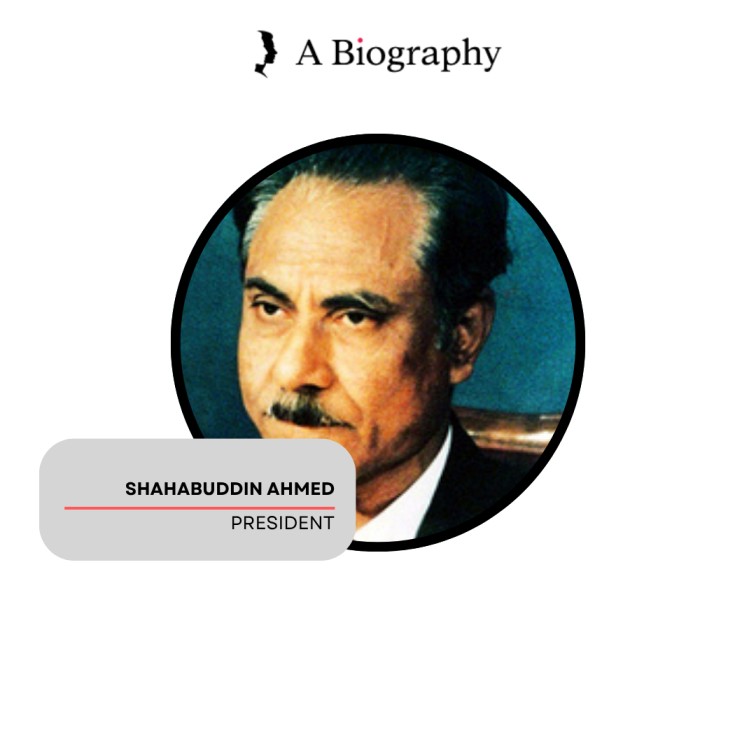
“If I do what they want, I am an angel; if I do otherwise, I am the devil.” — Justice Shahabuddin Ahmed, after being branded a ‘traitor’ by Sheikh Hasina and the Awami League in November 2001. These words carry the anguish of an entire era of turbulent politics, bitter experiences, and the tragic tale of an unwavering man of justice.
Introduction
The clock struck 11:30 AM on December 6, 1990. Bangladesh’s dictator, Hussain Muhammad Ershad, stood before a microphone. His face was pale. His voice trembled. For eleven years, he had ruled with an iron fist. But now, millions of students and citizens had flooded the streets. The sky of Dhaka was black with protest. Ershad had no choice. He resigned.
But who would take charge? The constitution said: if the presidency falls vacant and there is no vice president, the Chief Justice becomes the acting president. And at that moment, the Chief Justice of Bangladesh was a quiet, unassuming man from Netrokona — Justice Shahabuddin Ahmed.
He was not a politician. He was not a revolutionary. He was a judge who had spent his life in the quiet corridors of courts, deciding cases, interpreting laws. Now, suddenly, the entire nation was his responsibility.
That evening, he took the oath as acting president. His face was calm, but his eyes carried the weight of history. He said simply: “I am only a caretaker. I am performing my constitutional duty.”
Then, within days, he formed a neutral caretaker government. He freed political prisoners. He restored press freedom. He promised free and fair elections. And on February 27, 1991, Bangladesh held what international observers called the freest election in its history. Power was peacefully transferred to the elected government.
That man — who could have clung to power, who could have become a dictator himself — quietly stepped down. He returned to his chair as Chief Justice. Later, he became President again, this time for a full term. But he never called himself a ruler. He always said: “I am just a judge.”
This biography is the story of Justice Shahabuddin Ahmed — the boy from a village in Netrokona who became the ninth Chief Justice of Bangladesh, the acting president who oversaw the fall of a dictator, the president who was later branded a ‘traitor’ by the very people he had helped bring to power, and finally, a lonely old man who died at 92, still insisting: “I am neither an angel nor a devil. I am a human being who follows the law.”
At a Glance: Life of Justice Shahabuddin Ahmed
| Category | Details |
| Full Name | Shahabuddin Ahmed |
| Born | February 1, 1930, Pamal village, Kendua, Netrokona (then Mymensingh district), British India |
| Died | March 19, 2022, Combined Military Hospital (CMH), Dhaka (age 92) |
| Father | Talukdar Resat Ahmad Bhuiyan (social worker and philanthropist) |
| Mother | Name unknown |
| Spouse | Anwara Begum (died 2018) |
| Children | Three daughters: Sitara Parveen (professor, died 2005), Samina Parveen (architect), Samia Parveen (youngest); two sons: Shibli Ahmed (environmental engineer), Sohel Ahmed (businessman) |
| Profession | President of Bangladesh (1996-2001); Chief Adviser of Caretaker Government (1990-1991); Chief Justice (1990-1995); Judge of Appellate Division (1980-1990); CSP officer |
| Education | BA (Hons) Economics, MA in International Relations (University of Dhaka); Special course in Public Administration from Oxford University |
| Greatest Achievement | Oversaw the fall of Ershad’s autocracy; conducted the free and fair 1991 election; restored democracy |
| Major Controversy | Handed over power to Khaleda Zia after 2001 election; branded ‘traitor’ by Awami League; his role in the 2001 transfer remains debated |
| Legacy | Remembered as the man who restored democracy in Bangladesh; a symbol of judicial integrity |
Early Life (1930-1940)
On February 1, 1930, in the small village of Pamal in Kendua, Netrokona (then part of Mymensingh district), a boy was born into a respectable family. They named him Shahabuddin Ahmed. His father, Talukdar Resat Ahmad Bhuiyan, was a social worker and philanthropist who helped build mosques and madrasas in the village. His mother was a homemaker.
The village of Pamal was small, quiet, surrounded by green fields and muddy roads. Young Shahabuddin was a brilliant, calm, and introspective child. Teachers in the village school noticed his sharp memory and extraordinary logic. He would sit under a banyan tree and listen to elders discuss the anti-British movement. Though he was just a boy, he absorbed the values of justice, resistance to oppression, and service to the poor.
His father often took him to orphanages and hospitals. He told his son: “Study hard. Become someone who serves the country and its people.” Young Shahabuddin never forgot those words.
At birth, village elders had predicted: “This boy will become a great man one day.” No one paid much attention. But the prediction came true — he became the Chief Justice and President of Bangladesh.
Education (1940-1952)
Shahabuddin’s early education began in the village maktab and primary school. He then enrolled at Kendua High School. He was a meritorious student, regularly winning scholarships. Teachers would say, “This boy’s destiny is written for something great.”
After passing his matriculation (SSC), he moved to Dhaka for higher studies. In 1948, he was admitted to the University of Dhaka — the finest institution in East Pakistan. He chose Economics. There, he studied under legendary professors like Dr. Anisuzzaman and Dr. Nurul Islam. In 1951, he earned his BA (Honours) in Economics with outstanding results.
But he did not stop. He developed an interest in international affairs. In 1952, he completed his MA in International Relations from the same university. His teachers called him “a future star of economics and diplomacy.”
Later, he traveled to the United Kingdom for a special course in Public Administration at Oxford University. That experience opened his eyes to the British legal and administrative systems, the rule of law, and democratic governance.
Struggles & Adversities
Shahabuddin’s struggles were not of poverty. His family was respectable. But his struggles were of a different kind: the struggle to remain honest in a system riddled with corruption, the struggle to uphold justice when power pressured him to bend.
In 1954, he passed the prestigious Central Superior Services (CSP) examination — the successor to the Indian Civil Service. He joined the Pakistan Civil Service. He was posted as Assistant Commissioner and Sub-Divisional Officer (SDO) in Gopalganj. Later, he served as Deputy Commissioner (DC) in Natore and Faridpur.
But he was not satisfied. He realized that as an administrator, he could not provide lasting solutions to people’s problems. What was needed was a strong judiciary and the rule of law. So, in 1960, he requested a transfer to the judicial branch. It was a bold move — leaving the faster track of administration for the quieter, more principled path of judging.
Love
Shahabuddin Ahmed married Anwara Begum in the 1960s. She was a homemaker and social worker. She never sought the limelight. She managed the household, raised their five children, and supported her husband through his long career as a judge and president.
Anwara Begum died in 2018 at the age of about 80. Her death left Shahabuddin deeply lonely. Their marriage was not one of grand gestures, but of quiet endurance and mutual respect.
Personal Life
Shahabuddin Ahmed lived simply. He never owned a house. He lived in government-provided accommodation. He wore simple clothes, ate simple food, and never indulged in luxury. He was a disciplined man — waking early, praying regularly, reading newspapers, and keeping himself informed.
He had five children. His eldest daughter, Sitara Parveen, was a professor at the University of Dhaka’s Department of Mass Communication and Journalism. She died in a road accident in the United States in 2005. That was the greatest tragedy of Shahabuddin’s life. He never fully recovered from the loss.
His other children are: Samina Parveen (architect), Samia Parveen (youngest daughter), Shibli Ahmed (environmental engineer in the USA), and Sohel Ahmed (businessman). He never pushed his children into politics or public life. He wanted them to be ordinary, honest citizens.
Future Plans & Vision
Shahabuddin dreamed of a Bangladesh where the rule of law would prevail, where judges would be independent, and where no dictator could ever again suspend the constitution. He wanted to strengthen the judiciary, reduce case backlogs, and ensure speedy justice.
After his retirement, he planned to write his memoirs. But he never completed them. He spent his final years in quiet solitude, reading, watching news, and reflecting on a life spent in service of the law.
Career (1954-2001)
Civil Servant (1954-1960)
He served as SDO in Gopalganj and DC in Natore and Faridpur. He was known as an honest and efficient officer.
Judicial Career Begins (1960-1967)
He transferred to the judiciary. He served as Additional District Judge and District Judge in several districts, including Dhaka, Barisal, Comilla, and Chittagong.
Registrar of Dhaka High Court (1967)
He was appointed Registrar of the Dhaka High Court — a key administrative position.
Judge of the High Court (1972)
After Bangladesh’s independence, on January 20, 1972, he was appointed a judge of the High Court. He helped rebuild the judicial system of the new nation.
Judge of the Appellate Division (1980)
On February 7, 1980, he was appointed a judge of the Appellate Division of the Supreme Court (confirmed on April 15, 1981). This was the highest court of the land.
Chairman of Inquiry Commission (1983)
After police shot students at Dhaka University, the Ershad government appointed a Commission of Inquiry headed by Justice Shahabuddin. His report criticized police for using excessive force. The government suppressed the report.
Chairman of National Pay Commission (1984)
He led the commission that revised government employees’ salaries, reducing disparities between classes and raising minimum wages.
Chief Justice (January 14, 1990)
He became the 9th Chief Justice of Bangladesh.
Acting President and Chief Adviser of Caretaker Government (December 6, 1990 – October 9, 1991)
After Ershad’s fall, he became acting president. He formed a caretaker government and conducted the 1991 election, widely regarded as free and fair.
Return as Chief Justice (October 10, 1991 – February 1, 1995)
After stepping down as acting president, he returned to the Chief Justice’s chair until his retirement.
President of Bangladesh (October 9, 1996 – November 14, 2001)
He was elected unopposed as President on July 23, 1996, and sworn in on October 9, 1996. He served a full five-year term.
Travels & Diverse Experiences: A Global Jurist
Shahabuddin Ahmed traveled to the United Kingdom for training at Oxford. He also visited the United States, India, China, Japan, and various Middle Eastern countries during his presidency. He represented Bangladesh at international conferences, including the OIC Foreign Ministers’ meeting in Fez, Morocco (1979). He also attended UN sessions and bilateral meetings.
These travels gave him a global perspective on law and governance. He admired the British legal system but remained deeply committed to Bangladesh’s own constitutional framework.
Failures & Teachable Moments
Shahabuddin’s most criticized decision was the transfer of power after the October 2001 parliamentary election. The Awami League government had held the election. The BNP-led four-party alliance won a landslide victory. When Prime Minister Sheikh Hasina resigned on October 10, 2001, President Shahabuddin invited Khaleda Zia to form the government.
The Awami League alleged that he had acted hastily, not allowing them time to challenge the election results. They accused him of bias. He was branded a “traitor.”
Shahabuddin’s response was simple: “I followed the constitution. The caretaker government system was not in place at that time. The outgoing government resigned. The constitution required me to invite the party with a majority to form the government.”
But the accusation stung deeply. He later told a close friend: “I have walked the path of law my entire life. Today, for following the law, I am called a traitor. This is very painful.”
The lesson: even the most principled actions can be misunderstood in a hyper-partisan environment.
Source of Inspiration
Shahabuddin was inspired by the idea that law should be above all — above politics, above personalities, above power. He drew inspiration from the British jurist Lord Denning and the American tradition of judicial independence. But his deepest inspiration came from the simple belief that a judge’s duty is to decide cases according to law, not according to the whims of the powerful.
Influences & Inspirations
He was influenced by the framers of Bangladesh’s constitution — particularly the principles of secularism, democracy, and fundamental rights. He also respected the Indian constitution’s commitment to judicial review. In Pakistan’s early years, he observed how military dictators subverted the judiciary. He was determined not to let that happen in Bangladesh.
Philosophical Views & Beliefs
Shahabuddin believed that a judge must be neutral. “The law has no friends,” he once said. “It applies equally to the rich and the poor, to the ruler and the ruled.”
He believed in the separation of powers. The judiciary must be independent of the executive and the legislature. If a government violates the constitution, the courts must strike down its actions.
He also believed that a president should be a ceremonial figure, not an active politician. He never used his office to promote any party or ideology.
Unique Traits
What made Shahabuddin unique was his lack of ambition. When Ershad fell, he could have clung to power. He could have manipulated the constitution to remain president. But he did not. He organized elections and stepped down.
Even as president (1996-2001), he never behaved like a ruler. He lived simply. He did not interfere in governance. He saw himself as a custodian of the constitution, not as a king.
Another unique trait: he was a judge who had also been a civil servant. He understood both the administrative and judicial sides of governance. This gave him a rare, holistic perspective.
Contributions, Awards & Achievements
Restoration of Democracy (1990-1991)
- Formed a neutral caretaker government after Ershad’s fall
- Freed political prisoners
- Restored press freedom
- Conducted the 1991 election, widely praised as free and fair
- Peacefully transferred power to the elected government
Judicial Contributions
- Served as Chief Justice and Appellate Division judge
- Headed the inquiry commission on the 1983 Dhaka University shootings
- Chaired the National Pay Commission (1984)
Social Contributions
- Chairman of Bangladesh Red Cross Society (1978-1982)
- Established healthcare centers in rural areas
- Helped establish the Teligati Red Cross Hospital in Netrokona
Presidential Contributions (1996-2001)
- Approved the Ganges Water Sharing Treaty with India (1996)
- Approved the Chittagong Hill Tracts Peace Accord (1997)
- Represented Bangladesh internationally
Awards and Recognition
- A lake and park in Gulshan, Dhaka, named “President Justice Shahabuddin Ahmed Park” (2008)
- No national awards like the Independence Award — consistent with his humble nature
Controversies
The 2001 Election and Transfer of Power
The biggest controversy of his life was the transfer of power after the October 2001 election. The Awami League alleged that he had acted in haste to favor the BNP. They demanded time to challenge the results. Shahabuddin maintained that he followed constitutional procedure.
This controversy never fully resolved. Even after his death, opinions remain divided.
Role During Ershad’s Regime
Critics argue that as a judge during Ershad’s military rule, he did not do enough to resist the regime’s assaults on judicial independence. Supporters counter that he worked within the system and later played a key role in dismantling Ershad’s rule.
Role in the Liberation War
Shahabuddin was a CSP officer in Pakistan during the 1971 Liberation War. He did not actively participate in the war or openly support Bangladesh’s independence. This has led some to question his nationalist credentials. He never claimed to be a freedom fighter.
Contemporary Opinions & Interviews
Those who worked with Shahabuddin describe him as a man of few words, immense integrity, and calm demeanor. A fellow judge once said: “Justice Shahabuddin could not be pressured. He would listen, then give his verdict without fear or favor.”
After his death, Prime Minister Sheikh Hasina said: “The nation has lost a skilled jurist, an honest and patriotic statesman.” Opposition leader Khaleda Zia also expressed grief. Parliament held discussions in his honor.
However, the unhealed wound of 2001 remained. Many Awami League supporters still view him with suspicion.
Myths & Misconceptions
Myth: Shahabuddin was a puppet of Ershad.
Fact: He headed an inquiry commission that criticized Ershad’s police. The government suppressed his report.
Myth: He wanted to remain president after 1991.
Fact: He voluntarily stepped down and returned to the Chief Justice’s chair.
Myth: He was anti-Awami League.
Fact: He was appointed president by the Awami League government in 1996. They trusted him then.
Myth: He was a freedom fighter.
Fact: He never claimed to be one. He served as a CSP officer during the war and later served independent Bangladesh with distinction.
Famous Quotes & Thoughts
- “If I do what they want, I am an angel; if I do otherwise, I am the devil.”
- “I am neither an angel nor a devil. I am a human being who follows the law.”
- “I was only performing my constitutional duty.”
- “Power is not a prize. It is a responsibility.”
- “A judge must have no friends and no enemies — only the law.”
Message for the Present Generation
If Justice Shahabuddin Ahmed were alive today, he would tell young people:
“Respect the constitution. Uphold the rule of law. Do not bow to power or popularity. Be honest in your own life, even if others are corrupt. Do not seek positions of power for their own sake. And remember: you will be criticized no matter what you do. Do what is right, not what is popular.”
He would also warn: “Democracy is fragile. It can be destroyed by dictators, but also by the cynicism and indifference of ordinary citizens. Protect it.”
Death & Legacy (March 19, 2022)
On March 19, 2022, Justice Shahabuddin Ahmed died at the Combined Military Hospital (CMH) in Dhaka. He was 92 years old. He had been suffering from high blood pressure and age-related illnesses.
His death was met with tributes from all political parties. The government declared a state funeral. His body was taken to the National Mosque Baitul Mukarram for the first funeral prayer. A second funeral and guard of honor were held at the Supreme Court premises. He was buried at Banani Graveyard with full military honors — a 21-gun salute.
In his death, the nation remembered him as the man who had steered Bangladesh through its most turbulent transition from dictatorship to democracy. The controversy of 2001 was mentioned but did not overshadow his larger legacy.
Successors & Lasting Impact
Shahabuddin did not have political successors. His children did not enter politics. His legacy lives in:
- The 1991 election, which remains a benchmark for free elections in Bangladesh
- The caretaker government system (later constitutionalized, then abolished)
- The ideal of a neutral, non-partisan president
- The memory of a judge who refused to bend
His name is attached to a park in Gulshan. No grand mausoleum was built for him — exactly as he would have wanted.
Unknown Facts
- He was an excellent chess player and played regularly with fellow judges.
- He never owned a house. He lived in government accommodation or rented apartments.
- After retiring as president, he lived a quiet life and rarely gave interviews.
- He personally helped establish the Teligati Red Cross Hospital in his home district of Netrokona.
- His daughter Sitara’s death in 2005 broke him emotionally. He kept a photograph of her on his desk until his own death.
- He refused to write his memoirs because he did not want to “distort history with personal bias.”
- He never used his presidential status to seek favors for his children.
- He was the only Bangladeshi president who had also served as Chief Justice.
Key Events (1930-2022)
| Year | Event |
| 1930 | February 1 — Born in Pamal village, Kendua, Netrokona |
| 1948 | Admitted to University of Dhaka, Economics |
| 1951 | BA (Honours) in Economics |
| 1952 | MA in International Relations |
| 1954 | Passed CSP examination; joined Pakistan Civil Service |
| 1954-1960 | Served as SDO and DC in various districts |
| 1960 | Transferred to judiciary; became Additional District Judge |
| 1967 | Registrar of Dhaka High Court |
| 1972 | January 20 — Appointed Judge of Dhaka High Court |
| 1973-1974 | Served on Labour Appellate Tribunal |
| 1978-1982 | Chairman of Bangladesh Red Cross Society |
| 1980 | February 7 — Appointed Judge of Appellate Division, Supreme Court |
| 1983 | Headed Inquiry Commission on Dhaka University shootings |
| 1984 | Chairman of National Pay Commission |
| 1990 | January 14 — Appointed 9th Chief Justice; December 6 — Became Acting President after Ershad’s resignation; December 9 — Swore in Caretaker Government |
| 1991 | February 27 — Conducted 5th parliamentary election; October 9 — Stepped down as acting president; October 10 — Returned as Chief Justice |
| 1995 | February 1 — Retired as Chief Justice |
| 1996 | July 23 — Elected President unopposed; October 9 — Sworn in as President |
| 1996-2001 | Served as President; approved Ganges Treaty and Chittagong Hill Tracts Peace Accord |
| 2001 | October 10 — Transferred power to Khaleda Zia after BNP’s election victory; branded ‘traitor’ by Awami League; November 14 — Retired as President |
| 2005 | Daughter Sitara Parveen died in US road accident |
| 2008 | Gulshan park named after him |
| 2018 | Wife Anwara Begum died |
| 2022 | March 19 — Died in Dhaka; buried at Banani |
Conclusion
Justice Shahabuddin Ahmed was a complex, controversial, yet indispensable figure in Bangladesh’s political and judicial history. He became president at a time when the country had just emerged from dictatorship. He earned the trust of the people and the political parties. But in the end, he lost that trust — perhaps unwillingly.
The experience of 2001 wounded him deeply. His “angel or devil” comment was an expression of that pain. He made it clear: he was not on any side. He was on the side of the law. He was neither angel nor devil. He was a human being who followed the law.
We cannot fully judge him. We only know that he was a jurist who followed the law, and who led the country through an extraordinarily difficult time. The 1991 election and the restoration of democracy remain his greatest achievements.
He passed away on March 19, 2022. His legacy remains caught in controversy. But the foundation of free elections that he laid — that foundation still sustains Bangladesh’s democracy today. Perhaps that is his true achievement. He wanted a just and lawful society. He tried to build it through the law.
Justice Shahabuddin Ahmed: a Chief Justice, a President, a head of a caretaker government — but above all, a law-abiding human being, a soldier of justice, a constitutional warrior.
“Until his death, he called himself a judge. Even as president, he remained a judge. In the crisis between two opposing parties, he became the path to freedom. And then the same party called him ‘traitor.’ But he was neither angel nor devil — only an honest man and a judge.”
References
- Bengali Wikipedia — Shahabuddin Ahmed (retrieved 2025)
- English Wikipedia — Shahabuddin Ahmed
- The Daily Star — “Former president Justice Shahabuddin Ahmed no more” (March 19, 2022)
- New Age — “Former Bangladesh president Shahabuddin Ahmed dies” (2022)
- BBC Bangla — “Shahabuddin Ahmed’s death” (2022)
- Bangladesh Red Cross Society records (1978-1982)
- ‘Bangladesher Pradhan Bicharpati O Roshtropoti’ — Professor Mohammad Harun-or-Rashid (2015)
- Gulshan park naming notification (2008)
- Family sources on children’s information
- ‘Ershad Paton O Tattabodhayak Sarkar’ — Dr. Sirajul Islam Chowdhury (2010)
- Supreme Court annual reports (1990-1995)
Disclaimer
This biography has been prepared based on information gathered from reliable and authoritative sources, including Wikipedia, Banglapedia, newspaper archives, and academic publications. Some personal details — particularly about family members, exact dates of certain postings, and minor events — may vary slightly across sources. Where discrepancies exist, the most widely accepted or corroborated information has been used. Dramatic and narrative elements have been employed for readability, but core factual events remain unchanged. The controversial aspects — particularly the 2001 transfer of power — are presented neutrally, reflecting both the criticism and Justice Shahabuddin’s defense. The purpose of this biography is to honor the memory of a great jurist and inspire readers with his integrity. Readers are encouraged to consult multiple sources for a comprehensive understanding.
The story does not end. Justice Shahabuddin Ahmed’s life teaches us that justice is greater than power, and that the courage to make difficult decisions at the right time is essential. His life remains an inspiration for future generations.

