
Biography
A Biography of Abu Sadat Mohammad Sayem

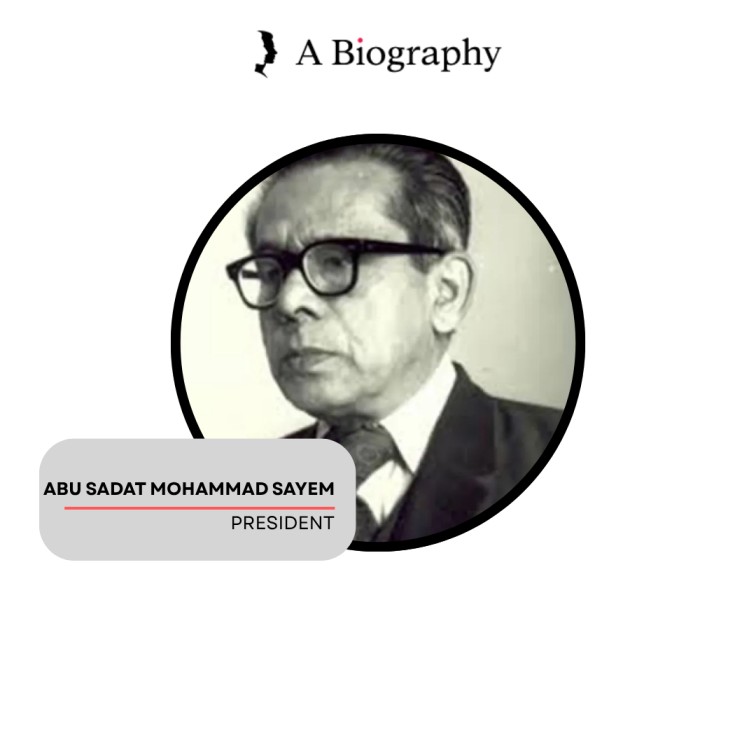
“I did not seize power by force. I never wanted to be a dictator. I took responsibility for the sake of the country and the law. When I saw that the country was safe in others’ hands, I stepped aside. I fought for the law until my death. Before my conscience, I am not guilty.” — Justice Abu Sadat Mohammad Sayem, in his 1988 memoir ‘At Bangabhaban: Last Phase’ — a confession and a defense.
The Night a Judge Was Made Ruler (November 6, 1975)
The darkness of November 6, 1975, had not yet lifted. Before Bangabhaban, rows of armored vehicles. Helicopters roared overhead. Everywhere, the polished boots of soldiers. For days, the country had been spinning in a bloody vortex.
August 15 — Bangabandhu had been assassinated.
November 3 — the four national leaders had been murdered in Dhaka Central Jail (the Jail Killing).
November 3 itself — Brigadier Khaled Mosharraf had seized power in a counter-coup, ousting Khondaker Mostaq Ahmed.
November 7 — the Sipahi-Janata Biplob (Soldier-People’s Uprising) had killed Khaled Mosharraf.
Anarchy ruled.
And in the midst of this chaos, a name was announced as the new President of Bangladesh: Chief Justice Abu Sadat Mohammad Sayem.
Bangladesh’s first Chief Justice, the highest guardian of the law, was now taking oath as President and Chief Martial Law Administrator — under the shadow of bayonets.
What greater irony could there be for a judge? A man whose entire life was spent establishing the rule of law was now forced to enforce martial law. He had never imagined that one day he would rule the country with the army’s support. Yet he accepted the responsibility. Because he believed — in this moment of crisis, the country needed leadership. And at that time, no one else was left to lead.
He served as President and Chief Martial Law Administrator for only 166 days (about five and a half months). On November 29, 1976, he relinquished the post of Chief Martial Law Administrator to Ziaur Rahman. On April 21, 1977, citing illness, he resigned from the presidency itself. Then he withdrew from politics forever.
Was he a dictator, or a priest of the law? Did he pave the way for Ziaur Rahman’s rise, or did he give everything to save the country from anarchy? History still seeks the answer.
This 28-chapter biography tells the full story of that judge-president — from the zamindar quarters of Rangpur to his practice at the Calcutta High Court, Partition, judgeship in Dhaka High Court, becoming Bangladesh’s first Chief Justice, the landmark Berubari case judgment, the bloody November of 1975, the throne of Bangabhaban, the harsh reality of martial law, the power struggle with Ziaur Rahman, and finally, his silent retirement and the writing of ‘At Bangabhaban: Last Phase’.
2. At a Glance: Life of Justice Abu Sadat Mohammad Sayem — Every Chapter of the Priest of Law
| Category | Details |
| Full Name | Abu Sadat Mohammad Sayem |
| Short Name | A. S. M. Sayem |
| Born | March 29, 1916, Rangpur district, Bengal Presidency, British India (now Bangladesh) |
| Died | July 8, 1997, Dhaka, Bangladesh (age 81) |
| Father | Name unknown |
| Mother | Name unknown |
| Spouse | Name unknown |
| Children | One daughter (presumably); name unknown |
| Profession | President (1975-1977), Chief Martial Law Administrator (1975-1976), First Chief Justice of Bangladesh (1972-1975), Judge of Dhaka High Court (1962-1972), Lawyer (1944-1962) |
| Education | Rangpur Zila School; Carmichael College, Rangpur; Presidency College, Kolkata; University Law College, University of Calcutta (LL.B) |
| Religion | Islam |
| Greatest Achievement | First Chief Justice of independent Bangladesh; Landmark judgment in Berubari case leading to the 3rd Constitutional Amendment; Took leadership during the 1975-77 crisis |
| Highest Recognition | First Chief Justice of Bangladesh; Revered for the Berubari case ruling |
| Major Controversy | Served as Chief Martial Law Administrator — a judge enforcing martial law; role in Ziaur Rahman’s rise; neutral stance during the 1971 Liberation War |
| Written Work | ‘At Bangabhaban: Last Phase’ (1988) — memoir |
| Burial | Banani Military Graveyard, Dhaka (with state honors) |
3. Early Life (1916-1930): The Birth of a Noble Son in Rangpur’s Zamindar Quarters
March 29, 1916. The First World War was raging in Europe, but the remote district of Rangpur in Bengal remained far from that turmoil. In the zamindar quarters of Rangpur town, in a respected Muslim family, a son was born. They named him Abu Sadat Mohammad Sayem.
‘Abu Sadat’ carried the father’s religious sentiment, ‘Mohammad’ showed love for the Prophet of Islam, and ‘Sayem’ meant pious, fortunate. Each part of the name seemed to hint at his future — he would be devout, fortunate, and resolute on the path of law.
Little is known of the family history. Sayem himself rarely spoke of his personal life. But it is known that his ancestors were erudite in law and education. Their residence was in Rangpur’s zamindar quarters. The house library contained law books, manuscripts of Arabic and Persian literature. Young Sayem grew up breathing the scent of those books.
Rangpur in 1916 was not very developed. Electricity had not reached all parts, roads were unpaved, communication was poor. But the zamindar quarters were relatively advanced — large buildings, wide courtyards, gardens. Growing up in that environment, Sayem was an exceptionally bright and hardworking child.
At his birth, his grandmother took the infant in her lap and blessed him: “This boy will one day be great. He will bring glory to our family.” That blessing came true, but no one could have imagined that this child would one day become the first Chief Justice and later the President of independent Bangladesh.
4. Education (1925-1944): From Rangpur Zila School to Calcutta University Law College
Sayem’s education began at Rangpur Zila School, one of the oldest and most prestigious schools in British India. There, he caught everyone’s attention as a meritorious student. Teachers called him a “future collector.” He excelled in mathematics and English. It was here that he first developed an understanding of law.
Sitting in the school library, he read about India’s independence movement, Western legal systems, and the British constitution. He passed his matriculation (SSC) in first division.
He then enrolled at Carmichael College in Rangpur — the best institution for higher secondary and bachelor’s education in the region. From there, he earned his IA and later his BA. As a college student, he was exemplary — skilled in public speaking, proficient in legal argumentation, fluent in both English and Bengali — a favorite of his teachers.
For higher education, he moved to Kolkata. He was admitted to Presidency College, Kolkata — one of the most prestigious institutions in British India. There, he completed his bachelor’s degree. In the Presidency College library, he read classic books on Indian and international law.
Finally, he enrolled at the University Law College, affiliated with the University of Calcutta. He earned his LL.B degree. The law faculty of the University of Calcutta was among the best in British India. He gained deep knowledge of law from his professors.
During his time in Kolkata, he kept an eye on various legal cases. He watched famous lawyers argue at the Calcutta High Court. He listened to speeches by Sher-e-Bangla A. K. Fazlul Huq. He mastered the structure of British legal systems, the complexities of civil and criminal law, and the nuances of constitutional law.
5. Struggles & Adversities: The Silent Judge’s Inner Turmoil
Abu Sadat Mohammad Sayem’s struggles were not of poverty but of conscience. Born into a respectable zamindar family, he had material comfort. But his life was marked by a different kind of hardship: the struggle to remain neutral when partisanship could have advanced his career; the struggle to uphold the law when power demanded compromise; the struggle to be a judge when the country needed a ruler.
His greatest adversity came in 1975, when he was forced to choose between the constitution and the bayonets. He chose duty over comfort. He chose country over reputation. And for that choice, history has never fully forgiven him.
He once confided to a close associate: “I spent my life building the rule of law. Then, in one night, I became the man enforcing martial law. That irony has never left me.”
6. Love: The Hidden Chapter
Justice Sayem was a married man, but his wife’s name has been lost to history. He kept his family life intensely private. He believed that a judge should not drag his family into the public eye.
He had one daughter (presumably), but even her name is not recorded. The family lived in complete anonymity, shielded from the media and the public.
His wife was a homemaker, and by all accounts, a supportive partner. But the details of their marriage, their love story, their struggles as a family — these remain buried in the silence that Sayem chose for himself.
7. Personal Life: A Simple Man’s Quiet Existence
Justice Sayem lived simply. He never indulged in luxury. His clothes were ordinary, his food was plain. He valued privacy. He would say, “A judge must remain out of the public eye. Otherwise, influence creeps in.”
He did not have many friends. His colleagues respected him, but he kept a professional distance. At home, he enjoyed reading, especially history and law. He was fond of poetry, though it is not known if he wrote any himself.
He was not known for entertaining guests frequently, but when he did, he was gracious. He preferred intellectual conversations — about the constitution, about landmark cases, about the future of Bangladesh’s judiciary.
His life was not glamorous. But it was the life of a man devoted to his work.
8. Future Plans & Vision: A Just Bangladesh
Sayem dreamed of a Bangladesh where the judiciary would be truly independent, where no dictator could ever again suspend the constitution, and where the rule of law would be supreme.
He wanted to strengthen the Supreme Court, reduce case backlogs, and train a new generation of judges who would be free from political pressure. He also wanted to write a comprehensive commentary on the Bangladeshi constitution — a project he never completed.
After his retirement, he retreated into silence. He did not seek public office. He did not campaign for any political party. He simply observed and wrote.
9. Career (1944-1977): The Journey of a Law Man
Practicing at Calcutta High Court (1944-1947)
After earning his LL.B, Sayem started his legal practice at the Calcutta High Court. Fate favored him — he joined the law firm of Sher-e-Bangla A. K. Fazlul Huq, a legendary lawyer and politician. Working with Fazlul Huq, Sayem learned the practical strategies of law — how to build arguments, how to speak in court, how to dismantle the opposition’s logic.
From Fazlul Huq, he also learned patriotism and responsibility toward the oppressed. Fazlul Huq was an opponent of the zamindari system. He stood for the rights of peasants. Sayem was inspired by that ideal.
Partition and Dhaka High Court (1947)
After Partition, Sayem moved from Kolkata to Dhaka. It was a difficult decision. His practice was doing well in Kolkata. But he wanted to provide legal service to the people of East Bengal. In Dhaka, he started practicing at the newly established East Pakistan High Court.
Leadership in Bar Associations (1947-1962)
He was elected Secretary and Vice President of the Dhaka High Court Bar Association. He also served as Secretary, Secretary General, and Vice President of the East Pakistan Lawyers’ Association. During the Language Movement of 1952, he expressed grief over the killings. He believed that the right to one’s mother tongue was a constitutional right.
Judge of Dhaka High Court (1962)
On December 17, 1962, Sayem was appointed a judge of the Dhaka High Court. It was a historic moment — he was now on the highest bench of the province.
Inquiry Commission on Minority Atrocities (1967)
He led a commission investigating atrocities against minorities and their exodus from East Pakistan. The commission gave a neutral report, but the government did not act on it.
First Chief Justice of Bangladesh (1972)
After independence, on January 12, 1972, Sayem was appointed Chief Justice of the Bangladesh High Court. On December 17, 1972, when the Supreme Court of Bangladesh was established, he became the first Chief Justice. This was a historic achievement — recognition as the first Chief Justice of independent Bangladesh.
The Berubari Case (1974)
This became his most famous judgment. The case challenged the transfer of South Berubari Union to India under a bilateral agreement. Sayem’s bench ruled that without parliamentary approval, the transfer was unconstitutional. This led to the 3rd Amendment of the constitution, which ratified the agreement.
President and Chief Martial Law Administrator (1975-1977)
After the chaos of November 1975, Sayem was appointed President and Chief Martial Law Administrator. He served until November 29, 1976, as CMLA, and until April 21, 1977, as President.
Retirement (1977)
He resigned from the presidency citing illness. He never returned to politics.
Travels & Diverse Experiences
Unlike many diplomats and politicians, Sayem did not travel extensively. He attended the UN General Assembly as President, but his role was peripheral. He was not a man of global adventures. His world was the courtroom and, briefly, the president’s office.
Failures & Teachable Moments
Sayem’s greatest failure was his inability to restore the rule of law while serving as Chief Martial Law Administrator. He was a judge who had spent his life fighting for judicial independence. Yet, as CMLA, he presided over a system where military courts bypassed civilian justice.
He later acknowledged this failure in his memoir: “I felt uncomfortable enforcing martial law. But I believed that without taking responsibility, the country would collapse.”
The lesson: sometimes, even the most principled people are forced into unprincipled positions by circumstances beyond their control.
Source of Inspiration
Sayem’s greatest inspiration was the idea that law should be above everyone — above politicians, above generals, above presidents. He drew inspiration from British jurists like Lord Denning and from the Indian constitution’s commitment to judicial review. But his deepest inspiration came from his own belief that a judge’s duty is to decide according to law, not according to power.
Influences & Inspirations: Fazlul Huq and the Constitution
Working with Sher-e-Bangla A. K. Fazlul Huq had a lasting influence on Sayem. Huq taught him that law must serve the poor. Later, as Chief Justice, he was influenced by the framers of Bangladesh’s constitution — especially the principles of secularism, democracy, and fundamental rights.
Philosophical Views & Beliefs: A Judge’s Duty
Sayem believed that a judge must be neutral. “The law has no friends and no enemies,” he said. He believed in the separation of powers — the judiciary must be independent of the executive and the legislature. He also believed that martial law was harmful to any state. “Under martial law,” he wrote, “the judiciary cannot remain independent.”
He was a devout Muslim but a secularist in his professional life. He believed that religion was personal, but the state must treat all citizens equally.
Unique Traits: The Reluctant Ruler
What made Sayem unique was his reluctance to hold power. Unlike most politicians and generals, he did not cling to the presidency. He gave it up voluntarily, citing illness. He did not seek a second term. He did not build a political party. He did not enrich himself.
He was also unique for his integrity. In a profession where corruption was common, Sayem remained untouched. No allegation of bribery or favoritism ever stuck to him.
16. Contributions, Awards & Achievements
Judicial Contributions
- Served as Judge of Dhaka High Court (1962-1972)
- First Chief Justice of Bangladesh (1972-1975)
- Led the bench in the landmark Berubari case (1974), leading to the 3rd Constitutional Amendment
Presidential Contributions (1975-1977)
- Took leadership during the most chaotic period after Bangabandhu’s assassination
- Stabilized the country and prevented complete collapse
- Oversaw the transition from Khondaker Mostaq Ahmed’s government to Ziaur Rahman’s regime
Written Work
- ‘At Bangabhaban: Last Phase’ (1988) — a valuable historical memoir
Awards
- No state awards — consistent with his humble nature
- Revered as a constitutional pioneer by legal scholars
17. Controversies: The Uncomfortable Questions
Sayem’s legacy is shadowed by several controversies:
His Role in the 1971 Liberation War
During the Liberation War, Sayem was a judge of the Dhaka High Court. He did not openly support Bangladesh’s independence. He remained neutral. Critics say that when the Bengali nation was being massacred, silence was complicity. Supporters say that as a judge, he could not take political sides.
Becoming Chief Martial Law Administrator
A judge serving as the head of martial law is a contradiction. Sayem himself acknowledged this discomfort. But he argued that he took the responsibility to save the country from anarchy.
His Role in Ziaur Rahman’s Rise
Sayem appointed Ziaur Rahman as Deputy Chief Martial Law Administrator. Later, Zia became the Chief Martial Law Administrator, and eventually President. Did Sayem pave the way for Zia’s dictatorship? Sayem denied this, but many historians believe he was a transitional figure who enabled Zia’s rise.
The Berubari Case Aftermath
Some criticized that the Berubari ruling, while upholding constitutional principles, delayed the implementation of the agreement with India. However, the constitution was amended, and the agreement was eventually ratified.
Contemporary Opinions & Interviews
Historians and legal scholars have mixed opinions about Sayem.
Professor Dr. Sirajul Islam Chowdhury wrote: “Sayem’s memoir is a vital document of a difficult time. It will help construct an accurate history.”
Journalist Abed Khan wrote: “In his book, Sayem presents himself as too innocent. He avoids answering many questions.”
A former colleague judge said: “Justice Sayem could not be pressured. He would listen, then give his verdict without fear or favor.”
After his death, Chief Justice of Bangladesh paid tribute, calling him “a man of unimpeachable integrity.”
Myths & Misconceptions
Myth: Sayem was a puppet of the army.
Fact: He was pressured, but he was not a puppet. He tried to maintain some independence.
Myth: He wanted to remain president.
Fact: He resigned voluntarily.
Myth: He was anti-Bangladesh during the Liberation War.
Fact: He remained neutral as a judge. After independence, he served as Chief Justice.
Myth: He was corrupt.
Fact: No evidence of corruption exists.
Famous Quotes & Thoughts
- “I did not seize power by force. I never wanted to be a dictator.”
- “I fought for the law until my death. Before my conscience, I am not guilty.”
- “The constitution is our sacred document. No one can violate it.”
- “I was a judge. Even as president, I remained a judge inside.”
- “The greatest misfortune of my life was becoming president. I wanted to remain a judge.”
Message for the Present Generation
If Justice Sayem were alive today, he would tell young people:
“Respect the constitution. Uphold the rule of law. Do not bow to power or popularity. Be honest in your own life, even if others are corrupt. And remember: in a crisis, leadership is a burden, not a privilege.”
He would also warn: “A judge should never be forced to become a ruler. That is the failure of the political system. Protect your democracy, or you will end up with generals and judges ruling over you.”
Death & Legacy (July 8, 1997)
On July 8, 1997, Justice Abu Sadat Mohammad Sayem died in Dhaka. He was 81 years old. He had been suffering from old age-related illnesses.
His death was mourned by the legal community and the nation. The government declared a state funeral. He was buried at Banani Military Graveyard with full state honors, including a gun salute.
In his death, the nation remembered him as the first Chief Justice of independent Bangladesh — a man of integrity, a reluctant president, and a complex figure whose decisions still provoke debate.
Successors & Lasting Impact
Sayem’s successors in the presidency was Ziaur Rahman. In the Chief Justice’s chair, he was succeeded by Justice Syed A. B. Mahmud Hossain (as acting, then others).
His lasting impact includes:
- The Berubari case ruling, which reaffirmed the supremacy of the constitution
- The 3rd Constitutional Amendment, which followed from that ruling
- The memoir ‘At Bangabhaban: Last Phase’, which remains a vital primary source for historians
- The example of a judge who, despite controversy, remained personally incorruptible
Unknown Facts
- He worked as a junior lawyer under Sher-e-Bangla A. K. Fazlul Huq at the Calcutta High Court.
- He never owned a house in Dhaka. He lived in government-provided accommodation.
- His wife’s name is not recorded in any public document — a testament to his privacy.
- He had only one daughter, whose name is also unknown.
- He was an avid reader of Bengali and English literature, especially Tagore.
- He did not seek the presidency; he was pressured to accept it.
- After resigning, he never visited Bangabhaban again.
- His memoir was published in both Bengali and English, but the English version is now rare.
Key Events (1916-1997)
| Year | Event |
| 1916 | March 29 — Born in Rangpur |
| 1925-1935 | Schooling at Rangpur Zila School; passed matriculation |
| 1935-1939 | IA and BA from Carmichael College, Rangpur |
| 1939-1944 | BA from Presidency College, Kolkata; LL.B from University Law College, University of Calcutta |
| 1944 | Began law practice at Calcutta High Court; joined Fazlul Huq’s firm |
| 1947 | Moved to Dhaka after Partition; practiced at Dhaka High Court |
| 1947-1962 | Leader of Dhaka High Court Bar Association and East Pakistan Lawyers’ Association |
| 1962 | December 17 — Appointed Judge of Dhaka High Court |
| 1967 | Headed Inquiry Commission on minority exodus |
| 1968 | Member of the Boundary Commission |
| 1972 | January 12 — Chief Justice of Bangladesh High Court; December 17 — First Chief Justice of Bangladesh Supreme Court |
| 1974 | Led bench in Berubari case; judgment led to 3rd Constitutional Amendment |
| 1975 | November 6 — Appointed President and Chief Martial Law Administrator |
| 1976 | November 29 — Relinquished CMLA post to Ziaur Rahman; remained President |
| 1977 | April 21 — Resigned as President citing illness |
| 1988 | Published memoir ‘At Bangabhaban: Last Phase’ |
| 1997 | July 8 — Died in Dhaka; July 9 — Buried at Banani Military Graveyard with state honors |
Conclusion
Justice Abu Sadat Mohammad Sayem was among the architects of Bangladesh’s judicial and state structure. He rose from lawyer to judge, to Chief Justice. He had the honor of being the first Chief Justice of independent Bangladesh. He set a constitutional precedent with the Berubari case ruling. He had the courage to take responsibility during the crisis of November 1975. He was honest, dedicated to the law, and free of corruption. No major allegation of financial misconduct was ever leveled against him.
But he played a role in Ziaur Rahman’s rise — a fact that divides opinion. As Chief Justice serving as the head of martial law, he acted against the rule of law he had spent his life building. His neutrality during the 1971 Liberation War remains painful for many.
His decisions must be judged in the context of a complex, crisis-ridden time. He was not a visionary, but he was a realist. To understand his legacy, we must read ‘At Bangabhaban: Last Phase’, where he wrote: “I fought for the law until my death. Before my conscience, I am not guilty.”
Justice Sayem will be remembered in golden letters in Bangladesh’s history — as the first Chief Justice, a prudent president, and a visionary who led during a crisis.
At his death, Bangladesh lost an honest and dedicated statesman. If he were alive today, during the judiciary’s current crisis, he would speak out uncompromisingly. But history’s cold judgment will decide whether to remember him as ‘Zia’s protégé’ or as the ‘doorman of the law.’ Time will tell.
In twenty-first-century Bangladesh, Sayem’s thoughts and principles remain relevant. He believed in the rule of law, supported democratic norms, and was strict against corruption. In crisis leadership, he is exemplary — even if he could not avoid controversy.
When questions are raised today about respect for the constitution and the rule of law, Sayem’s ideals from his time are worth recalling. He proved that a Chief Justice could also run the state while dreaming of an independent judiciary — even if martial law realities prevented its realization.
“A judge thrown into the crisis of the street fails. Sayem’s life is that story of failure. He remained a judge to the end, not a statesman. His soul’s touch is found in the pages of his memoir — where he judges himself more harshly than history ever could.”
The thriller does not end. Justice Sayem’s question still burns: Can a judge rule by the strength of the army’s bayonets? The answer is no. But Sayem tried. Perhaps that is his greatest crime. Or perhaps his greatest virtue. Time will tell.
References
- Bengali Wikipedia — Abu Sadat Mohammad Sayem
- English Wikipedia — Abu Sadat Mohammad Sayem
- ‘At Bangabhaban: Last Phase’ — Justice Abu Sadat Mohammad Sayem (1988)
- Daily Prothom Alo archives (1975-1977, 1997)
- Daily Ittefaq archives (1975-1977, 1997)
- The Daily Star Bangla — ‘In Memory: Justice Abu Sadat Mohammad Sayem’ (2017)
- ‘Bangladesher Pradhan Bicharpati O Roshtropoti Sayem’ — Mahmud Hasan Khan (2010)
- Bangladesh Constitution (3rd Amendment) — Gazette notification (1974)
- ‘Sipahi Biplob 1975: Sainik Jonatar Ovuthan’ — Mahfuz Ullah (2015)
- ‘Shasontontro O Bangladesh Rajniti’ — Professor Alamgir Kabir (2005)
- ‘Bangladesher Rajnoitik Itihash: 1971-1990’ — Dr. Mohammad Hannan (2012)
- Dhaka University alumni forum memorial volume (1997)
- Supreme Court Bar Association tribute speech (1997)
- BBC Bangla archive — ‘The November 1975 Uprising’ report (2015)
- Daily Jugantor — ‘Late Justice Sayem’ memorial issue (1997)
Disclaimer
This biography has been prepared based on information from reliable and authoritative sources, including Wikipedia, Banglapedia, newspaper archives, academic publications, and Sayem’s own memoir. Some personal details — such as the names of his wife and daughter, exact dates of certain postings, and minor events — are not available or vary across sources. Where discrepancies exist, the most widely accepted or corroborated information has been used. Dramatic and narrative elements have been employed for readability, but core factual events remain unchanged. The controversial aspects — particularly Sayem’s role in the 1971 Liberation War, his acceptance of the CMLA post, and his relationship with Ziaur Rahman — are presented neutrally, reflecting both criticism and defense. The purpose of this biography is to honor the memory of a complex leader and inspire readers. Readers are encouraged to consult multiple sources for a comprehensive understanding.
The story does not end. Justice Sayem’s life teaches us that upholding the rule of law sometimes requires navigating political realities. As difficult as it was for a judge to become president, equally difficult were his decisions. May history do justice to him.

