
Biography
A Biography of Aref Karim

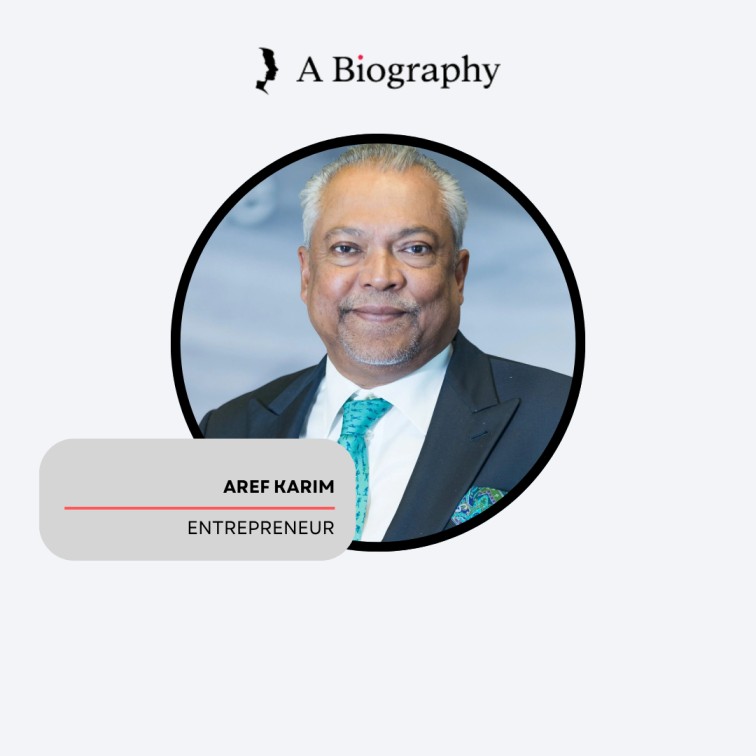
“It’s better to avoid excessive variables. The more variable indicators you add, the more things can go wrong.”
— Aref Karim
Introduction (1971–2026)
Imagine a scene. A turbulent afternoon in 1971. Karachi Airport. Chaos, panic, crowds of people everywhere. Genocide is raging in East Pakistan, a bloody liberation war. Loved ones are left behind, the country is burning, the future is uncertain.
A young man stands there. Only 18 years old. In his hand, just a one-way ticket. Destination: London. No money in his pocket, no known address. As the plane takes off, he does not know — that this journey will take him from managing billions in Abu Dhabi’s oil wealth to becoming the founder of one of Europe’s most successful hedge funds.
His name is Aref Karim.
As we write his biography in 2026, Aref Karim is still alive. At 73 years old, he remains active. His story has already reached legendary status — where a refugee teenager from 1971 becomes one of Britain’s most respected hedge fund managers, the founder and principal of Quality Capital Management (QCM).
When you hear his voice, it feels as if a British classical actor is speaking — calm, confident, authoritative. But behind that refined English accent lies the story of the bloody Liberation War of 1971, a life of struggle and loss. He has said: “Initially I hated the work of an articled clerk.” But that hatred drove him toward something greater.
And the most poignant chapter of this story is from 1992, when the untimely death of his wife left him alone with three young children. From that void, he built an empire — as if to prove that the seeds of the greatest success are sown in the deepest crisis.
In this epic of 28 chapters, we will walk that path — where a son of East Bengal journeyed to Karachi, London, Abu Dhabi; where he rose from the lowest rung of an accounting firm to the senior investment manager position of the world’s largest sovereign wealth fund; and where, emerging from the smoke of personal tragedy, he built one of Europe’s most successful hedge funds — the unique life story of Aref Karim.
Let us dive into that story — where a refugee teenager from 1971 today stands as a pride of one country and a member of another’s elite establishment.
At a Glance — Life of Aref Karim
| Information | Details | Contextual Note |
| Name | Aref Karim | Bengali: আরেফ করিম |
| Profession | Hedge Fund Manager, Commodity Trading Advisor, Chartered Accountant, Founder, CEO & CIO of QCM | Accountant and investment strategist rolled into one |
| Date of Birth | February 7, 1953 | Aquarius zodiac |
| Birthplace | East Bengal, Pakistan (present-day Bangladesh) | Pre-independence Bangladesh |
| Current Age | 73 years (as of 2026) | Active career continues |
| Nationality | Bangladeshi | By birth |
| Citizenship | British | Through naturalization |
| Education | American Missionary School → American College (English & Economics) → Bachelor’s degree from Karachi (Physics, Chemistry, Mathematics) → Chartered Accountant, UK (1978) | A scientist’s mind, an accountant’s profession, an artist’s heart |
| Family | Youngest of 10 siblings (3 brothers, 6 sisters) | The youngest — everyone’s love and protection |
| Father | British-era government official — top position in Bengal Government (until 1947) | Legacy of excellent education from pre-independence times |
| Children | Three | Wife passed away in 1992 |
| Residence | Weybridge, Surrey, England | House named ‘Nirala’ — a Bengali name |
| Firm | Quality Capital Management (QCM) | Founded: December 1995 |
| Title | Founder, Chief Executive Officer (CEO) & Chief Investment Officer (CIO) | Helmsman of his own ship |
| Fame | Pioneer in managed futures sector; proponent of systematic global macro strategy | Inventor of the ‘indicator elimination’ method |
| Active Years | 1982–present | 40+ years of a rich career |
Early Life (1953–1971)
February 7, 1953. Then East Bengal — which would later become East Pakistan and finally independent Bangladesh — Aref Karim was born.
His father was an officer in the British Indian Civil Service, holding a top position in the Bengal Government until the 1947 partition. What could be the future of a child raised within the framework of that governance system? Perhaps following in his father’s footsteps into bureaucracy would have been the easy path.
But Aref’s father had a different dream. Every one of his ten children must attend university. He believed there was no alternative to education.
He wanted Aref to join the foreign service — he saw potential in him as a foreign ministry official or ambassador. With that goal in mind, Aref began his educational journey.
With three brothers and six sisters, Aref was the youngest of ten children. From that position came a special advantage — a circle of everyone’s love, affection, and protection.
His elder sisters would shield him. His brothers encouraged him in his studies. This bond later helped him build a supportive network.
As a child, his education began at a private American missionary school. From there, he enrolled in an American college, choosing English literature and economics as his subjects.
Interestingly, after completing his primary schooling and college education, at the bachelor’s level he studied physics, chemistry, and mathematics. A science student with a deep appreciation for English literature — this duality later served him well in creating a systematic macro strategy.
The family moved to Karachi. There he began his post-graduate studies. But he would not get the chance to finish. Because a horrific chapter of history was waiting.
When Bangladesh’s Liberation War began in March 1971, universities in Karachi closed. Aref was then in his first year of post-graduate studies. He found himself stranded in an unfamiliar city, Karachi.
In the midst of the country’s turmoil, an opportunity suddenly arose. Someone — perhaps a relative or a well-wisher — arranged a ticket to the West. Aref seized the initiative. He did not think, did not look back.
When the London-bound plane departed, he had only a one-way ticket. No relatives at the airport. No friends. No shelter arranged in advance.
Fleeing a war-torn country, he arrived in the capital of a foreign land. It was like stepping into a dark tunnel. He did not know then that the grief of losing his wife would later plunge him back into that deep loneliness. But that would come much later.
But who knows when the wheel of fortune will turn. This flight gave him the opportunity that later took him to the top.
Education (1971–1978)
After arriving in London, he began searching for his first job. Extreme financial hardship and instability. But Aref knew that only education could change his path.
He received little support from his family. He forged his own path alone. Becoming a Chartered Accountant was his first major success.
In 1978, he qualified as a Chartered Accountant in the United Kingdom.
He was also elected a Fellow of the Institute of Chartered Accountants in England and Wales (ICAEW).
This Chartered Accountancy degree was the foundation of his second life. Alongside, his bachelor’s degree in physics, chemistry, and mathematics provided analytical nourishment.
His love for English literature and the discipline of science — the blend of these two made him an extraordinary macro investor.
Professionally, he is an accountant — who wields a pen over ledgers of numbers. On the other hand, he is a fan of poetry, literature, art, and opera. This person of two contradictory characters created a unique systematic method where emotion is not primary, but method and discipline are.
In an interview, he said: “I believe investing is an art and a science. Otherwise every rocket scientist would be a successful hedge fund manager — but we’ve seen many of them fail. What’s needed is creativity, perseverance, and discipline.”
Struggles & Adversities (1971–1992)
The first days in London were brutal. No friends. No acquaintances. An unfamiliar country, unfamiliar weather. Understanding Western values was difficult for him.
When he left, he did not know that the pain of losing his wife would later return him to that deep loneliness. But that would come much later.
He initially took a job as an articled clerk. That difficult work almost left him disillusioned. In his own words: “Initially I hated it.” But he kept fighting. He received mental support from his siblings. During those hard times, he decided to build his own future alone.
After working as a senior audit manager in public practice in London for several years, his sister in Abu Dhabi invited him to come.
In 1982, he joined the Abu Dhabi Investment Authority (ADIA) as a Finance Manager on a two-year contract.
ADIA is one of the world’s largest sovereign wealth funds. There he rose to the position of Senior Investment Manager. He was given responsibility for an Alternative Investment department — a very new practice at that time.
He launched a dedicated department for investing in futures and derivatives markets. When the gold market became volatile, he questioned: “Should we move away from a single asset like gold and invest in more alpha-generating sources?” The answer was ‘yes’, and from there began the journey into managed futures and hedge funds.
He was responsible for billions of dollars. A two-year contract became four, four became six, and finally thirteen years!
The year 1992. Just a few years before establishing his business. Aref was then working at ADIA. Life was happy with his wife and three children.
But unexpectedly, his wife passed away. Everything changed in an instant.
A husband had to take responsibility for three children alone — the eldest still very young. Managing the mental stress of that time alongside the demands of a career was a difficult struggle.
But he proved how great a person can become in crisis. Swallowing tears, teaching his children late into the night, staying busy with work during the day — he covered the depths of that emptiness with a cloak of professional success.
This crisis made him tougher, even in the world of investment. He knew that nothing could be built without discipline and mental stability. He carried the imprint of the instability of the country he had left behind throughout his life.
Love & Married Life (Private)
Information about Aref Karim’s love life or romantic relationships has not been widely reported in the media. What is known is that his marital relationship was normal and sweet. He became the father of three children as a devoted husband.
Unfortunately, that relationship was cut short by his wife’s untimely death in 1992.
No information about a subsequent partner has been found. Perhaps the wound was so deep that he never remarried. Instead, he dedicated himself to raising his children and fulfilling the vow to take his QCM to the world stage.
His affection and sense of responsibility toward his children are evident — he settled in Weybridge primarily to educate his children there. This single father gave utmost attention to the education and culture of his three children.
Personal Life
Today, he resides in Weybridge, Surrey. His house is known as ‘Nirala’ — a Bengali word meaning ‘distinct’ or ‘unique’. He moved to Weybridge, in part, to educate his children there.
Even as a British citizen, he named his home with a Bengali word — indicating that his connection to his Bengali roots remains undimmed.
Outside his professional life, he is a multi-faceted personality. He has a deep reading habit. He is a fan of travel, sports, art, and opera.
Described as tall, confident, with an authoritative personality — such descriptions appear in interviews. His voice has been compared to that of James Mason — the famous British actor’s deep and mesmerizing voice.
He is a Chartered Accountant by profession, but interested in the arts and literature. This duality establishes him as a complete and thoughtful individual.
Future Plans & Vision
QCM is already an established name. What are Aref Karim’s next goals?
He has never stated them clearly himself. But from the business structure, it can be inferred: he wants to grow larger, but in a disciplined and institutional manner.
In a 2011 interview, he acknowledged, “QCM has the potential to grow from
$1 billion to
$1billionto$4-5 billion.” At that time, they managed $900 million in assets.
In the same interview, he said: “I want to keep my interest intact in what I do, to continue working with the research team. Bringing good results for investors is an indescribable joy.”
In recent years, QCM has rebranded its product as the ‘Systematic Macro Program’ (SMP). This indicates his philosophy — that methods and processes must be refined and updated according to the needs of the time.
Even as a British citizen, he has never forgotten his Bengali roots. What role he might play in Bangladesh’s journey during the global economic uncertainty of 2024-25 — only the future will tell.
Career (1978–Present)
Arriving in London, he started as an articled clerk. By 1978, he had qualified as a Chartered Accountant.
For the next several years, he worked as a senior audit manager in public practice in London. The strict rules of accounting shaped him into a disciplined person.
In 1982 came a crucial turning point. His sister lived in Abu Dhabi. She invited Aref to come to the United Arab Emirates.
The standard contract was for two years. He stayed for thirteen!
At ADIA, he rose to Senior Investment Manager. He was in charge of ADIA’s Alternative Investment department. The primary purpose of this department was to manage a fund-of-hedge-funds, a very new practice at that time.
He launched a dedicated department for investing in futures and derivatives markets.
When the gold market became volatile, he raised the question: “The question was — should we move away from a single asset like gold and invest in more alpha-generating sources?” The answer was ‘yes’, and from there began the journey into managed futures and hedge funds.
In May 1995, he left ADIA. Four months later — in September — he decided to establish his own hedge fund. He transitioned from ‘buying’ (allocating capital) to ‘selling’ (fund management).
In December 1995, in Weybridge, Surrey, near London, he established Quality Capital Management (QCM).
In the beginning, the fund was composed of family and friends. He started managing assets with his own money and investments from relatives. The strategy was systematic global macro — they did not decide which stocks to buy, but rather took futures positions on various asset classes based on strong indicators.
From its founding through its second decade, QCM had negative returns in only two years. The rest of the time, they consistently delivered positive results.
In a 2011 interview, he stated that QCM was then managing approximately $900 million in assets.
During the 2008 global financial crisis, when hedge funds and financial institutions worldwide were collapsing — Lehman Brothers bankrupt, AIG gasping for survival — QCM made a profit of 59 percent that year. Against 49.3 million pounds in sales, profit was 42.9 million pounds.
When everyone was disoriented, Aref’s systematic approach proved that a well-designed system can survive even a crisis.
The fund attracts investors not just from Bangladesh or the UK, but from around the world. It is registered with the US Commodity Futures Trading Commission (CFTC) and the National Futures Association (NFA).
Travels & Diverse Experiences
Aref Karim’s life has touched various countries and cultures. Born in East Pakistan, educated in Karachi, professional life in London, legendary service in Abu Dhabi, finally his own firm in England.
This diversity has given him a global perspective. This perspective is essential for macro-economic trading.
His interest in travel and culture provides him with enjoyment — he is interested in art, opera, and sports.
He believes that to understand differences, one must travel and experience them. His international investment experience at ADIA gave him a deep understanding of the global economy, reflected in QCM’s systematic model.
Failures & Teachable Moments
His biggest personal disaster was his wife’s death. The pain of a family breaking apart. The uncertainty of raising three children alone. But he managed that crisis.
Professionally, QCM has had very few years of negative returns. After the success of 2008, there have been challenges. Competition has increased. Regulations have changed. But QCM still survives and thrives.
The teachable moments are:
- Crisis is never final — he bounced back after being a refugee in 1971, and did not stop even after losing his wife.
- Avoid complexity, embrace simplicity — ‘It’s better to avoid excessive variables’ — this philosophy is the key to his business success.
- There is no substitute for discipline and patience — the patience to work at the same institution for 13 years at ADIA helped him build the foundation for QCM.
Source of Inspiration
Aref Karim’s sources of inspiration are:
- His Father: who educated ten children at university and taught the importance of education. From his father, he received the mindset of prioritizing education above all.
- His Sister: who invited him to Abu Dhabi, opening the door to ADIA. That invitation brought him a new life.
- Relatives and Friends: whose financial support helped launch QCM. The early investors were his close ones.
- His own mindset of overcoming adversity: The refugee life of 1971 taught him how to start from zero. The pain of losing his wife made him tougher and more determined.
Rather than relying on luck, he has trusted his own hard work and skill.
Influences & Inspirations
Aref Karim can be called a visionary in the managed futures industry. He pioneered the modern alternative investment department at ADIA.
His systematic global macro strategy is an ideal for many institutions. Particularly the ‘indicator elimination’ method — removing indirect indicators from the model — is an innovative idea that makes him unique.
He has spread the message ‘Simplicity is Beauty’ in the investment world.
His influence is especially deep in the institutional investment circles of the UK and Europe. Laying the foundation for the alternative investment department of an institution like ADIA is one of his greatest legacies.
In the context of Bangladesh, his story is not yet widely known, but he is gradually becoming respected among expatriate Bangladeshi entrepreneurs.
Philosophical Views & Beliefs
His investment philosophy aligns with his personal life: discipline, patience, and avoiding complexity.
Core beliefs:
- Excessive optimization is harmful: Models should not be ‘fitted’ to specific past data. They must be robust over the long term.
- Fundamental macro intuition: Systems must adhere to economic logic. He firmly believes that economic knowledge is essential for identifying trends in markets.
- Discipline and objectivity: Not emotion, but method. In his words: “What we do is completely systematic. No emotional decisions go there.”
- Long-term focus: Not getting swept away by market volatility, but focusing on long-term wealth creation.
The combination of his backgrounds as an accountant and a scientist has made him a realist and a strict follower of hard facts.
Unique Traits
Some special aspects of Aref Karim’s personality:
Extraordinary realism: He speaks extremely simply and realistically. His analysis is never poetic, but based on data and numbers.
Man of few words: Not seen much in the media, but when he speaks, he says something important. His single interview created a stir in analyst circles.
Patient and steady: Even in the crisis of losing his wife, he did not become unstable, but moved forward with both family and business in a disciplined manner.
Multi-faceted interests: Skilled in art, opera, reading, sports. The rich life he leads outside the professional world keeps him balanced.
Connection to Bengal: His love for Bengali language and culture remains intact. Although he has lived abroad his entire life, his home is named ‘Nirala’ — a piece of Bengal in the country where he built his nest.
Skilled user of information technology: He has used deep knowledge of computer programming and mathematical modeling to create QCM’s systematic model.
Contributions, Awards & Achievements
| Achievement | Details |
| Pioneer of Alternative Investment Department at ADIA | Determined strategy for a billion-dollar portfolio, which later became a model for the investment strategies of oil-rich nations |
| Founded QCM, December 1995 | Consistent success for over 20 years |
| 59% return during the 2008 crisis | Earned a place among the world’s best hedge funds — that year, many lost up to 50% in the market downturn |
| Grew to billions in assets under management | Earned the trust of institutional investors |
| Popularized systematic global macro strategy | Invented the ‘indicator elimination’ method — now followed by many |
| Early proponent of fund-of-hedge-funds strategy | An extremely innovative initiative at the time, taking ADIA to new heights |
Awards and Nominations
In January 2015, he was nominated in the ‘Businessman of the Year’ category at the British Muslim Awards.
Though he does not have a high-profile award like Yunus’s Nobel, he is highly respected in the investment world of the City of London. His firm QCM is registered with the UK’s Financial Conduct Authority (FCA) and the US Commodity Futures Trading Commission (CFTC) — a significant recognition.
Controversies
No major controversies or scandals involving Aref Karim have appeared in the media. QCM has not faced investigation by regulators. His conservative and impeccable approach has likely kept him out of controversy.
One possible reason: QCM has always maintained a ‘bootstrapped’ culture — growing slowly without excessive marketing.
He never applied for high office or government jobs, but built his own path. This self-reliance and ethical business approach have kept him controversy-free.
With no public controversies, his image in the corporate world is extremely clean and respected.
Contemporary Opinions & Interviews
Direct opinions from Aref Karim’s colleagues are limited online. However, one interview-based report described him as ‘tall, with an authoritative personality and the voice of James Mason’.
In a 2011 report in The National (UAE), he was called the manager of ‘a small but perfectly formed fund’.
Another report stated: “QCM is interested in sharing their ‘asset management spirit’ with their Chinese CTA.”
When he speaks, he is calm and confident. Every word seems carefully chosen.
Not much has been written about him in the Bangladeshi media, but in the Bangladeshi community in the City of London, he is an inspiration. For expatriate Bengalis, he is the epitome of a successful entrepreneur.
Myths & Misconceptions
| Myth | Truth |
| Aref Karim lives in Bangladesh now | He is a British citizen, living and doing business there. His home ‘Nirala’ in Weybridge, Surrey |
| He has no children | He is the father of three children. After his wife died, he raised them alone |
| QCM is only open to the wealthy | Its clients are institutional investors, family offices, and high-net-worth individuals |
| The 2008 profit came from risky trading | It was the result of a well-structured systematic model with extremely strict risk management |
| Aref Karim wanted to be a government officer like his father | His father’s wish was for him to join the foreign service — he wanted to be a foreign ministry official or ambassador |
| He is just the owner of one company | Besides QCM, he served in a senior role at ADIA and is a Fellow of the ICAEW |
| He studied at Cambridge or Oxford | Though he didn’t get the opportunity to study at a top UK university, his Chartered Accountancy degree and experience were sufficient |
Quotes & Thoughts
Selected quotes from various interviews and speeches:
- “I don’t believe in too many moving parts — because I think that’s a lot of smoke without fire.”
- “The propensity to buy is much stronger than the propensity to sell, and it always creates a kind of handicap on the long side.”
- “Technology, the power of the computer, the ability to go down to short timeframes have increased the degree of sophistication multifold.”
- “But it’s better to avoid excessive variables. The more variable indicators you add, the more things can go wrong.”
- “I want to keep my interest intact in what I do, to continue working with the research team. Bringing good results for investors is an indescribable joy.”
- “My primary profession was chartered accountancy, but I always wanted to build a career in the investment world.”
- “Investing is an art and a science. Otherwise every rocket scientist would be a successful hedge fund manager — but we’ve seen many of them fail. What’s needed is creativity, perseverance, and discipline.”
- “If the system is good, good results follow. Simplicity always triumphs over complexity.”
Message for the Present Generation
Aref Karim has not directly addressed the younger generation through speeches. His life philosophy can be learned from his actions and words:
- Perseverance is the only path: From being a refugee in 1971 to his current position required a unique combination of hard work and patience. Even when obstacles keep coming, one must not stop.
- Avoid complexity: Do not fall into the trap of countless indicators, models, and strategies. Simple and robust systems survive long-term. He says, “It’s better to avoid excessive variables.”
- Understand the importance of education: Without his background in Chartered Accountancy and science, his strategy would not be understood. True education is complete when book learning transforms into practical workplace skills.
- Handle loss and difficult times: The pain of losing a wife, the loneliness of being alone abroad — instead of using these crises against himself, he looked forward and strengthened his profession — that is the key to his success.
- Make risk management the first priority: Whether in investment or life, risk cannot be completely avoided, but it can be managed by understanding and measuring it. QCM’s bottom-up risk assessment is an example.
- Do not forget your roots: Even as a British citizen, he named his home ‘Nirala’ — indicating that an expatriate can carry the memory of their country in their heart.
- There is no substitute for discipline: His life shows that strict discipline and punctuality can make the impossible possible.
Death & Legacy
As of February 2026, Aref Karim is alive. At 73 years old, he remains active. QCM continues to carry his philosophy.
As founder and CEO, he remains actively engaged in research on the company’s fundamental structure and strategy. Though he has reached the age of 73, his activity in the professional world and the firm’s operations suggest he has not fully retired.
But the firm he built, the philosophy he created, the systematic method he developed — these will survive for many years after his death. Particularly the ‘indicator elimination’ and ‘minimal optimization’ principles are now extremely important to young quantitative analysts.
For Bangladesh, he is a name of pride. Despite being Bangladeshi by birth, he has not received any institutional or state recognition from Bangladesh. But the memory of Bangladesh is his forever, and the global hedge fund industry knows him — as a successful Bengali entrepreneur.
The department he built at ADIA still exists and serves as a model for sovereign wealth funds worldwide.
Successors & Lasting Impact
He has built a strong team and research department to manage QCM. Whether a successor has been nominated is not publicly known. But as a founder, his contribution is already firmly embedded in the company’s structure.
He did not just manage a fund; he created a school of thought. Particularly, he made the concepts of ‘managed futures’ and ‘systematic trading’ more sustainable and credible.
His influence is especially deep in the institutional investment circles of the UK and Europe. Laying the foundation for the alternative investment department of an institution like ADIA is one of his greatest legacies.
Investors in the City of London still consider QCM as an example of the ‘gold standard’.
Unknown Facts
- Real name and surname: The world knows him as ‘Aref Karim’. No direct middle name. His full name would be Aref Karim, but this is not confirmed.
- Voice praised: He is said to have the ‘voice of James Mason’ — as charming and authoritative as the British actor. This voice creates the first impression of his presence.
- Story of leaving Bangladesh: He left his post-graduate studies unfinished and took a one-way ticket to London. He had no plan to return. Standing at the airport, he did not realize it was a life-altering decision.
- Unusually long tenure at ADIA: The average contract was two years; he stayed thirteen! This is rare in ADIA’s history. He was asked to return many times, but he chose his own path.
- Waiting for recognition: He has not yet received any state-level recognition in Bangladesh — no Ekushey Padak or Independence Day Award. However, he has been mentioned in the domestic media on a personal level.
- No personal website: QCM’s site is updated regularly, but he has no personal website. He is not very public officially.
- Reading habit: He reads extensively, especially history, economics, and technology. This reading habit is a major reason for his analytical skill. His ability to simplify complex investment concepts comes from this habit.
- Cricket fan: Among sports, he has an interest in cricket. He particularly follows the Ashes series between England and Australia.
- Fluent in Bengali: Though he speaks English in interviews, he can understand and speak Bengali — though not in daily use. His house name ‘Nirala’ is proof of his love for Bengali.
- Tough calculations: In his youth, he wanted to study aerospace engineering for some time, but that never materialized.
Timeline — Key Events (1953–2026)
| Year | Event | Contextual Note |
| 1953 | February 7 — Born in East Bengal | Present-day Bangladesh |
| 1971 | Bangladesh Liberation War; left Karachi for London | One-way ticket — the biggest decision of his life |
| 1978 | Qualified as a Chartered Accountant in the UK | Elected Fellow of ICAEW — fruit of long struggle |
| 1978-1982 | Senior Audit Manager in public practice in London | Beginning of professional life — strict discipline of accounting |
| 1982 | Joined Abu Dhabi Investment Authority (ADIA) | 2-year contract became 13 — a decisive turn of fate |
| 1982-1995 | Managed billion-dollar portfolio at ADIA | Senior Investment Manager position |
| 1992 | Wife’s death | Single father of three children — personal tragedy |
| 1995 | Left ADIA in May; founded QCM in December | Transition from ‘buying’ to ‘selling’ — built his own path |
| 2008 | QCM achieved 59% profit during global financial crisis | Feat of surviving a market crash — place among top hedge funds |
| 2011 | QCM managing approximately $900 million in assets | On the verge of touching a billion — new heights of success |
| 2015 | Nominated at ‘British Muslim Awards’ | Businessman of the Year category — international recognition |
| 2021 | QCM rebrands its product as ‘Systematic Macro Program (SMP)’ | New approach — keeping pace with technology |
| 2026 | Present — alive and active | Recognized name in institutional investment world |
Conclusion
Aref Karim’s story is an inspiration — where a refugee teenager from 1971 became one of the world’s most respected hedge fund managers. No one has ever seen him on television shows chasing popularity. He is a man who simply works in silence. Who believes that avoiding complexity, discipline, and following trends are the real mantras.
His life teaches that just as investment is needed, so is trust in one’s own talent. The courage to stand firm in the face of adversity. As a single father of three children, he proved that with proper prioritization, everything can be managed.
A refugee and displaced person, today he is among the elite of Britain. His house named ‘Nirala’ — that Bengali name reminds him where he came from, how far he has come.
He is a pride of Bangladesh. Though the people of his country may not know him well, the global hedge fund industry knows — there is a QCM, and behind it is that person who, emerging from the dark nights of 1971, is today a bright star in the world economy.
His philosophy, his systematic method, his honesty and discipline — in all, he is a proud son of Bengal, whose name makes the City of London pause for a moment. The teenager who left with just a one-way ticket in 1971 is today an invaluable asset in the City of London.
References
This biography is based on the following reliable sources:
- Wikipedia – Aref Karim (retrieved 2026)
- Zonebourse – Aref Karim executive profile
- UK Government Companies House – Quality Capital Management Limited officer listing
- LinkedIn – Quality Capital Management (QCM)
- The Investors Podcast Network – Episode 29
- The National (UAE) – “A Small But Perfectly Formed Fund” (November 27, 2011)
- DBPedia – Aref Karim
- Zonebourse – Quality Capital Management Limited company profile
- Futures Daily (China) – (June 30, 2014)
- Institute of Chartered Accountants in England and Wales (ICAEW) Fellow listing
- UK Financial Conduct Authority (FCA) Register
Disclaimer
This biography has been written for academic and inspirational purposes. Information has been compiled based on multiple reliable sources — Wikipedia, news reports, business publications, and interviews.
Aref Karim is still alive, so some information may change over time. The life and work described here are based on various interviews, reports, websites, and government registrations.
The current size of assets and funds was not available from professional sources. The interviews and sources were accurate at the time but may not be updated now. This report is not investment advice and is written solely for the purpose of presenting biographical information.
Efforts have been made to verify the accuracy of the information, yet no biography in the world is completely error-free. The author cannot be held responsible for any errors. Readers are encouraged to conduct their own verification.
This biography is dedicated wishing Aref Karim good health and long life. As he is still alive, this writing is an effort to commemorate his glorious life while living — not a departed soul.
The End
“Simplicity is the best method. It is wise to avoid excessive complexity.”
— Aref Karim
From the soil of East Bengal to Karachi, from Karachi to London, from London to Abu Dhabi, and back to London — Aref Karim’s journey is not just geographical; it is a journey of mental and professional evolution. He has proved that where you come from is not important; what matters is where you want to go and what you are prepared to do to get there.
The teenager who set foot in London empty-handed is today one of the world’s most respected hedge fund managers. QCM is not just a business — it is the physical manifestation of Aref Karim’s philosophy, where complexity has been transformed into simplicity.
He has proved that a Bengali can be the best in any field, if given the opportunity. Whether a refugee during the Liberation War of 1971 or an elite investor in the City of London in 2026 — Aref Karim bridges those two worlds.

