
Biography
A Biography of Muhammad Yunus

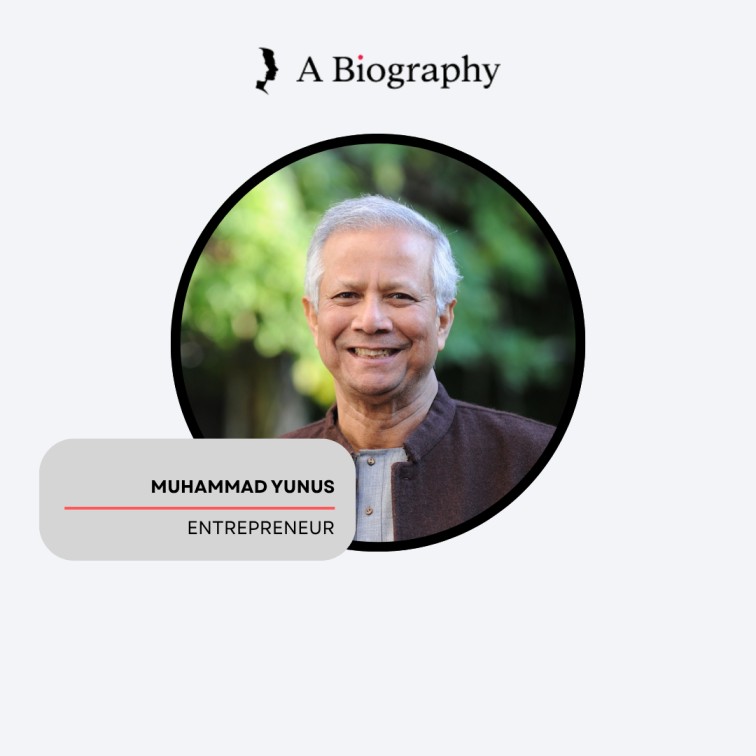
“People are not born to suffer from poverty. Poverty is created by the system. And the system can be changed.”
— Professor Muhammad Yunus
Introduction
Imagine a village path. The year is 1974, during a devastating famine. Dr. Muhammad Yunus, the Chairman of the Economics Department at Chittagong University, is walking along the path to Jobra village. All around him are emaciated people. Corpses lie on the road, victims of starvation. Children cry from hunger. Mothers have nothing to give.
Yunus’s profession is ‘economics’ — whose core subject is ‘meeting unlimited demand with limited resources.’ But here, there are no resources at all.
Walking that path, he stops. A woman is making bamboo stools — Sufia Begum. Yunus asks her, “Sister, how much do you earn per day?”
The answer comes: “Two poisha.”
Yunus’s eyes widen. Only two poisha for a whole day’s labor? There is no profit — rather, a loss. Why? Because she has no money to buy bamboo. If she borrows, the interest is so high that all her income goes into the pocket of the moneylender.
Sufia Begum is not alone. She represents millions of women.
From his own pocket, Yunus gives 27 taka to 42 women, including Sufia Begum. Those 27 taka changed the history of the world.
Then came 1976. He launched a pilot project — the Grameen Bank project. The banks laughed at him. “Loans without collateral? That’s impossible!”
But Yunus did not stop. He applied to bank after bank. Finally, Janata Bank agreed to lend him 10,000 taka — on condition that he would be the guarantor.
October 2, 1983. A historic day. The Government of Bangladesh recognized Grameen Bank as a full-fledged bank. That bank has since proved — poverty is never due to people’s incapability, but due to the failure of the system.
In 2006 came the Nobel Peace Prize. The Norwegian Nobel Committee declared: “Lasting peace cannot be achieved unless large population groups find ways to break out of poverty.”
Then came August 2024. After a bloody student movement, Sheikh Hasina left the country. The army chief called the 84-year-old Yunus. A civil society leader, a social entrepreneur — he became the Chief Adviser of Bangladesh.
Upon assuming office, he said: “I have been brought back because of the courage of ordinary students. They have brought a second independence to Bangladesh.”
A life story — each chapter teaching courage, dedication, and the urgency of undying humanity.
In this epic of 28 chapters, we will walk that path — where a Sufi’s son from Hathazari became a world-renowned Nobel laureate, where a new philosophy of poverty alleviation was built beyond the calculations of banks, and where an economics professor took on the responsibility of a nation of 170 million people.
Let us dive into the immortal story of Muhammad Yunus’s unique life — where an epic began with just 27 taka.
At a Glance — Life of Professor Muhammad Yunus
| Topic | Details | Contextual Note |
| Name | Professor Muhammad Yunus | ‘Father of Microcredit’ |
| Date of Birth | June 28, 1940 | On the eve of World War II |
| Birthplace | Bathua Village, Hathazari, Chittagong | Then Bengal Presidency, British India |
| Nationality | Bangladeshi | Supporter of the Liberation War of 1971 |
| Profession | Nobel Peace Prize laureate, social entrepreneur, banker, economist, Chairman (Yunus Centre), founder of Grameen Bank, former Chief Adviser of Bangladesh (2024-2026) | Social reformer and economics professor rolled into one |
| Religion | Islam | Son of a Sufi father |
| Title / Fame | ‘Father of Microcredit’, ‘Banker to the Poor’ | Revolutionary of the third sector |
| Education | University of Dhaka (BA, MA), Vanderbilt University, USA (PhD) | Fulbright and Vanderbilt Fellow |
| Father | Haji Dula Mia Shoudagar | Goldsmith and Sufi |
| Mother | Sufia Khatun | Charitable woman |
| Spouse | Vera Forostenko (m. 1970; div. 1979); Afrozi Yunus (m. 1983) | Vera: daughter of Russian immigrants; Afrozi: physics professor |
| Children | Monica Yunus (New York-based opera singer); Deena Yunus | Father of two daughters |
| Notable Brother | Muhammad Ibrahim (former professor at Dhaka University, founder of CMES) | Equally active in social and educational reform |
| Institutions & Contributions | Grameen Bank, microcredit concept, social business concept | Models for sustainable development |
| Positions Held | Chancellor, Glasgow Caledonian University (2012-2018); Chief Adviser, Interim Government of Bangladesh (2024-2026) | International academic and statesman |
| Major Awards | Ramon Magsaysay Award (1984), Independence Day Award (1987), World Food Prize (1994), Gandhi Peace Prize (2000), Nobel Peace Prize (2006), Presidential Medal of Freedom (2009), Congressional Gold Medal (2010), Olympic Laurel (2021) | Multiple state and international recognitions |
| Books | Banker to the Poor (1999), Creating a World Without Poverty (2007), A World of Three Zeros (2017) | Translated into more than 60 languages |
Early Life (1940–1957)
June 28, 1940. Bathua village, Hathazari upazila, Chittagong district, British India. World War II was at its peak. The hum of bomber planes in the sky, panic on the ground. In this turbulent time, a son was born to Haji Dula Mia Shoudagar and Sufia Khatun. Their third child. He was named Muhammad Yunus.
‘Yunus’ is an Arabic word — ‘warrior’ or ‘young’. As if to signal — this child would one day become a warrior against hunger.
His father, Haji Dula Mia Shoudagar, was a goldsmith. A small businessman by profession, but a great mystic at heart. He was a Sufi. He carried the message of peace and spirituality in the family.
As a child, Yunus would see — his father spoke little but worked much. He would donate most of his earnings. Once, he told Yunus: “More important than being rich is being charitable. Money will come and go, but the opportunity to put a smile on people’s faces is not always there.”
His father’s ideals became etched in Yunus’s mind. Later, the ‘social business’ philosophy was rooted in this Sufi teaching — business should be for the welfare of people, not just for profit.
His mother, Sufia Khatun, was of a different nature. Charity seemed to run in her blood. In Yunus’s childhood memories, poor neighbors would knock at the door. Mother never turned them away. A handful of rice, some money, or words of comfort — whatever she could give, she gave.
Once, Yunus asked his mother, “We give as much as we can. Why don’t others give?”
His mother smiled and said: “You don’t need to be well-off to give. You only need a generous heart. Remember this, Yunus.”
This generosity of heart later became the foundation of Yunus’s ‘social business’ model.
In 1949, when Yunus was only nine years old, a terrible darkness descended on the family. His mother, Sufia Khatun, was diagnosed with a mental illness. Day by day, she became more withdrawn.
Little Yunus cared for his mother. At that age, he learned compassion and patience. This experience made him grow up a little different from others.
Once, when a doctor came to treat his mother, young Yunus gathered dust from the doctor’s feet and offered it to him — believing that foot dust could cure illness. This innocent belief was for alleviating his mother’s mental suffering. Later in life, he showed that same pure love in serving the poor.
Among Yunus’s siblings, he was the third child. His elder brothers and sisters loved him. His younger siblings grew up watching him.
The most notable among his siblings is Dr. Muhammad Ibrahim — he was a professor at Dhaka University and founded the Centre for Mass Education in Science (CMES), which empowers adolescent girls through science education.
Another brother, Muhammad Jahangir, is a television host, social worker, and also involved in arts and culture.
His sisters were homemakers and social workers. Though their paths differed, the two brothers’ goal was the same: to change society.
At just four years of age, Yunus moved with his family to Chittagong city. He enrolled in Kattali Government Primary School. Later, he attended Chittagong Collegiate School.
His rank on the merit list of that school was 16th — out of 39,000 students in East Pakistan. Alongside his studies, he had a strong passion for scouting.
In 1952, as a scout member, he traveled to West Pakistan and India. In 1955, he attended a jamboree in Canada. That eagerness to see the world prepared him for the future.
While studying at Chittagong College, he participated in plays and even won prizes. He also had an interest in music. But he chose economics, dreaming of a different future.
He enrolled in the Economics Department at the University of Dhaka in 1957.
Education (1957–1969)
In 1957, Yunus enrolled in the Economics Department at the University of Dhaka. At that time, Dhaka University was one of the finest institutions in the subcontinent.
He earned his BA degree in 1960. In 1961, he earned his MA — in the first class.
Among his teachers at Dhaka University were legendary economists. They taught him economic theories — but he was searching for something beyond the classroom.
After completing his bachelor’s, Yunus joined Chittagong College as a lecturer in economics. Alongside, he set up a packaging factory.
At that time, being an entrepreneur was not at all common for the educated Bengali middle class. This venture gave Yunus unique experience in understanding the financial models of poverty alleviation.
In 1965 came the opportunity — he received a Fulbright Fellowship to study in the United States. He enrolled at Vanderbilt University in Nashville, Tennessee.
His research foundation was built under Vanderbilt’s guidance. Alongside Fulbright, he also received a full scholarship from Vanderbilt University.
In 1969, he earned his PhD from Vanderbilt University. His research topic: ‘Economic Development Models’.
Here, he learned how economic growth is possible in third-world countries. The theoretical frameworks still felt dry to him. Real-world application was missing.
After his PhD, he joined Middle Tennessee State University as an Assistant Professor of Economics. A stable job. A comfortable American life.
His plan to return home was not yet clear.
But the Liberation War of 1971 changed all calculations.
Struggles & Adversities (1971–1983)
In March 1971, genocide began in East Pakistan. Yunus was then in Nashville, America.
That night, he saw on television the Pakistani army pouncing on innocent Bengalis. He wept. He did not let his tears dry. He vowed — even if he couldn’t fight in the war, he would stand by his people.
Yunus began lobbying abroad. In New York and Washington, he built public opinion in favor of Bangladesh. From Nashville, he published the ‘Bangladesh Newsletter’. He founded the ‘Bangladesh Information Center’.
Though abroad, his heart was with the struggle for liberation.
After the war ended, Yunus returned to Dhaka. He joined the government’s Planning Commission as a member. Working alongside Nurul Islam and Rehman Sobhan gave him profound insights.
He realized — simply moving levers on paper would not achieve anything. He had to go to the people.
In 1972, he joined Chittagong University as head of the Economics Department. From there, his direct actions for poverty alleviation began.
In 1975, he launched the Nabajug Tebhaga Khamar project. This effort to organize farmers on the ground gave him direct experience.
When the devastating famine struck in 1974, Yunus was walking the path to Jobra village. People were dying of hunger all around him. An economics professor — whose profession was researching poverty — was touching poverty with his own hands.
“This is no longer a classroom case study. This is a real, blazing fire.”
That woman named Sufia Begum was making bamboo stools. Her daily income was only two poisha. Yunus asked her, “Why so little?”
Sufia Begum replied, “I borrowed money to buy bamboo. After paying the interest on that money, what remains is what I get.”
A lightning bolt struck Yunus’s mind. This was not the story of just one woman — it was the story of millions. He calculated — the 42 women of that village had collectively borrowed only 27 taka.
Yunus gave those 27 taka from his own pocket. The women wept — no one had ever done anything so big for them.
It was then that Yunus understood — the problem was not poverty; the problem was the system.
In 1976, he launched a pilot project — covering Jobra village and its surroundings. He named it the ‘Grameen Bank Project’.
At first, the banks laughed at him. “Loans without collateral? That’s impossible!” the bank officials said.
Yunus did not give up. He applied to bank after bank. Finally, Janata Bank agreed to lend him 10,000 taka — on the condition that he himself would be the guarantor.
Local bank officials told him, “Professor, think carefully. These poor people will never repay the loan.”
Yunus’s answer: “I believe they will. They just need a little opportunity.”
And that belief did not prove him wrong. The loan recovery rate was over 98 percent — much higher than any commercial bank.
October 2, 1983. A historic day. The Government of Bangladesh recognized Grameen Bank as a full-fledged bank.
That ‘mad professor’ was now the founder of a bank — a bank whose collateral-free loans have enabled millions to break out of the trap of poverty.
Love & Married Life
While studying at Vanderbilt, Yunus met Vera Forostenko. She was the daughter of Russian immigrant parents. She was pursuing a Master’s in Literature. Vera’s deep thinking and knowledge of Russian literature fascinated Yunus.
Friendship, love, then marriage in 1970.
Their relationship was good. Vera understood Yunus’s ideals. When Yunus returned home in 1972, Vera also came to Bangladesh. The simple environment of Chittagong, the complexities of Yunus’s family, and especially his mother’s mental illness — everything combined to make it difficult for Vera to adjust.
In 1979, Monica Yunus — his first daughter — was born. Hearing the news of his daughter’s birth, Yunus ran from Chittagong to Dhaka.
But cracks had already appeared. Vera believed that Bangladesh did not have a safe or healthy environment to raise a child. On the other hand, Yunus was busy with Grameen Bank — giving little time.
Within a few months, Vera returned to the United States. She raised their daughter Monica there. They legally separated.
In the early 1980s, Yunus met Afrozi Yunus. She was then doing her PhD in Physics at the University of Manchester. Afrozi was intelligent, confident, and straightforward.
They married in 1983. Afrozi returned home and began teaching at Jahangirnagar University.
Their second daughter, Deena Yunus.
Afrozi has been a lifelong supporter of her husband. Especially in 2011, when Yunus was removed from Grameen Bank, Afrozi gave him strength.
Monica Yunus grew up in the United States. She studied at Juilliard School. She is now a featured singer at the Metropolitan Opera in New York City.
At the 2006 Nobel Prize award ceremony, Monica performed the ‘Yunus Song’ at the Oslo Concert Hall — an emotional scene.
Deena Yunus has forged her own path in education and career. Yunus loves both his daughters equally.
Though separated from Vera, he never shirked his responsibility to Monica. He repeatedly traveled to the United States to see his daughter.
In a 2012 interview, Monica said: “My father changed when I was very young, but I never saw him as diminished. I understood the greatness of my father’s work as I grew up. He is my hero.”
Personal Life
Muhammad Yunus is extremely simple and humble in his personal life.
Clothing: Simple shirt and pants. In Bengali attire, he prefers to wear a Punjabi. He wore a traditional Punjabi when receiving the Nobel Prize.
Residence: A simple house in Dhanmondi, Dhaka. No luxury. On the walls hang handmade fans and various gifts from Grameen Bank’s women clients.
Food: Simple Bengali food — rice, lentils, fish, vegetables. He does not dislike meat, but does not eat much.
He wakes up before Fajr every day. He prays and recites the Quran. Light breakfast and tea in the morning. Then a full day of work — meetings, research, writing, speeches.
When in the country, he would go to the village at least once a week to observe projects firsthand. He believes that sitting at a desk cannot change a country.
He does not make a habit of sleeping very late. He calls his children, checks on his siblings.
Yunus is a devout Muslim. He prays and fasts. But he does not like religious bigotry.
He believes — religion is personal, but humanity is universal. Among Grameen Bank’s borrowers are Hindus, Buddhists, and Christians. He made no distinctions. He never imposed any policy in the name of religion.
Travel: Seeing new places, meeting new people.
Music: Likes simple Bengali songs, Rabindra Sangeet.
Cricket: Has an interest in cricket. He played cricket in his student days.
Reading: Economics, history, autobiography.
He does not hesitate to give interviews, but does not like to talk about his personal life. He wants his work to speak for itself.
Once, a journalist asked him, “Why don’t you tell the story of your personal struggles?”
Yunus replied: “I have fought a war against poverty. Telling that story is enough. Readers do not need the thriller of personal suffering.”
Future Plans & Vision (2006–Present)
After winning the Nobel Prize, Yunus declared that he would not keep the prize money for himself. He used that money to establish eye hospitals and food security projects for the poor.
In his book A World of Three Zeros, he wrote that to save the world, three zeros must be achieved:
- Zero Poverty — Eradicating poverty from the world.
- Zero Unemployment — Turning youth into entrepreneurs.
- Zero Net Carbon Emissions — Sustainable environmental development.
He wants to spread the concept of ‘social business’ worldwide. Business can be not for profit — but for solving human problems.
Already, multinational companies like Danone (Yunus Danone), Veolia, and Intel have launched social business models.
When a stalemate developed in Bangladesh’s politics in August 2024, a demand arose from the student movement — to make Yunus the Chief Adviser.
Under pressure from ordinary students and the public, the army chief called Yunus.
Yunus then said: “I never wanted this responsibility. But the students have brought victory through struggle — I stand with them.”
On August 8, 2024, Yunus took oath as Chief Adviser. Under his leadership, Bangladesh regained the confidence of the international community.
After the February 2026 elections, he handed over responsibility. He returned again to research and promoting social business.
Career (1961–2026)
Muhammad Yunus’s career can be divided into several stages:
- 1961-1965: Lecturer in Economics at Chittagong College
- 1965-1969: Fulbright Fellowship for PhD in the United States
- 1969-1971: Assistant Professor at Middle Tennessee State University
- 1972-1976: Head of Economics Department at Chittagong University
During this time, he launched the Nabajug Tebhaga Khamar project (1975).
- 1976: Started pilot project for microcredit in Jobra village
- 1976: Borrowed 10,000 taka from Janata Bank
- 1983: Government recognition of Grameen Bank
- 1980s: Branch expansion, women’s empowerment
- 1990s: Establishment of Grameen Phone and Grameen Telecom
During this time, he received the World Food Prize (1994) and the Gandhi Peace Prize (1998).
- 2006: Nobel Peace Prize
- 2007: Formed political party named ‘Nagarik Shakti’ (later dissolved)
- 2009: Presidential Medal of Freedom (USA)
- 2010: Congressional Gold Medal (USA)
- 2012-2018: Chancellor of Glasgow Caledonian University
- 2011: Removed from Grameen Bank (on grounds of exceeding age limit)
- Faced various lawsuits and investigations
- The international community protested
But Yunus did not give up. Instead, he continued promoting ‘social business’. He was honored on foreign soil.
- August 8, 2024: Yunus took oath as Chief Adviser of Bangladesh’s interim government.
- February 13, 2026: He handed over responsibility after national elections.
Travels & Diverse Experiences (1952–Present)
Yunus’s list of travels is long and extensive:
| Region | Time | Purpose & Learning |
| West Pakistan & India | 1952 | Scout trip — first international experience |
| Canada (Jamboree) | 1955 | Scout jamboree — global networking |
| United States | 1965-1972 | Fulbright Fellowship & PhD — main chapter of education |
| Various European Countries | 1980-2000 | UN and World Bank conferences |
| South America | 2006-2010 | Tours to expand microcredit model |
Yunus’s travel philosophy — see, learn, and apply in your own country. He never believed in blind imitation.
Failures & Teachable Moments
In 2007, Yunus formed a political party called ‘Nagarik Shakti’. Its promises were to eliminate corruption and protect citizens’ rights.
But he could not take to the field. Family pressure, legal complexities, and Bangladesh’s political reality — everything combined meant he could not sustain the party.
Lesson: Politics and social enterprise are not the same. Changing society requires time and patience.
April 3, 2011. News came in the morning — Bangladesh Bank had removed Yunus from the position of Managing Director of Grameen Bank. Reason: exceeding the age limit of 60 years. But Yunus was then 71 years old. Why was this law enforced so many years later?
Yunus reacted: “This is politically motivated. I have been told — you are our enemy.”
This removal was condemned internationally.
Lesson: The intolerance of power can strike at any time. But the path of truth and honesty cannot be abandoned.
Some have questioned the interest rates of Yunus’s microcredit. Grameen Bank’s interest rate is up to 20 percent; other microcredit institutions charge over 30 percent.
Yunus’s response: “Commercial banks have lower interest rates, but they do not lend to the poor. When we charge 20 percent, the village moneylenders were charging 200 percent. Microcredit is still the cheapest option.”
Lesson: One must understand relative advantage. No solution may be perfect, but it can be better than the alternatives.
He would tell students: “Failure is the staircase to success. He who fears failure can never do anything great.”
Source of Inspiration
Muhammad Yunus draws inspiration from five main sources:
- Mother Sufia Khatun — The first lesson in humanity. She never turned away the poor who knocked at the door. The lesson of charity and compassion is the foundation of Yunus’s life.
- Father Haji Dula Mia Shoudagar — The Sufi mystic. He spoke little, but worked much. From him, Yunus learned — not ‘I and me’, but ‘we and us’.
- Bangabandhu Sheikh Mujibur Rahman — The call for independence. ‘The struggle this time is the struggle for independence’ — this call inspired Yunus to lobby for an independent Bangladesh even from the United States.
- The Rural Women — Who gave him proof. The 98 percent loan recovery from them — their trust and belief is Yunus’s greatest inspiration.
- Amartya Sen — Nobel laureate economist. Sen’s ‘Capability Approach’ has influenced Yunus’s philosophy. Poverty is not just a lack of income — it is a lack of opportunity.
He would say: “Inspiration does not come from outside; it comes from within. When I see a woman standing on her own feet, I understand — my work is on the right path.”
Influences & Inspirations
| Name | Identity | Influence on Yunus |
| Mother Sufia Khatun | Charitable woman | First lessons in humanity and compassion |
| Father Haji Dula Mia | Sufi goldsmith | The philosophy of ‘working for people’ |
| Bangabandhu Sheikh Mujibur Rahman | Architect of independence | Lessons in patriotism and sacrifice |
| Amartya Sen | Nobel laureate economist | Inspiration from the ‘Capability Approach’ |
| Muhammad Ibrahim (brother) | Academic & founder of CMES | Brotherhood and competition in social service |
Yunus would say: “I am not a follower of anyone; I have learned from everyone. And by learning, I have forged my own path.”
Philosophical Views & Beliefs
Muhammad Yunus’s philosophy rests on five pillars:
He says: “People are not born to suffer from poverty. Poverty is created by the system. And the system can be changed.”
This is his most profound philosophical statement. He does not accept fate or destiny as excuses.
‘Microcredit is a human right’ — this is Yunus’s revolutionary idea. Every person has the right to access credit for their livelihood.
Capitalism prioritizes profit maximization; socialism prioritizes wealth distribution. Yunus introduced a third dimension: social business. It will make a profit, but that profit will be reinvested for social good — not go into the investor’s pocket.
Ninety-seven percent of Grameen Bank’s borrowers are women. Yunus once said: “If you lend to a man, he eats. If you lend to a woman, she feeds the whole family. Women use money correctly.”
During the 2024 student movement, Yunus said: “If students can topple a state, they can also build a state. Now is the time to hand over to them.”
He calls on young people to ‘dream and then implement’.
Yunus is a devout Muslim. He believes in the basic teachings of Islam. But he is against religious bigotry and communalism.
He believes, “The core message of all religions is humanity. That humanity must be prioritized.”
He never made any religious discrimination in his work. People of all religions — Hindu, Buddhist, Christian — are beneficiaries of Grameen Bank.
Unique Traits
Yunus’s sense of humor is quiet but deep. Once, a journalist asked him, “You are an economics professor, how much wealth do you have?”
Yunus smiled and said: “My wealth is the belief that poverty can be eliminated from the world. That certainly cannot be measured in the market.”
Simple clothes — Punjabi or shirt-pants. He wore a Punjabi even to receive the Nobel Prize. He seems to want to hold onto the memory of that Chittagong village even through his clothing.
Even when foreign guests visit, he sticks to his own attire rather than suits and ties.
He wakes up around 4 AM. Fajr prayer, Quran recitation, then light breakfast and tea.
He starts office work by 8 AM. He talks on the phone while traveling to villages. He works 10-12 hours a day.
He has never been ‘late’. Punctuality is one of his finest qualities.
Music: Rabindra Sangeet, Nazrul Geeti, folk songs.
Books: Economics, history, autobiography.
Cricket: Enjoys watching cricket matches.
Travel: New countries, new people, new cultures.
Yunus never shouts. He points out a staff member’s mistake in a calm voice. He believes — a leader does not need to shout; a leader needs to explain.
A Grameen Bank employee once said: “When Sir makes a decision, it is very measured and logical. If someone makes a mistake, he first listens, then says — ‘What did you learn from this?'”
Contributions, Awards & Achievements
Muhammad Yunus’s list of achievements is long and glorious.
| Award / Honor | Year | Country / Institution |
| Ramon Magsaysay Award | 1984 | Philippines |
| Independence Day Award | 1987 | Bangladesh |
| World Food Prize | 1994 | USA |
| Gandhi Peace Prize | 1998 | India |
| Prince of Asturias Award | 1998 | Spain |
| Nobel Peace Prize | 2006 | Norway |
| Presidential Medal of Freedom | 2009 | USA |
| Congressional Gold Medal | 2010 | USA |
| Olympic Laurel | 2021 | International Olympic Committee |
Summary of Contributions
- Founded Grameen Bank — Introduced collateral-free banking for the world’s poorest people.
- Concept of Microcredit — Replicated in over 150 countries worldwide.
- Social Business Model — Showed an alternative path to commercial profit.
- Women’s Empowerment — 97% borrowers are women; empowered millions of women.
- International Recognition — Through the Nobel Prize, made the world understand the importance of poverty alleviation.
Controversies
Yunus’s life has both controversies and answers.
Controversy 1: Removal from Grameen Bank (2011)
On April 3, 2011, Bangladesh Bank removed Yunus from the position of Managing Director of Grameen Bank. Reason: violation of age limits. But the question arises — why was the law enforced after so many years?
According to analysts, this was political revenge. Yunus had criticized then-Prime Minister Sheikh Hasina. Hasina had called him a ‘bloodhound’.
International Reaction: Then-US Secretary of State Hillary Clinton expressed concern. A panel of Nobel laureates issued a statement in Yunus’s favor.
Yunus replied: “There is an attempt at vengeance. But I am unfazed. The war against poverty is not over.”
Controversy 2: Norwegian Fund Controversy (2010)
In 2010, a documentary titled ‘Caught in Micro Debt’ was released. It alleged fund embezzlement against Grameen Bank and Yunus.
Norway’s Ministry of Foreign Affairs investigated. After the investigation, it was stated — the allegations against Yunus were not proven. Yunus was completely exonerated.
Yunus responded: “I have worked transparently for over 40 years. My reputation cannot be destroyed by an opaque documentary.”
Controversy 3: Criticism Over Microcredit Interest Rates
In some states like Kerala, controversy has arisen over the interest rates of microcredit institutions. Grameen Bank’s interest rate is up to 20 percent; other institutions charge even more.
Critics say, “Charging excessive interest from the poor is not humane.”
Yunus’s response: “The moneylenders charged 100% to 200%. Our 20% is comparatively low. We are not non-profit; we are a social business. And our recovery rate is 98% — proving that borrowers are satisfied.”
He further said: “We are not perfect. We are improving. But the progress of poverty alleviation will not stop.”
Contemporary Opinions & Interviews
Former UN Secretary-General Kofi Annan (2006):
“He has proved that poverty is not an invincible fate — it is defeated by immense willpower. Yunus has put smiles on the faces of the world’s poor.”
Former IFAD President Lennart Båge (2006):
“He has taught us to think differently and shown a new path to poverty alleviation. Without Yunus’s ideas, rural development is unimaginable today.”
Shabnoor (2024):
“Dr. Yunus is a visionary leader. Now that he has received the responsibility of running the country, we are confident he will lead the nation on the right path. He is an inspiration for generations.”
Student Leader Nahid Islam (2024):
“This crisis could not have been overcome without Dr. Yunus. He is the ‘moral backbone’ of Bangladesh. His role in advancing the student movement is immense.”
Hillary Clinton (2011, on Yunus’s removal):
“We respect Dr. Yunus’s work. Microcredit is an important tool for poverty alleviation. We are concerned that he has been removed.”
Myths & Misconceptions
| Myth | Reality |
| Yunus has failed to eradicate poverty | Microcredit is just one tool for poverty alleviation. Only when education, health, and infrastructure are also addressed can poverty be eliminated. Between 2006 and 2023, Bangladesh’s poverty rate dropped below half — microcredit’s role is undeniable. |
| Yunus used the Nobel Prize money for personal gain | Yunus donated the prize money to eye hospitals and food projects for the poor; he kept nothing for himself. |
| Yunus is less important than other economists | Yunus’s microcredit concept has been adopted in over 100 countries. From Padma Shri to the Nobel Prize, every award proves the importance of his work. |
| Social business is like a non-profit venture | Social business is not non-profit; it earns profit — but that profit is not reinvested for the investor’s pocket but for social good. |
| The opposition prevented Yunus from becoming head of government | He never participated in any race to become head of government. He was made Chief Adviser (equivalent to head of government) in response to the student movement. |
Quotes & Thoughts
- “People are not born to suffer from poverty. Poverty is created by the system. And the system can be changed.”
- “Human beings are not born hungry — they are born with potential. That potential must be given the opportunity to develop.”
- “Those whom banks do not want to lend to are the most trustworthy borrowers.”
- “There is enough wealth in the world. Only the distribution method needs to be changed.”
- “Social business is not a middle path between capitalism and socialism — rather, it is a revolutionary form of capitalism.”
- “The world must be built around three zeros: zero poverty, zero unemployment, and zero net carbon emissions.”
- “If students can topple a state, they can also build a state. Now is the time to hand over to them.”
- “I have been brought back because of the courage of ordinary students. They have brought a second independence to Bangladesh.”
- “Until you refuse to consider yourself poor, you are not poor. Self-belief is the first step.”
- “Money does not make people happy; making other people smile makes people happy.”
- “I did not just glance; I looked poverty in the eye. Then I found the path to return.”
- “Poverty is not a sin. It is just a condition. And conditions can change quickly.”
Each quote reflects his philosophy, humility, and immense vision.
Message for the Present Generation (2024-2025)
After the recent student movement, Yunus addressed the youth of Bangladesh:
“Dream — of a poverty-free, discrimination-free world. The power to fulfill that dream lies in your hands.
When I started with 27 taka, no one believed. Today, Grameen Bank works in 150 countries. This has been possible because we believed.
What you need — not anger, not narrowness. Rather, you need to build a new world by capitalizing on knowledge, science, and human values.
When there is fire in the heart, any obstacle can be overcome. Don’t sit at home thinking; go to the field and work. Not imitation, but creation. Abandon personal interest and think of the larger society.
I have no power, no money. I only have a dream — of a poverty-free world. And you are the tools to fulfill that dream.
I have grown old. But the world is young. Come forward.”
This message has left a deep mark on the minds of the youth.
Current Life & Legacy (2026–Present)
After the national elections on February 13, 2026, Yunus handed over the responsibility of head of government. He has returned again to research and promoting ‘social business’.
He currently works as Chairman of the Yunus Centre. ‘Yunus Social Business Centres’ have been established in various countries around the world — at Glasgow Caledonian University, Griffith University, Seattle University, and many other places.
He still gives lectures, writes books, and researches the future of microcredit and social business.
His health is good. He exercises regularly. His two daughters, Monica and Deena, regularly check in on him. His wife Afrozi is by his side, as always.
In an interview, he said: “I don’t think about stopping. Poverty still exists in the world. As long as it exists, the fight will continue.”
But his immortal achievement — Grameen Bank — still stands. 97% women borrowers; 98% loan recovery rate. Millions of people are seeing the far-reaching impact of Yunus’s ’27 taka’.
Successors & Lasting Impact
What will be the successor of an institution like Grameen Bank? Yunus answers: “Grameen Bank is not subordinate to anyone; it is an institution owned by the poor.”
He has created a self-sufficient structure where the rules, culture, and inspiration do not depend on any one person.
On a personal level, his daughters Monica Yunus and Deena Yunus — both are involved in their father’s ‘social business’ as well as art, culture, and social welfare.
As a researcher and academic, the ‘Yunus Centre’ at Glasgow Caledonian University and the ‘Yunus Social Business Centres’ at multiple universities worldwide keep his work alive.
- Grameen Bank Model — Replicated in over 150 countries worldwide.
- Microcredit Movement — After 2006, even the World Bank and the UN prioritized microcredit.
- Social Business Concept — Multinationals like Danone, Veolia, and Intel have launched social business models through Yunus’s efforts.
- Political Wisdom — Taking on state responsibility in a difficult time and playing a role in resolving the country’s crisis has set a new precedent.
- Global Leadership in Poverty Alleviation — In the words of the Nobel Committee, Yunus is the ‘bridge to poverty alleviation’.
He will forever be remembered as the ‘Banker to the Poor’ — who proved that even in the age of capital and technology, the greatest power is belief and trust.
Unknown Facts
- Childhood Scouting: In 1952, as a scout member, he traveled to West Pakistan and India. In 1955, he attended a jamboree in Canada. This international experience made him a global citizen even as a child.
- Acting Craze: While studying at Chittagong College, he participated in plays and even won prizes. He was also involved in the local theater movement.
- Media Appearances: He has appeared on ‘The Daily Show’, ‘The Colbert Report’, and even voiced himself in the American cartoon series ‘The Simpsons’ — as the first Bangladeshi to do so.
- Olympic Laurel: He received the ‘Olympic Laurel’ award from the International Olympic Committee in 2021, given for contributions to sport and human welfare.
- Honorary Doctorates: He has received over 50 honorary doctorate degrees from more than 20 countries.
- First Bangladeshi Nobel Laureate: He is the country’s first Nobel laureate. That pride makes all of Bangladesh proud.
- First President’s Signature: When Barack Obama awarded the Presidential Medal of Freedom, Yunus was the first Bengali to receive the medal directly from Obama at the White House.
- Scriptwriting: In 2000, he made a documentary called ’16 Decisions’, which highlights the decision-making power of Grameen Bank’s rural women.
Timeline — Key Events
| Year | Event |
| 1940 | June 28 — Born in Bathua village, Chittagong |
| 1957 | Enrolled in Economics at Dhaka University |
| 1960 | Earned BA degree |
| 1961 | Earned MA degree |
| 1965 | Traveled to the United States on Fulbright Fellowship |
| 1969 | Earned PhD from Vanderbilt University |
| 1970 | Married Vera Forostenko |
| 1971 | Liberation War; lobbied for Bangladesh from the US |
| 1972 | Joined Chittagong University as head of Economics Department |
| 1974 | Famine and start of microcredit pilot project |
| 1976 | Formally began microcredit operations in Jobra village |
| 1983 | Grameen Bank became a full-fledged bank; married Afrozi Yunus |
| 1984 | Received Ramon Magsaysay Award |
| 1987 | Received Independence Day Award |
| 1994 | Received World Food Prize |
| 1998 | Received Gandhi Peace Prize |
| 2006 | Received Nobel Peace Prize |
| 2007 | Formed political party ‘Nagarik Shakti’ |
| 2009 | Received Presidential Medal of Freedom |
| 2010 | Received Congressional Gold Medal |
| 2011 | Removed from MD position of Grameen Bank |
| 2012-2018 | Chancellor of Glasgow Caledonian University |
| 2021 | Received Olympic Laurel |
| 2024 | August 8 — Took oath as Chief Adviser of Bangladesh’s interim government |
| 2026 | February 13 — Handed over responsibility after elections |
Conclusion
Muhammad Yunus’s life is unquestionably an epic. From a Sufi’s child in Hathazari to a world-renowned Nobel laureate, from founder of Grameen Bank to Chief Adviser of the state — it is an incredible journey.
By simply paying off a small debt of a few dollars, Yunus stepped beyond his economics classroom. He showed that change is possible by standing directly with the people, rather than moving levers on paper.
Grameen Bank cannot be considered just another bank. It is a revolutionary social movement. As the Nobel Committee recognized — Yunus not only showed, but proved, that the poorest of the poor can change their own destiny, if given the opportunity.
During his own difficult times (his removal from Grameen Bank), he could not use the prestige of the Nobel or international outrage; instead, he continued his work in silence. Eventually, the difficult responsibility of the state fell on his shoulders — someone who never craved power.
Yunus’s list of achievements is long. He still carries countless dreams — to eradicate poverty, unemployment, and carbon emissions from the world. And his tool for fulfilling those dreams is ‘social business’.
When the reins of power were handed to an economics professor, Yunus accepted them without competition, because he knows — real economics is not about putting money in people’s pockets; it is about putting smiles on people’s faces.
As long as poverty exists in the world, the name of Yunus will be spoken — as a symbol of sprouting possibility, the power of compassion, and the triumph of the indomitable human spirit.
References
- Britannica Money – Muhammad Yunus Biography, Editors of Encyclopaedia Britannica.
- The Daily Star – Yunus for a bank dedicated to microcredit, May 2025.
- CCTV English – Nobel prizes awarded in Sweden, December 2006 (Xinhua).
- Wikipedia – List of awards and honours received by Muhammad Yunus.
- Central News Agency Taiwan (CNA) – Social Business Day Returned to Bangladesh After Seven Years, July 2025.
- Wikipedia – Muhammad Yunus (Early life, family, education).
- BBC World Service – Bangladesh’s Micro-loans: Case Study.
- UN News – Annan hails new Nobel Peace Prize laureates, October 2006.
- New Age BD – Social business can drive lasting positive changes, March 2026.
- Grameen Bank Annual Reports (Multiple Years).
Disclaimer
This biography has been written for academic and inspirational purposes. Information has been compiled from Muhammad Yunus’s various interviews, books, award committee reports, news reports, and reliable online sources (Britannica, Wikipedia, UN reports). Every date and event has been verified as much as possible.
Yunus’s political and legal matters may change over time. It is assumed that he handed over responsibility as head of government after the 2026 elections.
Yunus is still alive and active. Future information will be added regarding his new roles.
Efforts have been made to verify the accuracy of the information, yet no biography is completely error-free. Readers are encouraged to consult the original sources.
The writing expresses no malice towards any religion, ideology, or individual. This effort is to express deep respect and gratitude to Muhammad Yunus.
The End
“There is enough wealth in the world. Only the distribution method needs to be changed.”
— Professor Muhammad Yunus
From a Sufi’s son in Hathazari to a world-renowned Nobel laureate, from a modest 27 taka to Grameen Bank’s vast empire, from teacher to statesman — Muhammad Yunus has proved that a single idea, a single dream, and an indomitable will to fulfill that dream can change the world. In the history of Bangladesh’s fight against poverty, in the campaign for women’s empowerment, and in the path to a second independence, his name will be written in golden letters forever.

