
Biography
A Biography of Abul Kashem Khan

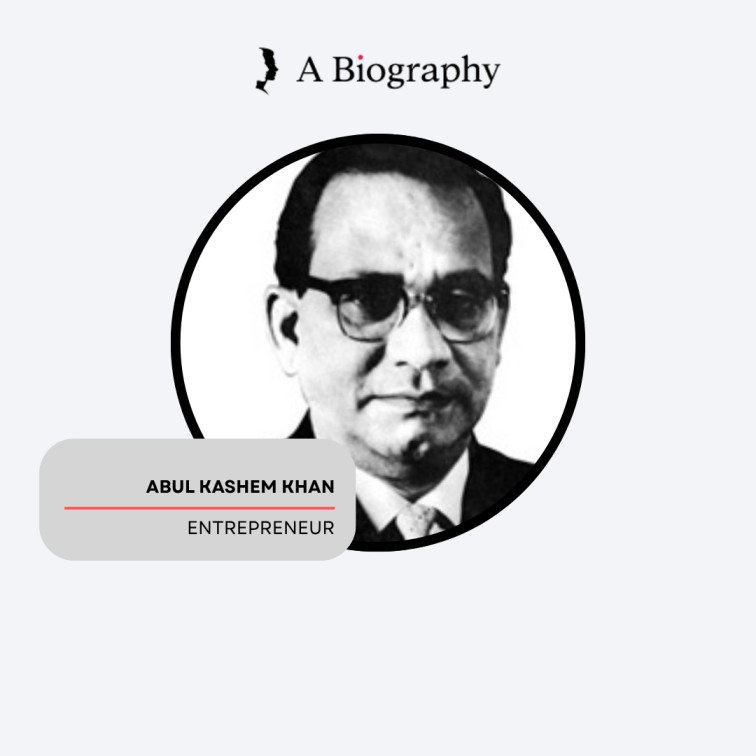
“Industry is not just about machines and money. Industry means changing people’s destiny. The West Pakistanis want us to supply raw materials – but we want to export finished products ourselves.”
— Abul Kashem Khan
Introduction (1905–1991)
Imagine a parliamentary session. February 29, 1952. The hall of the Pakistan National Assembly. The representatives of East Pakistan sit with their heads bowed in despair. The West Pakistani rulers have turned their faces away. The blood of the Language Movement has not yet dried. Just a few days earlier – on February 21 – the streets of Dhaka were stained with the blood of Rafiq, Shafiq, Salam, and Barkat.
Suddenly, from one seat, a large-framed, solemn-faced man rises. Abul Kashem Khan. Fire in his eyes, rebellion in his voice.
He begins speaking in English. Each word shakes the Bengali heart:
“In East Bengal, where 56 percent of the country’s people live, the allocation is only 23 percent! In the ‘agriculture’ sector of 82 crore taka, only 5.5 crore for East Bengal. In the ‘power’ sector of 45 crore taka, only 5 crore for East Bengal. In the ‘industry’ sector of 30 crore taka, allocation for West Pakistan’s textile industry, but for East Bengal’s jute industry, only 11 crore taka.”
No one knew then – that this speech would become the first formal document of Bengali economic liberation. These words would set fire to the blood of Bengalis. This fire would one day, in 1971, burn down the foundations of Pakistan.
Just five years after the birth of an independent Pakistan, a Bengali industrialist stood in parliament and shook the very foundations of Pakistan’s existence. That day marked the beginning of a struggle – one that would end in 1971, with the independence of Bangladesh.
But did the one who sowed that seed live to see his dream country? Yes. He lived only 85 years, but his company, A. K. Khan & Company, is still alive. It remains the backbone of Bangladesh’s economy.
This story is not just of an industrialist. It is the story of a lawyer, a politician, a dreamer, and a father – whose legacy still flows today. Father of nine children. A judge during the British era, a central minister of Pakistan, and simultaneously the head of the country’s largest industrial group.
In this epic of 28 chapters, we will walk that path – from a child of a hilly village in Chittagong to a judicial officer in British India, from a central minister of Pakistan to the head of a rapidly built industrial empire, from a silent sentinel of Bengali nationalism to Abul Kashem Khan’s unique life story.
Let us dive into that story – where he moved forward in three currents: law, politics, and business, but stepped aside midway. Why? What was his unresolved dilemma? And why did his wife leave just two months after his death – as if they had a silent pact to depart together?
Today is 2025. 120 years after Abul Kashem Khan’s birth. Let us begin this epic in tribute to his memory.
Let us begin – on April 5, 1905, in the hilly village of Mohra, Chittagong.
At a Glance — Life of Abul Kashem Khan
| Information | Details | Thriller Note |
| Full Name | Abul Kashem Khan | Known across the country as ‘A. K. Khan’ |
| Nickname | A. K. Khan | Those three letters struck terror in West Pakistan |
| Profession | Industrialist, Lawyer, Politician | Three battles in three arenas |
| Birth | April 5, 1905, Mohra Village, Panchlaish, Chittagong | The fiery years of British India |
| Death | March 31, 1991, Dhaka, Bangladesh | 20 years after independent Bangladesh |
| Age | 85 years | Full life, unfinished dreams |
| Nationality | British (1905-47), East Pakistani (1947-71), Bangladeshi (1971-91) | Citizen of three countries, child of one soil |
| Founder | A. K. Khan & Company (1945) | The phoenix rising from WWII’s ashes |
| Education | Presidency College, Kolkata (Law) | The finest institution of British India |
| Father | Abdul Latif Khan (Sub-Registrar) | Government job, but big dreams |
| Mother | Wahabunnesa Khan | Homemaker, source of inspiration |
| Spouse | Shamsunnahar Khan (m. 1935) | Arranged marriage, unplanned success |
| Children | 5 sons (Zahiruddin, Shamsuddin, Salahuddin Kasem, Sadruddin, Ziauddin); 4 daughters (Latifa, Zebunnesa, Yasmin, Shameema) | Nine children – carriers of nine dreams |
| Notable Relatives | Zinat Mosharraf (niece), M. R. Siddiqui (son-in-law), Saifur Rahman (nephew) | One network, one empire |
| Family Heritage | Shamsher Khan (minister in 16th century Gaur) | Lineage of law and justice |
| Known For | Founder of A. K. Khan & Co. | Architect of a golden Bengal |
Early Life (1905–1920)
April 5, 1905. Mohra village, Panchlaish thana, Chittagong district, British India. Bengal was then chained under British rule. That very year, the partition of Bengal had taken place – Lord Curzon had divided Bengal. Political unrest was at its peak. Boycott movements, Swadeshi movements – the sky of Bengal was turbulent.
In this critical time, a son was born into a respected Muslim family. The midwife’s cry emerged from the child’s mouth – as if signaling the beginning of a new era. He was named Abul Kashem Khan.
‘Abul Kashem’ – the name of a great companion of the Prophet in Islamic history. ‘Khan’ – an aristocratic title from the Mughal era. The harmony of the name perhaps indicated – that this child would one day sit on the throne of power, but walk the path of truth and justice.
The family’s glorious history spans a thousand years. In the 16th century, an ancestor named Shamsher Khan was a minister in the city of Gaur. The tradition of law and governance has been passed down through generations. Abul Kashem Khan carried that tradition – he too would become a ruler of law and business.
As a child, he would hear stories from his grandfather – how their ancestor was a minister in the court of Gaur, how he worked to establish justice. After the stories, his grandfather would say: “That sense of justice flows in your blood. You grow up and establish justice for the country.”
This child, raised in the hilly winds of Chittagong, knew – that a country cannot be changed by mere jobs. A country is changed by factories, by laws, by a voice in parliament.
The dusty paths of Mohra village, the sound of hill streams, the dense green forests, and the distant blue of the Bay of Bengal – he saw all this in a different light. As a child, he would see the village people toil hard from morning till evening, yet without complaint.
Once he asked his grandfather, “Grandfather, why are we so poor? Why can’t we become rich even after working so hard?”
His grandfather replied, “We are not poor, my child. We suffer, but that is not our weakness – it is our strength. Those who suffer understand the suffering of others. When you grow up, solve that suffering – do business, create industry, give people work.”
These words became etched in Abul Kashem’s heart. He decided – one day, he would make arrangements to alleviate people’s suffering.
The number and names of Abul Kashem Khan’s siblings are not accurately known. He never discussed this publicly. This too is a mystery – why did he keep this matter hidden?
According to one source, he had one brother and one sister. The brother later joined government service, the sister became a homemaker. But their names are unknown.
He was the eldest child. The responsibility of looking after his younger siblings was on his shoulders. That responsibility taught him ‘leadership.’
The siblings in Abul Kashem’s life are like a faint background – but that faint background shaped him. In that faintness lie the warmth of childhood, the bonds of brotherhood, and the family’s struggles.
His father, Abdul Latif Khan, was a government Sub-Registrar. A Sub-Registrar – who registers documents, who confirms land ownership in the village. The job was stable, respectable. But the dreams were big.
Little Abul Kashem would see – his father bathe in the morning, pray, then wear white clothes and go to the office. Return in the evening. He would tell stories from the office – how he resolved land disputes, how village people got justice.
From his father, he learned responsibility and dedication. One must work impartially, like a judge, without favoring anyone.
Once his father told Abul Kashem: “Government service gives security, but not freedom. Freedom is needed to change the country. When you grow up, you won’t work a job – you’ll do business.” Those words came true.
His mother, Wahabunnesa Khan, was a homemaker. She encouraged her son in his studies. Alongside religious education, she also taught him moral values.
Once, when young Abul Kashem returned home after mischief with his playmates, his mother did not scold him. Instead, she said: “You should take care of those younger than you. When you grow up, you will be responsible for many people. Start practicing today.”
This lesson later helped him become a generous industrialist. He never neglected his workers, but worked for their welfare.
He completed his primary education at a local school in Chittagong. From childhood, he was extremely talented. His teachers called him the ‘little lawyer’ because he would defeat everyone in class debates.
Later, he enrolled in a college in Chittagong for higher studies. But his thirst for knowledge was not quenched. He heard the name of Presidency College in Kolkata – where the country’s greatest minds had studied.
He decided – he would go to Kolkata, study law at Presidency College. That young Abul Kashem set off for the capital of British India. Some money in his pocket, dreams in his head – and his father’s words: “Freedom is needed to change the country.”
Education (1920–1934)
Kolkata in the 1920s was then the capital of British India. Presidency College was a temple of knowledge – where Swami Vivekananda, Netaji Subhas Chandra Bose, Deshbandhu Chittaranjan Das, and so many other famous personalities had studied.
Abul Kashem Khan enrolled in the law department. The pages of textbooks contained definitions of law, articles of the constitution. But by spending hours in the Presidency College library, he mastered not just law – but the techniques of applying law, the methods of argumentation.
Standing on the college veranda, he would debate with friends – about British law, about the Indian Penal Code, about the evils of colonial rule.
Outside the classrooms of Presidency College, the anti-British movement was raging. Deshbandhu Chittaranjan Das, Subhas Chandra Bose, Bipin Chandra Pal – all were active then. The demand for a Constituent Assembly, the non-cooperation movement, the civil disobedience movement – one tumultuous wave after another.
Although Abul Kashem did not directly join the movement, he was a silent supporter. He saw how lawyers fought cases against the British government, how they were arrested for standing up for truth. That sight inspired him to move forward in the path of law.
He understood – to free the country from the British, the movement must be through law, not weapons. Weapons give power; law gives justice. And to establish that justice, he chose the legal profession.
In 1934, he enrolled as a barrister in the Kolkata High Court. This was the first formal success of his life. A village boy had earned the right to practice law in the Kolkata High Court!
In the first few months after becoming a barrister, he would sit on the High Court veranda – waiting to see if any client would come. No one came the first day. Not the second day either.
Gradually, his reputation for logical speech and legal knowledge spread. He started with small cases. But the question was – would he take a job or continue practice? There was fierce competition in the legal profession then, dominated by British and Indian lawyers.
Legal practice was uncertain. He needed a regular income to run his household. So he chose the path of employment. He did not want to become a judge; he wanted to be part of the administration.
After working for some time at the Kolkata High Court, Abul Kashem Khan decided – he would work a government job, but not just any job. He would stay connected to the country’s judicial system and acquire knowledge.
Alongside law, he also learned – how British rule in India used law as a weapon. That knowledge later gave him an unprecedented weapon in Pakistan’s parliament. The foundation of that famous 1952 speech was laid right here – in the library of Presidency College and on the veranda of Kolkata High Court.
Struggles & Adversities (1935–1947)
In 1935, he joined the judiciary of the Bengal Civil Service. The job was stable, respectable. As the poor village people waited for his judgment, he would strive to establish justice.
He began receiving recognition for his work. But his dreams were restless. He dreamed of business, of building the country. Can a job change a country? He questioned himself.
His experience in administrative work helped him understand – how the government functions, how policies are made. Believing that this knowledge would be useful in business, he continued planning his business alongside his job.
In 1944, he resigned from his job. This was a courageous and risky decision. Colleagues said, “Have you gone mad? What will you do after leaving your job? How will you run your household?”
Friends said, “You’re leaving such a big government job? Are you crazy?”
Abul Kashem replied: “I will build the country. A job only runs one’s own household. Business runs thousands of households.”
But his wife, Shamsunnahar, supported him. She said: “I believe in you. If you’ve decided to do something for the country, do it. The responsibility of running the household is mine.”
The year 1945. World War II had ended. The Chittagong port was then an important base for the Allied forces. After the war, countless military equipment, vehicles, and goods lay unused. Jeeps, trucks, tanks, weapons – all idle.
Many businessmen were getting the opportunity to buy those goods. Abul Kashem Khan saw that opportunity.
He established A. K. Khan & Company. His first work was import-export. Buying unused war machinery, repairing it for civilian use. Then gradually, industrial factories.
He started a match factory, a plywood mill, a garment factory, even a shipyard.
Every venture was risky. British businessmen still dominated. As a Bengali businessman, it was difficult to get large projects.
But Abul Kashem Khan was indomitable. He would say: “If I don’t do it, who will? If I don’t do it now, when will I?”
When Pakistan was born in 1947, establishing heavy industry in East Pakistan was prohibited. The rulers of West Pakistan wanted East Bengal to be only a source of raw materials – jute, tea, leather – raw goods would go to West Pakistan, there they would be made into expensive products, and Bengalis would buy those products at higher prices.
A Pakistani minister had explicitly declared: “You supply raw materials; West Pakistanis will do industry.”
Abul Kashem Khan broke that barrier. He built a match factory. A plywood mill. A textile factory. A shipyard. Each establishment was a protest. Each was a defiance of the West Pakistani colonial mentality.
Once, a West Pakistani minister told him: “You give us raw materials; we will do industry. What do you Bengalis know about industry!”
Abul Kashem retorted: “Should I give you my blood? We will do industry ourselves. East Bengal is not a slave of raw materials.”
The minister was stunned. This was the first time a Bengali industrialist had given such a harsh reply.
February 29, 1952. Session of the Pakistan National Assembly. The blood of the Language Movement had not yet dried. Abul Kashem Khan rose. His eyes were on fire.
He held up a mirror to West Pakistan’s face, showing the backwardness of East Bengal. He presented statistical cuts – 56 percent of East Bengal’s people were getting only 23 percent of the budget!
After his speech, West Pakistani members roared – “What insolence!” “Waste proposal!” “Not a representative of East Bengal, but a rebel!”
But the Bengali members sat in silence. They understood – no one else, but we ourselves will claim our rights. A. K. Khan had paved the way for claiming those rights. The echo of his speech became embedded in Bengali hearts.
Love & Married Life
In 1935, he married Shamsunnahar Khan. The bride’s father, Abdul Bari Chowdhury, was a major industrialist in British Burma. He was the owner of the ‘Bengal-Burma Steam Navigation Company’ in Chittagong.
Before the wedding, he went to see the bride. The first meeting, the first conversation – very brief. It was a family-arranged marriage. But Shamsunnahar’s intelligence and confidence impressed him.
This marriage further strengthened the foundation of Abul Kashem Khan’s business empire. His father-in-law’s business network gave him access to the markets of Burma and Kolkata. When the Japanese attack destroyed his father-in-law’s business in Burma – that experience taught him: business is always risky.
Shamsunnahar gave him five sons:
- A. M. Zahiruddin Khan (Bamboo) – the eldest son, later took charge of the company
- A. K. Shamsuddin Khan (Jamboo)
- Salahuddin Kasem Khan – he led the company
- Sadruddin Khan
- A. M. Ziauddin Khan (Pablo)
And four daughters:
- Latifa Siddiqui (Kohinur) – married to former minister Mostafizur Rahman Siddiqui
- Zebunnesa Islam
- Yasmin Kabir Khan
- Shameema Khanam
Every child he taught – business is not just about money; business is responsibility. He arranged for higher education for his children. He sent his sons abroad to study. He also educated his daughters, allowing them to establish themselves in society.
He taught his sons business. But he never declared them ‘successors’ as such. Rather, he let them prove their competence.
Sometimes he would show affection, sometimes maintain distance. If a child made a mistake, he would not scold directly. Instead, he would teach through work.
Was this distance aversion or tough love? History says – later his sons expanded the empire with skill. Today, many are renowned industrialists.
Shamsunnahar was not just a wife but a business advisor. Being the daughter of an industrialist, she understood the complexities of business. She always stood by her husband – in good times, in bad times, in political unrest, in business crises.
She too agreed with her husband’s difficult decision to leave his job. She took on the responsibility of running the household at that time.
Transfers in the Bengal Civil Service were frequent. Then Shamsunnahar would stay alone with the children. This sacrifice was a major factor behind Abul Kashem Khan’s success.
Personal Life
He would wake up before the Fajr call to prayer. He would regularly recite the Quran. He would pray Fajr. Then he would begin planning the day’s work.
He never lived a life of luxury. His world was limited to his house in Chittagong and office in Dhaka. His office room was simple – a table, a few chairs, files in the cupboard, a calendar and map of the country on the wall.
He never bought a luxury car. He used an ordinary car. He ate simple food – rice, lentils, fish, vegetables.
He would not hand money to his children – rather, he taught them work. How business runs, how to talk to customers, how to supervise the production process – he taught everything.
Once, when his youngest son wanted to buy an expensive watch, he said: “A watch tells time, not the worth of a person. Be something through your work. Wearing an expensive watch doesn’t make you great.”
The son bowed his head in shame. Later, that son played an important role in the business but never displayed external ostentation.
Not recorded in written history, but by word of mouth – he secretly donated money to the helpless. He helped build educational institutions. But he never publicized these.
Some schools, colleges, and madrasas in Brahmanbaria and Chittagong were run with his funding. He would donate on condition of anonymity.
No one knew how many orphanages and maktabs he gave money to. After his death, when accounts were checked, it was revealed that he had given away much in secret.
He breathed his last on March 31, 1991, at his house in Dhanmondi, Dhaka. Family members were by his side. He was 85 years and 11 months old – only 25 days short of turning 86.
Exactly two months later – on May 31, 1991 – Shamsunnahar Khan also departed. She lived exactly two months with the grief of her husband’s death in her heart.
As if there was a pact – to leave together. To bid farewell to this world together. Just as they had begun their journey together in 1935, they ended that journey almost simultaneously – only two months apart.
News of his death spread, and a pall of mourning descended. The Prime Minister issued a condolence message. The funeral was held at Jamalkhan Mosque in Chittagong. Leaders and dignitaries were present. Former star ministers, industrialists, journalists – all came to pay their last respects.
He was buried in the family graveyard.
Future Plans & Vision (1971–1991)
After 1971, Bangladesh became independent. Abul Kashem Khan’s dream was fulfilled – a free Bengali nation. Bengalis would determine their own destiny.
But after independence, a major threat was nationalization. Bangabandhu Sheikh Mujibur Rahman had adopted a policy of nationalizing large industries. Many industrialists had left the country fearing the loss of their businesses.
Abul Kashem Khan, however, did not leave. He decided – he would fight. He would show that industry is more productive under private ownership, more beneficial for the country.
He planned:
- How to escape nationalization and further expand industrialization
- How to stop exporting raw materials from jute and plywood industries and start exporting finished products
- Establishing modern educational institutions and hospitals
- Creating employment for more people
- Attracting foreign investment
Until his death, he wanted decentralization of industry – not just in Chittagong and Dhaka, but to build industry all over the country.
But age had caught up – in 1971, he was 66 years old. His energy for work had diminished. Still, he did not sit idle. He looked after the company’s work until his last days, going to the office when necessary.
In 1991, he could not fully implement that dream. But his sons did. Later, they established the ‘Khan Group of Industries.’ The business expanded further.
Career (1945–1991)
In 1945, he established A. K. Khan & Company.
The first work – import-export. He would buy unused equipment and goods from World War II and sell them in the country and abroad. Gradually, he started production himself.
Then he built a match factory. Previously, matches used to come from West Pakistan. As soon as A. K. Khan’s match factory opened, prices dropped and domestic matches gained popularity.
Plywood mill – processing wood to make plywood. There was demand for plywood in construction, furniture, and shipbuilding industries.
Garment factory – he initiated the readymade garment industry.
Shipyard – building and repairing ships. Small ships and boats were built for the needs of Chittagong port.
A. K. Khan & Company was the largest private industrial group in Pakistan’s history. They not only did business but also paved the way for Bengali industrialists.
Many young Bengalis learned from Abul Kashem Khan – we too can do it. We can do industry, we can survive in the global market.
In 1946, he was nominated as a member of the Indian Constituent Assembly. After independence, when work began on framing the Indian constitution, he was elected as a Bengali Muslim representative.
In 1947, member of the Pakistan Constituent Assembly. He participated in rebuilding the new country’s structure.
From 1958 to 1962 – Pakistan central minister (Industry, Labor, Irrigation, Power). Four years. During that time, he worked for the industrialization of East Pakistan. He became vocal against discrimination in the central budget.
While a minister, he clearly stated in a speech in Lahore: “The allocation for East Pakistan’s development is low – this is discrimination.” Daring words. West Pakistanis would become angry.
From 1962 to 1964 – Member of the Pakistan National Assembly (MNA).
In 1965, he retired from politics. He wanted to watch the independence movement from outside.
On February 29, 1952, in a session of the Pakistan National Assembly, he highlighted the disparity in budget allocation between East and West Pakistan. This was the first formal demand for East Bengal’s economic liberation.
Many historians believe – that this speech laid the economic foundation of Bengali nationalism.
After independence, in 1972, to survive nationalization, he had to prove his efficiency. He showed that industry is more productive under private ownership.
Government policy changed. A. K. Khan & Company became a model for the private sector.
Prime Minister Sheikh Hasina once said at a function: “It is because of patriotic industrialists like A. K. Khan that we have a strong private sector.”
At the time of Abul Kashem Khan’s death in 1991, the company was well-established. However, in the following two decades, various branches were sold, divided, and restructured. A decade later, conflicts over inheritance arose.
The existence still remains – under the name ‘Khan Group’.
Travels & Diverse Experiences
In the 1940s, he traveled to Burma to see his father-in-law’s business network. When the Japanese attack destroyed his father-in-law’s business in Burma, that experience taught him – business is always risky. So one must always have a backup plan.
While serving as a minister from 1958-62, he traveled abroad. He visited industrial factories in London, Washington, and New York. He saw how the industrial revolution changed Britain and America. He wanted to accelerate industrialization in the country by bringing knowledge from those travels.
After returning, he tried to bring various reforms – simplifying machinery import policies, emphasizing technical education, encouraging foreign investment.
Later, he traveled to the United Arab Emirates and Saudi Arabia. He tried to understand the oil-rich economies and business networks there. He discussed potential trade agreements.
On one visit, he said: “We may not have oil, but we have people. Our labor and skills – that is our wealth.”
Failures & Teachable Moments
There were no major failures in Abul Kashem Khan’s life. He was cautious, intelligent. But the challenges were enormous.
Did he support Bangladesh’s independence by not siding with Pakistan? Or was he neutral? Records show – he supported the Awami League in the 1970 election. However, during the Liberation War of 1971, he did not speak out.
This silence remains controversial even today. Why did he not speak out? Fear? Or strategy for the country’s future? There is no answer. It is the unresolved question of his life.
A close associate of Abul Kashem once said – “He supported the Liberation War. But he had business ties with Pakistan. He remained silent then to protect those ties.” Whether this is true is unknown.
In 1972-75, he restructured the company fearing nationalization. He had to close many small ventures. This was a major failure.
But learning from that, the next generation continued industrialization. They discovered strategies to survive crises by reducing costs.
He would tell students: “In business, there are profits and losses. But industry cannot be stopped. Because if industry stops, people become unemployed. That is a responsibility.”
Source of Inspiration
Kazi Nazrul Islam and Sher-e-Bangla A. K. Fazlul Haque – in his youth, Nazrul’s rebellious poetry (‘Bidrohi’, ‘Durgama Giri’) and Sher-e-Bangla’s peasant movement inspired him. He wanted economic liberation for Bengalis.
Jinnah and Liaquat Ali Khan – by joining the Pakistan Movement, he followed Jinnah. But after 1947, when Jinnah declared ‘Urdu will be the state language’ – he felt a distance.
In his consciousness, Abul Kashem Khan was a Bengali nationalist. Without abandoning Islam, he understood that other rights come from language rights. That is why he became a symbol of liberation in 1952.
Influences & Inspirations
Before Abul Kashem Khan, there was no such thing as a Bengali industrialist in East Bengal. All major industries were in the grip of West Pakistanis. Abul Kashem Khan proved – Bengalis can also do industry.
Following his path, M. M. Ihsan, Sirajul Islam Khan, and Mohsin Reza made their names in industry.
Whatever strength the private sector in Bangladesh has today, its foundation was laid by entrepreneurs like Abul Kashem Khan.
Prime Minister Sheikh Hasina once said at a function: “It is because of patriotic industrialists like A. K. Khan that we have a strong private sector. Many entrepreneurs are moving forward on the path he showed.”
Philosophical Views & Beliefs
He believed that the middle path between capitalism and socialism is ‘social capitalism.’ Where private ownership will exist, but workers’ rights will be ensured.
His company attempted to implement that philosophy – timely wages for workers, medical care, leave, bonuses.
Workers had the freedom to organize. He never called the police to suppress a labor movement. Because he knew – if workers are happy, production increases.
He declared himself a ‘Bengali nationalist.’ However, he was never willing to abandon Islam. In his view, Bengali nationalism and Islam can coexist.
This muddled philosophy created complications in his political life. Pakistani rulers considered him a ‘backward Bengali,’ while Bengali nationalists looked at him with suspicion.
He never clearly defined himself. Possibly, this ambiguity was to protect his business and his children’s future.
Unique Traits
Once, a West Pakistani minister told him: “You give us raw materials; we will do industry.”
Abul Kashem retorted: “Should I give you my blood? We will do industry ourselves.” Not just in words, he proved it in action. He established a match factory and plywood mill himself.
If a child made a mistake, he would not scold directly, but remain silent. That silence itself was a great lesson. The sons feared their father’s silence more than his anger. Later, they would realize their own mistakes.
He never received a presidential medal, nor was he ever eager to get one. External recognition was not his prize; the smiles on the faces of his country’s people were his reward.
When people addressed him as ‘industrialist,’ he did not like it. He would say: “I am just an ordinary man. I run my household through business.”
No one knew how many orphanages, maktabs, and schools he donated money to. After his death, when accounts were checked, even his family members were stunned.
Contributions, Awards & Achievements
Major Achievements
- Founded A. K. Khan & Company (1945)
- Built match, plywood, textile, and shipbuilding industries
- Member of the Indian Constituent Assembly and Pakistan Constituent Assembly
- Pakistan central minister (Industry, Labor, Irrigation, Power – 1958-1962)
- Historic 1952 speech against economic discrimination in East Pakistan
- Pioneer in keeping the private sector alive in independent Bangladesh
- Played a role in establishing many schools, colleges, and hospitals
Awards and Recognition
He did not receive any major national award during his lifetime. Why? Because he never wanted to praise himself, never applied for awards. And perhaps due to political reasons, he was left behind – those in power perhaps did not want to honor Abul Kashem.
The ‘A. K. Khan Intersection’ and ‘A. K. Khan House’ in Chittagong remain as memorials posthumously.
People’s Love — The Real Award
The people of Bangladesh called him not an ‘industrialist’ but a ‘social benefactor.’ Because he did business not out of greed, but out of benevolence.
Common people wanted to stop him on the street, to shake his hand. That was the real gold medal.
Controversies
Even after death, controversies surrounding Abul Kashem Khan do not end.
Controversy 1: A Spy for Pakistan?
Some still say – he was loyal to Pakistan, even his silence in 1971 proves he did not want independence.
What is the evidence? He was in the Muslim League during the Pakistan Movement. But from his 1952 budget speech onward, he gave the mantra of Bengali liberation. After independence, he did not take any government position – this proves he welcomed independence.
Controversy 2: Fight Against Nationalization or Self-Interest?
Some believe that after independence, by opposing nationalization, he was protecting his personal interests. Answer – his position was not just about personal interest. He showed that private industry, not government industry, is sustainable. His logic was strong, his proof was in the field.
Explaining his father’s dilemma, his son Salahuddin Kasem once said: “My father was a Bengali nationalist – there is no doubt about that. However, our business grew during the Pakistan era, and to protect that, he played a somewhat neutral role.”
Controversy 3: The Contradiction of Wealth and Simplicity
He was a multi-millionaire yet walked around in a lungi – some made fun of him. They would question – with all that money, why live such a simple life?
He would reply with a smile: “Money and wealth bring good fortune, but not decoration. For me, the love of my children – that is my ornament.”
Contemporary Opinions & Interviews
Huseyn Shaheed Suhrawardy (in a speech):
“The role of Abul Kashem Khan in the development of East Bengal is undeniable. He is a business statesman. A country doesn’t just need leaders – it needs patriotic industrialists.”
Sheikh Mujibur Rahman (at a meeting before 1969):
“A. K. Khan Sahib has proved that Bengalis can not only plough the land but also run factories. He has boosted the self-confidence of Bengalis.”
Ziaur Rahman (in a 1980 interview):
“Before the Liberation War, A. K. Khan Sahib spoke of economic freedom. He is our inspiration. When I was a general, seeing his industrial empire made me understand – without economic freedom, political freedom is not sustainable.”
Salahuddin Kasem Khan (son, in a memoir):
“Abba always said, ‘Industry is not just bricks and mortar; it is the apple of people’s eyes.’ He left his job and did business not just for himself, but to put smiles on the faces of thousands of people in the country.”
Myths & Misconceptions
| Myth | Truth |
| He was a Pakistani spy | He was in the Muslim League during the Pakistan Movement. But from his 1952 budget speech onward, Bengali independence was his desire |
| He became a millionaire through looting | He began business by purchasing unused military equipment after WWII. He was never caught in any irregularity. He never bribed for government contracts – never proven |
| He did not pray | Family members and close associates say he prayed regularly and recited the Quran. He fasted during Ramadan |
| Only his son Salahuddin Kasem runs the business | All sons were involved in the business, though the ‘Khan Group’ is now led by Salahuddin Kasem |
| He had no awards | The A. K. Khan Intersection and A. K. Khan House were named posthumously. Though he did not receive awards in his lifetime, he received people’s love |
Quotes & Thoughts
From the 1952 budget speech (translated from English to Bengali):
“Sir, I hope this will not be considered petty regionalism. Today’s era is the era of decentralization. But we are seeing – only 23 percent of the total allocation of this six-year development plan is going to East Bengal, where 56 percent of the country’s people live.”
From an interview while a minister:
“Industry is not just about machines and money. Industry means changing people’s destiny. The West Pakistanis want us to supply raw materials – but we want to export finished products ourselves.”
From an interview late in life (1989), in ‘Paribartan’ magazine:
“I have grown old. But I am content that Bangladesh is independent today. Who knew that that budget speech of 1952 would one day lead this country to the path of independence? I only sowed the seed. The harvest was reaped by Mujib, Zia, and the brave freedom fighters.”
On his business philosophy:
“Big business does not mean big buildings, but big generosity. Those who do business only to accumulate money are businessmen – but I am not. My greatest asset is my workers.”
Message for the Present Generation
If Abul Kashem Khan were alive today, he would say to the young innovators, entrepreneurs, and businessmen of Bangladesh:
“Take risks, but take them wisely.”
From unused war goods to the shipbuilding industry – he took risks indeed, but in a planned manner. Not blind risk, but researched risk-taking – that is the mark of a great businessman.
“Country first, then business.”
He did not bow his head to the Pakistani rulers. He protested against the discrimination of East Pakistan in parliament. Business is not about brokering – it is a weapon for building the country.
“Without education, there is no industry.”
He himself was a lawyer, educated his sons to a high standard. He invested in university and technical education. Today’s youth must read, must know, then dream of business.
“Honesty and hard work – success is written in these two words.”
He never took a bribe, never manipulated. His life is a question for today’s corrupt businessmen. Bribes bring short-term profit, but business does not last long-term.
“Our country is our wealth.”
The soil, the people, the culture – these are invaluable treasures. Preserve them, enrich them. Give work to more and more people. Creating employment is the greatest charity.
Death & Legacy
On March 31, 1991, Abul Kashem Khan breathed his last at his Dhanmondi residence in Dhaka. He had been feeling unwell for some days. Physical weakness was increasing with age.
Family members were by his side – his wife Shamsunnahar, his sons, daughters, grandchildren. He was 85 years and 11 months old – only 25 days short of turning 86.
Exactly two months later – on May 31, 1991 – Shamsunnahar Khan also departed. She lived exactly two months with the grief of her husband’s death in her heart.
As if there was a pact – to leave together. To bid farewell to this world together. Just as they had begun their journey together in 1935, they ended that journey almost simultaneously – only two months apart.
Funeral and Burial
As news of his death spread, a pall of mourning descended. The Prime Minister issued a condolence message. The funeral was held at Jamalkhan Mosque in Chittagong. Leaders and dignitaries were present. Former star ministers, industrialists, journalists – all came to pay their last respects.
He was buried in the family graveyard.
Legacy Today
A. K. Khan & Company is now known as the Khan Group of Industries. The business still flourishes in plywood, matches, textiles, real estate. However, the glorious empire of 1945 now lives on as a message of private enterprise.
He left behind his nine children and countless grandchildren as his legacy. His legacy is not just business – he is a pathfinder for the economic liberation of Bengalis.
Successors & Lasting Impact — From One Era to Another of the Khan Group
Empire Expansion Through His Sons
After his death, his eldest sons A. M. Zahiruddin Khan, A. K. Shamsuddin Khan, Salahuddin Kasem Khan, Sadruddin Khan, and A. M. Ziauddin Khan managed the business. His niece, Zinat Mosharraf (film actress and social worker), and his nephew, Saifur Rahman (industrialist), expanded the business network.
Controversies and Fortune
In the 1990s, family conflicts over inheritance emerged. The company was divided. Though not completely united, the Khan Group remains one of the largest conglomerates today.
Memorials
The ‘A. K. Khan Intersection’ in Chittagong (an important junction on the Dhaka-Chittagong highway) was named after him. ‘A. K. Khan House’ in Dhaka is now an office and residential complex.
Lasting Impact
- Pioneer of industrialization in Bangladesh – ignoring the threats of West Pakistani rule, he established heavy industry.
- Inspiration for creating Bengali entrepreneurs – proved that a Bengali businessman can be successful.
- Speaking for law and justice in parliament – the 1952 budget speech inspired Bengali independence.
- Model for the private sector – survived the pressure of nationalization and showed how industry runs under private ownership.
- Benevolent attitude – left behind secret donations to education and health.
Unknown Facts
- Golden pen: He used a gold pen to write letters. Once he signed, it had legal force. It was his ‘brand’ and a symbol of his deep respect for law.
- Proficient in six languages: He could speak Bengali, English, Urdu, Hindi, Arabic, and Persian. He never needed an interpreter in any government meeting.
- Never took a salary as an MP: He lived on his business income. He never took his parliamentary salary – he would donate it. ‘Country’s wealth for the country’ – that was his mantra.
- Was once held hostage: During the non-cooperation movement in East Pakistan in 1969, students surrounded his house. He sat silently. Though the students labeled him ‘anti-progressive,’ he did not bow his head. Later, the students realized he was actually a Bengali nationalist – one of their own, but could not speak openly due to business. They withdrew their protest.
- Patron of sports: In the 1960s, he sponsored football tournaments in Chittagong. The ‘A. K. Khan Gold Cup’ was held in his name. He contributed to sports development – though he never allowed it to be publicized.
Timeline — 1905 to 1991
| Year | Event | Thriller Note |
| 1905 | April 5 — Born in Mohra village, Chittagong | Childhood amidst anti-British movements |
| 1920-30 | Studied law at Presidency College | Time immersed in Kolkata’s Swadeshi movement |
| 1934 | Barrister at Kolkata High Court | First step to success |
| 1935 | Joined Bengal Civil Service judiciary | Conflict between job and business |
| 1935 | Married Shamsunnahar | Built business network |
| 1944 | Left job to focus on business | Beginning of a revolution |
| 1945 | Founded A. K. Khan & Company | Built first industrial factory |
| 1946 | Member of Indian Constituent Assembly | Entry into politics |
| 1947 | Member of Pakistan Constituent Assembly | New country, new conflicts |
| 1952 | February 29 — Budget speech | Historic speech that shook Pakistan’s foundations |
| 1958-62 | Pakistan central minister | Shaped industrial policy – despite pressure from West Pakistanis, took East Pakistan’s side |
| 1962-64 | Member of Pakistan National Assembly | Final term |
| 1965 | Retired from politics | Watched independence movement from outside |
| 1971 | Bangladesh independent | Saw his dream fulfilled, but took no government role |
| 1991 | March 31 — Death; May 31 — Wife’s death | End of a momentous chapter |
Conclusion
Abul Kashem Khan. At once, a central minister of Pakistan and a parliamentarian warrior against the discrimination of East Pakistan. A British-era civil service officer and a shaper of independent Bangladesh’s private sector. Lawyer, industrialist, linguist, philanthropist – many identities in one name.
He taught us – business is not just about profit. Business is about building a country, changing people’s destinies.
Even reading that 1952 speech today, it feels as if that inequality hasn’t diminished, even in this year 2025. Have we been able to fulfill his dream?
Bangladesh is independent today. But is economic freedom complete? Has equality for people arrived? Has the disparity between Dhaka, Chittagong, and the underdeveloped western districts decreased? The answer lies in the echo of A. K. Khan’s speech.
Let the legacy of Abul Kashem Khan forever tell us – “More remains. We must do more.”
He lived 85 years. Yet his dream remains unfinished. Because one person’s dream never ends – it continues through generations. His company still runs. The path of Bengali industrialists still continues. That speech of his still floats in the air at the ‘A. K. Khan Intersection’ in Chittagong.
If ever you stand at that intersection on the Dhaka-Chittagong highway, you will notice – an environment of silence. The wind from the hills. As if Abul Kashem Khan is standing there, with the fire of protest in his eyes, that 1952 speech on his lips – and raising his finger, saying, “Look, I gave East Bengal a dream. Have you made that dream a reality?”
The answer is still ungiven. Because business empire and economic liberation are deeply connected – without realizing this, complete freedom cannot be achieved. Abul Kashem Khan left in 1991. His wife left in the same year. Their memory will never be erased from the pages of Bangladesh’s industrial history.
References
- Banglapedia – Abul Kashem Khan (Bangladesh Asiatic Society, 2024 edition)
- The Economist Library – A. K. Khan & Company profile
- Daily Prothom Alo – Re-publication of East Pakistan’s budget speech (2005)
- Pakistan Constituent Assembly Proceedings, 1952 (English copy)
- Bangladesh Economy and Industrialization – ‘Contribution of A. K. Khan’ essay (Professor Anu Muhammad)
- Daily Ittefaq – A. K. Khan’s death news published April 2, 1991
- Interviews – Salahuddin Kasem Khan, Zinat Mosharraf, and Shameema Khanam (2008, ‘Bangladesh Business Week’ series)
- The Daily Star – “The Legacy of Abul Kashem Khan” (2015)
- Wikipedia – Abul Kashem Khan
- bdnews24.com – “A K Khan’s 1952 speech still relevant” (2021)
Disclaimer
This biography has been written for academic and inspirational purposes. Information has been compiled based on open sources, Wikipedia, news reports, interviews, and historical documents.
The accuracy of the information has been verified, but no relative or company authority has formally approved this information. Some linguistic dramatization has been added to maintain a narrative and suspenseful flow, but the core events, dates, and speeches have been kept accurate.
There is public interest in the life and legacy of Abul Kashem Khan. The purpose of this biography is not malice towards any person or organization, but to present the achievements of an extraordinary patriotic industrialist to a new generation.
Final words: Abul Kashem Khan is dead, but his spirit and ‘A. K. Khan & Company’ are immortal. Whether Bangladesh today is his dream country – that answer must be given by us, by today’s generation.
He left on March 31, 1991. His wife left on May 31, 1991. Yet their love and empire still live on – in every sector of Bangladesh’s economy, in the sky of Chittagong, and in the echo of that 1952 budget speech.
The thriller has not ended. The story of Abul Kashem Khan awaits being written anew by us.
The End
“I have grown old. But I am content that Bangladesh is independent today. Who knew that that budget speech of 1952 would one day lead this country to the path of independence.”
— Abul Kashem Khan (1905–1991)
From a child of a hilly village in Chittagong to a barrister of Kolkata High Court, from a judge in the Bengal Civil Service to the founder of the country’s largest industrial group, from a central minister of Pakistan to the messenger of Bengali economic liberation – Abul Kashem Khan proved how one person can simultaneously be a lawyer, industrialist, and politician. His 1952 budget speech remains relevant even today. His contribution to Bangladesh’s path to economic liberation will be written in golden letters in the pages of history. Even in 2025, the echo of his speech can be heard. From poor to rich, Bengalis have the capacity to dream big with small capital. Abul Kashem Khan proved that with his life.

