
Biography
A Biography of Ahsan Khan Chowdhury

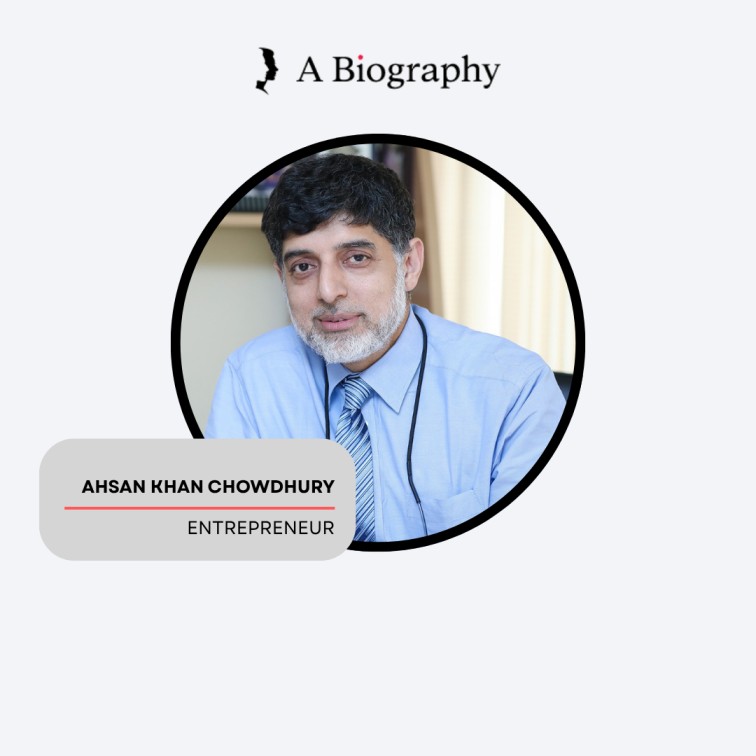
“We are not done, we’re just getting started. Stay positive. Stay in Bangladesh. Work hard, be competitive, and build something here. Our country has what it takes.”
— Ahsan Khan Chowdhury
Introduction (1970–2026)
Imagine a scene. 1992. A young man studying Business Administration at Wartburg College in Iowa, United States. He is only 22 years old. An unexpected telephone call changes everything. Hearing about his father’s condition, he makes a decision — he will return to the country without finishing his studies.
In his pocket was an incomplete bachelor’s degree; in his mind was the indomitable dream of managing his father’s business. No one knew then that this young man would one day lead Bangladesh’s largest industrial group.
He returned to join his father’s company. At that time, the company had only 30-40 employees and an annual turnover of about 1 crore taka. No one could have imagined that this small beginning would become the biggest success story in Bangladesh’s industrial history.
His father, Major General (Retd.) Amjad Khan Chowdhury, was a dreamer. In 1981, he established RFL (Rangpur Foundry Limited) — a small iron factory aimed at making irrigation pumps for rural farmers.
His son, Ahsan Khan Chowdhury, turned that dream into reality. Under his leadership, the PRAN-RFL Group today is Bangladesh’s largest and most diversified industrial conglomerate — with an annual turnover of $3 billion (approximately 36,000 crore taka), over 6,000 product lines, and exports to more than 145 countries.
Today, PRAN products are found not only in Bangladesh but also on supermarket shelves in the distant Fiji Islands.
He has taken his father’s philosophy of agriculture-based industry and spread it across plastics, home appliances, bicycles, footwear, heavy industry — everywhere. And most importantly, he has proven that a Bangladeshi company can compete in the global market with the right vision, dedication, and honesty.
In September 2025, at the 23rd edition of the DHL-The Daily Star Bangladesh Business Awards, he received the ‘Business Person of the Year’ award. In March of the same year, he was elected Chairman of Midland Bank PLC.
As of April 2026, when this biography is being written, Ahsan Khan Chowdhury is still alive. Even at 55-56 years of age, he remains active. His story has already reached legendary status — where a young man who left his studies and returned home is today the Chairman and CEO of the country’s largest industrial group.
In this epic of 28 chapters, we will walk that path — from the classrooms of St. Joseph’s to the canteen of Notre Dame, from Notre Dame to the library of Wartburg College, from Wartburg to the corporate office of his father’s company, and from there to the markets of 145 countries — the unique life story of Ahsan Khan Chowdhury.
Let us dive into that story — where he turned inheritance into unimaginable success, where he realized his father’s dream on a global scale.
At a Glance — Life of Ahsan Khan Chowdhury
| Information | Details | Thriller Note |
| Name | Ahsan Khan Chowdhury | Successor to his father’s dream |
| Date of Birth | September 6, 1970 | One year before independence — a sign that he would take independent Bangladesh to the world market |
| Birthplace | Dhaka, Bangladesh | Grew up in the capital, but spread business across the country |
| Current Age | 55-56 years (as of 2026) | Still active — the fire of youth hasn’t dimmed |
| Profession | Industrialist, entrepreneur, business leader | Head of the country’s largest industrial group |
| Current Position | Chairman & CEO, PRAN-RFL Group | Leader of a 36,000 crore taka empire |
| Education | St. Joseph Higher Secondary School (SSC 1987) → Notre Dame College (HSC 1989) → Wartburg College, Iowa, USA | All three are among the country’s best — fruit of talent and hard work |
| Father | Major General (Retd.) Amjad Khan Chowdhury | Founder and dreamer — from whom he received philosophy and ethics |
| Mother | Sabiha Amjad | Homemaker and social worker — from whom he received humanity |
| Siblings | Azhar J. K. Chowdhury, Dr. Shireen Haque, Uzma Chowdhury | Three siblings — each successful in their own fields |
| Spouse | Seema Chowdhury | Silent partner in family and dreams |
| Children | Two daughters — Samia and Sameen | Dream of handing over the future to his two daughters |
| Current Role | Chairman of Midland Bank (from 2025) | Contributing to the banking sector as well |
| Award | Business Person of the Year (2025) | National and international recognition |
| Companies | 34 companies, 6,000+ product lines | Size of the industrial empire |
| Employees | Directly 167,000+ | Livelihood of one and a half lakh people |
| Exports | 145+ countries, annual $550 million | Bengali products in 145 corners of the world |
Notice — he did not complete his studies. He left his college in the United States and returned home to join his father’s company. This decision was courageous and risky. But time has proven it was the right decision.
He inherited a company with 30-40 employees and a turnover of 1 crore taka from his father. Today, it has reached 167,000 employees and a turnover of 36,000 crore taka.
He received the Business Person of the Year 2025 award. This is recognition of his leadership and a rare honor in Bangladesh’s corporate world.
He has expressed important opinions in multiple public forums about the development of Bangladesh’s export sector and the business environment. His statement — “There is no way forward for Bangladesh without boosting exports” — is important for the country’s policymakers.
Questions arise — why did he leave his studies in the United States and return home? How did his father’s company with 30-40 employees grow to 167,000 employees? And how is he exporting products to 145 countries?
Let us return to the morning of September 6, 1970, in Dhaka to find the answers.
Early Life (1970–1985)
September 6, 1970. Dhaka city. Then the capital of East Pakistan. Only a few months remained before the fire of the Liberation War would ignite. In this turbulent time, a son was born into a respected family. He was named Ahsan Khan Chowdhury.
His father, Major General (Retd.) Amjad Khan Chowdhury, was then an officer in the Pakistan Army. His mother, Sabiha Amjad, was a homemaker and social worker. Due to his father’s job, his childhood was spent within the discipline of cantonments. There, he saw punctuality, discipline, and leadership qualities — which would later serve him well in his business life.
Ahsan Khan Chowdhury’s father, Amjad Khan Chowdhury, was a Major General — a two-star general in the army. He served in the Pakistan Army and participated in the 1965 war. In 1973, after the Liberation War, he joined the Bangladesh Army.
In 1981, he retired from the army and ventured into business — establishing Rangpur Foundry Limited (RFL). In the beginning, the company manufactured irrigation pumps and agricultural equipment.
As a child, Ahsan saw how his father traded his army uniform for business attire. He saw how his father did not stop even after hearing ‘no’ from banks. He saw how his mother, Sabiha Amjad, mortgaged ancestral property to realize her husband’s dream. The lessons of this time formed the foundation of his later life.
Ahsan Khan Chowdhury’s primary and secondary education began at the historic St. Joseph Higher Secondary School in Dhaka. It is a famous missionary school in old Dhaka.
He passed his SSC in 1987. His interest was greater in mathematics and business education. But he did not yet know that he would one day steer the country’s largest business. His teachers remember him as a ‘quiet but talented’ student.
After SSC, he enrolled at Notre Dame College — one of Dhaka’s finest higher secondary institutions. Studying here meant a tough admission test and strict discipline.
He passed his HSC in 1989. The strict discipline and curriculum of Notre Dame College prepared him for the challenges of real life.
In 1989, he enrolled at Wartburg College in Iowa, United States, to pursue a bachelor’s degree in Business Administration. The American education system and its freedom attracted him.
Sitting in the college library, he studied accounting, marketing, business strategy — all subjects. He studied American business models and strategies. But even before finishing his studies, he realized that his place was in the country, by his father’s side.
The decision to return home before completing his studies was extremely risky. Some tried to convince him to stay in America and finish his studies. But he was steadfast in his decision.
Education (1985–1992)
In St. Joseph’s classrooms, he not only studied but also learned discipline and punctuality. His teachers remember him as a ‘talented and humble student.’ The environment taught him to be disciplined and punctual — which would later serve him in his business life.
He would hang out with friends in the Notre Dame College canteen, but never lagged in studies. The competitive environment taught him to constantly give his best.
While studying at Wartburg College in the United States, he mastered all aspects of business administration. He did well in marketing, finance, and accounting. But he knew that only studying was not enough — real-life experience was also necessary.
Even without a degree, American education and environment gave him the concept of international business. He gained a thorough understanding of Western business methods, marketing strategies, and corporate governance — which later helped in expanding the company.
In 1992, he left his studies in the United States incomplete and returned home — the most important decision of his life.
His father’s health was not good. He had to take responsibility for the company — this thought led him to leave his studies. With the approval of the Board of Directors, he took charge of the business.
In an interview, he said: “When I joined my father’s business in 1992, there were only 30-40 employees. Turnover was about 1 crore taka. But I had a dream — to make this company the best company in Bangladesh.”
Struggles & Adversities (1992–2015)
When he left his studies in the US and returned home, there was a flood of questions. Relatives asked why he left his studies abroad. Friends asked what he would do in the country. He had to answer these questions. But he was not intimidated by these challenges. His self-confidence was unshaken — to take his father’s company forward.
He didn’t just sit in the office. He traveled to different parts of the country himself to understand the market and analyze customer needs. In the early days, he was also directly involved in product processing and marketing.
In 1992, when he joined PRAN-RFL Group as a Director, the company’s condition was not very good.
In the beginning, he focused on marketing and sales. He would personally talk to shopkeepers and get their opinions. He understood early on how tough the competitive market was.
He traveled from village to village to observe the product distribution system. He wanted PRAN products to reach even the most distant parts of the country. These travel experiences acquainted him with ground realities.
Like any successful person’s life, Ahsan Khan Chowdhury’s path was also full of challenges. On July 8, 2015, his father and founder, Amjad Khan Chowdhury, passed away. This was a major shock for the group.
The head of the entire industrial group suddenly left. Ahsan Khan Chowdhury had to take responsibility for the company during a crisis. He promised to fill his father’s shoes.
After his father’s death, the Board of Directors elected him as Chairman and CEO. Within a very short time, he proved that his father’s legacy was in the right hands. The company’s turnover and employment increased several times under his leadership.
Not only the domestic market but international competition was also tough. Competing especially with Thai products was challenging. When PRAN first started exporting, Thai products had already established themselves in the global market.
Ahsan Khan Chowdhury said: “In the beginning, we had to struggle with Thai competition. That experience taught us — first capture your own country’s market, then going abroad becomes easier.”
Managing all branches of the company after his father’s death was difficult. He had already had his hands in all sectors of the group. As Deputy Managing Director, he knew every level of the company. So he could make quick decisions during the crisis.
He introduced various reforms in the company’s management. He decentralized management authority, hired professional managers, and ensured the independent responsibility and accountability of each branch.
Love & Married Life
Ahsan Khan Chowdhury married Seema Chowdhury. She plays an active role in family affairs.
Not much is known about their marital relationship. But Seema Chowdhury has been a silent supporter of her husband’s career. She has managed all household responsibilities so that Ahsan Khan Chowdhury could fully focus on business.
Ahsan Khan Chowdhury has two daughters — Samia and Sameen. Both are completing their education in Canada and plan to join their father’s company in the future.
He has said: “My children are already getting involved. We are creating a culture where the next generation will be ready for global competition with fresh ideas and smart thinking.”
He wants his daughters to take over the company. This shows the modernity of his thinking — he does not believe in gender discrimination and prioritizes talent and skill.
He has not forcibly imposed business responsibilities on his children, but rather emphasizes their interest and capability. He learned from his own life experience — you cannot force someone; it has to come from their own desire.
Personal Life
Ahsan Khan Chowdhury is known as a workaholic. He starts work very early and continues until late at night. He is directly involved with the activities of all levels of the company every day.
He has said: “If we’re selling in New York, we can’t think like we’re in Narayanganj. We have to benchmark against the best.”
He is a devout Muslim. He prays and fasts. He believes that honesty and dedication are the greatest virtues in business. He sees religion as a personal belief and has never discriminated in business in the name of religion.
He is an extremely positive personality. He can easily mix with anyone. His colleagues say he always encourages employees and values their opinions.
Once, when journalists asked him the secret of PRAN’s success, he replied with a smile: “I just listen to my employees’ opinions, and do what they say. If I didn’t listen sometimes, the company wouldn’t be this big today.”
He remains optimistic even in crisis — this is the key to his leadership. Just as he maintained positivity after his father’s death in 2015, he also kept morale high during international competition.
He doesn’t just think about the present but plans for the future 10-20 years ahead. For the company’s sustainable development, he has hired professional managers and built a strong team.
Future Plans & Vision (2025–2050)
Ahsan Khan Chowdhury’s future plans extend beyond Bangladesh’s borders to the whole world.
One of Ahsan Khan Chowdhury’s big dreams is to build Bangladesh’s first truly multinational company. Production units have already been established in India and Nepal. He is planning further international expansion so that PRAN-RFL becomes a truly global brand.
He has said: “We want to create 10 lakh jobs. That’s our dream.”
Currently, the company directly employs over 167,000 people, and indirectly, about 1.5 million people depend on it.
With current growth at 30-40 percent annually, he believes that if this trend continues, PRAN-RFL Group will become a $25 billion company in the next 20 years.
Extensive investment is underway in southern and northern Bangladesh. An industrial park will be established in Bhola, which will be the largest project yet. This project will create thousands of new jobs and have a major impact on the economy of the southern region.
He wants to increase PRAN-RFL Group’s annual export earnings to $1 billion. He believes that if direct shipping from Chittagong to New York can be introduced, he alone can export $1 billion worth of products.
He is planning to invest in energy, heavy engineering, and technology sectors in the future. He is optimistic about the potential for earning foreign currency for Bangladesh through plastic products.
He wants to play a positive role in improving Bangladesh’s business environment. He wants policymakers to listen to businesspeople and economists so that rapid industrialization is possible.
He has emphasized improving law and order, efficient and effective port management, improved infrastructure, and uninterrupted supply of gas and electricity.
Career (1992–2026)
In 1992, after returning from the United States, he joined directly as a Director. In the beginning, he focused on marketing and sales. The goal was to ensure that PRAN products reached even the most distant parts of the country.
Initially, PRAN’s product processing started with pineapple slices and other local products. Later, it expanded into juices, sauces, pickles, and snacks.
During his father’s lifetime, he served as Deputy Managing Director. During this time, he had his hands in every sector of the company and gained significant experience.
As Deputy Managing Director, he played a crucial role in the company’s diversification process. Besides food processing, investment began in plastics, home appliances, bicycles, footwear, and heavy machinery.
He emphasized strengthening the rural economy from time to time. By working directly with farmers and rural entrepreneurs, he introduced new methods of raw material collection and processing.
After his father’s death, the Board of Directors unanimously elected him as Chairman and CEO.
As Chairman and CEO, he radically transformed the company: the group started exporting to over 145 countries, launched over 6,000 product lines, established about 20 new companies, and hired over 100,000 new employees.
In 2024-2025, the company’s export earnings reached $550 million.
Under his leadership, the company has expanded from food processing to plastics, household products, bicycles, footwear, and heavy industry.
Explaining his diversification philosophy, he said: “If one sector faces a downturn, another sector takes over. That’s how we remain resilient.”
In diversifying the company, he has demonstrated exceptional strategic skill. He has invested after assessing the potential of each sector. He has focused more on sectors that are sustainable and profitable in the long term.
Exports were limited during his father’s time. Under his leadership, products have reached 145+ countries. Annual export earnings have surpassed $550 million.
PRAN products have achieved British Retail Consortium (BRC) certification, a symbol of international buyers’ trust. He was able to maintain exports even during the COVID-19 pandemic.
In March 2025, he was elected Chairman of Midland Bank. He also serves as Chairman of the bank’s Risk Management Committee. He is a sponsor director of the bank and a member of the Executive Committee.
He is playing an important role in the bank’s Annual General Meeting (AGM) and half-yearly business conference.
Travels & Diverse Experiences (1992–2026)
Ahsan Khan Chowdhury regularly travels to different countries around the world. The main purpose of his travels is to create new markets and understand the dynamics of existing ones.
PRAN-RFL Group has offices in Dubai, Oman, India, Africa, Malaysia, and Spain.
He not only travels internationally but also travels equally to remote areas of the country. He personally observes the product distribution system. By understanding the food habits and preferences of people in different countries, he creates product taste and variety.
He designs products according to the needs of different regions, from Kerala to Kenya. He has deep knowledge of the markets of Asia, Africa, and the Middle East.
During his travels, he even observes product logos, packaging design, and color schemes — he is extremely careful about these matters because the reception of products in international markets depends on these small details.
Failures & Teachable Moments
When he first started exporting products, he faced many obstacles competing with Thai products. From that experience, he learned that maintaining international quality standards is crucial.
The hard lesson behind achieving BRC certification was this. To ensure the company’s products meet international standards, he has given utmost importance to quality.
He has said:
- “Export is not just about volume; it’s about trust and quality.”
- “First strengthen your own market, then competing abroad becomes easier.”
- Risk can be mitigated by spreading investment across various sectors.
- “There is no way forward for Bangladesh without boosting exports” — his statement addressed to the government and policymakers is relevant.
Despite business adversities, he has moved forward with patience. He has sought solutions to obstacles like bank interest rates, port charges, air freight charges, and customs complexities.
Source of Inspiration
Ahsan Khan Chowdhury’s sources of inspiration are four:
- Father Major General Amjad Khan Chowdhury: His father was his primary inspiration. He has inherited his father’s love for agriculture and philosophy of rural development. He says: “My father was passionate about agriculture. He believed that the country’s strength could be built around agriculture and food. I inherited that belief.”
- Mother Sabiha Amjad: Alongside his father, his mother Sabiha Amjad also played a role in the company’s foundation. She taught him that there are responsibilities beyond the family. From his mother, he learned compassion and humanity.
- Love for the Country: After studying abroad, he returned home because he believes Bangladesh’s potential is immense. His goal is to represent this country on the world stage.
- Inner Drive and Self-Confidence: He never despaired seeing the company’s small size. His indomitable willpower carried him forward.
He has relied on his own hard work and determination rather than depending on others. He even took the risk of leaving his studies in the US and returning home — but that risk led to success.
Influences & Inspirations
Ahsan Khan Chowdhury has shown that a Bangladeshi company can compete in the global market. His success story is guiding many young entrepreneurs.
His statement — “We want to create 10 lakh jobs. That’s our dream” — inspires young entrepreneurs to do something in the country.
PRAN-RFL Group directly employs 1.67 lakh people. Another 15-20 lakh people depend on it indirectly.
The biggest thing is that most employment is being created outside Dhaka and Chittagong — in rural areas. The company is increasing investment in the north and south — keeping the wheels of the rural economy moving.
PRAN-RFL Group has won the National Export Trophy for 16 consecutive years. This is a unique achievement for Bangladesh. It has received BRC certification as recognition of product quality and standards. His leadership was recognized at the 2025 Bangladesh Business Awards.
PRAN products are found on supermarket shelves in Fiji — this is another proof of his global success.
Philosophical Views & Beliefs
Ahsan Khan Chowdhury’s business philosophy rests on four pillars:
- “First the domestic market, then abroad”: Before international competition, it is necessary to build a strong position in your own country’s market. Then you can go abroad with confidence. PRAN has not only exported but also strengthened its position in the domestic market, which has helped them face foreign competition.
- “Fair business, long-term relationships”: He advocates ethical business practices and long-term partnerships. As he said: “With deep roots, a bold vision, and an unshakeable belief in Bangladesh.” He believes that honesty and transparency are most important in business. In the long run, reputation matters as much as profit.
- “Human resources are Bangladesh’s biggest asset”: If Bangladesh’s vast human resources can be properly utilized, the country can be made poverty-free. For this, job creation is necessary. He says: “Today in Bangladesh, most employment is being created in rural areas — not in Dhaka or Chittagong.”
- “Adapting to change”: Product diversification, obtaining BRC certification, using predictive analytics — through these, he has kept the company relevant.
Unique Traits
Some special aspects of Ahsan Khan Chowdhury’s personality:
Hands-On Manager: He doesn’t just sit in a chair and give orders. He is present everywhere himself. He exchanges opinions with his employees. He regularly visits factories and warehouses.
Workaholic: Starting work very early and continuing until late at night is his habit. He is 100% dedicated to whatever work he does.
Future Thinker: He doesn’t think about the present but plans for the future 10-20 years ahead. This quality is especially evident in product development, technology, and market expansion.
Generous and Humane: He wishes well for the company’s employees. He strives for the development of rural people and farmers. He is implementing this philosophy by establishing factories in rural areas.
Positive Attitude: Whenever he speaks at an event, he always says encouraging words. He does not indulge despair. He sees challenges as opportunities.
Use of Information Technology: He uses real-time data, international market research, and predictive analytics to determine company strategy.
Contributions, Awards & Achievements
| Field | Contribution |
| Industrial Expansion | Built PRAN-RFL Group with 34 companies and 6,000+ product lines |
| Employment | Direct employment for 167,000+ and indirect employment for about 1.5 million people |
| Exports | Exporting products to 145+ countries; annual income of $550 million |
| Rural Development | Extensive investment in northern and southern regions; establishing an industrial park in Bhola |
| Banking Sector | Serving as Chairman of Midland Bank |
| Award | Year | Presented By |
| Business Person of the Year | 2025 | DHL-The Daily Star Bangladesh Business Awards |
| National Export Trophy | 16 consecutive years | Government of Bangladesh |
| BRC Certification | — | British Retail Consortium |
| 2nd ICSB National Award (Silver) | 2014 | For Corporate Governance Excellence |
Controversies
Based on available information, there are no significant controversies in Ahsan Khan Chowdhury’s personal or professional life. He is known as an honest and visionary businessman.
There was some speculation about taking over the business after his father’s death. But he proved that he has the right qualifications to take on the responsibility.
He has been critical of authorities. He has made constructive criticisms of government policies and the business environment — especially regarding port management, gas and electricity shortages, high interest rates, etc. But this is not personal controversy, but criticism made in the interest of industrial development.
Contemporary Opinions & Interviews
Bangladesh Business Awards Authority: By selecting Ahsan Khan Chowdhury as Business Person of the Year, they acknowledged that he has made extraordinary contributions to Bangladesh’s economic progress.
His Speech at the Award Ceremony: “It was our people and customers who carried us forward” — he gave credit not to himself but to the people and customers, which shows his humility.
International Buyers: PRAN-RFL Group’s products have achieved BRC certification, a symbol of international buyers’ trust.
Midland Bank Officials: His participation and inspirational speeches at the bank’s half-yearly business conference are important for bank employees.
Industry Analysts: His 30-40 percent annual growth rate has set an example in Bangladesh’s industrial world and serves as a guide for other entrepreneurs.
Myths & Misconceptions
| Myth | Truth |
| Ahsan Khan Chowdhury just inherited his father’s company and didn’t do much himself | He has been with the company since 1992, when turnover was only 1 crore taka. Today it has reached 36,000 crore taka — this is not just inheritance, but the result of hard work and leadership |
| PRAN is only a domestic company | PRAN-RFL now exports to over 145 countries. It is an international competitor in food, plastics, bicycles, footwear — everything |
| The company’s growth has been impossibly fast | Any industrial development takes time. From 1992 to 2025, the company has progressed gradually by following the right methods and policies |
| He completed his degree in the United States | He did not finish his studies — he returned home without completing his degree |
| He has only been successful in the food industry | He has shown success in plastics, home appliances, bicycles, footwear, heavy machinery, and banking as well |
Quotes & Thoughts
- “We are not done, we’re just getting started”
- “Stay positive. Stay in Bangladesh. Work hard, be competitive, and build something here. Our country has what it takes”
- “If we’re selling in New York, we can’t think like we’re in Narayanganj. We have to benchmark against the best”
- “Export is not just about volume; it’s about trust and quality”
- “We want to create 10 lakh jobs. That’s our dream”
- “There is no way forward for Bangladesh without boosting exports”
- “If the government listens to economists, business leaders, and think tanks, and provides policy support, we’ll go much further, much faster”
Message for the Present Generation
Ahsan Khan Chowdhury has left a message for young entrepreneurs:
“Stay in the country, build something here” — He returned home without finishing his studies in the United States. He says young people should do something in their own country. Contributing to the country’s development is more important than moving abroad.
“Our country has what it takes” — This optimism is the driving force behind his success.
“Do ethical business” — In the long run, honest business succeeds. Do not sacrifice ethics for quick profits.
“Don’t be afraid to take risks” — To be an entrepreneur, you must take risks. But those risks must be calculated and planned. He himself took a risk in his early life — returning home without finishing his studies. That risk later turned into success.
“Don’t just depend on the government, take initiative yourselves” — Even while wanting policy support and a better business environment, he believes entrepreneurs must also be proactive. He has faith in the immense capability of Bangladesh’s youth and workers.
“Stay positive” — He says doing business in Bangladesh is challenging, but despite that, the country is progressing. There is no reason to be hopeless.
“Focus on education and technology” — He urges young people to focus on studies, acquire technical skills, and be curious about knowledge.
Current Status & Health (2026)
Ahsan Khan Chowdhury is currently in good health. He undergoes regular health check-ups. He walks lightly in the morning and follows a healthy diet.
He is still actively leading the company. As Chairman of Midland Bank, he regularly attends meetings.
He became mentally stronger after his father’s death. He has acquired crisis management skills.
He is actively exchanging views with the government and policymakers, especially on the business environment and export expansion. He gave important statements on the 2025 budget and export strategy.
He is also making significant contributions to the banking sector, especially in the development of Midland Bank.
Successors & Lasting Impact
Ahsan Khan Chowdhury’s two daughters — Samia and Sameen — are interested in taking over the company in the future.
He wants to ensure that the next generation takes the company forward with “fresh ideas and smart thinking.” For the company’s sustainable development, he has built a professional management team, which will ensure continuity of succession.
Economic Impact: PRAN-RFL Group’s annual turnover is $3 billion. Its contribution to the country’s GDP is undeniable. It exports $550 million worth of products annually.
Changing Industrial Structure: He has brought Bangladesh’s food processing industry to international standards. He has played an exemplary role in the diversification of domestic industry.
New Horizons of Employment: He has proven that significant employment can be created not only in government jobs or abroad, but also in the private sector. He has opened new horizons of employment in rural areas.
Rural Development: By establishing factories in villages rather than being city-centric, he has shown that profitable ventures can be run by investing in villages.
International Branding: He has brought the ‘PRAN’ and ‘RFL’ brands to global recognition. PRAN products are now readily available even in Fiji’s supermarkets. This has played an important role in Bangladesh’s branding and soft image creation.
Unknown Facts
- He did not complete his studies — He left college incomplete and returned home to join his father’s company. This was a rare decision.
- He did not become Chairman & CEO immediately after his father’s death — He was Deputy Managing Director first, later receiving the position by board decision.
- International expansion happened under his leadership — Exports were limited during his father’s time. Under his leadership, products reached 145+ countries.
- He exports not only food but also bicycles and footwear — Proof of diversification.
- He uses real-time data and predictive analytics — For market forecasting and product demand analysis.
- At the September 2025 award ceremony, when he received the Business Person of the Year award, he gave credit not to himself but to the customers and people.
Timeline — Key Events (1970–2026)
| Year | Event |
| 1970 | September 6 — Born in Dhaka |
| 1987 | SSC from St. Joseph Higher Secondary School |
| 1989 | HSC from Notre Dame College |
| 1992 | Left Wartburg College without completing studies; returned home; joined PRAN-RFL Group as Director |
| 2015 | Father Major General Amjad Khan Chowdhury passed away (July 8) |
| 2015 | Served as Deputy Managing Director |
| 2016-2018 | Formally assumed responsibility as Chairman & CEO |
| 2025 | Elected Chairman of Midland Bank PLC (March 20) |
| 2025 | Received Business Person of the Year award (September) |
Conclusion
Ahsan Khan Chowdhury is a visionary — he has taken the small business he inherited from his father to over 145 countries. When he joined in 1992, the company’s size was negligible. Today it is a 36,000 crore taka industrial group.
His greatest achievement is not just financial success. Rather, creating employment for millions of people, improving the standard of living for farmers and rural people, and bringing Bangladeshi products to the global market — this is his true success.
He teaches: to be an entrepreneur, you need honesty, dedication, and vision. He has implemented his father’s philosophy through modern technology and management. He has proven that a Bangladeshi company can survive in the global market — all it takes is proper planning, ethical business, and hard work.
For today’s Bangladesh, Ahsan Khan Chowdhury is an example to the younger generation — showing that dreams of success can be realized by staying in one’s own country.
He continues on the path shown by his father, and the day is not far when his company will stand tall in the world as Bangladesh’s first truly multinational company.
He has expressed his life’s principle most beautifully: “We’re not done, we’re just getting started.”
References
This biography is based on the following reliable sources:
- The Daily Star – “From family business to global player” (Bangladesh Business Awards coverage, 2025)
- The Daily Star Campaign – “Know the Pran of Bangladesh”
- Prothom Alo English – “No way forward without boosting exports”
- New Age BD – “Ahsan Khan new chairman and CEO of Pran-RFL group”
- The Financial Express – “Midland Bank elects new chairman”
- The Daily Star – “Celebrating Bangladesh’s private sector champions”
- The Daily Star – “Budget falls short on raising industrial competitiveness”
- Midland Bank PLC – Official Board Listing
Disclaimer
This biography has been written for academic and inspirational purposes. Information has been compiled based on multiple reliable sources — news reports, business publications, and official bank information.
Ahsan Khan Chowdhury is alive (updated: 2026). He is approximately 55-56 years old. This report does not refer to him as ‘deceased’ or ‘dead.’
The current size of assets and funds was not available from professional sources. The interviews and sources were accurate at the time but may not be updated now. Some statistics and information may change over time.
Efforts have been made to verify the accuracy of the information. Nevertheless, no biography in the world is completely error-free.
This biography is not intended to support or criticize any personal or professional decision of Ahsan Khan Chowdhury. It has been created solely as a documentary to help readers learn about the journey of a successful entrepreneur.
This biography is dedicated wishing Ahsan Khan Chowdhury good health and long life. As he is still alive, this writing is an effort to commemorate his glorious life while living — not a departed soul.
The End
“Stay in Bangladesh, work hard, be competitive, and build something here. Our country has what it takes.”
— Ahsan Khan Chowdhury (born 1970)
From the classrooms of St. Joseph’s to the canteen of Notre Dame, from the library of Wartburg College to the corporate office of PRAN-RFL — Ahsan Khan Chowdhury has proven that success is achieved not just through inheritance, but through merit and hard work. He took his father’s 1 crore taka company to 36,000 crore taka. He transformed his father’s 30-40 employees into 167,000 employees. He realized his father’s dream by exporting products to 145 countries.
But his greatest success is that he is leaving behind a model for his children, so that they too can carry this empire forward. The successor to his father’s dream is now dreaming himself — of 10 lakh employees.
In the days ahead, that dream will be fulfilled, and Ahsan Khan Chowdhury’s name will be written in golden letters in the pages of history — as a pioneer of Bangladesh’s industry.

