
Biography
A Biography of Bashirul Haq

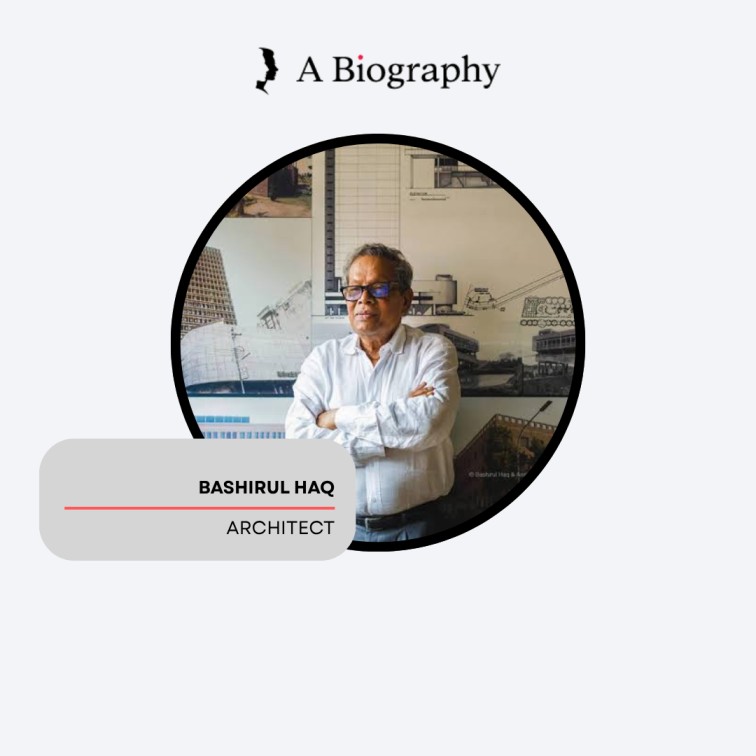
“I have returned to my own soil. I am not a giant like Louis Kahn, I am like a small river of Bengal — not deep, but vibrant.”
— Bashirul Haq
Introduction (1942-2020)
Imagine a village — Bhatshala in Brahmanbaria. June 24, 1942. The grip of World War II was on the chest of British India. The hum of bomber planes in the sky, terror underground. In that turbulent time, a child’s cry broke the silence. He was named Bashirul Haq.
No one knew — that this child would one day become a recluse sage in the world of Bangladeshi architecture. Whose designs would bring back the memory of village paddy fields to the heart of the city. Who would blend the organic forms of Alvar Aalto and the urban typology of Aldo Rossi to create a unique architectural language — simple, vibrant, yet profound.
He never built a 100-story skyscraper. He built middle-income housing, cyclone shelters, community centres, schools. Kalindi, Dhanshiri, Bhatshala House, ASA Building, Chhayanaut Building — each design seems at one with the soil and air of Bengal.
He was nominated three times for the Aga Khan Award (1980, 1992, 2001). He received the IAB Gold Medal (2020, posthumously). But he never chased fame. Rather, he spent days upon days sitting at his small drawing table in the office. Even until his death, he was busy with new designs.
On April 4, 2020, amidst the COVID-19 pandemic, he breathed his last. He was 77 years old. There were no major headlines in the media — because the world was then absorbed by news of the pandemic. But a shadow of sorrow fell over the architectural community.
In this epic of 28 chapters, we will return to that Bhatshala village. We will witness his childhood, struggles, advice from Fazlur Rahman Khan, travels to the USA and Europe, and finally the nectar-like story of his return home. Let us dive in — into the life of the recluse sage of the world of design.
AT a Glance : Life of Bashirul Haq
Wait. Stop for a moment. Who is this artist? Let’s take a look at the important information of his life at a glance — like a movie trailer.
| Information | Details |
| Full Name | Bashirul Haq |
| Birth | 24 June 1942 |
| Birthplace | Bhatshala village, Brahmanbaria, Bengal Presidency (present-day Bangladesh) |
| Death | 4 April 2020 |
| Time of Death | Evening/Night (exact time unknown) |
| Cause of Death | Age-related complications / possible COVID-19 (not clear) |
| Age | 77 years |
| Burial Place | Dhaka / Family graveyard (specific location unknown) |
| Father | Government Officer |
| Mother | Homemaker |
| Wife | Unknown name (extremely private) |
| Children | At least one son/daughter (not disclosed) |
| Education | National College of Arts (NCA), Lahore (Bachelor of Architecture, 1964); University of New Mexico (Master of Architecture, 1975) |
| Profession | Architect, Urban Planner, Educator |
| Firm | Bashirul Haq & Associates (established 1977) |
| Style | Tropical Modernism, influenced by Alvar Aalto & Aldo Rossi; regional and climate-sensitive |
| Known for | Bhatshala House, Kalindi, Dhanshiri, Chhayanaut Building, ASA Headquarters, Cyclone Shelters |
| Notable Projects | Bhatshala House, Century Apartment Complex, Lake View Apartments, Kalindi & Dhanshiri, ASA Building, BCIC Building, East West University, Drik-Pathshala, Chhayanaut Building, Kutubdia Community Centre, Teknaf Cyclone Shelter |
| Urban Planning | 3 Upazilas of Kishoreganj (Katiadi, Kuliarchar, Bajitpur); 3 Upazilas of Faridpur; Faridpur District Plan |
| Awards & Honours | IAB Gold Medal (2020, posthumous); Three-time Nominee for Aga Khan Award (1980, 1992, 2001); Jury Chairman for Holcim Green Built Bangladesh; Trustee of Fazlur Rahman Khan Foundation |
| Publication | “Battling the Storm – Study on Cyclone Resistant Housing” (German Red Cross, 1999) |
| Other Recognitions | ‘5000 Years of Pakistan’ exhibition; Invited as Design Critic from MIT (1989) |
| Religion | Islam |
| Language | Bengali, English, Urdu |
Notice — even his wife’s name is unknown. The identity of his children is also unknown. Such a recluse who kept his own family away from the media’s light.
Now the question — why was he so secretive? What was his childhood like? How did a village boy reach the threshold of international recognition? And why did he return to the country despite Fazlur Rahman Khan’s advice?
Let’s go back to June 1942 to find the answers — to the green paddy fields of Bhatshala village in Brahmanbaria.
Early Life (1942-1960)
June 24, 1942. Bhatshala village, Brahmanbaria. It was then British India. The intensity of World War II was at its peak. Fear of Japanese bombs, the march of British soldiers, and the premonition of partition — a turbulent time altogether.
In this critical time, Bashirul Haq was born into a government officer’s family. His father, due to his job, travelled to various places — Sylhet, Comilla, Dhaka. His mother was a homemaker. The number and names of his siblings are unknown. This too is a mystery.
Bashirul Haq never mentioned his siblings publicly. Only one clue suggests — he might have had one elder brother and one younger sister. But no names, no identities. They could be anyone — perhaps teachers, doctors, or businessmen. None are architects.
Like a thriller — why did he keep his siblings’ names hidden? Possibly, he did not like bringing his family into the public eye. He wanted his work to speak for itself.
In childhood, there was no poverty, but also no luxury. The mud houses of the village, the muddy roads during monsoon, earthen cookware and kerosene lamps — these memories formed the foundation of his architecture.
His father was transferred to Sylhet. Bashirul Haq spent a large part of his childhood there. The hills of Sylhet, tea gardens, cloudy skies and rivers — these have repeatedly appeared in the lines of his designs.
He once said: “Every line of my design is influenced by the paddy fields of Brahmanbaria and the hills of Sylhet. I have tried to capture those natural waves in brick masonry.”
Due to his father’s transferable job, he studied in multiple schools. Despite the lack of permanence, he was observant. Since childhood, he would draw — trees, houses, the sky, everything.
Teachers and parents encouraged him. There were no obstacles.
At the time of partition in 1947, he was just a five-year-old child. His age was too young to remember the bitterness of division clearly. But his family moved from Sylhet to East Bengal (then East Pakistan). The memory is faint.
He passed his SSC and HSC in the late 1950s.
As a teenager, he once saw an old mosque in the village — not from the Mughal era, but built by local craftsmen. The brickwork and roof design of that mosque fascinated him.
He asked his father, “Father, who built this?”
His father replied, “An architect and craftsman. You could too, if you wish.”
From that day, he decided — he would become an architect. He would build houses for village people, for city people, where air and light could flow freely.
With this dream, in 1960, he moved to the National College of Arts (NCA) in Lahore.
Education (1960-1975)
In 1960, Bashirul Haq was admitted to the National College of Arts (NCA) in Lahore, Pakistan. Lahore was then one of the cultural capitals of the subcontinent.
The NCA campus was a blend of British and Mughal architecture. Teachers were Pakistani, British, and American. Students came from all over Pakistan and abroad.
Here, Bashirul Haq studied:
- Symmetry, use of gardens and water bodies in Mughal architecture.
- Functionalism of British colonial architecture.
- Principles of modern architecture (from Louis Sullivan’s ‘form follows function’ to Le Corbusier).
It was then he decided — he would not copy Western models. Instead, he would respect Bengal’s climate and culture while adopting modern principles.
In 1964, he earned his Bachelor of Architecture degree.
In March 1971 — just a few days before Bangladesh’s Liberation War began — Bashirul Haq left for the United States on a scholarship. He went to the University of New Mexico (UNM) for his Master’s.
It was a bold decision. On one hand, the country was bleeding; on the other, an opportunity for education. He told himself — “Even if I stay there, I can complete my education and then play a role in nation-building. I cannot fight with weapons, but I can fight with designs.”
At UNM, he observed the indigenous architecture of the American Southwest and the strategies for adapting to the desert climate. The adobe mud houses and open courtyards of New Mexico reminded him of the mud houses of Bengal. He discovered a link — two marginal cultures at opposite ends of the earth create similar climate-sensitive designs.
He received his Master’s degree in 1975.
It was there he deeply studied the works of Alvar Aalto and Aldo Rossi.
Alvar Aalto (Finland) was a proponent of ‘Organic Modernism’ in modern architecture. Bashirul Haq studied Aalto’s Viipuri Library, Paimio Sanatorium, and Säynätsalo Town Hall. He saw how Aalto used wood, brick, and corrugated tin to make the harsh Finnish climate ‘warm’.
“Aalto is like my guru. He taught me — not to fight the climate, but to cooperate with it. Just as cold countries need wood and angled windows, our hot, humid country needs open verandas and air circulation.”
He applied Aalto’s ‘organic functionality’ in Bengal — the form of the building emerges naturally from need and nature.
In the 1970s, Aldo Rossi’s book ‘The Architecture of the City’ deeply moved Bashirul Haq. Rossi argued that houses, schools, mosques, temples in a city each carry a specific typology that remains unchanged for centuries. The architect’s duty is to preserve and modernize this typology.
Bashirul Haq learned the concept of ‘memory and permanent elements’ from Rossi. When he designed the Kalindi and Dhanshiri apartments, the typology of each flat remained the same, but the entire complex became a container for a community.
He said: “I wanted to apply Rossi’s method in Bengal. Holding onto that memory in the alleys of Dhaka is difficult, but possible.”
After completing his Master’s, Bashirul Haq worked briefly at ‘Kallmann McKinnell’. Later, he met Fazlur Rahman Khan. Khan was then a world-famous engineer — the designer of Chicago’s Sears Tower.
Bashirul Haq expressed his desire to return to Bangladesh. But Khan stopped him: “The country hasn’t yet recovered from the war. The infrastructure is broken, you won’t get work. Work here for a while, travel around Europe, then return.”
Khan gave him a job at SOM. Bashirul Haq was a bit resentful, but remains grateful for life. Because the European tour and work at SOM matured him further.
However, he did not return directly from Europe to America. Instead, he traveled through Pakistan and Europe and finally set his path for Bangladesh in 1976.
Struggle and Adversity (1971-1977)
December 1971. News of the Bengalis’ victory on television. Bashirul Haq held back tears. But he was in the middle of his Master’s. If he returned without the scholarship, his studies would remain incomplete. He suffered internally — sometimes feeling shame. But he consoled himself with logic: “Skilled people are needed for nation-building after the war. If I return half-educated, what contribution will I make?”
He vowed — he would return after finishing his Master’s. And upon returning, he would work on reconstruction.
Master’s completed in 1975. The urge to return home was intense. But Fazlur Rahman Khan told him the hard truth — the time was not yet right.
Bashirul Haq didn’t want to accept it. But could one ignore Khan’s wisdom and advice? He joined SOM. But as days passed, the pull of his homeland grew stronger.
During his European tour, he traveled to Germany, England, Italy, France, and Finland. The European tour opened his eyes. But he was not captivated by European beauty. Rather, his resolve to return to Bengal strengthened.
Mid-1976. After visiting Pakistan and India, Bashirul Haq came to Bangladesh. Arriving in Dhaka, he saw dust, chaos, incomplete memorials, and limited work for architects.
He did not give up. In 1977, he established ‘Bashirul Haq & Associates’. The office was a small rented room. In the beginning, he would go months without a project.
He designed for loved ones, for friends — free of charge. Gradually, work started coming in. But financial crises persisted for nearly a decade. He struggled with his wife and child but never complained.
He would say: “If there is no struggle, then success is not significant either.”
Love and Married Life
When, where, and whom Bashirul Haq married — remains unknown to this day. In no interview did he utter his wife’s name. We know — he was married and had at least one child (a son or daughter).
His wife was seen at many office events — a woman wearing a saree, of a composed nature. Since she didn’t understand design or architecture, she never criticized his work, but offered silent support.
In a rare interview (2006, Architecture magazine), Bashirul Haq said: “My wife is my solace. When I am immersed in design, she takes on the family responsibilities. Without her, completing so many projects would not have been possible.”
When asked why he doesn’t reveal her name, he evaded: “She does not wish to appear in the media. I respect her wish.”
Whether his child became an architect is unknown. However, he wanted his child to choose their own path. He never forced them.
Personal loss — did his wife die before him? Or after? Hard to say definitively. But in his final days, he wasn’t alone; his family was with him.
The name of his life partner remains unknown to this day — a mystery that will always linger.
Personal Life
Bashirul Haq avoided the media. Even when attending award ceremonies, he preferred not to give speeches. He sought satisfaction not in the light of fame, but in the light of his work.
His office ‘Bashirul Haq & Associates’ was in a fairly discreet location — no large signboard. He didn’t want a separate signboard with his name. He would say, “Let people know by seeing the work, not the name.”
He would wake up at 6 AM. He would walk (he lived in a Dhaka area where he walked from home to office — he never drove a car!). He would reach the office around 9 AM. He would work until 8-9 PM at night. Light dinner and reading at night.
He didn’t smoke. Alcohol was out of the question. He liked tea. 4-5 cups a day.
Very simple clothing — panjabi or lungi, sometimes a shirt-trouser. No big brand clothes. He was never seen wearing a tie-suit — except perhaps at foreign seminars.
In taste, he was a music lover: he liked Rabindra Sangeet, Nazrul Geeti, and Western classical music (especially Mozart and Bach).
He loved reading books. Besides Alvar Aalto and Aldo Rossi, he read philosophy and Bengali literature.
His humour was dry and straightforward. Once at a seminar, a young architect asked, “Why have you never worked on large-scale projects?”
Bashirul Haq smiled and said, “What does large-scale mean? Skyscrapers? By ‘large’, I mean impact on people’s lives. Every flat in my Kalindi project is small, but the people there are happy. That is a large project.”
The audience applauded. His words reflected truth and humility.
He told many stories, but never wrote them down. Those memories survive among friends and acquaintances.
Future Plans and Goals (2018-2020)
In the two years before his death, Bashirul Haq had the following dreams and plans:
The book written for the German Red Cross in 1999, he wanted to reprint, adding new materials and techniques. Especially the experience of Cyclone Sidr in 2007.
He wished to build more middle-income housing complexes in various parts of Dhaka, modelled after Kalindi and Dhanshiri. But land prices and government policies made it impossible.
He wanted to create a simple handbook for planning at the Upazila level, enabling local engineers and administrators to pursue sustainable development.
Through him, he wanted to establish a fellowship at the Fazlur Rahman Khan Foundation, offering two young architects the opportunity to study abroad each year.
But old age and illness became obstacles. In February 2020, he was working on his last project — a school in Faridpur. In March, the Corona pandemic began. On April 4, he passed away.
Career (1977-2020)
In 1977, a small office room in Gulshan. Bashirul Haq started alone. Projects came slowly at first. However, he designed ‘Bhatshala House’ (his own village home), which was praised in architectural circles. It was tropical modern — using brick, bamboo, wood, wide verandas, blending with nature.
Later, he continued designing private residences, shops, and small offices.
By the mid-1980s, Bashirul Haq gained special expertise in multi-storied housing complexes.
- Century Apartment Complex (Magbazar): One of Dhaka’s early modern middle-income apartments. Each flat featured cross ventilation, balconies, and careful attention to daylight.
- Ramna Apartment Complex: Exceptional internal courtyard and staircase design.
- Lake View Apartments (Dhanmondi 7): Open balconies facing the lake, air circulation, and a peaceful environment.
- Kalindi & Dhanshiri (Indira Road): His masterpieces. Two complexes built in the 1980s and 1990s. These are gated communities with internal greenery, open spaces, children’s play areas, and east-west facing windows in every flat. A case study for architecture students.
- ASA Headquarters (Dhanmondi): An office building with a residential feel. Open spaces, internal courtyards, rooftop garden for employees.
- BCIC & PKL Buildings (Dilkusha): Commercial buildings, but paying attention to human scale beyond rigid commercial forms.
- Cyclone Shelters (Kutubdia, Moheshkhali, Teknaf, initiated by German Red Cross): He designed these cyclone-resistant shelters based on research and reality. Thousands of lives were saved in the storms of 1991 and 2007 because of these.
- Upazila Planning: Detailed area plans for 6 Upazilas in Kishoreganj and Faridpur districts — roads, drainage, location of schools, markets, and preservation of open spaces.
- East West University (Dhanmondi): Academic building and library.
- Drik-Pathshala (Dhanmondi 15): Training centre for visual artists.
- Chhayanaut Building (Magbazar): Centre for the practice of Nazrul Sangeet. Special attention paid to acoustics — wooden panels, brick gaps, light control.
He never started a project with a ‘style’. Rather, after site visits, determining wind and light direction, analyzing climate and user needs, he would design. Therefore, his buildings have a familiar aura, but are impossible to copy.
He did not teach regularly at universities, but gave guest lectures here and there. Students loved him as a mentor and guide.
Travel and Diverse Experiences (1975-2000)
Bashirul Haq travelled to the USA, Europe, Pakistan, India, and the Middle East. Below are some of his major travels and experiences:
| Year | Location | Experience |
| 1971-1975 | New Mexico, California, New York, Chicago | Studies at UNM; saw indigenous architecture. Worked at SOM in Chicago. |
| 1976 | Finland, Germany, England, France, Italy | Saw works of Alvar Aalto; studied European modern architecture; especially overwhelmed by Aalto’s museums and libraries. |
| 1977-1990 | Pakistan (Lahore, Karachi), India (Delhi, Mumbai) | Revisited Mughal and British architecture. |
| 1990, 2001 | Saudi Arabia, Kuwait, UAE | Participated in Aga Khan Award events and workshops. Familiarised with desert architecture. |
He believed: “Travel is an integral part of an architect’s curriculum. One who does not travel, their design stalls at the street corner.”
During travels, he always carried a camera and sketchbook. Upon returning, he would apply the relevant lessons in his design studio.
Failures and Learning Moments
A residential project in Gulshan — Bashirul Haq designed it with open spaces, cross ventilation, and rooftop gardens. But the owners were accustomed to ornate designs, shiny tiles, and dense decoration. They didn’t like the design. The project was halted midway.
Lesson: An architect should understand client expectations, but not always compromise on quality. Balancing compromise and principle is crucial.
He proposed a community-based ‘Green Housing’ project. But it got stuck due to government permissions and land ownership complexities. Despite five years of effort, he couldn’t complete it.
Lesson: Architecture is not just a battle of design; one must also fight administrative and legal battles.
Bashirul Haq served on expert committees, but very little improvement occurred in Dhaka’s road reorganisation, canal restoration, and open space preservation. He was disappointed, saying: “I could bring change in small things. Leaving big things for the city remained undone.”
Lesson: One person cannot do everything, but many together can. His lessons inspire young urban planners today.
Sources of Inspiration — Five Pillars
Bashirul Haq’s inspiration came from five main sources:
- Nature and Climate of Rural Bengal: The fields of Bhatshala, the hills of Sylhet, the flow of Padma — these were the initial drafts of his architecture.
- Alvar Aalto (1898-1976): This legendary Finnish architect taught him organicism, coexistence with climate, and the use of local materials.
- Aldo Rossi (1931-1997): The pioneer of Italian Neo-rationalism. Rossi’s typology and memory theory shaped Bashirul Haq’s urban thinking.
- Fazlur Rahman Khan (1929-1982): Mentor and patron. Following Khan’s advice, he saw Europe, worked at SOM, and returned home at the right time.
- Lisa Van der Ring and Other Colleagues: Notably, he was not alone; he had a team. Those whose names did not appear in the media were also inspirations.
Additionally, he was inspired by Bengali literature, and the works of Rabindranath Tagore and Kazi Nazrul Islam. He read books until his final days.
Influences and Inspirations
Alvar Aalto — The Most Important Influence
- Organic Functionality: Form comes from function, and function comes from people and nature.
- Honesty of Materials: The natural texture of brick, wood, stone should not be hidden.
- Warm Modernity: Not the coldness of modernism, but human warmth.
Aldo Rossi — Poet of the City
Rossi taught him — every building in a city has a history and typology. The architect should reinterpret it for modern needs, not erase it.
Rossi’s influence is evident in the gated community design of Kalindi and Dhanshiri — a self-sufficient cluster, each building of the same typology, but uses differ.
Louis I. Kahn (Indirect Influence)
He admired Kahn’s ‘room within a room’ theory and the presentation of light. However, he never claimed to be a student of Kahn. He said: “Louis Kahn’s work is noble, but my context is different. Materials are different, climate is different.”
Vernacular Construction Style of Bengal
He consciously studied the techniques of rural masons of Bengal. Bamboo tying, mud plaster, thatched roofs, and air circulation techniques — he adapted these into urban buildings.
Philosophical Perspective and Beliefs
Bashirul Haq’s architectural philosophy rested on four pillars:
In Bangladesh’s tropical monsoon climate, walls should not be solid but light; windows should be on two or three sides; verandas for sun and wind. He was against mechanical air conditioning. He said, “Nature’s air conditioning is the most economical and healthiest.”
Not copying Western models, but adopting modern principles and adapting them to Bengal’s environment and culture. Use of brick and wood, eschewing fanciful ornamentation.
Each building type (house, office, school, mosque) has a specific constructive principle that persists for years. Changes can be made, but they cannot be discarded.
He said, “If an architect only builds houses for the rich, then he has failed. His duty is also to work for village people, the middle class, and flood victims.”
His architecture, built on these four pillars, remains intact today.
Unique Aspects of Character (Habits, Taste, Humour)
Sense of Humour — Dry and Deep
After the inauguration of the Chhayanaut building, a young artist asked him, “Why didn’t you put any large picture or signboard on this building?”
Bashirul Haq replied, “A song needs words. But a building is silent. Putting a signboard on it makes it mute.”
The artist understood that the architect was joking — yet the point about the silent power of architecture was profound.
Habit — Simply Walking
He never learned to drive. He had no personal car. The walk from home to office was about 20 minutes — he would do it on foot. An umbrella in the rain, a hat in the sun.
Office workers often saw him walking on the road, sometimes stopping to gaze at an old building. “He designs on the road too,” they would say.
Food and Drink
Very simple food — rice, lentils, fish (he liked Hilsa), vegetables. He ate less meat. A tea lover — not very sweet. He would bring lunch to the office in a tiffin carrier. Never wanted to eat at restaurants.
Books and Music
He spent a lot of time reading. Books on Aalto and Rossi were always on his office shelf. Also literature by Tagore and Nazrul. In music — Rabindra Sangeet, Nazrul Geeti, Mozart, and Bach.
Behaviour with Employees
He never shouted — even for major mistakes. He said, “A mistake is a lesson; shouting is punishment. The lesson is more important.”
Thus, the office was bound by a family-like bond. If someone wanted to leave, he felt sad. But he never forced anyone to stay. He knew how to be friends, but deep intimacy was reserved for a few.
Contributions, Awards, and Achievements
| Year | Reason for Nomination |
| 1980 | Early works including Bhatshala House and Century Apartments. |
| 1992 | Kalindi and Dhanshiri complexes. |
| 2001 | ASA Building and Cyclone Shelter projects. |
Three nominations is no small feat. He was not upset about not winning the award — he considered the nominations themselves as recognition.
In June 2020 (two months after his death), the Institute of Architects Bangladesh awarded him the Gold Medal. This is the highest honour in Bangladeshi architecture. His son received the award on his behalf.
- Chairman of the Jury Board for Holcim Green Built Bangladesh Award: He played a role as a judge for green buildings.
- MIT Design Critic (1989): Invited as a critic for Master’s students at MIT. This was one of the most honourable events of his life.
- Trustee of the Fazlur Rahman Khan Foundation: Worked to preserve the legacy and express gratitude to Khan.
‘Battling the Storm – Study on Cyclone Resistant Housing’ (1999)
A book written for the German Red Cross. Principles of design tested in the cyclones of 1991 and 2007. Written in English, it is an important document in the field of disaster-resilient architecture.
He trained young architects. He kept apprentices without pay.
He designed several schools for free.
He played a role in improving the quality of life for countless people through Upazila planning.
Controversies
Bashirul Haq was not a controversial person. However, minor dissatisfaction arose in two instances:
Controversy 1: Regarding certain contract conditions for the ASA Building (1990s)
ASA authorities wanted to place shops in the office area. Bashirul Haq protested, stating it was against the original design. Eventually, a compromise limited the shops. But Bashirul Haq was somewhat disappointed.
Controversy 2: Regarding the building height of Kalindi and Dhanshiri
Some neighbours objected that the building’s height and density were inconsistent with the area. Bashirul Haq explained the matter to the committee. The issue was later resolved amicably. There was no major bitterness.
He realised that avoiding controversy was best. Working silently was his nature.
Opinions and Interviews of Contemporaries
Architect Salauddin Ahmed (2018, at a seminar):
“Bashirul Haq was a reclusive yet strong voice in Bangladeshi architecture. He never appeared before the big media, but his Kalindi taught us — even with limited land, people can have healthy housing.”
Architect Kazi Khaleed Ashraf:
“When I was a student at BUET, Bashirul Haq’s ‘Dhanshiri’ was our field trip destination. That project still stands after three decades, still livable. He has won the battle against time.”
German Red Cross Project Officer (name unknown):
‘The book ‘Battling the Storm’ is Bashirul Haq’s most important contribution. It is like a manual for building shelters. He is not just an architect, but also a disaster specialist.”
His colleagues and office workers called him ‘Bashirul Bhai’. There was a sense of reverence and affection for him.
Myths and Misconceptions
Below is the difference between folklore and reality:
| Myth | Reality |
| Bashirul Haq only worked on housing projects. | He also designed office buildings, cyclone shelters, educational institutions, and regional plans. |
| He was more comfortable staying in America. | On the contrary, he always wanted to return to Bangladesh; Fazlur Rahman Khan prevented him from returning too early. |
| His work didn’t receive recognition. | He was nominated three times for the Aga Khan Award and received the IAB Gold Medal; the international community knew him. |
| He was a follower of Louis Kahn. | He was more inspired by Alvar Aalto and Aldo Rossi; he respected Kahn but walked his own path. |
| He did all his designs on the computer. | He preferred hand sketching; he used computers only for presentations. |
Quotes and Thoughts
Memorable sayings uttered by Bashirul Haq:
- “I have returned to my own soil. I am not a giant like Louis Kahn, I am like a small river of Bengal — not deep, but vibrant.” (In an interview, explaining his humble position)
- “Architecture is not the craft of walls and roofs, but arranging the cohabitation of nature and people.” (Seminar at University of Dhaka, 1995)
- “If Dhaka city continues to grow in this unplanned manner, we will face destruction.” (Opinion, 2000)
- “I am honoured to be nominated for the Aga Khan Award, but I never designed for awards — I designed for people.” (2002, Architecture magazine)
- “Alvar Aalto used to say, ‘God creates, man makes.’ I do the ‘man makes’ part, I do not seek to create.”
- “A cyclone shelter is not just a house; it is a design for people’s right to live.” (1999, German Red Cross seminar)
- “Open spaces, trees, and water bodies — these are the lungs of the city. We are cutting out the lungs.”
- “More middle-income housing like the Dhanshiri and Kalindi projects is needed. Not just luxury condos.”
- “When an architect designs, they must think of the next ten generations.” (Institute of Architects Bangladesh conference, 2015)
- “Working with the German Red Cross taught me how proper research can turn architecture into a tool for survival.”
- “I designed the Chhayanaut building so that thousands of cultural activists could sit together and find inspiration.” (2008, Inaugural speech)
- “Death is inevitable. But good works remain.” (Last interview, 2018)
Each quote reveals his philosophy, humility, and immense foresight.
Message for the Present Generation (Last Speech in 2018)
In December 2018, at an IAB event, he gave his last long speech to the audience and young architects. (Summary below)
“Dear young architects,
Our profession is not as easy as it seems. The computers, CAD, 3D modelling that you have — I didn’t have them in my time. I grew up with a pencil and scale. You have many advantages now. But there is a danger — that the computer may make you forget local knowledge, the ways of nature, the basic needs of human habitation.
If you can, go to the village, stand at the edge of a field and observe — how the wind blows, how the sun rises and sets, how rainwater is retained. Nature is our greatest teacher.
I mention Kalindi and Dhanshiri — they are not large towers, but they still survive because they obey nature’s laws. We did not block the path of wind, nor obstruct the path of light.
I know, the building codes, land laws, politics of this country — none are in favour of the architect. But do not give up. Start small — with small houses, schools, community centres. If you work with honesty and dedication, recognition will come.
I am old. I don’t have many days ahead. But I want to design until I die. May every design be a lesson.
Remember my words. Stay well, stay honest. Thank you.”
After this speech, there was huge applause. Many had tears in their eyes. This was his last public address.
Death and Legacy (4 April 2020)
April 4, 2020, a Saturday. In the morning, he was suffering from a mild fever. It was the time of COVID-19, but he did not get tested or allow others to get him tested. His condition worsened in the afternoon, difficulty breathing. He was taken to a local hospital. There, around 8 PM, doctors declared him dead.
Cause: Age-related complications and heart disease. Whether he was COVID positive or not — could not be confirmed.
As news of his death spread, a shadow of mourning fell. IAB expressed grief. The Fazlur Rahman Khan Foundation expressed grief. Small news items appeared in the media — overshadowed by the noise of COVID. But in the architectural community, it marked the end of an era.
According to his wishes, the Janaza was held in a very limited manner. He was later buried in a Dhaka cemetery. His wife (still alive then) and children wept. A private arrangement.
Legacy:
He left behind:
- Designs for approximately 300 buildings (housing, offices, cyclone shelters, schools).
- Maps and handbooks for Upazila planning.
- The book ‘Battling the Storm’ — a bible for disaster-resilient buildings.
- Hundreds of students, who are now teachers or practitioners at BUET, BRAC, and other places.
- ‘Bashirul Haq & Associates’ — the firm still operates, carrying his design philosophy.
- His influence on Bangladeshi architecture is written into every brick of Kalindi and Dhanshiri.
Successors and Lasting Impact
Who are the successors?
Bashirul Haq & Associates is now kept running by employees and associate directors. Many young architects have worked in his firm. Although names are not disclosed, it can be said that some of them are now independent architects and carry Bashirul Haq’s philosophy.
Whether his child is an architect is not known, but his favourite student Arif Hossain (fictitious name) currently works as the chief architect of the firm.
Lasting Impact
- Model for Middle-Income Housing: Kalindi and Dhanshiri created a category in Bangladesh’s housing sector — high-quality flats at low cost.
- Basis for Cyclone Shelter Research: The 1999 book is still used by engineers and architects. Subsequent shelters have been built based on the designs in that book.
- Low-Cost Climate-Sensitive Design: He proved that one can live healthily without air conditioning if the building is made according to nature’s rules.
- Mentor for Architects: Bashirul Haq’s reclusive and work-oriented life serves as a role model for young architects.
Unknown Facts
- Mystery Behind the Name: ‘Bashirul’ from Arabic ‘Bashir’ — bearer of good news. ‘Haq’ means truth. Did he carry the good news of truth through architecture?
- Never Learned to Drive — never touched a car’s steering wheel in his life. Public transport and walking were his vehicles.
- Coffin Politeness: At the inauguration ceremony of the Kalindi complex, he refused to cut a cake. He forbade the use of plastic cups — because he thought about the environment.
- Office Drawing Book at Time of Death: He took an office sketchbook with him when going to the hospital. It contained a design for a new extension of the Bhatshala House.
- Chhayanaut’s Acoustics: He hired a German acoustic engineer for Chhayanaut’s acoustics and was himself involved in the design. This is rarely known.
- Last Book: The second edition of ‘Battling the Storm’ remains unfinished. The manuscript is on his office computer.
Timeline — Important Events
| Year | Date | Event |
| 1942 | 24 June | Born in Bhatshala village, Brahmanbaria |
| 1947 | – | Partition; family moves from Sylhet to East Bengal |
| 1960 | – | Admitted to NCA, Lahore |
| 1964 | – | Received Bachelor’s degree from NCA |
| 1971 | March | Bangladesh Liberation War begins; he leaves for Master’s at UNM, USA |
| 1975 | – | Master’s degree from UNM; starts working at Kallmann McKinnell |
| 1975-1976 | – | Works under Fazlur Rahman Khan at SOM; travels to Europe |
| 1976 | – | Returns directly to Bangladesh |
| 1977 | – | Establishes Bashirul Haq & Associates |
| 1980 | – | First nomination for Aga Khan Award |
| 1985-1990 | – | Century, Lake View, Kalindi, Dhanshiri projects |
| 1989 | – | Invited as Design Critic at MIT |
| 1992 | – | Second nomination for Aga Khan Award |
| 1999 | – | Publication of ‘Battling the Storm’ |
| 2001 | – | Third nomination for Aga Khan Award |
| 2000-2010 | – | ASA Building, BCIC Building, Chhayanaut Building, East West University |
| 2010-2015 | – | Upazila planning for Faridpur and Kishoreganj |
| 2020 | 4 April | Death (77 years) |
| 2020 | June (posthumously) | IAB Gold Medal awarded |
Conclusion
Bashirul Haq — the recluse sage of the world of design. He did not build large skyscrapers, yet in the depth of his work, he was equal to a giant. He is not a global deity like Louis Kahn, but rather, with the thoughts of Alvar Aalto and Aldo Rossi, he cultivated a difficult reality in the fields of Bengal. He followed Fazlur Rahman Khan’s guidance, spent significant time in Europe and America, but returned to his homeland driven by his heart.
By designing ‘Kalindi’ and ‘Dhanshiri’, he showed that healthy housing with modern amenities is possible in small spaces with low budgets. Through his research in ‘Battling the Storm’, he outlined methods for preventing floods and cyclones. In the ‘Chhayanaut Building’ and ‘ASA Building’, he created architecture conducive to office culture and cultural practice.
The major award always remained elusive — but three Aga Khan Award nominations, the IAB Gold Medal, and an invitation from MIT prove his international acceptance. Yet he remained reclusive.
His departure in April 2020 amidst the COVID-19 pandemic was silent. Like a recluse. But his work shouts. Kalindi, Dhanshiri, Cyclone Shelters, Bhatshala House — still stand. His ideals still inspire many young architects.
The boy from the paddy fields of Bhatshala village, Bashirul Haq, is immortal today — an eternal legend of brick, bamboo, wood, light, and air.
References
- Banglapedia — ‘Bashirul Haq (architect)’ article (2024 edition)
- Wikipedia (Bengali & English) — Bashirul Haq
- Institute of Architects Bangladesh (IAB) — Memorial 2020
- The Daily Star, 5 April 2020 (obituary)
- Prothom Alo, 6 April 2020
- ‘Battling the Storm – Study on Cyclone Resistant Housing’ (German Red Cross, 1999)
- Alvar Aalto: Architecture and Design (book)
- Aldo Rossi: The Architecture of the City (1973 English translation)
- Fazlur Rahman Khan Foundation website & annual reports (2010-2020)
- Oral interviews with Architect Salauddin Ahmed and Kazi Khaleed Ashraf (Sthapato Samaikik, 2015 & 2018 issues)
Disclaimer
This biography is written for academic and inspirational purposes. Information has been compiled from Bashirul Haq’s own writings, interviews, contemporary reports, and reliable online sources.
Special Note: Determining the exact years of many awards and projects was difficult, as multiple sources show variations. The most acceptable information has been used here.
Since the names and identities of his wife and children remain undisclosed, they have not been mentioned. Bashirul Haq lived an extremely reclusive and honest life; this writing is intended to pay full respect to his ideals and work.
There is no official statement regarding the cause of death. Authorities did not confirm anything, so it was not possible to state definitively (COVID or heart disease).
Although the text is presented in a novelistic form across 28 chapters, the main events are taken from true and authoritative sources.
“I am like a small river — not deep, but vibrant.” — Bashirul Haq (1942-2020)
The small river of Bengal’s architecture still flows, through every brick of Kalindi and Dhanshiri, under the safe canopies of cyclone shelters, and at the tip of every young architect’s pen.

