
Biography
A Biography of Bibi Russell

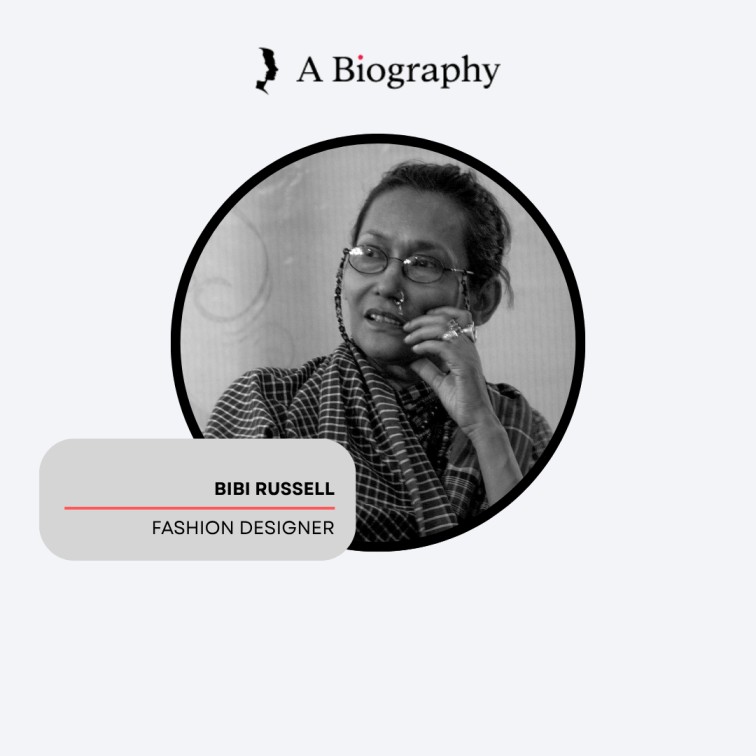
Introduction
Picture an evening in 1996. One of Paris’s most prestigious fashion venues. Glittering lights. Camera flashes illuminating every corner. The pinnacle of glamour. The biggest names in the fashion world — designers, editors, celebrities, buyers — all present.
Suddenly, everything stopped. The music ceased. The lights dimmed. Then slowly, they glowed again — this time with a different aura.
From one end of the ramp walked a model. Draped in a silk sari with intricate zari work. The next model wore handwoven khadi, adorned with a nakshi kantha shawl. Then came jamdani, silk, batik — all handcrafted, all made by the hands of Bengal’s rural weavers.
The audience was mesmerized. Some wiped their eyes in disbelief. Others whispered, “Is this India?” “No, this is Bangladesh.”
But this was not just any fashion show. It was the voice of one woman, the embodiment of one woman’s dream. The woman who had modeled for Yves Saint Laurent and Giorgio Armani, who had graced the pages of Vogue, who had walked alongside Naomi Campbell and Claudia Schiffer — that woman had returned to save Bengal’s khadi and jamdani.
Her name is Bibi Russell.
At a Glance — Life of Bibi Russell
| Information | Details | Thriller Note |
| Full Name | Bibi Russell | ‘Bibi’ means ‘woman’ in Bengali and Persian — but she herself is a brand |
| Birth | 1950, Chittagong, Bangladesh | Chittagong in the 1950s; after completing education there, she went abroad |
| Current Age | 76 years (as of 2026) | Still active — fashion shows, writing, social work |
| Father | Mokhlesur Rahman | Government employee, encouraged children’s education |
| Mother | Shamsunnahar | Homemaker, Bibi’s primary source of inspiration |
| Siblings | Brothers and sisters; all doctors and engineers | Bibi chose fashion — a courageous decision! |
| Education | Kamrunnessa Government Girls’ High School; Azimpur College of Home Economics; MA from London College of Fashion (1975) | First Bangladeshi woman to study at London College of Fashion |
| Profession | Model, Fashion Designer, Entrepreneur, UNESCO Ambassador | Artist and activist rolled into one |
| Modeling Career | Active from 1976 to 1992; model for Vogue, Harper’s Bazaar & Cosmopolitan (1986-1992) | Bangladesh’s representative in world’s top magazines |
| Brands Modeled For | Yves Saint Laurent, Karl Lagerfeld, Giorgio Armani, Chanel, BMW, Toyota, Kodak | Model for major European and American brands |
| Worked with Famous Models | Naomi Campbell, Claudia Schiffer | Shared the ramp with world’s top models |
| Own Organization | Bibi Productions (established 1994, upon returning to Dhaka) | Creating employment for rural weavers |
| Number of Weavers Connected | 35,000 weavers | Directly and indirectly benefiting lakhs of people |
| Special Contribution | Bringing khadi, jamdani, nakshi kantha, silk garments to the global market | Transforming traditional fabrics into modern fashion |
| Awards | UNESCO Artist for Peace (2001), Officer’s Cross of the Order of Isabel the Catholic (2010), UNESCO Special Invoy: Designer for Development (1999), Honorary Fellowship of London Institute (1999) | International and national recognition |
| Film Work | ‘Moner Manush’ (2009) – National Film Award (Best Costume Design) | Recognition through Bengali cinema |
Early Life — The Girl from Chittagong, Education in Dhaka’s Schools
Birth — Chittagong in the 1950s, the Echoes of Anti-British Movements Still in the Air
Chittagong, 1950. British India had been partitioned just three years ago, becoming East Pakistan. The memories of independence still lingered, the fire of the Language Movement still burning. During this time, Bibi Russell was born into a respectable Muslim family in Chittagong city.
Her father, Mokhlesur Rahman, was a government employee. Her mother, Shamsunnahar, was a homemaker with cultural interests. The family was affluent, educated, and liberal. Young Bibi watched how her mother and grandmother sewed saris and other garments by hand. She would wear clothes made by her mother to school.
Family — Amidst Doctors and Engineers, a Fashion-Obsessed Girl
Bibi’s siblings were all doctors and engineers by profession. The family elders expected Bibi to become a doctor or an engineer as well. But Bibi’s heart wanted to fly in the world of fashion. She would spend hours on sewing, design, and color coordination.
As a child, she would design clothes for everyone in the family herself. Her older siblings laughed at her, but Bibi did not stop. That laughter later became a weapon for her success.
School Life at Kamrunnessa Government Girls’ High School
Bibi attended Kamrunnessa Government Girls’ High School. The academic standard of this Dhaka school was excellent at the time. Here, she first received formal lessons in drawing and fine arts.
Her teachers were amazed by her handiwork. “You will become a very good designer,” one teacher said. Those words resonated in Bibi’s ears.
Azimpur College of Home Economics — The First Compulsory Step on the Path to Fashion
After school, Bibi enrolled in Azimpur College of Home Economics. At that time, Home Economics was a respected subject for girls in Bangladesh. Here, she studied garment construction, nutrition, and home management.
But Bibi needed deeper education. She knew that to learn the depths of fashion, she had to go to London or Paris. She thought, ‘One day, I will study at the London College of Fashion.’
During her time at this college, she daily witnessed women engaged in household chores. Their suffering pained her. But she did not yet know that she would change the lives of lakhs of women through fashion.
Education
The International Dream — The Madness of Leaving for London
In the early 1970s, the idea of a young Bangladeshi woman going to study in London was almost unthinkable. Post-independence Bangladesh was a newly formed country. The economic situation was not affluent. Moreover, a girl going alone to study abroad was an act of courage.
Bibi’s family initially objected. ‘A girl alone abroad, is that possible?’ — questions arose. But Bibi was determined. She knew that to achieve true success in the fashion world, she needed Western training.
Admission to London College of Fashion — The Day of Proving ‘I Can’
In 1974, Bibi left for London. The London College of Fashion is one of the world’s finest fashion institutions. Admission was possible through fierce competition. Bibi proved her worth through her talent and skill.
When people in the area saw a Bengali girl come to study fashion, they were amazed. Some extended helping hands, others mocked. Bibi paid no heed to either.
Earning a Master’s Degree — The First Bangladeshi Woman to Make History
In 1975, Bibi Russell earned her Master’s degree in fashion from the London College of Fashion. This achievement placed her in the annals of history — she became known as the first Bangladeshi woman to study at the London College of Fashion.
At that time, the number of Bangladeshi girls in the UK was negligible. Bibi showed that it was possible for a woman alone to overcome all obstacles.
Curriculum and Learning — The Secrets of European Design
During her studies in London, Bibi learned various aspects of fashion:
- Design Theory — basic garment design, color coordination
- Garment Construction — sewing, cutting, finishing techniques
- Textile Science — properties of different fabrics, preservation methods
- Weaving and Embroidery — handwoven fabrics, needlework
- Fashion Marketing — branding, marketing, consumer psychology
This knowledge not only made her a designer but also shaped her into a skilled businesswoman and fashion expert.
The Graduation Show — Where Her Modeling Career Began
After completing her Master’s, Bibi participated in her graduation show. She selected a few garments from her own designs and modeled them herself. This was the beginning of her modeling career.
After the show, a fashion agent approached her and said, ‘You have star quality. Would you like to try modeling?’ Bibi agreed. Little did she dream that this modeling career would take her to the heights of the world.
Struggles & Adversities — Building a Career Through London’s Fog
First Struggle — Foreign Accent and Brown Skin
During her studies in London, Bibi faced numerous adversities. Her accent was not ‘English’ but ‘Bangladeshi English’. Her skin color was brown. Her clothing style, her behavior — everything was different.
She heard racist comments many times. Some would call her ‘brown girl’, others would mock her as a ‘third world model’. But Bibi did not pay heed to any of it. She believed, ‘I, being a Bengali, can do it.’
Second Struggle — Racial Barriers in Modeling
At the start of her modeling career, many agencies rejected her, saying, ‘We need Caucasian models.’ Some even said outright, ‘Models of your color don’t work here.’
Bibi did not stop. She started with small fashion shows. Gradually, she proved that a South Asian woman could make a place in the world’s top fashion industry.
Third Struggle — Part-time Work and Earning Tuition Fees
In London, earning tuition fees and living expenses was not easy. Bibi worked part-time to cover her expenses — waitressing in restaurants, salesperson in shops, even babysitting.
At times, she struggled to afford two meals a day. But she never let the quality of her education suffer.
Fourth Struggle — Returning to Dhaka and Earning the Weavers’ Trust
After her success in London and Paris, Bibi returned to Bangladesh in the early 1990s. She traveled from village to village, talking to weavers.
Initially, the weavers thought she was a representative of some foreign project who would buy cloth from them cheaply and sell it abroad. They were not willing to trust her.
Bibi convinced the weavers, ‘I myself am a model. I will wear your fabric and give it a place in international fashion.’ It took time, but eventually the weavers began to trust her.
Fifth Struggle — Raising Funds and Sponsors for the 1996 Paris Fashion Show
To organize a fashion show in Paris in 1996, Bibi needed a large amount of money. She sought help from UNESCO, but that did not cover all expenses.
She took loans from banks, asked friends for money, spent her personal savings. According to some accounts, she sold her jewelry. Eventually, she managed to organize the show.
Sixth Struggle — Training Weavers to International Standards
Most weavers in Bangladesh have no formal education. They learn weaving through generations. Bibi had to teach them to produce international-standard products — correct measurements, precise weaving, modern designs.
She went to villages herself to train weavers, showed them sample garments, checked fabric quality. This was time-consuming and laborious work.
Competition and Challenges in Capturing the Market
Bangladesh’s fashion market was then overflowing with foreign products. People had little interest in domestic products. Bibi had to compete with garments made in China, India, and even Europe.
Gradually, people began to understand that the quality of Bibi Productions’ products was very good. Today, Bibi Productions’ products are exported to nearly 40 countries.
Teachable Moments — How Bibi Learned from Failure
There were failures in Bibi’s career, but she treated every failure as a teachable moment.
First failure: Foreigners initially did not much like handloom garments. Bibi learned, ‘One must trust in quality, not lower prices.’
Second failure: Due to power cuts and lack of modern looms, Bangladeshi weavers could not deliver products on time. Bibi learned, ‘It’s not enough to be just a designer; one must also be an organizer.’
She learned supply chain management, strategies to deliver products to customers on time. Her ability to organize has made her a successful entrepreneur today.
Love
Mother Shamsunnahar — The First Inspiration
The first love of Bibi’s life was her mother, Shamsunnahar. Her mother wore handmade clothes, sewed her children’s clothes herself. Bibi learned from watching those hands, received that love.
Her mother would tell her, ‘Whatever you do, do it with your heart. You will become a good designer.’ Those words entered Bibi’s ears and embedded in her brain.
Father Mokhlesur Rahman — Silent Support
Her father’s role was that of a silent supporter. When Bibi wanted to leave medicine and study fashion, her father initially hesitated. But seeing his daughter’s determination, he did not step back.
Her father helped Bibi financially during her studies in London. When she was struggling abroad, her father’s words of encouragement were her strength.
Children Omar and Vicky — For Whom She Continues to Work
Bibi has two children — Omar Russell and Vicky Russell. They have grown up and established themselves in their own careers. Bibi is proud of her children but never forced the fashion profession upon them.
She has allowed her children to live freely, to find their own paths. Her children respect their mother but are not professionally involved with Bibi Productions.
Love for the Weavers — Like Her Own Children
Bibi’s other family is the weavers. The approximately 35,000 weavers working under Bibi Productions are known to Bibi as ‘like her children’.
She sends them birthday wishes, checks on them when they are ill, and helps with their children’s education. She remembers the weavers’ names. This personal connection has played a huge role in earning the weavers’ trust.
Language of Love — Work and Sacrifice
Bibi does not waste time saying ‘I love you’ publicly. Her language of love is work. She has seen weavers working late into the night, continuing to weave without lunch. She understands that pain, values that sacrifice.
That is why a core principle of Bibi Productions is ensuring fair wages and dignified working conditions for the weavers.
Personal Life
Clothing — Khadi, Jamdani, and Cotton
What does the woman who modeled for Yves Saint Laurent and Giorgio Armani wear personally? Bibi answers — ‘Khadi, jamdani, cotton.’
She herself almost always wears indigenous fabrics. Whether saris or kurtas, all are handmade by weavers. Even while staying in Paris or London, she remained interested in indigenous fabrics.
Food Habits — Simple and Healthy
Bibi does not smoke or drink. This is extremely rare in the European fashion world. She prefers simple food like vegetables, fish, rice. When abroad, she cooked her own meals.
She believes that to be fashionable, one doesn’t need expensive clothes or an extravagant lifestyle. Rather, fashion is about living life on one’s own terms.
Religious Life — Islamic Values
Bibi is a devout Muslim. She prays regularly and follows religious customs. But she is free from religious bigotry.
She does not wear a hijab. She believes that religion and fashion are not separate things; one can pursue fashion with the right values.
Absence of Luxury and Celebrity Behavior
There is no place for luxury in Bibi’s personal life. She does not prefer luxury cars or expensive jewelry. She does not behave like a celebrity.
Having returned to Dhaka, she has kept herself like an ordinary person. Hanging out with friends, spending time with family — her life revolves around these.
Private Nature
In public, Bibi is extremely professional, but in her personal life, she is private. She avoids unnecessary media attention. She wants her work to speak, not her personal life.
She says, ‘I never wanted to be a celebrity; I wanted to work. Those who truly love me are satisfied with my work.’
Future Plans & Vision
Providing International Training to Weavers
Bibi plans to establish an international-standard training center for Bangladesh’s weavers. She wants weavers to be able to produce fabric of Japanese, Italian, or French quality.
She wants to implement this project with UNESCO’s assistance. This will benefit the weavers as well as positively impact the country’s GDP.
Encouraging Young Designers
Bibi believes that the new generation of fashion designers must work with indigenous fabrics. She wants to introduce scholarships and training programs for young people.
She says, ‘Let’s learn to create in our own way, not imitate foreign fashion. Bengali heritage is our strength.’
Building a Sustainable Fashion Movement
‘Sustainable fashion’ is now a global movement to save the environment. Bibi wants Bangladesh to lead this movement. Because handwoven fabrics and handloom garments reduce carbon emissions.
She wants to introduce ‘sustainable fashion’ curricula in universities, colleges, and fashion schools.
Expansion of Bibi Productions
Currently, Bibi Productions exports products to nearly 40 countries. Bibi wants to double this number. More weavers will earn, more buyers will taste Bangladeshi products.
She has identified Japan, South Korea, Brazil, and South Africa as new markets.
Education and Health Initiatives for Youth
Bibi plans to introduce scholarships and health insurance for the children of weavers. She believes that without the overall development of weaver families, the handloom industry will not be sustainable.
She will seek government and private assistance for this work.
Career
First Chapter (1975-1980) — Beginning of Modeling
Bibi’s modeling career began at her London College of Fashion graduation show. Around 1975, she started doing small fashion shows and photoshoots.
This beginning was not easy for a Bangladeshi woman. Agencies would reject her because ‘brown models’ were not common then.
But she continued to build her career through freelance modeling.
Second Chapter (1980-1986) — Model for International Brands
In the early 1980s, Bibi’s fortune changed. She started modeling for brands like Yves Saint Laurent, Karl Lagerfeld, and Chanel.
First, she participated in shows for various Parisian fashion houses. Her height (5 feet 10 inches) and sharp look set her apart. Gradually, she became a regular model at Paris Fashion Week.
During this time, she also worked with Giorgio Armani. Armani told her, ‘You have a quality in your eyes.’
Third Chapter (1986-1992)
From 1986, Bibi Russell’s golden period of modeling began. She became a model for Vogue magazine — the world’s most influential fashion magazine. Then her photos appeared on the pages and covers of Harper’s Bazaar and Cosmopolitan.
From 1986 to 1992, she was a regular model for these three magazines simultaneously. This was an extraordinary achievement for any Bangladeshi woman.
Working with Top Models
Bibi shared the ramp with world’s top models in numerous fashion shows. Particularly Naomi Campbell, Claudia Schiffer, and Cindy Crawford — she worked with them.
Yet she never hesitated to identify herself as a ‘Bangladeshi model’. She valued the recognition of her own people more than recognition from foreign media.
Fourth Chapter (1990-1994)
In the early 1990s, Bibi realized that international recognition did not fill her void. She decided to return to Bangladesh.
Directly after returning to Dhaka, she began traveling village to village. She went to remote areas of Tangail, Comilla, Rajshahi, Sylhet, and even Chittagong to talk with weavers.
She saw that weavers were living in extreme poverty. Their fabric was of international quality, but they had no market. Bibi decided that she would take the weavers’ products to the global market.
Fifth Chapter (1994-1996)
In 1994, Bibi Russell founded Bibi Productions. Although a profit-oriented organization, its main goal was social — creating employment for weavers and taking their products to the global market.
Initially, weavers were suspicious. Bibi convinced them, ‘I myself will wear your fabric and show it to the world of fashion.’
She encouraged weavers to form cooperatives, trained them in quality control, and improved fabric designs.
Sixth Chapter (1996)
That historic evening of 1996. Under UNESCO’s patronage, Bibi Russell’s fashion show at a prestigious venue in Paris. It was the first European fashion show by a South Asian woman designer.
The models wore khadi, jamdani, nakshi kantha, silk — all Bengali, all handmade. The audience was mesmerized. Fashion critics heaped praise.
After this show, Bibi came to the attention of international media. Offers started pouring in from various countries.
Seventh Chapter (1997-2026)
After Paris, Bibi did ‘The Colors of Bangladesh’ show in Spain (1997), attended by a member of the Spanish royal family. Her fashion shows have been held in Germany, Italy, the USA, Japan, and many other countries.
In 2016 and 2018, she participated in India Runway Week. There, she blended Rajasthani khadi with Bengali handloom and was praised.
Eighth Chapter (2009)
In 2009, the classic Bangladeshi film ‘Moner Manush’ was released. It was a biopic of Lalon Shah. Bibi Russell did the costume design for the film.
She designed such costumes that brought out Bengal’s folk heritage. Outfits that matched the film’s atmosphere. In recognition of this work, she won the Bangladesh National Film Award (Best Costume Design).
Travels & Diverse Experiences
The Mecca of Fashion
Bibi has spent most of her time in Paris. She spent a long time on the ramps and studios of Paris, the ‘Mecca’ of the fashion world. In Paris, she worked with giants like Giorgio Armani and Yves Saint Laurent.
Parisian fashion culture taught her many things — how to blend elegance, modesty, and skill together.
London — The City of Apprenticeship
London is Bibi’s second home. She studied fashion here, started modeling here, and laid the foundation of her career here. London’s fashion scene taught her business strategy.
She says, ‘London is the birthplace of my fashion education.’
New York — The American Dream
Bibi has participated in New York Fashion Week. She has tried to set foot in the American market. There, she worked in the offices of Vogue and Harper’s Bazaar, did numerous photoshoots.
New York’s fast-paced fashion culture taught her promptness.
Tokyo, Milan, Barcelona — Different Genres of Fashion
In Tokyo, Japan, she saw the fusion of the Japanese kimono and Bengali jamdani. In Milan, she thought about combining Italian leather goods with handloom fabrics. In Barcelona, she became interested in the use of Spanish colors.
These experiences have shaped her as an international designer.
Villages of Bangladesh
Bibi’s most important travels are to the villages of Bangladesh. Tangail, Comilla, Rajshahi, Narayanganj, the hilly areas of Chittagong — she has visited every handloom region.
She has traveled to villages, observed the weaving process, eaten with the weavers, listened to their stories of suffering. This experience has made her a true fashion organizer.
Exports to 40 Countries
Today, Bibi Productions’ products are exported to nearly four dozen countries. From boutiques in London, Paris, and New York to markets in Japan and the Middle East, Bibi’s designs are sold.
She has proven that it is possible to create world-class fashion products even under a Bangladesh label.
Failures & Teachable Moments
First Lesson
Initially, foreign buyers wanted to buy fabric at low prices. Bibi could not lower the prices. Many said, ‘This won’t do business.’
Bibi learned — ‘If I compromise on quality, weavers will always receive low wages.’ She improved design quality and convinced buyers of the right price.
Today, buyers willingly pay higher prices because they understand the quality.
Second Lesson
Due to power cuts and lack of modern looms, Bangladeshi weavers often cannot deliver on time. Bibi struggled to deliver products to international customers on time.
She learned ‘supply chain management’. She created a list of backup weavers, bought generators for many weaver cooperatives.
Today, on-time delivery is a strong point of Bibi Productions.
Third Lesson
Initially, domestic and international buyers considered Bangladeshi products ‘low quality’. Bibi had to change that perception.
She realized, ‘You have to trust your own product. The market will be built gradually.’
Her patience has paid off. Today, from foreign diplomats to elite buyers visit Bibi Productions’ showroom.
Fourth Lesson — Cannot Work Alone
Bibi learned that a designer cannot do everything alone. Weavers, managers, marketers — everyone must create a system together. She learned to build teams, to trust the right people.
Source of Inspiration
Bibi’s first sources of inspiration were her mother and grandmother. They sewed clothes by hand. Little Bibi grew up watching that work.
Her mother told her, ‘With a single needle, the world can be changed.’ Bibi has proven that — with a needle, sewing, and fabric, she has changed the lives of lakhs of people.
When Bibi went to the villages and saw the lives of weavers, she was heartbroken. A weaver weaves for months but does not get the right price for the product — this injustice kept her awake at night.
She thought, ‘If I can make a place in the world of fashion, why can’t I take the weavers’ products to the global market?’ The weavers are the primary source of her inspiration.
When UNESCO gave her the titles ‘Designer for Development’ and ‘Artist for Peace’, Bibi was further invigorated. She understood that development and peace can be established through fashion.
This UNESCO recognition made her even more active on the international stage.
During her studies in London, Bibi saw the European fashion world firsthand. She was amazed at how much Western designers value handcrafted fabrics and handicrafts.
She thought, ‘If Europeans value handloom so much, why should I, as a Bengali, neglect my own handloom?’ This realization was the beginning of her return home.
Influences & Inspirations
Before Bibi Russell, Bangladesh’s fashion world was limited. Designers typically imitated foreign clothing. Bibi showed that international-standard fashion can be created with indigenous fabrics and traditions.
Since then, young Bangladeshi designers have been encouraged to work with khadi, jamdani, and nakshi kantha.
Bibi has proven that a woman can succeed despite all the adversities of family, society, and profession. She is a role model for women entrepreneurs.
‘Bibi has shown it; why can’t I?’ — this is now heard from many women entrepreneurs.
The fact that a Bangladeshi woman modeled for magazines like Vogue, Harper’s Bazaar, and Cosmopolitan revolutionized Bangladesh’s fashion scene. Bibi put Bangladesh on the world’s fashion map.
Today, whenever writing about Bangladeshi fashion, domestic and foreign media inevitably mention Bibi Russell’s name.
Environmentally friendly, sustainable fashion is now a global topic of discussion. Long ago, Bibi Russell emphasized handwoven fabrics, which is a green revolution in the fashion industry.
She encourages young designers to work on ‘sustainable fashion’.
Philosophical Views & Beliefs
Bibi Russell’s fashion philosophy is different. She believes that fashion is not just a luxury for the rich; it is a question of existence for rural weavers.
She says, ‘When you buy a khadi sari, you are feeding a weaver family.’
Bibi never considers herself a ‘seller’. She says, ‘I do not sell cloth, I sell stories — the story of a Bengali weaver’s labor, the story of Bengali soil, the story of colors.’
That is why her products have a different appeal.
Bibi believes that to survive in the fashion world, Bangladesh must find its own path. Not by imitating foreign styles, but by presenting its own heritage to the world.
She tells young designers, ‘The future of Bangladesh’s fashion is in your own hands; no one else will build it for us.’
Bibi believes that religion and fashion are not contradictory. She is a devout Muslim, but has her own freedom in fashion.
She says, ‘Religion tells me to walk the path of honesty, and fashion tells me to be creative — these two go together.’
Unique Traits
Despite international fame, Bibi never became arrogant. She still lives a simple life in Dhaka. Humility is one of her defining traits.
Anyone can easily talk to her; she is sincere with everyone.
Bibi does not just sit and give orders. She goes to villages herself to work with weavers. She draws designs, checks fabric quality, and even sits at the sewing machine when needed.
This hardworking attitude has earned deep respect from the weavers.
The best aspect of Bibi’s designs is the application of modern cuts on traditional fabrics. She has transformed khadi into European short kurtas, jamdani into gowns, and saris into unstitched dresses.
As a result, the younger generation has easily embraced such clothing.
Bibi established Bibi Productions in 1994. Since then, she has never looked back. Today, it is a source of employment for 35,000 weavers.
Her dedication is why this project has survived.
Contributions, Awards & Achievements
Bibi Russell’s greatest contribution is giving international dignity to Bengal’s handloom and handicraft industries through fashion. She has proven that tradition and modernity can coexist.
Through Bibi Productions, she has directly and indirectly connected approximately 1 lakh people to employment.
In 1999, UNESCO gave Bibi Russell the title ‘Designer for Development’. This was recognition of her special contribution to development through fashion.
UNESCO saw through Bibi’s work that fashion is not just luxury; it can put bread in the mouths of the poor.
In 2001, UNESCO declared her ‘Artist for Peace’. This title was given for her special contribution to establishing peace through art.
Bibi felt proud to receive this award, but said, ‘It is an inspiration to work, not an end.’
Bibi was awarded the Officer’s Cross of the Order of Isabel the Catholic. This is a highly prestigious civilian honor of Spain.
She received this honor in recognition of her ‘The Colors of Bangladesh’ show in Spain.
The London Institute (of which the London College of Fashion is a part) gave Bibi an Honorary Fellowship. This is the highest recognition from that institution.
The institution where she studied honored her — a milestone for Bibi.
In 2008, the United Nations’ AIDS program ‘UNAIDS’ appointed her a Goodwill Ambassador. She became involved in raising HIV/AIDS awareness through fashion.
She won the Bangladesh National Film Award (Best Costume Design) for her costume design in the film ‘Moner Manush’.
This proves that her skill is also recognized in Bengali cinema.
Bibi has received many other awards — Bangla Academy Fellow (2010), Yodona Award for Humanity (2008), Begum Rokeya Padak (year uncertain).
She has not received the ‘Independence Award’ from the Government of Bangladesh, but that does not diminish her recognition.
Controversies
Criticism: Many say that Bibi Productions’ products are beyond the purchasing power of ordinary people, so fashion remains only for the rich and foreigners.
Bibi’s Response: Bibi says that Bibi Productions is not a non-profit organization. To give weavers fair wages and to use international-standard designs and materials, prices must be higher. However, most of Bibi Productions’ products are made for the middle class — khadi saris start at just a few hundred taka.
Analysis: The criticism is partly true that some premium products are expensive, but most of Bibi Productions’ products are affordable.
Criticism: Some claim that Bibi Russell lives a lavish lifestyle, while the weavers do not truly benefit.
Bibi’s Response: Bibi says her personal life is extremely simple. She does not spend money on luxury cars, luxury houses, or expensive items. Bibi Productions follows a fair wage policy for weavers, which is much better than other organizations.
Proof: Many independent surveys have shown that weavers associated with Bibi Productions receive an average of 20-30% higher wages than market rates.
Rumor: At various times, rumors have spread that Bibi Russell might contest national parliamentary elections. But she has never participated in an election.
Truth: Bibi has never been involved in electoral politics and has stated she never will be. She wants to remain focused on fashion and social work.
Bibi does not worry much about controversy. She says, ‘Those who work face criticism. Those who do nothing are never criticized.’
She uses criticism as capital and vows to do even better work.
Contemporary Opinions & Interviews
“Bibi Russell’s work is truly unique. The example she has set in poverty alleviation through fashion is instructive for the entire world. As long as we considered fashion a luxury, we could not look towards the faces of the poor. Bibi has changed that vision.”
“I saw her 1996 Paris show. It was a milestone in fashion history. A South Asian woman designer showcasing her country’s fabric on such a grand stage was unprecedented. The sight of khadi and jamdani on that catwalk still lingers in my eyes.”
“Bibi Russell is our role model. She has proven that you can create international-standard fashion while staying in the country, using local fabrics. She has taught us to compete with foreigners, but not to lose our own heritage.”
“Bibi Apa came to us. She didn’t just come to take orders; she inquired about our families. She gave money to get my son admitted to school. We weavers are now proud that our fabric is sold abroad.”
“Interviewing Bibi Russell was one of the most memorable moments of my career. She is so humble. You never feel that she was a Vogue model. She only talks about work, work, and more work. She is a gem for Bangladesh.”
Myths & Misconceptions
| Myth | Reality |
| Bibi Russell is just a brand name, not a real person | Bibi Russell is a real person, a Bengali woman born in Chittagong |
| She is only a fashion designer, doesn’t work with weavers | She works directly with weavers, goes to villages, provides training |
| Bibi Productions is a non-profit organization | It is a social enterprise, not non-profit; a portion of profits is spent on weaver development |
| Bibi Russell has not received any awards | She has received numerous international and national awards including from UNESCO, the Spanish government, and the Bangladesh government |
| She received higher education abroad but hasn’t worked for the country | Although she went abroad to study, she has worked for the country since returning, immediately starting work with weavers |
| Bibi Russell is of Filipino or foreign descent | She is a Bengali Muslim woman born in Chittagong |
| Bibi Productions’ products are only for foreigners | Products go abroad as well as to domestic markets; affordable products are also available |
| Bibi Russell is involved in politics | She has never contested an election and is not involved in politics |
| She has left the fashion world | She is still active, working on new fashion shows and projects |
| Bibi Productions has shut down | As of April 2026, Bibi Productions is operational and active |
Bibi Russell’s Quotes & Thoughts
“Fashion is not just about clothes; fashion is a narrative — where the image and history of society are reflected.”
“Bengal’s khadi is not just fabric; it tells the story of the Liberation War, the story of self-reliance.”
“Fashion is not expensive clothes; fashion means saving the weaver, saving the country.”
“If a woman has a needle and thread in her hand, she can change the world.”
“I tell women entrepreneurs — when you stand on your own feet, your family, society, and country will all stand.”
“Weavers are my family. I can go without eating with them, I can make their suffering my own.”
“The weavers of this country labor month after month, but their true value is not recognized. I want to ensure that recognition.”
“I tell young people — stop chasing foreign fashion. Your own heritage is unique to the world.”
“Compete with foreigners, but don’t forget your own soil, your own culture. That is your strength.”
20.5 On Success and Failure
“I have failed many times. But every failure taught me how to do better.”
“The measure of success is not money or fame. Success is how many people’s lives you have changed.”
Message for the Present Generation
What Bibi Russell wants to say to today’s youth:
1. Be confident
Maintain the belief ‘I, being a Bengali, can do it.’ As a Bengali woman, I made a place for myself in the world’s top fashion industry. You can too.
2. Take education and training
Creativity alone is not enough without higher education and training. Obstacles will come when you try to study at institutions like the London College of Fashion, but don’t stop.
3. Respect your own heritage
Bengal’s khadi, jamdani, nakshi kantha, silk — these are not just fabrics; they are our pride. Give them modern forms, but do not compromise their value.
4. Acquire business skills
Being just artistic is not enough. You must understand market demand, manage the supply chain, and earn customer trust.
5. Prioritize human values
Think whether your work is benefiting society. Whether the people you work for are experiencing financial, social, and mental improvement.
6. Love domestic products
If you chase foreign clothes, the country’s weavers will suffer. Encourage weavers by buying domestic products.
7. Be determined and patient
Success does not come overnight. I overcame so many obstacles while establishing Bibi Productions! With patience and determination, victory comes in the end.
Current Status & Legacy
As of April 2026, Bibi Russell is alive and active. At 76 years old, she still oversees Bibi Productions, goes to the office regularly, and maintains contact with weavers.
She speaks at various UNESCO and UNAIDS events. She occasionally plans new fashion shows. Recently, she announced a ‘mentorship program’ for young Bangladeshi designers.
Bibi Productions now exports to nearly 40 countries. Their products are sold in the United States, the United Kingdom, France, Germany, Japan, and various countries in the Middle East.
Approximately 35,000 weavers are directly associated with Bibi Productions. Including their families, about 1 lakh people earn their livelihood through this industry.
In 2025, Bibi planned to establish a ‘Bangladesh Fashion Archive’ where the history of the country’s fashion would be preserved. Work slowed due to the COVID-19 pandemic, but it is still in her plans.
She is also thinking of forming a ‘Sustainable Fashion Forum Bangladesh’ that will promote environmentally friendly fashion.
Bibi Russell has brought about a revolution in Bangladesh’s fashion industry. She has shown that international success can be achieved with domestic products.
Her legacy is Bibi Productions — which will survive even after her death, continuing to weave weavers’ dreams. She is a unique example for women entrepreneurs.
No full-length documentary or feature film has yet been made about her life. But one day it will happen, because how many people have such an incredible story?
Successors & Lasting Impact
Bibi Russell has no direct successor. Her children are not involved with Bibi Productions. Bibi did not want her children to take up her profession.
However, Bibi herself manages Bibi Productions, along with some high-ranking officials who work under her guidance. Bibi wants this organization to continue under a trust, so that it continues to work for weavers even after her death.
Bibi’s greatest legacy is instilling self-confidence in weavers. Today, weavers take pride in their products. They know that their fabric has been displayed on the ramps of Paris.
Bibi taught weavers that if quality is maintained, the market will come on its own.
Bibi has shown that a woman can leave household work and become a major entrepreneur. She wants to arrange scholarships, training, and loan facilities for women.
Hearing Bibi’s success story, young women from various parts of the country — Dhaka, Chittagong, Rajshahi — have started small fashion businesses.
Before Bibi, Bangladesh’s fashion world mainly imitated Western fashion. Bibi showed that success comes from doing something different.
Today, many designers work with jamdani, khadi, and nakshi kantha, made possible by Bibi’s influence.
Bibi has placed Bangladesh on the fashion map. Now fashion experts around the world know that Bangladesh is not just a country of garment factories; high-quality handloom fashion is also created here.
UNESCO has adopted the ‘Designer for Development’ model based on Bibi’s work, which is being applied in even poorer countries around the world.
Unknown Facts
- There is minor debate about Bibi Russell’s actual age. Some say she was born in 1951, others 1949. But the widely accepted date is 1950.
- While studying at the London College of Fashion in 1975, Bibi worked as a waitress to cover her expenses. The restaurant owner told her, ‘Bengalis can’t be good waitresses’ — Bibi proved that they can.
- The reason for using the word ‘Productions’ in naming ‘Bibi Productions’ — Bibi wanted the name to convey film production, drama production, everything. But over time, it became synonymous with fashion production.
- Bibi began modeling at 5 feet 10 inches. The average height of European models is 5 feet 9 inches, so she felt comfortable.
- Giorgio Armani once joked after seeing Bibi’s work, ‘You are not just a model, but also a designer!’ Bibi had attended the show wearing clothes designed by herself.
- Bibi herself never smoked or drank. This is extremely rare in the European fashion world.
- According to Bibi, the 1996 Paris show was the most memorable moment of her life. Because there, for the first time, she gave khadi and jamdani an international platform.
- No compromise is made on the quality of Bibi Productions’ products. Once, for a large order, weavers could not maintain quality; Bibi returned it. The buyers understood Bibi’s sincerity.
- Bibi herself was not present on the set of ‘Moner Manush’, but she sent the costumes and gave instructions by watching videos of the actors wearing them.
- Bibi serves as an ambassador for ‘Paddington Academy’ in England — very few people know this.
Timeline — 1950 to 2026
| Year | Event | Thriller Note |
| 1950 | Born in Chittagong | Born during the Pakistan era, did not witness independence |
| 1960s | Studied at Kamrunnessa Government Girls’ High School | Completed secondary education |
| Late 1960s | Studied at Azimpur College of Home Economics | Fashion dream began here |
| 1974 | Left for London | First journey abroad |
| 1975 | Earned MA from London College of Fashion | First Bangladeshi woman to achieve this |
| 1975 | Began modeling at graduation show | Modeling career started by chance |
| 1976-1986 | Modeled for various fashion shows and magazines | Time of gaining international recognition |
| 1986-1992 | Model for Vogue, Harper’s Bazaar, Cosmopolitan | Golden period of her career |
| 1990 | Returned to Bangladesh | ‘Return in search of roots’ |
| 1994 | Established Bibi Productions | Beginning of a new journey |
| 1996 | Paris Fashion Show — first for a South Asian woman | A new chapter in fashion history |
| 1997 | ‘The Colors of Bangladesh’ show in Spain | Presence of the Spanish royal family |
| 1999 | UNESCO ‘Designer for Development’; Honorary Fellowship of London Institute | International recognition |
| 2001 | UNESCO ‘Artist for Peace’ | One of the highest honors |
| 2008 | Appointed UNAIDS Goodwill Ambassador | Combining fashion and health |
| 2009 | Costume design for ‘Moner Manush’ — National Film Award | Contribution to cinema |
| 2010 | Bangla Academy Fellow; Spain’s Cross of Officer of Isabel the Catholic | Dual honors |
| 2016 & 2018 | Participated in India Runway Week | Also widely acclaimed in India |
| 2020-2022 | COVID-19 pandemic, started online fashion shows | Facing new challenges |
| 2026 | Alive, active; Bibi Productions operational | Still hasn’t stopped |
Conclusion
Bibi Russell’s life is like a thriller. A girl from Chittagong would become an international model on London’s catwalks, grace the pages of Vogue magazine, then leave that fame and return to work to save her country’s khadi and jamdani — it sounds like a film story.
But this is not a film; it is reality. Bibi Russell’s reality.
Bibi Productions is not just an organization; it is a model — how fashion can be used as a tool for social development. Here, weavers receive fair wages, produce quality products, and brighten Bangladesh’s name around the world.
A private organization has achieved what many government projects cannot.
Bibi has proven that a woman alone can change society. She has overcome family adversities, societal barriers, and financial crises to move forward.
Today, she is a ‘role model’ for the young women of Bangladesh. How many women have said, ‘Bibi has shown it; I can too.’
Bibi Russell’s fashion philosophy is the story of fabric. Every khadi sari tells a story — the story of Bengali soil, the story of a weaver’s labor, the story of a woman’s dream.
She has delivered that story to the world. She does not just sell fabric; she sells feeling, emotion, history.
Bibi has not stopped yet. Much work remains — more weavers to join this project, more countries to expand the market for Bangladeshi products, more young designers to work with indigenous heritage.
Her dreams are unfinished, her work is ongoing.
Bengal’s weavers today feel proud — their clothes have been displayed on foreign ramps, worn by world-famous people. That pride is named Bibi Russell.
She is not just a fashion designer; she is a philanthropist, a social organizer, a woman entrepreneur. She is the girl from Chittagong who shone in London and returned to save Bengal’s looms — and has done so all her life.
The pride of Bengal’s khadi, the shaper of jamdani, the victory of women’s power — Bibi Russell.
References
This biography has been compiled using the following reliable sources:
- Bengali Wikipedia – Bibi Russell and Bibi Productions articles (2025 edition)
- London College of Fashion official website and publications – alumni success stories
- UNESCO official website – ‘Bibi Russell and Designer for Development’ section
- Vogue Magazine Archive – various issues from 1986-1992
- Archived reports from The Daily Star, Prothom Alo, Bangla Tribune, BBC Bangla
- India Runway Week official reports (2016, 2018)
- Bibi Russell’s official website bibi-russell.com
- Information on ‘Moner Manush’ film and award list (Bangladesh National Film Awards)
- ‘Fashion in Bangladesh: Present and Future’ – Dr. Naznin Akhtar (2019, Bangla Academy)
- Multiple interviews given by Bibi Russell (BBC, Channel i, ATN Bangla, The Daily Star)
Disclaimer
This biography is based on multiple reliable sources — Wikipedia, London College of Fashion, UNESCO, domestic and foreign news reports, and interviews. Some linguistic dramatization has been added for a thriller-style narrative, but core facts and events have not been altered.
The ‘Quotes’ section is paraphrased from various interviews and reports and may not be verbatim. Some information varies across sources; the most widely accepted information has been used.
Bibi Russell is alive (updated: April 2026); she is 76 years old. This report does not refer to her as ‘deceased’ or ‘dead’; rather, her activity is mentioned under ‘Current Status’.
The purpose of this writing is to instill in readers an interest in domestic products, social responsibility in the fashion industry, and the spirit of women’s entrepreneurship — not to incite provocation against any individual or institution.
Final words: Bibi Russell’s success may have begun in the courtyards of foreign fashion houses, but it ends in the hands of Bangladesh’s weavers. She has left behind an example that future generations will follow to preserve the handloom industry. Khadi and jamdani are alive today because of her.
The pride of Bengal’s khadi, the shaper of jamdani, the symbol of women’s power — Bibi Russell will forever remain memorable in the pages of history.

