
Biography
A Biography of Dr. Kamal Hossain

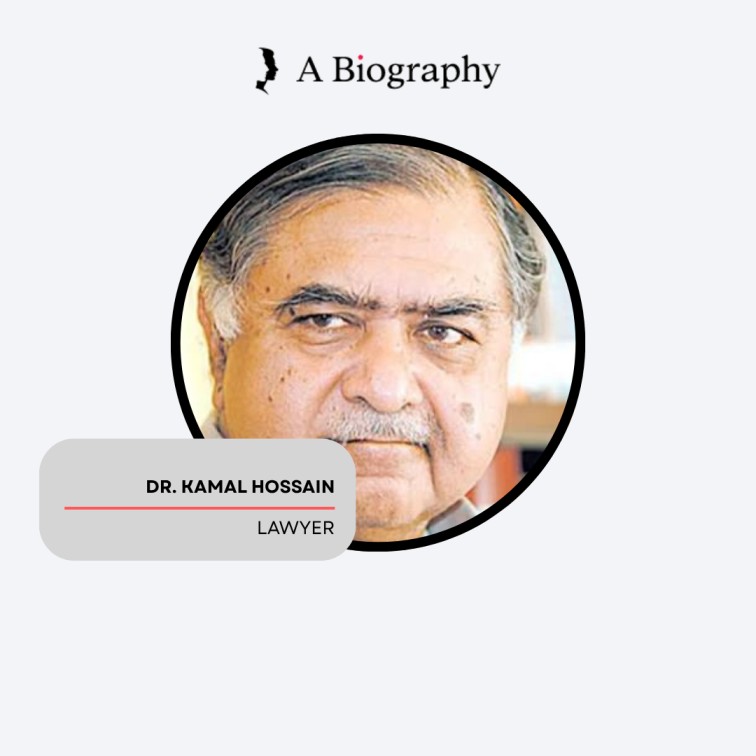
Introduction
January 4, 1968. The then East Pakistan, now Bangladesh’s capital Dhaka. The veranda of the East Pakistan High Court was crowded with an unusual gathering. Even before the trial began, there was restlessness among the common people. People had never seen this before — in a state conspiracy case, the most popular leader of East Pakistan, Bangabandhu Sheikh Mujibur Rahman, was standing in the dock, and presenting arguments on his behalf was a young lawyer who had not yet crossed thirty-one, educated at Lincoln’s Inn — Dr. Kamal Hossain.
Even before the trial effectively began that day, a dramatic situation arose. The state’s lawyers came forward, the government counsels were restless. But Kamal Hossain firmly submitted — “My client’s arrest is undoubtedly illegal. They have kept him in custody indefinitely, which is against the fundamental rights of the constitution.”
Standing in the dock, Bangabandhu Sheikh Mujibur Rahman looked at him and smiled gently. Kamal Hossain realized — through this case, the future of the entire nation would be determined. In this case, known as the Agartala Conspiracy Case , Bangabandhu and 35 other Bengalis were accused — the charge was that they were conspiring for the independence of East Pakistan with India’s help.
A panel of lawyers led by Kamal Hossain and T. H. Khan worked day and night. They provided legal advice to the arrested prisoners. They served one legal notice after another. Although the Pakistan government wanted to continue the case, it gradually backed down due to political pressure. With Dr. Kamal Hossain’s sharp arguments and application of international law, the case eventually collapsed.
This experience from the Agartala Case made Kamal Hossain a very close companion of Bangabandhu. He was not just a lawyer; he became the spokesperson of a silent revolution in the Bengali nation’s struggle for independence.
How did this thriller from about six decades ago end? On February 22, 1969 , the Pakistan government was forced to withdraw the case against Bangabandhu and all accused. This victory was a victory of Kamal Hossain’s legal brilliance. Through this event, he was installed as an international jurist and the future architect of Bangladesh.
Now, following that path of history, we will read the life story of Dr. Kamal Hossain, divided into 28 chapters.
At a Glance — Life of Dr. Kamal Hossain
| Information | Details | Special Note |
| Full Name | Dr. Kamal Hossain | Better known as ‘Dr. Kamal’ |
| Birth | April 20, 1937, Calcutta, Bengal Presidency (then British India) | Ancestral home in Shayestabad, Barisal |
| Death | — (currently alive) | Still active in 2026; retired from politics in 2023 |
| Father | Khan Bahadur Mohammad Ismail Hossain | From a zamindar and lawyer family |
| Mother | Begum Zebunnessa Khatun | Homemaker; believed in religious and social values |
| Wife | Hamida Hossain (married 1963-present) | Distinguished human rights activist and pioneer of women’s rights movement |
| Children | Sara Hossain (Barrister), Dina Hossain | Sara Hossain is a Supreme Court lawyer and human rights law expert |
| Profession | Lawyer, Politician, Diplomat, Academic, Human Rights Activist | One of the framers of Bangladesh’s constitution |
| Education | Notre Dame University, USA (BA 1955); Oxford University (BA Jurisprudence 1957, BCL 1958, D.Phil 1964) | Called to the Bar at Lincoln’s Inn in 1959; Professor of Law at Dhaka University |
| Religion | Islam | Strong stance in favor of secularism; fierce critic of Jamaat |
| Mother Tongue | Bengali | Proficient in English and Urdu |
| Extraordinary Achievements | Chief of the Constitution Drafting Committee of Bangladesh (1972); First Law Minister (1972); Foreign Minister (1973-1975); Minister for Petroleum and Energy (1974-1975); Representative of Bangladesh at UN; UN Special Rapporteur for Afghanistan; Member of Iran-USA Claims Tribunal | Included secularism as a principle in Bangladesh’s first constitution; architect of South Asia’s first secular constitution |
| Greatest Controversy | After Awami League’s defeat in the 1991 election, commenting that the election was ‘fair’ and facing the wrath of party leadership; Heated exchange with a journalist in media over alliance with Jamaat (2018); Forming a united front with BNP and later its breakup | Critics call him a ‘retired politician’, ‘electoral opportunist’ |
| Highest Recognition | Title of ‘Father of the Constitution’; Compared to Adlai Stevenson by The New York Times; Honored as ‘Pathfinder of Free Thought’ by The Daily Star; Honorary Doctorate from Dhaka University (2017) | One of the most influential jurists and politicians of Bangladesh |
| Founded Organizations | Gonoforum (1992); Jatiya Oikya Front (2018) | Currently Emeritus President of Gonoforum |
| Notable Books | ‘Bangladesh: Quest for Freedom and Justice’ (2003); Numerous articles and essays on international law | Published by Oxford University |
| Legal Career | Senior Advocate of the Supreme Court; Head of ‘Kamal Hossain and Associates’ law firm in Dhaka | Expertise in international arbitration, energy law, and corporate law |
Dramatic Beginning
The most dramatic chapter of Dr. Kamal Hossain’s life began in January 1971. He was imprisoned in a jail in West Pakistan. Along with Bangabandhu Sheikh Mujibur Rahman, he was also imprisoned on the orders of Pakistani military ruler Yahya Khan. Suddenly, one day news came — they were being released. But there was a condition: they would be exiled from Pakistan, forced to go to a specific destination.
Kamal Hossain decided to go to London. Because there he could strengthen the diplomatic lobby in favor of independence. Bangabandhu agreed. On January 8, 1972 , they left Pakistan on a special flight. When the plane was flying over the skies of Bengal, Kamal Hossain saw the ruins below. In a later interview, he said, “Sitting on that flight, I took a vow — if I live, I will draft a constitution that can deliver justice to the hungry and exploited people.” That vow earned him the title of ‘Father of Bangladesh’s Constitution’ . But behind that dramatic journey lay a complex history, still unresolved.
Early Life
Kamal Hossain was born on April 20, 1937 in Calcutta, then British India. His ancestral home was in the respectable Muslim village of Shayestabad, Barisal. His father was a lawyer, his mother a homemaker. His father wanted his eldest son to cross the boundaries of Bengal and make a name on the world map.
His childhood was largely spent at St. Xavier’s School in Calcutta. Alongside his studies, young Kamal developed a sense of discipline and law. He would go with his father to the local Congress office. There he heard about the anti-British movement. After the partition of India in 1947, Kamal’s family moved to Dhaka in East Bengal.
In Dhaka, he enrolled in St. Gregory’s High School. Here he became even more dedicated to the Bengali language and culture. He would occasionally visit his ancestral village home in Barisal. There, the village boats, boatmen, and people of the riverine areas fueled his imagination. But the family was financially middle-class. Despite the difficult household, his parents dreamed of higher education for their children.
According to family accounts, Kamal was very quiet and focused from a very young age. His mother said he would sit for hours studying, not going out to play. This nature would one day send him to the world’s best institutions.
Education
In 1952, Kamal Hossain passed his Matriculation from St. Gregory’s High School. On the strength of his merit, he enrolled in Notre Dame College (then Dhaka) for higher secondary. But he did not stop within the boundaries of the country.
In 1954, he earned a BA in Economics from the University of Notre Dame in the United States. At just 17 years old, he was on foreign soil. Alongside his studies, he had the opportunity to closely observe American society and the democratic system. During this time, he also studied the American civil rights movement and the activities of the United Nations, which helped build the foundation of his legal philosophy.
But the main attraction was jurisprudence. In 1957, he earned a BA in Jurisprudence (Honours) from the University of Oxford. The following year, in 1958, he earned a BCL (Bachelor of Civil Law) degree from Oxford. In between, he was called to the Bar at Lincoln’s Inn.
Then in 1964, he earned a Doctorate (D.Phil) in International Law from the same Oxford. At that time, he was the first Bengali to earn a doctorate in law in Oxford’s history. This achievement placed him at the top of the international law arena.
While at Oxford, although not a Rhodes Scholar, he continued his studies through various scholarships and fellowships. His research topic was state responsibility in international law, which later proved useful in his work on UN arbitration boards. This education and research not only made him a lawyer but also a global citizen.
Beginning of Legal Career
In 1959, with degrees from the UK and USA and a call to the Bar, Kamal Hossain returned to the country. He enrolled as a lawyer in the then East Pakistan High Court. At that time, the number of strong lawyers in East Pakistan was very low. A lawyer with a doctorate in international law was almost non-existent.
Initially, he gained proficiency in civil and constitutional cases. Soon, he became a familiar face in the court corridors. Young lawyers in the Bar Association were inspired by him. He became a Senior Advocate of the High Court at just 23 years of age.
It was then that his closeness developed with the young leader of Awami League, Sheikh Mujibur Rahman. Mujib told him, “The justice of the court alone does not become law; real law is made through the people’s movement.” Kamal Hossain remembered this saying for life. Through this connection, he represented Bangabandhu in the Agartala Conspiracy Case. It marked the beginning of a stormy period of his entry into politics.
The Agartala Conspiracy Case and Association with Bangabandhu (1968-1969)
In January 1968, the Pakistan government filed the Agartala Conspiracy Case against the then student and political leaders of East Pakistan. The main accused was Bangabandhu Sheikh Mujibur Rahman. The allegation was that they were conspiring for the independence of East Pakistan from Agartala, India.
Kamal Hossain was then a young lawyer. He joined Bangabandhu’s legal team. It was the first major political case of his life. He believed that the Pakistani government wanted to neutralize Bangabandhu through this case. With hard work and logic, he fought for Bangabandhu and others.
As a result of this case, a strong movement grew throughout East Pakistan. Faced with the popular uprising of 1969, the government was forced to release Bangabandhu. During this time, Kamal Hossain became Bangabandhu’s closest legal advisor.
Later, Kamal himself said that the experience of this case taught him — law is never isolated; law is the backbone of democracy. This case committed him definitively to drafting the constitution of an independent Bengal.
The 1970 Election and Awami League’s Member in Pakistan National Assembly
The 1970 election was a historic chapter for the people of East Pakistan. Awami League campaigned on the basis of Six Points. Kamal Hossain was elected a member of the National Assembly on an Awami League nomination from then East Pakistan.
In this election, Awami League won an absolute majority. But the West Pakistani ruling group refused to transfer power. In protest, Bangabandhu gave his historic speech on March 7, 1971. Kamal Hossain worked as an advisor to Bangabandhu at that time.
On the night of March 25, 1971, when the Pakistani army attacked unarmed Bengalis, Kamal Hossain went into hiding. But he could not avoid arrest. He was arrested and taken to West Pakistan. There he was imprisoned along with Bangabandhu. During this imprisonment, he thought he might not return.
However, in January 1972, under international pressure, they were released. This imprisonment further strengthened Kamal Hossain’s patience and determination.
Dramatic Story of the London Flight
January 8, 1972. Standing at the Pakistan airport, Kamal Hossain and Bangabandhu. They were told: you are leaving the country; tell us where you want to go. Kamal Hossain immediately said — London.
Pakistan’s then President Z. A. Bhutto wanted them to go to India. But through Kamal’s cleverness, they journeyed to London. Upon reaching London, diplomatic tours began. Meetings with British Prime Minister Edward Heath and opposition leader Harold Wilson. He lobbied to secure recognition for Bangladesh.
Sitting on the plane, he and Bangabandhu were thinking intensely. Freedom alone was not enough for the people of Bengal. A legal framework was needed to bring lasting peace. From that thought, the outline of the constitution was drawn.
On January 10, 1972 , he and Bangabandhu set foot on the soil of independent Bangladesh. They were greeted with tremendous enthusiasm by the masses. Tears were in Kamal Hossain’s eyes that day. He solidified his inner vow — drafting the constitution would be their highest priority.
First Law Minister of Independent Bangladesh (1972-1973)
When independent Bangladesh was formed in 1972, Kamal Hossain was appointed Minister for Law and Parliamentary Affairs. Bangabandhu had immense trust in him. Upon taking office, Kamal Hossain set to work on the primary task of drafting the constitution.
On April 11, 1972 , a Constitution Drafting Committee was formed in the Constituent Assembly. Dr. Kamal Hossain became the chairman of this 34-member committee. Under his leadership, the draft of Bangladesh’s constitution was written. Following Bangabandhu’s direction, he included the four fundamental principles — Nationalism, Democracy, Socialism, and Secularism — as the basis of the constitution.
After day-and-night meetings of the committee, the draft constitution was finalized through coordination of different perspectives. The Constitution Bill was passed in the Constituent Assembly on November 4, 1972 , and it came into effect on December 16, 1972 (Victory Day) . Through this constitution, Bangladesh became the first constitutionally secular state in South Asia.
But the question remains — was Kamal Hossain alone the architect of the constitution? No, he himself acknowledges the collective effort of Bangabandhu and the committee. Yet, the title of ‘Father of the Constitution’ stays with him for life.
Kamal Hossain’s Philosophy on Preserving Secularism
The inclusion of secularism in the 1972 constitution sparked various discussions at home and abroad. Kamal Hossain himself was a strong proponent of secularism. He believed that religion is personal, but the state should be governed by reason and human rights.
Years later, when Ziaur Rahman abolished secularism and added ‘Bismillahir Rahmanir Rahim’ to the constitution, Kamal Hossain protested strongly. He showed how the constitution’s fundamental principles were being distorted.
He says, “A constitution is the moral mirror of a nation. As long as this mirror remains clean, the nation walks the path of truth. By secularism, I mean the state’s neutral position on religion, not irreligion.”
Because of this philosophy, on one hand, religious Muslim circles criticized him; on the other, the international community recognized him as an icon of democracy and human rights.
Important Contributions as Foreign Minister and Petroleum Minister (1973-1975)
When Awami League won the 1973 election, Kamal Hossain was appointed Foreign Minister. At that time, many countries of the world had not recognized Bangladesh. Kamal Hossain strengthened diplomatic lobbying. He approached Japan, European countries, and America. Through his efforts, many countries granted recognition.
At the same time, he met with leaders of the USA, UK, and Japan to secure economic assistance for the country. He played a role in strengthening Bangladesh’s permanent membership in the UN.
In 1974, he became the Minister for Petroleum and Natural Resources. Following Bangabandhu’s instructions, he renegotiated contracts with international oil companies. He participated in border and energy agreement work with then India and Burma. He took a hard stance to protect Bangladesh’s interests from foreign companies.
During this time, he gained recognition as a capable administrator and jurist at the domestic and international levels. Bangabandhu said of him, “Kamal is skilled in both law and diplomacy.”
Bangabandhu’s Assassination and Political Change (1975)
August 15, 1975. The darkest chapter of Kamal Hossain’s life. A section of the army assassinated Bangabandhu and his family members. Kamal Hossain was abroad at this time. He returned to the country quickly and protested. He declared military rule unconstitutional and unacceptable.
Although the subsequent Zia government did not arrest him, he was effectively in exile. In 1977, he joined Clifford Chance as an international advisor. He moved to London and began living there. But the sorrow remained forever.
He returned to the country in 1979. By then, General Ziaur Rahman had amended the constitution, removing secularism and usurping presidential rule. Kamal Hossain became a protesting voice at this time. He realized his constitution was being distorted, but he was largely alone.
Around 1981, he focused on his legal profession. But he did not stay away from politics. The relationship with Awami League became distant. Later, he began a new political journey.
Democratic Movement
In the 1980s, General Hussain Muhammad Ershad seized power. Kamal Hossain became active in the movement. Through the Freedom Foundation and human rights organizations, he built public opinion against military rule.
In 1988, the Ershad government signed a contract with the foreign company ‘Simex Exploration’ . Allegations were that this anti-state contract was self-serving. Kamal Hossain entered arbitration against Simex using international law. In 1992, he won this case brilliantly. The arbitration board ruled in Bangladesh’s favor, fining the foreign company over 20 crore taka. This victory placed Kamal even higher in the hearts of the people.
In the 1990 anti-autocracy movement , he participated actively. He led various legal battles. When Ershad fell on December 6, 1990, Kamal Hossain demanded a new democratic constitution. Although that demand was not fully implemented.
After the 1991 election, when Khaleda Zia became Prime Minister, Kamal Hossain criticized the election process and misuse of the constitution. Later, he again endeavored to protect the constitution.
Kamal Hossain on the International Stage
Dr. Kamal Hossain’s talent was not confined to Bangladesh’s borders. He is a top expert in international law. From 1998 to 2003, he served as the UN’s ‘Special Rapporteur on the Human Rights Situation in Afghanistan’ .
At that time, Afghanistan was under Taliban control. Witnessing the horrors of human rights there, he drew the world’s attention. He strongly protested against the Taliban’s oppression of women and minorities. He recommended action to the UN.
Additionally, he has worked as an arbitrator at the International Centre for Settlement of Investment Disputes (ICSID) . He participated in several important decisions, most notably the Chevron vs. Bangladesh case. He played a crucial role in Bangladesh’s victory against Chevron in 2010.
He has also worked as a judge at the International Court of Justice (ad hoc). He has been appointed as an expert to law commissions in various countries around the world. This recognition has placed him at the top of Bangladesh’s legal diplomacy.
Top Lawyer and International Arbitration (2010)
In 2004, Chevron Corporation filed an arbitration case against Bangladesh at ICSID. The allegation was that the Bangladesh government had breached its contract with them. Initially, Bangladesh’s position was weak, so Petrobangla sought Kamal Hossain’s help.
Kamal Hossain created a blueprint. He presented strong arguments on behalf of Bangladesh in the ICSID forum. In 2010, the arbitration board ruled by consensus — in favor of Bangladesh. The ruling rejected Chevron’s claim of several million dollars.
This was a major diplomatic and economic victory for Bangladesh. With Kamal Hossain’s skill, Bangladesh was saved from the machinations of a multinational corporation. International media called him Bangladesh’s ‘legal warrior’ .
After this victory, Kamal set another example — that a small state can stand up to a large company with the help of law, but it requires skilled legal strategy. This success serves as a guide for the country’s young lawyers.
Supreme Court and President of the Supreme Court Bar Association
Kamal Hossain was elected President of the Supreme Court Bar Association of Bangladesh for the term 1990-1991. At that time, there were various complexities regarding the independence of the judiciary. During his tenure, he played an active role in protecting lawyers’ rights and judicial independence.
He played a significant role in the historic 8th Amendment Case to protect judicial independence. In this 1989 case, he argued on behalf of the state along with Syed Ishtiaq Ahmed and M. Amir-ul Islam. When the ruling declared the unconstitutional amendment void, it was highly praised in the country’s media.
During conflicts between justices and lawyers, he was a bridge. He worked to uphold the dignity of the court. As President of the Supreme Court Bar Association, he took important steps to protect the rights of minority lawyers. His organization demonstrates his skill and integrity as a lawyer.
Establishment of ‘Bangladesh Legal Aid and Services Trust’ (BLAST)
In 1993, Kamal Hossain and some other human rights lawyers founded the ‘Bangladesh Legal Aid and Services Trust’ (BLAST) . It is an organization that provides legal assistance to underprivileged and marginalized people.
Through BLAST, he tried to secure rights for poor women, children, indigenous peoples, and slum dwellers. The organization works to create legal awareness against violence against women and dowry practices. Kamal Hossain himself has conducted many cases pro bono (free of charge), some of which are still discussed as success stories.
Especially in legal battles against eviction, he has taken the side of the common people. He has spoken at the Human Rights Commission about forced eviction and housing rights. This stance of his has been like a thorn in the eyes of many land grabbers.
Through this organization, he created a new culture in the legal profession. Today, BLAST is recognized as a prominent human rights organization in the country. Kamal’s humanitarian side has placed him at an enviable height in the legal arena.
Founding Gonoforum (1992-1993)
When Sheikh Hasina returned to the leadership of Awami League in 1990, Kamal Hossain initially worked as a senior leader of the party. But soon, differences arose over the party’s decision-making process and democratic practices.
In 1992, while a member of the Presidium of Awami League, he resigned and left. In 1993, he founded ‘Gonoforum’ — a centre-left political party. The party’s principles were to restore the original spirit of the 1972 constitution and democratic reform.
After founding Gonoforum, he participated in various democratic alliances in the country. But the party did not expand much. Many say he is too idealistic and could not adapt to the realities of politics.
However, the founding of Gonoforum demonstrates his personal courage and political independence. He showed that he is uncompromising on matters of values, not hungry for power.
Gonoforum’s Journey as an Opposition Party
After founding Gonoforum, Kamal Hossain could never be elected a Member of Parliament. The party never won a significant seat in parliament. Yet, he himself had won the 1970 election by a huge margin. In Bangladesh’s first election (1973), he was elected as an Awami League candidate. But later, he could not win any more elections.
One reason for this is that he was not successful in forming large alliances. But he never left politics. He criticized corruption and autocracy.
In the early 2000s, he took a stance against Khaleda Zia’s BNP. But later, he also became a staunch opponent of Awami League. As a result, many young supporters called him ‘independent-minded’ and a ‘politician of non-party interests’ .
Later, he attempted to form a subtle alliance with Khaleda Zia’s BNP. This eventually led to the formation of the ‘Jatiya Oikya Front’ . Critics believe that Kamal Hossain perhaps got stuck in legal interpretations rather than understanding grassroots politics.
Alliance with BNP (2018)
In October 2018, Kamal Hossain formed a political alliance called ‘Jatiya Oikya Front’ (National Unity Front) . It included BNP, Gonoforum, JSD, and some smaller parties. Kamal Hossain became the chief of this alliance; with BNP Chairperson Khaleda Zia in jail, he was leading the alliance.
The alliance wanted to contest the election with a seven-point demand — dissolution of parliament, release of Khaleda Zia, a neutral caretaker government, etc. Kamal Hossain hoped the government would accept these demands.
But Awami League rejected these demands. Instead, Awami League leaders taunted Kamal Hossain as a ‘traitor to the Grand Alliance’ and ‘son-in-law of BNP’ (due to rumors of kinship with the Zia family).
Instead of boycotting the election, the alliance decided to participate. But the alliance did not achieve much success in the election. This was another major blow to Kamal’s political life.
However, Kamal Hossain rejected the results, saying the election was not free and fair. He questioned the role of the Election Commission and the government. During this time, his convoy was attacked on several occasions. He was injured. This attack caused intense political instability.
Retirement from Politics (2023)
After the 2018 election, Kamal Hossain gradually began to withdraw from politics. His alliance with BNP fell apart. Gonoforum’s organizational strength gradually weakened.
In October 2023, he formally retired as President of Gonoforum and completely withdrew from politics. In a speech, he said, “I have been in politics for seventy-five years. But now I want to create opportunities for new leadership. I will return to the legal profession.”
Although he refrained from making strong statements against any party directly, he continued writing about the interpretation of the constitution and the future of democracy. Analysts believe his decision is an admission of defeat to reality. He could not adapt to the tough aspects of politics, including working with his own party activists.
Nevertheless, he is still active in court as a lawyer. He is occasionally seen interpreting the constitution on various television talk shows. Common people still respect him as the ‘Guardian of the Constitution’ .
Later Political Philosophy and Movement to Protect the Constitution
Kamal Hossain is vocal in protecting the constitution’s four fundamental principles — Nationalism, Democracy, Secularism, and Socialism. He believes these principles have been eroded over time. He has called the removal of secularism especially a ‘crime’ .
In a 2020 interview, he said, “We gave the constitution as a means of liberation for the people. Today that constitution is being fragmented through repeated amendments. Those who are killing democracy in the name of democracy need to be identified.”
He advocates for an independent judiciary and limiting the president’s powers. This stance keeps him distanced from the ruling party. However, among ordinary citizens and lawyers, he is still considered a ‘moral compass’ .
He advocates for restoring the non-partisan caretaker government system. He has criticized both Awami League and BNP on this issue. While his philosophy is acceptable to many young people, it has become irrelevant to political parties.
Personal Life
Kamal Hossain’s personal life is quite simple, behind the media’s veil. In 1963, he married renowned human rights activist Hamida Hossain. Hamida Hossain was his companion in political and social struggles. She is also a famous law and human rights organizer and later served as a member of the National Human Rights Commission.
The couple has two daughters — Sara Hossain and Dina Hossain. Sara Hossain is a renowned Supreme Court lawyer and human rights activist. She also graduated from the Bar in the United Kingdom. Dina Hossain is involved in teaching and research at several universities in the United States.
Kamal Hossain becomes emotional when talking about his daughters. He encouraged them in patriotism and human values. Kamal Hossain’s life is not very luxurious. He has been accustomed to unpretentious and simple clothing throughout his life. His residence and expenses have been without luxury. Despite international fame, he remains a man of the soil.
A pure vegetarian, staying away from smoking and drinking, and habitually reading books — this person is known for his deep sense of responsibility towards his family as well as his institution.
Some Unknown Facts About Kamal Hossain
Contrary to popular belief, Dr. Kamal Hossain is a person close to ordinary people. He has conducted cases for free to provide legal services to the poor and needy. In the 1980s, he issued legal notices to secure the rights of street children. He was even directly involved in cases against human trafficking and slavery.
He has been a victim of state oppression several times. He has broken down mentally many times; but again, he has picked himself up. He always considers the media open. He helped journalists facing oppression with free legal aid.
He often invited university students to his legal chamber. There he would have in-depth discussions with students about the constitution and the philosophy of democracy. Students call him ‘Dr. Kamal’ or ‘Kamal Sir’ .
Additionally, he has worked on the rights of Bangladesh’s indigenous peoples. He filed several writ petitions to secure land rights and recognition of ethnic minorities in the Chittagong Hill Tracts. Although these steps did not receive much media coverage at the time, he continued this struggle throughout his life.
Awards and Recognition
Kamal Hossain has been bestowed with numerous awards and honors for his achievements. He has received international recognition as a UN Special Rapporteur. Various universities around the world have given him honorary doctorates.
Many lament that he has not yet received Bangladesh’s highest civilian award, the ‘Independence Award’ . Although he was a contender for the ‘Ekushey Padak’ in recognition of drafting the 1972 constitution, the government has not yet bestowed any state award upon him.
Various organizations have recognized his contribution to the development of the judiciary and legal profession. In 1981, The New York Times published an article comparing him to Adlai Stevenson. The European Union gave him a human rights award in 2012.
He received a ‘Lifetime Achievement Award’ for his skill in international arbitration and legal diplomacy. Additionally, his published essays in various legal journals are still read. Studying constitutional law in Bangladeshi educational institutions requires reading Kamal Hossain’s writings.
Message for the Present Generation
Kamal Hossain always urges the younger generation to come forward to protect democratic rights. He says, “Read the constitution. Know that the constitution pledges your voting rights, freedom of speech, freedom of expression. When someone tries to take away those rights, build resistance through the legal framework.”
He encourages young lawyers to take a stand for humanity alongside litigation. He has written several books and articles. He has written a small book for students called ‘Constitution: A Simple Reading’ .
He also calls on the current generation of political leaders to ‘continue dialogue to protect the constitution’ . He firmly believes that despite all differences, deadlock can be overcome through dialogue and legal frameworks.
During the 2020 quota reform movement , he expressed solidarity with the students, writing, “You are on the right path demanding rights. Just be careful so that no one creates anarchy outside the boundaries of the constitution.” This statement was praised among young protesters.
Conclusion
To the common people of Bengal, Dr. Kamal Hossain will always be an exemplary character. He gave the first draft of the constitution into the hands of a broken-hearted nation. He held multinational corporations accountable in international courts. He risked his career to protect democracy, secularism, and the rule of law.
But just as he has been touched by the scent of recognition, he also carries the intense shadow of controversy. To many young people, he is perhaps a dream figure; yet others hate him for his Liberation War and political controversies.
But he has never stopped. Amidst personal tragedy, political failure, and the pressure of international cases, he has built himself with an extraordinary human touch. His wife Hamida Hossain, his daughters, his established legal firm, BLAST, Gonoforum, the struggle for the constitution — everything together makes him a witness to an era, and also the architect of that era.
As long as Bangladesh’s constitution exists, people will know the name Kamal Hossain. Perhaps he worked most for the nation while studying abroad. He is an idol for lawyers, a trust for ordinary people. Time will tell how successful he was in grassroots politics, but his contribution to constitution-making and international law will never be lost in controversy.
Timeline
| Year | Event | Details |
| 1937 | April 20 — Born in Calcutta | Lawyer family; ancestral home in Barisal |
| 1944 | Enrolled in St. Xavier’s School | Beginning of primary education |
| 1952 | Matriculation from St. Gregory’s High School | Mark of merit |
| 1954 | Higher secondary at Notre Dame College & BA in Economics from Notre Dame University, USA | Earned scholarship |
| 1957 | BA (Jurisprudence) Honours from Oxford | First Bengali to graduate in law |
| 1958 | BCL degree from Oxford & called to Bar at Lincoln’s Inn | Rare example of being called to Bar at just 21 |
| 1959 | Enrolled as lawyer in East Pakistan High Court | Jurist educated abroad returned to country |
| 1963 | Marriage to Hamida Hossain | Human rights activist Hamida became companion |
| 1964 | Doctorate in International Law from Oxford | Unprecedented achievement |
| 1968-69 | Represented Bangabandhu in Agartala Conspiracy Case | Became Bangabandhu’s close legal advisor |
| 1970 | Elected as Awami League candidate in National Assembly election | Beginning of political life |
| 1971 | Liberation War begins; imprisoned in Pakistan jail | Imprisoned before country’s independence |
| 1972 | January 8 — Released from Pakistani prison & London flight | January 10 — Returned to Dhaka |
| 1972-73 | First Law Minister of independent Bangladesh & Chairman of Constitution Drafting Committee | Recognized as ‘Father of the Constitution’ |
| 1973-75 | Served as Foreign Minister & Petroleum Minister | Earned international recognition & renegotiated oil contracts |
| 1975 | August 15 — Bangabandhu assassinated, military rule begins | Was abroad; returned and protested |
| 1977-2001 | International advisor at Clifford Chance & independent legal practice | High income & international fame |
| 1988 | Argued for Bangladesh in the Simex Exploration case | Major legal victory for Bangladesh |
| 1990 | Elected President of Supreme Court Bar Association | Leadership in lawyers’ organization |
| 1992-93 | Left Awami League & founded Gonoforum | Beginning of new political party’s journey |
| 1993 | Founded BLAST | Legal aid for marginalized people |
| 1998-03 | UN Special Rapporteur (Afghanistan) | International human rights struggle |
| 2010 | Won Chevron vs. Bangladesh at ICSID | Another major international arbitration success |
| 2018 | Formed Jatiya Oikya Front & alliance with BNP | Participated in election rather than boycotting |
| 2018 | Convoy attacked during election campaign | Injured; widespread criticism |
| 2023 | Retired from politics & resigned as Gonoforum President | End of long political career |
| 2024-present | Active in legal practice, writing, family time | Despite health decline, mentally active |
Sources
- Bengali Wikipedia — Kamal Hossain
- English Wikipedia — Kamal Hossain (Lawyer)
- Commonwealth Oral History Project Interview — Dr. Kamal Hossain
- The Daily Star — “The conscientious Dr Kamal Hossain”
- The Daily Star — “Dr Kamal Hossain: A luminary of freedom and human rights”
- Dhaka Tribune — “The conscientious Dr. Kamal Hossain”
- bdnews24.com — “Dr Kamal writes to Hasina, demands talks with AL before elections”
- bdnews24.com — “Constitution framers-13: Dr. Kamal Hossain ‘controlled’ the entire process”
- Prothom Alo — “Dr. Kamal Hossain and his place in history”
- Prothom Alo — “Family of constitution drafting committee members protest Jamaat Amir’s comments”
- New Age — “Kamal Hossain turns 82 today”
- Jagonews24 — “I have failed, but not finished: Dr. Kamal”
- Priyo.com — Dr. Kamal Hossain Profile
- South Asian Rights — “The conscientious Dr Kamal Hossain”
- Wikipedia — 8th Amendment Case and 5th Amendment to the Constitution context
- Wikipedia — Agartala Case
- ICSID Official Website — Reference to Dr. Kamal Hossain’s arbitration rulings
- United Nations Audiovisual Library of International Law — Biography of Dr. Kamal Hossain
Disclaimer
This work is prepared based on reliable and authentic sources. Some linguistic dramatization has been added for the narrative of the biographical genre, but the main facts and events have not been altered. There may be slight differences in information about various aspects of Dr. Kamal Hossain’s personal and professional life across sources (there are disagreements about his imprisonment and position during the Liberation War). Efforts have been made to present controversial parts in neutral language; no event is claimed as final. The purpose of this biography is to present the contributions of an extraordinary lawyer, politician, and constitution maker to the new generation, not a biased evaluation.
Final Words
From the soil of Calcutta to the path of Dhaka, from the campus of Notre Dame to the minarets of Oxford, from the Barrack Field of London to the arbitration bench of ICSID — every time he stepped forward, every time he spoke, every time he took the law in his hands, he taught the people of Bengal to dream, to demand rights, to light lamps in darkness.
He who dreamed of drafting a future constitution in a West Pakistani prison, with darkness and the painful memory of Bangabandhu — cannot be called a failure. He may not have sat on the seat of power for long, he may have lost his way repeatedly in the blood-smeared, slippery alleys of politics. But every time after being finished, he rose again in a new form — a protesting voice in the media, the founder of BLAST standing for the poor and marginalized, the unwavering speaker protesting the army’s killing of Bangabandhu.
Some truths of the course of evolution never fully reveal themselves. But as long as Bangladesh’s constitution remains a document of governance, administration, and justice, the name of Dr. Kamal Hossain will remain unblemished. No matter how much controversy, no matter how limited the success — great characters of history never come in measurable sizes.
This indestructible symbol, this guardian of democracy and law — whose voice is still clear, undammed by age — like the artist Zainul Abedin painted life into Bengal’s skeletal form with his brush strokes, Kamal Hossain has outlined Bengal’s rights and constitution.
Dr. Kamal Hossain will live forever in the memory of that generation which believes that law is not for the ruler, but for the liberation of the ruled.

