
Biography
A Biography of Fazlur Rahman Khan

Introduction
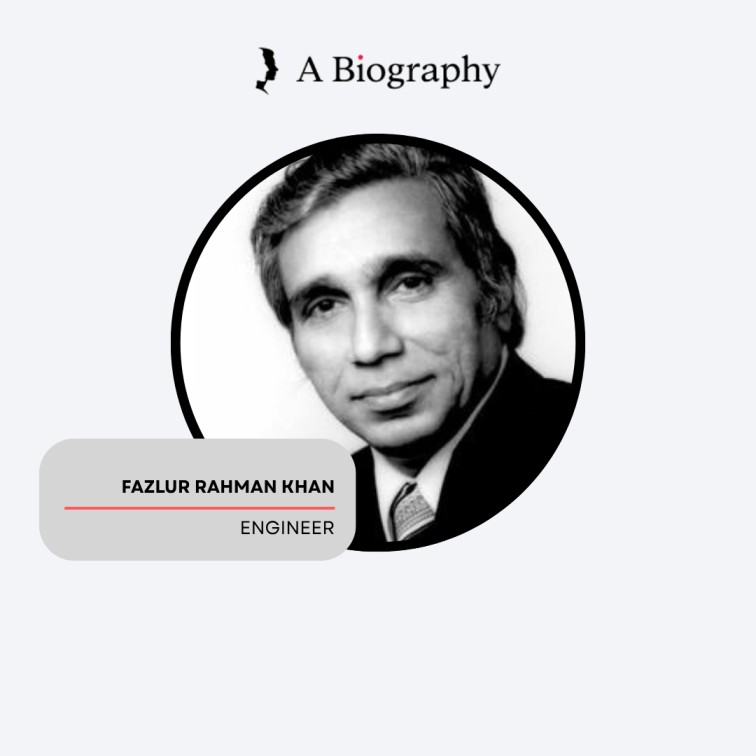
A cold morning in 1970. A middle-aged engineer in an impeccable suit stands on the winding dirt road of Bhandarikandi village in Faridpur. Three decades ago, as a boy, he had walked this very path, dreaming of conquering the world, and boarded a train. Today, he has returned on that same path — but the world has never allowed his dreams to return. He is now world-famous, with a ‘Doctor’ before his name, his designed buildings kissing the clouds. But before his eyes, no reality was greater than the tears of a poor Bengali woman standing ten feet away. Those tears ignited a fire of a question deep within him — “Have I done enough for my people?”
Fazlur Rahman Khan — a name, a legend, the story of an extraordinary Bengali. He did not just build two skyscrapers for the world; he gave birth to a new structural system known as ‘tube technology’. Thanks to that technology, any structure floating above 500 metres is now possible. He was truly a ‘son of Bengal’ — who touched the clouds but never forgot his roots.
In this epic of 28 chapters, we will turn the pages of Fazlur Rahman Khan’s thriller diary, where history, power, immigration, controversy, and indomitable stubbornness have merged to create an immortal masterpiece.
At a Glance : Life of Fazlur Rahman Khan
| Information | Details |
| Date of Birth | April 3, 1929 |
| Date of Death | March 27, 1982 |
| Age | 52 years |
| Father’s Name | Abdur Rahman Khan |
| Education | BSc from BUET (then Ahsanullah Engineering College), later two Master’s degrees and a PhD from the University of Illinois |
| Height of Sears Tower | 442 metres (1,451 feet) – currently Willis Tower; with antenna 527 metres |
| Area of Hajj Terminal | 425,000 square metres – 60 times a football field |
| 1971 Controversy | Did not openly support either side – he held a Pakistani passport, but no public statement in support of the Liberation War |
Birth and Family Background (1929)
April 3, 1929. The final echoes of independence in British India had not yet sounded. The lanes of Dhaka still held a peaceful atmosphere — but the wheels of history were turning rapidly. In this turbulent time, a fair-skinned son was born into a respectable Muslim academic family. He was named Fazlur Rahman Khan, meaning ‘gift of the merciful Lord’ — as if the name itself held the indication of his future greatness.
His father, Abdur Rahman Khan, was an extraordinarily talented man who had won a gold medal in Mathematics from the University of Calcutta. He was not only a professor of mathematics but also a textbook writer and a dedicated soldier of education. His mother was a homemaker — gentle, religious, and cultured. Through their hands, young Fazlur inherited the touch of that tradition.
The family’s ancestral home was in Bhandarikandi village, Shibchar, Faridpur. The soil of this village, its air, the shade of its banyan trees — everything seemed to be secretly building the mental foundation of a future architect. From childhood, this talented child grew up around his father’s library. Later in life, he said: “I was raised in an environment where books were not decorative furniture, but daily companions.”
But the other truth of this time in 1929 was that the entire subcontinent was divided by communal riots and political instability. At the time of his birth, little Fazlur did not know that his future path would be thorny, that he would have to leave his homeland for exile, that he would have to prove that a Bengali Muslim could erect the tallest building in the world.
He was the second of five siblings. His elder brother was Lutfar Rahman Khan, and his younger brothers and sisters were all talented. But it seemed as if the Creator had set Fazlur apart. In his hands were the toys of engineering, and in his eyes were dreams of buildings that would touch the sky.
Early Lessons Under the Village Banyan Tree (1933–1944)
Fazlur Rahman’s educational journey began in the shade of the banyan tree and the dirt paths of Bhandarikandi village, Faridpur. After school in the twilight hours, he would run to his father’s old bookshelf. He had an indomitable talent for mathematics, and in his sketchbook, he would draw designs of structures from the village.
From childhood, he had a strange mixture — on one hand, the talent to solve complex mathematical equations, and on the other, a deep love for the arts. It was the combination of these two forces that later made him unique. His father noticed this special quality in his son — whenever he saw any building, he would think about its load-bearing structure, curious about how much weight each part was carrying.
His elder brothers studied in Kolkata. From them, he heard stories of the vast buildings of distant Kolkata, the engineering marvel of the Howrah Bridge. Little Fazlur’s eyes sparkled at the stories of those massive brick-and-stone structures built by the ‘sahibs’. One day, he asked his father: “Father, who builds such houses in Bengal?” His father smiled and said: “Engineers and architects.” That day, Fazlur decided in his heart and soul — he would become an engineer, he would build buildings that would make the people of Bengal proud.
In 1944, he passed his matriculation from Armanitola Government High School in Dhaka. The results were outstanding — recognition of his excellence in mathematics and science. But the country’s situation at that time was complex. World War II was ending, the British had decided to leave India, and the power struggle between the Muslim League and the Congress was at its peak. The pain of partition in 1947 and the communal riots stalled many dreams. Fazlur Rahman Khan’s family also sensed that storm. But they did not know that this very storm would take their son to another continent.
Presidency College and Shibpur Engineering (1946–1949)
In 1946, Fazlur Rahman Khan enrolled at Presidency College in Kolkata and passed his ISc. It was the most prestigious institution of the time, where only a few talented students had the fortune to study. The curriculum there gave him deep knowledge of modern science and mathematics, which later laid the foundation of his career.
After Presidency College, he enrolled at the then Bengal Engineering College in Shibpur (now the Indian Institute of Engineering Science and Technology, Shibpur). Here, he absorbed mathematical equations and the knowledge of complex structural design. His professors praised his talent, his classmates envied him — such deep understanding at such a young age!
But cruel history was waiting for him. After the partition of 1947, the conflict between East and West Bengal intensified. Communal riots, genocide, looting — Kolkata became unstable amidst everything. Shibpur was on fire. Fazlur Rahman Khan’s final examinations were postponed. His studies stalled, and so did the path of his dreams.
He was forced to leave his studies. Other family members returned to East Bengal. Fazlur stayed in Kolkata for some time to observe the situation. But it became clear that the condition of Muslims in West Bengal was becoming increasingly unbearable. Finally, after a long wait, as the instability of partition subsided, he enrolled at Ahsanullah Engineering College in Dhaka (now Bangladesh University of Engineering and Technology — BUET).
Here, Fazlur’s frustration grew. Because the limited facilities of this educational institution in East Bengal disappointed him. Yet he did not give up. He studied like mad. In 1949, he earned his BSc in Civil Engineering from BUET — in the first division, with honours.
The first chapter of his education ended. A new struggle began.
Assistant Engineer and University Teaching (1950–1952)
After completing his education, Fazlur Rahman Khan took a job as an assistant engineer in the local highway department. The salary was good, the position respectable. But the engineer’s mind was not satisfied. Sitting at an office desk, only doing administrative work, staying away from real design — it was like a prison to him.
He would think — “What contribution can I leave for the distressed people of this country?” Roads were broken, bridges dilapidated, there were hardly any factories. The lethargy, corruption, and inefficiency in government service pained him. After office hours, he would stay up at night thinking, dreaming of new inventions. But the resources and research opportunities to fulfil his dreams were not being given to him.
In 1951, he joined the teaching profession at the University of Dhaka. He enjoyed teaching — he could recognise students’ talents, encourage them. But this was also not his desired profession. He realised — to truly be an engineer, to create something great, to amaze the world with his talent, he would have to leave the country.
Around this time, he applied for a Fulbright Scholarship. It was a highly competitive scholarship — only the talented received it. His application was accepted. He also received a scholarship from the Government of Pakistan. He did not let the opportunity slip away. But before leaving, family, relatives, acquaintances — everyone tried to dissuade him. The sin of leaving the country, the impossibility of establishing himself in another land — so much was said!
Fazlur Rahman Khan replied: “I will return one day. But until then, I will let the world know that Bengalis do not bow their heads; they can touch the sky.”
In early 1952, he bid farewell to the soil of his country. In his hand was a ticket, in his heart was fire, and before his eyes was a dream.
Fulbright Scholarship and Departure to America (1952)
In 1952, after receiving the Fulbright Scholarship and a scholarship from the Government of Pakistan, he travelled to the United States. America was then the world’s most powerful economy and centre of technology. It was a land of dreams for immigrants, like Ellis Island in New York. Fazlur Rahman Khan set foot at the University of Illinois at Urbana-Champaign.
Here, he proved — a Bengali is never less than anyone. In just three years, he earned two Master’s degrees — in Structural Engineering and in Theoretical and Applied Mechanics — and a PhD in Structural Engineering. Where it would normally take five or six years, he finished in three — with outstanding results.
His research topic was the analysis of prestressed concrete beams. It was a highly advanced subject at the time. His professors were amazed by his research paper — such depth, such originality! One professor commented: “This Bangladeshi youth will one day create a stir around the world.”
After completing his PhD, Fazlur Rahman Khan wanted to know more, to learn more. America’s construction industry was then undergoing unprecedented advancement — new materials, new technologies, new techniques. He absorbed everything. He would spend hours in the library, work in the lab even on weekends.
But during this time, another question arose in his mind — where would he go with this knowledge? Return to Pakistan and again work a highway department job? Or stay in America and do something big? This dilemma was stirring him from within.
But fate had a different plan for him.
Return to Homeland (1955–1956)
In 1955, after completing his doctorate, Fazlur Rahman Khan returned to his homeland. He joined the Karachi Development Authority as an Executive Engineer in the then capital of Pakistan, Karachi. The position was prestigious, the salary excellent, and the power substantial. Achieving this position at a young age was a great achievement.
But sitting at the office desk, he realised that he had been kept away from actual design. Here, he had to sign papers, sit in committee meetings, handle political pressure. Real engineering? That was a distant dream. Not only would he not be allowed to design buildings, but he also had to approve designs by others. Instead of using his skills where he excelled, he had to stay busy with government administrative work.
He became deeply disappointed. If an engineer cannot do engineering, what meaning does his existence carry? Every morning, entering the office, he would think — no, this is not his place. Yet he worked for some time. He tried to bring change, to give his opinions. But the environment could not digest him.
By 1956, Fazlur Rahman Khan decided — he would no longer stay in Pakistan. Here, they had only made him a ‘babu’; there was no scope for real engineering. He wrote letters to some companies in America. He gave interviews over the phone. The answer came — job offers. Skidmore, Owings & Merrill (SOM) — a leading architectural firm in Chicago — hired him.
Once again, preparations for departure began.
A 27-Year-Old’s Meteoric Rise
In late 1956, Fazlur Rahman Khan again travelled to the United States, this time with the address — Chicago. This city is called the Mecca of the architectural world. It is here that some of the world’s first skyscrapers were born. Here is ‘Skidmore, Owings & Merrill’ (SOM) — a very prestigious firm that has designed some of the world’s best buildings.
Joining SOM, he was initially a regular structural engineer. But he couldn’t stay ordinary for long. Within a few months, his colleagues realised that this Bengali youth was different. He would question — “Why this structure for this building? Isn’t there a more efficient way?”
His first project was the ‘Chestnut DeWitt’ residential building. The building was of medium height, but Fazlur Rahman Khan made some changes to its design that were more efficient. His office head, Bruce Graham (a world-famous architect), encouraged him. He understood that this man would do something big in the future.
Around this time, Fazlur Rahman Khan began researching the concept of tube structures. His idea — a building could be designed so that its outer wall itself would carry the load, with no columns on the inside. This was a revolutionary thought. Because the current prevalent structure — steel skeletons, long columns — was very expensive and good for medium heights. But for truly tall buildings — 50 storeys, 100 storeys, 200 storeys — that was not sustainable.
He began to prove that tube structures were the solution to this problem. But his colleagues laughed it off. Some said — ‘What would this Bengali know?’ But Fazlur did not give up. He kept working in silence.
The Beginning of a Revolution with a Bamboo Stick (1962)
SOM’s chief designer, Bruce Graham, asked Fazlur Rahman Khan: “How can we build taller buildings with a low budget?” The question was undoubtedly challenging. Because the budget was low, and making a building taller only increased costs. Yet Graham wanted to reduce costs.
Fazlur Rahman Khan paused for a moment. His eyes fell on a few bamboo sticks displayed in a flower shop outside the window. The bamboos were hollow inside but looked strong. If several bamboos are tied together, they form a bundle that is even stronger.
He told Graham: “That is the answer. Bamboo tubes.” He explained the ‘tube in tube’ system — where the outer tube would bear all the weight of the building, the inner tube would be for lifts and utilities. In between would be empty space where people would live or work, with no columns as obstacles.
Bruce Graham called his colleagues and said: “This Bengali Einstein has saved us. He understood what to do just by looking at a bamboo stick!” In fact, Fazlur Rahman Khan’s achievement was not just giving the idea, but also providing the entire structural mathematics, calculating the load for every element.
This discovery was revolutionary. Because thanks to this tube system, any structure floating above 500 metres is now possible. The structure was named ‘Framed Tube’, ‘Trussed Tube’, and ‘Bundled Tube’ — three fundamental concepts. These concepts became the tools for future generations of engineers.
The Tube Structure Magician (1960s)
Throughout the 1960s, Fazlur Rahman Khan was engrossed in his tube structures. He not only gave the concept but also gave it practical form. The three tube systems he created —
- Framed Tube: Here, the columns on the outer wall are so close together that they act like a single tube. Wind pressure travels down the wall of this tube. Used in buildings prior to the John Hancock Center.
- Trussed Tube: Here, diagonal bracing (X-shaped steel rods) is provided on the outer wall. This reduces sway from wind even further. This technology was used in the John Hancock Center.
- Bundled Tube: When multiple tubes are tied together, a bundle of tubes is formed, which is extremely strong and allows for very tall heights. This technology was first applied in the Sears Tower (now Willis Tower). It was the tallest building in the world from 1973 to 1998.
Tube technology revolutionised steel structures because of:
- More height with less material
- Full use of interior space (no columns obstructing)
- Increased resistance to wind and earthquakes
- Reduced construction costs
Even today, all the skyscrapers of the world — from Burj Khalifa to Taipei 101 — use some version of tube technology. Dr. Fazlur Rahman Khan is therefore called the ‘Father of Tube Structures’ and the ‘Einstein of Structural Engineering’.
John Hancock Center
In 1965, Fazlur Rahman Khan received his first truly large project. At the northern end of Chicago’s ‘Magnificent Mile’ (the famous Michigan Avenue), a 100-storey building was to be constructed. Its name — John Hancock Center. Height — 344 metres (1,129 feet). At the time, it was Chicago’s second-tallest and the world’s fourth-tallest building.
To withstand the city’s wind pressure, he used a ‘Trussed Tube’ structure, which changed the building’s appearance. The ‘X’ pattern bracing on the exterior walls was revolutionary both aesthetically and technically. These braces were wrapped in red-coloured aluminium, giving the building a distinct identity. Many now call this building ‘Big John’.
But during construction, various problems arose — the budget was exceeding, workers went on strike, local residents objected that the building would block their light. Fazlur Rahman Khan patiently solved everything. He took every obstacle as a challenge.
In 1970, construction of the building was completed. Thousands of people gathered at the inauguration ceremony. The mayor of Chicago said: “Today is a historic day. A Bengali engineer has proved that to do great work in the world, you don’t need great countries; you need a great mind.”
Until 2008, it was the tallest building on Michigan Avenue. It remains a major attraction for tourists. From the observation deck, one can see the sprawling city of Chicago and Lake Michigan. This building was the first full recognition of Fazlur Rahman Khan’s talent.
Sears Tower — The World’s Tallest Bundled Tube Masterpiece (1970–1974)
Immediately after finishing John Hancock, Fazlur Rahman Khan began an even larger project. This time, the client — Sears, Roebuck and Co. (America’s largest retailer). Their requirement — the world’s tallest building, with 350,000 square metres of office space. The name — Sears Tower (now Willis Tower).
He chose the ‘Bundled Tube’ technology. Here, nine tubes are bundled together to form a master tube. These tubes, of varying heights, ended in stages — some went all the way to 110 storeys, some stopped midway. This not only provided structural benefits but also gave the building a unique appearance — when light and shadow fall on it, it seems as if the building is climbing a staircase into the clouds.
Construction was completed in May 1973. Height — 442 metres (1,451 feet) — the peak was almost invisible in the sunlight. Total storeys — 110, lifts — 104, construction used — 76,000 tons of steel and 160,000 cubic metres of concrete. The US Vice President was present at the inauguration.
It remained the world’s tallest building until 1998. Although Dubai’s Burj Khalifa later broke the record, Sears Tower remains a role model for skyscraper enthusiasts. As of 2021, it is the second-tallest building in the United States.
Fazlur Rahman Khan said of this building: “Each tube is like a bamboo stick; bundled together, they are even stronger. This was known to our ancestors; I just applied it to modern engineering.”
Sears Tower sits at the pinnacle of Fazlur Rahman Khan’s career. He proved that talent alone is not enough; it also requires patience, determination, and the ability to dream.
Entry into the Middle East and Hajj Terminal Design (1974–1980)
In the mid-1970s, Fazlur Rahman Khan also began working in the Middle East. The Hajj Terminal of King Abdulaziz International Airport was to be built in Jeddah, Saudi Arabia. It would be the world’s largest airport terminal (by area), specially created for Hajj pilgrims.
Every year, millions of Muslims come to Saudi Arabia to perform Hajj. They need a vast space where they can wait, pray, and rest. Fazlur Rahman Khan designed a tent-like canopy — a tension structure made of white canvas and steel cables. These canopies looked like Arab Bedouin tents, yet were extremely modern.
These canopies were placed underground on pylons that could withstand wind pressure. The total canopy area of the complex was 425,000 square metres — 60 times a football field. An artificial cooling system, vast seating areas, and spaces for religious rituals — everything was arranged meticulously.
In 1983, this terminal won the Aga Khan Award — the world’s highest recognition for Muslim architecture. Fazlur Rahman Khan became emotional when receiving that award. He said: “I am blessed to have had the opportunity to serve the guests of Allah. This is a greater achievement for me than building any other building.”
The Hajj Terminal is still operational. The Saudi government maintains it every year. It is Fazlur Rahman Khan’s extraordinary contribution to the Islamic world.
Pioneer in Computer-Aided Design (CAD)
In 2024, we consider the use of CAD programs ordinary. But in the late 1960s, computers were massive machines that had to be programmed with punch cards. Even then, Fazlur Rahman Khan was a pioneer.
He realised — manually calculating the mathematics of complex structures was becoming impossible. So he learned the Fortran programming language. He regularly used the computer terminal at the University of Illinois. He would write his own programs and obtain output.
Thanks to computers, he could perform vast calculations in a short time, such as:
- The movement of an entire building under wind pressure
- Load distribution during earthquakes
- The performance of different configurations of tube structures
He also designed — the US Air Force Academy in Colorado, the McMath-Pierce Solar Telescope (the largest solar telescope in America), and many other stadiums and bridges.
He proved — the computer is not just a calculating machine; it is a tool for creativity. Following the path he showed, today’s engineers spend their days with CAD.
Personal Life
Fazlur Rahman Khan’s personal life is not as discussed as his work. He was a family man, although he could not devote much time. While living in Chicago, he married Anita Khan (some sources mention ‘Anita Ki’ as well). Anita Khan was a US citizen of Bangladeshi origin, from a respectable family.
They had two children — a son, Sadri Amjad, and a daughter, Mina Khan. Fazlur would spend half the night at the office, and on weekends he would be busy with urgent projects. During that time, Anita Khan alone managed all the household responsibilities — taking the children to school, teaching them, housework, entertaining guests, everything.
Anita never came before the media, never gave any interviews. But Fazlur was deeply respectful of her. In an interview, he said: “Behind what I have done, there is Anita’s invisible hand. Without her, it would have been impossible for me to survive in Chicago.”
Sadri grew up following in his father’s footsteps, choosing an engineering career. But he could not become a star like his father — however, he has deep respect for his father’s research and work. Mina Khan has established herself as a businesswoman. If Anita Khan were still alive today, she would be busy in her solitary life, working to preserve Fazlur Rahman Khan’s legacy.
The Calm Behind the Star
Among Fazlur Rahman Khan’s five siblings, he achieved the most fame and success. But in family reminiscences, he was still that little ‘Fazlu’ who would definitely do something extraordinary when he grew up, but his childish nature never left him.
His elder brother, Lutfar Rahman Khan, was a professor at the University of Dhaka. He was the most trusted contact for Fazlur during his Chicago life. They would spend time through correspondence — Lutfar would write about Dhaka’s weather and politics, while Fazlur would give opinions on the Mujibnagar government in America.
His younger brother, Farooq Rahman Khan, is a businessman. He learned many things from his elder brother but never chose the engineering profession. His sisters, Shameem and Salima — when they visited Fazlur in Chicago, they would embrace him and say, ‘Our elder brother has conquered the world.’
His parents — they lived in Dhaka. His mother worried about her son’s solitary life. Fazlur did not call every day, but he wrote letters regularly. He would write not in English but in the regional dialect of Dhaka, so that his mother could read easily. Those letters are preserved in the family album — as proof that a world-famous engineer is still just a child to his mother.
A Cascade of Awards and Honours (1970–1980)
The 1970s were the golden age of awards and honours for Fazlur Rahman Khan. Each year brought new recognition. Below are a few notable ones:
- 1972: Nominated ‘Man of the Year’ by Engineering News-Record (ENR). Achieving this award in one’s profession is a matter of great pride.
- 1973: Elected member of the US National Academy of Engineering.
- 1973: Elected Fellow of the American Concrete Institute and the American Society of Civil Engineers.
- 1974: Cover feature in Newsweek magazine. The photo shows Fazlur Rahman Khan standing in front of the Sears Tower, caption — ‘The Mathematician Inside the World’s Tallest Building’.
- 1978: ‘Illinois Engineer of the Year’ award from Chicago.
- 1980: Prestigious ‘IABSE International Association for Bridge and Structural Engineering Gold Medal’ (first Bengali to receive it).
ENR declared him the ‘most helpful person in the architectural industry’ five times. American engineers and architects awarded him the highest honour, the ‘Outstanding Structural Engineer’ medal.
These awards were not just matters of personal pride; they were pride for the whole of Bangladesh. No one had previously imagined that a Bengali would receive such great honour on American soil.
Aga Khan Award and Contribution to Muslim Architecture
In 1983 — a year after Fazlur Rahman Khan’s death — he was posthumously awarded the prestigious Aga Khan Award for Architecture. His wife, Anita Khan, received the award at the ceremony.
The award was given for the Hajj Terminal. The jury commented: “A completely new concept, where traditional airport concepts were broken and the design was tailored to the needs of Hajj pilgrims. This terminal is not just a building; it is an experience.”
The Aga Khan Award is usually given for mosques, schools, community centres. It is rarely given for an airport terminal. Fazlur Rahman Khan made the Hajj Terminal a place where comfort, peace, and spirituality all coexist — illuminated by light, facilities for prayer, resting places for weary travellers, play areas for children — he thought of everyone.
Accepting the award, Anita Khan said on behalf of her husband: “Fazlur believed that architecture is a medium for serving humanity. What a building gives to people is more important than the building itself.”
The award medal is still kept at SOM’s office in Chicago, where visitors can see it.
Controversies and Unresolved Questions (1971 and After)
The lives of all great figures in history have some unresolved questions. Fazlur Rahman Khan’s life is no different. The most controversial issue is his stance during Bangladesh’s Liberation War in 1971.
In 1971, did Fazlur Rahman Khan work for Pakistan? Answer: No, he was by then a partner at SOM, a permanent resident of America, but initially held a Pakistani passport. When the Liberation War began, he did not openly support either side. Some claim that he secretly collected funds and lobbied for the Mukti Bahini. Others claim that he remained silent, maintaining his relations with Pakistanis.
There is very little evidence or documentation. His official biography avoids this topic. His family and close colleagues have said that Fazlur was not in favour of the genocide and oppression; he wanted a peaceful solution.
Another controversy — why did he not work for Bangladesh’s development? The question is valid. Fazlur Rahman Khan did not design a single building in Bangladesh during his lifetime! Yet he worked for the Japanese, for the Saudis, for America — but why not for his own homeland?
Some sources say — in 1975, he visited Bangladesh, and the then government wanted him to design a tower, but due to political instability, it was not possible. Some sources say — he was commercially busy; he didn’t have time. Whatever the truth, this controversy will always remain.
But his relatives have said — even if Fazlur did not do anything for Bangladesh, Bangladesh did much for him. His talent, his intelligence, his roots — everything came from this soil. And that is a great achievement.
Issues with the Core Structure
Fazlur Rahman Khan is universally recognised as the father of the tube structure. However, some researchers question — the concept of this structure existed before; did Fazlur merely implement it?
The history is — the seed of the tube structure was hidden in some research papers from the 1940s. But no one had applied it to a full commercial building. Fazlur Rahman Khan was the first person to take that theory, elaborate on it, calculate every equation, apply it to a real building, and patent it. Therefore, the world recognises him as the ‘father’.
Second question — “Is the ‘X’ bracing of the John Hancock Center truly effective for diagonal wind pressure?” Some engineers have said that this bracing design was done somewhat for aesthetic reasons, more than structural necessity. But Fazlur’s statement — “Aesthetics and functionality go hand in hand. If it is not beautiful, the building cannot survive in people’s love.”
All in all, whatever the controversies, Fazlur Rahman Khan’s achievement and influence are undeniable. He laid the foundation for the Burj Khalifa — metaphorically and literally.
1982 : The Day a Genius’s Dream Flight Stopped
March 27, 1982. Fazlur Rahman Khan had gone to Jeddah, Saudi Arabia, on a business trip. He had a meeting scheduled with the King of Saudi Arabia to discuss some new projects. That morning, he felt unwell — chest pain. His companions took him to the hospital. But it was too late.
Cardiovascular attack (heart disease) — Fazlur Rahman Khan passed away at only 52 years of age. At this age, engineers are usually at the peak of their careers. Fazlur Rahman Khan’s untimely death shocked everyone.
Various discussions later arose about the cause of death. According to some, he was extremely hardworking — working 16-18 hours a day, often staying up all night designing, eating fast food, not exercising. This affected his health.
But family members have said that heart disease ran in the family. Fazlur’s father also suffered from heart disease. So genetic factors may also have been present.
When the news reached Chicago, the SOM office was closed. Colleagues wept, and messages of condolence came from around the world. Bangladesh’s then President Abdus Sattar expressed grief. A memorial meeting was held at BUET.
The American engineering community said — “We have lost one of the greatest minds of the century.”
Funeral and Burial at Graceland Cemetery
After his death in Jeddah, Fazlur Rahman Khan’s body was brought back to Chicago. The funeral arrangements were made by SOM and his family. The funeral was held at a mosque in Chicago, attended by the Mayor of Chicago, the Governor of Illinois, ambassadors from various countries, all the top executives of SOM, and numerous engineers, architects, and well-wishers.
After the funeral, he was buried at Graceland Cemetery — one of the oldest and most prestigious cemeteries in Chicago, where many historically famous figures of Chicago are buried. But Fazlur Rahman Khan’s grave is still viewed with special reverence.
The inscription on the grave reads: “Fazlur R. Khan — 1929-1982 — Structural Engineer — He Made the Sky the Limit.”
Every year on March 27, his death anniversary, expatriate Bangladeshis in Chicago and local engineers gather there to offer flowers and prayers. It has also become a tourist spot — visitors come to see the grave of a Bengali son.
The grave is under a large tree, in a calm, quiet environment. In winter, it is covered in a white sheet of snow; in summer, it is wrapped in green grass. But he whose grave it is lives forever in the immortal glory of the sky-touching buildings he left behind.
Charitable Foundation and Legacy
A great personality like Fazlur Rahman Khan would typically establish a foundation in his name — so that research is conducted in his name, scholarships are given. But Fazlur Rahman Khan did not do that. Why?
Because he was a man of action. He believed that the real legacy is theory and buildings, not money. Sears Tower and John Hancock Center will stand for centuries — what greater charity could there be than these?
However, some institutions and awards have been established in his name:
- Fazlur R. Khan Lifetime Achievement Medal: Instituted by the Council on Tall Buildings and Urban Habitat (CTBUH). It is awarded annually to the world’s best engineers and architects.
- Fazlur R. Khan Memorial Lecture: Established at Lehigh University and the University of Illinois. Each year, an invited speaker discusses Fazlur Rahman Khan’s work.
- Fazlur Rahman Khan Hall at BUET: A residential hall at Bangladesh University of Engineering and Technology has been named after him.
- ‘Fazlur R. Khan Way’ in Chicago: The street below the Willis Tower has been named ‘Fazlur R. Khan Way’. When pedestrians walk down this street, they don’t know they are walking alongside such a great name in history.
Children and Successors
His son, Sadri Amjad Khan, grew up to study engineering like his father. He earned a degree in Civil Engineering from the University of Illinois and worked at SOM for some time. But he did not have his father’s talent, and his father’s fame troubled him. Not being as acclaimed as his father, he left engineering and turned to business. He now lives in Chicago, regularly does social work, and tries to preserve Fazlur Rahman Khan’s memory.
His daughter, Mina Khan, grew up watching her father. Educated in the Western system, she did not go into architecture or engineering but studied commerce. Later, she married and lives with her husband. She is associated with some healthcare organisations in Kolkata.
There is a rumour among well-wishers — why did Fazlur Rahman Khan’s children not follow in their father’s footsteps? The answer perhaps is — the father’s shoes were huge; it is not easy to walk in them. And not every child needs to match their father; choosing an independent path is also a great thing.
The Building That Never Was in Bengal
During his lifetime, Fazlur Rahman Khan did not design a single permanent building in Bangladesh. That is a controversial truth. But the question is — if he had built something in Bangladesh, what would it have been like?
Imagine — standing in the heart of Dhaka would be a ‘Fazlur Rahman Tower’, designed in his own tube system. That would not only be a source of pride for the country but would also elevate Bangladesh to new heights on the world’s architectural map. But why didn’t it happen? Because Bangladesh had just become independent, political instability, lack of money, uncertain foreign investment. Fazlur Rahman Khan’s proposal was — he could provide the design for free, but the government could not raise the money needed for construction. So it was not possible.
In 1980, he visited Bangladesh and met with then President Ziaur Rahman, but no agreement was signed. Because his ill health had made him uncertain by then.
However, it is not entirely true that Fazlur Rahman Khan did nothing for Bangladesh. He arranged scholarships for Bangladeshi student engineers, donated some educational materials, and most importantly — Fazlur Rahman Khan’s name is now uttered in every home in Bangladesh. That is certainly no small contribution.
Names Established in Exchange for Fazlur Rahman Khan’s Recognition
In recognition of Fazlur Rahman Khan’s work, various places around the world have been named after him:
| Name | Country | Type |
| Fazlur R. Khan Way | USA (Chicago) | Road |
| Fazlur R. Khan Lifetime Achievement Medal | International (CTBUH) | Award |
| Fazlur R. Khan Memorial Lecture | USA (Lehigh University) | Lecture |
| Fazlur Rahman Khan Hall | Bangladesh (BUET) | Hall (building) |
| Dr. Fazlur R. Khan Chair in Structural Engineering | USA (UIUC) | Professorship |
| Khan-Tejas Award | International | Joint award |
This list is growing every year. The Mayor of Chicago again designated a street in Fazlur Rahman Khan’s name in 2020. The Government of Bangladesh issued a postage stamp in honour of Fazlur Rahman Khan in 2021.
This recognition is not only a matter of pride for the people of Bangladesh; it proves that a Bengali Muslim, coming to a developed country like the United States, overcoming language and cultural barriers, can become a world-class engineer if he has determination and talent.
Conclusion
Fazlur Rahman Khan never opened a construction company in his own country. He left behind the biggest trademark of tall building construction. Among the greatest structural engineers of the 20th century, his name comes first. Whatever the controversies, his talent was never questioned.
The people of Bangladesh still say with pride — “There is one of us who built a 100-storey skyscraper in Chicago, who invented the tube system!” This is not just a statement; it is a pride.
He is still visible among the pedestrians walking in the shadow of the Willis Tower. He is still in the air of Chicago, in the clouds of Bengal. That pride of the Bengali nation, who pierced the clouds and changed the world’s mark, merged into the power of dreams.
The thriller does not end. Fazlur Rahman Khan lives on in the depth of every tube-frame foundation, in the mirror of every skyscraper. He who never died, only merged into the glory of the countless sky-touching pillars he created.
“I never consider myself a poor Bengali; rather, I take pride in having elevated Bengal to a high seat before the world.”
— Dr. Fazlur Rahman Khan (1929–1982)
It is not the end, only the beginning. With every new building, every new structure, every new discovery, Fazlur Rahman Khan will live on. This is his immortality — which no death can erase.
Humble respects to the son of Bengal.

