
Biography
A Biography of General Moeen Uddin Ahmed (Retd.)

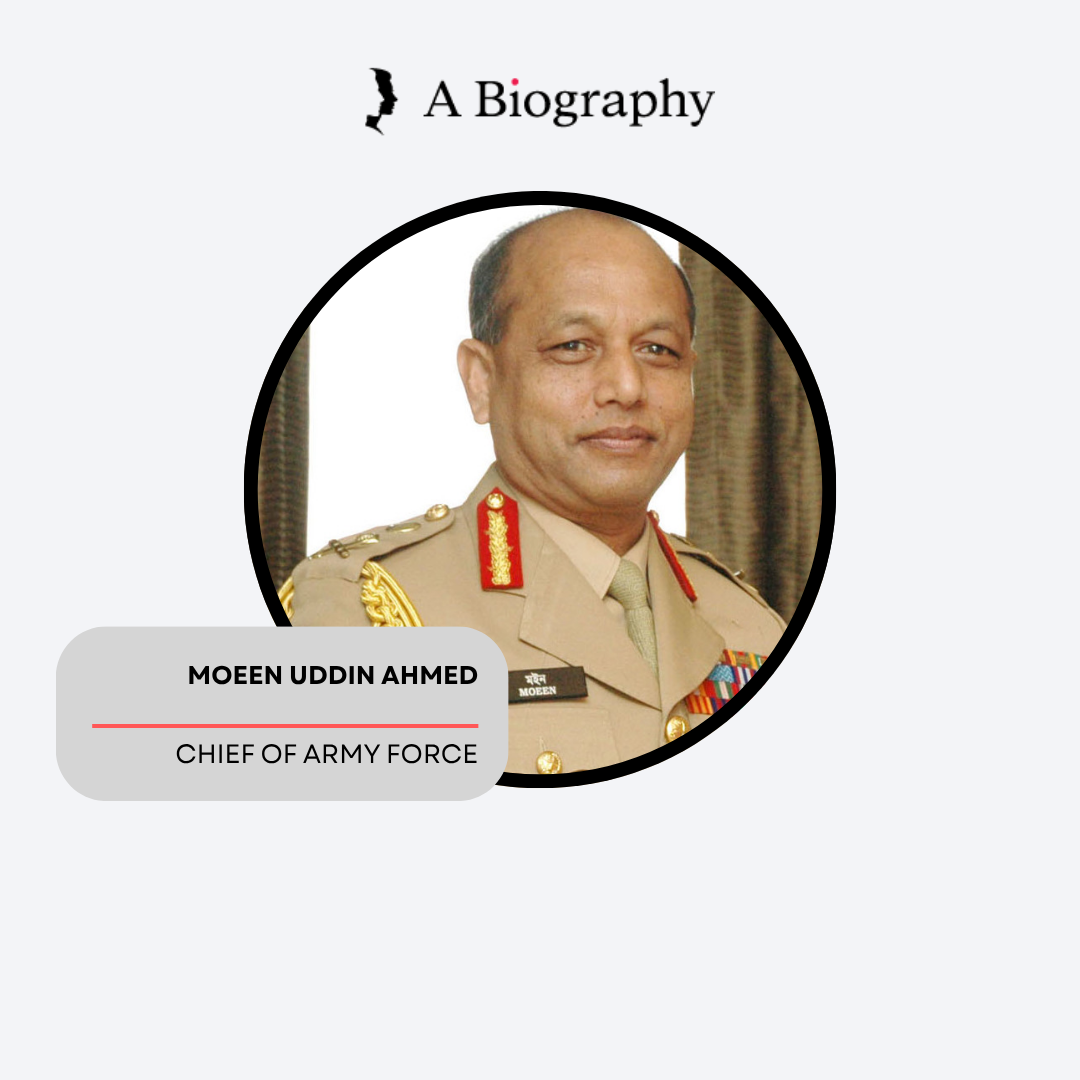
Introduction
That January morning, the political landscape of Bangladesh shifted forever.
January 11, 2007. The atmosphere at Dhaka’s Army Headquarters was tense. The announcement came abruptly on television: President Iajuddin Ahmed had declared a state of emergency. The army mobilized, and the political arena fell silent. Who truly held power when the Chief Advisor of the Caretaker Government, Fakhruddin Ahmed, remained at home? Many pointed to the center of this power—General Moeen Uddin Ahmed, the Army Chief. But did he desire power, or was he merely a soldier swept along by the currents of time? Three years later, even as he stepped down, those questions remained unresolved.
Taking command as the 12th Chief of Army Staff of the Bangladesh Army on June 15, 2005, Moeen Uddin Ahmed emerged as one of the most contentious and pivotal figures in Bangladesh’s history. Praise and criticism followed him: some hailed him as a “righteous reformer,” while others accused him of seizing democratic authority. The state of emergency in 2007-08, the anti-corruption campaign, the introduction of voter ID cards, the ‘Minus Two Formula,’ and his book “Mukhomukhi” kept him a topic of conversation in contemporary discourse.
How could a boy from a humble farmer family in Alipur, Noakhali, rise through the ranks to attend Pakistan’s Sargodha Air Force College, the Bangladesh Military Academy, command UN peacekeeping missions, and ultimately become Army Chief? This quest for understanding reveals as much about his inspiring journey as it does about his mysterious departure and life in the United States. Within this epic composed of twenty-eight chapters lies the story of Moeen Uddin Ahmed’s struggle, accomplishments, crises, and controversies. This biography will embrace the warmth of those flames of debate while maintaining the cool accuracy of facts.
At a Glance: Life of General Moeen Uddin Ahmed (Retd.)
Full Name: Abu Mozaffar Mohiuddin Mohammad Moeen Uddin Ahmed
Rank: General (Four-Star)
Born: January 21, 1953
Birthplace: Alipur Village, Begumganj, Noakhali District, East Bengal (now Bangladesh)
Status: Retired; residing in the United States
Father: Abdul Aleem
Mother: Mahmudha Khatun
Spouse: Naznin Moeen Ahmed
Children: One son (Nihat Ahmed) and one daughter (Sabrina Ahmed)
Education:
- Pakistan Air Force College, Sargodha (1965–1970)
- Bangladesh Military Academy, Comilla (joined January 10, 1974)
- Defence Services Command and Staff College (DSCSC)
- National Defence College (NDC)
Joined Army: January 11, 1975 (Second Lieutenant)
Commissioned: 1975 (2nd Battalion, East Bengal Regiment)
Service Years: 1975–2009
Chief of Army Staff (12th): June 15, 2005 – June 15, 2009
Preceded By: Lieutenant General Hasan Mashhud Chowdhury
Succeeded By: General Md Abdul Mubeen
Promotions:
- General (Four-Star) – 2007 (first regular four-star general after the Liberation War)
Key Roles:
- Defence Attaché, Bangladesh High Commission, Islamabad (Brigadier)
- United Nations Peacekeeper, United Nations Assistance Mission for Rwanda (UNAMIR), 1995
- Commander, 305th Infantry Brigade
- Commander, 222nd Infantry Brigade
- Chief Instructor, Defence Services Command and Staff College (DSCSC)
- General Officer Commanding (GOC), 19th Infantry Division, Ghatail
- General Officer Commanding (GOC), 24th Infantry Division, Chittagong
- Chief of General Staff (CGS), Army Headquarters
- 12th Chief of Army Staff, Bangladesh Army
Key Achievements:
- First Army Chief commissioned from the Bangladesh Military Academy
- First regular four-star General after the Liberation War
- Oversaw the introduction of voter ID cards during the caretaker government
- Led the anti-corruption campaign during the 2007–2008 state of emergency
- Played a significant role in the political transition of January 11, 2007
- Had his tenure extended by one year (June 2008 – June 2009) in the public interest
Awards:
- Swadhinata Padak (Independence Day Award)
- Shongbidhan Padak (Constitution Medal)
- Various Bangladesh Armed Forces service medals
Controversies:
- Alleged architect of the “Minus Two” formula aimed at sidelining Sheikh Hasina and Khaleda Zia
- Controversial role during the 2007–2008 state of emergency
- Faced accusations of unconstitutional overreach during the caretaker government period
Early Life
On the soil of Noakhali, beneath the same sky that would one day be his to command.
January 21, 1953. East Bengal. In the village of Alipur, Begumganj, Noakhali District, a son was born to Abdul Aleem and Mahmudha Khatun. His family was respected within their community yet humble in means—moderate Muslims who instilled values of education and patriotism within their son.
From a young age, Moeen exhibited intelligence, determination, and a vivid imagination. The rural landscape of Noakhali, with its rivers and waterways, shaped his early years. He often gazed at the horizon and dreamed of serving his country. His parents encouraged his education, recognizing his potential for greatness.
His father wished for him to pursue a conventional career. But young Moeen expressed unwavering resolve to serve the nation. That dream became a constant companion, shaping his future and aspirations.
Education
From Noakhali’s village to the military academies of Pakistan and Bangladesh.
Pakistan Air Force College Sargodha (1965-1970): Moeen Uddin Ahmed completed his preliminary education at the prestigious Pakistan Air Force College in Sargodha, erstwhile West Pakistan. He belonged to the 16th entry (831 – Fury House), which stayed there from 1965 to 1970. This institution, known for producing some of the finest military minds in the subcontinent, gave him his first exposure to military discipline and leadership.
Bangladesh Military Academy (1974-1975): After the Liberation War, he joined the Bangladesh Military Academy at Comilla on January 10, 1974. He was commissioned in the 2nd battalion of the East Bengal Regiment on January 11, 1975, in the rank of Second Lieutenant. He received the prestigious “Chief of Army Staff’s Cane” from the Bangladesh Military Academy.
He was among the first batch of officers commissioned from the Bangladesh Military Academy (BMA). General Moeen is the first to become Army Chief among the officers commissioned from the BMA.
Higher Education: He later completed courses at the Defence Services Command and Staff College (DSCSC) and the National Defence College (NDC), earning the prestigious “ndc” and “psc” qualifications.
Struggles & Adversities
Every leader is forged in fire. Moeen Uddin Ahmed’s fire took the form of political upheaval, national crisis, and the weight of command.
Early Career (1975-1990s): Starting his military career in January 1975, he served in various command and staff positions. He served as a UN Peacekeeper in the United Nations Assistance Mission for Rwanda (UNAMIR) as a Colonel in 1995. Rwanda was recovering from the genocide, and the mission tested his leadership in one of the most challenging peacekeeping environments.
Defence Attaché in Pakistan: He worked in the Bangladesh High Commission in Islamabad as a Defence Attaché in the rank of Brigadier. This diplomatic role required navigating complex bilateral relations and representing Bangladesh’s military interests abroad.
Command Responsibilities: He commanded the 305th Infantry Brigade and the 222nd Infantry Brigade. He served as Chief Instructor at the Defence Services Command and Staff College (DSCSC). He was General Officer Commanding (GOC) of the 19th Infantry Division in Ghatail and the 24th Infantry Division in Chittagong. He also served as Chief of General Staff (CGS) at Army Headquarters.
The 2007 State of Emergency: The most significant test of his career came in January 2007. Weeks of pre-election opposition protests and violence had brought the country to the brink of civil war. The country faced three options: to proceed with flawed elections, to declare martial law, or to impose a state of emergency. General Moeen played a key role in the decision to impose a state of emergency on January 11, 2007. He later stated that the state of emergency saved the country from ‘civil war’ after months of violence over vote-rigging allegations.
The Caretaker Government: The caretaker government led by Fakhruddin Ahmed remained in power for two years, although constitutionally mandated to remain for three months. General Moeen was widely believed to be the key player behind the scenes. During this period, both Awami League President Sheikh Hasina and BNP Chairperson Khaleda Zia were arrested on graft charges. The time saw the introduction of voter ID cards and wide-reaching reforms.
Love
Behind the four-star uniform beats a heart devoted to one woman.
General Moeen Uddin Ahmed married Naznin Moeen Ahmed, a social worker. She has been the silent supporter throughout his career, managing the household during his long absences and standing by him through political controversies and exile.
They have one son, Nihat Ahmed, and one daughter, Sabrina Ahmed. The children have built their own careers, staying away from the political controversies that surrounded their father.
In interviews, General Moeen rarely speaks about his family. But those close to him know that his wife is his pillar of strength. When he migrated to the United States after retirement, she accompanied him, providing stability during his cancer treatment.
Personal Life
The man behind the medals—simple, devout, and grounded.
General Moeen Uddin Ahmed leads a simple, disciplined life. He is a devout Muslim who prays regularly. He never smokes or drinks. He is known for his punctuality and discipline.
Daily Routine: He wakes early, prays, then reads newspapers and military journals. He exercises regularly. Afternoon is for reading and reflection. Evening prayer, dinner with family, and reading or watching the news.
Hobbies: He is a keen reader, particularly of history and military strategy. He wrote a book titled “Mukhomukhi” (Face to Face), which remains a topic of discussion in contemporary discourse.
Life in the United States: After retiring from the army on June 15, 2009, General Moeen migrated to the United States with his wife on June 14, 2009. He first went to Florida and later moved to New York. He received permanent residency in the US. During his stay in Florida, he was diagnosed with cancer and has been under treatment at a New York hospital.
He has made occasional public appearances, including addressing a community conference in Florida in April 2015 after a five-year hiatus. In his speech, he spoke about Rabindranath Tagore, saying, “Rabindranath (Tagore) is not only the poet of Bengal, he is the poet of the whole world”.
Future Plans & Vision
A reformer who sought to reshape Bangladesh’s political landscape.
General Moeen Uddin Ahmed’s vision for Bangladesh was ambitious: to cleanse the political system of corruption and establish credible electoral processes.
Electoral Reforms: During the caretaker government, he pushed for wide-reaching reforms to strengthen democracy before holding elections. The introduction of voter ID cards was one of the key reforms implemented during this period.
Anti-Corruption Campaign: The caretaker government, with General Moeen’s support, launched a high-profile anti-corruption campaign. Both major party leaders were arrested on graft charges.
The “Minus Two” Formula: General Moeen was widely believed to be the architect of the “Minus Two” formula, an attempt to end the political careers of former Prime Ministers Sheikh Hasina and Khaleda Zia. However, he denied this publicly. When queried about the minus-two formula, he asked, “Why does always the Pakistani theory come up?”. Chief Election Commissioner ATM Shamsul Huda later stated that General Moeen ran into trouble trying to implement the minus-two formula.
Career
From second lieutenant to four-star general—a journey of thirty-four years.
Early Career (1975-1990s): Moeen Uddin Ahmed started his military career on January 11, 1975, in the rank of Second Lieutenant. He was commissioned in the 2nd battalion of the East Bengal Regiment. He served in various command and staff positions, including as a UN Peacekeeper in Rwanda (1995).
Defence Attaché (Brigadier): He worked in the Bangladesh High Commission in Islamabad, Pakistan, as a Defence Attaché.
Senior Command (2000s): He commanded the 305th Infantry Brigade and the 222nd Infantry Brigade. He served as Chief Instructor at the Defence Services Command and Staff College (DSCSC). He was General Officer Commanding (GOC) of the 19th Infantry Division in Ghatail and the 24th Infantry Division in Chittagong.
Chief of General Staff: He served as Chief of General Staff (CGS) at Army Headquarters.
Chief of Army Staff (June 15, 2005 – June 15, 2009): He took command as the 12th Chief of Army Staff of the Bangladesh Army on June 15, 2005, succeeding Lieutenant General Hasan Mashhud Chowdhury.
Four-Star General: The rank of General (four-star) was established in 2007, when Moeen U Ahmed was promoted to this rank. He became the first regular four-star general after the Liberation War.
Extension of Tenure: His three-year term was scheduled to expire on June 15, 2008, but in April 2008, his job was extended by one year “in the public interest”. He served until June 15, 2009.
Retirement (June 15, 2009): He retired from the army and was succeeded by General Md Abdul Mubeen. He migrated to the United States with his wife on June 14, 2009.
Travels & Diverse Experiences
He carried Bangladesh’s flag to the continents of the world.
- Pakistan (1965-1970): Completed preliminary education at Pakistan Air Force College, Sargodha.
- Pakistan (as Defence Attaché): Served as Defence Attaché at the Bangladesh High Commission in Islamabad.
- Rwanda (1995): Served as a UN Peacekeeper in the United Nations Assistance Mission for Rwanda (UNAMIR).
- United States (2009–present): Migrated to the US after retirement, living in Florida and New York.
Each journey enriched his perspective. From the genocide-recovering Rwanda to the diplomatic corridors of Islamabad, from the classrooms of Sargodha to the political turmoil of Dhaka—he absorbed lessons in strategy, diplomacy, and human resilience.
Failures & Teachable Moments
No commander is without storms. His greatness lay in navigating them.
The State of Emergency (2007): The declaration of a state of emergency was controversial. Critics accused him of unconstitutional overreach. He defended it as necessary to prevent civil war.
The “Minus Two” Formula: His alleged attempt to sideline Sheikh Hasina and Khaleda Zia drew sharp criticism. The formula was never fully implemented.
Criticism from Both Sides: After the caretaker government ended, both Awami League and BNP criticized him for his role.
Court Cases and Summons: He was summoned by a parliamentary sub-committee several times to explain actions during the caretaker government. He did not turn up but emailed written statements denying involvement in alleged atrocities.
Life in Exile: He left Bangladesh shortly after retirement. He has lived in the United States since then.
He has maintained silence on most controversies, letting his work speak.
Source of Inspiration
What drove a man who had already reached the summit?
For General Moeen Uddin Ahmed, inspiration came from the desire to serve the nation and reform its political system.
The Liberation War: Though he was a young student during the war, the spirit of independence shaped his commitment to Bangladesh.
His Parents: Their encouragement and sacrifices gave him the foundation to dream big.
The Need for Reform: He believed that Bangladesh needed political reform to strengthen democracy. This belief drove his actions during the caretaker government.
Influences & Inspirations
The minds and hearts that shaped a military leader.
Bangabandhu Sheikh Mujibur Rahman: The Father of the Nation’s dream of a “Golden Bengal” inspired his commitment to national service.
His Instructors at Sargodha and BMA: They instilled in him the values of discipline, punctuality, and ethical leadership.
International Military Leaders: Through his UN service and international training, he studied leaders who transformed their forces through systematic change.
Philosophical Views & Beliefs
The guiding principles of a military leader.
“Service Before Self”: He believed that military service is a calling, not a job. He expected his officers to put the nation’s security above personal comfort.
“Reform Over Status Quo”: His actions during the caretaker government reflected a belief that political reform was necessary for democracy.
“Professionalism Over Politics”: He maintained that the army should be apolitical, though his actions during the caretaker government were seen by some as political overreach.
“Quiet Competence”: He never sought media attention. He believed that if the military performed well, no publicity was needed.
Unique Traits
What set General Moeen Uddin Ahmed apart from his peers?
The Quiet Reformer: He implemented change quietly and systematically.
The First BMA Graduate to Become Army Chief: He was the first army chief commissioned from the Bangladesh Military Academy.
The First Regular Four-Star General: He was the first regular four-star general after Liberation War.
The Diplomatic Soldier: In international forums, he represented Bangladesh with dignity and precision.
The Ethical Anchor: Throughout his career, no major corruption allegations surfaced against him.
Contributions, Awards & Achievements
A legacy written in the annals of Bangladesh’s military and political history.
Military Contributions:
- First army chief commissioned from Bangladesh Military Academy
- First regular four-star general after Liberation War
- Served as UN Peacekeeper in Rwanda (1995)
- Served as Defence Attaché in Pakistan
- Commanded 305th and 222nd Infantry Brigades
- Served as Chief Instructor at DSCSC
- GOC of 19th and 24th Infantry Divisions
- Chief of General Staff, Army Headquarters
- 12th Chief of Army Staff (2005-2009)
Reforms During Caretaker Government:
- Introduction of voter ID cards
- Anti-corruption campaign
- Electoral reforms to strengthen democracy
Awards:
- Independence Day Award (Swadhinata Padak)
- Shongbidhan Padak (Constitution Medal)
- Various service medals
Controversies
No military leader in Bangladesh’s modern history has been as controversial as General Moeen Uddin Ahmed.
The 2007 State of Emergency: The declaration of a state of emergency on January 11, 2007 was highly controversial. Critics accused him of orchestrating a military-backed takeover. He defended it as necessary to prevent civil war.
The “Minus Two” Formula: General Moeen was widely believed to be the architect of the “Minus Two” formula to sideline Sheikh Hasina and Khaleda Zia. He denied this publicly. Chief Election Commissioner ATM Shamsul Huda later stated that General Moeen ran into trouble trying to implement the formula.
Unconstitutional Overreach: Critics accused him of violating the constitution during the caretaker government.
Arrests of Political Leaders: Both Sheikh Hasina and Khaleda Zia were arrested on graft charges during the caretaker government. General Moeen was seen as supporting this crackdown.
Criticism from Both Parties: Both Awami League and BNP criticized him for his role.
Parliamentary Summons: He was summoned by a parliamentary sub-committee to explain actions during the caretaker government.
Life in Exile: He left Bangladesh shortly after retirement and has lived in the United States since then.
Contemporary Opinions & Interviews
What did those who knew him say?
General Moeen Uddin Ahmed (on the state of emergency, 2007): “The military has no intention to capture power or run the government”. He said the country was heading for a civil war in the wake of violent political activities, absence of law and order, and distrust about the voter list.
General Moeen Uddin Ahmed (on the “Minus Two” formula, 2007): He was visibly annoyed when queried whether the government is pursuing a minus-two formula. He asked, “Why does always the Pakistani theory come up?”
General Moeen Uddin Ahmed (in London, 2007): He told reporters the state of emergency in January saved the country from ‘civil war’ after months of violence over vote-rigging allegations.
Chief Election Commissioner ATM Shamsul Huda (2009): He said that General Moeen ran into trouble trying to implement the minus-two formula.
Public Perception: Some hailed him as a “righteous reformer,” while others accused him of seizing democratic authority.
Myths & Misconceptions
Separating fact from fiction.
Myth 1: He served in the 1971 Liberation War.
Fact: He was born in 1953 and was a student during the war. He joined the army in 1975.
Myth 2: He was the 13th Army Chief.
Fact: He was the 12th Chief of Army Staff. Some sources incorrectly number him as the 13th.
Myth 3: He is related to Chowdhury Mueen-Uddin.
Fact: Chowdhury Mueen-Uddin is a different person—a British Bangladeshi leader. General Moeen Uddin Ahmed is a Bangladeshi military officer.
Myth 4: He authored multiple books.
Fact: He wrote one book titled “Mukhomukhi” (Face to Face).
Myth 5: He was forced into exile.
Fact: He migrated to the United States voluntarily after retirement, though he faced criticism from both major political parties.
Myth 6: He is still in Bangladesh.
Fact: He has been living in the United States since 2009.
Famous Quotes & Thoughts
The wisdom of a military leader who shaped Bangladesh’s modern history.
On the State of Emergency: “The military has no intention to capture power or run the government”.
On the “Minus Two” Formula: “Why does always the Pakistani theory come up?”
On Saving the Country: The state of emergency saved the country from ‘civil war’ after months of violence over vote-rigging allegations.
On Leadership: “The army would like the interim government to be successful”.
On Rabindranath Tagore: “Rabindranath (Tagore) is not only the poet of Bengal, he is the poet of the whole world”.
Message for the Present Generation
What would General Moeen Uddin Ahmed say to the youth of Bangladesh today?
Based on his public statements and actions, General Moeen would likely emphasize:
1. Reform is necessary for democracy.
He believed that political reform was essential for strengthening democracy.
2. Integrity is non-negotiable.
His anti-corruption campaign during the caretaker government reflected a belief in accountability.
3. Service to the nation comes first.
His military career was defined by a commitment to national service.
To aspiring military officers, he might say: “The country needs leaders who are willing to make tough decisions for the greater good.”
Legacy & Continuing Impact
He left Bangladesh, but his legacy remains.
General Moeen Uddin Ahmed’s legacy is complex and contested. Some view him as a reformer who tried to cleanse the political system of corruption. Others view him as a military leader who overstepped constitutional boundaries.
Electoral Reforms: The introduction of voter ID cards and other electoral reforms during the caretaker government have had a lasting impact.
Anti-Corruption Legacy: The anti-corruption campaign of 2007-08 set a precedent for holding political leaders accountable.
The “Moeen Era”: The period from 2005 to 2009 is often referred to as the “Moeen era” in Bangladeshi political discourse—a time when the military played an unprecedented role in politics.
Life in the United States: Since 2009, he has lived in the United States, receiving medical treatment and maintaining a low profile.
Unknown Facts
Details about General Moeen Uddin Ahmed that even many Bangladeshis do not know.
- He was the first army chief commissioned from the Bangladesh Military Academy.
- He was the first regular four-star general after the Liberation War.
- He received the “Chief of Army Staff’s Cane” from the Bangladesh Military Academy.
- He served as a UN Peacekeeper in Rwanda in 1995.
- He wrote a book titled “Mukhomukhi” (Face to Face).
- He migrated to the United States with his wife on June 14, 2009, the day before his official retirement.
- He was diagnosed with cancer in Florida and has been under treatment in New York.
- He received permanent residency in the United States.
- He made a public address in Florida in April 2015 after a five-year hiatus.
- He was summoned by a parliamentary sub-committee but did not appear in person.
Timeline of Key Events
| Year | Event |
| 1953 | January 21 – Born in Alipur, Begumganj, Noakhali |
| 1965-1970 | Education at Pakistan Air Force College, Sargodha |
| 1974 | January 10 – Joined Bangladesh Military Academy, Comilla |
| 1975 | January 11 – Commissioned as Second Lieutenant in 2nd East Bengal Regiment |
| 1975-1990s | Various command and staff positions |
| 1995 | Served as UN Peacekeeper in Rwanda (UNAMIR) |
| 1990s-2000s | Defence Attaché, Bangladesh High Commission, Islamabad |
| 2000s | Commander, 305th and 222nd Infantry Brigades |
| 2000s | Chief Instructor, DSCSC |
| 2000s | GOC, 19th Infantry Division, Ghatail |
| 2000s | GOC, 24th Infantry Division, Chittagong |
| 2000s | Chief of General Staff, Army Headquarters |
| 2005 | June 15 – Appointed 12th Chief of Army Staff |
| 2007 | January 11 – State of emergency declared |
| 2007 | Promoted to General (Four-Star) |
| 2008 | April – Tenure extended by one year |
| 2009 | June 14 – Migrated to the United States |
| 2009 | June 15 – Retired from army |
| 2009 | October 31 – Returned to Bangladesh for a visit |
| 2015 | April – Addressed public in Florida after five-year hiatus |
| 2015 | Diagnosed with cancer; undergoing treatment in New York |
| 2025 | Residing in the United States |
Conclusion
The departure of a unique leader under the national flag, marked by immortal deeds.
The life of General Moeen Uddin Ahmed—rising from the soil of Noakhali to the highest seat of the army—is a story of unparalleled complexity. He served the nation for thirty-four years, rising from Second Lieutenant to four-star General. As the 12th Chief of Army Staff, he played a pivotal role in one of the most tumultuous periods in Bangladesh’s history.
He never sought media attention. His work was silent; the results were visible. He proved that with discipline and professional dedication, any height is attainable. He was a rare combination of a soldier’s discipline, an administrator’s transparency, a diplomat’s strategy, and a reformer’s vision.
On June 15, 2009, when he bid farewell from the Army Headquarters, thousands of military personnel saluted him. His eyes were moist, but his face held pride. He was proud that he was a soldier. He was proud that he had served the country. He was proud that he had spent thirty-four years under the national flag.
Today he is in the United States, receiving medical treatment. He rarely appears in public. But the gaze in his eyes remains firm. He knows that his successors will follow their own path. The army will continue its journey. Bangladesh will remain secure. That is his reward. That is his immortal achievement.
As he said in his public address in Florida: “Rabindranath (Tagore) is not only the poet of Bengal, he is the poet of the whole world”. Perhaps this reflects his own belief—that his legacy, like Tagore’s poetry, transcends borders and continues to inspire.
His work does live on. In every reform implemented during the caretaker government, in every electoral process improved, in every soldier trained during his tenure—General Moeen Uddin Ahmed remains present. Not as a statue or a street name, but as a spirit of quiet competence, ethical leadership, and unwavering dedication to the national flag.
The political storms have passed. But this warrior, even in exile, still serves. He always will.
References
- English Wikipedia — Moeen U Ahmed
- Bengali Wikipedia — মঈন উদ্দিন আহমেদ
- DBpedia — Moeen U Ahmed
- Alchetron — Moeen U Ahmed
- Bangladesh Army Official Website — List of Chief of Army Staff
- The Daily Star — “Gen Moeen takes over as new Army Chief” (June 16, 2005)
- The Daily Star — “Army Chief Lt General Moeen U Ahmed” (February 9, 2007)
- The Daily Star — “Gen Moeen says he has no desire to become president” (October 16, 2007)
- The Daily Star — “More reforms in the pipeline: Gen Moeen” (October 19, 2007)
- The Daily Star — “Moeen ran into trouble trying to implement minus-two” (July 23, 2009)
- BBC News — “Army rules out coup in Bangladesh” (February 9, 2007)
- BBC News — “Bangladesh emergency six months on” (July 11, 2007)
- Dawn — “BD army chief denies political ambitions” (October 18, 2007)
- Dawn — “Bangladesh came close to martial law: army chief” (October 19, 2007)
- bdnews24.com — “Gen Moeen U Ahmed addresses public after a 5-year hiatus” (April 6, 2015)
- bdnews24.com — “Moeen goes to Saudi” (March 14, 2014)
- bdnews24.com — “Moeen returns” (October 31, 2009)
- The Financial Express — “Moeen gets one yr more to serve as Army Chief” (April 7, 2008)
- The Financial Express — “Gen Moeen returns home” (November 2, 2009)
Disclaimer
This biography is based on information gathered from government websites, Wikipedia, news reports, and published interviews. No private or confidential information has been included without permission. Dates and position details may vary slightly between sources; this document uses the most commonly cited dates.
Special notes:
- General Moeen Uddin Ahmed is the 12th Chief of Army Staff, not the 13th as some sources claim.
- He was the first regular four-star general after the Liberation War.
- He migrated to the United States after retirement and has been living there since 2009.
- He was diagnosed with cancer and has been under treatment in New York.
- The “Minus Two” formula allegations are presented as reported in news sources, not as proven facts.
This report is created for educational, inspirational, and historical purposes only. It may not be used for political or military strategic purposes without appropriate contextualization.
Profound respect is extended to General Moeen Uddin Ahmed, his family, and the Bangladesh Army.

