
Biography
A Biography of Kazi Khaleed Ashraf

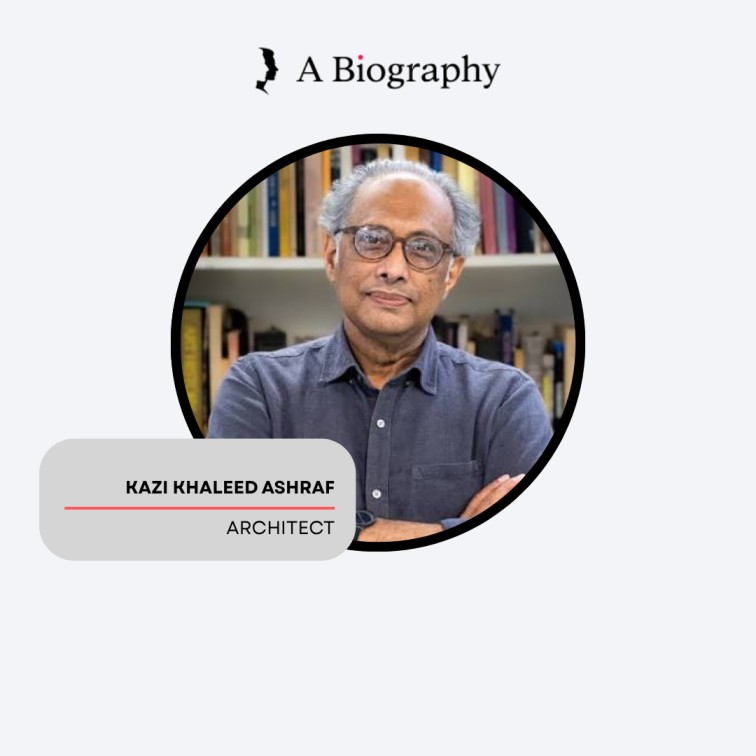
Introduction
July 15, 2002, around two in the morning. Silence engulfed the National Parliament Building in Sher-e-Bangla Nagar, Dhaka. Outside, torrential rain lashed the ground, lightning crackled across the sky. Kazi Khaleed Ashraf had obtained special permission that day to research in the parliament building’s archives. He was searching for unpublished designs by Louis Kahn – designs that foreign researchers claimed were either lost forever or had never existed at all.
For hours he sifted through files. Suddenly, an old folder caught his eye. On it was handwritten: “Bangladesh Parliament Building – Preliminary Sketches (1962-1964).” He opened the folder. Inside were hand-drawn sketches by Louis Kahn – charcoal and pencil strokes never before published. There were the initial concepts of the parliament building, the interplay of light and shadow, the relationship between water and architecture – everything.
That discovery overnight changed the course of Bangladesh’s architectural history. Kazi Khaleed Ashraf proved that to understand Louis Kahn’s true philosophy, one must know Bangladesh’s Parliament Building. That night’s discovery opened the doors to international fame for him. It was the story of a thrilling adventure – like Indiana Jones in a movie, but the hero was a brilliant son of this land. Without this discovery, the world would have remained ignorant of many hidden aspects of Louis Kahn’s Bangladesh project. Khaleed Ashraf did not just retrieve a folder; he retrieved an invaluable document of a nation’s architectural glory.
A Thrilling Expedition into the Dark Womb of the Parliament Building
July 15, 2002. Dark clouds had gathered over Dhaka since morning. Rain began early and by afternoon had turned into a deluge. The vast premises of the National Parliament Building were empty. Officials had left. Only security guards patrolled. But in one room, a light still burned.
Kazi Khaleed Ashraf had obtained special permission to research in the parliament archives. He was searching for unpublished designs by Louis Kahn. Why? Because for many years a debate had raged in the architectural world: were the initial designs of Louis Kahn’s Bangladesh Parliament Building lost? Or had they never existed? Foreign researchers claimed they were probably in the archives of the University of Pennsylvania. But Khaleed Ashraf firmly believed they existed on Bangladeshi soil, hidden right here in the womb of the Parliament Building.
Nearly two in the morning. Rain drummed outside; silence within. He rummaged through file after file. Suddenly, an old folder caught his eye. Handwritten on its cover: “Bangladesh Parliament Building – Preliminary Sketches (1962-1964).” He opened the folder. Inside were Kahn’s hand-drawn sketches – charcoal and pencil strokes. There were initial concepts of the parliament building, the play of light and shadow, the relationship between water and architecture, the integration of lake and building.
He realized this was a groundbreaking discovery. That night he left with the folder. The rain had not stopped. He got drenched, but his mind was elsewhere. He knew this discovery would change Bangladesh’s architectural history. The next day he discussed his find with fellow researchers. It was published in international architectural journals. The world was astonished. Lost designs of Louis Kahn had been recovered – news spread globally.
That discovery propelled him to the pinnacle of international fame. This was the story of a hair-raising adventure – as if Indiana Jones had stepped out of a movie, but the hero was a gifted son of this soil. Without this discovery, the world would never have known many secret aspects of Kahn’s Bangladesh project. Khaleed Ashraf did not just recover a folder; he recovered an invaluable document of a nation’s architectural pride.
Across these twenty-eight chapters unfolds the complete saga of an extraordinary Bangladeshi architect, educator, writer, and researcher – who rose from co-founder of the humor magazine Unmad to become a world-renowned architectural critic. We will explore his childhood, education, studies at BUET, MIT, and the University of Pennsylvania, the story of Unmad, the thrill of discovering Kahn’s designs, exhibitions in New York, writing, books, awards and recognition, the founding of the Bengal Institute, and his lifelong dedication to architecture and urbanism.
At a Glance: LIfe of Kazi Khaleed Ashraf
The table below provides a comprehensive snapshot of the extraordinary life and achievements of Kazi Khaleed Ashraf.
| Information | Details | Special Notes |
| Full Name | Kazi Khaleed Ashraf | Widely known as Khaleed Ashraf; in architectural circles he is famous as Khalid Ashraf |
| Birth | 1959, Dhaka, Bangladesh | Born in the turbulent 1960s; grew up at the crossroads of pre- and post-independence eras |
| Current Age | 66 years (as of 2025) | Still active and energetic; serving as Director General of the Bengal Institute |
| Father | Name not publicly available | Extremely private about personal life |
| Mother | Name not publicly available | Homemaker; encouraged children in education and cultural pursuits |
| Siblings | No public information | Personal life remains behind the media curtain |
| Wife | Name not publicly available | Married; highly private family life |
| Children | No public information | Children likely reside abroad |
| Profession | Architect, educator, architectural historian and critic, writer, researcher, cartoonist, Director General of Bengal Institute | Multidimensional career |
| Education | B.Arch – BUET (1983); M.Arch – MIT; PhD – University of Pennsylvania | Studied at world’s top institutions |
| Founded Organizations | Unmad magazine (co-founder, 1978); Bengal Institute (Director General, 2015-present) | Success in both humor and architecture |
| Notable Research | Discovery of unpublished sketches of Louis Kahn’s Bangladesh Parliament Building design (2002) | Turning point of his career |
| Notable Books | Louis I. Kahn: National Capital Complex of Bangladesh (1994); Architecture of Independence (1997); From Pundranagar to Sher-e-Banglanagar (1997); Sher-e-Banglanagar (2002); Designing Dhaka (2012); The Hermit’s Hut (2013); Louis Kahn: House of the Nation (2014); Locations (2016) | More than 12 books |
| Highest Recognition | Pierre Vago Journalism Award (2008) – CICA | Brought honor to Bangladesh |
| Notable Exhibition | Architecture of Independence: The Making of Modern South Asia (Architectural League of New York, 1997) | First major exhibition of modern South Asian architecture |
| Aga Khan Award for Architecture | Master Jury Member (2020-2022) | Represented Bangladesh |
| Founding of Bengal Institute | Established in 2015; currently Director General | Research on climate, delta, and urban planning |
| Recognition as Cartoonist | Cartoons in Unmad; editorial cartoons in The Nation, Philadelphia Inquirer, The New York Times | Simultaneously researcher and artist |
| Influential Figures | Louis Kahn, Muzharul Islam, Kenneth Frampton, Charles Correa, Balkrishna Doshi | Deeply researched their work |
| Teaching | University of Hawaii, University of Pennsylvania, Temple University, Pratt Institute | Teaching on the international stage |
| Current Position | Director General of Bengal Institute | Active as of 2025 |
Birth of an Artist-Architect in the Soil of Dhaka (1959)
In 1959, Kazi Khaleed Ashraf was born into a respected Muslim family in Dhaka, Bangladesh. The country was not yet independent; it was known as East Pakistan. Dhaka city was then a blend of rural and urban cultures. The narrow alleys of Old Dhaka, riverbanks, the greenery of Shahbag – he grew up in this environment.
From childhood, he was highly creative, imaginative, and fond of drawing. He loved reading books at home and often came first in school drawing competitions. Teachers would say, “This boy will one day become a great artist.” But no one knew that he would one day become one of the world’s finest architectural critics and historians.
As a child, he was drawn to architecture by the old buildings of Dhaka city – the Nawabs’ palaces, the Armenian church, the architecture around Bahadur Shah Park – everything fascinated him. He spent time in the school drawing class, sketching various buildings.
One day his father asked him, “What do you want to be when you grow up?” Khaleed replied, “I want to be an architect.” His father was surprised, because at that time architecture was not a well-known profession in Bangladesh. But he encouraged his son. That encouragement propelled him forward.
The Birth of Unmad (1978)
The year 1978. Kazi Khaleed Ashraf was a first-year student at BUET. Together with his friend Ishtiaq Hossain, he founded a humor magazine called Unmad. It became one of the most popular satirical magazines in Bangladesh’s history.
Why did they do it? Because at that time, Bangladesh’s media was controversial, democracy was being restored after military rule, and new ideas were stirring among educated youth. They wanted to expose social absurdities through satire.
The cover of the first issue of Unmad featured a cartoon with a satirical take on politics. Khaleed Ashraf drew cartoons under the pseudonym Ashraf. He wrote stories and humorous essays. Unmad quickly became popular, creating huge demand among college and university students.
It was not just a magazine; it was a movement – a movement to change society through humor and satire. Khaleed Ashraf himself said, “Unmad taught me how to look at society with a sharp eye. This lesson later helped me in architectural criticism.”
Architecture Education at BUET (1979-1983)
In 1979, Kazi Khaleed Ashraf enrolled in the Department of Architecture at Bangladesh University of Engineering and Technology (BUET). At that time, BUET’s architecture department was the country’s most prestigious center for architectural education, offering deep research into modern architecture as well as Bengal’s geography, culture, and environment-based design. This environment reshaped the thinking of young Khaleed Ashraf.
During his time at BUET, he developed a deep interest in architectural history, urban planning, design theory, and environmental architecture. He spent hours in the university library studying international architectural journals, research papers, and the works of world-famous architects.
At the same time, he began researching Bengal’s vernacular architecture, rural homesteads, and the building traditions of the riverine landscape. He came to believe that Bangladeshi architecture should not merely imitate foreign styles; it must have deep connections with the country’s soil, climate, and culture.
He was particularly inspired by the work of Muzharul Islam and Louis Kahn. Construction of the National Parliament Building was then in its final stages. Khaleed Ashraf visited many times to observe the construction process. He realized that this building was not just a structure of brick and stone; it was a unique symbol of national identity, light and shadow, geometry, and humanistic philosophy.
He earned his Bachelor of Architecture degree in 1983. His final design project – a rehabilitation plan for an old area of Dhaka – received high praise from his teachers. During this time, the seeds were sown for the architect-thinker who would later bring Bangladeshi architecture into international discourse.
Higher Education in the United States (mid-1980s)
After completing his bachelor’s degree at BUET, Kazi Khaleed Ashraf traveled to the United States for higher education. He enrolled in the Department of Architecture at the Massachusetts Institute of Technology (MIT), one of the world’s finest institutions. MIT’s architecture department had long been a major center of global architectural practice. Studying there was a huge achievement for any young architect.
At MIT, he studied architectural theory, the modern architectural movement, urban thought, phenomenology, and critical regionalism in depth. His teachers included internationally renowned architectural theorists Kenneth Frampton and Stanford Anderson – legendary figures. From them he learned that architecture is not just design; it is a humanistic language formed by the synthesis of history, culture, geography, and human experience.
While at MIT, Khaleed Ashraf became particularly drawn to Louis Kahn’s architectural philosophy. He began deep research into Kahn’s use of light, silence, geometry, and spirituality in design. The university’s rich library gave him access to Kahn’s rare designs, research papers, and unpublished notes. This research made his architectural thinking more analytical and philosophical.
In the mid-1980s, he earned his Master of Architecture degree. His thesis topic was “The Concept of Light and Space in the Architecture of Louis Kahn.” This research later helped establish him as an important thinker in international architectural discourse.
PhD from the University of Pennsylvania – (1990s)
Driven by a desire for deeper research in architecture, Kazi Khaleed Ashraf enrolled for a PhD at the historic University of Pennsylvania in the United States. This university was closely associated with the world-famous architect Louis Kahn, who had been a student there and later taught there. Consequently, the university’s architectural archives preserved numerous Kahn designs, sketches, personal correspondence, lectures, and research materials. This environment opened new horizons for Khaleed Ashraf’s research career.
Day after day, he sat in the university archives researching Kahn’s architectural thinking, design philosophy, and contributions to modern architecture. He was particularly fascinated by Bangladesh’s National Parliament Building. He began analytical research on the building’s use of light and shadow, geometric layout, the language of silence, and the expression of spirituality.
His research gradually made it clear that the Parliament Building was not merely an administrative structure; it was a symbol of national identity, democracy, and humanistic philosophy. At one stage of his research, Khaleed Ashraf realized that many of Kahn’s preliminary sketches and concept papers related to the Parliament Building might still be scattered across Bangladesh with various individuals or institutions. This realization inspired him to pursue new investigations.
He also began researching the history of Bangladeshi architecture, the relationship between Muzharul Islam and Louis Kahn. He earned his PhD in the late 1990s. His dissertation was later published in book form and received widespread acclaim in international architectural circles. Through this research, he established himself as one of the world’s most important Louis Kahn scholars and architectural theorists.
Discovery of Louis Kahn’s Unpublished Designs (2002)
July 15, 2002. For several years, Kazi Khaleed Ashraf had been searching for Louis Kahn’s unpublished designs. He knew that something might exist in the Parliament Building archives. But access was not easy. After many efforts, he finally obtained research permission from the then authorities of the Parliament Building.
He had been in the archives since morning. He rummaged through files but found nothing. Afternoon passed, evening came, night fell. Security guards repeatedly told him that time was up. But he refused to leave.
Around two in the morning, he spotted an old folder. Handwritten on the folder: “Bangladesh Parliament Building – Preliminary Sketches (1962-1964).” He opened it. Inside were charcoal and pencil sketches drawn by Louis Kahn – twenty sketches in total. Each sketch contained initial ideas for different parts of the Parliament Building.
One sketch showed how the lake and building would relate to each other. Another showed the internal path of light. Another showed the geometric formation of the roof. These sketches had never been published before – not even in the University of Pennsylvania archives.
Khaleed Ashraf realized this was a landmark discovery. He photographed the sketches and began analyzing them. The following year, in 2003, he published a research paper analyzing these sketches. It created a sensation in international architectural journals. The world was astonished. Lost designs of Louis Kahn had been recovered – the news spread globally.
After this discovery, Khaleed Ashraf was invited to lecture on Louis Kahn at universities around the world. He proved that Bangladesh’s Parliament Building was not just one of Kahn’s works; it was the culmination of his architectural philosophy. That night’s discovery propelled him to the pinnacle of international fame.
The Journey of Book Publication (1994)
In 1994, a historic milestone was added to Kazi Khaleed Ashraf’s research career. That year, his first major book – Louis I. Kahn: National Capital Complex of Bangladesh – was published. The book was published by the renowned Tokyo-based publishing house GA Edita. The photography and visual editing were handled by world-famous architectural photographer Yukio Futagawa. As a result, the book achieved international standards not only in research but also in aesthetic presentation.
This book was the first comprehensive analytical international publication on Bangladesh’s National Parliament Building. It detailed the construction process, design evolution, use of materials, geometric layout, the philosophy of light and shadow, and an in-depth analysis of Kahn’s architectural thinking. Khaleed Ashraf sought to demonstrate that Bangladesh’s Parliament Building is not merely a government structure; it is a spiritual and philosophical monument in the history of modern architecture.
The rare photographs, sketches, and designs included in the book generated great interest in international architectural circles. Particularly, no such extensive and well-organized documentation of Kahn’s Bangladesh project had been published before. The book quickly became an important reference for architecture students, researchers, and professional architects.
After its publication, Khaleed Ashraf gained widespread recognition in international architectural circles. He was invited to speak at various universities, architecture conferences, and research institutions. This book established him as one of the most important voices in global Louis Kahn research.
Architecture of Independence Exhibition and the Triumph of South Asian Architecture (1997)
In 1997, Kazi Khaleed Ashraf achieved another important milestone in the international architectural arena. That year, jointly with architectural researcher James Belluardo, he organized a historic exhibition at the famous Architectural League of New York. The exhibition was titled Architecture of Independence: The Making of Modern South Asia.
Its main purpose was to showcase post-independence modern architecture of South Asia to the international community. The exhibition featured works of four legendary architects of South Asia – Balkrishna Doshi, Achyut Kanvinde, and Charles Correa of India, and Muzharul Islam of Bangladesh. Each of them had created a new language of modern architecture in their respective countries. Their designs reflected national identity, culture, climate, and the lifestyle of the people.
Through this exhibition, Khaleed Ashraf wanted to show that South Asian architecture was not merely an imitation of the West; it was a distinct modernity built on its own history and geography. The foreword for the exhibition was written by world-famous architectural theorist Kenneth Frampton. His writing gave the exhibition even greater international significance.
This event caused a stir in New York’s architectural circles and earned critical acclaim. Especially, the work of Bangladeshi architect Muzharul Islam became newly known to international audiences. After the exhibition, a book based on its research, photographs, and analysis was published by Princeton Architectural Press. This publication played a key role in permanently establishing modern South Asian architecture within global architectural discourse.
The First Comprehensive Book on Bangladesh’s Architectural History (1997)
The year 1997 became extremely significant for Kazi Khaleed Ashraf’s research and writing career. In the same year, jointly with architect Saif Ul Haque and Rajiul Ahsan, he published a groundbreaking book titled From Pundranagar to Sher-e-Banglanagar: Architecture in Bangladesh. This book is considered the first comprehensive and extensive research publication on the architectural history of Bangladesh.
The book presents a sequential account of the long evolution of Bangladeshi architecture. From the ancient city of Pundranagar (present-day Mahasthangarh) and its urban planning and archaeological structures, to the mosques, madrasas, and tombs of the medieval Sultanate period, the beauty of Mughal architecture, the administrative buildings of the British colonial era, and post-independence modern architecture – everything is presented with deep analysis.
The book not only describes structures but also explains the social, political, and cultural influences of each period. Particularly, the National Parliament Building of Sher-e-Banglanagar is presented as a symbol of modern Bangladesh’s architectural identity. Khaleed Ashraf showed that the architectural history of Bangladesh is not a series of isolated chapters; it is the result of a thousand years of cultural continuity.
The book includes rare photographs, maps, designs, and research data, making it even more valuable. After publication, it quickly became an indispensable reference for architects, researchers, teachers, and students. This book also played an important role in introducing Bangladeshi architecture to the international research arena.
Louis Kahn and the Making of a Capital Complex (2002)
In 2002, Kazi Khaleed Ashraf published Sher-e-Banglanagar: Louis Kahn and the Making of a Capital Complex. This book was written on the behind-the-scenes history of Kahn’s Parliament Building, construction techniques, architectural philosophy, and political context. It was the culmination of his Louis Kahn research.
The book referenced Kahn’s unpublished sketches and correspondence. Shortly before its publication, he had discovered unpublished sketches in the Parliament Building archives, which were included in the book. The book was widely acclaimed in the international architectural world.
Guest Editor of Made in India Special Issue and the Pierre Vago Award (2007-2008)
In 2007, Kazi Khaleed Ashraf, as guest editor of the journal Architectural Design, published a special issue titled Made in India. This issue focused on contemporary architecture in India, discussing the works of young Indian architects as well as various aspects of architectural theory.
This special issue later received the Pierre Vago Journalism Award in 2008. It is a prestigious award given by the International Committee of Architectural Critics (CICA). This award stands at the pinnacle of his international recognition.
A Manifesto for a Better City (2012)
In 2012, Kazi Khaleed Ashraf published Designing Dhaka: A Manifesto for a Better City. In this book, he analyzed the failures and possibilities of urban planning in Dhaka. He proposed a 15-point agenda for transforming Dhaka into a super city:
- Rapid development of public transport (metro, BRT, ferries)
- Restoration of canals and rivers
- Increase public spaces (parks, squares)
- Control high-rise buildings and ensure setbacks
- Preserve historical structures
- Preserve and develop haor areas
- Rehabilitation plan for Old Dhaka
- Mandate climate-resilient design
- Build pedestrian-friendly footpaths
- Introduce bicycle lanes
- Strengthen waste management
- Promote urban agriculture
- Participatory urban planning
- Create digital database
- Emphasize research and education in architecture and urban planning
This manifesto remains relevant today.
The Hermit’s Hut: Asceticism and Architecture in India (2013)
In 2013, Kazi Khaleed Ashraf published The Hermit’s Hut: Asceticism and Architecture in India. In this book, he discussed architecture shaped by the ascetic and hermit culture of India. He traced the roots of minimalism to the ancient Indian hermit hut – a small cottage built in the forest with no luxuries, only necessities.
This idea was a precursor to the minimalism movement in modern architecture. The book received widespread response internationally, presenting a new perspective in the architectural world.
Louis Kahn: House of the Nation (2014)
In 2014, Kazi Khaleed Ashraf, jointly with Richard Saul Wurman and Grischa Ruschendorf, published Louis Kahn: House of the Nation. This book is the most comprehensive document on the construction history of the Parliament Building.
It contains Kahn’s unpublished correspondence, step-by-step construction photographs, the architect’s personal notes, and geometric analysis of the building. He received praise from around the world for this book. It is an invaluable resource for Louis Kahn researchers.
Founding the Bengal Institute for Architecture, Landscapes and Settlements and the New Journey of Delta Architecture (2015)
In 2015, Kazi Khaleed Ashraf undertook a groundbreaking initiative. He established the Bengal Institute for Architecture, Landscapes and Settlements – in short, the Bengal Institute. Located in Uttara, Dhaka, the institute conducts research on delta, climate, architecture, and urban planning.
For a riverine delta region like Bangladesh, traditional architecture and urban planning are insufficient; climate-resilient design is necessary. The institute’s goals include:
- Creating new models of urban planning in the context of climate change
- Preserving the natural and cultural heritage of the delta
- Creating a platform for architectural research, education and training
- Assisting in policy formulation
Khaleed Ashraf serves as the Director General of the institute.
Anthology of Architecture and Urbanism (2016)
In 2016, Kazi Khaleed Ashraf edited Locations: Anthology of Architecture and Urbanism (Volume 1). Published by ORO Editions and the Bengal Foundation, this volume collects essays by architects and researchers from around the world on architecture, urban planning, landscape, and environment. Work on the second volume is ongoing.
Pierre Vago Journalism Award and Another Milestone of International Recognition (2008)
In 2008, Kazi Khaleed Ashraf received the Pierre Vago Journalism Award. This prestigious award is given by the International Committee of Architectural Critics (CICA). He won the award for editing the Made in India special issue.
After receiving the award, he said, “This is not only my recognition; it is international recognition of Bangladeshi architectural criticism.”
Bangladesh at the Top Seat of World Architecture (2020-2022)
From 2020 to 2022, Kazi Khaleed Ashraf was selected as a Master Jury member of the Aga Khan Award for Architecture, the world’s most prestigious architecture award. As a jury member, he played a key role in selecting the world’s best architectural projects.
His selection was a great honor for Bangladesh. He served on the jury as one of Asia’s representatives.
Recognition as an Artist
Kazi Khaleed Ashraf is not only an architectural researcher but also a skilled cartoonist. His editorial cartoons have been published in The Nation, the Philadelphia Inquirer, and The New York Times. This is a rare achievement – the same person is a deep researcher of architecture and an internationally recognized cartoonist.
His cartoons satirize politics, society, and culture. Through his cartoons, he takes a stand for secular and humanist values.
Teaching Architecture
Kazi Khaleed Ashraf has taught at several international universities. He has taught at the University of Hawaii, the University of Pennsylvania, Temple University, and the Pratt Institute. He teaches students the history, theory, and design principles of architecture. Students flock to his classes because he shares real-world examples and his own research experiences.
Research in Climate and Water
The main focus of Kazi Khaleed Ashraf’s recent research is water and the city, especially for a riverine delta region like Bangladesh. He is creating new design strategies. His essays Water as Ground (2013) and Wet Narratives (2017) are important contributions to this subject.
He believes that the relationship between water and architecture must be reconsidered in future urban planning. He says, “Our architecture must learn to coexist with water, not compete against it.” At the Bengal Institute, he leads the Water and Delta project, which develops climate-resilient settlement designs for the coastal regions of Bangladesh.
Research on Muzharul Islam’s Architectural Philosophy and Recovery of Unpublished Designs
Kazi Khaleed Ashraf has conducted deep research on Muzharul Islam, the first modern architect of Bangladesh. His essay Muzharul Islam’s Modernity and the Idea of “Return Home” (2011) is one of the most important analyses of Muzharul Islam’s work.
He has also recovered unpublished designs by Muzharul Islam. He believes the core of Muzharul Islam’s architectural philosophy is the synthesis of tradition and modernity, contextual architecture, and internationalism within the Bangladeshi context.
Fifteen-Point Manifesto for Dhaka City – A Movement to Save a City (2003)
In 2003, in the Daily Prothom Alo, Kazi Khaleed Ashraf published Fifteen Points for Making Dhaka a City: A Manifesto. In this essay, he proposed 15 points to make Dhaka livable: public transport, canal restoration, public spaces, control of high-rise buildings, etc. This manifesto remains relevant today and is used as a reference by urban planners and activists.
Coastal Urban Planning of Bangladesh
Kazi Khaleed Ashraf, leading the Bengal Institute, has formulated plans for various cities of Bangladesh. He created vision plans for Narayanganj, Sylhet, and Mongla.
- The plan for Narayanganj included restoration of the Shitalakshya River and development of river-based tourism.
- The plan for Sylhet included preserving natural beauty and tourism-centered urban development.
- The plan for Mongla included modernization as a port city and climate-resilient design.
International Seminars and Lectures on Louis Kahn and Bangladesh’s Parliament Building
Kazi Khaleed Ashraf has spoken at seminars and conferences around the world on Louis Kahn. In 2016, he was a keynote speaker at an international seminar organized by the University of Pennsylvania. He highlighted Kahn’s architectural philosophy and the importance of Bangladesh’s Parliament Building.
In 2018, he lectured at the Architectural Association in London. In 2019, he lectured on Louis Kahn at Meiji University in Tokyo.
Conclusion
Kazi Khaleed Ashraf is a bright star in the architectural world of Bangladesh. He is a cartoonist who co-founded Unmad magazine, yet at the same time he is one of the world’s finest Louis Kahn researchers. By discovering Kahn’s unpublished designs in the Parliament Building archives, he proved that Bangladesh’s Parliament Building is not merely a piece of architecture; it is a philosophy.
He has won international awards, served on the jury of the Aga Khan Award, and authored numerous books. By establishing the Bengal Institute, he has opened new directions for architecture and urban planning in the delta context.
His life teaches us that through creativity, research, and dedication, one can achieve international fame. He has brought Bangladesh’s architectural history to the world stage. The Kahn sketches he discovered are now valuable assets for architectural researchers worldwide.
He has proven that world-class research and creativity can emerge from the soil of Bangladesh. The Bengal Institute he founded will serve as a unique research center for future generations.
The thriller does not end. Kazi Khaleed Ashraf’s story teaches us that there are no boundaries to discovery and creativity. Like the Kahn designs recovered from the dark womb of the Parliament Building, there are many unknown treasures in our country waiting only to be discovered. And if a person works with research and dedication, they can retrieve that treasure and make Bangladesh’s name shine on the world stage.
Major Events in the Life of Kazi Khaleed Ashraf (1959-2025)
| Year | Event (Detailed) |
| 1959 | Born in Dhaka; interest in architecture and art from childhood |
| 1978 | Co-founder of Unmad magazine with Ishtiaq Hossain; began career as cartoonist |
| 1979-1983 | Earned B.Arch from BUET; became interested in the works of Louis Kahn and Muzharul Islam |
| Mid-1980s | Earned M.Arch from MIT; student of Kenneth Frampton |
| 1990s | Earned PhD from University of Pennsylvania; focused on Louis Kahn research |
| 1994 | Published first book Louis I. Kahn: National Capital Complex of Bangladesh (Tokyo) |
| 1997 | Co-organized Architecture of Independence exhibition with James Belluardo (New York); published From Pundranagar to Sher-e-Banglanagar |
| 2002 | Discovered unpublished sketches of Louis Kahn in Parliament Building archives (July 15); published Sher-e-Banglanagar |
| 2003 | Published Fifteen Points for Making Dhaka a City manifesto (Daily Prothom Alo) |
| 2007 | Edited Made in India special issue (Architectural Design) |
| 2008 | Received Pierre Vago Journalism Award |
| 2012 | Published Designing Dhaka |
| 2013 | Published The Hermit’s Hut |
| 2014 | Published Louis Kahn: House of the Nation |
| 2015 | Founded Bengal Institute for Architecture, Landscapes and Settlements; assumed role of Director General |
| 2016 | Edited Locations: Anthology of Architecture and Urbanism |
| 2020-2022 | Selected as Master Jury member of the Aga Khan Award for Architecture |
| 2025 | Currently Director General of Bengal Institute; continuing writing and research |
Sources
- Kazi Khaleed Ashraf’s personal website and research papers
- Bengali Wikipedia – Kazi Khaleed Ashraf (retrieved 2025)
- English Wikipedia – Kazi Khaleed Ashraf
- Official website of the Bengal Institute
- Louis I. Kahn: National Capital Complex of Bangladesh – Kazi Khaleed Ashraf (1994)
- Sher-e-Banglanagar: Louis Kahn and the Making of a Capital Complex (2002)
- The Hermit’s Hut: Asceticism and Architecture in India (2013)
- Designing Dhaka: A Manifesto for a Better City (2012)
- Architecture of Independence (1997) – Kazi Khaleed Ashraf & James Belluardo
- From Pundranagar to Sher-e-Banglanagar (1997) – Kazi Khaleed Ashraf, Saif Ul Haque, Rajiul Ahsan
- Various articles published in Daily Prothom Alo and The Daily Star
- Various issues of Architectural Review journal
- Official website of the Aga Khan Award for Architecture
- Pierre Vago Journalism Award citation
- Locations: Anthology of Architecture and Urbanism (2016)
Disclaimer
This biography is based on reliable and authentic sources. Some linguistic dramatization and dialogue have been added for a thriller-like narrative and emotional description, which does not compromise the truth of the core events. Slight variations may exist across sources regarding Kazi Khaleed Ashraf’s personal life, education, and research events. The most reliable information has been presented here. Controversial aspects have been presented neutrally. No event is claimed as final. The purpose of this biography is to highlight the contributions of an extraordinary architect, educator, and researcher to the new generation.

