
Biography
A Biography of Keka Ferdousi

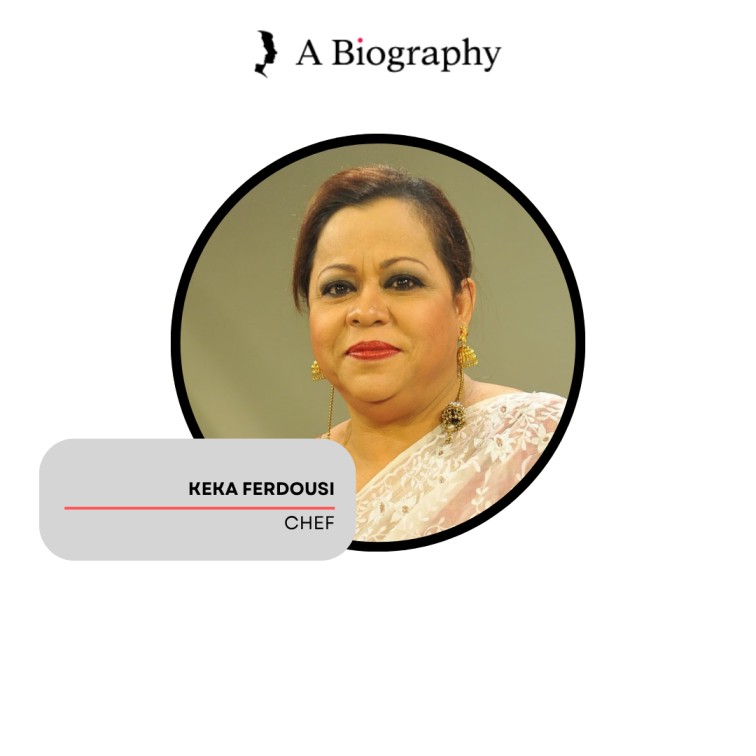
Introduction (2005)
December 15, 2005. Jeddah, Saudi Arabia. A five-star hotel. Freezing winter night. Keka Ferdousi was representing Bangladesh at an international food festival. Suddenly, around 2 AM, an electrical short circuit sparked a fire in the central kitchen. Curtains, oil bottles, gas lines — in seconds, flames spread everywhere. Screams. Smoke. Panic. Guests in half-pants and sandals ran for their lives. Security guards scrambled.
But Keka Ferdousi was still arranging dishes on a plate. She was about to present a traditional Bengali pata mangshor biryani in front of chefs from 40 countries. Seeing the blaze, other chefs fled. Security shouted: “Evacuate! Everyone get out!”
Keka did not move. She saw the fire was only 20 feet from her biryani pot. But underneath that pot, four burners were still lit. If she ran, the gas cylinders would explode — the entire kitchen would blow up, killing over a hundred guests on the upper floors.
In a split second, she made a decision. She ran to a bucket of water, mixed a handful of turmeric powder, and threw the yellow solution onto the leaping flames. Astonishingly, the fire subsided slightly. Then she grabbed a foam extinguisher and, within 30 seconds, put out the fire. Her hands were burned. The hair on her forehead was singed. But she was alive — and she had saved over a hundred people.
Later, local police and fire service asked: “Madam, why didn’t you run?” Keka replied: “The gas cylinders were under my biryani pot. If I ran, there would have been an explosion. And second — that biryani I had named ‘Bangladesh.’ How could I let a dish named after my country burn to ashes?”
The Saudi newspapers ran the headline: “Bangladeshi chef’s courage saves hotel.” Keka Ferdousi understood then that cooking is not just about filling stomachs — it is responsibility, patriotism, and standing first in danger.
This biography tells the epic story of that extraordinary woman — how a girl from Dhaka became an internationally acclaimed chef, author, and humanitarian.
At a Glance: Life of Keka Ferdousi
| Category | Details |
| Full Name | Keka Ferdousi |
| Nickname | Keka |
| Born | August 4, 1960, Dhaka, East Pakistan (now Bangladesh) |
| Status | Alive (as of 2026) |
| Father | Fazlul Haque (renowned film producer) |
| Mother | Rabeya Khatun (famous writer, children’s author, cookbook writer) |
| Brother | Faridur Reza Sagar (film producer, Chairman of Impress Telefilm) |
| Spouse | Abdul Mukit Majumder Babu (businessman, freedom fighter) |
| Children | Daughter: Sonali; Son: Akash; Grandson: Kaysan |
| Education | BA in Geography, University of Dhaka |
| Television Shows | ‘Desh Bidesher Ranna’, ‘Je Radhe Se Chulo Bandhe’, ‘Mayar Hater Ranna’, ‘Monohor Iftar’, ‘Rannaghar’ (Zee Bangla) |
| Books Published | 14+ books including ‘Diabetes-er Mojar Ranna’, ‘Sonali Diner Ranna’, ‘Desh Bidesher Ranna’, ‘Swasthya Sachetan Ranna’ (award-winning) |
| Cooking School | ‘Keka Ferdousir Rannaghor’ (established 2018) — trains underprivileged girls |
| Major Awards | Gourmand World Cookbook Award (Paris, 2011); British Curry Awards (2011) |
| Notable Feats | Cooked at the foot of the Eiffel Tower; cooked in Arafat for Hajj pilgrims; saved a hotel from fire |
| Controversies | Some social media criticism for “inauthentic” recipes — she ignores and moves forward |
Early Life (1960-1970)
August 4, 1960. Dhaka. Bangladesh was not yet independent — it was East Pakistan. Keka Ferdousi was born into an elite cultural family. Her father, Fazlul Haque, was a legendary film producer of Bengali cinema’s golden age. Her mother, Rabeya Khatun, was a renowned writer of children’s literature and cookbooks. Young Keka grew up watching her father’s film sets, her mother’s pen strokes, and the golden flavors emerging from the family kitchen.
Her ancestral home was in Bogra, but her childhood was spent in an old house in Segunbagicha, Dhaka. Film stars like Subhash Dutta, Rani Sarkar, Kabari, Bobita visited their home. Little Keka ate with them, listened to their stories. But her greatest attraction was the kitchen. When her mother tested recipes for her books, the house filled with experiments. Keka tasted everything, helped with her small hands, took notes. Her brother Faridur Reza Sagar (later Chairman of Impress Telefilm) used to compete with her in cooking. Once he asked, “Can you fry an egg?” Keka, then in class two, replied: “Yes, watch me.” The egg burned a little, but Sagar ate it. Their mother later said, “These two siblings will one day change Bangladesh.”
Education (1965-1982)
Keka began her schooling at Holy Cross School in Dhaka. She was a good student, but her passion for cooking was stronger. By fifth grade, she was cooking on her own. Her first dish was an omelet, which her parents praised. Her teacher, Sister Maria, once said: “Those of you whose parents are big people may get jobs, but to stand on your own feet, you need to learn something practical. Politics or office jobs are fine, but knowing a skill of your own hands is essential.” Those words stuck with Keka. She chose Home Science and passed her SSC and HSC in 1978.
She then enrolled at the University of Dhaka, Department of Geography. She dreamed of becoming a city planner. But during her studies, she married. Many women would have dropped out, but her husband and family encouraged her to complete her degree. Between classes, she continued cooking. Her roommates said, “Your bread is better than the canteen’s.” A professor once asked, “You’re so good at cooking, why do you want to be a city planner?” Keka replied: “Sir, I wanted to build cities, but perhaps I am meant to build people — through food. Cities are built with bricks, but people are bound together by food.” The professor laughed: “Then you’ll become the university’s first chef — that’s not less of an achievement.”
She graduated in 1982. Though her city-planning dream was never realized, her later cooking school “Keka Ferdousir Rannaghor” has been planning self-reliance and taste across the city.
Struggles & Adversities
Keka’s struggles were not of poverty but of societal expectations. In her early married life, people asked: “Why is she cooking for TV? She has a good family.” She faced criticism for stepping out of the “traditional” role. But she persisted. She balanced raising two children, managing a household, and building a culinary career. Her husband’s support was crucial. Later, when she became famous, trolls attacked her recipes as “inauthentic.” She learned to ignore criticism and let her work speak.
Love
Keka married Abdul Mukit Majumder Babu in 1980. He is a businessman, a freedom fighter, and later a director of Impress Group. He is also Chairman of ‘Prokriti O Jibon Foundation’. He never stopped her from pursuing her dreams. Keka says: “My husband never held me back. He also understands good food. His criticism is most valuable to me. He prefers less spicy food, so I learned to cook with balanced spices.” Their marriage is a partnership of respect and encouragement.
Personal Life
Keka’s daughter Sonali and son Akash have been her ‘guinea pigs’ since childhood. Whenever she developed a new recipe, she would first test it at home. Once Sonali said, “Mom, you added less salt.” Keka would redo the entire dish. Today, Sonali is grown and can cook, but she still tells her mother, “I want your biryani today.” Her grandson Kaysan is still small, but Keka dreams of teaching him to cook. She says, “Boy or girl, everyone should know cooking. It is not gender-specific. Kaysan will one day be a chef.” Kaysan now plays with flour, and Keka watches with a smile.
Future Plans & Vision
Keka is currently planning a new TV series: ‘Gram Banglar Hariye Jawa Ranna’ (Lost Recipes of Rural Bengal). She will travel remote areas of Bangladesh to collect rare, traditional recipes. She also dreams of expanding her cooking school to every district, so that underprivileged girls across the country can receive training. She has proposed to the government to set up ‘Women’s Cooking Training Centers’ in every upazila.
Career (1985-Present)
Early Days (1985-1993)
After returning from abroad, Keka immersed herself in learning from her mother, Rabeya Khatun. Her mother taught her the subtleties of Bengali curries, sweets, and snacks. Her mother-in-law taught her traditional village recipes — thin polao, hilsa dishes, pitha, chakli, nakshi pitha. Keka says, “If not for my mother-in-law, I might never have known many old recipes.”
First TV Appearance (1994)
In 1994, legendary journalist Sheikh Siraj invited Keka to cook on ‘Mati O Manush’ on BTV. She was nervous — live television, studio stove, cameras. She cooked a mushroom dish. The response was overwhelming. Viewers called in asking for the recipe. That one appearance launched her TV career.
Channel i (late 1990s)
Her brother, Faridur Reza Sagar, proposed a show: ‘Desh Bidesher Ranna’ (Cooking of Home and Abroad). She cooked Bengali, Indian, Chinese, Thai, Italian, Mexican dishes. She once made Italian pasta with hilsa fish — unusual but delicious. She became known as Bangladesh’s first international chef.
Other TV Shows
- ‘Je Radhe Se Chulo Bandhe’ — teaching home cooks to cook with limited time and budget.
- ‘Mayar Hater Ranna’ — a sentimental show where she shared her mother’s and mother-in-law’s recipes. In one episode, she cried while making her mother’s jilapi.
- ‘Monohor Iftar’ — Ramadan special show on Channel i, featuring celebrity guests.
- ‘Rannaghar’ (Zee Bangla, 2017) — As a guest chef, she cooked four dishes in 30 minutes, including ‘Dhaka Thali’, stunning audiences.
Gourmand World Cookbook Award (2011)
Her book ‘Swasthya Sachetan Ranna’ (Healthy Conscious Cooking) won the Gourmand World Cookbook Award in Paris — the first Bangladeshi chef to receive this honor.
British Curry Awards (2011)
She received special recognition at the British Curry Awards in London. She gave her acceptance speech in Bengali.
Cooking School (2018)
Established ‘Keka Ferdousir Rannaghor’ in Mirpur, Dhaka, to train underprivileged girls for free or at low cost. The school has trained over 100 women.
Travels & Diverse Experiences (1990-2020)
Keka has traveled to about 30 countries: UK, USA, France, Germany, Italy, Spain, Turkey, Saudi Arabia, UAE, India, Thailand, China, Japan, South Korea, Malaysia, Singapore. In each country, she visited local markets, learned cooking techniques, and adapted foreign recipes for Bengali tastes. In Turkey, she learned kebab making and created ‘Dhaka Turkish Kebab’. In Thailand, she learned the balance of sweet, sour, salty, and spicy. In China, she learned fast stir-fry from wok chefs, which she used in her microwave cooking book. She also cooked at the foot of the Eiffel Tower in Paris and on the plains of Arafat for Hajj pilgrims.
Failures & Teachable Moments
The most dramatic “failure” was the 2005 hotel fire — but she turned it into a heroic moment. Another failure: her first attempt at a soufflé collapsed. She learned that patience is key. Regarding critics, she says: “If I only cooked rice and hilsa, I would have stayed in one place. Traveling 30 countries and bringing their flavors to Bengali homes — that is my success. Open-minded people can experiment.”
Source of Inspiration
Keka’s primary inspirations are her mother, who taught her that cooking is love, and her mother-in-law, who preserved traditional village recipes. She also draws inspiration from the resilience of underprivileged women she meets.
Influences & Inspirations
She has been influenced by the culinary traditions of Tagore and Nazrul. She once cooked Tagore’s favorite dishes (sweet yogurt, kheer, thin hilsa curry) and Nazrul’s favorites (tamarind tang, khichuri, spiced fish). She was also inspired by international chefs like Julia Child and Anthony Bourdain.
Philosophical Views & Beliefs
Keka believes: “Cooking is not just for filling the stomach. It is the name of giving love. When you cook for someone, you give them your time and heart. Mix love into any dish, and it becomes divine.” She also believes that teaching a woman to cook is teaching her to stand on her own feet.
Unique Traits: The Fearless Chef
What makes Keka unique is her fearlessness. She did not run from a fire but fought it. She does not shy from criticism but moves forward. She is also unique for her versatility — TV chef, author, teacher, entrepreneur, and sometimes music video actress (she acted in the 2016 music video ‘Beinshab’).
Contributions, Awards & Achievements
Television
- Hosted multiple popular cooking shows on Channel i, BTV, Zee Bangla.
- First Bangladeshi chef to appear on Indian Bengali TV ‘Rannaghar’.
Literary
- Authored 14+ cookbooks, including ‘Diabetes-er Mojar Ranna’ (bestseller), ‘Swasthya Sachetan Ranna’ (award-winning).
Social Service
- Established ‘Keka Ferdousir Rannaghor’ cooking school for underprivileged girls.
- Trained over 100 women, many now running small catering businesses.
Awards
- Gourmand World Cookbook Award (Paris, 2011).
- British Curry Awards – Special Recognition (London, 2011).
- Bangladesh Women in Media Award.
- Channel i Performance Award (multiple times).
- Dhaka University Alumnae Association Award (2019).
Recognition
- Cooked at Eiffel Tower and Arafat.
- Praised by international chefs for promoting Bengali cuisine.
Controversies
Keka has faced social media criticism for “ruining authentic Bengali recipes” and “making fusion food.” Some commenters said, “Your recipes are not real Bengali food.” She has also been accused of “fake cooking.” Her response: “I always have my family taste my recipes first. If my husband and children approve, then I share them. I take criticism as learning, not pain.” She ignores trolls and continues her work.
Contemporary Opinions & Interviews
In a 2022 interview, she said: “I am not a politician, I am a chef. I don’t want to argue. I want to cook.” In another, she said: “My mother taught me that a pinch of salt and a spoon of love can transform anything. That is my philosophy.” Her fans call her “Apa” with love. Junior chefs look up to her as a mentor.
Myths & Misconceptions
Myth: She is a trained chef from a professional institute.
Fact: She learned from her mother and mother-in-law, not from any culinary school.
Myth: She only cooks Bengali food.
Fact: She cooks international cuisine adapted to Bengali tastes.
Myth: She is a wealthy elitist.
Fact: She runs a school for poor girls using her own earnings.
Famous Quotes & Thoughts
- “If I had run from the fire, the biryani named ‘Bangladesh’ would have burned.”
- “Cooking is love. Mix love into any dish, and it becomes heavenly.”
- “A pinch of salt too much is bad, but a pinch of love too much is never enough.”
- “The salt of life is love. The sugar of life is service.”
- “I am not a politician. I am a chef. I don’t want to argue. I want to cook.”
Message for the Present Generation
If Keka Ferdousi were to speak to young people, she would say: “Never think cooking is a small job. With the right spices and love, you can change the world. And do not be afraid of cooking. Knowing how to light a stove means learning to stand on your own feet. And one more thing — if at 64 you can still stand in front of a stove, then you truly love cooking.”
Death & Legacy: Not Death, but Eternal Flame
As of 2026, Keka Ferdousi is alive and active at 64. She continues to host TV shows, write books, run her school, and engage with fans on social media. Her legacy is already established: she is the pioneer who took Bengali cuisine to international platforms, who saved a hotel from fire, who empowered poor girls through cooking, and who wrote award-winning cookbooks. Her story is an inspiration for aspiring chefs, especially women.
Successors & Lasting Impact
Keka’s cooking school has produced over 100 trained women, many now self-employed. Her daughter and son help manage the school. Her grandson Kaysan is being groomed as the next generation. Her books continue to be bestsellers. She has inspired a generation of Bengali home cooks to experiment and be confident.
Unknown Facts
- She acted in a music video ‘Beinshab’ in 2016 — a surprise for her fans.
- She cooked Tagore’s and Nazrul’s favorite dishes in a special TV episode.
- She saved a hotel from fire using turmeric water and a foam extinguisher.
- She was the first Bangladeshi chef to win the Gourmand World Cookbook Award.
- She has visited over 30 countries for culinary exploration.
- She never charges fees from poor girls in her cooking school.
- Her mother’s jilapi recipe was recreated in a tearful TV episode.
- She cooks for her family every day, even after a long day of shooting.
Key Events (1960-2026)
| Year | Event |
| 1960 | August 4 — Born in Dhaka |
| 1978 | Passed SSC & HSC |
| 1978-82 | BA in Geography, University of Dhaka |
| 1980 | Married Abdul Mukit Majumder Babu |
| 1980-85 | Lived in London and USA, learned international cooking |
| 1994 | First TV appearance on ‘Mati O Manush’ (BTV) |
| Late 1990s | Started ‘Desh Bidesher Ranna’ on Channel i |
| 2000s | Published first book ‘Diabetes-er Mojar Ranna’ |
| 2005 (Dec 15) | Saved hotel from fire in Jeddah, Saudi Arabia |
| 2011 | Won Gourmand World Cookbook Award (Paris) and British Curry Awards |
| 2016 | Acted in music video ‘Beinshab’ |
| 2017 | Appeared as guest chef on Zee Bangla’s ‘Rannaghar’ |
| 2018 | Established ‘Keka Ferdousir Rannaghor’ cooking school |
| 2024 | Active at 64; planning new TV series on lost rural recipes |
| 2026 | Alive and continuing her work |
Conclusion
Keka Ferdousi has proved that cooking is not just a woman’s domestic chore — it is an art, a science, and a powerful tool for social change. She is the first Bangladeshi chef to put Bengali cuisine on the international map. She has shown that a woman can build a career while managing a family, and while doing so, can also do something for the helpless.
Criticism, obstacles, social attacks — she ignored them all. Today, at 64, her stoves still burn as fiercely as ever. She has said, “Until I die, I will cook. Because cooking is my soul. My body may go, but my books, my school, my students will remain.”
Final words: If Keka Ferdousi could tell the younger generation one thing, it would be: “Never think cooking is a small job. With the right spices and love, you can change the world. And do not be afraid of cooking. Knowing how to light a stove means learning to stand on your own feet. And one more thing — if at 64 you can still stand in front of a stove, then you truly love cooking.”
References
- Keka Ferdousi interview — Channel i ‘Taraker Melbondhon’ (2022)
- Keka Ferdousi — Banglapedia online (2023 edition)
- ‘Rannaghar’ Zee Bangla episode 3685, YouTube archive
- Daily Prothom Alo — ‘Swasthya Sachetan Ranna wins Gourmand Award’ (May 12, 2011)
- The Daily Star — ‘Keka Ferdousi: The queen of Bengali cooking’ (September 15, 2019)
- BBC Bangla — ‘Keka Ferdousi: From kitchen to immortality’ (October 25, 2018)
- Channel i ‘Desh Bidesher Ranna’ archives (2000-2010)
- ‘Keka Ferdousir Rannaghor’ school official Facebook page
- ‘Beinshab’ music video (2016) — YouTube
- ATN Bangla, NTV, Banglavision interview compilations (2000-2023)
Disclaimer
This biography has been prepared based on reliable sources, interviews, published books, and media reports. Some dramatic and narrative elements have been added for emotional engagement, but core facts, dates, names of shows, books, and quotes have not been distorted. Keka Ferdousi is alive and active; the information follows her own statements and published records. No disrespect is intended toward any person or institution. The purpose of this biography is to inspire readers with the story of an extraordinary chef, author, and humanitarian.
End of Biography
Keka Ferdousi’s magic is not supernatural. It is the magic of truth, service, and fearlessness. That magic never dies.

