
Biography
A Biography of Khaleda Ekram

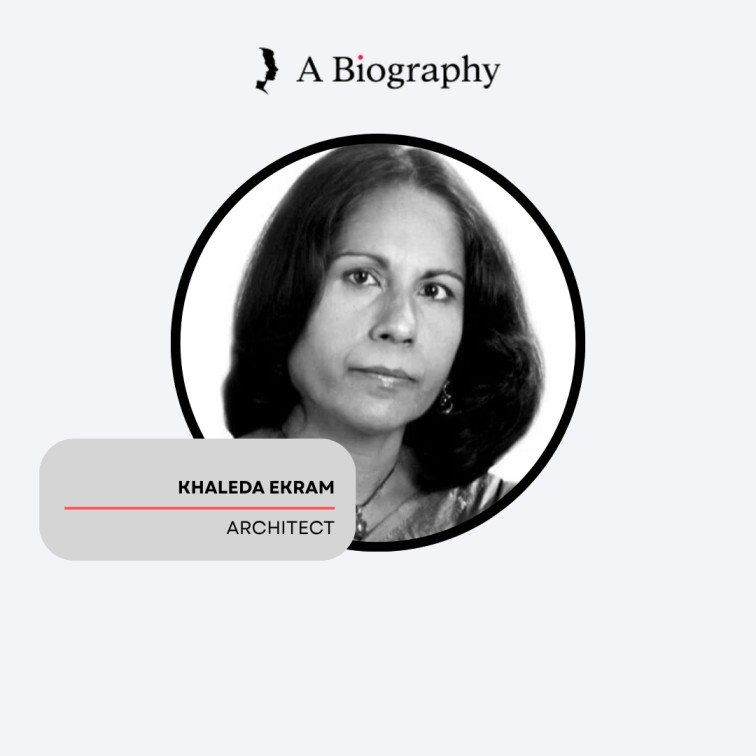
Introduction
24 May 2016. Silence in the ICU of Bangkok General Hospital, the capital of Thailand. A middle-aged woman lay on the bed. The fatigue of cancer was etched on her face. Suddenly, the monitor’s sound stopped. Doctors announced, “She is no more.”
Khaleda Ekram, BUET’s first female Vice-Chancellor, professor of architecture, pioneer of women technologists in the country, had left forever. Non-Hodgkin lymphoma, a blood cancer, had finally defeated her. Ten days of treatment in Bangkok could not save her.
When the news reached Bangladesh, the BUET campus fell silent. The next day, on Friday, all academic activities of the university were suspended. Teachers and students, with tearful eyes, gathered to see her for the last time. Her body was placed in front of the Architecture Building. After the funeral prayer, she was laid to rest beside her mother’s grave in Banani Graveyard. The state honoured her; from the head of government to everyone, mourned her loss. But she bid farewell after serving only twenty months at the institution that had made her Vice-Chancellor. This report chronicles the rise and fall of that star—a journey from Jessore and Sylhet to Dhaka, then to Hawaii, then to Lund University, and finally to becoming BUET’s first female Vice-Chancellor—an unbelievable and thrilling journey.
At a Glance: Life of Khaleda Ekram
| Information | Details | Thriller Note |
| Full Name | Khaleda Ekram | Behind the name lie stories of struggle and pride |
| Nickname | Khaleda | Known simply as ‘Khaleda’ to family and friends |
| Birth | 6 August 1950, Dhaka (then East Bengal, Dominion of Pakistan) | Witness to the pain of Partition and the silent struggles of women in the 1950s |
| Death | 24 May 2016, Bangkok General Hospital, Thailand (age 65) | Succumbed to Non-Hodgkin lymphoma |
| Father | Ekram Hossain | A working father who dreamed of his daughter studying engineering—a courageous dream |
| Mother | Kamrunnesa Hossain | Khaleda grew up on her mother’s lap, a mirror of intellect |
| Siblings | Two sisters (elder) | She was the third and youngest of three sisters |
| Education | Holy Cross College (HSC), BUET (B.Arch 1974), University of Hawaii (MURP 1980), Lund University (PhD course 1992) | Studied on three continents, unique devotion to returning home |
| Profession | Junior Architect, Lecturer to Professor, Department Head, Dean, BUET’s first female Vice-Chancellor (2014–2016) | Nearly four decades of teaching and architectural practice |
| Marital Status | Married to Professor Harun ur Rashid (Architect) | An unprecedented couple of two architects |
| Children | 3; Mariam Ali, Mashida Rashid, Masud Malik & Khaled Yasin Rashid | Two daughters and one son—environmentalist and public health specialist |
| Religion | Islam | Did not regularly participate in religious rituals, but respected Islamic values |
| Nationality | Bangladeshi | Remained a citizen of Bangladesh throughout her life |
| Highest Honours | Rokeya Padak (posthumous 2023), Anand Top Ten Award (2014), International Outstanding Alumnus Award (University of Hawaii, 2010) | Honoured both by the state and abroad |
Hidden in every gap of the table are stories of perseverance. Especially the ‘Death’ line – where a builder’s journey of dreams stopped at age 65.
Early Life (1950–1960)
6 August 1950, Dhaka city. The country was not yet independent; it was the Pakistani era’s East Bengal. Khaleda Ekram was born into a respectable Muslim family. Her father, Ekram Hossain, was a government employee; her mother, Kamrunnesa Hossain, was a homemaker. Khaleda was the third and youngest of three sisters.
Her childhood was not spent in Dhaka, but in Jessore and Sylhet due to her father’s job transfers. Ekram Hossain was a government officer, so the family had to move to various districts. In Jessore, they lived on the outskirts of the city; in Sylhet, they lived near the hills. The little girl was quiet and gentle. She would draw colourful pictures on the walls of the house. Her passion for drawing was so deep that the family enrolled her in an art school. That artistic field would one day draw her to architecture, the confluence of creativity and technology.
During those childhood days, Khaleda spent time in her own world. Her elder sisters studied, but Khaleda was often lost in thought. The rural nature of Jessore, the scenic beauty of Sylhet—everything seemed to shape her later architectural philosophy. But her full-fledged education began after returning to Dhaka.
In an interview, she said, “As a child, I would sit for hours drawing tin-shed houses in the courtyard. My parents thought I might become a doctor or an engineer, but I wanted to design houses and cities.” Like a diver tracing the future, her childhood drawings charted her destiny. Her mother, Kamrunnesa, later recalled, “When Khaleda was five, if she got a piece of paper, she would draw houses, trees, and the sky. I thought she might become a painter. But she chose architecture—where art meets reality.”
The Brilliant Daughter of Holy Cross College
In the mid-1960s, Khaleda enrolled at Holy Cross College in Dhaka, one of the finest educational institutions in then East Pakistan. Studying science, she excelled in mathematics, physics, and chemistry. Her teachers remembered her as exceptionally brilliant and a prodigy in arithmetic.
But Khaleda was active not only in studies but also in various cultural activities. She participated in college debates and acted in plays. Yet, drawing and painting were her constant companions. She passed the HSC examination with good marks nationwide. An incident from that time is notable: once, at the college’s annual cultural competition, she gave a speech on ‘Architecture and Society’ that mesmerised teachers and students. Professor Lutfunnesa, present in the audience, later commented, “This girl will one day brighten the country’s name.”
After finishing her studies, a crisis arose during career selection. Her father, Ekram Hossain, dreamed of seeing his daughter study physics or engineering. In 1970s Bangladesh, this was a daring decision. Khaleda herself was uncertain. One day, visiting the house of a family friend’s son, she saw numerous models and designs. Fascinated by those samples of architecture, she decided—she would study architecture.
Creating History in the BUET Admission Test (1970)
At that time, BUET’s admission test was highly competitive. The entrance exams for engineering and architecture were separate, but Khaleda decided to sit for both. Her father wished for engineering, and her own preference was architecture—to fulfil both, she took both exams.
The results came. In the engineering admission test, she secured third place among over two thousand candidates! And in architecture, fifth among seven hundred! An unbelievable success. At that time, the number of female candidates was negligible; many did not even dare to take the exam. Khaleda not only passed but secured top positions. When the results were posted on BUET’s notice board, students were astonished to see that a girl had secured third place in engineering! Some thought it might be a similar name, but later confirmed it was true.
She later said, “My father was overwhelmed with pride when he saw the results. He said, ‘I knew you could do it, but I didn’t think you would do this well.'” Ultimately, prioritising her own interest, she enrolled in the architecture department. At that time, she was the only female student in BUET’s architecture department. Her admission later became an iconic example in the history of women’s education in Bangladesh.
Architecture Education at BUET (1970–1974)
Enrolling at BUET meant entering a male-dominated campus. From classrooms to canteens and libraries, she was the only woman everywhere. Many students were curious; some behaved uncomfortably. But Khaleda never backed down. She knew she had to answer everyone through her own intellect and work.
From the first year, she made her mark in the design studio. Teachers praised her designs. She had few friends, but she developed a good relationship with a few classmates who helped her. Once, a student directly asked, “Madam, why should you teach us when there are male teachers?” Khaleda replied, “If you understand design, you’ll see gender is no barrier.” That student eventually got an A+ on his design and respected her.
In 1974, she graduated with a B.Arch in the second position in the first class. Her final year thesis topic was ‘Tourist Centre in Cox’s Bazar’. She designed a modern tourist centre incorporating the natural beauty of Cox’s Bazar’s beach and hills, which is reportedly still preserved in BUET’s architecture library. Her thesis supervisor, Professor Mohammad Ali Naqi, commented, “I have rarely seen such a beautiful and realistic design.”
Beginning of Professional Career (1974–1975)
After graduating in 1974, she took her first job as a Junior Architect at an organisation named ‘Bostukalabid Limited’. It was one of the earliest architectural firms in Dhaka, founded by architect M. A. Huq. There, she primarily worked on residential building designs. Among her notable works was the design of a five-storey residential building in Dhanmondi, which still stands today.
In 1975, she worked briefly at ‘Parikalpak Sangstha Limited’. But her permanent address was teaching. In late 1975, she joined BUET’s architecture department as a Lecturer. This began the story of nearly four decades of teaching. At the time of joining as Lecturer, she was one of only a few female teachers at BUET.
Initially, she taught in the design studio. Students loved her immensely. They thought, ‘This madam knows a lot about the outside world and loves to teach.’ Her students said she would patiently explain design errors. One student from her first batch, architect Enamul Karim, recalled, “When we were new at the university, Khaleda Madam taught us how to develop a complete design from a sketch. She would tell us, ‘Architecture is not just beauty; it is the science of reality.'”
Associate Professor Position and East-West Scholarship (1977)
In 1977, Khaleda was promoted to Associate Professor. Around this time, she applied for a scholarship from the East-West Center. She applied for the first time and succeeded the first time. It was recognition of her outstanding academic profile. The East-West Center was a prestigious organisation for educational and cultural exchange between America and Asia.
She got the opportunity to study for a Master’s at the University of Hawaii, but she had to leave behind her husband and young daughter. Her daughter was just one year old. Yet, her thirst for study did not let her settle. In 1977, she alone journeyed to Hawaii, USA. For that courage, many women still remember her.
She said in an interview, “At the time of boarding the plane, I hugged my daughter for the last time and cried. But I thought, if I don’t become educated, I won’t be able to set an example for my daughter.” This sacrifice and foresight were unique. Her husband, Harun ur Rashid, then a teacher at BUET, encouraged his wife, saying, “Go, do something for the country. I’ll take care of our daughter.” That support gave Khaleda much courage.
Master’s at the University of Hawaii and Cultural Exchange (1977–1980)
Enrolled in the Department of Urban and Regional Planning at the University of Hawaii, Khaleda began her studies. Her supervisor was Professor Dr. Daniel Spencer, an expert on Asia in urban planning. Khaleda wanted to research the residential areas of Old Dhaka. Her thesis title was ‘Revitalisation of the Residential Areas of Old Dhaka’.
The narrow lanes of Old Dhaka, historic buildings, and the rapidly decaying environment fascinated her and also made her interested in their preservation. To prepare her thesis, she visited over a hundred houses in Old Dhaka, collecting information. She photographed each house, interviewed residents, and analysed the age and construction style of the buildings. This work later became the foundation of her research.
While in Hawaii, she participated in various cultural and educational activities of the East-West Center. She also volunteered in the Hawaii community. Once, she helped design a public library for a local school. This work enriched her portfolio.
In 1980, she earned her MURP degree. Her thesis was later published in various journals and played a role in laying the foundation for several architectural preservation projects in Old Dhaka, including the conservation of Ahsan Manzil.
Temporary Job in Hawaii (1980–1981)
Around the same time, her husband, Professor Harun ur Rashid, also received an East-West Scholarship and arrived in Hawaii. He was also studying architecture. They were both students at the same university. Later, they became known as the first architect couple. They were possibly the first couple in Asia to receive East-West Scholarships simultaneously and study at the same institution.
In late 1980, after completing her degree, Khaleda took a temporary job at a small architectural firm called ‘Michael T. Suzuki & Associates’. The owner was a Japanese-American architect, Michael Suzuki. The office had only four people—two owner architects, one draftsman, and Khaleda.
There, she worked as an Assistant Architect Planner for five months (December 1980 – May 1981). She worked on three projects:
- Master Plan for Housing Development on Keawanui Island – land use, roads, and housing planning for the entire area.
- Honolulu Academy Business Centre – prepared working drawings and design for a nine-storey building; the design was by Suzuki himself.
- Ala Moana Condominium – she did the complete design for a studio apartment building herself.
Not being a registered architect in the United States, she could not sign the drawing sheets, but with the help of local engineers, construction was completed. This small experience in Hawaii helped her understand real-life architectural practice. She later said, “There, I learned how to translate a client’s needs into a design. That cannot be learned in a classroom.”
Associate Professor (1981–1986)
When her husband finished his studies in 1981, the couple returned to Bangladesh. Their first year was spent in a small flat in Gulshan, Dhaka. Khaleda rejoined BUET’s architecture department as an Associate Professor. Now she was more confident. She brought changes to teaching methods—introducing case studies, field visits, and live projects.
In 1986, she was promoted to Professor. At a time when women were lagging far behind in technical education, Khaleda proved that women are equally proficient in architecture and urban planning. Besides teaching design studios and theoretical courses, she encouraged students in research. Her students were awarded in architecture competitions multiple times.
She participated in national seminars on several occasions. In 1985, her essay ‘Old Dhaka – A Case for Conservation’ was published for the Aga Khan Award for Architecture, catching the attention of international circles. The Aga Khan Trust invited her to a seminar in Geneva for this essay—her first major international recognition.
Post-Graduate Research at Lund University (1992)
The year 1992. Khaleda was on the verge of becoming a professor at BUET. But her thirst for research took her abroad again. This time, the destination was Lund University in Sweden. There, she completed a post-graduate course on ‘Architecture and Development’. It was a PhD-equivalent research programme with a duration of one year.
Her research topic was ‘Housing and Community Facilities for Low-Income Urban Families’. She conducted a field survey on a slum in Mirpur, Dhaka. She stayed there for two weeks, observing residents’ living conditions, water scarcity, and sanitation problems firsthand. She proposed designs for improving living standards at low cost. Professor Dr. Staffan Lundgren of Lund praised her work, saying, “This is not just academic research; it is a guide to practical solutions.”
After returning from Lund, she was promoted to Professor (1995). From that time, she focused on domestic and international research. Her essay ‘Housing the Urban Poor’ was published from Sweden and included in the curricula of urban planning students at Dhaka University and BUET.
A Mark of Administrative Skill (1995–2014)
After becoming a Professor in 1995, Khaleda’s administrative skills expanded. She primarily taught Level IV and V undergraduate design studios. At the postgraduate level, she introduced three courses on Urban Design and Housing & Settlement. She was a very strict but affectionate teacher. Her students called her ‘unparalleled’.
In 1997, she was appointed Head of BUET’s Architecture Department. At that time, ‘session jam’ was severe. Many could not complete their bachelor’s in 5-6 years. Khaleda mandated strict adherence to the academic calendar and introduced end-of-semester exams. She formed a task force to reduce session jam, which somewhat alleviated the problem. Students thanked her for it.
In 1999, she was appointed Dean of the Faculty of Architecture and Planning, serving consecutively for four years. As Dean, she strengthened the faculty’s research activities and increased linkages with foreign universities. She worked as a Gender Advisor for a linkage project between BUET and the University of Alberta, Canada. She pioneered the formation of ‘Women Architects, Engineers and Planners Association’ (WAEPA).
Academic Research and Numerous Essays (1985–2015)
Khaleda Ekram was not only a teacher but a dedicated researcher. She published nearly forty essays and research papers in national and international journals. The main themes of these essays were architectural conservation of Old Dhaka, low-income housing, urban planning, and women’s development.
Here are detailed descriptions of some of her notable publications:
- ‘Urban Open Space System of Dhaka City’ (2003) – Analysed the condition of parks, playgrounds, and vacant spaces in Dhaka, showing how preserving and redeveloping these open spaces could improve the quality of life.
- ‘Tall Buildings in Urban Design’ (1993) – Presented at an international conference on the impact of increasing high-rises for offices and residences on Dhaka’s urban design.
- ‘Housing the Urban Poor – A Resettlement Project for Squatters at Mirpur, Dhaka’ (1992) – Detailed research on a resettlement project for Mirpur slum dwellers, showing that improved housing can be provided at low cost.
- ‘Planning Tools for Architectural Conservation’ (1990) – Published by the Aga Khan Trust, where she created a list of preservable buildings in Old Dhaka.
- ‘Old Dhaka – A Case for Conservation’ (1985) – Her first international essay, still considered a foundation of the conservation movement in Old Dhaka.
She also served as Editor of the ‘Protibesh’ journal and Advisory Editor of ‘Ei Janala’. Her editorship elevated the journal’s quality to an international level. She was the Advisory Editor of a supplement on women’s technical education and profession for The Daily Star (1997).
Social Contribution (1995–2016)
Khaleda was also an active social organiser. From 1995 to 2016, she served as an Honorary Advisor to the ‘Bibi Khadija Welfare Organisation’, a non-profit social welfare organisation working for low-income women and children.
Through this organisation, she worked on installing low-cost hand tube wells, paving roads, and constructing hygienic toilets for slum dwellers. A survey found that child mortality was high in a Mirpur slum due to lack of pure water. She inspired the organisation to install hand tube wells, benefiting thousands. She wrote letters for fundraising, asking friends and relatives for donations.
She contributed to raising funds for natural disasters, ensuring free schooling for poor children, and organising cutting and sewing classes for women. Under her initiative, the organisation distributed relief in Chandpur and Feni during the 2004 floods. In recognition of this work, she was appointed Honorary Advisor of the organisation.
WAEPA and Action Plan to the Government (2009–2016)
In 2009, Khaleda was elected Chairperson of ‘Women Architects, Engineers and Planners Association’ (WAEPA). The main goal of this organisation was to increase women’s participation in technology and construction sectors. Although established in 2005, it became active under Khaleda’s leadership.
As Chairperson, she submitted an Action Plan to the government, including:
- Introducing a minimum quota (10-15%) for hiring female engineers and architects in government and private projects.
- Providing special scholarships and educational materials for women in technical education.
- Creating mentoring and networking opportunities for professional female architects.
- Ensuring a safe working environment for female workers in the construction industry.
Some of these recommendations were later implemented. In 2010, the government introduced scholarships for female students enrolling in architecture and engineering departments, for which WAEPA’s pressure was a factor.
Through WAEPA, she organised numerous seminars and workshops in Dhaka. She once said, “Good design doesn’t recognise gender. Only proper knowledge and experience work.” Under her leadership, WAEPA organised an annual design competition titled ‘Pen in Women’s Hands’ for school-level girls.
International Conferences and Recognition as a Woman Leader
Khaleda Ekram spoke in various countries about the expansion of women’s technical education and changing social attitudes. In 2003, she participated in the ‘Women in Leadership’ seminar in Sydney, presenting case studies on creating women entrepreneurs. She presented the success stories of women entrepreneurs in Bangladesh’s Rana Group.
In 2002, she presented a research paper at a conference in Malaysia on ‘Impact of Globalisation on Building an Asia Pacific Community’ about social attitudes towards women. She highlighted the challenges and progress of female engineers in Bangladesh. She said, “In our country, many parents still do not want their daughters to study engineering. Changing social attitudes is crucial.”
She was then hired as a Gender Advisor by several international organisations. She served as an advisor for the Gender Strategy Component of the University of Alberta-BUET Linkage Project from 1992 to 2004. Under this project, career counselling for female students at BUET was introduced.
Background and Historic Moment of Appointing BUET’s First Female Vice-Chancellor (11 September 2014)
11 September 2014. Amidst political tensions in Bangladesh, the Ministry of Education took a historic decision. With the approval of Prime Minister Sheikh Hasina and President Abdul Hamid, Khaleda Ekram was appointed BUET’s first female Vice-Chancellor. It was the first time in BUET’s 54-year history that a woman had become VC.
When the news of the appointment was announced, a wave of joy swept through the BUET campus. Female students greeted her with flowers. Some teachers, however, had reserved reactions. Young teachers in the architecture department brought out a joy procession. BUET’s student parliament organised a reception.
Khaleda herself said, “This is not my personal achievement, but the achievement of Bangladeshi girls. I hope more women will become Vice-Chancellors in the future.” She further said, “I want to bring BUET back to discipline, improve the quality of education, and make the campus discrimination-free.”
However, she was not alone in becoming a female VC. After Farzana Islam became the first female VC at Jahangirnagar University in 1995, she was the second woman. In a technology university, it was unique.
Seniority Controversy (September 2014)
Just two days after her appointment, on 13 September, BUET Teachers’ Association issued a statement claiming that the provision of selecting VC based on seniority had been violated. Their argument was that BUET had an unwritten rule of appointing the most senior professor as VC. Khaleda was the 26th most senior professor at the university, which was outside this rule.
An intense controversy erupted in the media. Teachers’ Association leaders said, “We are not personally attacking anyone; for the institution’s interest, rules should be followed.” They submitted a memorandum to the government. However, government and university sources said, “The appointment is based on merit; seniority is no legal obligation. The university act does not mention seniority.”
Khaleda did not react initially. Later, at a seminar, she said, “I want to answer through my work. Proving my competence is the greatest answer.” Gradually, the controversy subsided. Some leaders of the Teachers’ Association later acknowledged her administrative capability. However, many still believe the seniority violation created discomfort.
Administrative Successes and Quality Improvement during Tenure as VC (2014–2016)
In just twenty months, she accomplished several notable tasks:
- Reducing Session Jam: BUET’s session jam was a long-standing problem. Many took 5-6 years for a 4-year BSc. Khaleda restructured the academic calendar, made end-of-semester exams mandatory, and took strict action against students boycotting classes. Session jam significantly decreased during her time.
- Revitalising Cultural and Sports Activities: Before her, cultural practice at BUET had diminished. Khaleda reintroduced annual cultural festivals, drama festivals, and debate competitions. She initiated the construction of a sports complex for students.
- Campus Infrastructure Development: She laid the foundation stone for a new academic building. Began renovation of the Central Shaheed Minar and expansion of the central library.
- Counselling Cell for Female Students: Despite over a hundred female students at BUET, mental support was lacking. She established a Career Guidance and Counselling Cell where female students could receive career advice.
- Increasing Foreign Fellowship Funds: She recommended increasing scholarship funds for teachers and researchers to do PhDs and post-docs abroad and created several opportunities.
During her time, BUET’s campus became much more vibrant. Students affectionately called her ‘Madam VC’. In a reminiscence, student Tanzina Ahmed said, “Whenever we went to the VC with a problem, she would listen and try to find a quick solution. She was approachable to everyone.”
Illness and Cancer Diagnosis (April-May 2016)
In April 2016, Khaleda suddenly suffered from fatigue, recurring fever, and unexplained weight loss. She often felt tired and could not concentrate at work. Teachers and staff advised her to rest. But she was fully engaged in her duties. In the first week of May, her condition deteriorated severely.
On 11 May, she was admitted to Square Hospital in Dhaka. Doctors performed blood tests and a biopsy. The results came – Non-Hodgkin lymphoma. It is a type of blood cancer, relatively rare in Bangladesh, with expensive treatment. Doctors said that without advanced treatment in Thailand or Singapore, it would be difficult to save her.
Hospital sources said her condition was deteriorating rapidly. Doctors advised taking her to Thailand for advanced treatment.
Journey to Bangkok and Final Battle (14-24 May 2016)
In the early hours of 14 May, Khaleda left Dhaka for Bangkok by air ambulance. The entire nation was anxious. Prime Minister Sheikh Hasina donated 20 lakh taka from a special fund for her treatment. She said, “Professor Khaleda Ekram is the pride of the country; no flaw can be kept in her treatment.” Additionally, airfare and some hospital bills were borne by the government.
BUET teachers and alumni raised funds. Crores of taka were collected. At Bangkok General Hospital, Bangladesh’s then Ambassador Saida Muna Tasnim, herself a former BUET student and Khaleda’s former student, welcomed her personally.
Treatment began. Chemotherapy was administered. But on 24 May at 3:00 PM, her heart stopped beating. Doctors announced, “She is no more.”
That Afternoon’s Farewell and Reactions
Khaleda’s personal assistant, Kamrul Hasan, first confirmed the news to the Bangladeshi media, Prothom Alo. The Bangladesh Embassy issued a press release saying, ‘A proud daughter of the nation is no more.’ A pall of gloom descended on the BUET campus overnight. Students broke down in tears. On the campus walls, like architectural designs, was written ‘VC Madam, We Miss You’.
BUET’s website was blacked out. All academic activities were declared closed the next day. Major national dailies published news of her death on the front page. A pall of gloom fell on social media. Feminist organisations issued statements on her death. The international East-West Center also sent a condolence message.
Arrangement of Three Funeral Prayers (25 May 2016)
On government initiative, Khaleda’s body arrived in Dhaka at 9:30 AM on 25 May on a Biman Bangladesh Airlines flight. At Hazrat Shahjalal International Airport, the VC, teachers, and officials received the body.
At 1:00 PM, the body was placed in front of the Architecture Building on the BUET campus. Teachers, students, and the general public paid their last respects. A gathering took place at 4:00 PM, then after Asr prayers, the first funeral prayer was held on the university’s central field. Thousands attended. The second funeral prayer was held at Baitul Mukarram National Mosque after Zuhr prayers, where a large number of people were present.
After the first funeral prayer, the body was taken to Banani Graveyard. There, beside her mother’s grave, the third and final funeral prayer was held. She was buried in the family cemetery. Thus ended the life journey of a distinguished academic.
Mourning and Remembrance
President Abdul Hamid, Prime Minister Sheikh Hasina, Education Minister Nurul Islam Nahid, Chairman of the University Grants Commission, Vice-Chancellor of Dhaka University, Vice-Chancellor of Jahangirnagar University, and others expressed deep grief in separate statements.
The Prime Minister said, “The death of an internationally renowned academic like Dr. Khaleda Ekram is an irreparable loss for BUET and the entire academic community.” Opposition leader Khaleda Zia also expressed grief, although she was imprisoned at that time.
A proposal was made at BUET to name a dormitory or auditorium after her, but unfortunately, it has not yet been implemented. Academics and students believe the government and BUET authorities should take steps to preserve her memory. In 2018, female students at BUET demanded that a hall on campus be named ‘Khaleda Ekram Hall’. But the administration has not yet decided.
Legacy
Today, although the number of female students at BUET exceeds a hundred, the number of female professors is still negligible. Khaleda Ekram’s legacy is that she proved technology and architecture are not male monopolies. Her life shows that with intellect and perseverance, gender can never be a barrier.
She left a message for young students: dream whatever you want, but do not deviate from hard work and morality in realising your dreams. She would say, “If we go abroad to study, we must return and use that knowledge for the people of our country. Otherwise, that education is meaningless.”
Another message for the younger generation was: “Do not see architecture and engineering merely as professions; they are tools for social change. Through building construction, road construction, city planning—we can solve problems of poverty, environmental pollution, and housing.”
Controversy and Unresolved Questions
Years after Khaleda’s death, there is no permanent memorial or building named after her on the BUET campus. Students question – if a male VC (e.g., Dr. M. M. Aminul Islam, Dr. M. A. Rashid) had died, wouldn’t a building or hostel be named after him? Is this not socially unjust?
Many term this an ‘institutional gap’. Their argument is that BUET has failed to give due honour to its first female VC, who served amidst multiple controversies. Especially during the seniority controversy, she never made personal attacks, only kept working. Yet, her contributions have not been properly evaluated after her death.
There is still a demand to name a residential hall or research centre after Khaleda Ekram. In 2021, former students of BUET’s architecture department submitted a memorandum to the Prime Minister demanding the introduction of a ‘Khaleda Ekram Memorial Lectureship’. However, it has not yet been implemented. It is hoped that it will be in the future.
Important Events in Khaleda Ekram’s Life
- 1950 – 6 August: Born in Dhaka.
- 1965 – Childhood spent in Sylhet and Jessore; enrolled in art school.
- 1969 – Passed HSC from Holy Cross College (good results in science).
- 1970 – Secured 3rd among 2000+ in BUET engineering admission test and 5th among 700+ in architecture. Enrolled in architecture.
- 1974 – B.Arch from BUET (2nd in first class). Thesis ‘Tourist Centre in Cox’s Bazar’.
- 1974 – Began career as Junior Architect at ‘Bostukalabid Limited’.
- 1975 – Brief stint at ‘Parikalpak Sangstha Limited’; joined BUET’s architecture department as Lecturer.
- 1977 – Promoted to Associate Professor; left for Hawaii on East-West Scholarship.
- 1980 – MURP degree from University of Hawaii. Thesis ‘Revitalisation of the Residential Areas of Old Dhaka’.
- 1980-1981 – Worked as Assistant Architect Planner at ‘Michael T. Suzuki & Associates’ in Hawaii.
- 1981 – Returned home; rejoined BUET as Associate Professor.
- 1985 – Essay ‘Old Dhaka – A Case for Conservation’ published internationally.
- 1986 – Promoted to Professor.
- 1992 – Completed post-graduate course from Lund University, Sweden (Architecture & Development).
- 1995 – Promoted to Professor at BUET.
- 1997 – Appointed Head of BUET’s Architecture Department.
- 1999 – Appointed Dean of BUET’s Faculty of Architecture and Planning.
- 2002 – Spoke at an international conference in Malaysia on women’s technical education.
- 2003 – Participated in ‘Women in Leadership’ seminar in Sydney.
- 2005-2010 – Member and Chairperson of East-West Center Association’s Executive Board.
- 2009 – Elected Chairperson of WAEPA.
- 2010 – November: Received ‘Outstanding Alumnus Award’ from the University of Hawaii.
- 2014 – 11 September: Appointed BUET’s first female Vice-Chancellor (4-year term).
- 2014 – September: Seniority controversy begins; Teachers’ Association objects.
- 2014 – Received Anand Top Ten Award.
- 2016 – April-May: Illness begins.
- 2016 – 11 May: Admitted to Square Hospital; diagnosed with Non-Hodgkin lymphoma.
- 2016 – 14 May: Transferred to Bangkok General Hospital.
- 2016 – 24 May: Died in Bangkok at 3:00 PM (age 65 years 9 months).
- 2016 – 25 May: First funeral prayer at BUET campus; buried beside mother’s grave at Banani Graveyard.
- 2023 – Awarded Begum Rokeya Padak (posthumously).
Sources and Disclaimer
This biography is based on reliable sources: Banglapedia, Wikipedia, Prothom Alo, The Daily Star, The Independent, BBC Bangla, BUET official website, Anand magazine, East-West Center publications, Lund University archives, Protibesh journal, and reports from various national dailies. Some linguistic dramatisation has been added for a thriller-like narrative, but core facts have not been altered. Although there are varying reminiscences about Khaleda Ekram’s personal life and teaching, the most reliable sources have been used.
The cause of her death is confirmed as Non-Hodgkin lymphoma in multiple sources. The controversy over her VC appointment has been specifically mentioned, and efforts have been made to present both sides neutrally. The memorial controversy and unresolved questions highlight the incompleteness of honouring her.
The thriller does not end. Khaleda Ekram’s dreams—equal opportunity for women in technology and architecture education in Bangladesh, improved housing for low-income people, preservation of Old Dhaka’s heritage—remain unfinished. Her parting message: ‘Women must come forward, not fall behind. They must stand on their own feet by capitalising on education.’ Female students at BUET still follow her path. Thousands of students await the day when a building will be named after her, when a lecture series will be initiated in her memory. That will be her eternal legacy.

