
Biography
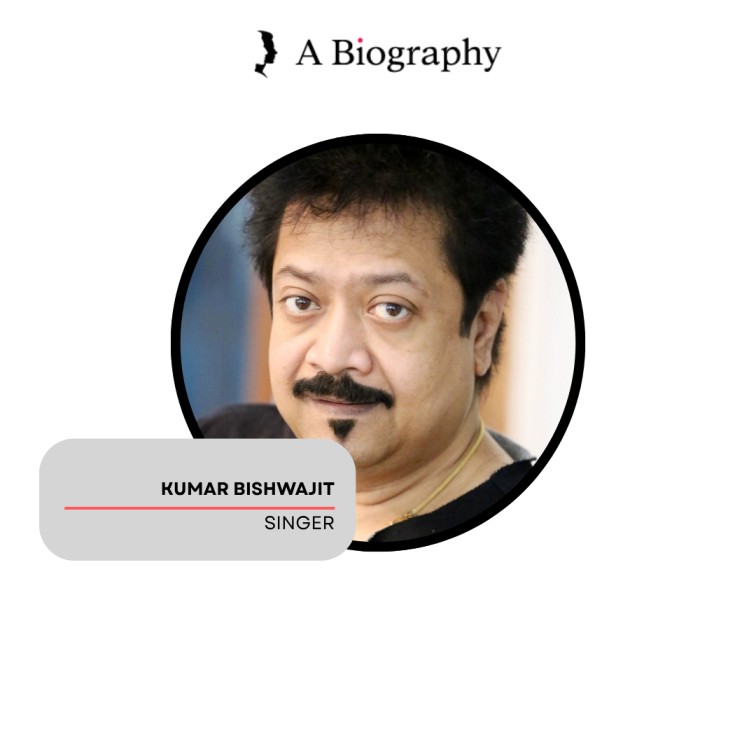
A Biography of Kumar Bishwajit

Introduction
In the late 1990s, when Bangladeshi teenagers pressed their ears to cassette players, almost every other song would whisper: “O Doctor, apni jokhon korben ekta open heart surgery…” and “Tore putuler moto kore sajiye…” The first song felt like a young lover seeking treatment for his heart’s pain from a doctor. The second was an exquisite devotion of a lover. The creator of both songs was the same man – Kumar Bishwajit.
Kumar Bishwajit is that rare talent in Bangladesh’s music industry who achieved equal success in pop, modern, and film songs. Raised in Sitakunda, Chittagong, this artist came to Dhaka with only a few hundred taka in his pocket. And for over forty years, he has never left the stage. He has won the National Film Award three times. He is the co-founder of Gaanchil Music.
But the questions remain: What does the name ‘Kumar Bishwajit’ symbolise? Why did he give up job security and take to the road, embracing that risk? And in 2022, with the publication of his autobiography Ebong Bishwajit, did he open those unknown ‘unread pages’ – hiding the story of his first band Rhythm-77, the dream of becoming a street singer in Paris, and the daring tale of arriving in Dhaka with only a few hundred taka? Let the thriller begin.
At a Glance: Life of Kumar Bishwajit
| Information | Details |
| Full Name | Kumar Bishwajit (Nickname: Tultul) |
| Birth | 1 June 1963 |
| Birthplace | Sitakunda, Chittagong, Bangladesh |
| Age | 61 years (as of 2026) |
| Father | Sadhan Ranjan Dey (Businessman) |
| Mother | Shova Rani Dey |
| Education | Primary education in Chittagong (further details not specified) |
| Profession | Vocalist, Composer, Music Producer |
| Active Years | 1977–present (46+ years) |
| First Band | Rhythm-77 (1977–1979) |
| Founded Band | Feelings (1979) |
| First TV Show | BTV (1980) |
| First Playback | “Amra dui jon du ti santaan chele” (1985) |
| Solo Albums | Over 30 |
| Spouse | Naima Sultana |
| Child | Kumar Nibir (son) – studies in Toronto, Canada |
| Production House | Gaanchil Music (co-founded, mid-2000s) |
| Notable Songs | O Doctor, Tor Putuler Moto Kore Sajiye, Premer Manush, Gonotontro, Uchchhrinkhol, Tumi Rojo Bikele |
| Awards | National Film Award (Best Male Vocalist – 2009, 2011; Best Composer – 2009), Film Bangla Award (2010), Rotary Club Honour (2021) |
| Autobiography | Ebong Bishwajit (2022) – written by Joy Shahriar, published by Ajaab Prokash |
Behind every line of this table hides a chapter – especially the chapter where, through the song Gonotontro, he raised his voice against autocracy. Though there was no official commercial promotion, the song remains relevant to this day.
Early Life
On 1 June 1963, a child nicknamed Tultul was born into a Hindu family in Sitakunda, Chittagong. His father, Sadhan Ranjan Dey, was a businessman; his mother, Shova Rani Dey, was a homemaker. From childhood, the atmosphere of Chittagong was music-loving. The port city has long been exposed to international culture, so its artists have always been innovative, courageous, and risk-takers.
As a mere teenager, Bishwajit dreamt of conquering the world. While his peers focused on studies, he would strum guitar strings, listen to the radio, and immerse himself in thoughts of forming a band. Chittagong’s cultural arena gave him the initial inspiration to fulfil that dream.
Thriller Element: Who planted the seed of music in that child growing up in Chittagong in the late 1960s? His father was a businessman – was he the one who first showed him the dream of a guitar? Or was it the affection and encouragement of his mother, Shova Rani Dey?
Education
Kumar Bishwajit completed his primary education in Chittagong. But details of higher education or college-university have not yet been published online. Rather, his real education began in adolescence through radio and bands. In the 1960s–70s, formal music education in Bangladesh was very limited; music schools or training centres were scarce. So Bishwajit’s ‘school’ was the radio station and neighbourhood programmes, and later the jam sessions of Rhythm-77. He learned music by directly listening to songs, mastering tunes through repeated practice – a method that made him distinctive.
Thriller Twist: Did his allegiance to the band Rhythm-77, instead of a university degree, push him against the current, or did it help his talent break free? He answered this in an interview: “My classroom was the radio station.”
Struggle and Adversity
When Kumar Bishwajit came to Dhaka to build his career, he boarded the train with only a few hundred taka in hand. He left the financial security of the family business to step onto the path of art. By the end of his first week, the money had run out. But that ‘hungry artist’ mentality drove him forward.
At that time, Bangladesh’s middle-class society did not readily welcome being an artist as a profession. Bishwajit’s father wanted him to be a businessman. But his mother, Shova Rani Dey, stood by her son’s dream. She put him on the train, saying, “I know you. Whatever you do, you will do well.” That mother’s love and trust gave him the strength to overcome the tough obstacles on his path.
Thriller Element: How did a young man with only a few hundred taka and an indomitable will transform from a ‘hungry artist’ to the co-founder of the Gaanchil music label? The answer perhaps lies in his own song lyrics: “Friend, if you want to live, you must defeat fear.”
Love
Kumar Bishwajit has not publicised his personal love story very much. He married Naima Sultana. Their only child is a son, Kumar Nibir. Nibir is currently studying in Toronto, Canada.
Just as the intoxication of love appears in his song lyrics (such as Tor Putuler Moto Kore Sajiye, Premer Manush), there is a touch of that intoxication in his personal life. In an interview, he shared: “My family is as melodious as my songs. My wife has always been by my side; Nibir has grown up on his own path.”
Thriller Hint: While recording O Doctor, did Bishwajit ever think that not in a real hospital, but in the hospital of melody, he would perform the biggest ‘open heart surgery’? Was there some personal heartbreak behind the song, or was it just imagination?
Personal Life
Kumar Bishwajit currently lives in a spacious house in Uttara, Dhaka. The speciality of his house: as soon as you pass the main gate, you are greeted by a dog named ‘Candy’. Inside his house, there is a lift, which he installed for his late mother’s convenience. It is a symbol of his deep respect and affection for her. To preserve his mother’s memory, he keeps the lift unused but intact as an unfading vow.
Bishwajit is a book lover, especially of Sher-o-Shayari (Urdu and Persian poetry). From the words and moods of that poetry, he draws inspiration for new songs. His collection includes many yellowed, old Diwans and anthologies.
An amusing incident: Once, on the morning of a concert, he broke his foot. Yet he went on stage in a wheelchair, wearing a cast. The audience thought it was a dramatic act for O Doctor. After the show, everyone applauded, but no one knew his foot was actually broken.
Thriller Tragedy: After his mother’s passing, the lift remains an eternal memory. When he rides that lift, does he think of his mother, or of his own ‘hungry artist’ days?
Future Plans and Goals
After the publication of Ebong Bishwajit in 2022, Kumar Bishwajit said, “The ‘hungry’ artist I once was has written songs all his life, but I have no desire to stop now.”
He continues his work with Gaanchil, training new-generation artists. He wants the art world to have more original tracks, fewer repetitions of old songs. His dream: Gaanchil should not just be a label, but become a pilgrimage site for artists.
Thriller Element: Why the title Ebong Bishwajit? Why ‘Ebong’ (And)? Why didn’t he finish the entire story in his autobiography, leaving an ‘And’ open? Or is it a hint that “My story is not over yet”?
Caree _ A Remarkable 40-Year Journey
9.1 Rhythm-77 and Feelings (1977–1980)
In 1977, at just 14 years old, Kumar Bishwajit began his career through a radio programme. Although small in scale, after hearing that recording, his fellow artists and listeners realised – ‘this boy will do something special.’ From 1977 to 1979, he was a member of Rhythm-77, one of Chittagong’s pioneering bands of that time.
In 1979, he formed his own band, ‘Feelings’. The naming was deeply emotional – he felt that song was the most powerful medium for expressing feelings. Later, he left that band to focus on a solo career. In 1980, he performed his first television show on BTV – a live music show that gave him nationwide recognition for the first time.
9.2 Playback and Albums
In 1985, his first playback came through the film Amra dui jon du ti santaan chele. Though the film was not very successful, his song caught the audience’s attention. Then, one after another, he lent his voice to films like Prem Kahini (1985), Pratirodh (1987), Rong Number (2004), The Father, Shoshurbari Zindabad, and others.
By April 2014, he had released over 30 solo albums. Notable songs: O Doctor, Tor Putuler Moto Kore Sajiye, Tumi Rojo Bikele, Premer Manush, Gonotontro, Nirbashon, Uchchhrinkhol, Jodi Amake Jiggash Koro, Chandrobindu.
Tor Putuler Moto Kore Sajiye reached every home. The lyrics were not just a devotion but seemed like a surreal personal narrative. He didn’t just sing; he ‘lived’ the songs.
His film song list includes Prem Kahini (1985), Pratirodh (1987), Rong Number (2004), The Father, Kukhatya Khuni (2000), Shami Strir Wada (2009), Jago (2010), Ma Amar Chokher Mani (2011), Ek Mon Ek Pran (2012), and others. In a four-decade career, he has lent his voice to nearly seven hundred songs.
9.3 Bishwajit as Music Director
He directed the music for the film Shami Strir Wada (2009) and for the government-granted film Shunyatar Thikana (2015). This was testament to his skill as a composer. For Shami Strir Wada, he won both Best Male Vocalist and Best Composer in the same year – a rare feat in Bangladesh’s film history.
9.4 Gaanchil Music: A Revolution for Artist Welfare
In the mid-2000s, Bishwajit co-founded ‘Gaanchil Music’. The main goal was to ensure proper royalty sharing for new artists. It became one of Bangladesh’s largest music labels. Under its umbrella, countless young artists received a platform, including Dilshad Nahar Kana, Tanvir Alam Sajib, and many other new names.
9.5 The Judge’s Chair and ‘CloseUp 1’
He served as a judge for talent hunts like ‘CloseUp 1’ and ‘Khude Gaanraj’. On the judge’s seat, his easy and affectionate manner made him popular among young contestants. He said of his CloseUp 1 memories, “That show proved how much talent is hidden in every home in Bangladesh.”
Travels and Diverse Experiences
Kumar Bishwajit has performed concerts in various countries outside Bangladesh. His stories of ‘the hungry youth looking back’ return again and again. From street singers in Spain to stages in the UK and the USA – everywhere, this Bangladeshi artist has won audiences’ hearts. Expatriate Bangladeshis living in London, especially, have listened to his songs with tearful eyes.
Thanks to his son’s studies, he frequently visits Canada. During those visits, he has exchanged views with local South Asian artists.
Failures and Teachable Moments
Once, on the morning of a concert, he broke his foot. It was a physical failure for him, but a story of mental victory. He sat in a wheelchair and sang anyway. The audience thought it was a dramatic pose for O Doctor. And Bishwajit did not correct that misconception. Even though he had to go to the hospital after coming off stage, he knew – ‘The show must go on.’ Lesson from this incident: Art is something that can overcome physical limitations.
Sources of Inspiration
Kumar Bishwajit’s first and primary inspiration was his mother. Society at the time did not look favourably on the profession of artist. But his mother’s encouragement and support gave him courage. In an interview, he said: “My mother put me on the train and said, ‘I know you. Whatever you do, you will do well.’”
His second inspiration – the Indian legend Manna Dey. Especially the song “Ami aajibon shudhu bhul kore gechi” is his favourite. He is also captivated by Hariharan and Adnan Sami. He considers Kishore Kumar a ‘guru’. He said, “I grew up listening to Kishore Kumar and Manna Dey. I learned to sing by watching them.”
He is a fan of Satyajit Ray’s Hirak Rajar Deshe, Tapan Sinha’s Bancharamer Bagaan, Chashi Nazrul Islam’s Ora 11 Jon, and the Hindi film Kissa Kursi Ka. In his view, these are not just films – they are philosophy.
Influence and Inspiration
In Bangladesh’s music scene, the name ‘Kumar Bishwajit’ is an institution. Through his band ‘Feelings’, he initiated a new genre. Through the Gaanchil music label, he provided a platform for the new generation. The song O Doctor is still requested at concerts. His melody and singing style are exemplary for the next generation of artists. Fellow musicians always praise his professionalism and human qualities.
Philosophical Outlook and Beliefs
Kumar Bishwajit’s core philosophy: ‘Be original, not imitation.’ One can be inspired by others, but one must not lose one’s own identity. Whether in songs or in life, he follows this principle. He says, “Your singing must be your own, not a copy of anyone else. Just copying, no one can ever become authentic.”
Second philosophy: Patriotism. He believes in carrying forward Tagore’s words, ‘the ever-unfolding stream’. His wish is that the new generation preserves the cultural stream, not blindly accepting foreign culture.
Unique Traits
Kumar Bishwajit encourages almost every new artist. He once told a young drummer, “Play properly, make the tabla sound. Don’t just strike it – you have to play music.”
Like the tune of his songs, his behaviour is ‘open-hearted’. Whether it’s a young artist on set or a street singer in Canada – his attitude towards everyone is open and accepting. As an artist, he never sat on his own pedestal; rather, he mixed with everyone, listened, and advised.
Contributions, Awards, and Achievements
16.1 National Film Awards
- 2009: Best Male Vocalist – Shami Strir Wada
- 2009: Best Composer – Shami Strir Wada (Two awards for the same film in the same year)
- 2011: Best Male Vocalist – Ma Amar Chokher Mani
16.2 Other Awards
- Film Bangla Awards: Best Male Playback Singer – for “Jhum Jhum Brishti” from Jago (2010)
- Channel i Film Award
- Channel i Performance Award
- Bachsas Award
- Binochon Bichitra Award
- 2021 – Honour from Rotary Club of Uttara
Controversy
The song Gonotontro carries political meaning in its very title. During the anti-autocracy movement of the late 1990s, it gained particular popularity. Although there was no direct ban from the administration, due to its content, it was not equally broadcast on radio and television. As a result, it fell into the category of ‘suppressed’ songs for some time. Though not controversial, the song expressed signs of rebellion. Bishwajit clarified in interviews that he wants to see it as a ‘song of love for democracy’. He said, “I am not a singer of any political party, but if the people of Bangladesh ever get true democracy, that’s why I wrote that song.”
Opinions and Interviews of Contemporaries
Kumar Bishwajit built deep bonds with artists of his generation. He reminisces about his old friendship with Nakib Khan. On winter afternoons, they would sit together and write songs – songs that later captured teenage hearts. Through Gaanchil, he gave opportunities to young talents. The publication of Joy Shahriar’s autobiography proves the trust his fellow artists have in him.
During the 2019 lockdown, he participated in an online concert and exchanged views with Indian artists.
Myths and Misconceptions
Myth 1: Kumar Bishwajit has only sung ‘modern’ songs.
Truth: He has sung in all genres – pop, rock, melodic. In Gonotontro, he raised a protest voice, and it was in the rock genre.
Myth 2: He has won the National Film Award only once.
Truth: He has won the National Film Award three times (twice as Best Male Vocalist, once as Best Composer).
Myth 3: He is not a co-founder of Gaanchil Music, only an artist.
Truth: He is one of the founding partners and a pioneer of the label.
Quotes and Thoughts
- “My mother put me on the train and said, ‘I know you. Whatever you do, you will do well.’” – Reminiscing about his mother’s debt.
- “It’s not just about striking an instrument – you have to know how to play it properly.” – Advising a young drummer.
- “No matter the situation, the show must go on.” – Memory of singing at a concert even after breaking his foot.
- “I think I have contributed very little, yet an autobiography was written about me.” – At the launch of Ebong Bishwajit.
- “I am not a singer of any political party, but if the people of Bangladesh ever get true democracy, that’s why I wrote Gonotontro.”
Message for Today’s Generation
At the book fair event in 2022 for his autobiography, he told young people: “When I came to Dhaka, I had only a few hundred taka in my pocket. I thought it might not be enough for anything. But if you have faith in your dreams, even without money, something can happen. And instead of trying to become famous quickly by remaking old classic songs, you must invest in original music.”
He further said, “I want new artists to learn from our mistakes, not to retreat from failure but to find new paths.”
Death and Legacy
Fortunately, Kumar Bishwajit is still alive. As of 2026, he is 63 years old. He remains active in music. He regularly goes to the studio, performs concerts at home and abroad. After 2022, he has released a new music video, which has also created a stir among the youth.
Successors and Long-lasting Impact
Bishwajit did not want to bring his own son, Kumar Nibir, into music; rather, Nibir chose his own path, which he has accepted with honour. But through Gaanchil, he has nurtured many young artists. New-generation artists still seek his guidance. O Doctor remains as popular as ever, nearly four decades later.
The path he has shown in Bangladesh’s music industry will not fade even in a hundred years.
Unknown Facts
- In 1977, at just 14 years old, he began his career by singing on the radio.
- In 1979, he formed the band ‘Feelings’, which later paved the way for his solo career.
- The song O Doctor is not based on real experience; it is entirely fictional and a humorous plea of love. He wrote it as a joke while hanging out in a recording studio.
- The lift in his house was installed for his mother – an invaluable testament to personal emotion.
- He is a fan of Sher-o-Shayari (Urdu-Persian poetry) and uses them in his choice of words for new songs.
- Ebong Bishwajit was penned by Joy Shahriar, a journalist and author.
- At the 2022 book launch event, a government minister was present and praised the book.
- He won the Film Bangla Award in 2010 for the song “Jhum Jhum Brishti” from the film Jago.
- He personally likes hot tea, and it is known that he does not start work in the studio without tea.
- He considers Kishore Kumar and Manna Dey as his ‘gurus’. Their portraits adorn his studio.
Important Events
| Year | Event |
| 1963 | 1 June – Born in Sitakunda, Chittagong |
| 1977 | Begins career through radio programme at age 14 |
| 1977–1979 | Member of band Rhythm-77 |
| 1979 | Forms band ‘Feelings’ |
| 1980 | First television show on BTV |
| 1985 | First playback for film Amra dui jon du ti santaan chele |
| Mid-2000s | Co-founds ‘Gaanchil Music’ |
| 2009 | National Film Award – two awards for Shami Strir Wada (Best Vocalist & Best Composer) |
| 2010 | Film Bangla Award – “Jhum Jhum Brishti” from Jago |
| 2011 | National Film Award for Ma Amar Chokher Mani |
| 2021 | Honoured by Rotary Club of Uttara |
| 2022 | Autobiography Ebong Bishwajit published |
Epilogue
Kumar Bishwajit is not just a singer; he is the name of an emotion. The teenager who boarded a train with only a few hundred taka eventually became a three-dimensional talent winning National Film Awards. He has sung on stages from the alleys of Dhaka to the world. Pop, modern, film songs, and occasionally the protest song Gonotontro – as if every colour of the spectrum has been captured in his voice.
He has shown that success comes through stubborn dedication. Through the Gaanchil music label, he provided financial security to new-generation artists – a groundbreaking step in Bangladesh’s music industry. His autobiography Ebong Bishwajit seems to have ended those ‘unread pages’, yet through the word ‘Ebong’ in the title, it hints at a new beginning.
Perhaps, like in O Doctor, he wants to tell someone: “If you wish, go ahead and do an open heart surgery; still, the song of love will not stop.” Through his voice, he has kept that ‘love’ alive for millions of Bangladeshis.
The thriller ends? No. His notebook of unreleased tunes, Gaanchil’s new initiatives, and the eternal appeal of youth – together, Kumar Bishwajit is still an incomplete sentence beginning with ‘Ebong’, whose final outcome has not been written. If the new generation follows his path, then new Kumar Bishwajits will be born. Until then, his voice is immortal.
Not goodbye, but a wait for ‘Ebong Bishwajit’.
Sources
- “Kumar Bishwajit’s biography launched” – New Age BD
- “The man who won the world: An afternoon with Kumar Bishwajit” – The Daily Star
- “Ganga Jatra and Monpura shine” – The Daily Star (National Film Awards 2009)
- “This book opens the unread pages of my life” – The Daily Star
- Kumar Bishwajit – Wikipedia
- Kumar Bishwajit – DBpedia
- “I revealed the untold stories of my life in this book” – The Daily Star
- “Through The Eyes Of Kumar Bishwajit” – The Daily Star
- Kumar Bishwajit – Wikiwand
- “Atmakathane Kumara Bisvajit ebm Bisvajit” – Princeton University Library
Disclaimer
This biography is based on multiple reliable sources – newspapers, open encyclopedias, and biography portals. Some linguistic dramatisation has been added for a thriller-like narrative, but the core information and events have not been altered.
There may be slight variations in information about Kumar Bishwajit across different sources, such as the number of awards or song lists. The most reliable sources have been followed.
Sources of quoted statements and interviews have been indicated. Information from the autobiography and book has been used based on specific publications.
The purpose of this report is to present Kumar Bishwajit’s extraordinary and long career and legacy to the new generation. The author is not responsible for any decisions taken based on the information provided here.
The thriller does not end – Ebong Bishwajit is not just a book title; it seems a promise for the future: ‘And Bishwajit… something more.’ Perhaps the next generation will receive new inspiration from him, new songs. Until then, his voice will remain immortal, O Doctor will remain immortal, Tor Putuler Moto Kore Sajiye will remain immortal.

