
Biography
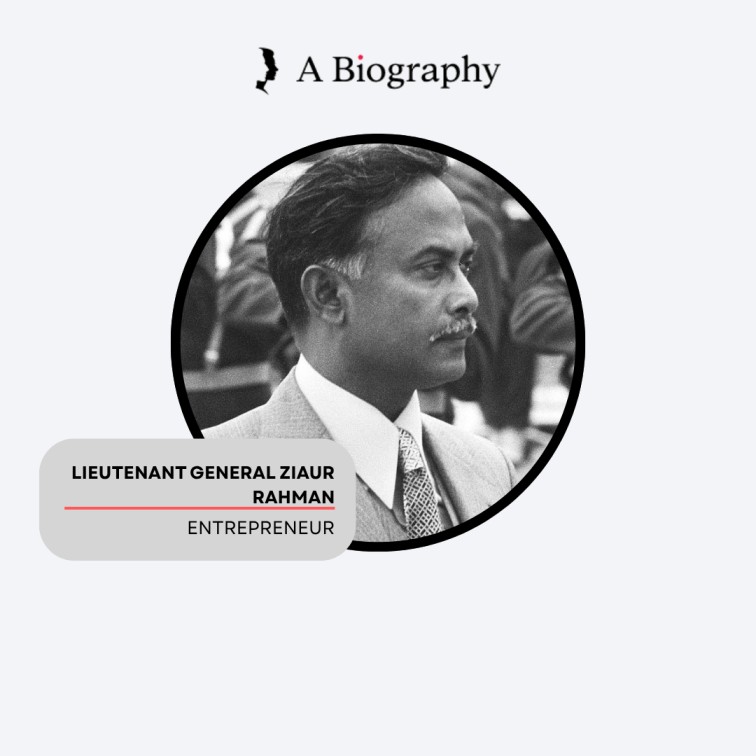
A Biography of Lieutenant General Ziaur Rahman

Introduction
The night was thick with dread. March 25, 1971. Pakistani tanks rolled through the sleeping streets of Dhaka, their headlights cutting through the darkness like knives. Soldiers kicked down doors. Students, professors, doctors, ordinary families—they were dragged from their beds and shot where they stood. By dawn, the blood of thousands stained the soil of a land that had dreamed of freedom.
Somewhere in Chittagong, a thirty-five-year-old major listened to the distant thunder of artillery. His name was Ziaur Rahman. He knew that Bangladesh’s founding father, Sheikh Mujibur Rahman, had been arrested hours earlier. He knew the Pakistani army was hunting down every educated Bengali they could find. He knew that if someone did not speak now, the world might never know that a nation was fighting for its breath.
On March 27, 1971, at the Kalurghat Radio Station in Chittagong, Ziaur Rahman leaned into a microphone. His voice trembled slightly—not from fear, but from the weight of history pressing against his chest. He spoke words that would echo through generations: “I, Major Ziaur Rahman, on behalf of the provisional government of Bangladesh, hereby declare the independence of this land.”
The Bengali nation erupted. But questions remained. Who was this soldier? Why was he the one to declare independence? How did the same man later transform from a freedom fighter into a controversial president, a military ruler, a man who gave Bangladesh Islam as state religion and a new definition of nationalism? Some call him a national hero. Others call him a dictator. This biography seeks to unwrap the layers of a legend—epic of courage, power, betrayal, and an unsolved murder that still haunts Bangladesh.
At a Glance: Life of Ziaur Rahman
| Category | Details |
| Full Name | Ziaur Rahman |
| Nickname | Kamal (childhood), Komo (friends) |
| Born | January 19, 1936, Bagbari, Gabtali, Bogra, British India |
| Died | May 30, 1981, Chittagong Circuit House, Bangladesh (age 45) |
| Father | Mansur Rahman (scientific officer, Writer’s Building, Kolkata) |
| Mother | Jahanara Khatun (died when Zia was young) |
| Siblings | Ahmed Kamal, Khalilur Rahman |
| Spouse | Khaleda Zia (married August 1960) |
| Children | Tarek Rahman (b. 1966), Arafat Rahman (Koko, 1970-2015) |
| Profession | Soldier, President, Founder of BNP |
| Military Rank | Lieutenant General |
| Highest Awards | Bir Uttom (Bangladesh), Hilal-i-Jurat (Pakistan), Order of the Nile (Egypt) |
| Religion | Islam |
| Controversies | Independence declaration debate, Islamization policies, military rule |
This biography will now take you through every chapter of his extraordinary life.
Early Life (1936-1947)
On January 19, 1936, in the quiet village of Bagbari in Bogra’s Gabtali upazila, a boy was born into a respectable Bengali Muslim family. They named him Ziaur Rahman. But to his mother, he was always “Kamal”—a name that suited his fair complexion and gentle nature. His father, Mansur Rahman, worked as a scientific officer at Kolkata’s famous Writer’s Building, testing chemicals and inks for the British government. His mother, Jahanara Khatun, was a homemaker with a quiet strength that would leave a permanent mark on her son.
Ziaur grew up running through the muddy fields of Bagbari, playing football and kabaddi with village boys. He climbed trees, caught fish in narrow canals, and listened to elders tell stories of the British oppression. Even as a child, something burned in him—a restlessness, a hunger to be part of something larger than himself.
In 1946, Mansur Rahman moved the family to Kolkata. Young Ziaur was enrolled in Hare School, one of the city’s finest institutions. He walked streets that still carried the echoes of the Swadeshi movement. He saw protests, heard slogans, felt the electricity of a people demanding freedom from British rule. But 1947 brought tragedy and displacement. India was partitioned. Pakistan was born. Mansur Rahman chose Pakistan and moved the family to Karachi.
Ziaur was eleven years old when he left behind the red soil of Bengal. He did not know that one day he would return to free it.
The greatest blow came soon after. His mother, Jahanara Khatun, died at just thirty-six. The boy who had already lost his homeland now lost the woman who had held his hand through darkness. That wound never fully healed.
Education (1947-1955)
In Karachi, Ziaur joined the Academy School. He was a sharp student, but his real passions lay in sports—wrestling, football, cricket—and in the art of debate. He loved to argue, to persuade, to command attention. In 1952, at sixteen, he passed his SSC from the Academy School.
He enrolled at D.J. Sindh Government Science College for higher secondary studies. But the classroom could not contain him. He had grown up watching soldiers march in perfect formation. He had seen the crisp uniforms, the polished boots, the way men saluted and the world seemed to obey. He wanted that. He needed that.
In 1953, before completing his college degree, Ziaur Rahman joined the Pakistan Military Academy (PMA) at Kakul. He was one of the youngest cadets in the 12th Long Course. The training was brutal—physical exhaustion, mental torment, the constant pressure to be perfect. But Ziaur thrived. He earned top-ten rankings, completed paratrooper training, mastered commando tactics, and received specialized intelligence training from British and American instructors.
On September 18, 1955, he was commissioned as a Second Lieutenant. The boy from Bagbari had become an officer.
Struggles & Adversities
Throughout his life, Ziaur carried an invisible weight. Losing his mother at such a young age shaped him in ways he rarely spoke about. He became fiercely independent, unwilling to show vulnerability. When he married in 1960, his father could not attend the ceremony because he was stationed in Karachi. Ziaur organized the wedding almost alone—a young captain, barely twenty-four, arranging his own marriage without a mother to guide him or a father to bless him.
In the Pakistan Army, Bengali officers faced constant discrimination. They were passed over for promotions. Their loyalty was questioned. They were treated as second-class soldiers in their own homeland. Ziaur felt every slight, every whispered insult. But he did not complain. He worked harder. He trained longer. He proved himself in ways that could not be ignored.
In 1965, he would have his chance.
Love
In August 1960, in the town of Feni, a wedding took place that would eventually shape the political destiny of Bangladesh. Captain Ziaur Rahman married fifteen-year-old Khaleda Khanam Putul, the daughter of Major Iskandar Majumdar and Tayeba Majumdar. She would later be known to the world as Khaleda Zia—Bangladesh’s first female prime minister.
The wedding was modest. Ziaur’s father could not attend. His mother was already gone. The ceremony was supervised by a local spiritual leader, a pir. The bride was barely a teenager; the groom was a rising star in Pakistan’s military. It was an arranged match, but it grew into a partnership of profound loyalty. Khaleda would stand by him through war, through political upheaval, through the highest heights and the darkest shadows.
Personal Life
Ziaur Rahman was not a man of luxury. He lived in military quarters, ate from the army canteen, wore simple clothes. He was disciplined in every habit—waking before dawn, praying regularly, reading the Quran, fasting during Ramadan. His two sons, Tarek (born 1966) and Arafat (born 1970), grew up seeing a father who was strict but loving, demanding but present.
Tarek would later become the acting chairman of the BNP, living in exile in London. Arafat would become a cricket organizer and die of a heart attack in Bangkok in 2015. The family’s story, like Ziaur’s own, is woven with triumph and tragedy.
Future Plans & Vision
Even in the 1960s, Ziaur Rahman dreamed of a day when Bengalis would not be second-class citizens. He secretly encouraged young Bengali men to join the military. He lobbied for the creation of two new East Bengal regiments—the 8th Bengal and 9th Bengal—knowing they would become the backbone of any future liberation struggle. He was not yet a politician. He was a soldier preparing for a war he could sense coming.
Career (1955-1971)
Ziaur’s military career was a steady climb. After commission, he served in various units in Karachi. In 1957, he joined the East Bengal Regiment—the heart of Bengali military identity. From 1959 to 1964, he worked in military intelligence, learning the dark arts of espionage and strategy.
Then came 1965.
The India-Pakistan war erupted in September. Ziaur was a company commander in the Khem Karan sector of Punjab. He led his men with extraordinary bravery, holding ground against overwhelming opposition. For his valor, Pakistan awarded him the Hilal-i-Jurat—its second-highest military honor. He was one of only a handful of Bengalis ever to receive it.
After the war, he became an instructor at PMA Kakul and later at the Command and Staff College in Quetta. He traveled to West Germany for advanced training with the British Army of the Rhine. He was being groomed for greatness—but whose greatness? Pakistan’s, or Bengal’s?
By 1970, he was a Major stationed in Chittagong, commanding the 8th East Bengal Regiment. And history was about to grab him by the throat.
From Germany to the Battlefields of Bengal
Ziaur traveled widely: West Germany, the United Kingdom, various postings across Pakistan. Each journey broadened his understanding of military strategy, but also deepened his sense of Bengali identity. He saw how other nations organized their armies, how other cultures preserved their heritage. He returned to East Pakistan with a burning question: Why can’t we have our own country?
Failures & Teachable Moments
In 1969, the Mass Uprising in East Pakistan shook the foundations of Ayub Khan’s regime. Ziaur watched as students and workers took to the streets. He saw the Pakistani government’s brutal response. He felt helpless—a soldier bound by oath to a state that was murdering his own people. That helplessness became a teacher. He learned that loyalty to an oppressive state was not virtue; it was cowardice. He would not make that mistake again.
Source of Inspiration
Ziaur often said that his greatest inspiration came from ordinary Bengalis—the peasants who worked under the scorching sun, the mothers who sent their sons to uncertain fates, the students who dreamed of a free land. He was also inspired by the military discipline of the British Army and the strategic brilliance of leaders like Atatürk.
Influences & Inspirations
Though he would later become a political rival of Sheikh Mujibur Rahman’s legacy, Ziaur deeply respected the man. In 1971, he declared independence in Bangabandhu’s name. He saw Mujib as the father of the nation—but he also believed that the nation needed a different kind of father after Mujib’s assassination. This contradiction lies at the heart of Ziaur’s complicated legacy.
Philosophical Views & Beliefs
Ziaur rejected “Bengali nationalism” because it emphasized ethnicity and language—ties that connected East Pakistan to West Bengal in India. Instead, he promoted Bangladeshi nationalism, rooted in geography and statehood. Every citizen of Bangladesh, regardless of religion or ethnicity, was a Bangladeshi. This was inclusive in theory, but critics argued it was a way to diminish the role of Hinduism and secularism in national identity.
He also believed that Islam should play a central role in public life. In 1977, he introduced the 5th Amendment to the constitution, replacing “secularism” with “absolute trust and faith in Almighty Allah.” He added “Bismillahir Rahmanir Rahim” to the constitution’s preamble. He reached out to Muslim nations—Saudi Arabia, Pakistan, Egypt—and built alliances that transformed Bangladesh’s foreign policy.
Unique Traits
Ziaur rarely raised his voice. He did not posture or threaten. He listened more than he spoke. But when he decided on a course of action, he moved with the precision of a trained marksman. He was physically brave—he had jumped out of airplanes, led charges into machine-gun fire, walked through minefields. But his quiet courage—the willingness to stand alone, to declare independence when no one else would—that was his true weapon.
Contributions, Awards & Achievements
Military Achievements:
- Hilal-i-Jurat (1965) – Pakistan’s second-highest military award
- Bir Uttom (1972) – Bangladesh’s second-highest gallantry award
- Led Z Force during the Liberation War
- Declared independence from Kalurghat Radio Station
Presidential Achievements (1977-1981):
- Restored multi-party democracy (1979 elections)
- Introduced the Gram Sarkar (village government) system
- Boosted food production through irrigation and fertilizer programs
- Established Bangladesh Rice Research Institute and Bangladesh Jute Research Institute
- Proposed the creation of SAARC (South Asian Association for Regional Cooperation)
- Strengthened ties with Muslim-majority nations
- Freed the press and restored judicial independence
International Awards:
- Order of the Nile (Egypt) – Highest civilian honor
- Order of the Yugoslav Star (Yugoslavia)
- Hero of the Republic (North Korea)
- A street in Ankara, Turkey, named Ziaur Rahman Caddesi
In 2004, a BBC Bangla poll ranked him the 20th greatest Bengali of all time.
Controversies
The Declaration of Independence
Did Bangabandhu declare independence on March 26, or did Ziaur on March 27? This debate has poisoned Bangladesh’s politics for decades. Supporters of Sheikh Mujib say he declared independence before his arrest. Supporters of Ziaur say that declaration was not widely broadcast, and it was Ziaur’s voice that truly mobilized the nation. The truth may never satisfy either side.
Islamization and Secularism
By removing secularism from the constitution, did Ziaur betray the spirit of the Liberation War? Or did he simply reflect the religious identity of 85% of the population? This question continues to divide Bangladesh.
The Assassination of Bangabandhu
Ziaur became army chief after the August 15, 1975, coup that killed Sheikh Mujib and most of his family. Was Ziaur involved in the plot? There is no direct evidence, but his rapid rise after the killings has always raised suspicions.
Military Dictatorship or Democratic Leader?
Ziaur seized power through martial law. He held a referendum that he easily won. He later restored parliamentary democracy. Was he a dictator who legitimized himself through elections, or a pragmatist who saved a collapsing nation?
Contemporary Opinions & Interviews
In a 1971 interview with German Radio, Ziaur explained why he declared independence: “The Pakistani army was killing innocent people. Someone had to tell the world that we are fighting back. I did not seek this responsibility. It sought me.”
Foreign journalists described him as “cool under fire” and “a man of few words but decisive action.” Indian intelligence reports from the time portrayed him as ambitious but reliable. Pakistani officials called him a traitor. Bengalis called him a hero.
Myths & Misconceptions
Myth: Ziaur single-handedly declared independence.
Truth: Multiple declarations were made by multiple people. Ziaur’s was the most widely heard and most effective.
Myth: Ziaur was a fundamentalist.
Truth: He was a religious Muslim but not a radical. He drank tea, played chess, and worked closely with non-Muslims throughout his career.
Myth: Ziaur stole the credit for the Liberation War.
Truth: He consistently acknowledged Bangabandhu’s leadership. His own role was that of a field commander and a messenger, not a founding father.
Famous Quotes & Thoughts
- “I have no personal ambition. My only ambition is to see Bangladesh as a happy and prosperous nation.”
- “The soldier who does not cry for his people is no soldier at all.”
- “Bangladeshi nationalism means love for this soil, this river, this sky. Nothing more, nothing less.”
- “Discipline is not the enemy of freedom. It is the guardian of freedom.”
Message for the Present Generation
Ziaur believed that young people should embrace both their heritage and their modernity. He wanted them to be proud of being Bangladeshi—not Bengali, not Muslim first, but citizens of a sovereign nation. He wanted them to work hard, to respect discipline, and to never forget the sacrifice of 1971. He also warned against extremism, saying that Islam is a religion of peace, not of violence.
Death & Legacy (May 30, 1981)
May 29, 1981. President Ziaur Rahman traveled to Chittagong to resolve a factional dispute within his party, the BNP. He checked into the Circuit House, a government guesthouse overlooking the hills. He met with local leaders, listened to their grievances, and went to bed late.
At 3:30 AM on May 30, a group of mutinous military officers stormed the Circuit House. They shot the guards, overpowered the ADC, and burst into Ziaur’s bedroom. He grabbed a weapon—some say a rifle, some say a pistol—and fought back. But he was outnumbered.
Bullets tore through his body. He fell on the floor, blood pooling around him. He was forty-five years old.
The mutineers held the Circuit House for several hours before loyal troops crushed the rebellion. But Ziaur was already gone. The man who had declared independence, who had led Z Force through the bloodiest battles of 1971, who had rebuilt a shattered nation, was dead.
More than two million people attended his funeral in Dhaka. It was the largest gathering in Bangladesh’s history. His body was buried near the Parliament Building, in a complex now known as Chandrima Udyan (formerly Zia Udyan).
Successors & Lasting Impact
His wife, Khaleda Zia, took over the BNP. She became prime minister twice (1991-1996, 2001-2006). His son, Tarek Rahman, now leads the party from exile in London. The BNP remains one of Bangladesh’s two dominant political forces.
Ziaur’s legacy is also institutional: the Gram Sarkar system, the food security programs, the opening of the economy, the SAARC proposal, the reorientation toward the Muslim world. Every government since has built on or reacted against his policies.
Unknown Facts
- Ziaur’s childhood nickname was “Kamal” because of his fair skin and gentle nature.
- He could speak fluent Urdu, having grown up in Karachi.
- He was one of the first Bengali officers to complete paratrooper training.
- He personally recruited many future freedom fighters into the military.
- His favorite hobby was chess—he played against his officers to relax.
- He refused to live in the presidential palace, preferring army quarters.
- He wrote poetry in his youth, though none survives.
- He was a heavy smoker, which may have contributed to his stressed appearance in later years.
Timeline: Key Events
| Year | Event |
| 1936 | Born in Bagbari, Bogra |
| 1946 | Moved to Kolkata, enrolled in Hare School |
| 1947 | Partition; moved to Karachi |
| 1952 | Completed SSC in Karachi |
| 1953 | Joined Pakistan Military Academy |
| 1955 | Commissioned as Second Lieutenant |
| 1960 | Married Khaleda Zia |
| 1965 | Fought in India-Pakistan war; received Hilal-i-Jurat |
| 1971 | Declared independence; formed Z Force |
| 1972 | Awarded Bir Uttom; promoted to Brigadier |
| 1975 | Became army chief after August 15 coup; removed in November coup; reinstated on November 7 |
| 1977 | Became President; held referendum |
| 1978 | Founded BNP; retired from military |
| 1979 | Held free elections; restored democracy |
| 1981 | Assassinated in Chittagong |
Conclusion
Ziaur Rahman’s life is an unfinished story. Some see a hero who saved Bangladesh from chaos. Others see a power-hungry general who twisted history to serve his ambition. The truth, as always, lies somewhere in the gray.
What cannot be denied: he was brave. He was decisive. He loved his country—perhaps to a fault, perhaps with a love that did not always respect democratic norms. He gave Bangladesh stability, food security, and a voice in the world. He also gave it religious politics, military rule, and a never-ending debate about its founding principles.
The bullets in Chittagong did not just kill a man. They froze a legacy mid-sentence. What would Ziaur have become if he had lived another twenty years? A revered elder statesman? A disgraced dictator? We will never know.
What we do know is this: the boy who ran through the fields of Bagbari, the soldier who defied Pakistan, the president who rebuilt a broken nation—he was, in the end, a human being. Flawed. Courageous. Contradictory. Unforgettable.
*He was a hero whose call awakened Bengal. He was a ruler whose policies reshaped a nation’s character. He is a question that continues to divide his people. On May 30, 1981, the blood-soaked body lying on the dark stairs of Chittagong Circuit House became history’s most contested book—Ziaur Rahman. Bangladesh has not forgotten him. Bangladesh will never forget him.*
References
- Banglapedia – Ziaur Rahman (Asiatic Society of Bangladesh)
- Wikipedia (Bengali & English) – Ziaur Rahman
- Anthony Mascarenhas, Bangladesh: A Legacy of Blood (London: Hodder and Stoughton, 1986)
- Dr. Mahfuz Ullah, Ziaur Rahmanner Rajniti (Dhaka: Anupam Prakashani, 2005)
- Muntasir Mamun, Muktijuddhe Ziaur Rahman (Dhaka: Abosar Prakashana, 2010)
- Golam Murshid, Dwitiyo Biplab O Zia (Dhaka: Sahitya Prakash, 1982)
- BBC Bangla, “Sarbakaler Srestho Bangali” poll (2004)
- Daily Prothom Alo and Daily Ittefaq archives (1971-1981)
- Bangladesh Government Investigation Commission Report – Ziaur Rahman murder case (1991, 2000)
Disclaimer
This biography is based on information gathered from various reliable sources, including published books, newspaper archives, government reports, and reputable online encyclopedias. Some personal details, especially from Ziaur Rahman’s childhood and family background, may vary slightly across different sources. Dates of certain events, particularly during the chaotic period of the 1971 Liberation War, may have minor discrepancies in different accounts. Every effort has been made to ensure factual accuracy while acknowledging that history is often a matter of interpretation. The author holds no political affiliation and presents this biography as an objective account of a complex historical figure. Readers are encouraged to consult multiple sources to form their own conclusions.

