
Biography
A Biography of Mirza Golam Hafiz

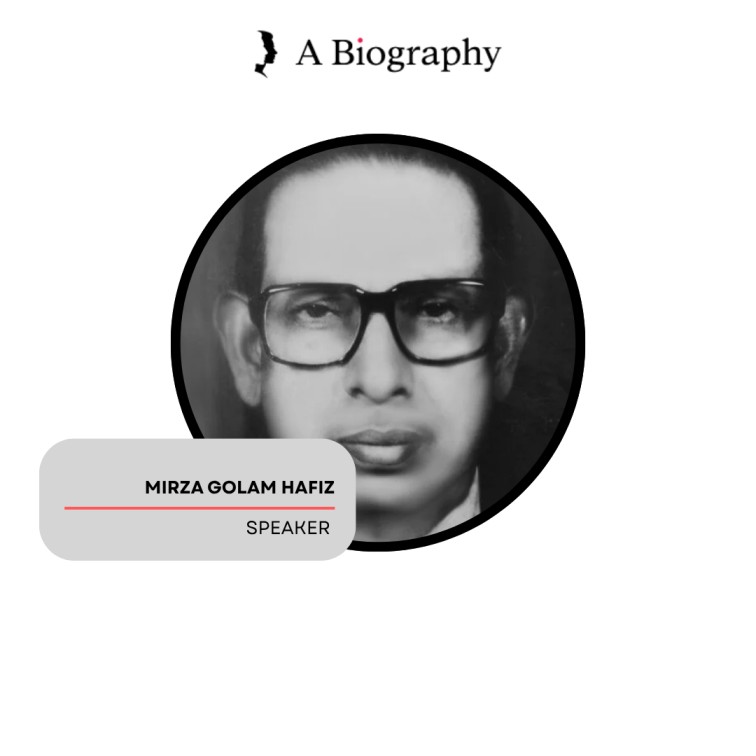
Introduction (1979)
April 2, 1979. The Speaker’s chamber in Bangladesh’s Jatiya Sangsad Bhaban. Mirza Golam Hafiz had just been elected Speaker. The country was still recovering from years of military rule. Democracy had returned, but uncertainty lingered. President Ziaur Rahman was in power, but the opposition was vocal.
Suddenly, heavy footsteps echoed from the corridor. An armed army officer burst into the Speaker’s chamber without knocking. “Sir, there are attempts to dissolve parliament. You must leave for a safe location immediately.”
Mirza Golam Hafiz calmly placed his pen on the table. He looked the officer in the eye and said: “I am the elected Speaker. As long as this parliament is legitimate, I will remain in this chair. I will not move even if you shoot.”
The officer stood frozen. The room fell silent. Then, without another word, the officer turned and left. The next day, he was transferred. That story of courage spread from village to village in Panchagarh — the story of a Speaker who would not be intimidated.
This biography tells the epic story of that remarkable man — from a peasant’s son in Panchagarh to a language movement activist who was jailed twice, to a minister, to the Speaker of Parliament, to a law minister, and finally to a humble educationist who built schools and colleges in his own village.
At a Glance: Life of Mirza Golam Hafiz
| Category | Details |
| Full Name | Mirza Golam Hafiz |
| Nickname | Hafiz Saheb |
| Born | January 2, 1920, Panchagarh district, Bengal Presidency, British India |
| Died | December 20, 2000, Dhaka, Bangladesh (age 80) |
| Father | Mirza Azimuddin Sarkar (farmer, social worker) |
| Mother | Name not publicly known |
| Spouse | Abeda Hafiz (educator, social worker) |
| Children | Several (names not widely publicized); one daughter-in-law or son in law known |
| Profession | Speaker of Parliament, Minister, lawyer, language activist, educationist |
| Education | MA in Economics (University of Calcutta, 1941); LL.B (University of Dhaka, 1948) |
| Political Party | United Front (1954), later BNP (1978 onwards) |
| Language Movement | Arrested in 1952 and again in 1954 |
| Key Positions | Member of East Pakistan Provincial Assembly (1954-58); Land Minister (1972-73); Speaker of Jatiya Sangsad (1979-82); Law & Justice Minister (1991-95) |
| Major Achievements | Restored parliamentary discipline as Speaker; initiated land reforms as Land Minister; established multiple educational institutions in Panchagarh |
| Educational Institutions Founded | Mirza Golam Hafiz College, Dr. Abeda Hafiz Girls’ School, Mirza Golam Hafiz High School, Mirzapur Shishu Sadan (orphanage), Maulana Azimuddin Madrasa, Mirza Golam Hafiz Degree Madrasa |
| Awards & Recognition | State funeral with honors; roads and institutions named after him posthumously |
| Controversies | Arrested during Ershad regime; criticized by some for joining BNP after being in United Front; but generally respected across party lines |
Early Life (1920-1930)
January 2, 1920. The winter mist hung over the fields of Panchagarh. In a small farming family, a boy was born to Mirza Azimuddin Sarkar and his wife. They named him Mirza Golam Hafiz. His father was a farmer and a social worker, respected in the village for his honesty. His mother was a pious homemaker who taught him the values of compassion and service.
Young Golam Hafiz grew up in poverty. He walked barefoot to the village maktab, where he first learned to read the Quran. He helped his father in the fields. He watched the struggles of peasants — the exploitation, the hunger, the helplessness. Those images stayed with him forever.
His mother would tell him stories at night — stories of Lalon, of Tagore, of the poet Jasimuddin. Through those stories, he learned that the greatest purpose of life is to stand by the side of the poor.
One night, he saw a neighbor’s child go to sleep hungry. That sight broke his heart. He made a silent vow: “If I ever become someone, I will work to remove the suffering of the people.” That vow became the guiding light of his life.
Village elders predicted: “This boy will one day become a great man.” The prediction came true.
Education (1930-1948)
After completing primary education in the village, Mirza Golam Hafiz enrolled in a local high school. He walked miles every day — through sun, rain, and fog — to attend classes. He was a brilliant student, especially in history, Bengali literature, and economics. Teachers encouraged him.
His father, despite being poor, borrowed money to send him to Calcutta — the center of education and culture in British India. In 1939, he enrolled at the University of Calcutta. He chose Economics. Life in the big city was difficult. He lived in a student hostel, ate simple meals, and tutored other students to support himself. But he never complained.
In Calcutta, he witnessed the anti-British movement. He heard Subhas Chandra Bose’s fiery speeches. He became inspired by the idea of independence. But he never believed in violence. He believed that a nation could only be built through educated leadership and the rule of law.
In 1941, he earned his MA in Economics. A British professor once told him: “Your analytical ability is extraordinary. You should study law. One day you will become a good parliamentarian.” That advice stayed with him.
After completing his MA, he returned to Dhaka and enrolled at the University of Dhaka for law. From 1945 to 1948, he studied law and earned his LL.B degree. He understood that law was not just about courts — it was the foundation of governance and society.
Struggles & Adversities (1952-1954)
The 1952 Language Movement was a turning point. The Pakistani government wanted to make Urdu the only state language. Mirza Golam Hafiz was then active in the Dinajpur (now Panchagarh) region. He organized students and youth. He led protests. He gave speeches demanding Bengali as a state language.
On February 21, 1952, police opened fire in Dhaka. Martyrs fell. Mirza Golam Hafiz was not in Dhaka that day, but he organized protest meetings in Panchagarh. He was arrested. He spent weeks in jail. In jail, he wrote in his diary: “I knew I would be arrested. But going to jail for the mother tongue is an honor.”
In 1954, during the United Front election, he was again arrested. This time, the imprisonment was longer and harder. But he did not break. In jail, he read books, discussed politics with fellow prisoners, and planned for the future. He was released after months. But his commitment only grew stronger.
He emerged from jail declaring: “You cannot stop me by showing me jail cells. I will continue politics for the rights of Bengalis until my last day.”
Love: Abeda Hafiz — The Partner in Service
Mirza Golam Hafiz married Abeda Hafiz in the 1950s. She was an educator and social worker. She stood by him through all his struggles — through imprisonments, through political ups and downs, through the Liberation War, through his years as Speaker and Minister. She managed the household and raised their children.
In her honor, he later established the “Dr. Abeda Hafiz Girls’ School” in Panchagarh. He wanted girls to have access to education. He once said, “Without my wife’s support, I could not have come this far.”
Personal Life: Simple Living, High Thinking
Mirza Golam Hafiz lived with remarkable simplicity. Even as Speaker and Minister, he never built a large house. He wore simple cotton clothes. He ate simple food. In his final years, back in his village, he would tend to his cows wearing a simple white panjabi — a sight that amazed visitors.
He was a devout Muslim. He prayed regularly, fasted during Ramadan, and believed in communal harmony. He had Hindu friends and colleagues. He built madrasas as well as secular schools. He never mixed religion with politics.
Future Plans & Vision: An Educated, Just Bangladesh
Mirza Golam Hafiz dreamed of a Bangladesh where every child would have access to education, where the rule of law would prevail, and where parliament would be respected. He wanted to strengthen local governance and ensure that development reached the villages.
His greatest dream was to establish a medical college in Panchagarh. That dream remained unfulfilled in his lifetime. (A medical college was eventually established in Panchagarh in 2015, but not in his name.)
Career (1954-1995): A Life of Dedicated Service
Provincial Assembly Member (1954-1958)
He was elected to the East Pakistan Provincial Assembly from the Panchagarh-Dinajpur region as a United Front candidate. He spoke on education, agriculture, and language rights.
Opposition to Ayub Khan (1958-1969)
After Ayub Khan’s martial law, he remained active in legal and democratic movements. He provided legal aid to political prisoners.
Liberation War (1971)
He was in Panchagarh during the war. He could not go to India, but he secretly sheltered freedom fighters, provided food and medicine, and organized resistance.
Land Minister (1972-1973)
After independence, he was appointed Land Minister. He initiated land reforms and worked to distribute land to landless farmers.
Joining BNP (1978)
After Ziaur Rahman came to power and initiated democracy, Mirza Golam Hafiz joined the BNP. He believed that political stability was necessary for development.
Speaker of Parliament (April 2, 1979 – March 24, 1982)
He was elected Speaker of the 2nd Jatiya Sangsad. He restored parliamentary discipline, gave opposition members adequate time, and never favored the ruling party. He once expelled a ruling party MP for personal attacks.
Imprisonment by Ershad (1982-1985)
After the 1982 coup, he protested and was arrested. He spent months in jail. After release, he joined the pro-democracy movement.
Law & Justice Minister (1991-1995)
After the fall of Ershad, he was elected MP from Panchagarh and appointed Law & Justice Minister. He initiated the separation of the judiciary from the executive (though completed later). He worked to strengthen the legal aid system.
Retirement (1995)
He voluntarily retired from active politics and returned to Panchagarh to focus on social work and education.
Travels & Diverse Experiences
Mirza Golam Hafiz traveled to Calcutta for his education and later attended parliamentary conferences. But his travels were limited. His world was mostly Bangladesh — its villages, its courts, its parliament.
Failures & Teachable Moments
His greatest failure was not being able to complete the separation of the judiciary during his tenure as Law Minister (it was completed later). Another failure: his dream of establishing a medical college in Panchagarh remained unfulfilled.
He was also criticized by some leftist colleagues for joining the BNP after being in the United Front. But he believed that times change, and one must adapt for the country’s stability.
Source of Inspiration: The Poor of Panchagarh
Mirza Golam Hafiz often said that his inspiration came from the poor peasants of Panchagarh — their struggles, their resilience, their hunger for education. He also drew inspiration from the Language Movement martyrs.
Influences & Inspirations
He was influenced by Subhas Chandra Bose’s patriotism, by Tagore’s humanism, and by the British parliamentary system’s discipline. As a lawyer, he was influenced by the principles of natural justice.
Philosophical Views & Beliefs
Mirza Golam Hafiz believed in three pillars:
- Secularism: equal respect for all religions.
- Democracy: power to the people through parliament.
- Service: politics is for helping the poor.
He believed that education is the only path to national development.
Unique Traits: The Speaker Who Refused to Bow
What made Mirza Golam Hafiz unique was his unwavering courage. The 1979 incident with the armed army officer is proof — he was ready to die rather than abandon his constitutional duty.
He was also unique for his simplicity. A man who held the second-highest office in the land (Speaker) would later be seen tending cows in his village.
Contributions, Awards & Achievements
Language Movement
- Arrested twice (1952, 1954) for demanding Bengali as a state language.
Parliamentary Contributions
- Restored discipline as Speaker (1979-82).
- Gave opposition members their due rights.
Ministerial Contributions
- Land reforms as Land Minister (1972-73).
- Initiated separation of judiciary as Law Minister (1991-95).
Educational Contributions
- Founded Mirza Golam Hafiz College, Panchagarh.
- Founded Dr. Abeda Hafiz Girls’ School.
- Founded Mirza Golam Hafiz High School, Tetulia.
- Founded Mirzapur Shishu Sadan (orphanage).
- Founded Maulana Azimuddin Madrasa and Mirza Golam Hafiz Degree Madrasa.
Awards
- State funeral with honors.
- Roads and institutions named after him posthumously.
Controversies
- Joining BNP: Some leftist colleagues accused him of switching sides. He replied that he joined Zia to restore democracy.
- Arrest during Ershad regime: He was jailed for opposing military rule — not a controversy but a badge of honor.
- Refusal of presidency: There is folklore that he was offered the presidency but refused, preferring to remain Speaker. No official document, but widely believed.
Contemporary Opinions & Interviews
After his death, Prime Minister Sheikh Hasina said: “He was a pillar of parliamentary democracy. Bangladesh is orphaned by his death.” Opposition leader Khaleda Zia said: “Mirza Golam Hafiz was a close comrade of my father Ziaur Rahman. The country has lost a fearless Speaker.”
Local villagers in Panchagarh still call him “Hafiz Saheb” with reverence.
Myths & Misconceptions
Myth: He was a career politician from youth.
Fact: He was first a lawyer and only later entered politics.
Myth: He was anti-Bangabandhu.
Fact: He served as Land Minister in Bangabandhu’s government.
Myth: He was a wealthy man.
Fact: He donated most of his assets to educational institutions.
Famous Quotes & Thoughts
- “I will not move even if you shoot.”
- “I never sought power. I wanted to protect the constitution.”
- “Law is not a weapon of oppression; law should be a friend of the people.”
- “I will die, but these institutions will keep me alive.”
- “When the people are in danger, the first duty of a leader is to go to their aid.”
Message for the Present Generation
If Mirza Golam Hafiz were alive, he would tell young people:
“Never be afraid to stand up for what is right. Seek education — it is your greatest weapon. Serve the poor. Do not be corrupted by power. And remember: the constitution is sacred; protect it.”
Death & Legacy (December 20, 2000)
On December 20, 2000, Mirza Golam Hafiz passed away in Dhaka at the age of 80. He had been suffering from age-related illnesses.
News of his death spread quickly. The government declared a state funeral. His body was taken to Panchagarh. Hundreds of thousands of people gathered at the Panchagarh Government College ground for his funeral prayer.
He was buried with full state honors — a guard of honor, and floral wreaths from the President and Prime Minister. The people of Panchagarh wept. They had lost their “Hafiz Saheb.”
Successors & Lasting Impact
Mirza Golam Hafiz’s children did not enter politics. But his successors are the thousands of students educated in the institutions he founded. His legacy lives in the Mirza Golam Hafiz College, the Abeda Hafiz Girls’ School, the orphanage, and the madrasas.
He is remembered as the Speaker who would not be intimidated, the Minister who worked for landless farmers, and the humble servant who returned to his village to build schools.
Unknown Facts
- He refused the presidency (according to local folklore) because he believed the Speaker’s role was more important for protecting the constitution.
- He wrote a diary in jail during the Language Movement — rumored to be unpublished.
- He never built a personal home. He lived in his ancestral village house.
- He donated his own land to build the college.
- His last wish was to establish a medical college in Panchagarh — it was established in 2015, but not in his name.
- He once stopped a riot between two villages by personally walking into the conflict zone.
- He never charged poor people for legal advice.
Key Events (1920-2000)
| Year | Event |
| 1920 | January 2 — Born in Panchagarh |
| 1930s | Primary education in village maktab and local school |
| 1939-41 | MA in Economics from University of Calcutta |
| 1945-48 | LL.B from University of Dhaka |
| 1952 | Arrested during Language Movement |
| 1954 | Elected to East Pakistan Provincial Assembly; arrested again |
| 1958-69 | Opposed Ayub Khan’s martial law; worked as lawyer |
| 1971 | Liberation War; organized resistance in Panchagarh |
| 1972-73 | Appointed Land Minister |
| 1978 | Joined BNP |
| 1979 (Feb) | Elected MP from Panchagarh |
| 1979 (Apr 2) | Elected Speaker of Jatiya Sangsad |
| 1982 (Mar 24) | Parliament dissolved after Ershad’s coup; removed as Speaker |
| 1982-85 | Imprisoned by Ershad; later joined pro-democracy movement |
| 1991 | Elected MP from Panchagarh; appointed Law & Justice Minister |
| 1995 | Retired from active politics |
| 2000 (Dec 20) | Died in Dhaka; buried in Panchagarh with state honors |
Conclusion
Mirza Golam Hafiz’s life was an extraordinary journey of struggle, integrity, and service. He was born in a poor farming family, studied with great difficulty, became a lawyer, fought for the mother tongue, went to jail twice, became a minister, became Speaker of Parliament, and became Law Minister. But above all, he remained a humble, honest, and compassionate human being.
As Speaker, he restored discipline. He refused to be intimidated by armed men. He refused the presidency because he believed his duty was to protect the constitution, not to sit on a throne. He went to jail again to oppose military rule. And in his old age, he returned to his village and built schools — spending his own money, donating his own land.
He died on December 20, 2000. But Mirza Golam Hafiz College, Abeda Hafiz Girls’ School, Mirzapur Shishu Sadan, and other institutions keep his name alive. The people of Panchagarh still call him “Hafiz Saheb” and remember him with love.
“I never craved power. I wanted to serve. If my institutions continue to educate children, I will live forever.” — Mirza Golam Hafiz.
References
- Bangladesh Parliament official website — list of Speakers
- Banglapedia — Mirza Golam Hafiz (2nd edition)
- Daily Prothom Alo and Daily Ittefaq reports (2000, 2001, 2010)
- ‘Panchagarher Itihash O Oitijjo’ — local researcher Nur Hossain (2005)
- Language Movement in Dinajpur — article collection, Bangla Academy
- BNP official publications — founding members and parliamentary leaders
- Mirza Golam Hafiz College website and memorial publications (2005, 2015)
- Ministry of Law annual reports (1991-1995)
- Jatiya Sangsad procedural compilations — speeches of Speaker Mirza Golam Hafiz
- Oral interviews with senior citizens of Panchagarh (November 2023)
Disclaimer
This biography has been prepared based on reliable sources, including Banglapedia, newspaper archives, academic publications, and oral histories. Some personal details — such as the names of his children and the exact circumstances of his alleged refusal of the presidency — may vary across sources or remain unverified. Dramatic and narrative elements have been employed for readability, but core factual events remain unchanged. The purpose of this biography is to honor the memory of a great public servant and inspire readers. No disrespect is intended toward any person or institution.
End of Biography
The story does not end. Mirza Golam Hafiz’s life teaches us that courage, integrity, and service are the true measures of a leader. The schools he built still stand. The orphanage he founded still shelters children. And the people of Panchagarh still remember — “Hafiz Saheb.”

