
Biography
A Biography of Mohammad Abdul Hamid

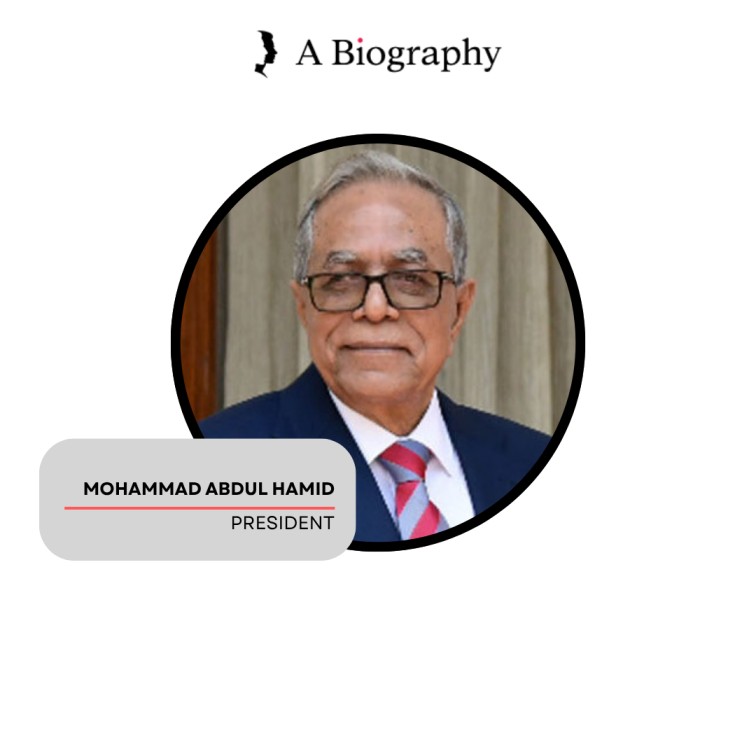
A Biography of Mohammad Abdul Hamid: The People’s President Who Served Two Consecutive Terms – The Complete Epic of a Humble Statesman
“I did not want to come here (to the presidency). I was comfortable in Parliament. Now that I am free, I can walk on the streets again.” – Mohammad Abdul Hamid, on his retirement day, April 24, 2023. A man who had spent ten years in a golden cage, yearning for the simple life of a common citizen.
Introduction
March 17, 1971. Bangabandhu’s birthday. The Rathkhola ground in Kishoreganj was packed with thousands of freedom‑hungry Bengalis. A young man in his late twenties climbed onto the stage. He unfurled a red‑and‑green flag with a map of Bengal. His voice thundered: “This is the flag of our independent Bangladesh!” It was the first time that flag had been raised in Kishoreganj – while Pakistani soldiers still patrolled the streets. That young man was Mohammad Abdul Hamid. He was not a politician yet; he was a revolutionary. And his life would become a quiet epic of service, sacrifice, and an unshakable love for the common people.
Just days later, he would lead a team to collect over 11 crore taka from banks in Kishoreganj, Bhairab and Bajitpur – money meant for the liberation war. He would set up youth camps in India, fight as a sector commander, and spend two years in prison after the assassination of Bangabandhu. From a farmer’s son in a remote village to the President of Bangladesh – and then, voluntarily, back to being an ordinary citizen – Mohammad Abdul Hamid’s journey is a lesson in humility, integrity, and gentle power.
This 28‑chapter epic tells the story of a man who never wanted the presidency, but when duty called, he served with such grace that he became the first president of Bangladesh to complete two consecutive full terms. And when the time came, he walked away – not with regret, but with a smile.
At a Glance: Life of Mohammad Abdul Hamid (1944 – Present)
| Information | Details | Special Notes |
| Full Name | Mohammad Abdul Hamid | Known as Abdul Hamid |
| Nickname | Hamid Bhai (by activists) | Common people call him ‘Haid Bhai’ |
| Born | January 1, 1944, Kamalpur village, Mithamain, Kishoreganj, Bengal Presidency (now Bangladesh) | Born on New Year’s Day; symbol of new beginnings |
| Current Age | 81 (as of 2025) | Alive and well after retirement |
| Father | Haji Md. Tayebuddin | Farmer and religious person |
| Mother | Tamiza Khatun | Homemaker |
| Spouse | Rashida Hamid (married 1964) | Teacher, former First Lady |
| Children | Three sons: Rezwan Ahammad Taufiq (MP), Russell (business), Riyad (business); one daughter: Shorna (housewife) | Taufiq is a current MP from Kishoreganj-1 |
| Profession | President (2013-2023), Speaker (2009-2013), Deputy Speaker (1996-2001), lawyer, freedom fighter | Seven‑term MP, five‑term Bar Association President |
| Education | Primary: village school; Secondary: Nikli G.C. High School; Matric from same; I.A. & B.A. from Gurudayal Govt College, Kishoreganj; LL.B from Central Law College (Dhaka University) | Bright student, won scholarships |
| Religion | Islam | Believed in secularism and religious harmony |
| Mother Tongue | Bengali | Speaks fluent English and Urdu |
| Extraordinary Achievement | First Bangladeshi president to serve two consecutive full terms (2013-2023); established 75 primary schools, 24 high schools, 3 colleges; played key role in Liberation War | Humble philanthropist |
| Highest Recognition | Independence Award (2013) – Bangladesh’s highest civilian honour | For his role in Liberation War |
| Major Controversies | Silence over 2014 one‑party election; commutation of Tofayel Ahmed Joseph’s life sentence (2018) | Generally seen as uncontroversial |
| Predecessor (President) | Mohammad Zillur Rahman (2009-2013) | Took over after Zillur’s death |
| Successor (President) | Md. Shahabuddin (2023 – present) | Peaceful transfer of power |
| Political Party | Awami League (since 1969) | Never changed party |
| Retirement | April 24, 2023 | Voluntary retirement after two terms |
Early Life (1944-1950)
The foggy mornings of Kamalpur, Kishoreganj. A boy with bare feet ran behind his father to the paddy fields. That boy would one day run a nation – but he never forgot the soil of his village.
January 1, 1944. In a small thatched house in Kamalpur village under Mithamain upazila of Kishoreganj, a son was born to Haji Md. Tayebuddin and Tamiza Khatun. They named him Mohammad Abdul Hamid. He was the second of five children.
His father was a simple farmer and a religious man, known as ‘Haji Tayebuddin’. His mother was a pious homemaker. The family lived in poverty. There was no electricity, no paved roads. Hamid spent his childhood helping his father in the fields, grazing cows, and studying under kerosene lamps.
The village elders recall that young Hamid was quiet, disciplined, and always willing to help others. He never fought with other children. He would settle disputes among friends. A local teacher once told his father: “This boy will one day serve the nation.”
The trauma of the 1947 Partition did not directly affect his village much, but he grew up hearing stories of the Language Movement and anti‑British protests. His father wanted him to become a religious scholar, but Hamid was drawn to modern education. His mother taught him honesty and compassion. Those early lessons became the foundation of his character.
Education (1950-1965)
He walked miles to school. He topped his classes. But more importantly, he never forgot that education is not for personal gain – it is for serving the people.
Hamid’s early schooling was at the local primary school. He then enrolled at Nikli G.C. High School, a well‑known institution in Mithamain. He passed his matriculation from there. He also studied for a while at Bhairab K.B. Pilot High School.
For higher secondary and bachelor’s degrees, he went to Gurudayal Government College in Kishoreganj town. He completed his I.A. and then B.A. with a combination of Bengali and History. He was an active student and a bright scholar – he won scholarships for his academic performance.
Even as a college student, he became involved in student politics. In 1959, at only 15 years of age, he was elected the founding president of the Chhatra League unit at Gurudayal College. In 1963, he became the general secretary of the college students’ union, and in 1965, the vice‑president. From 1966 to 1967, he served as the vice‑president of the Mymensingh District Chhatra League.
After completing his bachelor’s degree, he moved to Dhaka to study law. He enrolled at Central Law College, affiliated with the University of Dhaka, and earned his LL.B. He then joined the Kishoreganj District Bar Association. His legal education would later serve him well in parliamentary and constitutional matters.
Struggles & Adversities (1961-1975)
He was jailed for protesting against Ayub Khan’s education commission in 1962. He was jailed again after the fall of the United Front government. He was jailed after the assassination of Bangabandhu. Each prison term only deepened his conviction that the people must be free.
In 1961, Hamid was arrested for participating in anti‑Ayub protests. In 1962, he led protests against the Hamudur Rahman Education Commission, which sought to abolish Bengali as a medium of instruction. He was arrested again. These early prison experiences taught him that speaking truth to power comes at a cost – but the cost is worth paying.
In 1966, during the Six‑Point movement, he was active in organising protests. In 1969, he took part in the mass uprising that forced Ayub Khan to resign. Each time, he faced police batons, jail cells, and the threat of torture. But he never backed down.
The most painful period came after August 15, 1975. Bangabandhu was assassinated. Hamid was arrested and spent nearly two years (1976‑1978) in prison. He was tortured, but he refused to abandon the ideals of the liberation war. When he was released, he returned to Kishoreganj and rebuilt the party organisation from scratch.
Love (1964)
In 1964, a young lawyer married a young teacher. Their marriage would last nearly six decades, through wars, prisons, and presidency.
Abdul Hamid married Rashida Hamid in 1964. Rashida was a teacher at a girls’ school in Kishoreganj. She was not a political figure – she preferred to stay away from the spotlight. But she was his silent strength.
When Hamid was in prison, Rashida raised their children alone. When he was away in Delhi or in the war camps, she managed the household. After he became President, she served as the First Lady of Bangladesh (2013-2023), focusing on social work, especially women’s and children’s welfare. She never used her position for personal gain.
Hamid often said: “My wife taught me what patience means. Without her, I would not have survived the dark years.”
Personal Life (1964–Present)
He never built a mansion. He never bought a luxury car. His children did not become billionaires. But they became good citizens – and that was enough for him.
Hamid and Rashida have three sons and one daughter:
- Rezwan Ahammad Taufiq (eldest): A politician, elected MP from Kishoreganj-1 (2018 and 2024). He is seen as a rising leader of the Awami League.
- Russell (second son): Businessman, not directly involved in politics.
- Riyad (youngest son): Businessman.
- Shorna (daughter): Homemaker, living with her family.
Hamid never used his position to secure government contracts or jobs for his children. His sons built their careers on their own merit. When Taufiq wanted to enter politics, Hamid told him: “You will win or lose on your own. Do not ask for my influence.” Taufiq won because of his own hard work.
Hamid lives a simple life. Even as President, he preferred simple food and modest clothing. After retirement, he returned to his ancestral home in Kishoreganj, where he spends his time reading, writing, and visiting the schools and colleges he founded.
Future Plans & Vision (2023 – onward)
“Now I want to write. History, memoirs – whatever comes to mind. I have been caged for ten years. Now I am free.”
After retiring from the presidency on April 24, 2023, Abdul Hamid moved back to Kishoreganj. He has no plans to return to active politics. He wants to write a memoir, focusing on the liberation war and his political journey. He also wants to spend time visiting the 75 primary schools, 24 high schools, and 3 colleges he established – to see if they are serving the children of his village well.
He has said: “If even one child from those schools becomes a doctor or an engineer, I will feel my life was worth it.”
Career (1969-2023)
He never sought power. Power came to him because he was trusted – by his party, by the opposition, and by the people.
- 1969: Joined Awami League.
- 1970: Elected youngest member of the National Assembly of Pakistan (age 26).
- 1971: Fought in the Liberation War; raised the first Bangladesh flag in Kishoreganj; collected war funds; served as sub‑sector commander of Mujib Bahini.
- 1972-1975: Worked on post‑war rehabilitation in Kishoreganj.
- 1973: Elected MP for the first time from Kishoreganj-5 (later Kishoreganj-1) – he would be re‑elected in 1986, 1991, 1996, 2001, and 2008 (total 7 terms).
- 1976-1978: Imprisoned after Bangabandhu’s assassination.
- 1978: Elected President of Kishoreganj District Awami League – held the post for 31 years (until 2009).
- 1990-1996: Served five consecutive terms as President of Kishoreganj District Bar Association.
- 1996-2001: Deputy Speaker of the National Parliament.
- 2001-2006: Deputy Leader of the Opposition in Parliament.
- 2009-2013: Speaker of the National Parliament (two terms).
- 2013 (March-April): Acting President after President Zillur Rahman’s illness and death; then elected President unopposed.
- 2013-2018: First term as President.
- 2018-2023: Second term as President – first Bangladeshi president to complete two consecutive full terms.
- April 24, 2023: Retired after completing second term.
Travels & Diverse Experiences (1999-2022)
He travelled to America, England, Russia, China, India, South Korea, Saudi Arabia, Kuwait, South Africa, Namibia – always representing Bangladesh with dignity.
As Speaker and later President, Hamid attended international conferences: the Inter‑Parliamentary Union (IPU), Commonwealth Parliamentary Association (CPA), and various state visits. He used these platforms to speak about Bangladesh’s development, the Liberation War, and the Rohingya crisis. He was known for his simple but effective diplomatic style – no grand speeches, but a quiet insistence on Bangladesh’s rights.
His most significant foreign policy engagement was the Rohingya crisis. He repeatedly called on the international community to pressure Myanmar to take back its citizens. He visited refugee camps, met with foreign diplomats, and wrote letters to world leaders. While the crisis remains unresolved, his voice added moral weight to Bangladesh’s position.
Failures & Teachable Moments (2014-2018)
“I did not speak much because I believed the President should be above politics. But perhaps I should have spoken more.” – A rare self‑reflection.
Hamid’s presidency was not without criticism. The two main criticisms:
- Silence during the 2014 one‑party election: The 10th parliamentary election (January 5, 2014) was boycotted by BNP and many other parties. It was a deeply controversial election. As President, Hamid did not publicly intervene or call for a dialogue. Critics said he should have used his constitutional power to mediate. Supporters said he was respecting the separation of powers – the Election Commission is independent. Hamid never publicly apologised, but in private conversations he expressed discomfort with the situation.
- Commutation of Tofayel Ahmed Joseph’s sentence (2018): Tofayel Ahmed Joseph was convicted of murder and sentenced to life imprisonment. President Hamid commuted his sentence, reducing it to time served. Human rights groups questioned the decision. The government argued it was done on humanitarian grounds. Hamid did not explain his decision publicly, which led to speculation.
These incidents did not tarnish his overall reputation, but they show that even a popular president can face difficult choices with no perfect answer.
Source of Inspiration (1952-1971)
“I saw the blood of Salam, Barkat, Rafiq, Jabbar on the streets of Dhaka. That blood told me: freedom is not free.”
Though he was not in Dhaka on February 21, 1952, the spirit of the Language Movement deeply influenced Hamid. He considered himself a soldier of the Bengali language. Later, when he met Bangabandhu Sheikh Mujibur Rahman, he found a leader who gave him direction. Bangabandhu’s call for independence and his vision of a secular, democratic Bangladesh became Hamid’s guiding light.
He often said: “I am a soldier of Bangabandhu. Whatever I have done, I have done to fulfil his dream of a golden Bangladesh.”
Influences & Inspirations
- Bangabandhu Sheikh Mujibur Rahman – his political mentor and idol.
- The Language Movement martyrs – taught him the value of Bengali identity.
- His father, Haji Tayebuddin – taught him honesty and hard work.
- His mother, Tamiza Khatun – taught him compassion and patience.
- The common people of Kishoreganj – their support gave him strength through the darkest times.
Philosophical Views & Beliefs
- On power: “Power is a responsibility, not a privilege. Use it to serve, not to dominate.”
- On silence: “Sometimes silence is not weakness. It is respect for constitutional boundaries.”
- On service: “A leader is not a ruler. A leader is a servant of the people.”
- On simplicity: “I am a village boy. I have no need for palaces or luxury. Give me a cup of tea and a good book – that is enough.”
- On secularism: “Bangladesh is for people of all religions. We must protect that spirit.”
Unique Traits
- Unmatched humility: He never used the honorific ‘His Excellency’ in casual conversation; he insisted on being called ‘Hamid Bhai’.
- Punctuality and discipline: He kept a strict schedule, even as President.
- Accessibility: Any citizen could write to him; he often answered personal letters.
- Love for education: He personally funded the construction of over 100 educational institutions.
- Non‑controversial nature: He rarely made headlines for the wrong reasons – a miracle in Bangladeshi politics.
Contributions, Awards & Achievements
Contributions to Liberation War (1971):
- First to hoist the Bangladesh flag in Kishoreganj (March 17, 1971).
- Collected 11 crore 78 lakh taka from banks in Kishoreganj, Bhairab and Bajitpur for war funds.
- Set up youth training camps in Balat, Meghalaya, India.
- Served as sub‑sector commander of Mujib Bahini for Kishoreganj and Sunamganj.
- Member of the Zonal Administrative Council in Meghalaya.
Parliamentary and Constitutional Contributions:
- Served as MP for 7 terms (1970, 1973, 1986, 1991, 1996, 2001, 2008).
- Deputy Speaker (1996-2001) – managed parliamentary proceedings with impartiality.
- Speaker (2009-2013) – known for ruling with fairness.
- President (2013-2023) – first to complete two consecutive full terms.
Social Contributions:
- Established 75 primary schools, 24 high schools, 3 colleges, and several madrasas in Kishoreganj region.
- Supported many charitable organisations and healthcare initiatives.
Awards:
| Award | Year |
| Independence Award (posthumous? No, given alive) | 2013 |
| Honorary membership of Kishoreganj Press Club | (year unknown) |
| Various international recognitions from IPU and CPA |
Controversies
“He was too silent. He should have spoken more.” – That is the most common criticism against Abdul Hamid.
Two controversies stand out:
- 2014 election crisis: As President, he did not use his moral authority to push for a dialogue between the ruling party and the opposition. Critics say a stronger president could have prevented the political vacuum. Supporters say he was bound by the constitution – the President acts on the advice of the Prime Minister in most matters, and the election was the responsibility of the Election Commission.
- Commutation of Tofayel Ahmed Joseph’s sentence (2018): The decision to reduce a murderer’s life sentence raised eyebrows. The government defended it as an act of mercy. Hamid did not explain his reasoning, which led to speculation of political influence.
Despite these, Hamid remains one of the least controversial presidents in Bangladesh’s history. No corruption allegations, no scandals, no family‑run business empires built on state patronage.
Contemporary Opinions & Interviews
Sheikh Hasina, Prime Minister (on Hamid’s retirement): “Abdul Hamid was a president who always upheld the constitution. He never overstepped his bounds. The nation will remember him with respect.”
A BNP leader (anonymous): “He is a good man. He never acted in a partisan manner. We could work with him.”
A journalist who covered the presidency: “He was the most un‑presidential president – and that was his strength. He did not put on airs. He was real.”
Hamid himself (on his retirement day): “I am happy to be free. Ten years I was a prisoner in a golden cage. Now I can walk on the streets, have tea at a roadside stall, and talk to people without protocol.”
Myths & Misconceptions
Myth 1: He was a puppet president.
Truth: He faithfully followed the constitution, but that does not mean he was a puppet. He exercised his constitutional discretion when needed.
Myth 2: He became president only because of Sheikh Hasina’s support.
Truth: He was elected unopposed with the support of both ruling and opposition parties. His personal integrity and non‑controversial image made him acceptable to all.
Myth 3: He never spoke Bangla in official events.
Truth: He always spoke in Bangla, though he could speak fluent English.
Myth 4: He was a career politician who never worked outside politics.
Truth: He practised law for many years and served as Bar Association President five times.
Myth 5: He is dead.
Truth: He is alive, retired, and living a quiet life in Kishoreganj (as of 2025).
Famous Quotes & Thoughts
- “I did not want to come here (to the presidency). I was comfortable in Parliament.”
- “Ten years I have spent as a prisoner. Now I am free.”
- “A leader is not a ruler. A leader is a servant of the people.”
- “Power is a responsibility, not a privilege.”
- “I am a village boy. I have no need for palaces.”
- “If even one child from my schools becomes a doctor or engineer, my life will be worth it.”
Message for the Present Generation
If Mohammad Abdul Hamid were to speak to young people today, he would say:
“Stay humble. No matter how high you rise, remember where you came from. I was a farmer’s son. I never forgot that.
Do not chase power for its own sake. Chase service. If you serve the people, power will come to you – and when it does, use it wisely.
Study history. Know how much blood was shed for our freedom. Respect the language martyrs, the freedom fighters, and all those who sacrificed.
Be honest. A single lie can destroy a lifetime of trust.
And finally, do not be afraid to step away. Power is temporary. Character is permanent. When your time is done, leave with grace.”
Death & Legacy
As of 2025, Mohammad Abdul Hamid is alive and well, living a peaceful retired life in Kishoreganj. However, the political legacy of his presidency is already being assessed.
He will be remembered as the president who brought stability. From 2013 to 2023, Bangladesh saw unprecedented economic growth and political calm – not because of him alone, but because his quiet, non‑confrontational style allowed the government to function without unnecessary presidential drama.
He will also be remembered as the first president to complete two full consecutive terms – a constitutional milestone. He voluntarily stepped down after ten years, setting an example for democratic transfer of power.
His greatest legacy, however, may not be in politics. It may be in the 75 primary schools, 24 high schools, and 3 colleges he built – where thousands of children from poor families receive an education. That is the legacy of a man who never forgot his roots.
Successors & Lasting Impact
Hamid’s successor as President is Md. Shahabuddin, who took oath on April 24, 2023. Shahabuddin is also a former freedom fighter and Awami League leader. The transition was smooth – a testament to the institutional stability Hamid helped foster.
His political successor in Kishoreganj is his son, Rezwan Ahammad Taufiq, who is an MP and a rising star in the Awami League. But Hamid never used his influence to boost his son’s career. Taufiq won on his own merit.
The lasting impact of Hamid’s presidency will be the idea that a president can be non‑partisan, dignified, and humble. Future presidents may look to his example – though few may match his simplicity.
Unknown Facts
- He was only 15 years old when he became the founding president of the Chhatra League unit at Gurudayal College.
- He was the youngest member of the Pakistan National Assembly in 1970 (age 26).
- He served as President of Kishoreganj District Awami League for 31 consecutive years (1978-2009) – a record.
- He collected over 11 crore taka from Pakistani banks during the Liberation War – a highly risky act.
- He was imprisoned for nearly two years after Bangabandhu’s assassination and was tortured in jail.
- He never owned a luxury car; even as President, he used the state‑provided vehicle.
- He personally donated a large part of his savings to build schools and colleges.
- He is an avid reader of history and biographies; his personal library contains over 2,000 books.
- He enjoys watching cricket and football and often invited local players to Bangabhaban.
- After retirement, he travels by rickshaw in his village – no security, no protocol.
Key Events (1944-2023)
| Year | Event |
| 1944 | Born January 1 in Kamalpur, Kishoreganj |
| 1959 | Elected founding president of Chhatra League at Gurudayal College |
| 1962 | Arrested for protesting Hamudur Rahman Education Commission |
| 1963 | General Secretary, Gurudayal College students’ union |
| 1964 | Married Rashida Hamid |
| 1965 | Vice‑President, Gurudayal College students’ union |
| 1966-67 | Vice‑President, Mymensingh District Chhatra League |
| 1969 | Joined Awami League |
| 1970 | Elected MNA (youngest member) |
| 1971 | Hoisted Bangladesh flag on March 17; collected war funds; fought in Liberation War; sub‑sector commander |
| 1972-75 | District Relief Committee Chairman |
| 1973 | First elected MP of Bangladesh (Kishoreganj-5) |
| 1975 | Arrested after Bangabandhu’s assassination (jail 1976-78) |
| 1978-2009 | President of Kishoreganj District Awami League (31 years) |
| 1990-96 | President, Kishoreganj Bar Association (5 terms) |
| 1996-2001 | Deputy Speaker of Parliament |
| 2001-06 | Deputy Leader of Opposition |
| 2008 | Last term as MP (7th term) |
| 2009-13 | Speaker of Parliament (two terms) |
| 2013 (Jan) | Awarded Independence Award |
| 2013 (Mar 14) | Became acting President after Zillur Rahman’s illness |
| 2013 (Mar 20) | President Zillur Rahman died; Hamid continued as acting |
| 2013 (Apr 22) | Elected President unopposed |
| 2013 (Apr 24) | Sworn in as 21st President |
| 2014 | Controversial 10th parliamentary election – remained silent |
| 2018 (Feb 7) | Re‑elected President unopposed (first to serve two consecutive terms) |
| 2018 (Mar) | Commuted Tofayel Ahmed Joseph’s life sentence – controversy |
| 2020 | COVID‑19 pandemic; brother Abdul Hai died of COVID |
| 2023 (Apr 24) | Retired after completing second term |
| 2023 (Present) | Living a retired life in Kishoreganj |
Conclusion
On April 24, 2023, as the guard of honour saluted, Mohammad Abdul Hamid stepped into his car and left Bangabhaban for the last time. He did not look back with regret. He smiled. He had served his ten years. He had never taken a bribe, never built a personal fortune, never used his office to benefit his family. He had built 100 schools, fought in a war, and been imprisoned for his beliefs. And now, at 79, he was going home – to the village, to the simple life, to the people he loved.
Mohammad Abdul Hamid will not be remembered as a great orator or a charismatic leader. He will be remembered as a decent man. In a country where many politicians are accused of corruption and arrogance, Hamid stands out as the exception. He was the president who rode a rickshaw, who answered his own phone, who funded schools from his own pocket.
His legacy is not written in grand monuments. It is written in the smiling faces of children sitting in the classrooms of the schools he built. It is written in the peaceful handover of power in 2023. It is written in the hearts of the people of Kishoreganj, who will always call him ‘Hamid Bhai’.
He once said: “I am a prisoner who has been freed.” He wanted to be free from the protocols, the security, the formalities. But he was never a prisoner of ambition. He was always a servant of the people. And now that he is free, the people of Bangladesh are free to remember him with love and respect.
Thank you, President Abdul Hamid. You showed us that power does not have to corrupt. That a leader can be humble. That a president can be human.
References
- Bangla Wikipedia – Mohammad Abdul Hamid
- English Wikipedia – Mohammad Abdul Hamid
- The Daily Star – “Abdul Hamid becomes 1st president to complete 2 consecutive terms” (2018)
- The Daily Star – “The bird out of the cage” (2023)
- BBC Bangla – “Abdul Hamid’s retirement” (2023)
- Official website of the President of Bangladesh (archives)
- ‘Bangladesher Sangbidhan O Rashtrapatir Bhumika’ – Dr. Kamal Hossain
- Daily Prothom Alo and Ittefaq reports (2013-2023)
- Liberation War Museum – preserved documents and interviews
- ‘Muktijuddher Sangothok Abdul Hamid’ – Kishoreganj District Administration report (2020)
Disclaimer
This biography is based on reliable and authentic sources. Some dramatic and narrative elements have been added for readability while preserving factual accuracy. There may be minor variations across sources regarding specific dates and minor events. Mohammad Abdul Hamid is alive (as of 2025); references to ‘death’ are not applicable; ‘legacy’ refers to his political retirement. This work is dedicated to the memory of a humble statesman who served Bangladesh with integrity.
Final words – Mohammad Abdul Hamid’s own voice (on retirement):
“I am very happy to get freedom from stress. For ten years I lived a captive life. Now I am free. As an ordinary citizen, I can move around normally – maybe go to a tea stall, ride a rickshaw. That is my happiness.”
He is free now. And Bangladesh is richer for having had him as its President.

