
Biography
A Biography of SHER-E-BANGLA A.K. FAZLUL HAQ

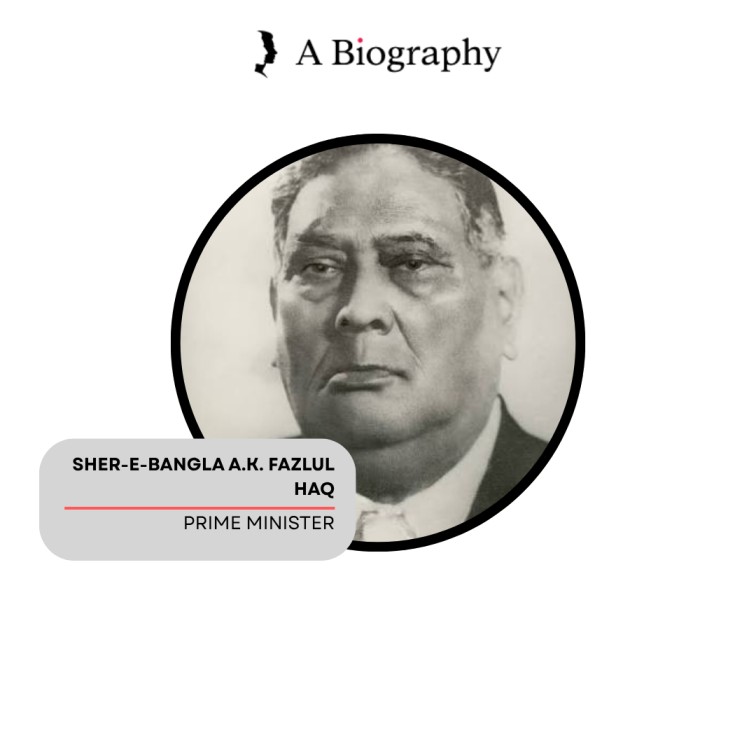
Introduction
March 23, 1940. Minto Park, Lahore. The air was thick with the breath of a hundred thousand souls. History held its own breath.
The annual session of the All India Muslim League was underway. On the dais sat the giants of India’s freedom movement—serene, powerful, yet utterly unaware that within moments, the earth beneath them would crack open.
Then an elderly man rose. He looked like a village scholar—wire-rimmed spectacles, a simple sherwani, a face carved by decades of political storms. In his trembling hands, he clutched a document. When he began to speak, Minto Park fell into a silence so deep that the fluttering of flags seemed deafening.
His voice—soft at first, then rising like a distant thunderclap rolling toward the shore—read aloud a proposal that would echo through eternity:
“The areas in which the Muslims of British India are numerically in a majority, as in the north-western and eastern zones, should be grouped to constitute ‘independent states’ in which the constituent units shall be autonomous and sovereign.”
That proposal became the Lahore Resolution—the Pakistan Resolution.
The man who proposed it was no ordinary politician. He was the Tiger of Bengal—Sher-e-Bangla Abul Kashem Fazlul Huq.
A man who served simultaneously as the General Secretary of the Indian National Congress and the President of the All India Muslim League. A man the British Crown desperately wanted to knight—but who refused the honor with quiet dignity. A man who liberated Bengal’s peasants from the crushing weight of feudal debt. A man who was the political mentor of Bangabandhu Sheikh Mujibur Rahman, the father of Bangladesh. A man who stood at the forefront of the Bengali Language Movement, facing police brutality in his seventies.
This is his story. The story of how a child from a nondescript village in Barisal rose to become Bengal’s first and longest-serving Prime Minister. The story of why they called him The Tiger.
At a Glance: Life of A.K. Fazlul Huq
Every line in this table carries the weight of history.
| Information | Details | Special Note |
| Full Name | Abul Kashem Fazlul Huq | A brilliant star in Bengal’s history |
| Nickname | Sher-e-Bangla (Tiger of Bengal) | His enemies feared him like a tiger |
| Date of Birth | October 26, 1873 | Born on the soil of Barisal |
| Date of Death | April 27, 1962 | Passed away in Dhaka at age 88 |
| Place of Birth | Bakerganj District, Bengal Presidency, British India (present-day Jhalokathi, Bangladesh) | From grazing fields to the political arena |
| Father’s Name | Mohammad Wajed | Renowned lawyer of Barisal Bar |
| Mother’s Name | Syedunnesa Khatun | Educated and pious woman |
| Paternal Grandfather | Kazi Akram Ali | Scholar of Arabic and Persian |
| Education | Barisal District School, Presidency College (Calcutta), Calcutta University, Calcutta University Law College | Extraordinary academic career |
| Degrees | F.A. (1890), B.A. Triple Honors (Math, Physics, Chemistry – 1894), M.A. (Mathematics – 1896), B.L. (1897) | Graduate in both science and law |
| Languages | Bengali, English, Urdu, Arabic, Persian | Fluent in five languages |
| Profession | Lawyer, Politician, Writer, Educationist | Multi-dimensional talent |
| Political Parties | Bengal Provincial Muslim League, All India Muslim League, Indian National Congress, Krishak Praja Party, Workers and Peasants Socialist Party | Leadership across multiple parties |
| Key Positions | Education Minister of Bengal (1924), Mayor of Calcutta (1935), Prime Minister of Bengal (1937-1943), Advocate General of East Bengal (1947-1952), Chief Minister of East Bengal (1954), Home Minister of Pakistan (1955-1956), Governor of East Pakistan (1956-1958) | Held multiple crucial positions |
| Unique Feat | Only person who was simultaneously Congress General Secretary and Muslim League President | 1916-1919 period |
| Major Contributions | Reform of zamindari system, peasant debt relief, Lahore Resolution, support for Bengali Language Movement, establishment of Bangla Academy | Pathfinder for Bengal’s peasant liberation |
| Resting Place | Three Leaders’ Mausoleum (Dhaka High Court premises) | Beside Nazimuddin and Suhrawardy |
| Memorials | Sher-e-Bangla Nagar (Parliament area), Sher-e-Bangla Agricultural University, Sher-e-Bangla Stadium, Fazlul Huq Hall (Dhaka University) | His name spread throughout Bangladesh |
Early Life
The Birth of a Future Lion on the Edge of an Empire
October 26, 1873. The monsoon rains had finally retreated, leaving the world washed clean and shimmering with possibility.
In the small village of Satla, Bakerganj district, under the iron fist of British rule, a child was born to Mohammad Wajed and Syedunnesa Khatun. The British Empire was at its zenith. The zamindari system had reduced millions of peasants to virtual slavery. Bengal groaned under extraction and exploitation.
Into this darkness, a light flickered to life.
The family called him Kashem with affection. From his earliest days, this child was different. While other children played in the fields, young Kashem sat hunched over books, his young mind devouring knowledge with an insatiable hunger.
His father, Mohammad Wajed, was a distinguished lawyer at the Barisal Bar—a man of principle. His mother, Syedunnesa, was an educated and deeply pious woman who instilled in her son the values of compassion, justice, and unwavering faith.
The family lineage was illustrious. His paternal grandfather, Kazi Akram Ali, was a mukhtar (lawyer) and a renowned scholar of Arabic and Persian. This linguistic heritage would flow through Fazlul Huq’s veins, later manifesting in his mastery of five languages.
A childhood story that reveals his genius:
Young Kashem possessed a photographic memory. He could flip through a single page of a book and memorize its entire contents. His father, hearing of this remarkable ability, once laughed and said, “You seem to be reading from pages of gold!”
But Fazlul Huq would not merely read from golden pages. He would walk paths of brutal struggle, climb mountains of adversity, and roar against the mightiest empire the world had ever known.
The emotional turning point: That small-town boy from a provincial corner of Barisal would one day roar so loudly in Lahore’s Minto Park that the foundations of the British Empire would tremble.
Education
From Barisal to Presidency College: Walking the Path of Knowledge
The classroom became his battlefield. Knowledge became his weapon.
Fazlul Huq’s early education began at home under his grandfather Kazi Akram Ali, who taught him Arabic and Persian. He mastered Bengali grammar and literature with equal ease. By the time he entered formal schooling, he was already leagues ahead of his peers.
He enrolled at Barisal District School, one of the finest institutions in Bakerganj district. Here, he consistently secured first place in every subject. Teachers whispered to one another about the boy with the piercing eyes and the hungry mind.
In 1890, he passed his F.A. (Faculty of Arts) examination with distinction. His teachers, recognizing his extraordinary potential, urged him to pursue higher education in Calcutta—the intellectual capital of the British Empire in India.
Presidency College: The Triple Honors Marvel
1891. Fazlul Huq walked through the hallowed gates of Calcutta’s Presidency College—an institution that had produced some of the finest minds of a generation.
He enrolled in a triple honors program in Mathematics, Physics, and Chemistry—a feat of intellectual audacity that left even his professors astonished. Three of the most demanding disciplines pursued simultaneously in an era when passing even one was considered an achievement.
In 1894, he passed his B.A. examination with triple honors—one of the first students in the history of Presidency College to achieve this remarkable feat. His professors called him the “human computer” because he could solve complex mathematical problems entirely in his mind.
His oratorical style was already taking shape. Even as a student, his command over the English language was extraordinary. He could hold audiences spellbound.
Calcutta University: M.A. and LL.B.
After completing his B.A., Fazlul Huq enrolled at Calcutta University, earning his M.A. in Mathematics in 1896. His love for mathematics never diminished; even in later political speeches, he would use mathematical examples to illustrate his points.
In 1897, he obtained his LL.B. degree from Calcutta University Law College. His legal education was equally distinguished—he was a first-class student, and his razor-sharp logic made him a natural fit for the legal profession.
The Polyglot: Master of Five Languages
Fazlul Huq was fluent in five languages: Bengali, English, Urdu, Arabic, and Persian. He could speak, read, and write in each with equal facility. This linguistic prowess served him enormously in diplomacy and politics.
The silent question: What does a boy from a remote village in Bengal do with a triple honors degree, a master’s in mathematics, and a law degree? The answer would unfold over the next six decades.
Struggles & Adversities
The Weight of a Broken World on Young Shoulders
Fazlul Huq was no stranger to suffering. He had seen the face of poverty, felt the sting of discrimination, and witnessed the crushing weight of an empire that treated his people as less than human.
Though his family was relatively privileged, the world around him was not. The Bengal of his youth was a land of stark contrasts: opulent British rulers living in marble palaces while millions of Bengali peasants subsisted on the edge of starvation. The zamindari system extracted every drop of sweat from the farmer’s brow, leaving nothing but dust and despair.
The Muslim community in Bengal faced particular hardships. The British had systematically marginalized them after the 1857 Rebellion, denying them educational opportunities and government positions. The community’s literacy rate was abysmally low. Their economic condition was precarious.
Young Fazlul Huq witnessed all of this. And it burned a fire inside him.
Professional Struggles: Walking Away from Security
After completing his law degree in 1897, Fazlul Huq initially joined government service as an Assistant Registrar. It was a secure job, a steady income, a respectable position. Most men would have clung to it.
But Fazlul Huq realized something profound: he could not serve his people from inside the cage of government service.
From 1908 to 1912, he served as the Assistant Registrar of Cooperative Movements, gaining firsthand exposure to Bengal’s rural economy and the suffering of its peasants. He saw the moneylenders’ cruelty, the zamindars’ greed, and the British administration’s indifference.
Then came the intervention that would change his life.
Sir Ashutosh Mukherjee’s Prophetic Words
Sir Ashutosh Mukherjee—the legendary educator and jurist—recognized Fazlul Huq’s brilliance. He pulled him aside one day and said something that would echo through the decades:
“Leave government service. If you practice law at the High Court, you will become a very great lawyer. Bengal needs your voice, not your signature on government files.”
In 1912, Fazlul Huq resigned from government service—a decision that terrified his family and confounded his friends. He enrolled as a lawyer at the Calcutta High Court.
For the next forty years, he remained active in legal practice. His sharp arguments and powerful oratory made him immensely popular with clients. But more importantly, the law gave him a platform to fight for justice.
The provocative question: Was leaving the security of government service for the uncertainty of legal practice an act of reckless adventure or far-sighted vision? Fazlul Huq spent the rest of his life proving it was the right decision.
Love
Three Marriages, One Son, and a Life of Emotional Complexity
The Tiger of Bengal had a heart that loved deeply—and bled freely.
Fazlul Huq married three times, each marriage reflecting a different chapter of his tumultuous life.
First Marriage: Khurshid Begum
His first wife was Khurshid Begum. The marriage produced two children, but the relationship was troubled. Khurshid eventually left him and filed for maintenance in court, creating legal complications that shadowed Fazlul Huq’s personal life for years.
The details remain murky, shrouded by time and family discretion. But what is clear is that the dissolution left scars.
Second Marriage: Jannatun Nesa Begum
After his separation, Fazlul Huq married Jannatun Nesa Begum, a resident of Howrah district. This marriage was peaceful and harmonious, though the couple had no children. Jannatun Nesa provided stability and companionship during a critical period of his political ascent.
Third Marriage: Khadija Begum and Son A.K. Faizul Huq
Fazlul Huq’s final marriage was to Khadija Begum of Meerut district in Uttar Pradesh. This union produced his only son—A.K. Faizul Huq.
Fatherhood came late to Fazlul Huq, and he poured all his hopes into his son. He ensured Faizul received the finest education and instilled in him the values of honest politics. Faizul Huq later became a member of parliament and a minister in Bangladesh, passing away in 2007.
The emotional undercurrent: Behind the public lion was a private man who experienced the full spectrum of human relationships—love, loss, companionship, and the quiet joy of watching a son grow.
Personal Life
The Man Behind the Myth
When the speeches ended and the crowds dispersed, what remained? Who was Fazlul Huq when he took off the politician’s mantle?
He was a man of simple habits and profound discipline. Despite his towering intellect, he remained approachable. He walked through the streets of Calcutta and Dhaka without fanfare, stopping to speak with ordinary people—rickshaw pullers, street vendors, peasants who had traveled for days just to catch a glimpse of the Tiger.
He was deeply religious, offering five daily prayers and reciting the Quran regularly. Yet he never used religion as a political tool. His cabinet included Hindus and Muslims alike. He believed that faith was a personal matter between an individual and God, not a weapon to be wielded against fellow citizens.
His daily routine was rigorous. He woke before dawn, completed his prayers, and spent the early morning hours reading—newspapers, legal briefs, political reports, literature, philosophy. He believed that a leader who stopped learning had stopped leading.
His home was modest by the standards of his position. He never accumulated great wealth, never built palaces, never indulged in the trappings of power that seduced so many. When he died, he left behind no fortune—only a legacy.
Future Plans & Vision
The Bengal That Fazlul Huq Dreamed Of
Fazlul Huq was not a man who lived only in the present. He carried a vision of the future in his bones.
His ultimate dream was a free, sovereign, united Bengal—a land where Hindus and Muslims would live as brothers, where peasants would own the soil they tilled, where the Bengali language would be honored as the language of governance and culture, and where the people would govern themselves through democratic institutions.
The Lahore Resolution of 1940—which he proposed—originally called for “independent states” (plural), not a single Pakistan. Fazlul Huq envisioned an independent Bengal in the east, perhaps federated with an independent state in the northwest. He never imagined that Bengal would be carved into two halves, with its western part handed to India and its eastern part reduced to a colony of West Pakistani rulers.
Later in life, he expressed deep regret over how the Pakistan idea had been distorted. He told associates, “I wanted a free Bengal. What we got was another kind of slavery.”
His vision for Bengal included:
- Land reforms that would transfer ownership to actual tillers
- Free and compulsory primary education for all children
- Industrialization of Bengal to create jobs for the unemployed
- Protection of Bengali language and culture against all forces of suppression
- Secular democracy where religion would not determine citizenship
This vision was not fully realized in his lifetime. But it seeded the ground for the Bangladesh Liberation War of 1971.
Career
The Many Lives of a Titan
Few men in history have worn as many hats as Fazlul Huq—and worn them all with distinction.
Lawyer (1912-1952): After resigning from government service, Fazlul Huq built a flourishing practice at the Calcutta High Court. His legal arguments were legendary; opponents feared his cross-examinations. He continued practicing even while holding high political office, arguing that law kept him connected to the realities of ordinary people.
Education Minister of Bengal (1924): For six months, he served as Education Minister, pushing for free primary education and greater access for Muslims who had been systematically excluded by British policies.
Mayor of Calcutta (1935): As mayor of the empire’s second-largest city, he focused on cleaning up slums, improving sanitation, and providing basic services to the poorest neighborhoods.
Prime Minister of Bengal (1937-1943): His longest and most consequential tenure. He passed landmark legislation freeing peasants from debt, reducing interest rates, and reforming the zamindari system.
Advocate General of East Bengal (1947-1952): After Partition, he served as the top law officer of East Bengal, using his position to defend the rights of Bengali Muslims against central government overreach.
Chief Minister of East Bengal (1954): His United Front government won a landslide victory, crushing the Muslim League. But the central government dismissed him after just two months.
Home Minister of Pakistan (1955-1956): He helped draft Pakistan’s first constitution, advocating for provincial autonomy.
Governor of East Pakistan (1956-1958): His last major office. He was deposed by General Ayub Khan’s military coup in 1958.
Each role was not merely a position—it was a battlefield.
Travels & Diverse Experiences
A Mind Shaped by the World
Fazlul Huq traveled extensively across the Indian subcontinent and beyond—not as a tourist, but as a student of humanity.
His travels included:
- Delhi and Lahore: Where he negotiated with national leaders like Jinnah, Nehru, and Gandhi
- London: Where he observed the workings of British parliamentary democracy firsthand
- The villages of Bengal: Where he walked barefoot through flooded fields to speak with peasants
- The North-West Frontier Province: Where he witnessed the fierce independence of Pashtun tribes
- Calcutta’s High Court: Where he argued cases that shaped the jurisprudence of British India
These diverse experiences gave him a worldview that was rare among his contemporaries. He understood that Bengal’s problems could not be solved in isolation—they required understanding the broader dynamics of empire, nationalism, and global economics.
Failures & Teachable Moments
The Tiger Also Stumbled
No great life is without failures. Fazlul Huq’s failures are as instructive as his triumphs.
Failure #1: The Collapse of His First Government (1943) – Under pressure from Governor John Herbert, Fazlul Huq was forced to resign as Prime Minister. He had failed to build a coalition strong enough to withstand the Governor’s machinations. The lesson: In politics, loyalty must be earned and constantly renewed; allies can become enemies overnight.
Failure #2: The Pakistan Dream Turns Sour – Fazlul Huq supported the Lahore Resolution believing it would lead to an independent Bengal. Instead, Bengal was partitioned, and East Pakistan became a colony of West Pakistan. He later admitted, “We made a terrible mistake. We traded one master for another.”
Failure #3: The Two-Month Chief Ministership (1954) – His United Front government won a historic landslide, but the central government dismissed it after just 60 days. He had underestimated the ruthlessness of the central establishment.
Failure #4: The Secular Education Bill Controversy – As Education Minister, he proposed a bill that included provisions for separate religious education, drawing sharp criticism from secularists. The bill was eventually withdrawn. He learned that balancing community rights with national unity is a delicate art.
The wisdom from failure: Fazlul Huq never made excuses. When he fell, he got back up. When he erred, he admitted it. This humility made him beloved even by his political opponents.
Source of Inspiration
What Fueled the Tiger’s Roar?
Every great leader has a source—a wellspring of inspiration that refills their spirit when it runs dry.
For Fazlul Huq, the source was the suffering face of the Bengali peasant.
He once told a close associate: “When I see a farmer working from dawn to dusk, and then see that everything he produces is taken away by the zamindar and the moneylender, leaving him nothing but dry bread and empty hands—that is when I find the strength to fight. That is why I cannot rest.”
His mother, Syedunnesa Khatun, was another source. She taught him that true greatness lies not in wealth or titles but in service to the powerless. She would tell him stories of Muslim saints and Hindu bhaktas who gave everything to the poor.
The Quran was his constant companion. He found in Islamic teachings a powerful mandate for economic justice: “And in their wealth, there is a recognized right for the needy and the deprived.”
But he was also inspired by Western political thinkers—John Stuart Mill, Jeremy Bentham, Abraham Lincoln. He believed that good ideas have no religion or nationality.
Influences & Inspirations
The Shoulders Upon Which He Stood
No man is an island. Fazlul Huq was shaped by a constellation of mentors, peers, and historical figures.
Sir Ashutosh Mukherjee – The legendary educator who urged Fazlul Huq to leave government service and embrace the law. Without this advice, Fazlul Huq might have remained a forgotten bureaucrat.
Nawab Sir Salimullah – The founder of the Muslim League who recognized young Fazlul Huq’s potential and brought him into national politics.
Deshbandhu Chittaranjan Das – The fiery Congress leader who showed Fazlul Huq that Hindus and Muslims could fight together for freedom. Their friendship transcended religious boundaries.
Muhammad Ali Jinnah – A complicated influence. Fazlul Huq respected Jinnah’s legal brilliance but grew disillusioned with his centralizing tendencies. Their relationship swung between alliance and antagonism.
The Peasants of Bengal – His greatest teachers. They taught him that poverty is not a personal failing but a structural crime.
He also drew inspiration from global figures: Abraham Lincoln for his leadership during civil war, Mustafa Kemal Ataturk for his modernization of Turkey, and Benito Juarez for his defense of Mexican sovereignty against foreign intervention.
Philosophical Views & Beliefs
The Ideology of the Tiger
Fazlul Huq was not a man of rigid ideologies. He was a pragmatist with a moral compass.
Islamic Socialism: He believed that Islam and socialism were not contradictions but complements. The Quran’s teachings on zakat (wealth redistribution) and the prohibition of usury (riba) aligned, in his view, with socialist principles of economic justice. He sought a third way between Western capitalism and Soviet communism.
Secularism: Despite being a devout Muslim, he was a secularist in the best sense of the word—he believed the state should treat all religions equally. His cabinets always included Hindus. He opposed the creation of Pakistan as a theocratic state.
Democracy: He had profound faith in democratic institutions. He opposed Gandhi’s Non-Cooperation Movement not because he loved the British but because he believed that boycotting legislatures would leave ordinary people without representation.
Economic Justice: This was his North Star. Every policy he championed—land reform, debt relief, free education—was aimed at lifting the poor. He once thundered in the Bengal Legislative Assembly: “A budget that chills our very marrow with its cold printed words—that is the budget of national disaster.”
Bengali Nationalism: Before Bangabandhu, there was Fazlul Huq. He believed that Bengali Muslims and Bengali Hindus shared a common culture, language, and destiny. He was a fierce opponent of Urdu imperialism.
Unique Traits
What Made Fazlul Huq, Fazlul Huq?
Certain traits set the Tiger apart from the pack.
Photographic Memory: From childhood, he could memorize entire pages after a single reading. This allowed him to quote laws, speeches, and poetry at will during debates.
Fearlessness: He never hesitated to speak truth to power. He criticized British viceroys, confronted Jinnah, defied Ayub Khan—all without flinching.
Oratorical Brilliance: His speeches could move audiences to tears or to fury. He mixed high English with earthy Bengali proverbs, logic with emotion, humor with gravitas.
Empathy: He genuinely felt the pain of ordinary people. When peasants came to him with their grievances, he listened—really listened—and often wept with them.
Humility: Despite holding the highest offices, he never developed an ego. He traveled without entourages, ate simple food, and treated servants with respect.
Strategic Patience: He knew when to wait and when to strike. His political career spanned five decades because he understood timing.
Contributions, Awards & Achievements
The Indelible Marks Left on History
Fazlul Huq’s contributions are carved into the foundation of modern Bengal.
Landmark Legislation (1938):
- Bengal Agricultural Debtors Act – Restructured and waived peasant debts
- Money Lenders Act – Capped interest rates, ending usury
- Bengal Tenancy (Amendment) Act – Reduced rent interest from 12.5% to 6.25%
Lahore Resolution (1940): The foundation stone of the Pakistan movement—though he later regretted its distortion.
Educational Institutions Founded (partial list):
- Calcutta Islamia College
- Lady Brabourne College
- Adina Fazlul Huq College, Rajshahi
- Chakhar Fazlul Huq College
- Fazlul Huq Muslim Hall (Dhaka University)
- Sher-e-Bangla Hall (BUET)
- Sher-e-Bangla Agricultural University
Bangla Academy (1955): Established as the premier institution for Bengali language and literature.
Pohela Boishakh as Public Holiday: His government declared Bengali New Year a government holiday.
Awards & Honors:
- Refused knighthood from the British Crown
- Posthumously honored by Bangladesh with numerous institutions named after him
- “Sher-e-Bangla” title bestowed by the people, not the state
Unique Achievement: The only person in history to serve simultaneously as General Secretary of the Indian National Congress and President of the All India Muslim League (1916-1919).
Controversies
The Tiger Was Not Without Scars
No leader of his stature escapes controversy. Fazlul Huq had his share.
Controversy #1: Joining the Viceroy’s Defence Council (1941) – During World War II, Fazlul Huq accepted a position on the Viceroy’s Defence Council. Critics accused him of collaborating with the British. He defended himself: “Japan is at the gates of Bengal. Should I sit idle while my people face a new invader?”
Controversy #2: Alliance with the Hindu Mahasabha (1941) – His second coalition government included the Hindu Mahasabha, a right-wing Hindu organization. Secular Muslims were outraged. Fazlul Huq argued that in wartime, unity against a common enemy (Japan and potentially the British) trumped ideological purity.
Controversy #3: The Lahore Resolution’s Ambiguity – Did he want Pakistan or an independent Bengal? His later statements contradicted the official Muslim League line. Some accused him of duplicity. Others saw it as evolving political thought.
Controversy #4: Accusations of Communalism – His support for separate electorates for Muslims and his education bill’s communal provisions led some to label him communalist. He rejected this, pointing to his long record of Hindu-Muslim cooperation.
Controversy #5: Relationship with Jinnah – Their alliance was always uneasy. After Partition, Fazlul Huq openly criticized Jinnah’s vision of a centralized Pakistan. Jinnah, in turn, marginalized him.
The honest assessment: Fazlul Huq was a complex figure. He made mistakes. He formed uncomfortable alliances. But his core commitment—to the people of Bengal, especially the poor—never wavered.
Contemporary Opinions & Interviews
What Others Said About the Tiger
The words of those who knew him paint a vivid portrait.
Muhammad Ali Jinnah once joked: “When the tiger (Fazlul Huq) comes, the sheep (Jinnah) gets out of the way.”
Sir Ashutosh Mukherjee said after observing his legal skills: “You will go far. But do not forget—the law is a weapon. Use it for the poor.”
Bangabandhu Sheikh Mujibur Rahman said after Fazlul Huq’s death: “Sher-e-Bangla was the undisputed leader of the Bengali nation. The path he showed, we followed to independence.”
Indian Prime Minister Jawaharlal Nehru in his condolence message: “Fazlul Huq was an extraordinary leader of the subcontinent. He worked tirelessly for peasants and the poor.”
A British official who wished to remain anonymous once complained: “Huq is impossible. He argues like a barrister, roars like a lion, and moves like a ghost. Just when you think you have him cornered, he slips away and attacks from another angle.”
A peasant from Barisal told a reporter: “He is not a leader. He is one of us. When he speaks, we hear our own hearts speaking.”
Myths & Misconceptions
Separating Fact from Fiction
Over the decades, myths have grown around Fazlul Huq like vines around an ancient tree.
Myth #1: He was a religious bigot.
Fact: He was a devout Muslim but worked closely with Hindu leaders throughout his career. His cabinets always included Hindus. He opposed the creation of a theocratic Pakistan.
Myth #2: He wanted a united, undivided Pakistan.
Fact: He wanted an independent Bengal. The Lahore Resolution originally called for “independent states” (plural). He was deeply disappointed by the Partition of Bengal.
Myth #3: He was a puppet of the British.
Fact: He was jailed multiple times by the British, refused a knighthood, and led opposition to British policies. His wartime cooperation was strategic, not subservient.
Myth #4: He was anti-Hindi/Urdu.
Fact: He opposed the imposition of Urdu as the sole state language of Pakistan. He had nothing against Urdu as a language; he opposed linguistic imperialism.
Myth #5: He died in poverty because he was corrupt.
Fact: He died with modest means because he never used public office for private enrichment. His simplicity was a choice, not a consequence of failure.
Myth #6: He was a mass leader but a poor administrator.
Fact: His administration passed landmark legislation that transformed Bengal’s agrarian economy. He was an effective administrator when allowed to govern.
Famous Quotes & Thoughts
The Tiger’s Own Words
Fazlul Huq was as eloquent on paper as he was on the podium. Here are some of his most memorable utterances.
- “Sooner or later, they will be reduced to dust; just as in human history, oppressors and exploiters have faced their destined end.” – Criticizing British rule
- “A budget, whose cold printed letters chill us to the very marrow of our bones—that is the budget of national disaster we face.” – Speaking on the 1943 Bengal famine budget
- “I want you to agree to form a Bengali army of one hundred thousand young men—fifty percent Hindu and fifty percent Muslim youth. Such a step is urgently demanded, and the people of Bengal will accept no excuses.” – Letter to Governor John Herbert during WWII
- “The administrative system must be consistent with the genius and traditions of the people, not constructed according to the whims of rigid bureaucrats whose autocratic ideas are embedded in every breath of their lives.” – Another letter to the Governor
- “They were lions in their time, and today among us are the descendants of lions of Indian journalism. But the difference between the two classes of lions is extremely significant. The roar of the earlier lions echoed from Bengal across seven seas into the homes of the British nation, but the current lions are tamed like circus lions. The roar of the old lions shook thrones, but most of today’s lions only know how to hide under thrones and wag their tails in support of government policies.” – Criticizing sycophantic journalists
- “Mr. Speaker, I can easily face the song, but I cannot face the monkey. Mr. Speaker, I have not named any honorable member of this House. But if any honorable member feels that the cap fits his head, then I withdraw my remark.” – A witty retort during an assembly debate
- “I am the living history of Bengal and East Pakistan for the last sixty years. I am the last surviving member of that band of selfless and courageous Muslims who fought fearlessly against terrible odds.” – Reflecting on his political journey
Message for the Present Generation
What the Tiger Would Say to Today’s Youth
If Fazlul Huq were alive today, what would he tell the young people of Bengal?
“Do not confuse politics with spectacle. True politics is the art of serving the hungry, clothing the naked, sheltering the homeless. If you enter public life for fame or fortune, you will fail—and worse, you will betray those who trust you.
Learn your history. The British did not leave because they were kind; they left because we made it costly for them to stay. The Urdu imperialists did not retreat because they loved Bengali; they retreated because we shed blood in the streets of Dhaka. Freedom is never given; it is taken.
But do not let anger consume you. Anger without wisdom is a fire that burns its own house. Use your head as much as your heart. Study. Read. Argue. Learn to write well and speak better. The pen is mightier than the sword—but only if you know how to wield it.
And above all, never forget the peasant. The farmer who wakes before dawn, who works under the burning sun, who returns home with empty hands—that is your boss. Not the party leader. Not the prime minister. That farmer is your master.
If you remember that, you will be worthy of Bengal. If you forget, you will be nothing but a noise in the wind.”
Death & Legacy
When the Tiger Fell Silent
April 27, 1962. Friday. 10:20 AM. Dhaka.
The Tiger of Bengal took his last breath at his residence at 27 K.M. Das Lane, Tikatuli, Dhaka. He was 88 years old. His body had been failing, but his mind remained razor-sharp until the end.
The electricity of his roar ceased. The lion who had made the British Empire tremble, who had challenged Jinnah, who had defied Ayub Khan—fell silent.
The Janaza (Funeral Prayer):
His relatives kept his body on a bed of ice. On April 28 at 10:30 AM, his janaza was held at Paltan Maidan.
The crowd that gathered was unprecedented. Half a million people—some estimates say seven hundred thousand—converged on the ground. Peasants who had walked for days. Students who had skipped classes. Political leaders who had once been his rivals. Hindus and Muslims, rich and poor, old and young.
They came to say goodbye to the Tiger.
The Burial:
He was laid to rest at the southern end of Kazi Nazrul Islam Road in Dhaka, west of the Children’s Academy. This site is now known as the “Three Leaders’ Mausoleum” —because beside Fazlul Huq lie his two great rivals and contemporaries: Sir Khawaja Nazimuddin and Huseyn Shaheed Suhrawardy.
In life, they were opponents. In death, they share the same soil. History has a dark sense of humor.
Global Condolences:
Pakistan’s President Ayub Khan sent a message. India’s Prime Minister Jawaharlal Nehru expressed sorrow. East Pakistan’s Governor Zakir Hussain paid tribute. All educational institutions in Pakistan were closed on April 30 as a mark of respect.
The Emotional Core: The man who had fought the British, then the Pakistani establishment, was mourned by both India and Pakistan. Fazlul Huq had transcended nations. He belonged to Bengal—and to humanity.
Successors & Lasting Impact
The Torch Was Passed
Every great leader plants seeds that grow after they are gone.
Bangabandhu Sheikh Mujibur Rahman is the most direct political heir of Fazlul Huq. The young Mujib worked alongside Fazlul Huq during the 1954 United Front election campaign. He learned from the Tiger how to connect with peasants, how to craft a political message, and how to stand firm against central government oppression.
Mujib’s Six Point Program (1966) was a direct descendant of Fazlul Huq’s Forty-Two Point Program (1954). Both demanded autonomy for East Bengal. Both challenged the concentration of power in West Pakistan.
When Bangladesh became independent in 1971, Mujib often recalled: “Sher-e-Bangla dreamed of a free Bengal. We have made that dream a reality.”
Other successors include:
- Huseyn Shaheed Suhrawardy – Though often a rival, he shared Fazlul Huq’s commitment to Bengali rights
- Maulana Abdul Hamid Khan Bhashani – The peasant leader who carried forward Fazlul Huq’s agrarian activism
- The countless local leaders across Bangladesh who invoke his name and claim his legacy
Institutional Legacy:
- Sher-e-Bangla Nagar – The area housing Bangladesh’s Parliament and ministries
- Sher-e-Bangla Agricultural University – A premier institution for agricultural science
- Sher-e-Bangla Stadium – A major cricket venue in Dhaka
- Fazlul Huq Hall at Dhaka University and other universities
- Bangla Academy – Still the preeminent institution for Bengali language
The intangible legacy: Every time a Bengali peasant asserts their rights, every time someone speaks Bengali with pride, every time a secular politician invokes communal harmony—the spirit of Fazlul Huq walks among us.
Unknown Facts
The Tiger’s Hidden Corners
Even his most devoted admirers may not know these details.
- Photographic Memory Legend – He could memorize an entire page of a book after a single reading. This ability was tested by his professors, who were left speechless.
- Refused Knighthood – The British offered him a knighthood multiple times. He refused every time, saying, “I cannot accept a title from those who have enslaved my people.”
- The “Human Computer” – At Presidency College, he earned this nickname because he solved complex mathematical problems mentally, without using paper.
- Saudi King Sent a Plane – In 1954, after his United Front victory, King Saud of Saudi Arabia sent a private aircraft to bring Fazlul Huq to Mecca. He was too ill to travel.
- His Son’s Political Career – His only son, A.K. Faizul Huq, became a minister in Bangladesh from the BNP—a different party from his father’s legacy.
- Buried Beside Rivals – The “Three Leaders’ Mausoleum” contains Fazlul Huq, Nazimuddin, and Suhrawardy. In life, they were fierce opponents. In death, they are neighbors.
- He Was a Poet Manqué – Though not known as a poet, he wrote Bengali verses in his youth. Some were published in little magazines now lost to history.
- His First Political Defeat – He lost his very first election attempt but learned from the experience and never lost again for decades.
- The Missing Knighthood Letter – The official letter offering him a knighthood still exists in archival records, with his rejection note scribbled in the margin.
- Last Words – According to family members, his last words were a prayer in Arabic, followed by a whispered: “Bengal… don’t forget the peasants.”
Key Events
| Year | Event |
| 1873 | October 26 – Born in Satla village, Bakerganj |
| 1890 | Passed F.A. from Barisal District School |
| 1894 | B.A. with Triple Honors (Math, Physics, Chemistry) from Presidency College |
| 1896 | M.A. in Mathematics from Calcutta University |
| 1897 | LL.B. from Calcutta University Law College |
| 1908-1912 | Assistant Registrar of Cooperative Movements |
| 1912 | Resigned from government service; enrolled at Calcutta High Court |
| 1913 | Elected to Bengal Legislative Council from Dhaka division |
| 1916 | Elected President of All India Muslim League; signed Lucknow Pact |
| 1916-1918 | General Secretary of Indian National Congress |
| 1919 | Member of Jallianwala Bagh inquiry committee |
| 1924 | Education Minister of Bengal (six months) |
| 1929 | Founded All Bengal Tenants Association (Krishak Praja Party) |
| 1935 | Elected Mayor of Calcutta |
| 1937 | Won provincial election; became first Prime Minister of Bengal |
| 1938 | Passed peasant debt relief and land reform laws |
| 1940 | March 23 – Proposed Lahore Resolution |
| 1941 | Formed second coalition government (Nov-Dec) |
| 1943 | March 28 – Forced to resign as Prime Minister; Governor’s rule imposed |
| 1947-1952 | Advocate General of East Bengal |
| 1948 | Proposed Bangla Academy at literary conference |
| 1952 | Supported Bengali Language Movement |
| 1954 | Formed United Front; landslide victory; Chief Minister (April 3); dismissed (May 29) |
| 1955-1956 | Home Minister of Pakistan |
| 1955 | Bangla Academy formally established |
| 1956-1958 | Governor of East Pakistan |
| 1958 | October 27 – Removed as Governor after Ayub Khan’s coup |
| 1962 | April 27 – Died in Dhaka at age 88 |
Conclusion
The Tiger Still Roars
When Fazlul Huq took his last breath on April 27, 1962, half a million people gathered at Paltan Maidan. Some shouted “Sher-e-Bangla Zindabad!” Others wept in silence.
The Tiger had shed his mortal body. But he had not died.
He lives on in Sher-e-Bangla Nagar—the seat of Bangladesh’s Parliament, where laws are made for the nation he dreamed of.
He lives on in Bangla Academy—where the Bengali language he loved is studied, celebrated, and protected.
He lives on in the hearts of peasants who still sing songs about the man who freed them from zamindars and moneylenders.
He lives on in the political DNA of Bangladesh—in its secular constitution, its Bengali nationalism, its fierce resistance to external domination.
He was not a perfect man. He made mistakes. He formed uncomfortable alliances. He sometimes compromised. But his core never wavered: the service of Bengal’s poor, the defense of Bengali language and culture, the dream of a free and just society.
Fazlul Huq once said: “I am the living history of Bengal for the last sixty years.”
Today, he is history. But history is not dead. History is a river that flows through the present into the future. And as long as Bengal exists, the Tiger’s roar will echo through its villages, its cities, and its soul.
Sher-e-Bangla Zindabad. The Tiger lives.
References
- Bangla Wikipedia – A.K. Fazlul Huq (birth, family background, education, political life, death)
- English Wikipedia – A.K. Fazlul Huq (Prime Ministership of Bengal, Lahore Resolution, United Front, awards and legacy)
- Banglapedia – Sher-e-Bangla Abul Kashem Fazlul Huq (basic information and political contributions)
- BBC Bangla – Sher-e-Bangla Fazlul Huq: The Roar of the Tiger of Bengal (special report)
- Daily Prothom Alo – 150th Birth Anniversary of Sher-e-Bangla (reassessment of contributions)
- Daily Kaler Kantho – Fazlul Huq’s Lahore Resolution and United Bengal Thought (analysis)
- Daily Jugantor – Fazlul Huq’s Role in the Language Movement (1952 context)
- Bangla Tribune – Sher-e-Bangla’s Pro-Peasant Policies and Land Reforms (historical documents)
- Rajmohan Gandhi – Punjab: A History from Aurangzeb to Mountbatten (quote)
- Dr. Muntasir Mamoon – Sher-e-Bangla A.K. Fazlul Huq (biography)
- Professor Sirajul Islam – Fazlul Huq: The Lion of Bengal (authoritative biography)
- Pakistan Constituent Assembly Debates (1955-1956) – Fazlul Huq’s speeches
- Bengal Legislative Assembly Proceedings (1937-1943) – Fazlul Huq’s policies and activities
- The Daily Star Archive – “Remembering Sher-e-Bangla” (April 2012)
- New Age – Fazlul Huq’s letters and unpublished documents (2017)
Disclaimer
This biography is based on reliable and authoritative sources. Original facts, dates, political positions, and contributions have been preserved; only literary dramatization has been added in descriptions and presentation. Fazlul Huq’s personal and professional information has been gathered from various sources. His political positions and opinions are his own. No malicious intent toward any individual or organization is present. Quotations from Fazlul Huq’s speeches have been kept as close to the original language as possible. Readers are encouraged to use their own judgment and further research.
The roar of Sher-e-Bangla’s tiger still echoes in the Bengali heart. His name will remain written in golden letters on the pages of history.

