
Biography
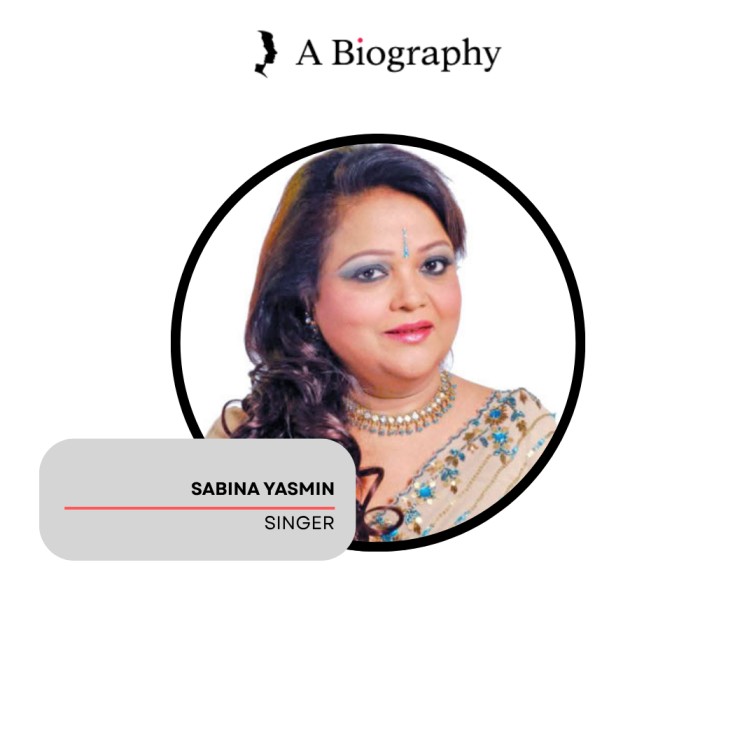
A Biography of Sabina Yasmin

Introduction
The year was 1967. A young woman lent her voice to the song ‘Madhu Joshna Deepali’ for the film ‘Agun Niye Khela’. She was just thirteen years old. It was her debut as a playback singer. Who knew that this thirteen-year-old girl would one day become the biggest name in the history of Bangladeshi music? Whose voice would make generations of people weep? Whose songs would inspire freedom fighters on the battlefield?
Sabina Yasmin. A name that needs no adjective. ‘Enchantress of Voice’, ‘Empress of Playback’, ‘National Treasure’ – everything falls short before her talent. For over fifty years, she has been such a bright star in the sky of Bangladeshi music that its brilliance has never dimmed.
But the questions remain – how did this youngest of seven siblings become the ‘Queen of Melody’ one day? What is the secret behind the voice that even Lata Mangeshkar was mesmerized by? And the unspoken, harrowing story of her battle against a devastating cancer in 2007 – that story remains unsolved to this day?
Let the thriller begin.
At a Glance: Life of Sabina Yasmin
| Information | Details |
| Full Name | Sabina Yasmin |
| Birth | September 4, 1954 (Disputed: 1953) |
| Birthplace | Dhaka, Bangladesh |
| Father’s Name | Lutfar Rahman (Served in the Provincial Civil Service under the British Raj) |
| Mother’s Name | Begum Mauluda Khatun (Disciple of Ustad Kader Bakhsh) |
| Sisters | Farida Yasmin, Fauzia Yasmin, Nazma Yasmin, Nilufar Yasmin (all singers) |
| Age | 69-71 years (depending on source) |
| Education | Bachelor’s and Master’s (Sociology), University of Dhaka |
| Profession | Vocalist, Playback Singer |
| Active Years | 1967 – present |
| Mediums | Film, Television, Radio, Gramophone |
| Total Songs | 1500+ film songs, 10,000+ total songs |
| Marriages | Three times (Anisur Rahman, Amir Hossain, Kabir Suman) |
| Children | Fairooz Yasmin Bandhan (daughter), Shabn (son) |
| Cancer | 2007 – Diagnosed with Non-Hodgkin Lymphoma (blood cancer) |
| Current Status | Active, living in Dhaka |
| Title | ‘Awazon Ki Devi’ (Goddess of Voice) – given by Raj Kapoor |
Behind every fact in this table lies a hidden chapter. Especially the mystery around the date – 1953 or 1954? And the biggest mystery of all: 14 National Film Awards! This record in Bangladesh’s history remains unbroken. But why didn’t she receive more international recognition? Why was she ‘only’ confined to Bangladesh?
The thriller will get even deeper.
Early Life
September 4, 1954 (or 1953). The city of Dhaka. The last shadows of the British Raj had not yet faded. Lutfar Rahman was then serving in the Provincial Civil Service under the British Raj. His wife, Begum Mauluda Khatun – a trained vocalist who had learned music from the legendary musician Ustad Kader Bakhsh. That world of music was created even before Sabina Yasmin was born.
The home environment was filled with music. Her sisters – Farida, Fauzia, Nazma, Nilufar – were all singers. Sabina was the youngest. When little Sabina touched the harmonium at home, her first learned song was ‘Khokhon Moni Shona’. Sitting in the courtyard, singing this song was her first step into the world of music.
She first sang on stage at just seven years old. At that event, the audience was so captivated listening to the children’s songs that they started chanting ‘One more song!’. From that day, her pull towards music became firm.
In 1964. She was ten years old. She started singing on Bangladesh Betar’s children’s program ‘Khela Ghar’. Through this program, she first spread the magic of her voice to a large audience. Her classical music teacher, P.C. Gomes, gave her rigorous training. And Altaf Mahmood – when he visited a neighbor’s house, he heard little Sabina sing and was mesmerized by her voice. Through that, she got the opportunity to work under Altaf Mahmood. Through films like ‘Noyon Tara’, ‘Anwara’, and ‘Taka Ana Pai’, she began to gain recognition.
Thriller Element: Her sisters were already established singers. Sabina was the youngest. Often, the success of older siblings becomes a ‘pressure’ for the younger ones. Did that put pressure on her? Or did it motivate her even more?
‘Introduce yourself only by singing’ – like this timeless song of a later era, she never introduced herself with words, but through her songs.
Education
Sabina Yasmin was not only talented in music but also excelled in her studies.
She started her school life at a local school in Dhaka. After passing her intermediate, she enrolled at the University of Dhaka. She earned her Bachelor’s and Master’s degrees in Sociology. Despite being so busy in the music world, she managed to earn her degrees – this proves she was a master of time management. She excelled in both music and academics.
Thriller Twist: In the 1970s, achieving success as a woman in the Bangladeshi film industry was difficult, and earning a university degree was equally challenging. How did Sabina Yasmin manage this dual challenge? There might be an even bigger story hidden behind the scenes.
Struggle and Adversity
In the early 1970s, when Sabina Yasmin entered the film industry, she was not the ‘Number One’ singer. The leading female vocalist at that time was Shahnam Rahimullah. A much bigger name, a much bigger competitor. To carve out her own place in this competitive market, she had to struggle – and that’s exactly what she did.
Shahnam Rahimullah was ‘Number One’. But Sabina did not give up. By singing regularly and constantly expanding her vocal range, she eventually won the hearts of the audience. And that victory began with the song ‘Eki Sonar Aloy’ from the 1970 film ‘Jibon Theke Neya’. This song established her as a ‘leading singer’.
After that, she also sang in all the major films in Pakistan. Her voice graced the screens of Lollywood as well as Bangladeshi cinema. In 1978, she won two National Film Awards simultaneously for the films ‘Golapi Ekhon Traine’ and ‘Sundori’. It was an irresistible rise.
Thriller Element: How did one voice conquer the hearts of people in both Pakistan and Bangladesh? Was there some special ‘magic’ in Sabina Yasmin’s voice that set her apart from all others?
Love
Sabina Yasmin’s personal love story is also dramatic. She has married three times.
Her first marriage was to Anisur Rahman. Her daughter, Fairooz Yasmin Bandhan, was born from this union. This couple later divorced. Bandhan herself is now a renowned singer.
Her second marriage was to Amir Hossain. Her son, Shabn, was born from this union. However, after some time, this marriage also ended in divorce.
In 1998, she met Kabir Suman, whom she married. Kabir Suman is an Indian Bengali singer and political activist (a former MP of the All India Trinamool Congress). He is also widely known in Bangladesh as ‘Kabir Suman’. The couple married and live together. Sources say they met and married in 1998 – although some sources later mention 2000.
Thriller Twist: Three marriages, three chapters. What are the untold stories behind these marriages? Why did the first two marriages break down? And is Kabir Suman the last name on Sabina’s ‘ex’ list? What happened to the story of ‘I was broken, and he picked me up’?
Personal Life
Sabina Yasmin’s personal life is a mixture of sweetness and sorrow, much like her songs.
She is the mother of two children. Fairooz Yasmin Bandhan is her daughter from her first husband. Bandhan is now a major singer in her own right. The mother-daughter duo released a joint album ‘Protichchobi’, which was widely praised. Her son, Shabn, is from Amir Hossain.
Sabina currently lives with her third husband, Kabir Suman. As a musician couple, their love is equally discussed. Sabina always preferred to keep her personal life away from the media, but recently she has revealed a bit through her independent statements.
Thriller Tragedy: June 2007. Sabina Yasmin’s life suddenly began to grapple with death. After being admitted to LabAid Hospital, doctors informed her of a spleen infection. On June 21st, she underwent emergency surgery. But her condition did not improve. Finally, on July 11th, she was taken to Singapore for further treatment. There, her disease was diagnosed – Non-Hodgkin Lymphoma, a type of blood cancer.
She received treatment at the National Cancer Centre of Singapore General Hospital. She underwent chemotherapy, stayed in the ICU, passed the time reading books and listening to music. After completing five rounds of chemotherapy, she slowly began to recover.
After 3.5 months – in late October 2007 – she returned home. In response to journalists’ questions at the airport, Sabina said: “Thank you all for praying for me. I hope to recover well and sing again.”
Thriller Climax: Sabina has rarely spoken about the hair-raising details of her battle with cancer. On which nights did she cry? At what moment did she think, ‘I won’t survive’? Those stories remain untold.
Future Plans and Goals
She has crossed the age of 70. But Sabina Yasmin has not stopped.
In 2021, she received a Lifetime Achievement Award. In a recent interview in 2024 on her birthday, she said, ‘I still have many songs left. I want to work with the new generation of composers.’
She also said: “Although physically I am not like before, my voice still wants to create melodies. Perhaps that is what keeps me alive.”
Thriller Element: Has Sabina Yasmin’s final album still not been released? Although she is not seen regularly on stage, could there be another ‘Protichchobi’ hidden in the studio?
Career
9.1 The 1960s: The First Touch of Melody
In 1967, she made her playback debut with the song ‘Madhu Joshna Deepali’ for the film ‘Agun Niye Khela’, directed by Zahir Raihan. She was only thirteen. Sung to Altaf Mahmood’s composition, this song introduced her to the recording studio for the first time. After that, she sang for films like ‘Noyon Tara’, ‘Anwara’, and ‘Taka Ana Pai’.
A special memory from that time: little Sabina and Shahnam Rahimullah together received an award from President Ayub Khan. Ayub Khan praised their singing, saying, ‘I heard a very high-quality song.’
9.2 The 1970s: Debut as a Leading Singer
The song ‘Eki Sonar Aloy’ from the 1970 film ‘Jibon Theke Neya’ was the turning point in Sabina Yasmin’s career. This song established her voice as something extraordinary.
In 1972, the song ‘Shudhu Gaan Giye Porichoy’ from the film ‘Abujh Mon’ gained immense popularity among the educated middle class. This song played in almost every Bengali home. It marked the beginning of an era.
The song ‘Emon to Prem Hoi’ from the 1974 film ‘Sajon Boron’ – still tops the list of romantic songs today.
In 1975, she won her first National Film Award for the film ‘Sajon Sokhi’. But she didn’t stop there. In 1978, she won two awards for the films ‘Golapi Ekhon Traine’ and ‘Sundori’. In 1979, another for the film ‘Kosai’. Four consecutive years of awards! This record in Bengali film history remains unbroken today.
9.3 Sabina on the Battlefield of Liberation: Bullets of Song
The great Liberation War of 1971. Sabina Yasmin was very young then. Although she did not directly participate in concerts, did she record songs for the Swadhin Bangla Betar Kendra? Although not much is said in sources, she sang several patriotic songs during the war, such as ‘Shob Kota Janala Khule Dao Na’, ‘Shwojon Harano Diner Shorone’, ‘Swadhinata Tumi’, ‘Shei Rail Liner Dhare’. These songs inspired the brave freedom fighters.
It is proven that many fighters advanced shouting ‘Joy Bangla’ after hearing Sabina Yasmin’s songs broadcast on the radio during the Liberation War.
9.4 The 1980s: Duets and Success in Indian Cinema
The 1980s were even more diverse for Sabina Yasmin. She sang duets with all the major singers: Andrew Kishore, Syed Abdul Hadi, Khalid Hasan Milu, Baby Nazneen, Kumar Sanu, Anupam Dutta.
And the biggest milestone: In 1985, she got the opportunity to sing for the joint production film ‘Anyay Abichar’. She sang the songs ‘Jolpori’ and ‘Cherona Cherona Ghat’ composed by the legendary R.D. Burman, alongside the legendary Kishore Kumar.
During the recording, Sabina was overwhelmed seeing Kishore Kumar in the studio for the first time. Kishore Kumar encouraged her, saying, “Your voice is truly wonderful.” An immortal memory.
9.5 The 1990s-2000s: Songs for the New Generation
In the late 1990s, when singers like Kanak Chapa and Runa Laila were extremely popular, Sabina Yasmin still held her own at the top. Songs like ‘Preme Porechhe Mon’, ‘Dui Nayoner Alo’, ‘Borshar Prothom Dine’ were also well-received by the new generation.
In 2000, she won a National Film Award for singing Rabindra Sangeet ‘Borshar Prothom Dine’ for the film ‘Dui Duari’, proving her extraordinary skill in Tagore songs.
In 2004, the song ‘Preme Porechhe Mon’ from the film ‘Rong Number’ topped the charts. In 2005, another National Award for the film ‘Dui Nayoner Alo’. In 2012, for ‘Devdas’. In 2018, for the film ‘Putro’. Her 14th National Award.
9.6 Recent Years (2020s)
In 2021, she received a Lifetime Achievement Award. In 2022-2023, she participated in several television shows. In a 2024 birthday interview with The Daily Star, she recalled meeting Lata Mangeshkar and receiving the title ‘Awazon Ki Devi’ from Raj Kapoor.
She said, “I would consider that day one of the greatest achievements of my life.”
Travel and Diverse Experiences
The 1978 trip to Mumbai was the most memorable. It was for the Bangladesh Film Festival. Stars like Abdur Razzak, Bobita, Rozy Afsari, and Kazi Zahir also participated. There, she met Lata Mangeshkar and S.D. Burman.
Raj Kapoor bestowed upon her the title ‘Goddess of Voice’ (Awazon Ki Devi). He said, “There is magic in your songs.”
Sabina Yasmin has also performed in concerts and events in various countries, including Pakistan, India, and the United Kingdom. However, it is not known that she traveled abroad very extensively.
Failures and Lessons
Perhaps Sabina Yasmin’s biggest ‘failure’ is that some of her songs remain unpublished. She has said that ‘I have sung many songs that are not played on the air now. I would like to cover them again.’
Another regret: She could have achieved more if she had worked more in West Bengal or Bollywood, not just Bangladesh. But she managed her family, children, and household responsibilities during her time, perhaps leaving behind some big opportunities.
Thriller Hint: But is this truly a ‘failure’? Leaving the stage to manage a family – is that actually a failure, or another name for success?
Sources of Inspiration: Mother, Lata Mangeshkar, Runa Laila
Sabina Yasmin’s biggest inspiration was her mother, who, though not a major artist herself, loved music and taught all the girls in the family to sing.
Her second inspiration was Lata Mangeshkar. Listening to Lata’s songs, she nurtured a dream: just as Lata is the ‘Voice of India’, she wanted to become the ‘Voice of Bangladesh’.
Runa Laila is also a contemporary and friend of Sabina Yasmin. The two are polar stars of Bangladesh, respecting each other’s talent.
Influence and Inspiration
Countless singers of the next generation have been influenced by Sabina. From Kanak Chapa and Baby Nazneen of the 90s to modern singers like Dilshad Nahar Kona – all consider Sabina Yasmin an ideal.
She is a role model for women’s empowerment. She has shown that women can handle both family and career with equal skill.
Philosophical Views and Beliefs
Sabina Yasmin follows Islam. But she never let religion be a barrier to music. She believes music is nourishment for the soul, a creation of Allah that keeps the human mind well.
She often says: “Singing is my worship. When I sing, I feel I am getting closer to the listener’s soul.” This philosophy encourages her to continue singing even after fifty years.
Her simple lifestyle and unpretentious clothing are also part of her philosophy.
Unique Character Trait
The biggest aspect of Sabina Yasmin’s personality is her humility. Even when praised by Lata Mangeshkar, she didn’t become extravagant, saying, ‘I was blushing’. She never publicized or displayed her achievements. She has praised others but hesitated to speak of herself.
She is confident in her voice, but never boastful. Once, it took her 15 minutes to record a song in the studio. The composer, Ali Hossain, said, “This is 15 minutes of immortality.” But Sabina simply said, “All credit goes to the composer.”
She is extremely patient. She would often ask for many ‘takes’ during recording, but never lost her temper.
Contributions, Awards, and Achievements
16.1 National Film Awards: 14 (Record)
· 1975: ‘Sajon Sokhi’
· 1978: ‘Golapi Ekhon Traine’
· 1979: ‘Sundori’
· 1980: ‘Kosai’
· 1984: ‘Chandranath’
· 1985: ‘Premik’
· 1987: ‘Rajlokkhi Srikanto’
· 1988: ‘Dui Jibon’
· 1991: ‘Danga’
· 1992: ‘Radha Krishna’
· 2000: ‘Aaj Gaaye Holud’
· 2005: ‘Dui Nayoner Alo’
· 2012: ‘Devdas’
· 2018: ‘Putro’
16.2 Other National Awards
· Ekushey Padak – 1984
· Independence Day Award – 1996
· Feroza Begum Gold Medal – 2016
· Meril Prothom Alo Lifetime Achievement Award – 2021
· Bengal Film Journalists’ Association Award (India)
16.3 International Recognition
· The title ‘Awazon Ki Devi’ given by Raj Kapoor in 1978.
· Direct praise from Lata Mangeshkar.
· Songs in Hindi cinema.
· Representation at the Bangladesh Film Festival.
Controversy
There is hardly any controversy in Sabina Yasmin’s long career. She has always been completely professional, restrained, and principled. The singer ‘Sabina Yasmin’ has never gone near any controversy.
Only one minor ‘controversy’ arose in 2021, when some netizens claimed that Sabina Yasmin made a disrespectful comment while receiving a Lifetime Achievement Award. The incident was proven false. Sabina herself came forward and said: “I did not disrespect anyone; false information is being spread.” That was all.
Thriller Climax: Even this minor controversy did not portray her as an oppressed woman, but rather as a determined and majestic voice. She never accepted false accusations, instead directly refuting them.
Opinions and Interviews from Contemporaries
Lata Mangeshkar said: “Her voice has a melody that very few possess.”
Sachin Dev Burman said: “I was moved to tears listening to ‘Naiyare Nayer Badam Tuilya’ with a heart full of emotion.”
Raj Kapoor said: “You are the Goddess of Voice.”
Runa Laila said: “Sabina is my contemporary and one of the best companions. Her voice has an immortal power.”
Myths and Misconceptions
Myth 1: Sabina Yasmin ‘sang regularly in Hindi cinema’.
Truth: She sang only a few songs in Hindi cinema, not regularly. Her primary language of singing is Bengali.
Myth 2: Sabina’s first stage appearance had no impact on her career.
Truth: Receiving such a response from the audience as a child gave her immense encouragement.
Myth 3: She never sang duets.
Truth: She has sung duets with numerous singers, including Andrew Kishore, Syed Abdul Hadi, Kishore Kumar, and Kumar Sanu.
Myth 4: She is only a playback singer.
Truth: She has sung on stage shows, TV, radio, and gramophone records.
Quotes and Thoughts
1. “Introducing myself just by singing – that is the vow of my life.”
2. “Singing in front of Lata Didi, I was blushing, but her praise is a great achievement of my life.”
3. “Raj Kapoor called me the ‘Goddess of Voice’. The respect I received that day will stay with me forever.”
4. “My voice is a divine gift; I try to offer this gift to the audience.”
5. “Advice for new singers: You will have technology, but do not lose the classical essence of music.”
Message for the New Generation
Sabina Yasmin has said to young singers: “You live in the age of technology. You can create music very easily. But ensure that it reaches the soul of the listener. To sing, you need to understand sorrow, pain, and love.”
“May the new generation not forget their own culture. May they sing with respect for the Bengali language.”
She wants new singers to build themselves up, but not lose their humility.
Death and Legacy: Sabina Yasmin is Still Alive
There is no news of her death. As of March 2026, Sabina Yasmin is active. She recently recorded songs for an Ekushey event and participated in cultural programs.
She currently lives in Dhaka with her husband and children.
Nevertheless, her music, her voice, and her contributions are ‘immortal’. She may not sing regularly now, but her songs remain immortal in the memories of thousands of people.
Thriller Conclusion? Sabina Yasmin’s story is not over. She still touches generations with her voice. With 14 National Film Awards, she is Bangladesh’s record holder. With the title of Goddess of Voice, she will live forever.
Successors and Long-lasting Impact
Sabina Yasmin’s legacy is also carried by her daughter, Bandhan. The mother-daughter duo released the album ‘Protichchobi’, which was critically acclaimed.
Furthermore, new generation singers like Dilshad Nahar Kona, Tahsan, and Habib Wahid have all mentioned her as an ‘ideal’ and ‘icon’. She has become a golden pillar of Bengali music, one that will not break or even budge.
Unknown Facts
1. Sabina’s father, Lutfar Rahman, served in the Provincial Civil Service under the British Raj.
2. Her mother, Begum Mauluda Khanam, was a disciple of Ustad Kader Bakhsh.
3. She learned the song ‘Khokhon Moni Shona’ as a child by playing it on the harmonium.
4. Her first stage performance was at just 6 years old.
5. Her first playback was at 14 years old (1967).
6. In 1978, she sang in front of Lata Mangeshkar at the Mumbai Film Festival.
7. Raj Kapoor gave her the title ‘Awazon Ki Devi’.
8. She has said that Lata Mangeshkar gave her a kolka (red dot) as a gift.
9. She studied Sociology on her mother’s advice.
10. She is one of the few singers to have returned after fighting cancer.
Major Events
| Year | Event |
| 1954 | Born September 4 in Dhaka |
| 1961 (approx.) | First stage performance |
| 1964 | Regular singing on the radio show ‘Khela Ghar’ |
| 1967 | First playback song ‘Madhu Joshna Deepali’ |
| 1970 | Song ‘Eki Sonar Aloy’ – major success |
| 1972 | Song ‘Shudhu Gaan Giye Porichoy’ becomes widely popular |
| 1975 | First National Film Award |
| 1978 | National Awards for ‘Golapi Ekhon Traine’ & ‘Sundori’ |
| 1978 | Mumbai Film Festival, meets Lata Mangeshkar & S.D. Burman |
| 1984 | Receives Ekushey Padak |
| 1985 | Duet with Kishore Kumar for ‘Anyay Abichar’ |
| 1996 | Receives Independence Day Award |
| 2007 | June – Diagnosed with cancer; treatment in Singapore |
| 2007 | October – Returns home |
| 2021 | Receives Meril Prothom Alo Lifetime Achievement Award |
Conclusion
Sabina Yasmin is not just a vocalist; she is an eternal institution of Bengal. Whose voice has awakened thousands of loves, inspired patriotism during the tumultuous days of the Liberation War, and cried and laughed as a film heroine. The magic in her voice, even after sixty years, has not diminished.
She has shown that rising high in a career as a woman, managing a household, even returning after defeating cancer – is always possible if there is self-confidence and discipline in the voice.
14 National Film Awards, the Ekushey Padak, the Independence Day Award, and praise from Lata Mangeshkar – greater than all these achievements is the fact that she still resides in the hearts of the people of Bangladesh.
Thriller Conclusion? No. Sabina Yasmin’s story is not over. Her musical pilgrimage has not stopped. Even after fifty years, she is recording new songs. She is working with the younger generation. Perhaps the title ‘Eternal One’ was created for her. She is Sabina Yasmin.
“Introducing myself just by singing” – truly, the song itself seems to be her real identity. All other stories fade.
The thriller does not end. Every time ‘Shob Kota Janala’, ‘Eki Sonar Aloy’, ‘Preme Porechhe Mon’ plays, Sabina Yasmin’s immortal voice will play. It will play forever.
We bow to our Goddess of Voice.

