
Biography
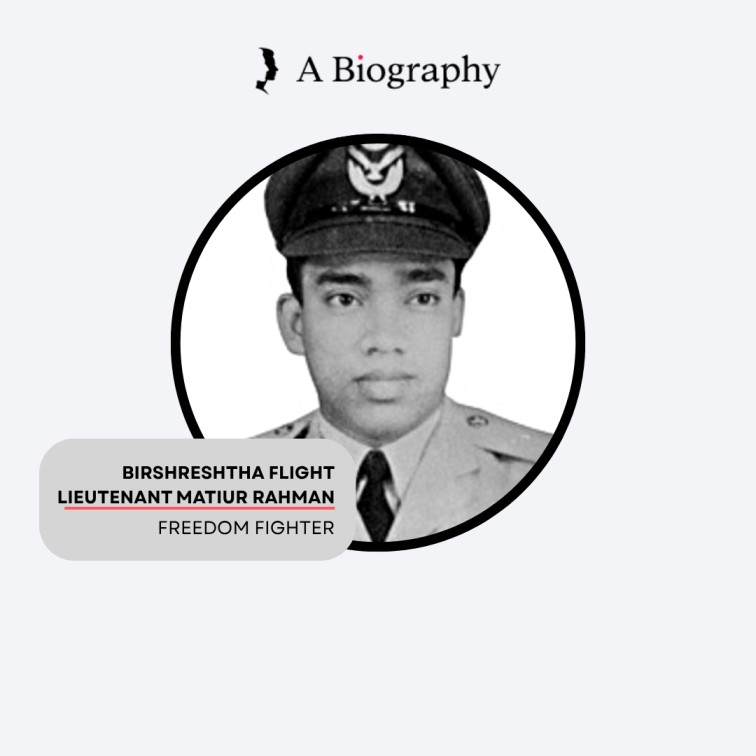
A Biography of Birshreshtha Flight Lieutenant Matiur Rahman

Introduction
Karachi, Pakistan. Masroor Air Base. Friday, August 20, 1971. 12:05 PM.
It was Jummah prayers. The base was quiet. Most officers were home with their families. Flight Lieutenant Matiur Rahman, a Bengali pilot serving as an instructor in the Pakistani Air Force, saw his opportunity.
He approached a young Pakistani pilot, Pilot Officer Rashid Minhas, who was preparing to fly a T-33 Jet Trainer (serial number 63-8792) for a routine solo flight.
“I will fly with you today,” Matiur said calmly.
Rashid agreed. He had no reason to suspect anything. Matiur was his senior, a respected instructor. They climbed into the cockpit—Rashid in the front seat, Matiur in the back, the instructor’s position.
The aircraft took off at 12:05 PM. For a few minutes, everything was normal. Then, without warning, Matiur disabled the radio. He grabbed the controls and turned the aircraft toward India.
Rashid realized what was happening. He fought for control. The two men wrestled inside the cramped cockpit, 30,000 feet above the earth.
“Three-One-Two-With… Three-One-Two-With…” Rashid managed to transmit to the control tower. Then silence.
Matiur spoke his final words: “I want to fight against Pakistan. For the independence of my country, Bangladesh. If you try to stop me, we will both die. But I will go.”
The aircraft approached the Indian border. Desperate, Rashid opened the cockpit canopy—perhaps to push Matiur out, perhaps because the controls were jammed. The sudden wind tore Matiur from his seat. He had not fastened his seatbelt.
His body fell 200 yards from the crash site. Rashid Minhas died in the wreckage. The T-33 exploded in a fireball over the Thatta desert.
Pakistan called Matiur Rahman a traitor. Bangladesh called him Birshreshtha—the greatest of the great.
This biography is the story of that man. From the narrow lanes of Old Dhaka to the skies of Karachi. From a childhood dream to a death that shook two nations. From being called “Gaddar” (traitor) in one country to being honored as “Birshreshtha” in another.
At a Glance: Life of Birshreshtha Flight Lieutenant Matiur Rahman
| Category | Details |
| Full Name | Matiur Rahman |
| Born | October 29, 1941 – Mubarak Lodge, 109 Aga Sadek Road, Old Dhaka, Bengal Presidency (now Bangladesh) |
| Died | August 20, 1971 – Thatta district, Sindh province, Pakistan (age 29 years, 9 months, 22 days) |
| Father | Maulana Abdus Samad (renowned Quran translator and Islamic scholar) |
| Mother | Syeda Mobarakunnesa Khatun (homemaker) |
| Spouse | Mili Rahman (married 1960s) |
| Children | Two daughters: Lubna Rahman and Sharmin Rahman |
| Education | Dhaka Collegiate School; Pakistan Air Force Public School, Sargodha; PAF Academy, Risalpur |
| Profession | Military pilot; Flight Lieutenant in Pakistan Air Force; flight instructor |
| Commissioned | June 22, 1963 – Pilot Officer, PAF |
| Final Rank | Flight Lieutenant (equivalent to Squadron Leader in later Bangladesh Air Force) |
| Notable Achievement | Hijacked a PAF T-33 jet trainer on August 20, 1971, attempting to join Bangladesh’s Liberation War; died in the attempt |
| Highest Honor | Birshreshtha (posthumous, 1973) – Bangladesh’s highest military award (first recipient) |
| Other Honors | Independence Day Award (1997, posthumous); commemorative stamp and coin; BAF Base Matiur Rahman named after him |
| Pakistan’s Verdict | “Traitor” – his photo was displayed at the Masroor Base gate with the label “Gaddar” (removed in 2006) |
| Final Resting Place | Mirpur Shaheed Buddhijibi Cemetery, Dhaka (reburied June 24, 2006 after 35 years) |
Early Life (1941-1955)
October 29, 1941. Mubarak Lodge, 109 Aga Sadek Road, Old Dhaka.
World War II was raging across the globe. In the narrow, bustling lanes of Old Dhaka, a son was born to Maulana Abdus Samad and Syeda Mobarakunnesa Khatun. They named him Matiur Rahman.
His father was no ordinary man. Maulana Abdus Samad was one of the first translators of the Holy Quran into Bengali—a scholar, a theologian, a man of deep faith and principle. His mother was a homemaker who raised six sons and two daughters with love and discipline. Matiur was the sixth child.
Childhood in Old Dhaka was simple but vibrant. The lanes were narrow, the houses close together, the air filled with the smell of spices and the sound of rickshaw bells. Matiur was a restless, energetic boy. He loved climbing trees, flying kites from the rooftop, and listening to his father’s stories of Islamic history and Bengali pride.
One story is told in the family. Young Matiur was flying a kite from the roof of Mubarak Lodge when a Pakistani military aircraft flew overhead. He pointed at the sky and said, “One day, I will fly that plane. And I will do something for my people.”
No one took him seriously. He was just a child.
But that child would grow up to make history.
Education (1955-1963)
Matiur attended Dhaka Collegiate School, one of the oldest and most prestigious schools in the city. He was a bright student, but not extraordinary in academics. What set him apart was his determination and his obsession with flying.
In 1955, he passed his matriculation examination. Then he made a decision that would change his life: he applied to the Pakistan Air Force.
He was selected and sent to the PAF Public School in Sargodha for preliminary training. Then came the PAF Academy in Risalpur—the toughest military training institution in Pakistan. Here, he was one of only a handful of Bengali cadets.
The training was brutal. Physical exercises, drill, navigation, meteorology, flight theory. Matiur threw himself into it with relentless energy. While other cadets rested, he studied. While others complained, he practiced.
His instructors noticed. One of them, Flight Lieutenant (later Air Commodore) Sadiq Malik, once asked him, “Why do you work so hard?”
Matiur replied, “Sir, I don’t just want to be a pilot. I want to be an excellent pilot. So that in any crisis, my confidence never fails me.”
On June 22, 1963, Matiur Rahman was commissioned as a Pilot Officer. His course was the 36th GD (Pilot) course. The dream had become real.
Struggles & Adversities (1963-1971)
The Pakistan Air Force in the 1960s was dominated by Punjabis and Pathans. Bengali pilots were a tiny minority. They faced prejudice, mockery, and subtle discrimination.
Matiur experienced this firsthand. Colleagues called him “Dhakaiya” (a man from Dhaka) with a sneer. He was told that Bengalis were not natural pilots—that they were better suited to desk jobs.
Matiur said nothing. He let his performance speak.
He scored 75.66% in his jet training. He was selected for fighter conversion training on the F-86 Sabre—one of the most advanced jets of its time. He scored 81%—an exceptional result. His instructor wrote in his record: “Matiur Rahman is a natural fighter pilot. He was born for the sky.”
In 1965, he participated in the India-Pakistan war on Pakistan’s side. He flew multiple sorties. He performed his duty. But the war changed something inside him.
He saw how West Pakistan treated East Pakistan. He saw how Bengali soldiers were sacrificed while Punjabi officers took credit. He saw the contempt in their eyes.
After the war, he wrote a letter to his elder sister: “I thought we were all Pakistanis. But the war showed me how little they value us Bengalis. Our language, our culture—they mock everything. Is this right?”
Marriage (1960s): Mili Rahman
In the mid-1960s, Matiur married Mili Rahman. She was educated, modern-minded, and supportive of his career. They had two daughters: Lubna (born 1967) and Sharmin (born 1970).
Family life was happy. Matiur was a devoted father. He would spend hours playing with Lubna, reading her stories, dreaming of her future. He wanted his daughters to be educated, independent, and proud of their heritage.
But the political situation in East Pakistan was deteriorating. In 1970, the Awami League won a landslide victory. The Pakistani military refused to transfer power. On March 25, 1971, they launched Operation Searchlight—a genocide against Bengalis.
Matiur was on leave in Raipur, Kishoreganj, when he heard the news. He told Mili: “I can no longer be a Pakistani pilot. I have to do something for my country.”
Mili cried. But she did not stop him.
That was the last time she saw him alive.
Personal Life (1963-1971)
Those who knew Matiur personally describe him as calm, disciplined, and deeply principled. He was not a loud person. He did not seek attention. He simply did what he believed was right.
He was devout in his faith. He prayed five times a day, fasted during Ramadan, and respected all religions. His father had been a scholar, and Matiur inherited his spiritual depth.
He was also a man of contradictions. He had trained to fight for Pakistan. He had worn its uniform, flown its aircraft, and risked his life in its wars. Yet, when the moment came, he turned against everything he had sworn to defend.
Some call it betrayal. Others call it the highest form of patriotism.
His close friend, Group Captain Zulfiqar Ali (later of the Bangladesh Air Force), recalled: “Matiur never showed his cards. He smiled, he joked, he flew his missions. But inside, a fire was burning. And on August 20, 1971, that fire consumed him.”
Future Plans & Vision
Matiur’s dream was simple but profound: a free, independent, democratic Bangladesh. A country where Bengalis would not be second-class citizens. A country where his daughters could grow up with dignity.
He wanted to join the Liberation War. He believed that as a trained fighter pilot, he could make a difference. His plan was to hijack a PAF aircraft, fly it to India, and then travel to Bangladesh to join the Mukti Bahini.
He never made it.
But his dream outlived him. Bangladesh was liberated on December 16, 1971. His sacrifice became part of that victory.
Career (1963-1971)
1963: Commissioned as Pilot Officer after training at Risalpur.
1963-1965: Posted to various squadrons; trained on F-86 Sabre jets.
1965: Participated in the India-Pakistan war; flew combat missions.
1967: Promoted to Flight Lieutenant.
1967: Completed MiG conversion course in Sargodha with excellent grades.
1968-1970: Posted as flight instructor at Masroor Base, Karachi.
1971 (March-August): Secretly trained freedom fighters in Raipur; planned the hijacking.
August 20, 1971: Hijacked T-33 jet trainer; died in the attempt.
Travels & Diverse Experiences
As a PAF pilot, Matiur traveled extensively. He saw the deserts of Sindh, the mountains of the North-West Frontier, the coastal beauty of Karachi, and the crowded cities of Punjab.
He also visited India during the 1965 war—not as a tourist, but as a combat pilot. He saw the enemy up close. He saw the destruction war brings.
These travels shaped him. He realized that war was not glorious—it was brutal. He also realized that Pakistan was not a nation but a geographical accident. The people of West Pakistan had nothing in common with the people of East Pakistan except religion. And religion was not enough to hold a country together.
Failures & Teachable Moments
Matiur’s final mission failed. The aircraft crashed. He died. By any objective measure, the hijacking was a failure.
But failure, in this case, became a greater victory than success. His death became a symbol. His sacrifice inspired a nation.
The lesson: sometimes, the attempt itself is the triumph. Sometimes, the courage to try—even when you know you will fail—is the greatest gift you can give.
Source of Inspiration
Matiur’s primary inspiration was his father, Maulana Abdus Samad. The Maulana was a scholar who believed that knowledge should be accessible to all. He translated the Quran into Bengali so that ordinary people could understand it.
This commitment to justice and equality passed to his son. Matiur could not accept that Bengalis were treated as second-class citizens. He could not accept that his people were being slaughtered while the world watched.
His father died in 1968. But his voice lived on in Matiur’s heart.
Influences & Inspirations
In the months before his death, Matiur was deeply influenced by Bangabandhu Sheikh Mujibur Rahman. He listened to the March 7 speech secretly, on a smuggled recording. He showed it to a Pakistani colleague, who dismissed it as “madness.”
Matiur said nothing. But his teeth were clenched.
He also drew inspiration from the Bengali freedom fighters he trained in Raipur. These young men, armed with little more than courage, were ready to die for their country. Matiur felt he could do no less.
Duty Above All
Matiur believed that duty to one’s people and country transcends duty to any uniform or oath. He had sworn allegiance to Pakistan. But when Pakistan began murdering his people, he considered that oath broken.
His philosophy can be summed up in one sentence: “A soldier’s first duty is to protect the innocent. If your uniform makes you complicit in killing, discard the uniform.”
This is a radical philosophy. It is also the philosophy of every freedom fighter who has ever lived.
What Made Matiur Different
Calculated courage: He was not reckless. He planned for months. He studied the T-33’s systems, the control tower’s routines, the security gaps. His courage was not blind—it was strategic.
Emotional control: He smiled and joked even in the days before the hijacking. He showed no fear, no hesitation, no doubt.
Physical strength: The struggle in the cockpit required immense physical power. Matiur was a fit, strong man.
Selflessness: He could have stayed in Pakistan, continued his career, and lived comfortably. He chose to die for an idea.
Humility: He never claimed to be a hero. He simply did what he believed he had to do.
Contributions, Awards & Achievements
Military Honors (Bangladesh)
- Birshreshtha (1973) – Bangladesh’s highest military award (first recipient)
- Independence Day Award (1997) – Bangladesh’s highest civilian award (posthumous)
Commemorations
- BAF Base Matiur Rahman – Bangladesh Air Force’s largest base, renamed in his honor
- Birshreshtha Matiur Rahman Road – a major thoroughfare in Old Dhaka
- Commemorative stamp (2001) – Bangladesh Postal Service
- Commemorative coin (2001) – Bangladesh Bank
- Honorary Doctor of Law – University of Dhaka (posthumous, 2012)
Institutions Named After Him
- Matiur Rahman Bridge (Kishoreganj)
- Matiur Rahman Primary School (Kishoreganj)
- Matiur Rahman Hall (at various educational institutions)
Controversies
Pakistan’s Perspective:
Pakistan considers Matiur Rahman a traitor. The PAF displayed his photograph at the main gate of Masroor Base with the word “Gaddar” (traitor) written on it—a warning to other pilots. This sign remained for 35 years, until 2006.
Pakistani textbooks describe him as: “A Bengali pilot who, under Indian influence, attempted to hijack a PAF aircraft. He was stopped by the martyrdom of Pilot Officer Rashid Minhas.”
Bangladesh’s Perspective:
Bangladesh considers Matiur Rahman the greatest hero of the Liberation War. He is the first among the seven Birshreshthas. His portrait hangs in the Bangladesh Air Force headquarters. His name is taught in every school.
The Neutral View:
Both countries have valid perspectives. Rashid Minhas was doing his duty, defending his nation. Matiur Rahman was doing his duty, trying to create his nation. Two young men, two nations, two versions of heroism—colliding in the sky.
Contemporary Opinions
Mili Rahman (wife):
“I never stopped him. I knew he would do something big. I just didn’t know it would be his last.”
Lubna Rahman (daughter, age 4 when her father died):
“I grew up without a father. But I grew up with his story. Every Bangladeshi child knows his name. That is my father’s legacy.”
Group Captain Zulfiqar Ali (friend):
“Matiur was the best pilot I knew. He was also the most patriotic. When he made up his mind, nothing could stop him.”
Pakistani Air Force Official (anonymous, 2004):
“Call him a traitor if you want. But you cannot question his courage. He knew he would die. He did it anyway.”
Myths & Misconceptions
Myth 1: “Matiur was an Indian agent.”
Fact: No evidence supports this. He was motivated purely by the desire for Bangladesh’s freedom.
Myth 2: “He survived the crash and lived in India.”
Fact: His body was recovered by Pakistani authorities and buried in Thatta. DNA testing confirmed his identity in 2006.
Myth 3: “He was forced to attempt the hijacking.”
Fact: All evidence suggests it was his own decision, planned over months.
Myth 4: “He killed Rashid Minhas deliberately.”
Fact: The crash was accidental, caused by the struggle for control. Matiur did not intend to kill anyone except perhaps himself.
Myth 5: “Pakistan still has his body.”
Fact: His remains were repatriated in 2006 and reburied in Dhaka.
Famous Quotes & Thoughts
To his wife before leaving for Karachi (May 1971):
“I may not return. But raise our daughters well. Tell them their father fought for their country.”
To Rashid Minhas in the cockpit (August 20, 1971):
“I want to fight against Pakistan. For the independence of my country, Bangladesh. If you try to stop me, we will both die. But I will go.”
From his diary (found after his death):
“I go. Perhaps I will not return. But this path will not close. You too will come forward. We must build a golden Bangladesh. For that Bangladesh, this sacrifice.”
Message for the Present Generation
Matiur Rahman’s life offers powerful lessons:
“Country before self.” He had a comfortable career, a loving family, a secure future. He gave it all up for an idea.
“Courage is not the absence of fear—it is action despite fear.” He was surely afraid. He still acted.
“One person can make a difference.” He did not lead an army. He did not command a battalion. He simply did what he could, with what he had, where he was.
“Failure is not final.” His mission failed. But his sacrifice succeeded beyond measure.
“Never forget where you came from.” He was the son of Old Dhaka, the son of a Quran translator, the son of Bengal. He never forgot that.
Death & Legacy (1971-Present)
August 20, 1971. Thatta, Pakistan.
The aircraft crashed. Matiur’s body was thrown 200 yards from the wreckage. His left hand was broken, his skull fractured, his body battered. The Pakistani authorities buried him in a fourth-class employees’ cemetery—an intentional insult to a man they considered a traitor.
For 35 years, he lay there. Unmarked. Unmourned. Forgotten by Pakistan.
But not forgotten by Bangladesh.
In 2006, after delicate diplomatic negotiations, Pakistan agreed to return his remains. On June 24, 2006, a special aircraft carried his coffin to Dhaka.
The entire nation wept.
At the airport, he received a guard of honor. The Prime Minister, the army chief, the air force chief—all were present. His daughters, Lubna and Sharmin, now grown women, touched the coffin and broke down.
“After 35 years,” Sharmin said, “my father has come home.”
He was reburied at the Mirpur Shaheed Buddhijibi Cemetery with full military honors. Twenty-one gun salutes. Missing-man formation by BAF jets. Thousands of mourners.
A nation that had been waiting for 35 years finally said goodbye.
Successors & Lasting Impact
Every pilot in the Bangladesh Air Force knows Matiur Rahman’s story. They are told: “He was one of us. He sacrificed everything. Be worthy of his legacy.”
BAF Base Matiur Rahman in Dhaka is the hub of Bangladesh’s air defense. Every aircraft that takes off from that base carries his name. Every mission flown is dedicated to his memory.
Beyond the military, his story has inspired films, documentaries, books, and songs. Children perform plays about his life. Poets write verses in his honor.
His daughters, Lubna and Sharmin, have become custodians of his legacy. They speak at events, give interviews, and ensure that their father’s name is never forgotten.
Unknown Fact
- He never told his wife about the hijacking plan. She learned about it from the news.
- He was afraid of heights as a child—yet he became a pilot.
- His father translated the Quran into Bengali while Matiur was a child.
- He scored the highest marks in his fighter conversion course—81%—beating many Punjabi and Pathan colleagues.
- He had only 15 minutes of fuel left when the aircraft crashed. He was just minutes from the Indian border.
- The T-33 he hijacked was nicknamed “Shooting Star.” It became his shooting star to immortality.
- His body was identified by a scar on his leg when it was repatriated in 2006.
- His daughter Lubna named her own daughter after him—Matiur’s bloodline continues.
- A Pakistani film about Rashid Minhas portrays Matiur as a villain. A Bangladeshi film portrays him as a hero. Both are popular in their respective countries.
- The gate sign calling him “Gaddar” was removed from Masroor Base in 2006—just before his remains were repatriated.
Timeline: Key Events in the Life of Matiur Rahman
| Year | Event |
| 1941 | October 29 – Born at Mubarak Lodge, Old Dhaka |
| 1955 | Passed matriculation from Dhaka Collegiate School |
| 1955-1961 | Attended PAF Public School, Sargodha |
| 1961 | Admitted to PAF Academy, Risalpur |
| 1963 | June 22 – Commissioned as Pilot Officer |
| 1965 | Participated in India-Pakistan war as PAF pilot |
| 1967 | Promoted to Flight Lieutenant |
| 1967 | Completed MiG conversion course |
| 1968 | Father Maulana Abdus Samad died |
| 1967 | Daughter Lubna born |
| 1970 | Daughter Sharmin born |
| 1971 | March 25 – Pakistani military launches Operation Searchlight |
| 1971 | April – Trained freedom fighters in Raipur secretly |
| 1971 | May 9 – Left Dhaka for Karachi with family |
| 1971 | August 20 – Hijacked T-33 jet trainer; crashed; died (age 29) |
| 1971 | August – Buried in Thatta, Pakistan (fourth-class cemetery) |
| 1973 | Awarded Birshreshtha (Bangladesh’s highest military honor) |
| 1997 | Awarded Independence Day Award (posthumous) |
| 2006 | June 24 – Remains repatriated to Bangladesh |
| 2006 | June 24 – Reburied at Mirpur Shaheed Buddhijibi Cemetery |
| 2010 | BAF Base Kurmitola renamed BAF Base Matiur Rahman |
| 2012 | Honorary Doctor of Law from University of Dhaka (posthumous) |
Conclusion
Matiur Rahman died at 29. He left behind a wife, two young daughters, and a country that did not yet exist.
He failed in his immediate mission. He did not reach India. He did not join the Liberation War. He died in a desert, 2,000 miles from home, branded a traitor by the country he had served for a decade.
And yet—he succeeded.
He succeeded because every child in Bangladesh learns his name. He succeeded because the largest air base in the country bears his name. He succeeded because his daughters grew up proud, not ashamed.
He succeeded because he proved that one man, with enough courage, can defy an empire.
Matiur Rahman, the “traitor” of Pakistan, is the “Birshreshtha” of Bangladesh. The same act, seen from two sides, produces two truths.
But one truth is universal: he was brave. Braver than most. Braver than those who judge him from the safety of their armchairs.
He climbed into that cockpit knowing he would likely die. He wrestled with a younger, stronger man, fighting for control of a hurtling metal tube. He fell 30,000 feet to the desert floor.
And in that fall, he rose.
He rose into the pantheon of national heroes. He rose into the hearts of 170 million Bangladeshis. He rose into the sky he loved so much—and never came down.
References
- Wikipedia (Bengali & English) – Birshreshtha Matiur Rahman
- “Bangladesher Birshreshtha” – Moinul Ahsan Saber (Anupam Prakashani, 2009)
- Pakistan Air Force investigation report (Cecil Chowdhury, 1971)
- Yawar A. Mazhar, Pakistan Military Consortium (2004) – blog post
- The Daily Star – “Matiur Rahman’s body repatriated” (June 25, 2006)
- BBC Bangla – “35 years later, Birshreshtha Matiur returns home” (June 24, 2006)
- Prothom Alo – “Birshreshtha Matiur Rahman: An Immortal Saga” (August 20, 2020)
- Film “Astitto Amar Desh” – director Khijir Hayat Khan interview
- Bangladesh Air Force – Annual Report (2021)
- Sultan Mahmud’s memoir – “Matiur Rahman: As I Saw Him” (blog, 2011)
- Mili Rahman interview (Channel i, 2008)
Disclaimer
This biography is based on reliable and authentic sources, including Wikipedia, military reports, newspaper archives, and published interviews. Some narrative elements—including dialogue, emotional descriptions, and internal thoughts—have been added for dramatic and readability purposes. These additions do not distort factual accuracy.
There are discrepancies in some sources regarding the exact sequence of events in the cockpit, the cause of the canopy opening, and the precise moment of Matiur’s death. This biography follows the most widely accepted accounts based on official Pakistan Air Force investigation reports and Bangladeshi government records.
Controversial aspects of Matiur Rahman’s life—including his classification as a “traitor” in Pakistan and as a “hero” in Bangladesh—have been presented neutrally, with acknowledgment of both perspectives.
This biography is not an authorized account. It is a tribute to a man whose sacrifice helped create Bangladesh, written with respect for the truth and for the feelings of those who see him differently.
The sky remembers. Bangladesh remembers. Birshreshtha Matiur Rahman is immortal.

