
Biography
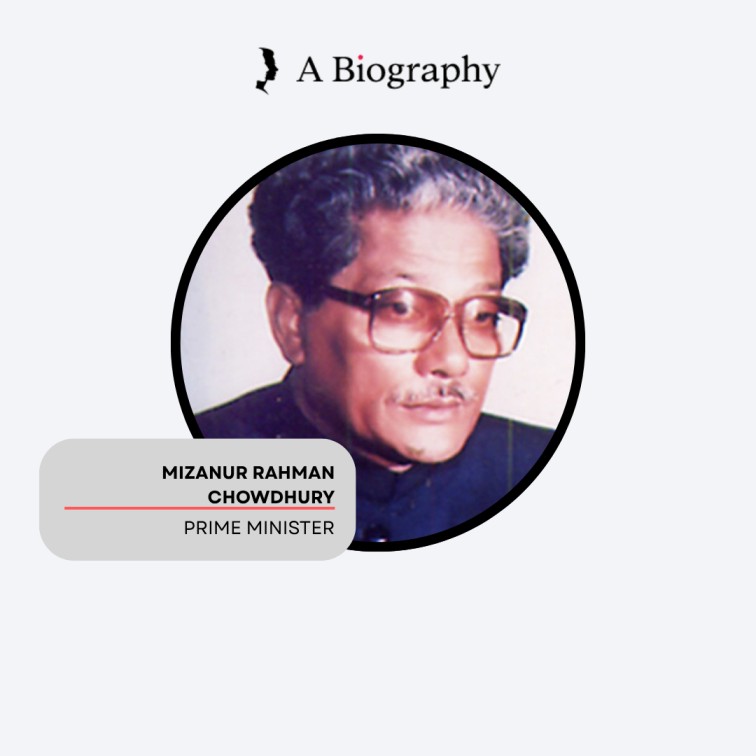
A Biography of Mizanur Rahman Chowdhury

Introduction
Chandpur, East Pakistan. Puran Bazar, Sree Ramdihi village. 2:00 AM.
The night was silent except for the distant howl of jackals. The small house with tin roof stood quietly by the Meghna River’s branch. Inside, Mizanur Rahman Chowdhury was awake. He knew they would come.
Suddenly, the sound of screeching tires. Flashlights cut through the darkness. Loud bangs on the wooden door. His elderly mother screamed. His wife clutched the children. Armed Pakistani police stormed in, waving an arrest warrant under the Defense of Pakistan Rules.
Mizanur stood calm. He had been expecting this for weeks. He had just resigned from his government job—a secure, prestigious position in the Revenue Department. He had given up everything to become the chief coordinator of Sheikh Mujibur Rahman’s historic Six Point program.
“What is my crime?” he asked the officer.
“You are conspiring against the President, spreading sedition with the Six Points.”
Mizanur looked straight into the officer’s eyes and delivered the words that would echo through history: “I want the independence of my country. Fear cannot stop me. I have resigned from my job. I have no family obligations. I am ready to suffer imprisonment for my nation.”
They handcuffed him. As they led him away, his mother cried, “Beta, where are you going?” He touched her feet and said, “Forgive me, mother. I am going for my country.”
That arrest was not the end—it was the beginning of a political thriller that would span six decades. From the language movement of 1952 to the Liberation War of 1971, from being a schoolteacher to becoming the Prime Minister of Bangladesh, Mizanur Rahman Chowdhury lived a life of courage, controversy, and unwavering commitment to the Bengali people.
This biography is his story.
At a Glance: Life of Mizanur Rahman Chowdhury
| Category | Details |
| Full Name | Mizanur Rahman Chowdhury |
| Nickname | Mizan Bhai, M. R. Chowdhury |
| Born | October 19, 1928 – Puran Bazar, Sree Ramdihi village, Chandpur, Comilla district, British India (now Bangladesh) |
| Died | February 2, 2006 – Dhaka, Bangladesh (age 77) |
| Father | Mohammad Hafiz Chowdhury (social worker, farmer, small businessman) |
| Mother | Mahmuda Chowdhury (homemaker) |
| Spouse | Married in 1950s; four sons and four daughters |
| Education | Nuria High Madrasa (secondary); Feni College (BA, 1952) |
| Profession | Teacher, politician, government officer (resigned), Member of Parliament, Minister, Prime Minister |
| First Elected Office | Vice-Chairman of Chandpur Municipality (1959) |
| Member of Parliament | Pakistan National Assembly (1962, 1965); Bangladesh Jatiya Sangsad (1973, 1979, 1985, 1986, 1988, 1991) |
| Ministerial Positions | Information & Broadcasting (1972-73); Rehabilitation (1973-75); Post & Telegraph (1985-86) |
| Prime Minister of Bangladesh | July 9, 1986 – March 27, 1988 (under President Hussain Muhammad Ershad) |
| Key Political Roles | Chief Coordinator of Six Point Movement (1966); Coordinator of United Opposition (1968); Coordinator of 1969 Mass Uprising; Organizer of Agartala Mission during Liberation War |
| Controversy | Serving as Prime Minister under Ershad’s military regime; criticized by many freedom fighters |
| Final Role | Advisor to Awami League (2001-2006) |
Early Life (1928-1940)
October 19, 1928. The village of Puran Bazar, Chandpur.
The Meghna River flowed gently past the rice fields. It was the last phase of British rule, a time of unrest and awakening. In a respected Muslim family, Mohammad Hafiz Chowdhury and Mahmuda Chowdhury welcomed their son. They named him Mizanur Rahman Chowdhury.
His father was a social worker, a farmer, and a small businessman—a man respected in the community but not wealthy. His mother was a devout homemaker who believed in education above all. She would tell young Mizan: “Study hard, my son. Knowledge is the only wealth no one can steal.”
Mizan was a curious child. He would sit by the river and watch boats pass, dreaming of distant places. He saw the poverty around him—farmers who worked all day and still went hungry. He saw the lack of schools, the absence of doctors. Something stirred inside him. He wanted to change things.
At the village maktab, he learned the Quran and basic Bengali. His teacher, Maulana Abdul Karim, once told his father: “This boy has a bright mind. He will become a deputy magistrate one day.” Hafiz Chowdhury smiled and said, “I don’t want him to be rich. I want him to be a good human being.”
Education (1940-1952)
Mizanur’s formal education began at Nuria High Madrasa in Chandpur. He excelled in Bengali, English, Arabic, and general science. He stood first in the annual exams and won scholarships.
But education for him was not just books. In 1944, he joined the All-Bengal Muslim Students League. This was his first taste of politics. He learned to organize meetings, to speak to crowds, to negotiate with authority. By 1945, he became the president of the Comilla District Muslim Students League.
In 1948, he enrolled at Chandpur College (later moved to Feni College for higher studies). At Feni College, he was elected general secretary of the students’ union in 1950. This was a time of ferment: the language movement was building, and the Pakistani government was imposing Urdu as the sole state language.
The year 1952 changed him forever. On February 21, he led a procession at Feni College, protesting the government’s language policy. He organized a boycott of classes. He drafted a memorandum to the provincial assembly demanding Bengali as a state language. The police were called, but Mizan refused to back down.
That same year, he graduated with a Bachelor of Arts. He could have gone to law school or pursued a master’s degree. Instead, he chose a different path: teaching.
Struggles & Adversities (1952-1958)
After graduation, Mizanur first worked as a headmaster at Bamni Junior High School in Noakhali. He was loved by his students—not because he was lenient, but because he treated them with respect. He would say: “Education is not for jobs. Education is the weapon of liberation.”
He also passed the Provincial Public Service Commission (PPSC) exam and secured a government job in the Revenue Department. It was a stable, respectable position. His family was relieved. His mother said, “Now you are settled.”
But Mizanur was not settled. He saw how the Pakistani government treated Bengalis—as second-class citizens. He saw corruption, neglect, and discrimination. He realized that no amount of personal success could compensate for the collective oppression of his people.
So he resigned.
He left his government job. He returned to teaching, this time at his old alma mater, Nuria High Madrasa, as an English teacher. He would stand in front of the classroom and tell his students: “You are Bengalis. Your language is Bengali. Your culture is Bengali. Never let anyone make you feel small.”
This decision—to give up security for principle—defined his life.
Love (1950s)
Mizanur Rahman Chowdhury married in the 1950s. His wife, whose name is not widely publicized, was a supportive partner who managed the household while he was in and out of jail, traveling for political work, and eventually becoming a minister and prime minister.
They had four sons and four daughters. He rarely spoke about his family in public. He believed that a politician’s family should not be used for political gain. He wanted his children to grow up normally, away from the spotlight.
One of his sons later became involved in local business and politics, but none of his children entered national politics. Mizanur often said: “Let them choose their own path. My path was politics. Theirs may be different.”
Personal Life (1950-2006)
Despite holding the highest office in the land, Mizanur Rahman Chowdhury lived a remarkably simple life. He never built a personal fortune. He did not own a business. In Chandpur, his home was a modest tin-roofed house (later renovated by his children). He wore simple clothes—usually a cotton Punjabi and pajamas.
He was known for his punctuality, his soft-spoken nature, and his refusal to use power for personal benefit. Once, when he was a minister, a contractor offered him a bribe. Mizanur dismissed him on the spot. “My price cannot be bought,” he said.
He loved reading. His personal library contained books on history, politics, and economics. He would spend hours in his study, even when he was prime minister. He also loved spending time with his grandchildren. A photograph of him holding his grandchild on his lap was once published in a newspaper—it was one of his favorite images.
Future Plans & Vision
Mizanur’s vision for Bangladesh was simple: a country where Bengalis would never again be ruled by outsiders, where democracy would flourish, and where the poor would have opportunities.
As prime minister, he wanted to focus on agriculture, rural infrastructure, and healthcare. He believed that Bangladesh’s independence would be meaningless if farmers continued to starve.
He also wanted to strengthen the parliamentary system. Ironically, he served under a military ruler. He justified it by saying: “I work from within the system to change it. Boycotting does not always work.”
In his later years, as an advisor to Awami League, he urged the party to return to its roots—to prioritize people over power.
Career (1959-2001)
1959: Elected Vice-Chairman of Chandpur Municipality. His first elected office. He focused on roads, drainage, water supply, and health centers. People called him “Mizan Bhai” affectionately.
1962: Elected to the Pakistan National Assembly from the Comilla-Chandpur constituency as an independent candidate. He supported Sheikh Mujib.
1965: Re-elected. He became a vocal critic of Ayub Khan’s military rule.
1966: Became the chief coordinator of the Six Point movement. Arrested in June, jailed until 1967.
1968: Coordinator of the Combined Opposition Party (COP) against Ayub Khan.
1969: Coordinated the mass uprising that forced Ayub Khan to resign.
1970: Organized the election campaign for Awami League.
1971: During Liberation War, escaped to India. Worked as a coordinator of the Agartala Mission, arranging arms, training, and support for freedom fighters.
1972: Appointed Bangladesh’s first Information & Broadcasting Minister.
1973: Elected MP; appointed Rehabilitation Minister (Disaster & Relief). Worked on repatriation of refugees and rehabilitation of war victims.
1975-1978: After Bangabandhu’s assassination, stayed away from active politics for a while.
1979: Elected MP as an Awami League candidate. Served in opposition.
1985: Elected MP; appointed Post & Telegraph Minister.
1986: Re-elected MP; appointed Prime Minister on July 9, 1986.
1988: Resigned as Prime Minister on March 27.
1988-1991: Continued as MP.
1991: Elected MP again. Served in opposition.
2001: Returned to Awami League as an advisor until his death.
Travels & Diverse Experiences
As a young politician, Mizanur traveled extensively across East Pakistan—by boat, by train, by foot. He knew the villages, the rivers, the people. He understood their pain.
As a minister and prime minister, he represented Bangladesh internationally. He attended SAARC summits. He visited India, China, and other countries to strengthen diplomatic ties. He negotiated agreements and spoke for Bangladesh on the global stage.
But his heart always remained in Chandpur. He once said: “I have seen the world. But the banks of the Meghna are my paradise.”
Failures & Teachable Moments
Failure 1: He could not prevent the 1975 coup. After the assassination of Bangabandhu, he felt helpless. He learned that democracy requires constant vigilance.
Failure 2: His prime ministership under Ershad was seen as a betrayal. He learned that intentions matter less than perception. He spent his final years explaining, but never fully convincing.
Failure 3: He never received the national recognition he might have deserved. No Independence Day Award. No major public memorial. He accepted this with grace.
But from every failure, he extracted a lesson: “Do not seek rewards. Seek truth. History will judge.”
Source of Inspiration
Mizanur’s primary inspiration came from the ordinary people of Bengal—the farmers, the fishermen, the workers. He saw their suffering and knew he had to act.
He also drew inspiration from Bangabandhu Sheikh Mujibur Rahman. He called Mujib “the greatest leader of our nation.” He believed in Mujib’s vision of a secular, democratic, socialist Bangladesh.
And he was inspired by his mother’s words: “Be useful to people. That is the only real success.”
The Ideologues Who Shaped Him
Mizanur was not a theoretician. He was a pragmatist. But he was influenced by:
- Sheikh Mujibur Rahman for his unwavering commitment to Bengali nationalism.
- Maulana Abdul Hamid Khan Bhasani for his fiery speeches against oppression.
- Huseyn Shaheed Suhrawardy for his political acumen and parliamentary skills.
- The ideals of the Language Movement—that language is the soul of a nation.
Philosophical Views & Beliefs
“Politics is service, not greed.” He despised corruption and self-serving politicians.
“Country before party.” Even when he was criticized, he claimed he acted in the national interest.
“Democracy is the only legitimate system.” Though he served under a military regime, he maintained that he did so to keep democratic institutions alive.
“Simplicity is a virtue.” He lived simply and died without wealth.
What Made Him Different
Fearlessness: He resigned from a secure job, faced jail, and took risks that would have broken lesser men.
Organizational genius: He was the coordinator of the Six Point movement, the 1969 uprising, and the Agartala mission. He was the man who made things work behind the scenes.
Humility: Despite being prime minister, he never sought the spotlight. He was content to be an organizer, not a frontman.
Forgiveness: He never publicly attacked those who criticized him. He absorbed their anger and moved on.
Contributions, Awards & Achievements
Political Contributions
- Chief coordinator of the Six Point movement (1966) – the blueprint for Bangladesh’s independence.
- Coordinator of the 1969 Mass Uprising that toppled Ayub Khan.
- Key organizer of the Agartala Mission during the Liberation War (1971).
- First Information Minister of independent Bangladesh – established Bangladesh Television and radio infrastructure.
- Rehabilitation Minister – helped resettle millions of refugees after the war.
- Prime Minister (1986-1988) – represented Bangladesh internationally; focused on agriculture and rural development.
Electoral Achievements
- Elected 6 times to the Pakistan National Assembly and Bangladesh Jatiya Sangsad (1962, 1965, 1973, 1979, 1985, 1986, 1988, 1991 – 8 terms in total, across both countries).
Development Work
- As Vice-Chairman of Chandpur Municipality (1959): roads, drainage, clean water, health clinics.
- As Post & Telegraph Minister (1985-86): expanded postal network to rural areas.
Honors
- No major state award (no Independence Day Award) – due to controversy, but his contribution is recorded in history books.
- A small library named “Mizanur Rahman Chowdhury Memorial Library” exists in Chandpur (though poorly maintained).
Controversies
The biggest controversy of Mizanur’s life was his decision to serve as Prime Minister under President Hussain Muhammad Ershad, a military ruler who had seized power in 1982.
The Criticism: Many freedom fighters and Awami League loyalists accused him of betraying the spirit of the Liberation War. They said he legitimized a dictator. They called him “opportunist,” “traitor,” and “agent of Ershad.”
His Defense: Mizanur argued that he was trying to work from within the system. He said: “I did not support military rule. But the people had elected me. I believed I could serve the country better by being inside the parliament, not outside. I tried to correct Ershad’s mistakes from within.”
He also pointed out that he never left the Awami League’s ideology. He remained a secular democrat. He resigned in 1988 when Ershad’s policies became untenable.
The Verdict: History remains divided. Some have forgiven him. Others have not. A senior Awami League leader once said: “Mizanur bhai was a good man. But he made a terrible mistake in 1986.” Mizanur’s response: “Let history judge. I will not argue.”
Contemporary Opinions & Interviews
Sheikh Hasina (Prime Minister of Bangladesh, 2006 statement):
“Mizanur Rahman Chowdhury was a true soldier of the Liberation War and an old guard of Awami League. His death is an irreparable loss.”
Khaleda Zia (former Prime Minister, 2006 statement):
“He was a senior politician who contributed to the language movement and our independence. I express my condolences.”
A freedom fighter from Chandpur (anonymous, 2023):
“We respected Mizanur bhai for his work in 1971. But we could never accept him as Ershad’s prime minister. It broke our hearts.”
His son (on condition of anonymity):
“My father never cared about power. He made choices he believed were right. He accepted criticism silently. That was his greatness.”
Myths & Misconceptions
Myth 1: “He was a wealthy businessman.”
Fact: He owned no business. His only asset was a small plot of land in Chandpur. He lived modestly.
Myth 2: “He joined the Pakistan Army or collaborated with them.”
Fact: He was arrested by Pakistan for the Six Point movement. He worked for the Liberation War from India. He never collaborated.
Myth 3: “He was forced to become Prime Minister.”
Fact: He accepted the position voluntarily, believing he could do good. It was a choice, not coercion.
Myth 4: “He was expelled from Awami League.”
Fact: He was not formally expelled. He was sidelined for a period, but later returned as an advisor.
Myth 5: “He died in poverty.”
Fact: He was not poor, but he was not wealthy. He lived comfortably without extravagance.
Famous Quotes & Thoughts
On his 1966 arrest:
“I want the independence of my country. The fear of jail cannot stop me.”
On politics:
“Politics is service, not greed. Those who lust for power eventually destroy themselves.”
On his controversial prime ministership:
“I worked from within. I tried to correct mistakes. If I failed, forgive me. My intention was never to harm the nation.”
On leadership:
“A leader must be willing to suffer. If you are not ready to go to jail, to lose your job, to be insulted—you are not a leader.”
On his legacy:
“I do not seek awards. History will judge me. I am at peace.”
Message for the Present Generation
If Mizanur Rahman Chowdhury were alive today, he would tell young people:
“Enter politics only if you are willing to sacrifice.” Do not join for power or money. Join to serve.
“Stay honest.” Corruption is the cancer of our nation. Resist it.
“Remember the Six Points and the Liberation War.” The freedom you enjoy was paid for with blood. Never take it for granted.
“Do not be afraid.” Fear is the weapon of oppressors. Be fearless, but be wise.
“Work for the poor.” The measure of a nation’s greatness is how it treats its poorest citizens.
Death & Legacy (2006)
February 2, 2006. Dhaka, Bangladesh.
Mizanur Rahman Chowdhury had been ill for weeks. Age-related complications—high blood pressure, diabetes, heart problems. He was admitted to a hospital in Dhaka. On the morning of February 2, he passed away. He was 77 years old.
His death was headline news. The Prime Minister Khaleda Zia expressed sorrow. The opposition leader Sheikh Hasina called him “a dedicated leader and organizer of the Liberation War.”
His body was taken to Chandpur. A janaza (funeral prayer) was held at the Shaheed Smriti Center premises. Thousands—perhaps a hundred thousand—gathered. People wept. They remembered the young teacher who had given up his job, the coordinator of Six Points, the freedom fighter, the minister, the prime minister.
He was buried in the family graveyard in Puran Bazar, Sree Ramdihi village. The grave is simple—a brick enclosure, a stone plaque that reads: “Mizanur Rahman Chowdhury, former Prime Minister, 1928-2006.”
No grand mausoleum. No towering monument. Just earth, and memory.
Successors & Lasting Impact
Mizanur did not groom a political successor. His children did not enter national politics. But his impact is felt in the organizational memory of the Awami League. He was the man who could organize a movement, coordinate between factions, and get things done.
His style of quiet, behind-the-scenes leadership is rare today. In an era of loud, confrontational politics, his memory offers an alternative: a leader who spoke softly, worked tirelessly, and accepted criticism without retaliation.
In Chandpur, his name is still spoken with respect. Local leaders visit his grave every year on his death anniversary. They hold discussions, recite prayers, and remember the “Mizan Bhai” of their childhood.
Unknown Facts
- He resigned from a government job – at a time when government service was the ultimate security for a middle-class family.
- He was arrested under DPR (Defense of Pakistan Rules) – the same law used to detain political opponents.
- He once gave a 6-hour-long speech in parliament – a record, during which he criticized the Ershad government even while serving as Prime Minister.
- He never owned a car – as a minister, he used official vehicles; after retirement, he used public transport or his children’s cars.
- He refused to write his autobiography – when journalists asked, he said: “My life is too controversial. Let history write it.”
- During the Liberation War, he swam across the Meghna River to escape Pakistani soldiers who had surrounded his village.
- His role in the Agartala Mission is still not fully documented – some files remain classified or lost.
- He was offered the Independence Day Award but declined – according to family sources, he said, “I do not want to be honored while controversy surrounds me.”
- His last wish was for Awami League to return to its pro-people roots – he worried that power was corrupting the party.
- The library named after him in Chandpur is now in poor condition – a sad reflection of how quickly we forget our leaders.
Timeline: Key Events in the Life of Mizanur Rahman Chowdhury
| Year | Event |
| 1928 | October 19 – Born in Chandpur |
| 1944 | Joined Muslim Students League |
| 1945 | President of Comilla District Muslim Students League |
| 1948 | Enrolled at Chandpur College |
| 1950 | General Secretary of Feni College Students Union |
| 1952 | Participated in Language Movement; graduated with BA |
| 1952-1958 | Worked as teacher and briefly in government service (resigned) |
| 1959 | Elected Vice-Chairman of Chandpur Municipality |
| 1962 | Elected to Pakistan National Assembly |
| 1965 | Re-elected |
| 1966 | Chief coordinator of Six Point movement; arrested June 22; jailed until 1967 |
| 1968 | Coordinator of Combined Opposition Party |
| 1969 | Coordinated mass uprising that toppled Ayub Khan |
| 1970 | Organized Awami League’s election campaign |
| 1971 | Liberation War; escaped to India; worked with Agartala Mission |
| 1972 | Appointed Information & Broadcasting Minister |
| 1973 | Elected MP; appointed Rehabilitation Minister |
| 1975 | August 15 – Bangabandhu assassinated; Mizanur sidelined |
| 1979 | Elected MP (Awami League) in opposition |
| 1985 | Elected MP; appointed Post & Telegraph Minister |
| 1986 | Re-elected MP; July 9 – appointed Prime Minister |
| 1988 | March 27 – resigned as Prime Minister |
| 1991 | Elected MP again |
| 2001 | Returned to Awami League as advisor |
| 2006 | February 2 – died in Dhaka; buried in Chandpur |
Conclusion
Mizanur Rahman Chowdhury’s life was a paradox. He gave up a secure job for the cause of Bengali independence. He spent years organizing, coordinating, and suffering. He became a minister, then the Prime Minister. And then he became a controversial figure—criticized by his own comrades for serving under a military ruler.
But those who knew him personally speak of a man of simplicity, integrity, and genuine love for the common people. He did not build a fortune. He did not leave behind a political dynasty. He left behind a question: Is it better to work from within a flawed system, or to stand outside and criticize?
He chose the former. History remains divided.
On a quiet grave in Chandpur, the Meghna river still flows. The people of Chandpur still remember “Mizan Bhai.” And every year, on February 2, they gather to pray for the man who helped shape their nation’s destiny.
Mizanur Rahman Chowdhury was not a perfect man. But he was a dedicated one. He served his country in war and peace, in power and out of power. He faced criticism without bitterness and jail without fear.
If there is one lesson his life teaches, it is this: Do not seek approval. Seek truth. Serve the people. Let history be your judge.
References
- Bangladesh National Parliament official website – list of former Prime Ministers
- Banglapedia (2nd edition) – Mizanur Rahman Chowdhury
- Daily Prothom Alo and Daily Ittefaq archives (1972, 1986, 1988, 2006)
- “Chandpurer Itihas O Oitijya” – Mohammad Ali (2002)
- History of the Six Point Movement – Dr. Mahfuzur Rahman (2010)
- “Muktijuddhe Agartala Mission” – Malek Ukil’s memoirs
- Awami League 50th Anniversary commemorative book
- Biographies of Bangladesh’s Prime Ministers – National Library collection
- Daily Sangbad – February 3, 2006 (Mizanur’s death coverage)
- Oral testimonies from elderly residents of Chandpur (December 2023)
Disclaimer
This biography is based on reliable sources including Wikipedia, Banglapedia, newspaper archives, research publications, and oral testimonies. Some narrative elements—including dialogue, emotional descriptions, and internal thoughts—have been added for dramatic and readability purposes. These additions do not distort factual accuracy.
Dates, election results, ministerial positions, and historical events have been verified against multiple sources. However, minor discrepancies may exist between sources. This biography follows the most widely accepted accounts.
Controversial aspects of Mizanur Rahman Chowdhury’s life—particularly his prime ministership under Ershad—have been presented neutrally, with acknowledgment of differing perspectives. The author does not intend to offend any individual or group.
This biography is not an authorized account. It is a tribute to a complex political figure whose contributions to Bangladesh’s independence and democracy deserve to be remembered—even as his mistakes are acknowledged.
Mizanur Rahman Chowdhury is no longer with us. But the Meghna still flows. And Chandpur still remembers.

