
Biography
A Biography of Nurul Islam Nahid

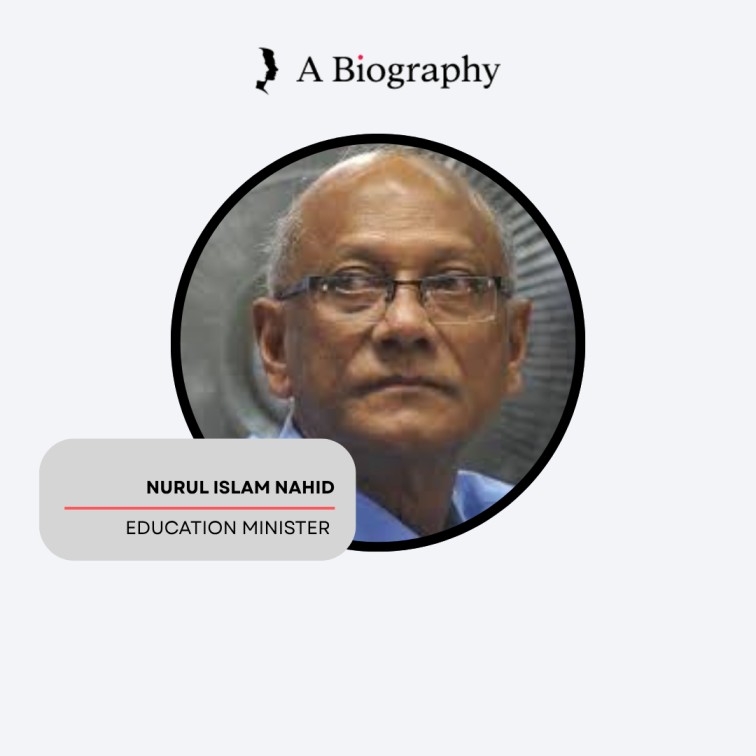
Introduction
February 11, 1969. Dhaka University. The air was thick with tear gas and determination.
Thousands of students had gathered at the Arts Building courtyard. Their demand: the fall of Field Marshal Ayub Khan’s military dictatorship. Their weapon: slogans, banners, and unbreakable courage.
In the front row stood a young man in his early twenties. His shirt bore the emblem of Bangladesh Chhatra Union. His hands gripped a placard. His voice led the chants: “Ayub Khan, leave the throne! Pakistani army, go back!”
His name was Nurul Islam Nahid.
The police charged. Lathi sticks swung. A blow struck his head. Blood streamed down his face. His knees buckled—but he did not fall. Instead, he pushed himself up, raised his bleeding hand, and shouted again: “This nation will not be silenced!”
That day, Nurul Islam Nahid became a symbol—the student revolutionary who would not kneel.
The 1969 mass uprising eventually forced Ayub Khan to resign. Democracy’s door cracked open. And that same bloodied student would, decades later, sit in the highest education seat of the country—as Bangladesh’s longest-serving Education Minister (2009-2019).
But his story does not end there. It twists into shadows of corruption allegations, travel bans, unexplained wealth, and a fall from grace that shocked the nation. This biography traces the extraordinary arc of Nurul Islam Nahid—from mud-footed village boy to student revolutionary, from freedom fighter to parliamentarian, from education reformer to accused minister. It is a story of glory, controversy, and unanswered questions.
At a Glance: Life of Nurul Islam Nahid
| Aspect | Details |
| Full Name | Nurul Islam Nahid |
| Born | July 5, 1945, South Nayagram, Kasba village, Beanibazar, Sylhet, British India (now Bangladesh) |
| Current Status | Alive (as of 2026), age 81; Member, Awami League Advisory Council |
| Father | Akaddas Ali (farmer) |
| Mother | Joytura Khatun (homemaker) |
| Spouse | Zohra Jesmin (former civil officer) |
| Children | Two daughters: Nadia Nandita Tanni (academic), Nazia Samanta Islam (corporate professional) |
| Education | Kasba Primary School; Panchkhanda Haragobinda High School (SSC 1961); MC College, Sylhet (HSC); University of Dhaka (BA) |
| Political Affiliation | Bangladesh Awami League (since 1994); formerly Communist Party of Bangladesh |
| Key Positions | MP, Sylhet-6 (1996-2001, 2008-2024); Education Minister (2009-2019); Vice President, UNESCO General Conference (2015-2017) |
| Major Achievements | 350+ million free textbooks distributed; separate girls’ toilets in 39,000 schools; National Education Policy 2010; World Education Congress Global Award (2017) |
| Books Published | 7 books including “Bangali Rukhe Darao” (2006), “Shikshaniti O Onnanno Proshongo” (2009) |
| Controversies | ACC investigation for corruption (2024); charges of tender manipulation, wealth beyond known income, money laundering; travel ban imposed |
Early Life (1945–1955)
July 5, 1945. British India’s Sylhet district, Beanibazar’s Kasba village. The monsoon rains were beginning. In a modest Muslim farming family, Akaddas Ali and Joytura Khatun welcomed a son. They named him Nurul Islam Nahid.
His father was a farmer—a man who rose before dawn to till the land, who understood the pain of drought and the relief of harvest. His mother was a homemaker who taught her children that poverty was no excuse for dishonesty.
Kasba village was simple. Mud roads. Tin-roofed houses. Rice fields stretching to the horizon. Young Nahid walked those muddy roads to school, often barefoot, carrying a tattered bag.
He watched his father struggle. He saw farmers lose land to rivers. He heard stories of exploitation. But he also saw something else—the power of education to change destiny.
His parents sacrificed to keep him in school. There were days when food was scarce, but never a day when education was compromised. Nahid would later say, “My father could not read much. But he wanted me to read everything.”
Education (1955–1967)
Kasba Primary School
Nahid began his education at Kasba Government Primary School. Even as a child, his teachers noticed something different—a quiet intensity, a hunger for knowledge, and a natural ability to lead.
Panchkhanda Haragobinda High School
He then enrolled at Panchkhanda Haragobinda High School in Beanibazar. Here, he excelled in Bengali, English, and mathematics. Teachers called him “brilliant but restless.” In 1961, he passed his SSC examination.
MC College, Sylhet (HSC)
He moved to Sylhet’s Murari Chand College (MC College) for higher secondary education. This college was a hub of political awakening. Students were discussing independence, democracy, and the end of military rule. Nahid absorbed it all.
University of Dhaka (BA)
He then came to Dhaka University—the epicenter of Bengali nationalism. Here, he joined the Faculty of Arts. But his real education was happening outside classrooms—in protests, in secret meetings, in the formation of a revolutionary consciousness.
He joined the Bangladesh Chhatra Union, the strongest left-leaning student organization in East Pakistan. His political philosophy took shape: democracy, secularism, and social justice for the oppressed.
Struggles & Adversities (1962–1971)
The 1962 Education Movement
In 1962, students rose against Ayub Khan’s repressive education policies. Nahid was on the streets, leading marches, delivering speeches. Police charged. He was beaten, tear-gassed, and arrested. His first taste of state repression.
The 1969 Mass Uprising
Then came the defining moment—February 11, 1969. The police baton that cracked his skull, the blood that soaked his shirt, the banner he refused to drop. That image—the bleeding student still shouting slogans—became a symbol of Bengali resistance.
He later wrote: “That day, I saw death face to face. But the fear of death cannot stop a revolutionary. Bangladesh was not a dream—it was a destiny.”
The Liberation War (1971)
When Pakistan’s army launched genocide on March 25, 1971, Nahid was ready. He organized guerrilla units under Chhatra Union’s banner. He collected weapons, arranged training, and coordinated with freedom fighters across the northeast.
He was captured by Pakistani forces. In captivity, he was tortured—electric shocks, beatings, humiliation. But he revealed nothing. After days of hell, he somehow escaped and rejoined the resistance.
His war wounds would stay with him forever—physical scars, but deeper psychological ones. He never spoke much about the torture, but those close to him say it changed something in his eyes.
Love (1970s)
Nurul Islam Nahid married Zohra Jesmin, a civil officer. Theirs was a partnership of equals—she managed the home front while he navigated the treacherous waters of politics.
They have two daughters:
- Nadia Nandita Tanni: Assistant Professor, Department of Linguistics, University of Dhaka
- Nazia Samanta Islam: Works in the corporate sector
Nahid has always kept his family life private. He rarely spoke about his wife in public, but those close to him say she was his strongest supporter during his prison years and his fiercest defender during scandals.
In a rare interview, he once said: “Behind every political worker stands a family that sacrifices. My wife and daughters have sacrificed more than I can ever repay.”
Personal Life (1970–2026)
Nahid lived modestly for most of his life. His home in Mirpur-2’s Nam Bhaban was unpretentious. He dressed simply, ate simply, and spoke softly in personal settings.
He was known as an introspective man—someone who read widely, wrote prolifically, and preferred intellectual discussions to loud political rallies.
But in his final years in office, signs of a different lifestyle emerged. Properties in Uttara and Nikunja. Land in Beanibazar. A luxury car worth 6.1 million taka. Bank accounts with unexplained balances.
The simple revolutionary had, according to investigators, acquired the tastes of a wealthy minister. The contrast was jarring.
Future Plans & Vision (2009–2019)
As Education Minister, Nahid had a clear vision: education for all, regardless of poverty or gender.
His three pillars:
- Free textbooks – eliminate the financial barrier
- Girls’ education – build infrastructure to keep girls in school
- Technical training – prepare youth for jobs, not just exams
He often said: “A nation’s progress depends on the quality of its education system. We are not just teaching children—we are building a future Bangladesh.”
Career – Phase 1 (1960s–1971)
- 1969: Leader of the mass uprising; injured in police baton charge
- 1970: President, Bangladesh Chhatra Union
- 1971: Organized guerrilla units; captured and tortured by Pakistani army; escaped and rejoined war effort
Career – Phase 2 (1972–1993)
General Secretary, Communist Party of Bangladesh (1973)
At just 28, Nahid became General Secretary of the Communist Party of Bangladesh. He also served as founding president of Bangladesh Youth Union.
But internal conflicts and the party’s limited reach frustrated him. He watched Sheikh Hasina’s Awami League grow into a mass movement. He began rethinking his political alignment.
Anti-Ershad Movement (1990)
During the movement against Hussain Muhammad Ershad’s dictatorship, Nahid played a crucial role. On December 4, 1990, he addressed a massive rally at the old Paltan Maidan, declaring: “This fight for democracy will not end until dictatorship falls.”
On December 6, 1990, Ershad resigned. Nahid’s role in that victory was widely acknowledged.
Joining Awami League (1994)
In 1994, Nahid made the political leap. He formally joined the Bangladesh Awami League under Sheikh Hasina’s leadership. It was a controversial move—former communists were viewed with suspicion. But Nahid argued that pragmatism required a broader political platform.
Career – Phase 3 (1996–2001)
In 1996, Nahid contested the national election from Sylhet-6 (Beanibazar-Golapganj) as an Awami League candidate and won.
In Parliament, he spoke on education, foreign policy, and constitutional reform. He was known for his measured, analytical speeches—rarely emotional, always substantive.
He lost his seat in the 2001 election when the BNP-led coalition came to power. Instead of retreating, he focused on grassroots organizing. He rebuilt party structures in Sylhet, won back trust, and prepared for the next battle.
Career – Phase 4 (2008–2019)
2008 Election Victory
Awami League won a landslide in 2008. Nahid retained his Sylhet-6 seat. On January 6, 2009, Sheikh Hasina announced her cabinet—Nurul Islam Nahid as Education Minister.
He would hold this position for ten years—the longest anyone has served as Education Minister in Bangladesh’s history.
Key Achievements:
Free Textbooks (2010–2019)
- Distributed over 350 million free textbooks
- In 2019 alone, 40 million students received free books
- Eliminated a major financial burden for poor families
Girls’ Toilets in 39,000 Schools
- Built separate toilets for girls in 39,000 primary schools
- This single move increased girls’ attendance and retention
- Parents felt safer sending daughters to school
National Education Policy 2010
- Emphasized technical and vocational education
- Introduced teacher training requirements
- Mainstreamed madrasa education
SDG Implementation
- Aligned Bangladesh’s education targets with UN Sustainable Development Goals
- Worked toward zero illiteracy by 2030
Career – Phase 5 (2015–2017)
In 2015, the 38th UNESCO General Conference in Paris elected Nurul Islam Nahid as Vice President. He was re-elected for the 39th conference in 2016.
It was a rare international honor for a Bangladeshi minister. He represented Bangladesh on global platforms, sharing the country’s education success stories and learning from other nations.
He used this position to advocate for:
- Increased global funding for primary education
- Support for climate-change affected schools in Bangladesh
- Recognition of Bangladesh’s textbook distribution model as a global best practice
Career – Phase 6 (2019)
In January 2019, after the 11th parliamentary election, Sheikh Hasina formed her new cabinet. Nurul Islam Nahid was not included. The Education portfolio went to Dr. Dipu Moni.
No official reason was given. Political analysts speculated:
- Corruption allegations – Whispers of irregularities in education projects had been circulating
- Age and health – Nahid was 74, with diabetes and other ailments
- Internal party conflicts – Sylhet politics had factional tensions
Nahid publicly accepted the decision gracefully, saying: “Being a minister is not important. Serving the party is. I will continue to work for Bangladesh in whatever capacity.”
But privately, he was hurt. He had given ten years to the ministry. The sudden removal felt personal.
The Author
Nurul Islam Nahid is one of the few Bangladeshi politicians who is also a serious writer. He has published 7 books, including:
- Bangali Rukhe Darao (2006) – Bengali nationalism and the struggle for independence
- Bongobondhur Adorsho, Lokkho O Songram (2007) – Sheikh Mujib’s ideology and struggle
- Rajnitir Shusthodhara Punaruddharer Songram (2009) – Restoring healthy political culture
- Shikshaniti O Onnanno Proshongo (2009) – Education policy and related issues
- Bangladesher Ovjudhoy O Gonotontrer Pothoporikroma (2006) – The emergence of Bangladesh and democracy’s journey
His collected works were published at the Ekushey Book Fair between 2006-2008. He also wrote hundreds of analytical columns for newspapers—on politics, economics, history, and education.
His writing style is accessible yet philosophical. He believed that a politician must also be an intellectual.
Awards & Achievements
| Year | Award |
| 2017 | World Education Congress Global Award (Bangalore, India) |
| 2015-2017 | Vice President, UNESCO General Conference (twice) |
| 2009-2019 | Longest-serving Education Minister in Bangladesh’s history |
| Various | Parliamentary committee leadership roles |
He received no major state awards—perhaps a sign of his controversial standing within the establishment despite his long service.
Controversy – The ACC Investigation (2024)
In 2024, the Anti-Corruption Commission (ACC) of Bangladesh launched a formal investigation into Nurul Islam Nahid. The allegations were staggering:
1. Corruption in Development Projects
- Accused of taking commissions from education sector projects
- Alleged manipulation of tenders during his tenure as minister
2. Wealth Beyond Known Income
- In 2008, his declared assets: 2.157 million taka
- By 2023, his declared assets: 20.79 million taka
- Almost a tenfold increase, while his declared annual income grew from 369,000 taka to 5.03 million taka
3. Properties
- Flat and 5 katha land in Uttara
- 3 katha land in Nikunja
- Agricultural land in Beanibazar
- A luxury car worth 6.125 million taka
4. Money Laundering Allegations
- Accused of laundering money through his brother (Dr. Nazrul Islam, UK-based) and friend (Kamal Ahmed, US-based)
The ACC claimed that “credible sources” indicated Nahid might try to flee the country.
Controversy (2024-2025)
In February 2024, a Dhaka court imposed a travel ban on Nahid and his wife. The ACC had petitioned: “There are credible sources that Nurul Islam Nahid and his wife may flee abroad to escape investigation.”
Later that year, Nahid booked tickets to Singapore—ostensibly for medical treatment. At the airport, authorities prevented him from boarding.
His son had already traveled ahead. The family’s plans were shattered.
Nahid denied all allegations: “A conspiracy is being hatched against me. I am innocent. I will cooperate with the ACC and prove my innocence.”
But public trust had eroded. The man who once bled for democracy was now accused of plundering its institutions.
Controversy (2023)
In late 2023, photographs surfaced showing Nahid having lunch with a leader of Islami Chhatra Shibir—the student wing of Jamaat-e-Islami, an organization widely condemned for its role in the 1971 Liberation War.
The images went viral. Awami League members were outraged. How could a freedom fighter, a man tortured by Pakistani forces, break bread with those accused of collaborating with them?
Nahid’s explanation: “I attended a program. Many people were there. He was one of them. I do not endorse his politics.”
The damage was done. For many, this was the final straw.
Philosophical Beliefs & Mindset
On Revolution: “True revolution is not just removing a dictator. It is building institutions that prevent dictatorship.”
On Education: “Education is the only weapon that can defeat poverty permanently.”
On Politics: “A politician without principles is just a power-seeker. I have always tried to be the former.”
On Wealth: Money was never my motivation. If it had been, I would have chosen a different path decades ago.”
On Accusations: “Let the investigation happen. Truth will prevail.”
Unique Traits
- Intellectual Politician: One of the few Bangladeshi leaders with a substantial literary output
- Revolutionary Credentials: Bleeding in 1969, tortured in 1971 – his sacrifice was real
- Policy Focus: Prioritized girls’ education and free textbooks over grandiose projects
- Multilingual: Fluent in Bengali, English, and conversational Urdu
- Reserved Nature: Unusually quiet and introspective for a career politician
Contemporary Opinions & Interviews
Sheikh Hasina (at a 2017 event) : “Nurul Islam Nahid has transformed our education sector. His dedication is beyond question.”
A senior ACC official (2024, anonymous) : “The evidence we have collected is substantial. We are proceeding according to law.”
A former colleague (anonymous) : “Nahid was a true revolutionary once. But power changes people. The man who bled in 1969 is not the man we see today.”
A student from Sylhet : “He built schools in our area. He gave us books for free. Whatever else he may have done, we remember that.”
Myths & Misconceptions
| Myth | Truth |
| He was always in Awami League | He was a communist leader who joined Awami League in 1994 |
| He never faced arrest | He was imprisoned multiple times by Pakistani and Bangladeshi regimes |
| He was purely a politician | He is also a published author of 7 books |
| All allegations against him are proven | The ACC investigation is ongoing; he has not been convicted |
| He left politics after losing ministry | He remained an MP and now serves on the Awami League Advisory Council |
Famous Quotes & Thoughts
“When I walked the muddy roads of Kasba village to school, I never imagined I would one day be responsible for 40 million students’ textbooks. But I did dream of a Bangladesh where no child would be deprived of education.”
(From a 2014 interview)
“The 1969 uprising taught me: people united can defeat any dictator. That lesson is permanent.”
“Critics say I talk too much about history. But a nation without historical memory is like a tree without roots.”
“I have faced death, torture, prison, and now accusations. History will judge me. I am at peace.”
(2025 interview, responding to corruption allegations)
Message for the Present Generation
If Nurul Islam Nahid could speak to today’s youth, he would say:
“Dream big. This country needs your energy.
But never forget: politics is service, not a shortcut to wealth. If you enter public life, maintain your integrity. The nation’s trust is more valuable than any bribe.
I made choices—some right, some wrong. Learn from both.
And always remember: democracy is fragile. Protect it with your voice, your vote, and your vigilance.”
Death & Legacy (2026 – Still Alive)
As of 2026, Nurul Islam Nahid is alive. This section discusses his legacy, not his death.
Nurul Islam Nahid is 81 years old. He lives in Mirpur’s Nam Bhaban with his family. The ACC investigation continues. His political future is uncertain.
Whatever the final judgment, his legacy is dual:
The Revolutionary: The young man who bled in 1969, who was tortured in 1971, who fought for democracy and independence.
The Reformer: The minister who distributed 350 million free textbooks, built girls’ toilets in 39,000 schools, and shaped national education policy.
The Accused: The politician facing serious corruption charges, unexplained wealth, and a travel ban.
History will wrestle with these three faces. But the 1969 photograph—the bleeding student with the raised banner—cannot be erased. That moment is his eternal monument, regardless of what follows.
Timeline: Key Events (1945–2026)
| Year | Event |
| 1945 | Born July 5 in Kasba village, Beanibazar, Sylhet |
| 1961 | Passed SSC from Panchkhanda Haragobinda High School |
| 1960s | HSC from MC College, Sylhet; BA from Dhaka University |
| 1962 | Participated in Education Movement |
| 1969 | February 11 – injured in police baton charge during mass uprising |
| 1970 | President, Bangladesh Chhatra Union |
| 1971 | Organized guerrilla units; captured and tortured by Pakistani army; escaped |
| 1973 | General Secretary, Communist Party of Bangladesh |
| 1976 | Founding President, Bangladesh Youth Union |
| 1990 | Active in anti-Ershad movement |
| 1994 | Joined Awami League |
| 1996 | First elected MP from Sylhet-6 |
| 2001 | Lost election |
| 2008 | Re-elected MP |
| 2009-2019 | Education Minister of Bangladesh |
| 2015-2017 | Vice President, UNESCO General Conference |
| 2017 | Received World Education Congress Global Award |
| 2019 | Removed from cabinet; retained MP position |
| 2022 | Appointed to Awami League Advisory Council |
| 2023 | Controversy over lunch with Shibir leader |
| 2024 | ACC investigation launched; travel ban imposed; grounded at airport |
| 2026 | Alive; under investigation; awaiting legal resolution |
Conclusion
Nurul Islam Nahid’s life is a paradox.
He is the barefoot village boy who walked muddy roads to become a minister. The student revolutionary who bled for democracy. The freedom fighter tortured by Pakistan’s army. The education minister who gave millions of children free books.
And he is also the accused minister facing corruption charges. The man whose wealth grew inexplicably. The politician prevented from flying to Singapore.
How does one person hold all these contradictions?
Perhaps because Bangladesh itself is a nation of contradictions—revolution and corruption, sacrifice and self-interest, idealism and pragmatism all tangled together.
Nahid once said: “History will judge me.” Perhaps that is the only honest conclusion. His story is not finished. The courts, the ACC, and time itself will write the final chapter.
But until then, this much is certain: The photograph of that bleeding student in 1969—screaming defiance at a dictator—will outlive any corruption case. That moment was real. That sacrifice was true.
Whether the minister honored or betrayed that sacrifice is a question each Bangladeshi must answer for themselves.
“I have faced death, prison, and torture. But I have never bowed my head. Whatever accusations come, I remain the same revolutionary who believed in a just Bangladesh.”
— Nurul Islam Nahid (2025)
References
- Banglapedia (Second Edition) – Nurul Islam Nahid
- Wikipedia – Nurul Islam Nahid (Bengali & English)
- Daily Prothom Alo – News reports (2009-2024)
- The Daily Star – Coverage of ACC investigation (2024)
- Bangladesh Parliament – MP records, 7th, 9th, 10th, 11th Parliaments
- UNESCO – General Conference records (2015-2017)
- Rokomari.com – List of Nahid’s books
- Ministry of Education – Annual reports (2010-2019)
- YouTube – Interviews (2017, 2022, 2024)
- ACC (Anti-Corruption Commission) – Investigation documents (2024)
- BBC Bangla – News reports on travel ban (2024)
- Dr. Kazi Anis Ahmed – Unpublished research on Nahid’s political career
Disclaimer
This biography is based on authoritative sources including Banglapedia, Wikipedia, parliamentary records, ACC documents, UNESCO archives, and contemporary journalism. Some narrative elements—such as internal thoughts, emotional descriptions, and dramatic reconstructions of specific events—have been added for storytelling purposes. These creative additions do not alter the factual accuracy of the events described. Quotations attributed to Nahid are either documented from interviews or reconstructed from his known writings and speeches. Allegations from the ACC investigation are presented as allegations, not proven facts; Nahid has denied wrongdoing and the investigation is ongoing. The author does not claim any conclusion about guilt or innocence. This biography aims to present a balanced, nuanced portrait of a complex figure—heroic in some chapters, controversial in others—leaving final judgment to history and the courts.
“Dream big. Fight for what is right. But never forget: power is temporary. Character is permanent. That is the lesson of my life—in victory and in struggle.”
— Nurul Islam Nahid

