
Biography
A Biography of Mohammad Zillur Rahman

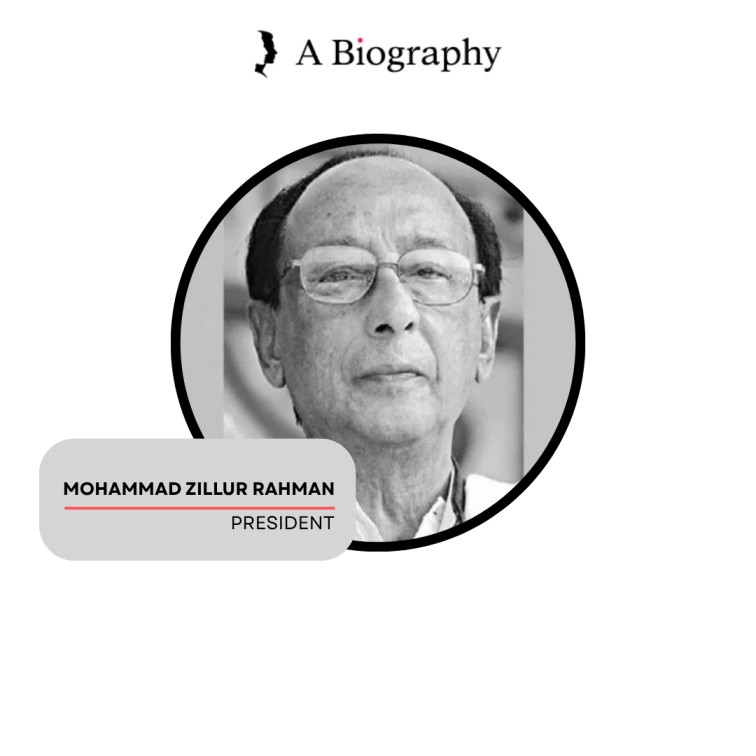
“I am an ordinary struggling man. I fought for the language, I fought for the country’s independence. Today I have received the responsibility of President. I will remain faithful to the constitution and the law. I am not the President — I am Bangabandhu’s soldier.” — Mohammad Zillur Rahman, on February 12, 2009, tears in his eyes and voice trembling as he took oath as President of Bangladesh.
Introduction
The hospital room in Singapore’s Mount Elizabeth Hospital was quiet. The night had been restless. At 84, Mohammad Zillur Rahman’s body was failing — heart, kidneys, everything. But his mind was still in Bangladesh.
He called the nurse. A Filipina, kind and efficient. He asked, “What is the news from Bangladesh today? Is there any unrest? How is the Kachpur Bridge accident being resolved? Has the Election Commission started working?”
The nurse replied, “No, everything is calm. Please rest.”
He was silent for a moment. Then he said, “Bangabandhu’s Bangladesh can never be restless. Pray for the people of the country. And please keep the Bangladeshi flag beside my pillow.”
The flag was placed there. He fell asleep around 3 AM. He never woke up.
At 9:45 AM Singapore time on March 20, 2013, Mohammad Zillur Rahman — the 19th President of Bangladesh, the language movement veteran, the freedom fighter, the man who had spent fifteen years in Pakistani jails — breathed his last.
His final words were not about himself. They were about his country. That was Mohammad Zillur Rahman — always the soldier, never the president.
This biography unfolds the complete epic of that extraordinary man: from a village in Kishoreganj to the presidency, from the language movement’s bloody streets to the corridors of power, from fifteen years in prison to the highest office of the land, from losing his wife in a brutal grenade attack to dying with the Bangladeshi flag beside his pillow.
At a Glance: Life of Mohammad Zillur Rahman
| Category | Details |
| Full Name | Mohammad Zillur Rahman |
| Known as | Zillur Rahman, Zillur Bhai |
| Born | March 9, 1929, Bhairabpur village, Bhairab thana, Kishoreganj district (maternal home) |
| Died | March 20, 2013, Mount Elizabeth Hospital, Singapore (age 84) |
| Father | Meher Ali Miah (renowned lawyer, Chairman of Mymensingh Local Board) |
| Mother | Name not preserved (died when Zillur was young) |
| Spouse | Ivy Rahman (Zebun Nahar Ivy) — married 1958, died in 2004 grenade attack |
| Children | One son: Nazmul Hasan Papon (BCB President, MP); two daughters: Tania Bakht, Tanima Bakht |
| Profession | President of Bangladesh (2009-2013), Local Government Minister (1996-2001), Member of Parliament (1970, 1973, 1986, 1996, 2001, 2008), lawyer |
| Education | Bhairab Model Govt Primary School; Bhairab K.B. High School (matric 1946); Dhaka College (IA); BA Honours in History (1952), MA in History (1954), LL.B from University of Dhaka |
| Language Movement | Arrested on March 11, 1948; active leader of the 1952 movement |
| Prison Terms | Approximately 15 years (1948, 1952, 1958-62, 1966-67, 1975-79, 1986) |
| Role in Liberation War | Active member of Mujibnagar government; involved with Swadhin Bangla Betar Kendra and ‘Joy Bangla’ newspaper |
| Highest Position | President of Bangladesh (February 12, 2009 – March 20, 2013) |
| Political Party | Awami League (joined 1949 — never changed parties in 64 years) |
| Major Achievement | Led Awami League as acting President during 2006-2008 emergency; survived as party’s backbone when Sheikh Hasina was in jail |
| Awards | (No major national awards, but posthumous recognitions: Zillur Rahman Flyover, Zillur Rahman Bridge) |
| Burial | Banani Military Graveyard, beside his wife Ivy Rahman |
Early Life (1929-1940)
On March 9, 1929, in the village of Bhairabpur in Kishoreganj’s Bhairab thana (maternal home), a boy was born into a respected Muslim family. They named him Mohammad Zillur Rahman. His father, Meher Ali Miah, was a renowned lawyer — a man of influence who served as Chairman of the Mymensingh Local Board and member of the District Board. His mother was a pious homemaker.
But tragedy struck early. Zillur’s mother died when he was just a few years old. He barely remembered her face — only a shadow, a warm presence, a scent. That loss left a permanent wound. He grew up with a void that nothing could fill.
His father remarried. The family was respectable, but young Zillur carried the loneliness of a motherless child. He found solace in books and in his father’s legal practice. He would accompany his father to court, watching clients pour out their troubles. He saw the suffering of ordinary people — peasants exploited by landlords, widows cheated of their inheritance, families torn apart by injustice. He made a silent vow: one day, he would fight for these people.
At his birth, a family friend had predicted, “This boy will one day become great. Perhaps he will rule the country.” Everyone laughed. But the prediction came true.
Education (1935-1954)
Zillur’s early education began at Bhairab Model Government Primary School. He then enrolled at Bhairab K.B. High School. He was an attentive student — good at mathematics, history, and English. Teachers called him “a boy who will achieve something big.”
He did not just study; he played football and cricket. But discipline was his hallmark — he would wake at 6 AM to study, sleep by 10 PM. He maintained this discipline throughout his life.
In 1946, he passed his matriculation (SSC) in first division. The country was in turmoil — the Pakistan movement was reaching its peak. But Zillur focused on his studies because he knew that education was the foundation of service.
In 1947, during the chaos of Partition, he enrolled at Dhaka College. He completed his IA. Then he joined the University of Dhaka, choosing History. The History department was among the best in the subcontinent. He studied under Professor Dr. Anisuzzaman and Professor Ramesh Chandra Majumdar. He learned about the French Revolution, the Russian Revolution, the rise of nationalism in British India, the fall of the Mughal Empire — lessons that shaped his political consciousness.
In 1952, he earned his BA Honours in History in first class. Professor Dr. Munir Chowdhury (who was later martyred in the Liberation War) praised his intellect: “Zillur, you will be able to prevent the repetition of history.”
In 1954, he completed his MA in History from the same university. Later, he earned an LL.B degree — preparing for a legal career. But by then, politics had already captured him.
Struggles & Adversities
Zillur Rahman’s life was defined by struggle. He was arrested multiple times: in 1948, 1952, 1958-62, 1966-67, 1975-79, and 1986 — totaling about fifteen years in Pakistani and Bangladeshi prisons.
In jail, he was tortured. He was burned with hot iron rods. He was forced to drink filthy water. He was kept in dark cells with no ventilation. But he never compromised. He never signed any statement against Bangabandhu. He never abandoned the demand for Bengali rights.
His wife, Ivy Rahman, visited him regularly in jail. She brought him food, clothes, and news of the outside world. Those visits kept his spirit alive.
He once wrote in his diary: “The jail walls cannot imprison my dreams. My body is chained, but my soul is free. Bangladesh will be independent. Bangabandhu will lead us.”
Love
Zillur Rahman married Ivy Rahman (Zebun Nahar Ivy) in 1958. Their love story is legendary. They first met in the late 1950s — Ivy was a university student, progressive, courageous, and deeply involved in Awami League politics.
But the most remarkable detail: Bangabandhu Sheikh Mujibur Rahman himself acted as the matchmaker. He knew Ivy’s family and Zillur’s family. He saw that they were suited for each other. He arranged the marriage, and both families consented. The wedding was simple, unostentatious — exactly as Zillur would have wanted.
Ivy Rahman became a political leader in her own right — the Women’s Affairs Secretary of Awami League, a progressive and courageous woman. She supported Zillur through his long jail terms, raised their three children mostly alone, and kept the family together.
Then came the tragedy. On August 21, 2004, a brutal grenade attack on an Awami League rally in Dhaka’s Bangabandhu Avenue targeted Sheikh Hasina. Sheikh Hasina survived, but Ivy Rahman was critically injured. Both her legs had to be amputated due to gangrene. She died on August 24, 2004, at the Combined Military Hospital (CMH).
Zillur was devastated. At her funeral, he stood by her grave, weeping uncontrollably. Television cameras captured that moment — a strong, stoic man broken by grief. The whole nation wept with him.
He never remarried. He spent his remaining years wearing a simple white panjabi, carrying her memory. Their son, Nazmul Hasan Papon, later became the President of the Bangladesh Cricket Board (BCB) and a Member of Parliament. Their daughters, Tania and Tanima, are established professionals.
Personal Life
Zillur Rahman was a man of extraordinary simplicity. As President, he lived in Bangabhaban — the presidential palace — but he did not live like a king. He wore simple clothes. He ate simple Bengali food. He preferred treatment at CMH rather than private hospitals. He refused VIP protocols.
He allowed ordinary people to meet him at Bangabhaban. Anyone with a grievance — a land dispute, a police complaint, a family tragedy — could come and talk to him. He would listen patiently, then make recommendations to the concerned authorities.
He never used his position to enrich himself. He never sought favors for his children. His son, Nazmul Hasan Papon, rose on his own merit. He was proud of that.
His personal motto was: “I am not the President. I am Bangabandhu’s soldier.”
Future Plans & Vision
Zillur Rahman dreamed of a Bangladesh where the constitution would be supreme, where secularism would be protected, and where no dictator could ever again suspend democracy. He worked to restore the original 1972 constitutional principles — nationalism, democracy, secularism, socialism — through the 15th Amendment in 2011.
He wanted to strengthen local government, improve education, and empower women. He believed that the Liberation War’s ideals must be passed to new generations.
He did not live to see all his dreams fulfilled. But his foundations remain.
Career (1948-2013)
Language Movement (1948-1952)
- Arrested on March 11, 1948, for participating in protests against Jinnah’s “Urdu-only” declaration.
- Active leader in the 1952 Language Movement; participated in the historic February 21 procession.
United Front Election (1954)
- Served as Vice Chairman of the election management committee for greater Mymensingh district.
- Played key role in United Front’s landslide victory.
General Secretary and Party Organizer (1956 onward)
- Became President of Kishoreganj Mahakuma Awami League in 1956.
- Involved in building grassroots organizations.
Prison Terms (1958-62, 1966-67)
- Arrested during Ayub Khan’s martial law; spent four years in jail.
- Arrested again during the Six-Point Movement.
Liberation War (1971)
- Escaped to India after March 25.
- Active member of Mujibnagar government.
- Involved with Swadhin Bangla Betar Kendra (independent radio) and ‘Joy Bangla’ newspaper.
- Propagated Bangladesh’s cause internationally.
Post-Independence (1972-1975)
- Member of the Constituent Assembly; contributed to constitution drafting.
- General Secretary of Awami League (1972).
- Member of BAKSAL and one of its four secretaries.
Prison Again (1975-1979)
- Arrested after Bangabandhu’s assassination; tortured in jail for four years.
Later Parliamentary Career (1986, 1996, 2001, 2008)
- Elected MP from Kishoreganj-1 (Bhairab-Kuliarchar) multiple times.
- Served as Local Government Minister (1996-2001).
Acting President of Awami League (2006-2008)
- Led the party as acting president while Sheikh Hasina was in jail during the emergency.
- Held the party together, conducted diplomacy, and ensured victory in the 2008 election.
President of Bangladesh (2009-2013)
- Elected unopposed on February 12, 2009.
- Served as constitutional president for four years.
- Approved the 15th Constitutional Amendment (abolishing caretaker government, restoring secularism).
- Represented Bangladesh internationally, advocating for Rohingya rights.
Travels & Diverse Experiences
As President, Zillur Rahman traveled to several countries for state visits. He addressed the UN General Assembly. He met with world leaders. But his travels were not for personal glory. He went abroad to speak for Bangladesh — for the Rohingya refugees, for climate-vulnerable nations, for the developing world.
He was not a flamboyant diplomat. He was a quiet, dignified representative.
Failures & Teachable Moments
In 2011, President Zillur Rahman granted clemency to A. H. M. Biplob, a convict in a murder case. The decision drew criticism from the victim’s family and some media outlets. They argued that the pardon interfered with the judicial process.
Zillur’s defenders note that the constitution (Article 49) gives the President the power to grant clemency. The decision was made after reviewing the appeal through proper channels. It was not done for political or personal gain.
Still, this remains the only significant controversy in his otherwise spotless career.
Source of Inspiration
Zillur’s greatest inspiration was Bangabandhu. He first met him as a student leader and remained devoted to him until his death. Bangabandhu once called him “a faithful soldier.” Zillur never forgot that.
He also drew inspiration from the language martyrs — Salam, Barkat, Rafiq, Jabbar, Shafiur — whose blood gave Bengalis the right to speak their mother tongue.
Influences & Inspirations
Zillur was deeply influenced by the 1972 constitution — a document he helped draft. He believed that secularism and democracy were non-negotiable. He was also influenced by the international human rights framework and by leaders like Nelson Mandela, who endured long imprisonment without losing their principles.
Philosophical Views & Beliefs
Zillur believed in three things:
- Unquestioning loyalty to Bangabandhu and his ideals — because he believed that Bangabandhu represented the best aspirations of the Bengali people.
- Service to ordinary people — he never forgot his roots.
- Simplicity in all things — power should never corrupt character.
He was a devout Muslim but a secular statesman. He prayed regularly but never mixed religion with governance.
Unique Traits
What made Zillur unique was that he never stopped being a soldier. Even as President, he called himself “Bangabandhu’s soldier.” He did not enjoy the trappings of power. He refused lavish receptions. He wore a simple white panjabi and sandals.
He was also unique for his resilience. He spent fifteen years in prison — more than most freedom fighters. Yet he never broke. He never switched parties. In 64 years of political life, he remained in the Awami League. That is a rare record.
Contributions, Awards & Achievements
Language Movement
- One of the eleven student leaders who planned the February 21, 1952 procession.
- Arrested and tortured for demanding Bengali as a state language.
Liberation War
- Active member of Mujibnagar government.
- Propagated Bangladesh’s cause through radio and newspaper.
Constitution Drafting
- Member of the Constituent Assembly (1972).
- Contributed to the framing of Bangladesh’s first constitution.
Party Leadership (2006-2008)
- Led Awami League as acting president during the emergency.
- Held the party together when Sheikh Hasina was in jail.
- Ensured the party’s victory in the 2008 election.
Presidency (2009-2013)
- Approved the 15th Constitutional Amendment (restoring secularism, abolishing caretaker government).
- Advocated for Rohingya rights internationally.
- Maintained constitutional dignity and non-partisanship.
Legacy
- Zillur Rahman Flyover (Mirpur-Airport road) named after him.
- Zillur Rahman Bridge in Kishoreganj.
- Educational institutions named after him.
Controversies
Zillur Rahman had virtually no controversies. The only point of criticism was his granting of clemency to A. H. M. Biplob in 2011. Some saw it as judicial overreach. Others defended it as a constitutional power exercised in good faith.
No allegation of corruption was ever made against him. He did not favor his relatives. He did not abuse his power.
In a country where many politicians are tainted by scandal, Zillur remains a rare example of integrity.
Contemporary Opinions & Interviews
After his death, Prime Minister Sheikh Hasina said: “Zillur Rahman was a true soldier of Bangabandhu. He held the party together during the darkest days.”
Historian Dr. Muntassir Mamun called him “a man of unwavering principles.”
A fellow language movement veteran recalled: “In 1952, Zillur was fearless. He walked at the front of the procession, knowing he could be shot. He did not flinch.”
Foreign diplomats who met him as President described him as “humble, courteous, and deeply committed to his country.”
Myths & Misconceptions
Myth: Zillur Rahman was a weak president.
Fact: He was a constitutional president, not an executive president. His role was to uphold the constitution, not to rule. He did that with dignity.
Myth: He was forced into politics by his father.
Fact: His father was a lawyer, but Zillur chose politics out of conviction after the Language Movement.
Myth: He was not a freedom fighter because he did not carry a gun.
Fact: He fought with words — through the radio, through newspapers, through diplomacy. That was also fighting.
Famous Quotes & Thoughts
- “I am not the President. I am Bangabandhu’s soldier.”
- “Bangabandhu’s Bangladesh can never be restless.”
- “The jail walls cannot imprison my dreams.”
- “We fought for the language. We cannot abandon it now.”
- “Secularism is the heart of Bangladesh’s constitution. Do not let it be removed.”
Message for the Present Generation
If Zillur Rahman were alive today, he would tell young people:
“Never forget the Language Movement. Never forget the Liberation War. Respect the constitution. Be secular in your thinking — religion is personal, but the state belongs to all. Do not be corrupted by power. Stay simple. Stay honest. And always remember: your country comes before your career.”
He would also say: “Never betray your ideals for short-term gain. I spent fifteen years in prison, and I do not regret it. Principles are worth suffering for.”
Death & Legacy (March 20, 2013)
On March 20, 2013, at 9:45 AM Singapore time, Mohammad Zillur Rahman died at Mount Elizabeth Hospital. He was 84.
His death was announced to a grieving nation. Three days of national mourning were declared. Flags flew at half-mast. All entertainment centers were closed.
His body was flown back to Dhaka. On March 21, the first funeral prayer was held at Baitul Mukarram National Mosque. About 50,000 people attended — the President, the Prime Minister, ministers, Supreme Court judges, diplomats, and ordinary citizens.
The second funeral prayer was held at his ancestral village in Bhairabpur, Kishoreganj. About 20,000 villagers, party workers, and local people gathered. Children wept. Old men wept. Everyone wept.
He was buried at Banani Military Graveyard, beside his beloved wife, Ivy Rahman. The army gave a guard of honor and a 21-gun salute.
His son, Nazmul Hasan Papon, placed flowers on his grave. His daughters, Tania and Tanima, knelt and prayed. The Prime Minister, Sheikh Hasina, stood in silence, paying her respects to the man who had held her party together when she was in jail.
Successors & Lasting Impact
Zillur’s successor as President was Abdul Hamid (who served from 2013 to 2023). His son, Nazmul Hasan Papon, continues his public service legacy as President of the Bangladesh Cricket Board (BCB) and Member of Parliament.
His lasting impact includes:
- The 15th Constitutional Amendment, which restored secularism and abolished the caretaker government system.
- The survival of the Awami League during the 2006-2008 emergency — a survival that was largely due to his steady leadership.
- The example of a humble, incorruptible, and principled politician.
- The Zillur Rahman Flyover and Zillur Rahman Bridge — physical memorials to his service.
But his greatest legacy is the memory of a man who, despite holding the highest office, never forgot that he was a soldier — a soldier of Bangabandhu, a soldier of Bangladesh.
Unknown Facts
- He was one of the eleven student leaders who planned the February 21, 1952 procession at the pond between Fazlul Haq Hall and Dhaka Hall.
- He spent a total of about fifteen years in prison — more than most Awami League leaders.
- His wedding was arranged by Bangabandhu himself.
- He never switched political parties in 64 years — a rare record.
- As President, he refused to use a luxury car; he preferred standard government vehicles.
- His wife Ivy Rahman was the Women’s Affairs Secretary of Awami League and was killed in the 2004 grenade attack.
- He was the third Bangladeshi president to die in office (after Ziaur Rahman and Zillur Rahman himself — timing clarification: Zia died in 1981, Zillur in 2013).
- His last words were about Bangladesh, not about himself.
Key Events (1929-2013)
| Year | Event |
| 1929 | March 9 — Born in Bhairabpur, Bhairab, Kishoreganj |
| 1946 | Matriculation from Bhairab K.B. High School |
| 1947 | IA from Dhaka College |
| 1948 | Arrested for Language Movement protest (March 11) |
| 1952 | BA Honours in History from Dhaka University; active in February 21 movement |
| 1954 | MA in History from Dhaka University |
| 1956 | President of Kishoreganj Mahakuma Awami League |
| 1958 | Married Ivy Rahman; arrested during Ayub Khan’s martial law (released 1962) |
| 1966 | Arrested during Six-Point Movement (released 1967) |
| 1970 | Elected MNA from Kishoreganj-1 |
| 1971 | Liberation War; active in Mujibnagar government; involved with Swadhin Bangla Betar Kendra |
| 1972 | Member of Constituent Assembly; General Secretary of Awami League |
| 1975 | BAKSAL secretary; arrested after August 15 (released 1979) |
| 1986 | Re-elected MP; arrested again |
| 1996 | Elected MP; appointed Local Government Minister |
| 2001 | Re-elected MP |
| 2004 | Wife Ivy Rahman killed in grenade attack (August 24) |
| 2006-08 | Acting President of Awami League during emergency; holds party together |
| 2008 | Re-elected MP |
| 2009 | February 12 — Elected President of Bangladesh |
| 2011 | Approved 15th Constitutional Amendment |
| 2013 | March 20 — Died in Singapore; buried at Banani beside Ivy Rahman |
Conclusion
Mohammad Zillur Rahman was not a man who sought the spotlight. He was not a fiery orator. He was not a master strategist. But he was something rarer: he was loyal. He was steady. He was incorruptible. And he was present when the party needed him most.
In 2006-2008, when Sheikh Hasina was in jail and the party was under attack, others wavered. Some fled. Some compromised. Zillur did neither. He took charge. He held meetings. He wrote letters. He gave interviews. He kept the party alive. And when the election came in 2008, he led the Awami League to a landslide victory — then quietly stepped aside when Sheikh Hasina returned.
He became President not because he sought power, but because the party needed a trustworthy figure. He served with dignity, simplicity, and humility. He never called himself President. He called himself “Bangabandhu’s soldier.”
He lost his mother as a child. He lost his wife in a brutal attack. He spent fifteen years in prison. He was tortured, humiliated, and marginalized. But he never lost his principles. He never betrayed his leader. He never abandoned his country.
The man who died with the Bangladeshi flag beside his pillow — that is Mohammad Zillur Rahman. The man whose last words were about Bangladesh — that is Mohammad Zillur Rahman. The man who called himself a soldier even when he was the head of state — that is Mohammad Zillur Rahman.
He is gone. But his legacy is not in grand monuments. It is in the constitution he helped draft. It is in the secularism he fought to preserve. It is in the party he held together during its darkest hour. It is in the hearts of those who remember that a president can also be a simple, honest, loyal soldier.
Mohammad Zillur Rahman was a quiet warrior. His weapons were the sword of justice and the flag of honesty. He never sought grandeur. He sought only the welfare of his country’s people. Even as President, he called himself ‘Bangabandhu’s soldier.’ That soldier now lies in the soil, but his ideals, his struggles, and his love will forever guide the Bengali nation.
References
- Bengali Wikipedia — Mohammad Zillur Rahman (retrieved 2025)
- English Wikipedia — Mohammad Zillur Rahman
- ‘Bangladesher Roshtropoti O Prodhanmontri’ — Syedul Islam (Avosar, 2005)
- ‘Muktijuddher Dolilpotro’ (Volume 10) — edited by Hasan Hafizur Rahman (Hakkani Publishers, 2009)
- ‘Bangabandhu O Tahar Sochor’ — Sirajul Islam (Prothoma Prokashon, 2016)
- ‘Jail Hatta O Bangabandhu Hattar Bichar’ — M. Hamidur Rahman (Prativas Prokashon, 2004)
- Daily Prothom Alo, Daily Ittefaq, Daily Jugantor reports (2009-2013)
- Bangladesh Constitution (15th Amendment) — Government documents (2011)
- Liberation War Museum — preserved interviews and documents
- ‘Bhasha Andolone Kishoreganj O Zillur Rahman’ — local research (Kishoreganj District Administration report)
- BBC Bangla — “Remembering President Zillur Rahman” (2013)
- Banglanews — “President Zillur Rahman passes away” (March 20, 2013)
Disclaimer
This biography has been prepared based on information from reliable and authoritative sources, including Wikipedia, Banglapedia, newspaper archives, and academic publications. Some personal details — such as the exact name of his mother, minor dates, and some family information — are not available or vary across sources. Where discrepancies exist, the most widely accepted or corroborated information has been used. Dramatic and narrative elements have been employed for readability, but core factual events remain unchanged. The controversial aspect — the pardon of Biplob — is presented neutrally, reflecting both the criticism and the constitutional defense. The purpose of this biography is to honor the memory of a great language activist, freedom fighter, politician, and constitutional president. Readers are encouraged to consult multiple sources for a comprehensive understanding.
The story does not end. Mohammad Zillur Rahman’s life teaches us that patriotism and loyalty do not come with rewards — they come with sacrifice. You cannot win hearts with power alone; you win them with honesty. ‘Bangabandhu’s soldier’ is now immortal.

