
Biography
A Biography of M. Mansur Ali

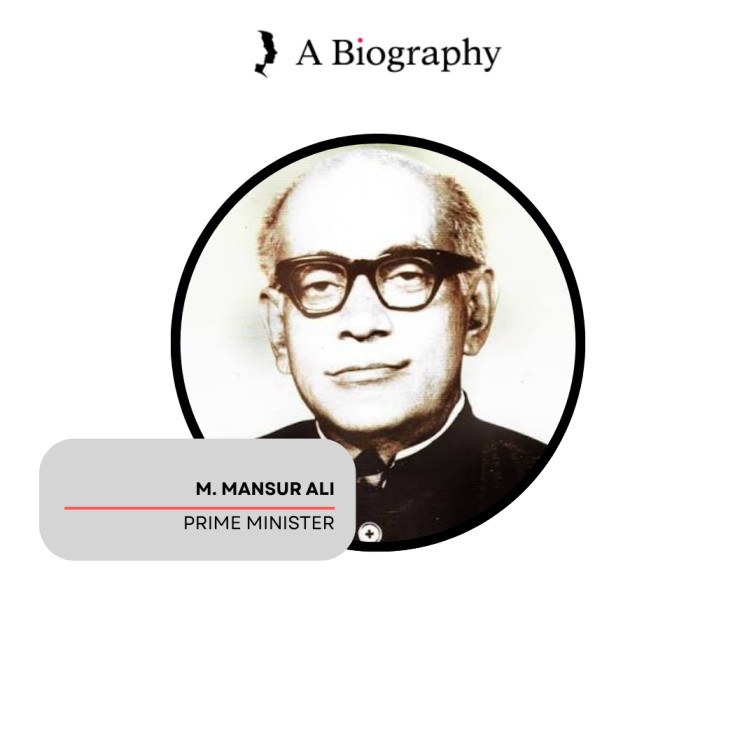
“I will not sit in the same cabinet as the killers. I will not form a government by betraying Bangabandhu’s ideals.” — Captain M. Mansur Ali, refusing to join President Khondaker Mostaq Ahmed’s cabinet after Bangabandhu’s assassination. This single sentence proves how principled and idealistic he was. He sacrificed his own life rather than betraying Bangabandhu.
Introduction
The darkness over Old Dhaka Central Jail was thick enough to drown hope. It was past 3:30 AM. The prisoners had long been asleep. But outside the gates, a pickup van had stopped. Armed soldiers jumped out, automatic rifles glinting under the pale moonlight. They had come for four men.
Inside his cell, Captain Muhammad Mansur Ali heard the footsteps. He had been here before — in Pakistani jails during the Language Movement, during the Six-Point Movement, during the Ayub Khan years. But tonight was different. Tonight, the air smelled of death.
The cell door burst open. Flashlights blinded him. Orders were barked. He was dragged into the corridor along with three other men — Syed Nazrul Islam, Tajuddin Ahmad, and A. H. M. Qamruzzaman. These were the four pillars who had built Bangladesh when its founding father lay in a Pakistani dungeon.
Standing in the prison yard, Mansur Ali did not beg. He did not weep. He looked his killers in the eye and said: “I never compromised on Bangabandhu’s path. I do not compromise now. The people of Bengal will one day judge you.”
Then the bullets came.
Even as the shots tore through his body, he raised his voice one last time: “Joy Bangla!” — Victory to Bengal.
His blood soaked the prison floor. He fell beside his comrades. The man who had been Bangabandhu’s Finance Minister, his Home Minister, his Communications Minister, and finally his Prime Minister — was gone. His only crime: loyalty to Sheikh Mujibur Rahman. His only sin: refusing to betray the father of the nation.
This biography tells the story of that extraordinary man — Captain M. Mansur Ali. From a peasant family in Sirajganj to Aligarh University, from the Language Movement to the Liberation War, from the Mujibnagar government to the Prime Minister’s office, and finally to a prison cell where he was martyred for his principles.
At a Glance: Life of Captain M. Mansur Ali
| Category | Details |
| Full Name | Muhammad Mansur Ali (M. Mansur Ali) |
| Known as | Captain Mansur Ali |
| Born | January 16, 1917 (some sources say 1919), Kuripara village, Kazipur, Sirajganj (then Pabna district), British India |
| Died | November 3, 1975, Old Dhaka Central Jail (age 58) |
| Father | Horof Ali Sarkar (farmer and social worker) |
| Mother | Begum Rowshon Ara (homemaker) |
| Spouse | Begum Amina (daughter of a district judge from Rangpur) |
| Children | Five sons: Dr. Mohammad Selim (politician, former MP), Mohammad Nasim (politician, former Health & Home Minister), Md. Rezaul Karim, Md. Maruf Ahmed, Md. Monjur Hossain; one daughter: Shirin Hossain |
| Profession | Prime Minister (Jan 25 – Aug 15, 1975), Finance Minister, Home Minister, Communications Minister, Mujibnagar government minister, lawyer |
| Education | Matriculation from Sirajganj B.L. High School (1935); IA from Edward College, Rajshahi (1937); BA from Islamia College, Kolkata (1941); MA in Economics & LL.B from Aligarh Muslim University (1944-45) |
| Military Training | Received ‘Captain’ title after training at Jessore Cantonment (1948) |
| Political Party | Muslim League (student days), Awami League (from 1949) |
| Role in Language Movement | Arrested in 1952 for organizing protests in Pabna |
| Prison Terms | Total of about 4-5 years in Pakistani jails |
| Role in Liberation War | Finance Minister of Mujibnagar government (1971) |
| Highest Position | Prime Minister of Bangladesh (January 25 – August 15, 1975) |
| Major Development Work | Elenga-Bhuapur highway, Bhuapur ferry service, roads and bridges in Kazipur, electrification and water supply |
| Awards | Independence Award (posthumous) — Bangladesh’s highest civilian honor |
| Burial | Four Leaders’ Mausoleum, Mirzapur, Tangail |
Early Life (1917-1930)
January 16, 1917. In the village of Kuripara in Kazipur, Sirajganj (then part of Pabna district), a boy was born into a simple farming family. They named him Muhammad Mansur Ali. His father, Horof Ali Sarkar, was a farmer and social worker. The villagers called him “Sarkar Saheb” with respect. His mother, Begum Rowshon Ara, was a pious homemaker.
The village lay near the banks of the Jamuna River. In those days, the river flowed close to the village. Mansur Ali grew up watching the mighty Jamuna, the farmers working the fields, the landlords exploiting the peasants. He saw his own father sometimes fall victim to injustice. These experiences planted the seeds of patriotism and empathy in his young heart.
His father wanted him to become educated so that he could serve the people. His mother wanted him to be pious and honest. Despite the family’s modest means, they sacrificed to educate their children.
One story from his childhood is still told in Kuripara. During a drought, two farmers fought over water for their fields. Young Mansur, barely a teenager, stepped in and resolved the dispute. The villagers were astonished — how could a boy show such wisdom? The elders predicted, “This boy will one day become a great leader of the country.”
He was not just a dreamer. He worked hard. He studied under oil lamps. He walked miles to school. He knew that education was his only path out of poverty.
Education (1935-1945)
Mansur Ali’s early education began in the village maktab and local primary school. He learned Bengali, Arabic, and basic English. He then attended Gangail Ratankandi Union Ali Ahmed High School. Later, he enrolled at Sirajganj B.L. High School and passed his matriculation (SSC) in 1935 with first division — a rare achievement in those days.
In 1937, he passed his IA from Rajshahi Government Edward College. It was here that his political consciousness began to awaken. He read newspapers about the anti-British movement and became involved in student politics.
In 1941, he earned his BA from Islamia College in Kolkata (now Maulana Azad College). Kolkata during World War II was a city of political ferment. The Quit India Movement, the Bengal Famine of 1943, the growing demand for Pakistan — all these shaped his young mind.
Then came the most important phase of his education. In 1944-45, he studied at Aligarh Muslim University — the intellectual cradle of the Pakistan movement. He earned both an MA in Economics and an LL.B degree. Aligarh exposed him to a liberal, secular, yet Islamic environment. He joined the Muslim League and participated in the Pakistan movement.
But after Partition, when he saw how West Pakistan was exploiting East Bengal, he grew disillusioned. The Language Movement of 1952 pushed him decisively toward Bangabandhu’s Awami League.
Struggles & Adversities
Mansur Ali’s struggles were not of poverty but of principle. He came from a modest family, but his real hardships came from his political beliefs.
He was arrested multiple times: in 1952 for the Language Movement, in 1954 after the United Front government was dismissed, in 1958 during Ayub Khan’s martial law, in 1966 for the Six-Point Movement. In total, he spent about four to five years in Pakistani jails.
In jail, he was tortured. He was kept in solitary confinement. He was denied basic amenities. But he never compromised. He never signed any statement against Bangabandhu. He never abandoned the demand for Bengali rights.
His wife, Begum Amina, held the family together during his absences. She raised their six children mostly alone. Mansur Ali carried the guilt of being away from his family, but he believed that the country came first.
Love
Mansur Ali married Begum Amina, the daughter of a district judge from Rangpur. She was a homemaker and a pious woman. She never sought the limelight. She managed the household, raised their five sons and one daughter, and supported her husband through his long absences in jail and political work.
Their marriage was not one of grand gestures, but of quiet endurance. When Mansur Ali was in prison, Begum Amina visited him regularly, brought him food and clothes, and kept his morale high.
After his martyrdom, she raised their children alone. Two of their sons — Dr. Mohammad Selim and Mohammad Nasim — became prominent Awami League leaders. Nasim served as Health Minister and Home Minister. Selim chaired the Parliamentary Committee on Foreign Affairs.
Begum Amina passed away in 2004 and was buried beside her husband at the Four Leaders’ Mausoleum in Tangail.
Personal Life
Mansur Ali was a devoted family man. Despite his busy political career, he made time for his children. He taught them the values of honesty, hard work, and love for the motherland. He told them, “Never compromise with injustice. Never betray your principles for power.”
His sons remember him as a strict but loving father. He did not believe in luxury. He lived simply, ate simply, and dressed simply. Even as a minister and Prime Minister, he never accumulated wealth. He died a poor man — rich only in integrity.
His two sons followed in his footsteps. Mohammad Nasim became a senior Awami League leader and minister. Dr. Mohammad Selim was also a respected parliamentarian. The family continues to serve the nation.
Future Plans & Vision
Mansur Ali dreamed of a Bangladesh where poverty would be eliminated, where every citizen would have access to education and healthcare, and where the rule of law would prevail.
As Communications Minister, he built roads and bridges to connect remote areas. As Home Minister, he worked to restore law and order after the war. As Prime Minister, he focused on education and agriculture. He believed that economic development and social justice must go hand in hand.
He did not live long enough to see his plans fully implemented. But his foundations remain.
Career (1946-1975)
Early Political Career (1946-1949)
While at Aligarh, Mansur Ali joined the Muslim League and supported the Pakistan movement. From 1946 to 1950, he served as Vice President of the Pabna District Muslim League.
Joining Awami League (1949)
Disillusioned with the Muslim League’s neglect of East Pakistan, he joined the newly formed Awami Muslim League (later Awami League). He became a member of the central executive committee and President of the Pabna District Awami League.
Language Movement (1952)
He organized protests in Pabna demanding Bengali as a state language. He was arrested on February 21, 1952.
United Front Minister (1954)
He was elected to the East Pakistan Provincial Assembly as a United Front candidate. He became a minister in the A. K. Fazlul Huq-led government, handling Law, Food & Agriculture, and Commerce & Industry portfolios. The government was dismissed within months, and he was arrested again.
Anti-Ayub Movement (1958-1969)
He was arrested during Ayub Khan’s martial law (1958-59). He participated actively in the Six-Point Movement (1966) and was arrested again. He was released during the 1969 uprising.
Member of National Assembly (1970)
He was elected from Pabna-1 (now Sirajganj) as an Awami League candidate in the 1970 general election.
Liberation War and Mujibnagar Government (1971)
After March 25, he escaped to India. On April 10, the Mujibnagar government was formed. He became the Finance Minister — responsible for raising funds for the war effort. He opened bank accounts in India, contacted friendly governments, and managed the finances of the provisional government.
Minister in Independent Bangladesh (1972-1975)
After independence, he served as Communications Minister and Finance Minister (1972-73), then Home Minister and Communications Minister (1973-75). As Communications Minister, he built the Elenga-Bhuapur highway and Bhuapur ferry service, connecting Dhaka to northern Bangladesh.
Prime Minister (January 25 – August 15, 1975)
When the constitution was amended to introduce the one-party BAKSAL system, Bangabandhu became President and Mansur Ali became Prime Minister and General Secretary of BAKSAL.
Arrest and Martyrdom (August 23 – November 3, 1975)
After Bangabandhu’s assassination, he refused to join Khondaker Mostaq Ahmed’s government. He was arrested on August 23 and murdered in jail on November 3.
Travels & Diverse Experiences
Mansur Ali traveled to India frequently during the Liberation War, meeting with Prime Minister Indira Gandhi and other leaders. He also visited the United Kingdom and other countries to raise support for Bangladesh’s independence.
As Finance Minister and Prime Minister, he traveled abroad for diplomatic and economic purposes. However, his life was not defined by foreign travels. His world was Bangladesh — its villages, its people, its struggle.
Failures & Teachable Moments
The only criticism leveled against Mansur Ali was his acceptance of the one-party BAKSAL system in 1975. Some argue that he should have resisted Bangabandhu’s authoritarian turn. But those who knew him say that his loyalty to Bangabandhu was absolute. He believed that Bangabandhu had earned the right to make decisions for the nation.
He later paid for that loyalty with his life. The lesson: standing by a leader in good times is easy; standing by him in controversial times requires immense courage.
Source of Inspiration
Mansur Ali’s greatest inspiration was Bangabandhu Sheikh Mujibur Rahman. He met him in the 1950s and became his devoted follower. Bangabandhu once called him “my right hand.” Mansur Ali carried that compliment with pride for the rest of his life.
He also drew inspiration from Sher-e-Bangla A. K. Fazlul Huq, under whom he served as a minister in 1954. Huq taught him that politics must serve the poor.
Influences & Inspirations
Mansur Ali was deeply influenced by the peasants of his home district. He had seen their suffering under the zamindari system. He had watched them struggle against floods, droughts, and exploitation. He believed that the only purpose of politics was to improve their lives.
He was also influenced by Islamic principles of justice and equality. He was a devout Muslim but a secular statesman — believing that religion was personal, but governance must be for all.
Philosophical Views & Beliefs
Mansur Ali believed in three core principles:
- Loyalty to Bangabandhu was loyalty to the nation.
- Service to the people was the purpose of politics.
- Sacrifice was the price of principle.
He never compromised with injustice. He never betrayed his leader. He never enriched himself from public office. He lived and died by these beliefs.
Unique Traits
What made Mansur Ali unique was his combination of skills: he was a trained economist from Aligarh, a lawyer, a military-trained “Captain,” a minister, a prime minister, and above all, a man of absolute integrity.
He was also unique in his refusal to join the post-August 15 government. Many others compromised. He did not. He chose death over dishonor.
Contributions, Awards & Achievements
Political Contributions
- Participated in Language Movement (1952) — arrested
- Participated in Six-Point Movement (1966) — arrested
- Member of United Front ministry (1954)
- Member of Pakistan National Assembly (1970)
- Finance Minister of Mujibnagar government (1971)
- Finance Minister, Communications Minister, Home Minister of independent Bangladesh
- Prime Minister of Bangladesh (1975)
Development Contributions
- Built Elenga-Bhuapur highway connecting Dhaka to northern Bangladesh
- Established Bhuapur ferry service
- Developed roads and bridges in Kazipur and Sirajganj
- Improved electrification and water supply in his constituency
Awards
- Independence Award (posthumous) — Bangladesh’s highest civilian honor
Legacy
- Remembered as one of the “Four National Leaders”
- Four Leaders’ Mausoleum in Tangail
- Captain Mansur Ali Road in Dhaka
- Educational institutions named after him in Sirajganj and Kazipur
Controversies
Mansur Ali is one of the rare politicians in Bangladesh’s history who remained virtually controversy-free. No allegation of corruption was ever leveled against him. He did not favor his relatives. He did not abuse his power.
The only criticism — acceptance of BAKSAL — is mild and widely seen as an act of loyalty, not opportunism.
Some have questioned his tough stance as Home Minister against opposition parties. But given the post-war chaos and the threat of armed insurgency, his actions were within the bounds of law.
Contemporary Opinions & Interviews
After his death, Prime Minister Sheikh Hasina said: “Captain Mansur Ali was a true patriot who sacrificed his life for his principles.”
Historian Dr. Muntassir Mamun called him “an uncompromising patriot.”
Fellow prisoner Sheikh Abdul Aziz, who survived the jail killing, recounted: “Before they killed him, Mansur Ali said, ‘Joy Bangla.’ He did not beg for mercy. He was a brave man.”
Myths & Misconceptions
Myth: Mansur Ali was a rich zamindar’s son.
Fact: He was the son of a simple farmer from Sirajganj.
Myth: He compromised with the post-August 15 regime.
Fact: He refused to join Khondaker Mostaq Ahmed’s cabinet and was arrested.
Myth: He was weak as a minister.
Fact: He was known as a tough administrator who got things done.
Myth: He was a puppet of Bangabandhu.
Fact: He was a leader in his own right, but his loyalty to Bangabandhu was absolute.
Famous Quotes & Thoughts
- “I will not sit in the same cabinet as the killers.”
- “I never compromised on Bangabandhu’s path. I do not compromise now. The people of Bengal will one day judge you.” (last words)
- “Never compromise with injustice.”
- “Politics is for service, not for power.”
- “Joy Bangla!” (last shout before death)
Message for the Present Generation
If Captain Mansur Ali were alive today, he would tell young people:
“Be honest. Be principled. Never compromise with injustice. Do not seek power for its own sake. Serve the people. And remember: loyalty to the ideals of the Liberation War is the highest form of patriotism.”
He would also remind them: “Your country comes before your career. Your principles come before your comfort. And if necessary, your life comes before your betrayal.”
Death & Legacy (November 3, 1975)
On November 3, 1975, Captain M. Mansur Ali was murdered inside Dhaka Central Jail along with three other national leaders. He was 58 years old.
His body was not returned to his family immediately. Two days later, on November 5, it was handed over. He was buried at the Four Leaders’ Mausoleum in Mirzapur, Tangail.
Every year on November 3, Bangladesh observes Jail Killing Day. People gather at the mausoleum to pay tribute. His sacrifice is remembered as the ultimate price of principle.
He did not die a natural death. He was executed by those who had seized power after killing Bangabandhu. But his legacy is immortal. He is remembered as one of the four pillars of the Liberation War — a man who refused to betray his leader and his country.
Successors & Lasting Impact
Mansur Ali’s political successors include his sons — Dr. Mohammad Selim and Mohammad Nasim — who continued his legacy in the Awami League. Nasim served as Health Minister and Home Minister. Selim chaired the Parliamentary Committee on Foreign Affairs.
His lasting impact includes:
- The Elenga-Bhuapur highway, which still connects Dhaka to northern Bangladesh
- The Four Leaders’ Mausoleum, a site of pilgrimage for patriots
- The ideal of an uncompromising, incorruptible politician
- The Independence Award, Bangladesh’s highest civilian honor
Unknown Facts
- He was a trained “Captain” from Jessore Cantonment (1948) — hence the title.
- He spent about 4-5 years in Pakistani jails — one of the longest-serving political prisoners.
- He earned both an MA in Economics and an LL.B from Aligarh Muslim University.
- He personally supervised the construction of the Elenga-Bhuapur highway.
- His two sons, Mohammad Nasim and Dr. Mohammad Selim, both became prominent Awami League leaders.
- His wife, Begum Amina, was the daughter of a district judge from Rangpur.
- He never owned a house in Dhaka. He lived in government accommodation.
- His last words before execution were “Joy Bangla!” — Victory to Bengal.
Key Events (1917-1975)
| Year | Event |
| 1917 | January 16 — Born in Kuripara, Kazipur, Sirajganj |
| 1935 | Matriculation from Sirajganj B.L. High School |
| 1937 | IA from Edward College, Rajshahi |
| 1941 | BA from Islamia College, Kolkata |
| 1944-45 | MA (Economics) & LL.B from Aligarh Muslim University |
| 1946-50 | Vice President, Pabna District Muslim League |
| 1948 | Military training at Jessore Cantonment; received ‘Captain’ title |
| 1949 | Joined Awami League |
| 1951 | Started law practice at Pabna District Bar |
| 1952 | Participated in Language Movement; arrested |
| 1954 | Elected to Provincial Assembly; became United Front minister; arrested after government dismissal |
| 1958 | Arrested during Ayub Khan’s martial law (released 1959) |
| 1966 | Participated in Six-Point Movement; arrested |
| 1969 | Released during uprising |
| 1970 | Elected to Pakistan National Assembly from Pabna-1 |
| 1971 (March 25) | Escaped to India after Pakistani genocide |
| 1971 (April 10) | Appointed Finance Minister of Mujibnagar government |
| 1971 (Dec 16) | Returned to independent Bangladesh |
| 1972-73 | Served as Communications Minister and Finance Minister |
| 1973-75 | Served as Home Minister and Communications Minister |
| 1975 (Jan 25) | Appointed Prime Minister after BAKSAL constitution |
| 1975 (Aug 15) | Bangabandhu assassinated; Mansur Ali goes into hiding |
| 1975 (Aug 23) | Arrested for refusing to join Khondaker Mostaq’s government |
| 1975 (Nov 3) | Murdered inside Dhaka Central Jail |
| 1975 (Nov 5) | Buried at Four Leaders’ Mausoleum, Mirzapur, Tangail |
Conclusion
Captain M. Mansur Ali was not a man who sought power. He was a man who sought justice. He could have joined Khondaker Mostaq’s government. He could have saved his life. He could have continued his career. But he refused. He chose death over dishonor. He chose principle over power. He chose loyalty over betrayal.
His life teaches us that politics can be an honorable profession. That a minister can be incorruptible. That a prime minister can live simply. That a man can face death without flinching — if he knows that he has lived with integrity.
On the night of November 3, 1975, when the bullets tore through his body, he did not curse his killers. He did not beg for mercy. He raised his voice one last time: “Joy Bangla!”
That shout did not die with him. It echoes still — in every Bengali who believes in justice, in every citizen who refuses to bow to tyranny, in every patriot who remembers that independence was bought with blood.
Mansur Ali is gone. But his legacy is immortal. He is remembered as one of the four national leaders who gave their lives for Bangladesh. He is honored with the Independence Award. His name is on roads and schools. His sons carry his legacy. And every year on November 3, the nation pauses to remember: this was a man who refused to betray his leader, his country, and his conscience.
The man who dreamed of a golden Bengal alongside Bangabandhu fell on the dirty floor of a prison cell, murdered by assassins. But this ‘Captain’ fought for justice until the end, and died for justice. He proved that it is possible to die rather than commit betrayal. Muhammad Mansur Ali is no more, but his ideals, his sacrifice, his honesty — all remain eternal inspirations for the Bengali nation.
References
- Bengali Wikipedia — Muhammad Mansur Ali (2026)
- English Wikipedia — Muhammad Mansur Ali (2026)
- Banglapedia — Ali, Captain Mohammad Mansur (Asiatic Society of Bangladesh)
- ‘Muktijuddher Itihash’ — Dr. Muntassir Mamun (Bangla Academy, 2005)
- ‘Char Neta: Hattyakanonder Omimangshito Rohossho’ — Dr. Muntassir Mamun (Deep Prakashan, 2005)
- ‘Bangladesher Shadhinota Juddho: Doliplotro’ (multivolume) — edited by Hasan Hafizur Rahman
- ‘Jail Hattyakando: Kalo Adhyay’ — Lt. Col. (retd.) Oli Ahmed (2008)
- Daily Ittefaq, November 4, 1975 (front page)
- Daily Prothom Alo, November 3, 2015 (memorial supplement)
- Liberation War Museum archives and audio archives
- Interviews of Dr. Mohammad Selim and Mohammad Nasim (various dates)
- ‘Captain Mansur Alir Jibon O Kormo’ — Sirajganj District Awami League publication (1989)
- ‘Asomapto Atmojiboni’ — Bangabandhu Sheikh Mujibur Rahman (UPL, 2012)
- Four Leaders’ Mausoleum — Tangail District Administration
- Supreme Court verdict on the Jail Killing case (2010)
- ‘Bangladesh: A Legacy of Blood’ — Anthony Mascarenhas (Hodder & Stoughton, 1986)
Disclaimer
This biography has been prepared based on information from reliable and authoritative sources, including Wikipedia, Banglapedia, newspaper archives, academic publications, and court records. Some personal details — such as exact dates and minor family information — may vary slightly across sources. Where discrepancies exist, the most widely accepted or corroborated information has been used. Dramatic and narrative elements have been employed for readability, but core factual events remain unchanged. The controversial aspects — particularly the acceptance of BAKSAL — are presented neutrally, reflecting both the historical context and the criticism. The purpose of this biography is to honor the memory of a great patriot and inspire readers. Readers are encouraged to consult multiple sources for a comprehensive understanding.
The man who walked with Bangabandhu, who dreamed of a golden Bengal, who served as Finance Minister, Home Minister, and Prime Minister, who refused to join the murderers’ government, who faced death with “Joy Bangla” on his lips — his blood was not shed in vain. Bangladesh is free. The people of Bengal remember. Every November 3, when the nation observes Jail Killing Day, Captain M. Mansur Ali’s name is spoken with reverence — so that future generations know that there were men on this soil willing to die for their principles. You are immortal, Captain Mansur Ali.

