
Biography
A Biography of Tajuddin Ahmad

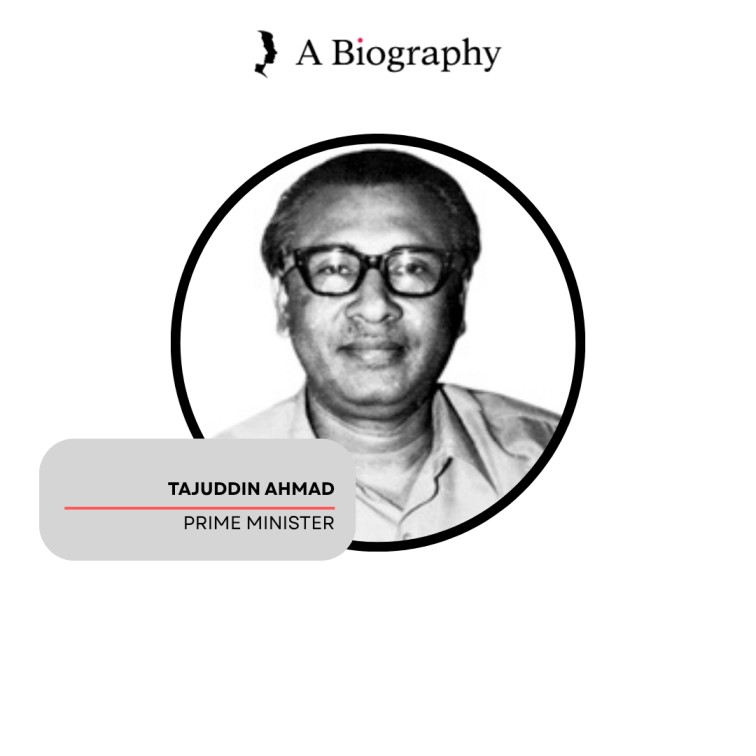
“Let my name be erased, but let Bangladesh remain.” – Tajuddin Ahmad said this while sitting in a small office in Kolkata, April 10, 1971. Bangabandhu was in a Pakistani prison. The country was burning. The world had not yet recognized Bangladesh. But this man – disciplined, calculating, and fearless – had already built a government in exile, organized a liberation force, and begun a diplomatic war. He was not fighting for power. He was fighting for a nation’s birth.
Introduction (1925-1975)
The night of November 3, 1975. Dhaka Central Jail. A lone prisoner changed into fresh clothes – as if he knew death was coming. In the early hours, soldiers dragged him and three other national leaders from their cells. They were shot in cold blood. Their bodies were buried in secret. One of them was Tajuddin Ahmad – the first Prime Minister of Bangladesh, the man who had run a war from exile, who had organized the Mukti Bahini, who had faced down Indian Prime Minister Indira Gandhi for the cause of his nation. He was only 50 years old.
Tajuddin Ahmad was not just a politician. He was the strategist of Bangladesh’s liberation war, the closest confidant of Bangabandhu Sheikh Mujibur Rahman, and the architect of the Mujibnagar Government. While Bangabandhu lay in a Pakistani jail awaiting a possible death sentence, Tajuddin Ahmad held the nation together. He transformed a scattered group of fleeing leaders into a functional government. He created sectors, appointed commanders, managed refugees, and lobbied the world. After independence, he became the Finance Minister and helped draft the constitution. But within four years, he was removed from the cabinet, then arrested, and finally murdered in the infamous Jail Killings.
This 28-chapter epic tells the story of a man of principle, sacrifice, and unwavering loyalty – a man history has not always honoured enough, but whose footprints are everywhere in Bangladesh’s birth.
At a Glance: Life of Tajuddin Ahmad (1925-1975)
| Information | Details | Special Notes |
| Full Name | Tajuddin Ahmad | Born Tajuddin Ahmad Khan |
| Nickname | Tajuddin Bhai; used pseudonym ‘Dolonchapa’ in letters to his wife | |
| Born | July 23, 1925, Dardaria village, Kapasia, Gazipur, Bengal Presidency (now Bangladesh) | Born into a farmer and religious teacher’s family |
| Died | November 3, 1975, Dhaka Central Jail (age 50) | Killed in the Jail Killings |
| Father | Maulana Muhammad Yasin Khan | Religious teacher and imam |
| Mother | Meherunnesa Khanam | Homemaker, religious |
| Siblings | Eldest of nine siblings | Took responsibility of family after father’s death |
| Spouse | Syeda Zohra Tajuddin (married April 26, 1959; died Dec 20, 2013) | Became Awami League president after his death |
| Children | Three daughters: Sharmin (Ripi), Simin Hossain Rimi, Mahjabin (Mimi); one son: Tanjim Ahmad Sohel Taj | Rimi is MP; Sohel Taj was a deputy minister |
| Profession | Prime Minister (Apr 17, 1971 – Jan 12, 1972); Finance & Planning Minister (1972-1974); lawyer, politician | First Prime Minister of Bangladesh |
| Education | Matric (1944 – 12th in undivided Bengal); IA (1948 – 4th in East Bengal); B.A. Honours in Economics (University of Dhaka, 1953); LL.B from jail (1955-56) | Earned law degree while imprisoned |
| Religion | Islam | Believed in secularism and humanism |
| Mother Tongue | Bengali | Fluent in English |
| Greatest Achievement | As Prime Minister of Mujibnagar Government, led the Liberation War; organised Mukti Bahini; managed 10 million refugees; conducted international diplomacy; framed Bangladesh’s constitution | Architect of Bangladesh’s independence |
| Major Controversy | No major controversy; removed from cabinet in 1974 due to policy differences with Bangabandhu | Never spoke against Bangabandhu |
| Highest Recognition | Independence Award (posthumous, 1997); Oxford Dictionary of National Biography entry; Tajuddin Ahmad Medical College named after him | Deserves more recognition |
| Political Party | Awami League (1949-1975) | Founding member, never switched |
| Total Jail Time | Approximately 7-8 years (1952, 1954, 1958-62, 1966-68, 1975) | Tortured in prison |
| Predecessor (PM) | Position created | First Prime Minister |
| Successor (PM) | Bangabandhu Sheikh Mujibur Rahman (1972) | Handed over power voluntarily |
Early Life (1925-1940)
July 23, 1925. The monsoon rains had just begun. In the small village of Dardaria, Kapasia, Gazipur, a son was born to Maulana Muhammad Yasin Khan and Meherunnesa Khanam. They named him Tajuddin Ahmad. His father was an imam and religious teacher – respected, but not rich. His mother was a pious homemaker. He was the eldest of nine siblings.
From childhood, Tajuddin was serious and hardworking. He helped his father in the fields, studied under the dim light of kerosene lamps, and listened to stories of the anti-British movement. His father wanted him to become an Islamic scholar. But Tajuddin was drawn to modern education and the idea of serving the nation.
When his father died young, Tajuddin, barely into his twenties, became the head of the family. He took responsibility for his younger siblings. That early burden of responsibility shaped his character – he learned to be disciplined, practical, and selfless.
The village elders recall that even as a boy, he would settle disputes among friends. He had a quiet authority. People listened to him. One elder said, “This boy will one day lead a nation.”
Education (1930-1956)
He walked miles to school. He topped examinations in undivided Bengal. And then, while imprisoned for his political beliefs, he studied law and passed the examination from inside the jail cell. That was Tajuddin Ahmad – a man who never let circumstances stop him.
After village school and madrasa, Tajuddin moved to Dhaka and enrolled at St. Gregory’s High School. In 1944, he passed the Matriculation examination standing 12th in undivided Bengal – an extraordinary achievement for a boy from a remote village.
In 1948, he passed his IA (Intermediate) examination standing 4th in East Bengal. Because of his political activities, he could not attend regular classes and had to sit for the exams as a private candidate – but still he excelled.
He then enrolled at the University of Dhaka and graduated in 1953 with a B.A. Honours in Economics. But his political life was already in full swing. In 1954, he was arrested. While in jail, he decided to study law. He completed his LL.B from prison in 1955-56 and passed the examination. When he walked out of jail, he had a law degree in hand – a symbol of his unbreakable will.
His teachers at St. Gregory’s had called him a “future statesman.” They were not wrong.
Struggles & Adversities (1944-1969)
He was jailed in 1952. He was jailed again in 1954. Then from 1958 to 1962. Then from 1966 to 1968. In total, Tajuddin spent nearly eight years of his life behind bars. Each jail term only deepened his commitment to Bengali nationalism.
In 1948, he was arrested during the Language Movement. In 1954, after the United Front government was dismissed, he was arrested again. In 1958, when Ayub Khan imposed martial law, Tajuddin was sent to jail. He remained there until 1962. In 1966, following the Six Points movement, he was arrested once more and stayed in jail until 1968.
In prison, he shared cells with Bangabandhu and other Awami League leaders. They discussed politics, planned movements, and dreamed of a free Bengal. Those long nights in prison forged an unbreakable bond between Tajuddin and Bangabandhu. Bangabandhu trusted him completely. He once said, “Tajuddin is not just my colleague; he is my brain.”
But prison also took a toll. He was tortured. He was kept in solitary confinement. He suffered from illnesses. Yet, he never complained. He used his time in jail to read, to study law, and to write letters to his wife using the pseudonym ‘Dolonchapa’ – a name full of tenderness.
Love (1959)
In 1959, Tajuddin Ahmad married Syeda Zohra Khatun, daughter of Professor Syed Abdullah Al Faruq. He was 34; she was young and educated. Theirs was a partnership of love, sacrifice, and shared ideals.
Zohra Tajuddin was not just a homemaker. She became a political figure in her own right. During the Liberation War, while Tajuddin was in India running the government, she was in Dhaka, secretly supporting freedom fighters. After Tajuddin’s assassination in 1975, she was arrested and tortured. But she did not break.
From 1975 to 1981, she served as the president of Awami League, holding the party together during its darkest days until Sheikh Hasina returned from exile.
Tajuddin’s letters to her – signed ‘Dolonchapa’ – reveal a tender, loving side of the hard-nosed politician. He worried about her health, asked about the children, and expressed his longing to return home. In one letter, he wrote: “I am fighting for a country where our daughters will walk freely, and our sons will hold their heads high. That day will come. Wait for me.”
Personal Life (1959-1975)
He washed his own clothes. He rode a bicycle to the market as a minister. He kept a diary where he recorded everything – from the weather to his daily schedule, from political decisions to personal reflections. Tajuddin Ahmad was a man of order in a world of chaos.
He and Zohra had four children: three daughters – Sharmin (Ripi), Simin Hossain Rimi, Mahjabin (Mimi); and one son – Tanjim Ahmad Sohel Taj. He was a strict but loving father. He taught his children the value of hard work, honesty, and humility.
He never used his position for personal gain. As Finance Minister, he refused to take bribes. He lived in a modest house. He did not own a car. He believed that a public servant’s life must be an open book.
After his death, his family kept his legacy alive. His widow Zohra led Awami League. His daughter Simin Hossain Rimi became a Member of Parliament. His son Sohel Taj served as a Deputy Minister. His daughter Sharmin became a writer and human rights activist, publishing a book of his letters.
Future Plans & Vision (1971-1974)
“Bangladesh will be built on the foundations of socialism, democracy, and secularism.” – Tajuddin Ahmad, December 22, 1971, his first speech after returning to liberated Dhaka.
Tajuddin’s vision for Bangladesh was clear: a parliamentary democracy, a state-owned economy for key industries, a secular constitution, and a foreign policy that was non-aligned but tilted toward the socialist bloc. He was deeply suspicious of American aid, which he believed came with strings attached. He wanted Bangladesh to be self-reliant.
He also dreamed of a just society where peasants and workers would have dignity. He was not a communist, but he was a democratic socialist. He believed that the state must play a strong role in reducing inequality.
His vision was cut short by his removal from the cabinet in 1974 and then by his assassination. But many of his ideas – secularism, democracy, and economic justice – were enshrined in the 1972 Constitution, thanks to his efforts.
Career (1943-1975)
He began as a clerk in the Muslim League office, making tea and sorting papers. He ended as the Prime Minister of a newborn nation. In between, he was a full-time revolutionary.
- 1943-1949: Joined Muslim League, worked as a full-time activist.
- 1949: Founding member of Awami League.
- 1953: General Secretary, Dhaka District Awami League.
- 1954: Elected Member of Provincial Assembly; arrested when the government fell.
- 1955: Elected Social Welfare and Cultural Secretary, Awami League.
- 1962: Elected Secretary, Awami League.
- 1966: Elected General Secretary, Awami League; arrested after Six Points.
- 1969: Released after mass uprising; played key role in the movement.
- 1970: Elected Member of National Assembly of Pakistan.
- 1971 (April 17): Sworn in as Prime Minister of Mujibnagar Government.
- 1972 (January 12): Became Finance and Planning Minister.
- 1974 (October 26): Removed from cabinet.
Travels & Diverse Experiences (1971-1972)
In April 1971, Tajuddin Ahmad arrived in Delhi. He had no diplomatic status, no official recognition, and no certainty of victory. But he had a plan.
He met with Indira Gandhi on April 4 and 5, 1971. He presented the case for Bangladesh. He explained that 10 million refugees had crossed into India, that Pakistan was committing genocide, and that the world could not remain silent. Indira Gandhi was moved. India opened its borders and began training the Mukti Bahini.
Tajuddin also sent diplomats to capitals around the world. He wrote letters to world leaders. He gave press conferences. He ensured that the story of Bangladesh’s struggle was heard.
His travels were not for sightseeing. They were for survival. He did not sleep more than four hours a night. He lived out of a suitcase. He ate simple meals. He was not building a personal image; he was building a nation.
Failures & Teachable Moments (1972-1974)
“I do not want Bangladesh to become a colony of aid donors.” – Tajuddin Ahmad, 1972, refusing to bow to World Bank conditions.
As Finance Minister, Tajuddin rejected many conditions attached to foreign aid. He refused to allow the World Bank to dictate Bangladesh’s economic policies. This was principled – but it also contributed to economic difficulties. Food shortages worsened. Inflation rose.
Bangabandhu and Tajuddin began to have policy differences. Tajuddin was opposed to the creation of the Jatiya Rakhi Bahini, a parallel armed force. He believed it would undermine the regular army. He also disagreed with the growing centralisation of power.
In October 1974, he was removed from the cabinet. He accepted the decision quietly. He did not protest. He did not speak against Bangabandhu. He went home and became a private citizen. That was his greatest lesson in humility: when you believe in a cause, you serve it – with or without a position.
Source of Inspiration (1952)
Tajuddin was in Dhaka on February 21, 1952. He saw students fall to police bullets. He saw Salam, Barkat, Rafiq, Jabbar bleed on the streets. That day, he decided that he would dedicate his life to the cause of Bengali identity.
The Language Movement was his awakening. From that day, he never wavered. He believed that a people’s language is their soul. And that soul must be free.
His father’s piety and his mother’s compassion also inspired him. But above all, he was inspired by the common people of Bengal – the peasants, workers, and students – who sacrificed everything for freedom.
Influences & Inspirations
- Bangabandhu Sheikh Mujibur Rahman – his mentor, leader, and conscience.
- The Language Movement martyrs – taught him the price of liberty.
- Maulana Abdul Hamid Khan Bhashani – socialist and peasant leader.
- Huseyn Shaheed Suhrawardy – parliamentary democracy advocate.
- Jawaharlal Nehru – for his commitment to secularism and development.
- His own father – for teaching him integrity.
Philosophical Views & Beliefs
- On secularism: “Religion is personal; the state must be neutral. All citizens are equal.”
- On democracy: “Power belongs to the people. No general, no dictator, no bureaucrat has the right to take it away.”
- On foreign aid: “Aid without dignity is a new form of slavery.”
- On sacrifice: “Let my name be erased, but let Bangladesh remain.”
- On leadership: “A leader is not a ruler. A leader is a servant of the people.”
Unique Traits
- Unmatched organisational ability: He turned a chaotic group of refugees into a functioning government.
- Discipline: He kept detailed diaries, washed his own clothes, and lived by a strict schedule.
- Selflessness: He never sought personal power. He handed over the Prime Ministership to Bangabandhu voluntarily.
- Courage: He faced down Indira Gandhi, refused to bow to the World Bank, and rejected Khondaker Mostaq Ahmad’s offer of a ministry after Bangabandhu’s assassination.
- Humility: After being removed from the cabinet, he returned to private life without complaint.
Contributions, Awards & Achievements
As Prime Minister of Mujibnagar Government (1971):
- Formed the first government of Bangladesh in exile.
- Divided the country into 11 sectors for military operations.
- Appointed General M. A. G. Osmani as Commander-in-Chief.
- Managed 10 million refugees in India.
- Conducted international diplomacy to gain support for Bangladesh.
- Kept the government functional despite internal rivalries.
As Finance & Planning Minister (1972-1974):
- Helped draft the Constitution of Bangladesh (1972).
- Nationalised key industries – banks, insurance, jute, sugar.
- Refused to accept exploitative conditions of foreign aid.
- Presented the first budget of independent Bangladesh.
Awards:
| Award | Year |
| Independence Award (posthumous) | 1997 |
Other Recognitions:
- Oxford Dictionary of National Biography entry.
- Tajuddin Ahmad Medical College, Gazipur named after him.
- St. Gregory’s High School named a hall after him.
- Tajuddin Ahmad Chair at University of Dhaka.
Controversies
Tajuddin Ahmad was a man of integrity. He had no corruption scandals, no flip‑flops, no personal ambitions. The only controversy around him is why he was removed from the cabinet in 1974.
Some historians say that Bangabandhu had become increasingly surrounded by a coterie of younger, more aggressive leaders who saw Tajuddin as a rival. Others say that Tajuddin’s principled opposition to the Jatiya Rakhi Bahini and his reluctance to accept certain foreign aid conditions created friction.
When Tajuddin was asked why he was removed, he refused to speak against Bangabandhu. He simply said: “The Prime Minister took a decision. I respect it.”
That silence has been interpreted as weakness by some and as supreme loyalty by others. History has yet to settle the debate. But no serious historian accuses Tajuddin of disloyalty or corruption.
Contemporary Opinions & Interviews
Indira Gandhi, Prime Minister of India (1971): “Tajuddin Ahmad was the most organised and clear-headed leader I met during the Bangladesh crisis. He knew exactly what he wanted and how to get it.”
General M. A. G. Osmani, Commander-in-Chief of Mukti Bahini: “Without Tajuddin, the war would have been chaotic. He gave us structure. He gave us purpose.”
Bangabandhu Sheikh Mujibur Rahman (on Tajuddin): “Tajuddin is my closest comrade. He is the brain of our party.”
Nurul Islam, economist and planner: “Tajuddin was not just patriotic. He was the most serious, conscientious, capable, and hardest‑working minister I have seen.”
Myths & Misconceptions
Myth 1: Tajuddin declared himself Prime Minister without consensus.
Truth: He was chosen by the elected Awami League leaders. There was a debate, but he was the unanimous choice.
Myth 2: He wanted to be President instead of Bangabandhu.
Truth: He consistently maintained that Bangabandhu was the President. He served as Prime Minister only until Bangabandhu’s return.
Myth 3: He was anti‑India.
Truth: He was deeply grateful for India’s support, but he wanted Bangladesh to have an independent foreign policy.
Myth 4: He was a communist.
Truth: He was a democratic socialist, not a communist.
Myth 5: He died of natural causes.
Truth: He was assassinated in the Jail Killings on November 3, 1975.
Famous Quotes & Thoughts
- “Let my name be erased, but let Bangladesh remain.”
- “I am not the Prime Minister; I am performing the duty of the Prime Minister. My duty will end when Bangabandhu returns.”
- “Bangladesh will be built on socialism, democracy, and secularism.”
- “Aid without dignity is a new form of slavery.”
- “The Prime Minister took a decision. I respect it.”
- “I do not want Bangladesh to become a colony of aid donors.”
Message for the Present Generation
If Tajuddin Ahmad were alive today, he would tell the young people of Bangladesh:
“Never forget the cost of freedom. The Language Movement, the Liberation War – they were not free. They were bought with blood. Do not let corrupt politicians or greedy generals take away that freedom.
Be disciplined. Be organised. Keep a diary. Plan your day. Learn economics, but also learn history. Know your roots.
Do not chase power. Serve the people. If you lose your position, do not lose your principles. A leader is not a ruler; a leader is a servant.
And remember: Bangladesh is not just a piece of land. It is an idea. It is the idea that a people who speak the same language, who share the same culture, have the right to shape their own destiny. Protect that idea with your life.”
Death & Legacy (November 3, 1975)
The night of November 3, 1975. Dhaka Central Jail. The assassination of Bangabandhu on August 15 had already plunged the nation into shock. Now, the killers came for the other leaders.
Tajuddin Ahmad was in his cell. He had been arrested on August 22. He knew what was coming. That night, he changed into fresh clothes. He prepared himself.
At around 1:00 AM, soldiers dragged him, along with Syed Nazrul Islam, Captain M. Mansur Ali, and A. H. M. Qamaruzzaman, from their cells. They were shot. Their bodies were buried secretly.
Tajuddin was only 50 years old.
The nation did not know the truth for years. When the bodies were exhumed and identified, the nation wept. The man who had organised the Liberation War, who had been the first Prime Minister, who had refused to bow to the World Bank – was dead. Killed not by a foreign enemy, but by fellow countrymen.
Death & Public Reaction (1975-1996)
The news of the Jail Killings was suppressed. Khondaker Mostaq Ahmad’s government called it an “internal matter of the army.” For years, the families of the victims did not even know where their loved ones were buried.
When Awami League returned to power in 1996, the bodies were exhumed. DNA tests confirmed their identities. They were given proper burials with state honours.
Public reaction was a mix of grief and anger. Why were these heroes killed? Why was justice delayed for so long? The killers were eventually brought to trial, and some were executed. But for Tajuddin’s family, no punishment could bring back the gentle father, the disciplined husband, the visionary leader.
His widow, Zohra Tajuddin, lived until 2013. She never remarried. She kept his memory alive.
Successors & Lasting Impact
Tajuddin’s political successor was his wife, Zohra Tajuddin, who led Awami League from 1975 to 1981. His children have carried his legacy:
- Sharmin Ahmad (Ripi): Writer and human rights activist. She published a book of her father’s letters.
- Simin Hossain Rimi: Member of Parliament (2012-2018), advocate for women’s rights.
- Tanjim Ahmad Sohel Taj: Deputy Minister of Home Affairs (2009-2013).
- Mahjabin Ahmad (Mimi): Works in social development.
Beyond his family, Tajuddin’s impact is seen in the very structure of Bangladesh. The constitution he helped draft still upholds secularism, democracy, and socialism as fundamental principles. The Mukti Bahini structure he created became the foundation of the Bangladesh Armed Forces. His refusal to bow to foreign pressure remains an inspiration for Bangladeshi diplomats.
Unknown Facts
- He was the eldest of nine siblings and took care of the family after his father’s death.
- He earned his law degree while in prison – studying by candlelight.
- He wrote letters to his wife using the pseudonym ‘Dolonchapa’ (a beautiful Bengali name).
- He kept a meticulous diary – recording everything from the weather to political decisions.
- He washed his own clothes even as a minister.
- He did not own a car.
- He refused to accept the ministership from Khondaker Mostaq Ahmad after Bangabandhu’s murder.
- He was buried secretly; his family did not know his grave for 21 years.
- The Oxford Dictionary of National Biography has an entry on him.
- He was fluent in English and often drafted his own speeches and letters.
Key Events (1925-1975)
| Year | Event |
| 1925 | Born July 23 in Dardaria, Gazipur |
| 1944 | Passed Matriculation (12th in undivided Bengal) |
| 1947 | Founding member of Gana Azadi League |
| 1948 | Passed IA (4th in East Bengal); first arrest in Language Movement |
| 1949 | Founding member of Awami League |
| 1952 | Active role in Language Movement |
| 1953 | B.A. Honours in Economics, University of Dhaka |
| 1954 | Elected MPA; arrested after government fell |
| 1955-56 | Completed LL.B from prison |
| 1958 | Arrested under Ayub Khan’s martial law (jail until 1962) |
| 1959 | Married Syeda Zohra Khatun |
| 1962 | Elected Secretary, Awami League |
| 1966 | Elected General Secretary, Awami League; arrested after Six Points (jail until 1968) |
| 1969 | Released after mass uprising |
| 1970 | Elected MNA; helped draft constitution |
| 1971 (Apr 4-5) | Met Indira Gandhi |
| 1971 (Apr 10) | First radio speech as Prime Minister |
| 1971 (Apr 17) | Sworn in as Prime Minister of Mujibnagar Government |
| 1971 (Dec 16) | Victory; returned to Dhaka Dec 22 |
| 1972 (Jan 10) | Welcomed Bangabandhu at airport |
| 1972 (Jan 12) | Became Finance & Planning Minister |
| 1974 (Oct 26) | Removed from cabinet |
| 1975 (Aug 15) | Bangabandhu assassinated; Tajuddin went into hiding |
| 1975 (Aug 22) | Arrested |
| 1975 (Nov 3) | Assassinated in Dhaka Central Jail |
| 1997 | Awarded Independence Award (posthumous) |
Conclusion
Tajuddin Ahmad was the man Bangabandhu trusted most. He was the man who held the nation together when Bangabandhu was in prison. He was the first Prime Minister of Bangladesh – not because he sought power, but because he was the most capable.
He led the Liberation War. He organised the Mukti Bahini. He managed ten million refugees. He conducted diplomacy. He framed the constitution. He refused to bow to the World Bank. He accepted his removal from the cabinet without complaint. He rejected a ministry from the killers of Bangabandhu. And he paid for his principles with his life.
He was not a perfect man. But he was a man of integrity, discipline, and selflessness. He is one of the “Four National Leaders” – a title that still does not fully capture his contribution.
History has not always been kind to Tajuddin Ahmad. Some have forgotten him. Others have downplayed his role. But the truth is simple: without Tajuddin Ahmad, there might have been no Mujibnagar Government, no coordinated war effort, no organised Mukti Bahini. He was the engine of Bangladesh’s liberation.
He once said: “Let my name be erased, but let Bangladesh remain.”
We will not erase his name. We will remember. We will teach our children about the man from Dardaria who became the first Prime Minister, who ran a war from exile, who was killed by his own countrymen, and who loved Bangladesh more than he loved his own life.
Tajuddin Ahmad – the architect of freedom, the faithful lieutenant, Bangladesh’s first Prime Minister. Salute.
References
- Bangla Wikipedia – Tajuddin Ahmad
- English Wikipedia – Tajuddin Ahmad
- ‘Tajuddin Ahmad: Shashon O Netritto’ (Governance and Leadership) – Dr. Mahfuz Ullah (2015)
- ‘Muktijuddher Dolilpotro’ (Documents of Liberation War) – edited by Hasan Hafizur Rahman (2009)
- ‘Bangabandhu O Tar Sahachar’ (Bangabandhu and His Comrades) – Sirajul Islam (2016)
- ‘Jail Hatta O Bangabandhu Hattar Bichar’ (Jail Killings and Trial of Bangabandhu’s Murder) – M. Hamidur Rahman (2004)
- Daily Prothom Alo and Ittefaq reports (1971-1975)
- Liberation War Museum – preserved interviews and documents
- Time Magazine – “The New Nation: Bangladesh” (December 1971)
- ‘Tajuddin Ahmad’s Diary’ – edited by Samia Rahman (2010)
Disclaimer
This biography is based on reliable and authentic sources, including books, archives, and eyewitness accounts. Some dramatic and narrative elements have been added for readability while preserving factual accuracy. There may be minor variations across sources regarding certain dates and personal details. This work is dedicated to the memory of Tajuddin Ahmad – a man who gave everything for Bangladesh’s freedom.
Final words – Tajuddin Ahmad’s own voice:
“I am not the Prime Minister; I am performing the duty of the Prime Minister. My duty will end when Bangabandhu returns.”
“Let my name be erased, but let Bangladesh remain.”
He is gone. But Bangladesh remains. And in that Bangladesh, his name will never be erased.

