
Biography
A Biography of Shah Azizur Rahman

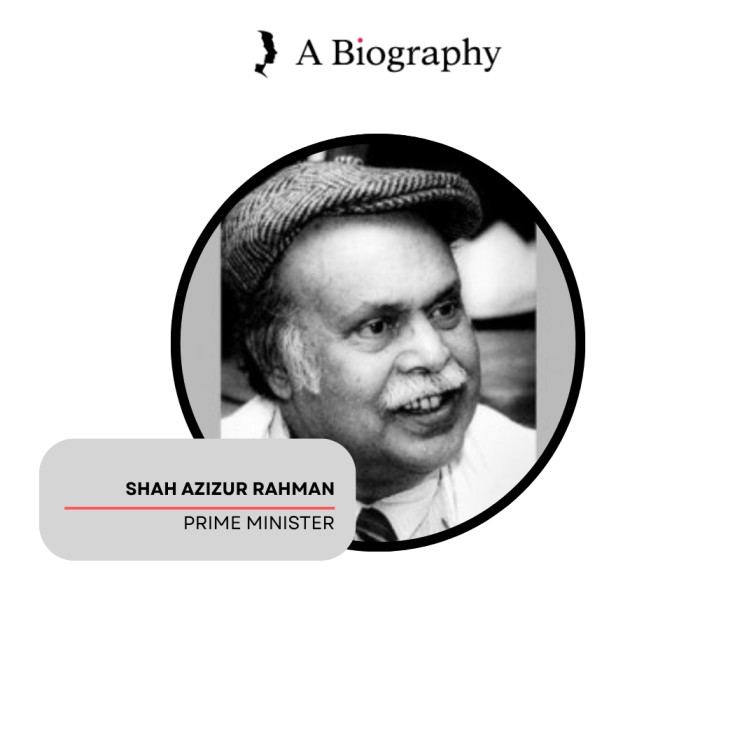
The person who stood by Pakistan and later took over the reins of governing Bangladesh
“He was the most controversial character in the political history of Bangladesh — on one hand, an opponent of the 1952 Language Movement, on the other, he spoke at the UN in favour of the Pakistani forces during the 1971 Liberation War. Yet this very person later became the Prime Minister of Bangladesh. How could history give such a huge responsibility to such a person? — This remains an eternal question.”
Introduction
Shah Azizur Rahman. The mere utterance of the name unveils a deep and controversial chapter in the history of Bangladesh’s politics.
He was the fourth Prime Minister of Bangladesh. He served in this role from 15 April 1979 to 24 March 1982. But more discussed than his tenure are those decisions and stances of his that placed him at the centre of intense controversy.
Why is he so controversial?
Because he opposed the 1952 Language Movement. He supported the Pakistani forces during the 1971 Liberation War. He went to the United Nations as a representative of Pakistan and claimed there that Operation Searchlight was not genocide. After the Liberation War, he was arrested as a ‘collaborator’.
Yet this person became the Prime Minister of Bangladesh in 1979. Behind this appointment lies a complex tale of President Ziaur Rahman’s hesitation, a secret ballot of parliamentarians, and political equations.
In 28 steps, we will tell the story of that complex, controversial, and mysterious life of Shah Azizur Rahman.
At a glance: Life of Shah Azizur Rahman’s
| Information | Details |
| Full Name | Shah Mohammad Azizur Rahman |
| Identity | Former Prime Minister of Bangladesh (1979-1982) |
| Date of Birth | 23 November 1925 |
| Birthplace | Daulatpur Upazila, Kushtia, British India (present-day Bangladesh) |
| Death | 1 September 1989 |
| Place of Death | Dhaka, Bangladesh |
| Age at Death | 63 years |
| Nationality | British Indian (1925-1947), Pakistani (1947-1971), Bangladeshi (1971-1989) |
| Higher Education | B.A. in English language and literature — Calcutta University; B.L. — Dhaka University |
| Profession | Lawyer, Politician |
| Tenure | 15 April 1979 – 24 March 1982 |
| Political Party | Muslim Student League → Muslim League → National Democratic Front → Awami League (1964-1970) → National League (1970) → Bangladesh Muslim League (1976) → BNP (1978-1985; 1989) → National Front (1985) |
Early Life (1925-1940)
A sharp talent rising from the soil of Kushtia
Shah Azizur Rahman was born on 23 November 1925 in Daulatpur Upazila of Kushtia district, British India. Very little information is known about his childhood. But one thing is certain — he was highly intelligent and ambitious.
The family was religious and education-oriented. From a young age, he was deeply interested in language and literature. This interest later made him proficient in multiple languages (Bengali, English, Urdu, Persian, Arabic).
His adolescence was spent during the final days of British rule. The shock of the Second World War had not yet subsided. The soil of Bengal was turbulent — on one side the anti-British movement, on the other the tide of the Pakistan Movement. Which path would this youth, growing up amidst these two currents, choose? History says — he chose the path of the Pakistan Movement.
Education (1940-1948)
Calcutta University: Bachelor’s (Honours) in English Language and Literature
He first enrolled at Calcutta University and obtained a B.A. (Honours) degree in English language and literature. This was one of the most prestigious degrees of that time.
University of Dhaka: Bachelor of Laws
After completing his bachelor’s, he studied law at the University of Dhaka. He obtained his B.L. degree around 1948.
Multilingual Proficiency
A special quality of Shah Azizur Rahman was — he was equally proficient in five languages: Bengali, English, Urdu, Persian, and Arabic. This skill later helped him communicate effectively in national and international arenas.
Although he had command over the Bengali language, he opposed the movement to make Bengali a state language in 1952 — this is an astonishing and controversial event in history.
Struggles and Adversities (1945-1971)
1. Start of Student Politics (1945-1947)
From 1945 to 1947, he served as the General Secretary of the ‘All Bengal Muslim Student League’. From this time, he became actively involved in the Pakistan Movement.
2. Role in Pakistan Movement and Opposition to Language Movement
After the creation of Pakistan in 1947, he returned to East Pakistan and was appointed Joint Secretary of the East Pakistan Muslim League.
But his first major ‘controversy’ began with the 1952 Language Movement. He was a staunch opponent of the Bengali Language Movement. Why?
His argument was that Urdu should be the state language of Pakistan — because he supported the core spirit of the Pakistan Movement. This opposition to the Language Movement remained a ‘black mark’ on his shoulders throughout his life. In 2025, when a decision was made to name a dormitory at Islamic University ‘Shah Azizur Rahman Hall’, widespread controversy erupted, and this incident came up for discussion again.
3. Ayub Khan’s Rule and Joining Awami League (1962-1964)
He was defeated from Kushtia in the 1962 election. The same year, he joined the National Democratic Front (NDF) led by Huseyn Shaheed Suhrawardy and participated in the movement to restore democracy.
In March 1964, he joined the Awami League and was elected Vice President of the Pakistan Awami League. In 1965, he was elected a member of the Pakistan National Assembly from Kushtia and served as Deputy Leader of the Opposition until 1969.
4. Defence Lawyer in the Agartala Conspiracy Case
Shah Azizur Rahman was one of the defence lawyers in the Agartala Conspiracy Case. In this case, Sheikh Mujibur Rahman and 35 other Bengali leaders were accused of conspiring against Pakistan. He represented the other side.
5. Expulsion from Awami League (1970)
Due to disagreements with the top leadership, Shah Azizur Rahman was expelled from the Awami League in 1970. The reason for expulsion was violating party discipline and taking a stand against the leadership. Afterwards, he joined the National League and was elected its General Secretary.
He was defeated from the Kushtia-2 constituency in the 1970 election.
Liberation War and his Role (1971)
What was Shah Azizur Rahman doing at that time?
Taking a stand in favour of Pakistan
Contrary to Bangladesh’s independence struggle, he took a stand in favour of the Pakistani forces. He vehemently criticized the Bengali nationalist movement.
Joining the Malik Ministry of East Pakistan
During the Liberation War, he served as a member of the East Pakistan cabinet led by Abdul Motaleb Malik and as the Minister of Revenue. That is, he was a part of the Pakistani regime during the war.
Pakistan’s Representative at the United Nations
In November 1971, he went to the United Nations as the leader of the Pakistani delegation. There, he firmly claimed — “Operation Searchlight is not genocide.”
History testifies today — this was the most tragic falsehood.
Arrest and Release (1972-1973)
Shah Azizur Rahman was arrested under the ‘Collaborators Act’. The accusation — he collaborated with the Pakistani forces during the Liberation War.
But in December 1973, when Bangabandhu Sheikh Mujibur Rahman declared a general amnesty, he was released from prison.
As a Member of Parliament, he was rehabilitated. But he remained a highly controversial figure to the nation.
Step 8: Personal Life — Knowledge of languages and the prick of sarcasm
Very little information is known about Shah Azizur Rahman’s personal life. Whether he was married or not — is unknown. Whether he had children — that too is not documented.
His most discussed personal quality was — he was an extraordinary orator and a sharp-tongued speaker. His speeches in parliament were aggressive; no party could easily answer him. He could also speak Urdu, Persian, and Arabic — which brought him special advantages during the Pakistan era.
The people of Bangladesh never recognized him as a ‘leader of the masses’. He was elite, intellectual, controversial — but not popular.
Resurrection (1976-1979)
Revival of Muslim League (1976)
After the assassination of Bangabandhu Sheikh Mujibur Rahman in 1975, the course of Bangladesh’s politics changed. When the Muslim League was revived under the leadership of Abdus Sabur Khan in August 1976, Shah Azizur Rahman joined this party and was elected General Secretary.Joining BNP and becoming Minister (1978).When President Ziaur Rahman established the ‘Bangladesh Nationalist Party’ (BNP) in 1978, Shah Azizur Rahman joined the BNP. Ziaur Rahman appointed him as the Minister of Labour and Industry.
The Story of Becoming Prime Minister
March 1979. President Ziaur Rahman was planning to appoint a Prime Minister. His preferred candidates were — Badruddoza Chowdhury and Saifur Rahman.
But Zia wanted the members of parliament to elect their leader through a secret ballot. He thought his preferred candidates would win. But history decided otherwise that day.
Shah Azizur Rahman won the secret ballot.
Zia was astonished. He did not want Shah Azizur Rahman to become Prime Minister. But he won, so he won. Zia could not bypass him.
On 15 April 1979, Shah Azizur Rahman was sworn in as the Prime Minister of Bangladesh.
Duties as Prime Minister (1979-1982)
Approval of the Indemnity Ordinance
While serving as Prime Minister, he played a role in approving the Indemnity Ordinance. This ordinance halted the trial of Bangabandhu’s assassins — it is a stain on history.
BNP’s victory in the National Parliament election
The BNP won the 1979 parliamentary election by a huge margin. Shah Azizur Rahman assisted Zia in formulating the strategy for this victory.
Retained in post after Ziaur Rahman’s death (1981)
President Ziaur Rahman was killed in a military uprising in Chittagong on 30 May 1981. Abdus Sattar became the new President. He retained Shah Azizur Rahman as Prime Minister.
Fall of Power: Ershad’s Coup (1982)
On 24 March 1982, Army Chief Hussain Muhammad Ershad seized power through a military coup. Both President Abdus Sattar and Prime Minister Shah Azizur Rahman were ousted.
Step 12: After Power — Alliance with Ershad and Return to BNP
After martial law, Shah Azizur Rahman remained silent for a long time.
In June 1985, a split occurred in the BNP. Shah Azizur Rahman split from the BNP, formed a new party, and was elected Chairman.
On 17 August 1985, he joined General Ershad’s National Front. But within a few months, he left that front.
In August 1989 — just a few weeks before his death — he returned to the main BNP led by Begum Khaleda Zia.
Step 13: Final Chapter and Death (1989)
Shah Azizur Rahman died in Dhaka on 1 September 1989. He was 63 years old.
At the time of his death, he departed as a controversial figure. He had few relatives. He spent his last days in seclusion.
Post-Death Controversy
In February 2025, the Syndicate meeting of Islamic University in Kushtia decided — the university’s ‘Bangabandhu Sheikh Mujibur Rahman Hall’ would be renamed ‘Shah Azizur Rahman Hall’.
Following this decision, widespread criticism erupted across the country. Netizens protested. Because — Shah Azizur Rahman was an opponent of the 1952 Language Movement and had taken a stand in favour of Pakistan during the 1971 Liberation War. In 1971, he was a member of Abdul Motaleb Malik’s cabinet and went to the UN to claim Operation Searchlight was ‘not genocide’.
Facing controversy, the university authorities later announced they would reconsider the decision. But the incident is still discussed.
List of Political Parties
| Period | Political Party | Position |
| 1945-1947 | All Bengal Muslim Student League | General Secretary |
| 1947-1962 | Muslim League (East Pakistan) | Joint Secretary; General Secretary (1952-1958) |
| 1962-1964 | National Democratic Front (NDF) | Member |
| 1964-1970 | Awami League | Vice President of Pakistan Awami League |
| 1970 | National League | General Secretary |
| 1976-1978 | Bangladesh Muslim League | General Secretary |
| 1978-1985 | Bangladesh Nationalist Party (BNP) | Senior Vice President |
| 1985 | National Front | Member (few months) |
| 1989 | BNP (again) | Leader |
Contemporary Judgment
After Independence — From ‘Enemy of the State’ to Prime Minister
After Bangladesh became independent, he was arrested as a ‘collaborator’. But after the change in top state leadership post-1975 — in a strange dramatic turn — he not only gained freedom but returned to power again.
Does he have any written books?
Role of sarcasm in parliament as Prime Minister
He was a very powerful Member of Parliament. He could mock opponents with extraordinary diction. Opposition leaders described him as ‘a bolt of lightning’.
No previous source provides information about any book written by Shah Azizur Rahman. He is more known as a lawyer and politician, not as a writer. He did not write an autobiography or memoirs.
His role in the international arena
Shah Azizur Rahman first gained international attention as the leader of Pakistan’s delegation to the United Nations in November 1971. There, he denied the allegations of genocide. But it is believed this stance was taken in line with the orders of the Pakistani ruling clique, rather than being his personal words.
As Prime Minister, he made foreign trips, but no information about any significant diplomatic achievements is found. However, his multilingual skills gave him a special place in diplomatic circles.
Lessons and Moral Questions
- To what extent does the right to forgive extend? — Bangabandhu granted him a general amnesty in 1973. But did the nation forgive him?
- Can someone with a controversial past hold a prestigious position? — He became Prime Minister. But should he have been allowed this position given his past actions?
- Where does the morality of politics stand? — He became the supreme ruler of Bangladesh despite having sided with Pakistan. Is this a failure of democracy or party leadership?
The answers to these questions are not easy. The biggest lesson from Shah Azizur Rahman’s life is — politics is not always judged by morality; sometimes it is judged by politics alone.
Myths and Realities
| Myth | Reality |
| He was with the Muslim League his entire life. | He was also in the Awami League (1964-1970), the National League, and later the BNP. |
| He was a supporter of the Language Movement. | He was a staunch opponent of the 1952 Language Movement. |
| He was neutral during the Liberation War. | He was an active supporter of Pakistan and represented Pakistan at the UN. |
| He ruled for a long term as Prime Minister. | He ruled for about 2 years and 11 months (1979-1982). |
| Ziaur Rahman wanted him to be Prime Minister. | Zia wanted someone else, but was forced to accept him because he won the ballot. |
Unknown Facts
- Defence Lawyer in the Agartala Case — He was one of the lawyers in that historic case filed against Sheikh Mujib and 34 other Bengali leaders.
- Participated in democracy restoration movement — In 1962, he joined Suhrawardy-led movement against Ayub Khan.
- Expelled from Awami League — He was expelled from the party in 1970.
- Final political role — Just before his death (August 1989), he returned to the BNP led by Khaleda Zia.
- Accused Cabinet Member — He was a member of the pro-Pakistan cabinet of Abdul Motaleb Malik in 1971.
- Claimed to be ‘Loyal to Pakistan’ — During the Liberation War, he declared himself loyal to Pakistan.
Timeline
| Step | Period | Event |
| 1 | 1925, 23 November | Born in Kushtia |
| 2 | 1945-1947 | General Secretary of All Bengal Muslim Student League |
| 3 | 1940s | B.A. (Honours) in English Literature from Calcutta University |
| 4 | Late 1940s | B.L. degree from University of Dhaka |
| 5 | 1947-1962 | Leader of East Pakistan Muslim League; General Secretary 1952-1958 |
| 6 | 1952 | Opposed the Language Movement |
| 7 | 1962 | Defeated in National Assembly election; joined NDF |
| 8 | 1964, March | Joined Awami League and elected Vice President |
| 9 | 1965 | Elected to Pakistan National Assembly; Deputy Leader of Opposition |
| 10 | Late 1960s | One of the defence lawyers in Agartala Case |
| 11 | 1970 | Expelled from Awami League; General Secretary of National League |
| 12 | 1970 | Defeated in National Assembly election |
| 13 | 1971, November | Spoke at the UN as Pakistan’s representative |
| 14 | 1972-1973 | Arrested under Collaborators Act; released in 1973 |
| 15 | 1976, August | General Secretary of revived Muslim League |
Conclusion
On one hand, he participated in the Pakistan Movement. On the other, he became the Prime Minister of Bangladesh. He was an MP from the Awami League, and also led the Muslim League and BNP.
But whatever history’s verdict, one truth is undeniable — he is one of the most controversial and complex figures in the history of Bangladesh’s politics.
Message for Today’s Generation
First, it is necessary to understand how far compromise is acceptable on questions of morality and ideology. The biggest stain on Shah Azizur Rahman’s life is — in 1971, he stood against Bangladesh’s independence.
Second, the importance of educational qualifications and language skills. He was proficient in five languages and obtained bachelor’s degrees in law and literature — which helped him reach high positions in politics.
Third, it is necessary to think about what the process for selecting state leadership in a democratic country should be like.
Message for the youth — Stay firm in your ideals. Do not compromise your principles for the lure of power. History demands the price of that compromise — perhaps not now, but one day it will hold you accountable.
References
- Wikipedia (English) — Shah Azizur Rahman article
- Banglapedia — National Encyclopedia entry on ‘Rahman, Shah Azizur’
- Banglapedia (Prime Minister) — List and tenure of Prime Ministers
- Daily Observer — Report on the 2025 Islamic University hall controversy
- Canadian Archive — Information on tenure
- IPFS Wikipedia Mirror — Additional information
Information regarding date of birth, education, political party, opposition to Language Movement, role in Liberation War, arrest under Collaborator Act, Prime Ministerial tenure, and death has been obtained from these sources.
Disclaimer
This biography has been prepared solely for research and informational purposes. Information collected from Wikipedia, Banglapedia, Daily Observer, and other open sources has been used.
There is no intent to disrespect or defame Shah Azizur Rahman’s person or family. Rather, historical documents and events have been presented as described in various reliable sources.
All information is presented based on media and data archives. Corrections from the research community are gratefully accepted for any unintentional errors or omissions.
Special Note — As specific reliable information about Shah Azizur Rahman’s personal life, marriage, and children was not available in open sources, those have been omitted.
Final Analysis
There is clear contradiction within these four identities. Through this contradiction, one understands the complexity of his politics and moral vacillation.
He knew how to win — how to win a secret ballot, how to bypass Zia’s hesitation and seize power. But did he know how to govern? That 3-year chapter of parliamentary democracy remains a subject of review for historians today.
Most importantly — did he understand the moral value of his actions? Or was power the only goal? He never answered this question publicly. Until his death, he never publicly expressed regret or apologized for his 1971 stance.
This character in Bangladesh’s history — illuminated by the light of eternal controversy — reminds us: sometimes, certain moral boundaries are greater than power, and crossing them is not forgiven by history.
Shah Azizur Rahman in Literature and Culture
Mentioned in books on ‘The Genocide and Atrocities of 1971’
Shah Azizur Rahman’s name finds a place as a ‘dark chapter’ in various books on Bangladesh’s Liberation War. Particularly, his comments at the UN regarding Operation Searchlight have been criticized in Faruk Azam’s ‘Ekattor Ebong Amra’ and the memoirs of military historian Major Rafiqul Islam.
Islamic University Naming Controversy (2025)
The 2025 incident of renaming Islamic University’s ‘Bangabandhu Hall’ to ‘Shah Azizur Rahman Hall’ caused a nationwide stir. Students and dignitaries protested. This proves — Shah Azizur Rahman’s controversy has not ended; even 36 years after his death, it remains a festering wound in society’s conscience.
Examples of Political Speeches
Written records of several of his speeches are preserved in the records of Bangladesh’s National Parliament. Linguistically, they were aggressive and sarcastic — leaving a mark on the history of Bengali oratory. But was that oratory for the common people? Or to corner opponents in parliamentary seats? — The question remains.
Final words — Not every character in history can be labelled ‘good’ or ‘bad’. Shah Azizur Rahman is also one of those unresolved and complex characters — who spoke for Pakistan on one hand, yet ruled Bangladesh on the other. History’s judgment is correct for those who present the truth of the time without distortion. This biography is written with that very purpose.

