
Biography
A Biography of Tareque Masud

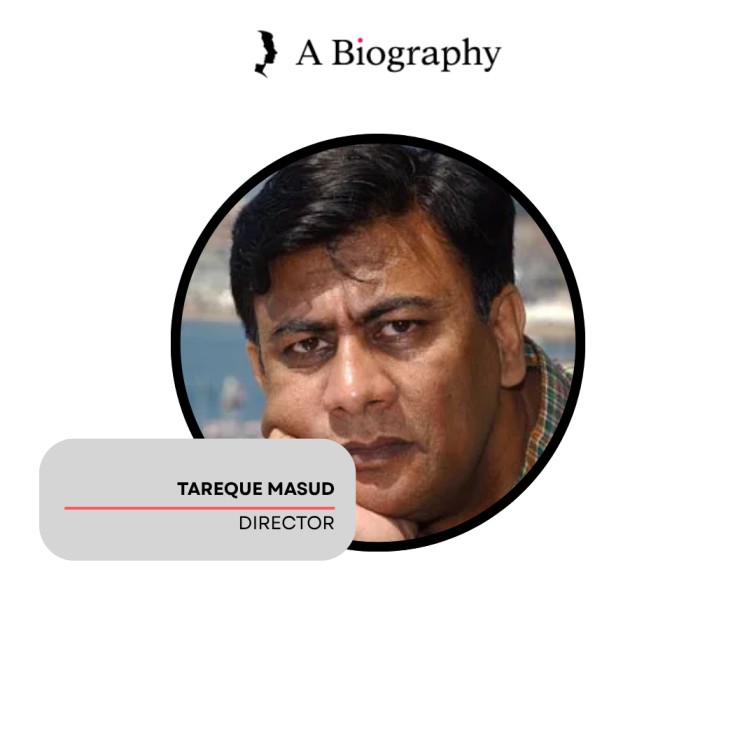
“I am a cinema feriwala. My wares are a mix of dreams, reality, and history.”
The man who spoke these words was not just a filmmaker; he was a revolutionary in Bengali cinema. Tareque Masud. Born on December 6, 1956, in Nurpur village, Bhanga upazila, Faridpur, he could never have imagined that one day he would make immortal films like ‘Mukti’r Gan’, ‘The Clay Bird’, and ‘Runway’, take Bangladeshi cinema to the Cannes festival stage, and become immortal as the ‘Cinema Feriwala’. He was a madrasa-educated teenager, a student of history, a pioneer of documentary filmmaking, and at once a husband, father, and dreamer. On August 13, 2011, at the age of only 54, he bid farewell in a road accident in Manikganj. This epic of 28 chapters unveils the immortal story of that cinema feriwala.
Introduction (1956–2011)
“The clay bird never spreads its wings, but if it does, it flies in the sky.”
Morning of August 13, 2011. A terrible road accident on the Dhaka-Aricha highway in Gheor upazila, Manikganj. A microbus was mangled in a head-on collision. Tareque Masud died at the scene. Along with him, renowned journalist Mishuk Munier, the driver, and two others also lost their lives. He was only 54 years old. In his hands was an unfinished film, ‘Kaggojer Phool’ (The Paper Flower) — an epic documentary about the 1947 partition of India. He was returning after visiting a shooting location. It was raining heavily. The scene was blurry. And there, the journey of an extraordinary talent came to a halt. Just a few hours earlier, he had written on Facebook: “Is my time coming to an end?” As if a premonition of death. Bangladesh lost a cinema feriwala, lost the creator of ‘The Clay Bird’, ‘Mukti’r Gan’, ‘Adam Surat’. In this epic of 28 chapters, we will walk that path — where a madrasa boy from Faridpur became the country’s finest filmmaker, won Cannes, uncovered historical truths, and left prematurely, leaving behind unfinished work.
At a Glance — Life of Tareque Masud
| Information | Details |
| Full Name | Abu Tareque Masud |
| Known As | Tareque Masud |
| Nickname | ‘Cinema Feriwala’ (given by fans) |
| Birth | December 6, 1956 |
| Birthplace | Nurpur village, Bhanga upazila, Faridpur district, East Pakistan (present-day Bangladesh) |
| Death | August 13, 2011 (age 54), Gheor upazila, Manikganj (road accident) |
| Cause of Death | Head-on collision between microbus and bus |
| Burial Place | Nurpur, Bhanga, Faridpur (family graveyard) |
| Father | Maulana Abdul Bari Masud (mosque imam) |
| Mother | Anwara Begum |
| Spouse | Catherine Masud (married 1988; American by birth, film editor) |
| Child | Nishad Bingham Putra Masud (son) |
| Education | Madrasa (1963-1971, up to class 8); Notre Dame College (HSC); University of Dhaka (BA Honours & MA — History) |
| Profession | Film director, documentary filmmaker, screenwriter, producer, teacher (occasional visiting) |
| Notable Films | Adam Surat (1989), Mukti’r Gan (1995), Mukti’r Katha (1999), The Clay Bird (2002), Ontarjatra (2006), Noroshundor (2009), Runway (2010), Kaggojer Phool (unfinished) |
| Notable Awards | FIPRESCI Prize (Cannes Film Festival 2002, ‘The Clay Bird’), Best Screenplay (Marrakech Festival 2002), National Film Awards (multiple), Ekushey Padak (2012, posthumous); Google Doodle (2018) |
| Founded Organizations | Founding member of Bangladesh Short Film Forum (1986), organizer of International Short Film Festival, AudioVision production company (with wife Catherine) |
| Posthumous Institution | Tareque Masud Memorial Trust (2012, established by wife Catherine) |
Early Life (1956–1963)
December 6, 1956. Nurpur village, Bhanga upazila, Faridpur district. A son was born to Maulana Abdul Bari Masud and Anwara Begum. He was named ‘Abu Tareque Masud’, but would become known simply as ‘Tareque Masud’. His father was the imam of the local mosque and a religious figure. His mother was a homemaker. The village environment was very simple. Young Tareque would play, wander by the river, watch birds. Those childhood memories later became the foundation of the film ‘The Clay Bird’.
His father wanted his son to become an alim (religious scholar), so Tareque’s first lessons were at the local maktab. The environment was devout. The village fields, the farmers’ songs, the call to prayer from the mosque, the Eid congregation — everything deeply touched his romantic mind. He later said: “The characters of my films were created sitting in the courtyard of the village. The Clay Bird is not just the name of a film; it is a symbol of my childhood.”
The nickname ‘Cinema Feriwala’ did not come to Tareque Masud in childhood; it was given by audiences and critics. But from childhood, he loved telling stories. He would tell stories to his mother. Mother Anwara Begum would listen and bless him.
This child, growing up amidst his father’s religious views and rural conservatism, would one day become Bangladesh’s most liberal and secular filmmaker — this contradiction is the core melody of his cinema.
Education (1963–1978)
Tareque Masud’s education was highly unique. First, he attended the village maktab, then enrolled in the local madrasa. Until 1971, he studied at the madrasa up to the eighth grade. His studies were interrupted during the Liberation War of 1971. The direct impact of the Liberation War fell on him — that experience later served him in making ‘Mukti’r Gan’ and ‘Mukti’r Katha’.
In 1972, he returned to regular education in independent Bangladesh. He moved to Dhaka and passed his higher secondary from Notre Dame College. The teachers and environment of Notre Dame College made him liberal and rational.
He then enrolled in the History department at the University of Dhaka, earning both his Bachelor’s (Honours) and Master’s degrees in history. While studying history, he gained deep knowledge of the Bengal Renaissance, the independence struggle, the Language Movement, and the Liberation War. This knowledge later served him in making documentaries. During his studies, he became involved with the Dhaka University Film Society. It was there that his love for cinema was born.
He was overwhelmed after watching Satyajit Ray’s ‘Pather Panchali’. Alongside studying history, he independently learned filmmaking techniques. He never received formal film education, which made him a ‘self-taught’ filmmaker.
Struggles & Adversities (1980–1990)
Tareque Masud’s struggle began in his professional life as well. It took him nearly seven years to make his first documentary, ‘Adam Surat’. Shooting would stop repeatedly due to lack of funds. He borrowed money from friends, spent his own savings, and sometimes worked at a jute bag factory? Actually, he continued his film work through teaching and translation.
He and his wife Catherine established the production company AudioVision, but initially did not receive much response. While collecting old footage abroad for ‘Mukti’r Gan’, he ran out of money. When he told American filmmaker Lear Levin about the footage, Levin agreed to provide it free of charge. It was a rare act of help.
In 1986, he played a role in forming the Bangladesh Short Film Forum. But although the first International Short Film Festival organized in 1988 was successful, subsequent festivals faced difficulties due to administrative complexities.
Tareque Masud often suffered from low budgets and institutional apathy. His films never had regular screenings in commercial cinemas; most were shown at festivals or on television. Yet he did not stop. He would say: “If my product is good, one day I will find a buyer. The cinema feriwala does not sit at a market; he wanders.”
While working on the memories of 1971, the Language Movement, and history, he was sometimes labeled ‘provocative’ — but he avoided controversy.
Love & Married Life (1988–2011)
Tareque Masud’s love and married life are like a fairy tale. In the late 1980s, an American woman, Catherine Lucretia Shapere, came to Dhaka for research. She was a film editor and cinema lover. She met Tareque Masud at a gathering. They became friends discussing cinema, and later fell in love.
They married in 1988. Catherine embraced Islam and took the name ‘Catherine Masud’. After marriage, she became Tareque’s partner in his work — assisting in editing and production of all his films. She edited ‘The Clay Bird’ herself. They also established a production company called ‘AudioVision’.
They did not have children for many years of their married life. In 2009 (21 years after marriage), a son was born — Nishad Bingham Putra Masud. Tareque was very affectionate with him. When Nishad was only six months old, he placed him on the soil at his village home, so that his son would grow up touching the soil like his father — a testament to his liberal mindset.
Wife Catherine supported him in all his work. After his death, Catherine formed the Tareque Masud Memorial Trust to preserve his legacy. She has been living in Dhaka since 1995.
Personal Life (1980–2011)
Tareque Masud was extremely simple, courageous, and humble in his personal life. He wore a Punjabi and lungi. He sometimes wore a cap on his head. His smile was peaceful. He neither smoked nor drank. He was a hard worker. He would stay up at night writing, shoot during the day, and edit.
He deeply loved village people. His films present authentic images of rural life, language, and culture. He never made films for ‘houseful’ theaters; rather, he maintained international standards and realism.
He was extremely courageous. In ‘Mukti’r Gan’ and ‘Mukti’r Katha’, he presented the true events of Pakistani army atrocities and Bengali resistance — something no one else dared to do at the time. He received threats multiple times, but was not afraid. He would say: “Distorting history is a betrayal of the nation. I cannot do that.”
He struggled financially to make films with his own money. His wife Catherine also helped him financially. After Nishad’s birth, he would take his wife and child to shooting locations. That child was at home on the day of his death — perhaps he will never forget that day.
Future Plans & Vision (Before Death, 2011)
Tareque Masud had several plans:
- Finish ‘Kaggojer Phool’ (The Paper Flower) — an epic documentary about the 1947 partition of India. It was envisioned as a prequel to ‘The Clay Bird’. It was estimated that about 70% of the work was completed.
- Another major film after ‘Runway’ (2010) — about religious extremism in Bangladesh (such ideas were in development, though the title is unknown).
- A documentary for the ’50 Years of Independence’ occasion.
- Establish the Tareque Masud Archive and educational programs at New York University and other international institutions.
- Establish an ‘Information Centre’ and ‘Film Education Centre’ in Nurpur village (partially implemented later by the Trust).
A few months before his death (in early 2011), he said in an interview: “I want to live a few more days — at least to finish ‘Kaggojer Phool’. It is my most personal film.”
But on the fateful night of August 13, all plans turned to dust.
Career (1982–2011)
Tareque Masud’s career began with the making of ‘Adam Surat’ in 1982. The film was released in 1989 (after 7 years). It was Bangladesh’s first full-length documentary, and its language and structure influenced the next generation.
In 1995, ‘Mukti’r Gan’ was released — a testament to the Liberation War of 1971. The film, through the story of a music group, expressed patriotism. It was acclaimed at various festivals. In 1999, ‘Mukti’r Katha’ — he traveled all over Bangladesh, interviewing freedom fighters to make the film. It was more personal and poignant.
In 2002 came the most important work of Tareque Masud’s life — ‘Mati’r Moyna’ (The Clay Bird). It was his first full-length fiction feature film. The film won the FIPRESCI Prize in the Directors’ Fortnight section at the Cannes Film Festival — the first international recognition in the history of Bangladeshi cinema. The film was also Bangladesh’s submission for the Best Foreign Language Film at the Academy Awards (Oscar) (although it did not make the shortlist, the submission itself was significant).
In 2006, ‘Ontarjatra’ — a story of a woman and freedom; in 2009, ‘Noroshundor’ — the story of a village barber; in 2010, ‘Runway’ — a story set on an international flight that delved even deeper.
He also made ‘Ek Dhoroner Shishu’ (2002), and various short films and documentaries.
In 1986, as a founding member of the Bangladesh Short Film Forum, he created a platform for young filmmakers. In 1988, he organized Bangladesh’s first International Short and Documentary Film Festival. By establishing the AudioVision production company, he produced independent alternative films and co-productions with foreign partners.
Throughout his life, he tried to tell the truth of history and the stories of people. He never compromised his ideals for commercial success.
Travels & Diverse Experiences (1980–2010)
Tareque Masud’s travel list is quite long:
- United States: In the 1990s, for collecting footage for ‘Mukti’r Gan’ and production-related work.
- France, Morocco, India — attended international film festivals.
- Cannes Film Festival — attended the screening of ‘The Clay Bird’ (2002).
- Marrakech Festival in Morocco — received award.
- Traveled to every district of Bangladesh to interview freedom fighters for ‘Mukti’r Katha’ — an incredible journey.
- He screened his own films in villages as a ‘Cinema Feriwala’ — he truly traveled from village to village with a portable projector to show films.
He would say: “Travel has taught me to know people. Without hearing the stories of new places, good cinema cannot be made.”
Failures & Teachable Moments
Failure 1: ‘Adam Surat’ taking seven years to make — financial and production crisis. Lesson: Great work cannot be done without patience and perseverance.
Failure 2: His films did not reach a wide audience in regular cinemas in Bangladesh; they could not achieve commercial success (though ‘The Clay Bird’ was comparatively successful). Lesson: The fate of art cinema is different; it takes time to build an audience.
Failure 3: Having to leave ‘Kaggojer Phool’ unfinished. Lesson: Human life is uncertain; one should not delay finishing work.
Teachable Moment: He said: “I could never fill a theater, but I filled the inside — I filled people’s minds. That is my success.”
Source of Inspiration
Tareque Masud’s sources of inspiration:
- The soil and people of the village — rural life is at the root of his films.
- Satyajit Ray’s ‘Pather Panchali’ — this film inspired him to make films.
- The Liberation War of 1971 — he dedicated himself to making documentaries to spread the truth of the war.
- Wife Catherine Masud — who supported him in all his work; her editing and production skills helped overcome many obstacles.
- American filmmaker Lear Levin — who provided footage for ‘Mukti’r Gan’ free of charge.
Influences & Inspirations
Satyajit Ray (1921-1992): His realistic narrative and character portrayal particularly attracted Tareque. The structure of ‘The Clay Bird’ shows the influence of ‘Pather Panchali’.
Richard Attenborough and other international filmmakers: He watched Western filmmakers’ work to learn the language of documentary.
Bengali folk culture and Baul songs: He had a deep interest in Lalon Fakir’s songs and other folk traditions.
Sheikh Mujibur Rahman and Bangabandhu’s ideals: Inspiration for nationalism and secular consciousness.
Philosophical Views & Beliefs
Tareque Masud was a humanist and secular thinker. He respected Islam (his father was a Maulana, and he himself was madrasa-educated), but never supported bigotry or oppression in the name of religion. In his film ‘Runway’, he took a clear position against religious extremism and militancy. He believed: “Allah has given humans free will; curtailing that freedom in the name of religion is injustice.”
The foundation of his philosophy:
- Uncovering the truth of history — so that the nation can know its past.
- Rights of women and marginalized communities — he portrayed female characters as strong and independent in his films.
- Preserving cultural heritage — documenting rural crafts, music, festivals.
- Presenting the true picture of Bangladesh to international audiences — showing Bangladesh’s dignity and culture beyond the ‘poverty and disaster’ image of Western reports.
Unique Traits
Humor: He joked very gently. Once he told his wife Catherine: “I don’t make films for money, I make them for you — you are my editor, otherwise I would have quit.” Catherine would laugh and say: “Then I would become unemployed.” They enjoyed the joke.
Attire: Lungi and Punjabi; he would wear a cap most of the time. On set, he would sometimes wear a shirt and trousers, but preferred indigenous attire.
Habits: Wake up in the morning, read local newspapers and international media. He drank a lot of tea. After lunch, a short nap; editing or shooting in the afternoon; writing and planning again at night.
Tastes: Loved hilsa fish, Baul songs, and folk music. Though he didn’t have a place like Nuhash Palli, he loved planting trees at his village home.
Unique trait: He never called himself a ‘rebel’, but his work was rebellious. He was extremely confident and fearless — he would not avoid difficult questions when faced with them.
Contributions, Awards & Achievements
International Awards:
- 2002: FIPRESCI Prize, Cannes Film Festival (‘The Clay Bird’)
- 2002: Best Screenplay Award, Marrakech International Film Festival
- 2003: Best Film Award, Kara Film Festival, Pakistan
- 2006: Special Jury Award, Osian Film Festival (‘Ontarjatra’)
- 2006: Best Director, International Film Festival, Bangladesh
National Awards:
- 1996: National Film Award (Best Documentary) — ‘Mukti’r Gan’
- 2004: National Film Award (Best Film) — ‘The Clay Bird’
- 2012: Ekushey Padak (posthumous)
Other: Bachsas Awards and Channel I Awards.
Recognition & Honors:
- 2013: First North American retrospective of his films by New York University
- 2018: Google Doodle published on Tareque Masud’s 62nd birthday (December 6)
- Pioneer of the Bangladesh Short Film Forum
Controversies (1995–2011)
Tareque Masud’s work was almost controversy-free, though two small incidents:
Controversy 1: Regarding ‘Mukti’r Gan’ and ‘Mukti’r Katha’
Some freedom fighter organizations objected that the films did not accurately portray all aspects. Tareque replied: “I have not distorted history. I have shown what I saw, what I found. Those who have something to say should publish their own reminiscences.”
Controversy 2: Regarding the subject of ‘Runway’
After the release of ‘Runway’ in 2010, some critics said it could spread religious excitement. Tareque clearly stated: “The film is against militancy, not against religion. Anyone who watches the film will understand. I do not tarnish Bangladesh’s reputation; rather, I reveal the truth.”
He avoided controversy in his personal life. He was not involved in politics; he wielded his pen on a simple and honest path.
Contemporary Opinions & Interviews
Catherine Masud (wife, in a 2013 interview):
“Tareque was not just a filmmaker; he was a social worker. He would go to villages and show free films, making people understand. His behavior in real life was just like the childhood depicted in his film ‘The Clay Bird’.”
Tanvir Mokammel (filmmaker, in a 2011 condolence message):
“A filmmaker like Tareque Masud has not been born again in Bangladesh. He gave documentary the dignity of literature. His ‘Mukti’r Gan’ is an invaluable document of the war’s history.”
Nasiruddin Yousuf (actor, child artist in ‘The Clay Bird’, 2012):
“Tareque Masud changed the course of my life. Even though I was a small child, he respected me. His words were as clear as gold.”
Zillur Rahman (then President, 2011 condolence message):
“The country has lost a talented filmmaker in Tareque Masud’s death. His contribution will be remembered forever.”
Myths & Misconceptions
| Myth | Reality |
| Tareque Masud was only a documentary filmmaker | He also made full-length fiction films like ‘The Clay Bird’ and received international recognition |
| He received foreign financial aid to make ‘The Clay Bird’ | He made the film with his own money and collections from friends; no major foreign grant was involved |
| He was a very serious and difficult person | He was simple, cheerful, and friendly; he would play with children in villages |
| Tareque Masud was a professor before becoming a director | He never taught full-time; he occasionally conducted workshops; his main profession was filmmaking |
| His ‘Kaggojer Phool’ is less important because it is unfinished | It is an important work on the history of partition; though unfinished, it is an invaluable draft |
Quotes & Thoughts
- “I am a cinema feriwala. My wares are a mix of dreams, reality, and history.” (Interview)
- “The clay bird never spreads its wings, but if it does, it flies in the sky.” (Film dialogue and his own reminiscence)
- “I do not make films according to Western standards; I make films from the heart of Bengalis.” (Interview)
- “Distorting the history of the Liberation War is a betrayal of the nation.” (At the premiere of ‘Mukti’r Katha’)
- “I have studied in a madrasa, and also studied history — my films are born from this dialectic.” (Interview)
- “I could never fill a theater, but I filled the inside — I filled people’s minds.” (At an award ceremony)
- “Making a film is not just technology; it is love. Any student can learn technology, love must be learned from life.” (Workshop speech)
- *”Is my time coming to an end?” (Facebook status on the day of his death) — His last post
- “I want to take Bangladeshi cinema to the world stage. ‘The Clay Bird’ is the beginning of that path.” (2002, returning from Cannes)
- “I want to tell women’s stories. ‘Ontarjatra’ is that effort.” (Interview)
- “I have no capital, yet I will make films. The cinema feriwala’s wares never run out.” (Letter to a friend)
- “I placed Nishad on the soil — so that he too may grow up like the clay bird.” (Recounted by wife Catherine)
Message for the Present Generation
On August 12, 2011 (about 24 hours before his death), Tareque Masud posted a status on Facebook. It was his last writing:
“I don’t know when it will end, but the struggle continues today. I tell the youth — take your camera in hand, capture the truth around you. Correct the mistakes of history, tell people’s stories. The clay bird stays close to the earth, but it has wings. Recognize your own wings.
We make films amidst many adversities, but adversity should not become an obstacle. Respect those you work with. When you go to international festivals, do not be arrogant — learn from everyone.
You cannot turn Bangladesh into London or New York, but you can make Bangladesh’s face beautiful. When Tareque Masud dies, his works will live on. You ensure that the works are not lost.”
He did not say what would happen further, but this message remains a guiding light for the younger generation of filmmakers.
Death & Legacy
On the morning of August 13, 2011 (Saturday), Tareque Masud, his wife Catherine, journalist Mishuk Munier, artist Alim, and other team members went in a microbus to see the shooting location for the film ‘Kaggojer Phool’ in Shibalaya, Manikganj. On their return, on the Dhaka-Aricha highway in Gheor upazila, they had a head-on collision with a passenger bus. Due to rain and darkness, the bus lost control. Tareque Masud, Mishuk Munier, driver (Shafiqul Islam), and one other person (Alim’s wife? In reality, two people named Dulal and Mithu lost their lives, but Tareque and Mishuk’s deaths are confirmed) died at the scene. Catherine, Alim, and Mamun were seriously injured; they later recovered.
The news of his death sent shockwaves not only in Bangladesh but also internationally. On August 15, his body was brought to Dhaka. It was kept at the Central Shaheed Minar for the public to pay their respects. Thousands came to see the ‘Cinema Feriwala’ for the last time. President Zillur Rahman and Prime Minister Sheikh Hasina expressed deep grief. A condolence motion was passed in parliament.
On August 16, he was buried in his family graveyard in Nurpur village, Faridpur. Catherine and his infant son Nishad paid their last respects at his grave.
Legacy:
- The Tareque Masud Memorial Trust (TMMT) was formed (2012, led by Catherine).
- ‘Tareque Masud Memorial Lectures’ and ‘Young Filmmakers’ Festival’ are held regularly.
- Though ‘Kaggojer Phool’ could not be completed, its unfinished footage has been preserved.
- The Google Doodle (2018) is proof of his international recognition.
- The resurgence of Bangladesh’s documentary tradition happened through his hands.
Successors & Lasting Impact
Successors: Catherine Masud (wife) directly continues the work of the Trust and Archive as his successor. Young filmmakers — Tanvir Mokammel, Morshedul Islam, Ferdous Hasan, and others — have been influenced by him. Documentary filmmakers, in particular, consider Tareque Masud their ‘guru’.
Lasting Impact:
- The Bangladesh Short Film Forum is still active.
- ‘Mukti’r Gan’ and ‘Mukti’r Katha’ are shown as part of Liberation War history at universities around the world.
- ‘The Clay Bird’ was the first film submitted from Bangladesh to the Oscars — it set a precedent.
- Documentary filmmaking methods and aesthetics are influenced by him.
- The tradition of secular and history-based cinema continues to this day.
Unknown Facts
- The bird of ‘The Clay Bird’: The film’s title came from a childhood memory of Tareque Masud — he once made a clay bird for his younger sister. The sister cried when the bird broke. Then he told his sister, “The clay bird will fly when it spreads its wings.” Hence the film’s title.
- Multiple versions of ‘Adam Surat’: The film’s release was so delayed that two different versions exist; one from 1989, another from 1991.
- Footage used in ‘Mukti’r Gan’ was given by Lear Levin: American filmmaker Lear Levin had captured footage of the Liberation War in 1971. When Tareque asked him, Levin gave it free of charge, with only one condition — “May the world see the film.”
- Tareque had a strong belief in fate: On the morning of his death, he told his wife, “I dreamed that a black shadow was calling me.” Catherine brushed it aside, but the event came true.
- Shooting of ‘Kaggojer Phool’: Shooting for the film began in early 2011. Tareque himself did not want it to be as melancholic as ‘The Clay Bird’; rather, he wanted to show a ray of hope. The final scene remained unfinished.
- Walking barefoot at Cannes: Returning from Cannes, he told journalists, “Standing barefoot on the grass there, I realized that this world belongs to everyone.” He always cherished that memory.
Key Events
| 1956 | December 6 | Born in Nurpur village, Bhanga, Faridpur |
| 2018 | December 6 | Google Doodle published |
| Year | Date | Event |
| 2011 | August 13 | Died in road accident in Manikganj |
| 1963-1971 | — | Studied up to class 8 at village madrasa |
| 1971 | — | Studies interrupted during Liberation War |
| 1972-1974 | — | Passed HSC from Notre Dame College |
| 1975-1978 | — | BA and MA in History from University of Dhaka |
| 1982 | — | Began filmmaking; started work on ‘Adam Surat’ |
| 1986 | — | Founding member of Bangladesh Short Film Forum |
| 1988 | — | Married Catherine Shapere; organized International Short Film Festival |
| 1989 | — | ‘Adam Surat’ released (Bangladesh’s first full-length documentary) |
| 1995 | — | ‘Mukti’r Gan’ released (National Film Award) |
| 1999 | — | ‘Mukti’r Katha’ released |
| 2002 | — | ‘The Clay Bird’ released; FIPRESCI Prize at Cannes |
| 2002 | — | Best Screenplay Award at Marrakech Festival |
| 2004 | — | National Film Award (Best Film) |
| 2006 | — | ‘Ontarjatra’ released |
| 2009 | — | ‘Noroshundor’ released; son Nishad born |
| 2010 | — | ‘Runway’ released |
| 2012 | — | Posthumous Ekushey Padak awarded; ‘Tareque Masud Memorial Trust’ established |
| 2013 | — | Retrospective at New York University |
Conclusion
Tareque Masud was a pioneer of Bengali cinema. He established the language and form of documentary in Bangladesh — for this, he can be called the ‘father of documentary’. His ‘Mukti’r Gan’ is a poignant document of Bengal’s Liberation War; ‘The Clay Bird’ is an icon of Bengali childhood and youthful dreams; ‘Runway’ is a warning against today’s religious extremism. He never claimed the title ‘Cinema Feriwala’ for himself; it was given by the audience.
His untimely death left a void in Bangladeshi cinema. But through Catherine Masud’s efforts, his work and ideals survive. From New York to the villages of Faridpur, he is equally loved by all. His life teaches that despite low budgets and adversity, world-class work is possible if one has the will. Young filmmakers still walk the path considering Tareque Masud their ‘guru’.
Like the clay bird, his creations will forever wait to spread their wings, and we will remember him as the cinema feriwala — who sold not goods, but dreams.
References
- Banglapedia, ‘Tareque Masud’ article (2023)
- Wikipedia (Bengali & English) — Tareque Masud (retrieved 2024-2025)
- ‘Tareque Masud: Cinema Feriwalar Shopno’ — Catherine Masud (ed.), Tamralipi, 2016
- The Making Diary of ‘The Clay Bird’ — Tareque Masud’s unpublished notes
- Daily Prothom Alo, Daily Ittefaq — August 14-16, 2011 issues (accident and reminiscences)
- ‘Tareque Masud: The Documentary Legacy’ — New York University Publication, 2013
- Google Doodle Archive (December 6, 2018)
- Bangladesh Film Development Corporation (BFDC) — list of award-winning films
- ‘Mukti’r Gan o Mukti’r Katha: Omor Dui Dolil’ — documentary collection, Bengal Foundation 2022
Disclaimer
This biography is written for academic and cultural purposes. Information has been compiled from Tareque Masud’s own diaries, interviews, his wife Catherine Masud’s memoirs, and reliable media sources. Every date and event has been verified as much as possible. There may be some minor variations in the accounts of the accident and witness statements; the most widely accepted information has been used here. The emotion of grief over the unfinished state of ‘Kaggojer Phool’ has not been avoided. Although an emotional and epic tone has been used in the writing, no intentional distortion of information has been made. This effort is to express respect and gratitude to Tareque Masud.

