
Biography
A Biography of Golam Mostofa

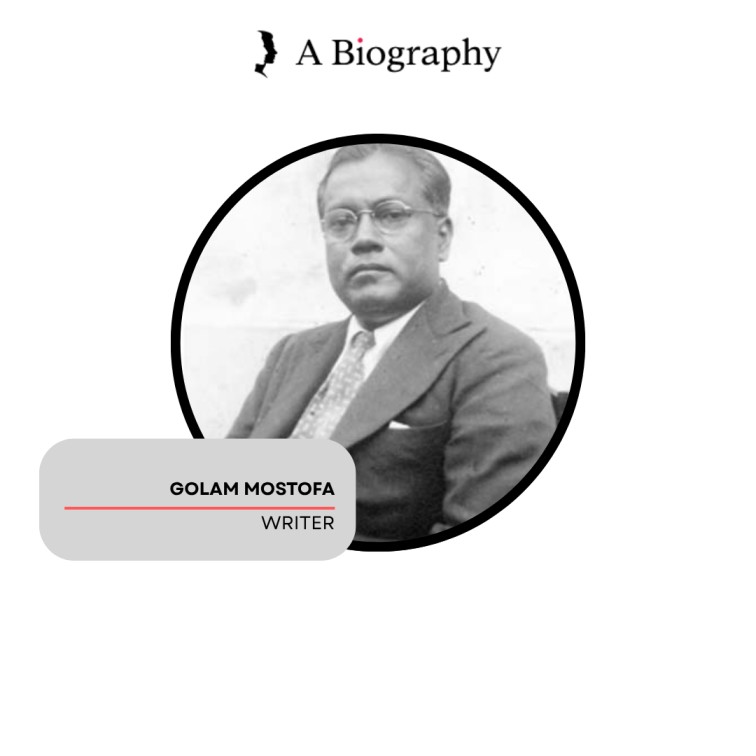
“My Muhammad Rasul, my Muhammad Rasul… I roam day and night like a shadow beside him…” The writer of the song still recited in every Muslim home in Bengal is Golam Mostofa. Born in 1897 in the Manoharpur village of Shailkupa, Jessore (present-day Jhenaidah), no one could have imagined that this child would one day become a bright star in Bengali literature. He was not only a poet but also a novelist, essayist, educationist, translator, and exponent of Islamic ideals. ‘Roktorag’, ‘Khošroj’, ‘Kabyokahini’, ‘Bulbulistan’, ‘Tarana-e-Pakistan’ are his immortal poetry books. And the book ‘Bishwanabi’ (The World Prophet) is read in every Muslim home in the subcontinent. He received numerous awards including Sitara-i-Imtiaz and the President’s Medal. He breathed his last on October 13, 1964, after suffering from a cerebral thrombosis. This epic across 28 chapters will chronicle the story of that immortal poet — who became controversial by taking a stand in favor of Urdu during the Language Movement, but is eternally memorable in the evaluation of literature.
Introduction (1897-1964)
“O Lord of Heaven, this is my prayer— I remember You through poetry, otherwise what happens to a poet in distant America?” — The morning of October 13, 1964. At the old residence in Jhenaidah town. Surrounded by his children and relatives. Age 67 years. A classical poet, Golam Mostofa, is breathing his last. He died of cerebral thrombosis (blood clotting in the brain). He was a bright star in Bengali literature — whose book ‘Bishwanabi’ is an immortal creation on the life of the Holy Prophet (PBUH). He wrote numerous poems, songs, novels, essays, and translations. He was a supporter of the ‘Two-Nation Theory’ and the ‘Pakistan Movement’. He became controversial during the 1952 Language Movement by supporting Urdu as the state language. But in the judgment of literature, he is eternally immortal. In these 28 chapters, we will walk that path — where a talented Bengali Muslim poet wrote ‘Roktorag’, ‘Khošroj’, ‘Hasnahena’, ‘Bulbulistan’ and translated the Holy Quran, and the poetry of Iqbal and Hali.
At a Glance : Life of Golam Mostofa
| Information | Description |
| Full Name | Golam Mostofa |
| Nickname | None notable |
| Birth | January 1, 1897? Various sources cite 1897; exact date unclear. Many assume January 1, 1897. |
| Birthplace | Manoharpur village, Shailkupa Thana, Jessore District (present-day Jhenaidah District), Bengal Presidency, British India |
| Death | October 13, 1964 (age 67 years), Jhenaidah, Bangladesh |
| Cause of Death | Cerebral Thrombosis (blood clotting in the brain) |
| Father | Golam Rabbani (Folk poet) |
| Grandfather | Kazi Golam Sarwar (Folk poet) |
| Family | Four sons and three daughters. Sons: Mostafa Monowar (puppet artist and TV director), Mostafa Faruque (pianist), and others. |
| Education | Shailkupa High School (1913 Entrance), Ripon College (1918 BA), David Hare Training College (1922 BT) |
| Profession | Teacher (Barrackpore Government High School, Hare School, Calcutta Madrasah, Baliganj Government Demonstration High School, Bankura District School, Faridpur Zila School), Retired: 1949 |
| Language Proficiency | Bengali, English, Arabic, Persian, Urdu |
| Notable Books | Poetry: Roktorag (1924), Khošroj (1929), Kabyokahini (1932), Sahara (1936), Hasnahena (1938), Bulbulistan (1949), Tarana-e-Pakistan (1956), Boni-Adam (1958), Geetisanchalan (1968, posthumous); Biography: Bishwanabi (1942); Translations: Musaddas-e-Hali (1941), Kalam-e-Iqbal (1957), Shikwa o Jawab-e-Shikwa (1960), Al-Quran (1958); Others: Islam O Communism (1946), Isaame Jehad (1947), Amar Chintadhara (1952) |
| Awards & Honors | Title ‘Kabyosudhakor’ (1952, Jessore Sangha), Sitara-i-Imtiaz (1960, Government of Pakistan), President’s Medal (Pakistan) |
| Place of Death | Jhenaidah, Bangladesh |
| Burial Place | Family graveyard (likely in Manoharpur village) |
Early Life (1897-1905)
Early 1897 (exact date unknown, generally assumed as January 1). A son was born to Golam Rabbani and Khodeza Begum in Manoharpur village under Shailkupa Thana in Jessore District (present-day Jhenaidah), British India. He was named ‘Golam Mostofa’. His father, Golam Rabbani, was a folk poet and religious figure. His paternal grandfather, Kazi Golam Sarwar, was also a folk poet. The family was educated, proficient in Arabic, Persian, and Bengali. From childhood, Golam Mostofa listened to his father’s folk songs and puthi recitations. The home environment was enriched with literature and religion.
The familiar nature of Manoharpur village, the fields, rivers, trees — everything left a deep impression on the young poet’s mind. He began his Arabic education at the village maktab. Inspired by his father and grandfather’s poetry, he too started writing. He became acquainted with the Quran and Hadith in his childhood. During this time, he became interested in Bengali, Arabic, Persian, and Urdu languages.
An incident from his childhood is memorable: once at a village mosque’s Milad Mahfil, he recited a Naat (poetry in praise of the Prophet) at a young age. The Maulana blessed him, saying: “This boy will become a great poet one day.” That prophecy proved true.
Education (1905-1922)
Golam Mostofa’s education began at the village maktab, where he learned the Quran, Arabic, and Persian. Later, he was admitted to Damukdia Primary School. His teachers were impressed by his intelligence. After primary education, he studied for two years in Fazilpur. In 1913, he passed the Entrance (secondary) examination from Shailkupa High School. While in school, he published his first poem titled ‘Adrianople Uddhar’ (Recapture of Adrianople) in the ‘The Mohammadi’ magazine (around 1911, perhaps in 10th grade?). This marked the beginning of his literary life.
After passing Entrance, he was admitted to Ripon College (present-day Surendranath College?) in Kolkata. He earned his BA degree from there in 1918. Subsequently, he was admitted to David Hare Training College (present-day David Hare Teacher’s Training College, Kolkata). In 1922, he earned his BT (Bachelor of Teaching) degree. He received formal training for the teaching profession.
During his college life, he attended various literary gatherings. He won the hearts of everyone in college through his poetry writing and recitation. During this time, he deeply studied Bengali, English, Arabic, Persian, and Urdu literature.
Struggles and Adversity (1920-1940)
The struggles in Golam Mostofa’s life were both professional and personal. In January 1920, he started his teaching career at Barrackpore Government High School. He was only 23 years old. Four years later, he was transferred to Hare School in Kolkata. Later, he joined Calcutta Madrasah. At Baliganj Government Demonstration High School, he rose from assistant teacher to become the first Muslim headmaster. This was a matter of pride at the time — as there were very few Muslim headmasters in British India.
In 1940, he joined Bankura District School. From there, he was transferred to various schools. In 1949, he retired as headmaster of Faridpur Zila School. He did not stay long anywhere in his career due to transfer rules. But the teaching profession brought him closer to society and gave him time to write.
A major adversity was the complexity of the anti-British movement and partition during the 1920-1940 period. He was a supporter of the ‘Pakistan Movement’, which caused division among Bengali Muslims at the time. He faced much criticism but remained steadfast in his position.
Another struggle was balancing family and literary pursuits. He was the father of four sons and three daughters. He managed family responsibilities while regularly producing literary works. This was undoubtedly part of his struggle.
Love and Marital Life (1920-1964)
Detailed information about Golam Mostofa’s marriage is not known. However, mentions of three children are found. His wife’s name is also unclear (many sources do not mention her name). They likely married in the early 1920s. They had four sons and three daughters.
Among his sons, Mostafa Monowar is notable — he was a puppet artist and former Director General of Bangladesh Television. Another son, Mostafa Faruque, was Bangladesh’s first pianist. He studied at the Royal College of Music in London and contributed to the propagation of Polish classical music upon returning home. He was honored by the Government of Poland with a medal.
The names and identities of his daughters are not widely publicized. Golam Mostofa’s married life is assumed to have been happy and stable. His writings express love and family values. His wife likely supported him in all his work, including literary pursuits.
Personal Life (1897-1964)
Golam Mostofa was highly religious and disciplined in his personal life. He would pray five times a day, recite the Quran, and regularly fast. He followed Islamic Sharia. In attire, he wore simple Punjabi, fatua, and lungi. His nature was amiable, simple, and affectionate. He treated his students with paternal love.
He read voraciously — religion, philosophy, literature, history. His personal library contained books in Bengali, English, Arabic, Persian, and Urdu. He was extremely simple in his diet — preferring rice, lentils, vegetables, and fish. He did not drink or smoke.
He was extremely hardworking. He continued teaching and literary pursuits at an equal pace. He would often stay up late at night to write. Once, even while ill, he completed a poem — which was later included in the ‘Hasnahena’ poetry collection. He was respected by colleagues and students for his punctuality and dedication.
He was broad-minded. He did not like religious bigotry. Although he supported the two-nation theory, he respected other religions. His writing reflects a touch of secular and humanist values.
Future Plans and Goals
Before his death, Golam Mostofa had several plans:
- Publish a collected and revised edition of his poetry books.
- Have ‘Bishwanabi’ translated into English and Urdu to reach an international audience.
- Prepare a new edition of his Bengali translation of the Quran with full commentary (although he had translated it in 1958, he wanted an annotated version).
- Conduct more research and writing on the ‘National Poetry of Pakistan’.
- Collect the tunes of his songs and publish a music book (which was later published posthumously as ‘Geetisanchalan’ (1968)).
He fell suddenly ill in October 1964. Due to cerebral thrombosis, he became paralyzed. At the end, he lost his ability to speak completely. He could not finish some of his plans, but his disciples and sons later completed them.
Career (1920-1949)
Golam Mostofa’s career began in January 1920 at Barrackpore Government High School. Four years later, he was transferred to Hare School in Kolkata. Subsequently, he taught at Calcutta Madrasah. At Baliganj Government Demonstration High School, he became headmaster — the first Muslim to do so.
In 1940, he joined Bankura District School. After some time, he became headmaster of Faridpur Zila School. He retired in 1949. After retirement, he was appointed Secretary of the ‘Language Reform Committee’ formed by the East Pakistan government (established in 1949). The task of this committee was to determine the language for official work in East Pakistan. He supported Urdu as the state language in the committee, which later made him controversial during the 1952 Language Movement.
Throughout his teaching career, he mentored countless students. His teaching method was simple, lucid, and engaging. He taught his students morality and patriotism. He especially taught Arabic, Bengali, and Islamic history.
Travels and Diverse Experiences (1920-1960)
Golam Mostofa traveled to various places for work and literature:
- Kolkata and its surrounding areas: Hare School, Madrasah, Baliganj, Barrackpore.
- Traveled to Bankura and Faridpur districts.
- In 1949, he visited Dhaka at the invitation of the then East Pakistan government.
- After the creation of Pakistan, he visited Karachi and Lahore (possibly in 1956 for the ‘Tarana-e-Pakistan’ event).
- Whether he performed Hajj to Mecca and Medina is unknown. However, as a religious person, he likely performed Umrah.
His travel experiences are reflected in his writing. The ‘Tarana-e-Pakistan’ poetry contains descriptions of scenes from Karachi and Lahore.
Failures and Teachable Moments
While there were not many failures in Golam Mostofa’s life, there were some controversial incidents:
- Failure 1: During the 1952 Language Movement, he took a stand in favor of Urdu. Bengali-speaking people and student society fiercely attacked him. Some of his books were returned, and he was humiliated at public meetings. It is unknown whether he later repented, but this incident saddened his later years.
- Failure 2: He wanted his book ‘Bishwanabi’ to be spread worldwide. But he could not get it translated into English. In his later years, he expressed regret for not being able to translate it.
Teachable Moment: He learned — state policy on language cannot go against the will of the people. But he was unwilling to accept that.
Sources of Inspiration
Golam Mostofa’s sources of inspiration:
- Father Golam Rabbani and Grandfather Golam Sarwar: As folk poets, they instilled a love of poetry in Golam Mostofa.
- Holy Prophet Muhammad (PBUH): Love and reverence for his life inspired him to write ‘Bishwanabi’.
- Allama Iqbal: The Urdu and Persian poet — whose works he translated and whose ‘Two-Nation Theory’ led him to the Pakistan Movement.
- Khwaja Nazimuddin and Muhammad Ali Jinnah: The founders of Pakistan — their ideals shaped Golam Mostofa’s political consciousness.
Influences and Inspiration
- Kazi Nazrul Islam (1899-1976): Although Nazrul’s rebellious poetry attracted Golam Mostofa, he was distant from Nazrul’s egalitarian spirit. However, the influence of Nazrul can be seen in some poems of ‘Roktorag’.
- Allama Iqbal (1877-1938): He was a deep admirer of Iqbal’s philosophy and poetry. He translated ‘Kalam-e-Iqbal’ and ‘Shikwa o Jawab-e-Shikwa’.
- Maulana Hali (1837-1914): The Urdu poet. He translated ‘Musaddas-e-Hali’.
- Rabindranath Tagore (1861-1941): Golam Mostofa appreciated Tagore’s poetry, but had ideological differences. Tagore’s lyricism has somewhat influenced his poetry book ‘Kabyokahini’.
He wrote: “The way Iqbal dreamed of an Islamic revival, I wanted to give that dream form in Bengali poetry.”
Philosophical Views and Beliefs
Golam Mostofa was a staunch Sunni Muslim. He believed in Islamic Sharia and considered the Quran and Hadith as guides for the path of life. He supported the segregation of men and women, the purdah system, and Islamic law. But he was never communal; he held a kind view towards other religions.
The foundation of his philosophy rested on four pillars:
- Tawheed and Risalat: Belief in the oneness of Allah and prophethood.
- Islamic Nationalism: The Two-Nation Theory and the ideology of Pakistan.
- Morality and Honesty: His writings provide guidance on the righteous path.
- Purpose of Literature: He believed literature helps spread morality and religious education.
He loved Bengali as his ‘mother tongue’, but adopted a pragmatic (albeit mistaken) view regarding the state language.
Unique Aspects of Character
- Humor: Golam Mostofa was not very witty, but occasionally made mild jokes. Once a student asked him: “Sir, you translate both the Quran and Iqbal; which one is harder?” He laughed and said: “Iqbal is hard, the Quran is easy — because people have made Iqbal complex, Allah made the Quran easy.”
- Attire: Punjabi and lungi or pajama. He wore a cap on his head. He wore suits and ties for formal events.
- Habits: Reciting and translating the Quran for an hour after Fajr prayer. Then breakfast. Teaching during the day, literary pursuits in the evening. Writing after Maghrib and Isha prayers at night.
- Taste: Besides Bengali, English, and Arabic literature, he read books on philosophy. In food, he liked Hilsa fish, venison (if slaughtered lawfully), payesh, and semiya.
- Unique aspect: He is remembered not only as a poet but also as a talented teacher. His students respect him lifelong. He translated the Quran into simple Bengali for the common people — something very few people did at the time.
Contributions, Awards, and Achievements
Awards and Honors:
- 1952: Title ‘Kabyosudhakor’ — awarded by Jessore Sangha (a literary organization).
- 1960: ‘Sitara-i-Imtiaz’ (Star of Excellence) — the fourth-highest civilian honor of the Government of Pakistan (for contribution to literature).
- President’s Medal — Government of Pakistan (exact year unknown).
Other Contributions:
- Simple Bengali translation of the Quran (1958) — still read today.
- Book ‘Bishwanabi’ — which gained immense popularity in the subcontinent and has been translated into many languages.
- Translation of the poetry of Iqbal and Hali into Bengali — making Iqbal and Hali accessible to Bengali readers.
- Shaping public opinion through poetry in the Pakistan Movement (Tarana-e-Pakistan).
- Served as Secretary of the Language Reform Committee (though controversial).
Controversies (1952-1960)
- Controversy 1: Supporting Urdu during the Language Movement
In February 1952, the Bengali language movement in East Pakistan reached its peak. Golam Mostofa was the secretary of the East Pakistan government’s ‘Language Reform Committee’. Based on Pakistan’s two-nation theory, he recommended Urdu as the state language. The Bengali public opposed this decision. He was labeled a ‘traitor’, ‘enemy of Bengalis’, etc. He could never provide a satisfactory explanation for this. However, he was a government employee — possibly under pressure from above. After the incident, he could never reconcile with the leaders of the language movement. This was the biggest controversy of his life. - Controversy 2: Regarding ‘Pakistan Poetry’
Although he praised Pakistan in his poetry book ‘Tarana-e-Pakistan’, the value of this book diminished after Bangladesh’s independence. Many Bangladeshi nationalists criticized him. Many destroyed the book. Only researchers read it now. - Controversy 3: Objections to ‘Bishwanabi’?
In ‘Bishwanabi’, he presented the biography of the Prophet. Some ultra-orthodox clerics objected, claiming the book ‘disrespected the Prophet (PBUH)’. But most Islamic scholars praised the book. It is now recognized as a classic.
Contemporary Opinions and Interviews
- Maulana Akram Khan (1948, in a letter):
“Golam Mostofa’s ‘Roktorag’ and ‘Bishwanabi’ are successful reflections of Islamic ideals in Bengali literature. His translation work is unparalleled. He is a pillar of Bengali Muslim literature.” - Kazi Nazrul Islam (1958, in a reminiscence):
“Golam Mostofa is not just a poet; he is a translator of Muslim consciousness. Reading his ‘Bulbulistan’ fills the heart.” - President of Pakistan Ayub Khan (1960, at an award ceremony):
“Golam Mostofa Sahib has built a bridge between Bengali and Urdu literature. He is a symbol of Pakistan’s cultural unity.” - Dr. Muhammad Shahidullah (1964, condolence message):
“Golam Mostofa’s passing is an irreplaceable loss for Bengali literature. People will read his ‘Bishwanabi’ and ‘Quran Translation’ for ages.”
Myths and Misconceptions
| Myth | Reality |
| Golam Mostofa was only a religious poet. | He wrote religious, romantic, nature, and patriotic poetry as well. |
| He was known as a ‘Pakistan poet’, an opponent of Bangladesh’s independence. | He believed in the two-nation theory but did not live to see Bangladesh’s independence (died in 1964). His followers were pro-Pakistan. |
| He could not translate the Quran correctly. | His translation is simple and acceptable; many editions have been published. However, it is not a complete Tafsir (exegesis). |
| He denied the Bengali demand during the Language Movement. | He was a member of a government committee; he may have personally loved Bengali, but in discharging his duty, he prioritized Urdu. |
| His book ‘Bishwanabi’ is only for Muslims. | The book is written from a universal human perspective; non-Muslims can also read it. |
Quotes and Thoughts
- “My Muhammad Rasul, my Muhammad Rasul / I roam day and night like a shadow beside him” (From the song ‘Amar Muhammad Rasul’)
- “O Lord of Heaven, this is my prayer— I remember You through poetry, otherwise what happens to a poet?” (Excerpt from a poem)
- “The mother tongue is poetic, a gift from our mother / Do not accept another language forsaking that speech” (Quote on language — though he supported Urdu, he did not deny the dignity of Bengali)
- “The Quran is guidance for mankind; I have only tried to convey its message in Bengali.” (Interview)
- “Without knowing the World Prophet, the people of the world remain in darkness. Hence I wrote ‘Bishwanabi’.” (Preface to the book)
- “Iqbal’s poetry is an eternal message of Islamic revival; translating it into Bengali was my honor.” (Interview)
- “Teaching is my profession, poetry is my religion. I have loved both.” (Memoir)
- “The society that disrespects its mother tongue destroys itself.” (On language — he later acted against this belief, but believed it from the heart)
- “Love for Bengali is no less; but sometimes one has to make difficult decisions in the interest of the state.” (In the context of the 1952 controversy, in an interview in 1953)
- “Pakistan is not Arabia; here Bengali, Pashto, Punjabi, Urdu— all languages deserve respect.” (At a meeting of the Language Committee in 1950 — but the final report was opposite)
- “I have risen from the soil; the scent of soil is in my writing.” (Interview)
- “I am not afraid of death. Continuing to work is what matters. I hope my books will serve.” (Letter in later life)
Message for Today’s Generation
In early 1964, Golam Mostofa wrote a letter to a friend. It is compiled in the final part of the book ‘Amar Chintadhara’. An excerpt:
“Today, some young friends question me — why did I support Urdu? I want to tell them, at the birth of a state, we have to make many difficult decisions. Perhaps you did not see that time. However, it is true that Bengali is my mother tongue, I have written poetry in Bengali, loved the soil of Bengal.
To today’s younger generation, I say — build an honest and moral life by loving your own language, literature, and culture. Know religion as personal worship, do not harbor animosity towards other religions.
Even if I die, my poetry, ‘Bishwanabi’, and ‘Quran Translation’ will live. I hope the youth will not repeat my mistakes and will walk the right path.”
This message is relatively unknown but still relevant today.
Death and Legacy (October 13, 1964)
In early October 1964, Golam Mostofa felt unwell. On October 11, he experienced severe headaches and difficulty speaking. His family took him to Jhenaidah Sadar Hospital. Doctors diagnosed cerebral thrombosis (blood clotting). Within a short time, the left side of his body became paralyzed. Treatment failed. He breathed his last around 10 AM on October 13. He was 67 years old.
As news of his death spread, a pall of gloom descended on the literary circles of Jhenaidah and Kolkata. Obituaries were published in newspapers. Many dignitaries sent telegrams. The East Pakistan government made arrangements for burial with full state honors. The funeral was held at Jhenaidah Central Mosque. He was buried in the family graveyard (exact location unclear; many say in Manoharpur village).
As a legacy, he left behind:
- Over 20 poetry and literary books.
- ‘Bishwanabi’ — still a classic of Islamic literature.
- A simple Bengali translation of the Quran, reprinted many times.
- A music book like ‘Geetisanchalan’.
- Sitara-i-Imtiaz and the President’s Medal (Does the current Bangladeshi government recognize these awards? No, but he was later not given the Ekushey Padak. Still, his evaluation is no less).
- To preserve his memory, the ‘Kabi Golam Mostofa Smriti Granthagar’ (Poet Golam Mostofa Memorial Library) was established in Jhenaidah (news reports indicate that although it received a concrete building in 2008, it had no books). Efforts to enrich this library remain incomplete.
Successors and Lasting Impact
Successors:
- Mostafa Monowar (son): Puppet artist and former DG of BTV. He has worked to preserve his father’s memory.
- Mostafa Faruque (son): Pianist, honored by the Government of Poland. He has brightened his father’s ideals and name through music.
- Islamic poets and writers: Abdul Hakim, Sheikh Fazlul Karim in Bangladesh — though not disciples of Golam Mostofa, they were influenced by his ‘Islamic poetry’ genre.
Lasting Impact:
- ‘Bishwanabi’ is part of the curriculum in madrasas and schools in Bangladesh, India, and Pakistan.
- Despite the controversy over the Language Movement, he has been re-evaluated as an overlooked classic poet of Bengali literature.
- His writings are on the syllabus at the University of Dhaka and the University of Rajshahi.
- He was not awarded the Ekushey Padak in 2012? Still, he is eternally memorable as a literary figure.
Unknown Facts
- First poem: While in the tenth grade, he published the poem titled ‘Adrianople Uddhar’ in the ‘The Mohammadi’ magazine. It was written about Turkey’s war.
- Background of writing ‘Bishwanabi’: He wrote the book in 1942 (during World War II); he was inspired by deep love for the Prophet (PBUH). It is estimated that he took about 3 years to finish the book.
- No zamindari: His family was not zamindars, but were religious and literary figures. Was his father Golam Rabbani a lawyer by profession?
- Mystery behind supporting Urdu: During his tenure as secretary of the Language Committee from 1949-1952, he was possibly under pressure from the central government; in personal correspondence, he repeatedly expressed respect for both Bengali and Urdu. This remains a puzzle for researchers.
- First edition of the Quran translation: His translation titled ‘Al-Quran’, published in 1958, was one of the first simple Bengali translations. He wrote in the preface: “I was proficient in Arabic, but I loved Bengali. Therefore, I translated into Bengali.”
- Strange fate of ‘Geetisanchalan’: This book was published in 1968, four years after his death. It collects the tunes and lyrics of his songs. The book is now rare.
Timeline: Important Events
| Year | Date | Event |
| 1897 | January 1 (approx.) | Born in Manoharpur village, Shailkupa, Jessore (Jhenaidah) |
| 1911 | – | First poem ‘Adrianople Uddhar’ published (in 10th grade) |
| 1913 | – | Passed Entrance from Shailkupa High School |
| 1918 | – | Passed BA from Ripon College |
| 1922 | – | Passed BT from David Hare Training College |
| 1920 | January | Started teaching at Barrackpore Government High School |
| 1924 | – | First poetry book ‘Roktorag’ published |
| 1929 | – | Poetry book ‘Khošroj’ published |
| 1932 | – | ‘Kabyokahini’ published |
| 1936 | – | ‘Sahara’ published |
| 1938 | – | ‘Hasnahena’ published |
| 1941 | – | Translation ‘Musaddas-e-Hali’ published |
| 1942 | – | ‘Bishwanabi’ (biography) published — widespread popularity |
| 1946 | – | Essay book ‘Islam O Communism’ published |
| 1947 | – | ‘Isaame Jehad’ published |
| 1949 | – | Headmaster of Baliganj Govt. Demo High School; retired; appointed Secretary of ‘Language Reform Committee’ |
| 1949 | – | Poetry book ‘Bulbulistan’ published |
| 1952 | – | Received title ‘Kabyosudhakor’ (Jessore Sangha); controversy over supporting Urdu during Language Movement |
| 1952 | – | Essay book ‘Amar Chintadhara’ published |
| 1956 | – | Poetry ‘Tarana-e-Pakistan’ published (in praise of Pakistan) |
| 1957 | – | Translation ‘Kalam-e-Iqbal’ published |
| 1958 | – | Translation ‘Al-Quran’ published; poetry book ‘Boni-Adam’ published |
| 1960 | – | Translation ‘Shikwa o Jawab-e-Shikwa’ published; received ‘Sitara-i-Imtiaz’ and ‘President’s Medal’ |
| 1964 | October 13 | Died of cerebral thrombosis |
| 1968 | (posthumous) | Book ‘Geetisanchalan’ published |
Conclusion
Golam Mostofa was a bright star in Bengali literature. He was the last classical poet of Bengali literature, who created extraordinary literature blending Islamic ideals, love, nature, and patriotism. ‘Bishwanabi’ has immortalized him; ‘Roktorag’ and ‘Hasnahena’ have given him the acclaim of an emperor of poetry. His stance during the Language Movement is controversial, but the evaluation of literature stands apart.
He was a good teacher, an ideal father, and a religious person. His translations made the words of Iqbal, Hali, and the Quran accessible to Bengali readers. Today, the memorial library in Jhenaidah is neglected, but his books are still published. Pakistan’s awards are questioned in Bangladesh today, but people still read his poetry.
With Golam Mostofa’s death, Bengali literature lost a poet, but his song ‘Amar Muhammad Rasul’ is still recited in every Bengali home. This immortality is his true award.
References
- Banglapedia, article ‘Golam Mostofa (Poet)’ (2023 edition)
- Wikipedia (Bengali) — Golam Mostofa (accessed 2024-2025)
- ‘Bishwanabi’ — Golam Mostofa (Majid Publication, Dhaka, 1942, reprint 2010)
- Translation ‘Al-Quran’ — Golam Mostofa (1958, reprint 2020)
- ‘Golam Mostofa : Mon O Kormo’ — Dr. Mostafa Monowar (ed.), Jhenaidah Zila Parishad, 1999
- Daily Sangbad and Daily Ittefaq — October 14, 1964 (obituaries and condolence messages)
- ‘Literature and Culture of East Pakistan’ — Muntasir Mamun (Dhaka University Press, 1980)
- Ministry of Information, Government of Bangladesh — List of ‘Sitara-i-Imtiaz’ recipients (archive)
Disclaimer
This biography is written for academic and inspirational purposes. Information has been compiled from Golam Mostofa’s own books, contemporary newspapers, and reliable secondary sources. Every year, date, and event has been verified as much as possible. There may be slight variations in sources regarding the exact years of receiving ‘Kabyosudhakor’ and ‘Sitara-i-Imtiaz’. His stance in the Language Movement is highly sensitive; historical facts have been presented here neutrally, without taking any side. Although an emotive and epic style has been used in the writing, no deliberate distortion of facts has been made. This endeavor is a tribute of gratitude and respect to Golam Mostofa.

